
Trong các máy điều hòa không khí hiện đại, máy nén không chỉ được xem như một đơn vị mà còn là một phần của hệ thống điện tử. Chi phí cho mạch biến tần thay thế máy nén tốc độ biến đổi dao động trong khoảng từ $500 đến $1,100 trong khi thay thế quạt ECM dao động từ $400 đến $1,000. Và khi làm như vậy, người đọc phải nhớ rằng trong trường hợp tăng điện áp đột ngột, chi phí trên sẽ không được bảo hành bởi nhà sản xuất.
Người ta có thể thấy sự liên kết của trí tuệ trên với khái niệm kinh tế hoàn toàn hợp lý. Nhưng các sản phẩm được mua để giải quyết vấn đề đã nêu không thể được xem như vậy.
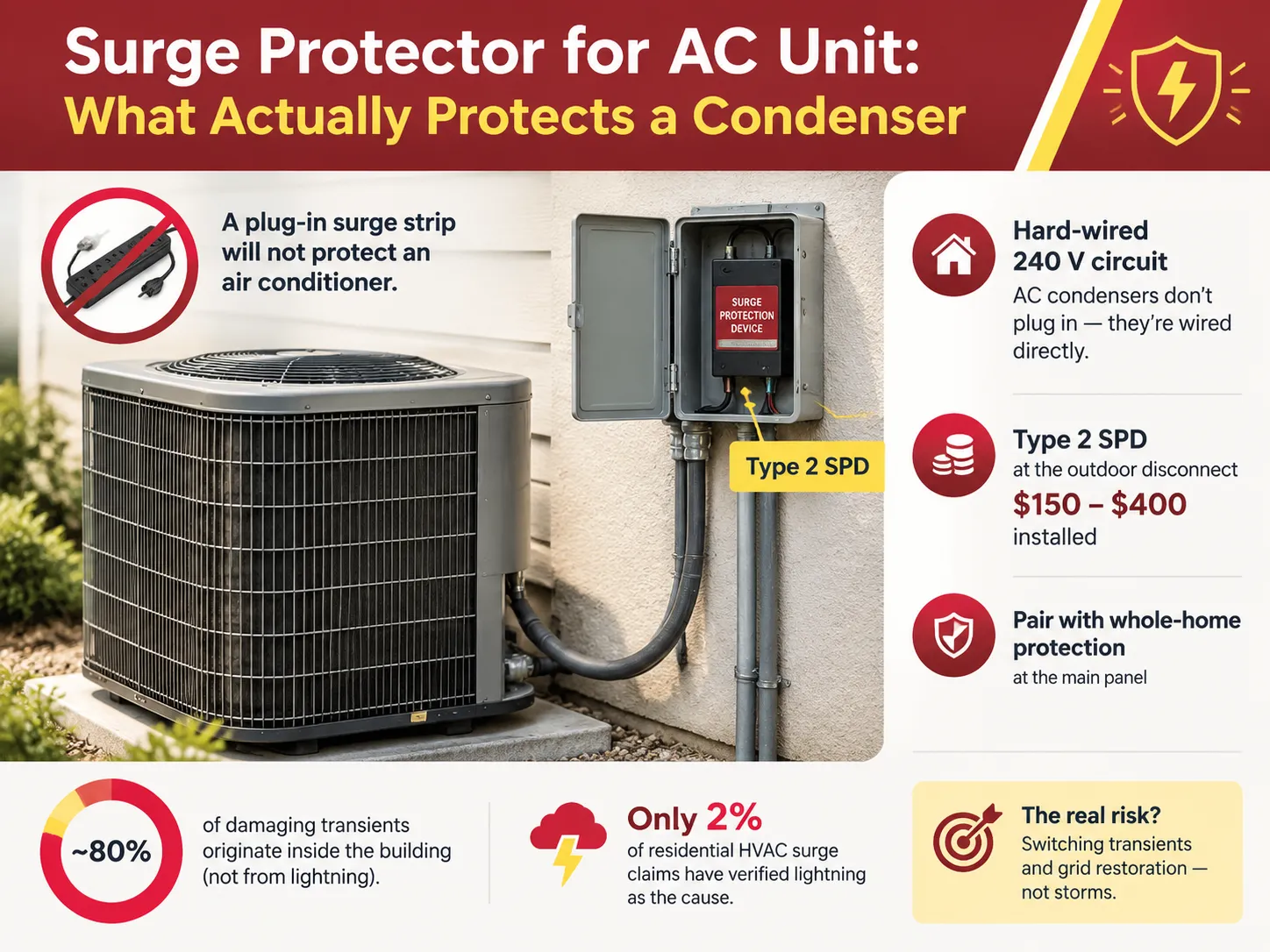
Về việc liệu bộ bảo vệ tăng áp cắm vào có thể bảo vệ một thiết bị điều hòa không khí hay không, câu trả lời là không. Lý do cho kết luận này là một thiết bị AC có máy nén được cấp nguồn bằng mạch 240 V, mà bộ bảo vệ tăng áp cắm vào không thể tiếp cận được. Do đó, một thiết bị bảo vệ tăng áp loại 2 phải được lắp đặt tại ngắt kết nối ngoài trời, chi phí dao động từ $150 đến $400 và sẽ hoạt động phối hợp với bảo vệ toàn bộ ngôi nhà được lắp đặt tại bảng điện chính. Hơn nữa, cần hiểu rằng trong gần 20% tất cả các trường hợp, nguồn bên ngoài là nguyên nhân gây ra các xung điện có hại, trong khi chỉ khoảng 2% các khiếu nại HVAC cho thấy xung điện rõ ràng do sét gây ra, cho thấy đây là kết quả của hoạt động chuyển mạch xung điện chứ không phải do bão.
Câu trả lời ngắn gọn cho một thiết bị AC hiện đại
Trong trường hợp có hệ thống điều khiển biến tần hoặc hệ thống tốc độ biến đổi, không quá 15 năm tuổi, nên sử dụng SPD loại II tại điểm ngắt ngoài trời. Lý do là vị trí này cung cấp sự bảo vệ tối ưu cho thiết bị vì máy nén nằm ở cuối một mạch dài và mạch này hoạt động như một ăng-ten.
Đối với các hệ thống một cấp, bao gồm một contactor đơn giản và một tụ điện, kinh tế kém hơn, do đó nên chi tiền cho bảo vệ toàn bộ ngôi nhà của bảng điện thay vào đó.
Trong trường hợp hệ thống gần hết tuổi thọ, nên bỏ qua thiết bị và đầu tư vào việc thay thế, thay vì bảo vệ một máy nén sẽ không sử dụng được trong hai năm tới.
Tại sao một thiết bị AC lại dễ bị phơi nhiễm bất thường
Có bốn yếu tố cần xem xét, và chỉ có một phụ thuộc vào thời tiết.
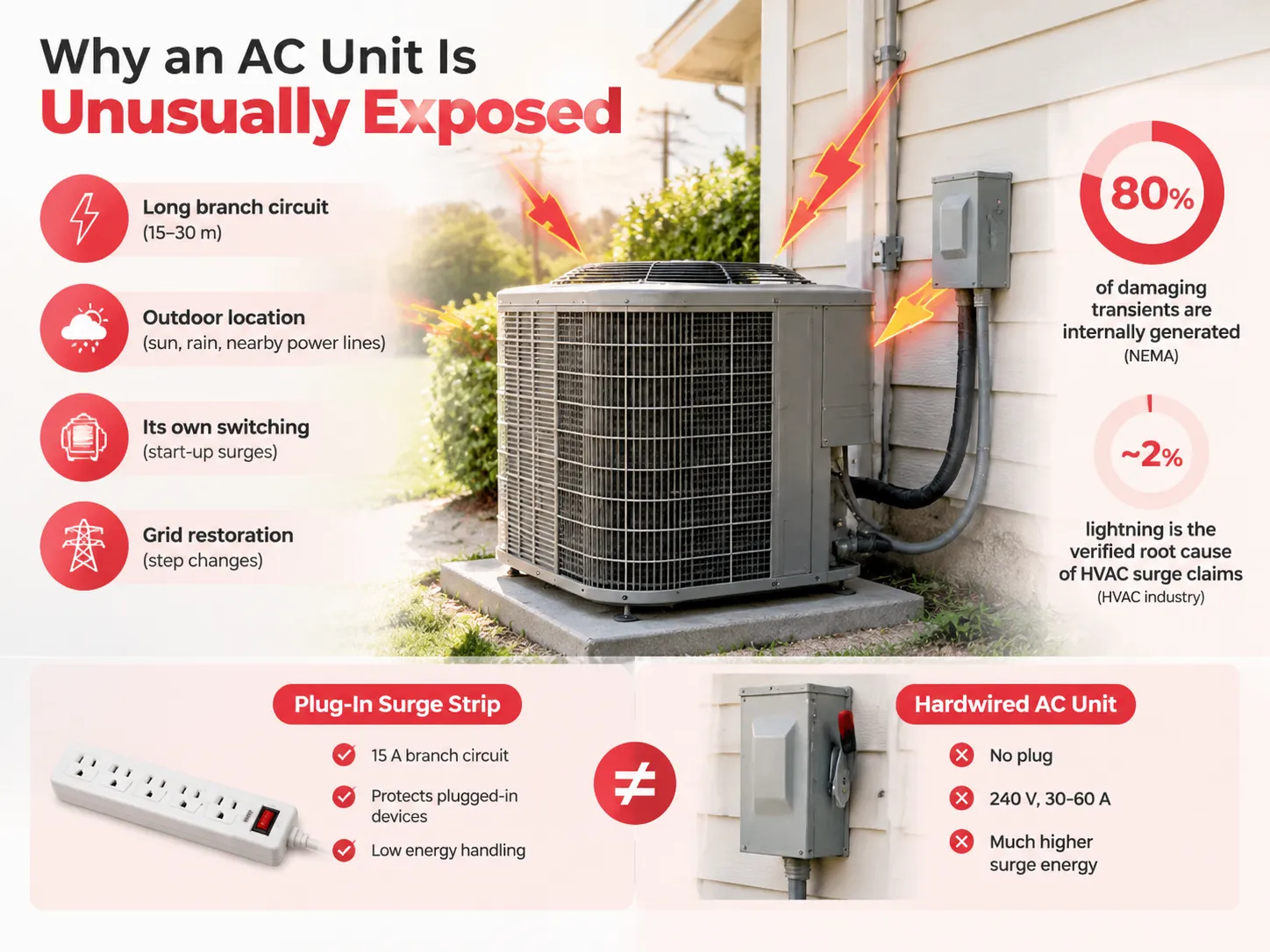
- Các mạch nhánh dài. Khoảng cách từ bảng điện đến dàn ngưng thường khoảng 15-30 mét. Các xung điện có khả năng xảy ra, do đó thiết bị đặt tại bảng điện không thể giảm thiểu được tăng áp.
- Ngoài trời. Môi trường ngoài trời, Marbella, có thể mang nhiệt hoặc mưa đến vị trí đặt thiết bị và nơi cũng có cột điện tiềm năng cùng các thiết bị khác.
- Hành động chuyển mạch riêng của nó. Quá trình bật thiết bị liên quan đến dòng điện cao hơn khoảng 6-8 lần so với dòng điện sử dụng trong quá trình vận hành bình thường và tạo ra các xung điện trên cùng mạch đó.
- Sửa chữa lưới điện. Khi tiện ích khôi phục hoạt động sau sự cố mất điện, khu vực nhận toàn bộ sự thay đổi cùng một lúc. Điều này xảy ra thường xuyên hơn so với tác động của sét và gây ra thiệt hại tương tự.
Thống kê xác nhận các phát biểu cuối cùng. Phân tích của NEMA cho thấy nguồn gốc của các vấn đề điện là nội bộ trong tới 80% các trường hợp.
Những gì một Dải Cắm Không Thể Làm
Một dải cắm phù hợp cho các mạch cung cấp thiết bị điện, thường được định mức 15A và cung cấp bảo vệ cho bất kỳ thiết bị nào được cắm vào nó. Một máy điều hòa không khí không có phích cắm; nó được đấu dây vào một bộ ngắt kết nối và hoạt động trên mạch 240V định mức từ 30A đến 60A, và không có dải cắm nào có thể sử dụng trong mạch này.
Ngay cả khi có thể sử dụng loại hệ thống bảo vệ này, quy mô của các đợt tăng năng lượng liên quan là khác nhau. Dải cắm bảo vệ các mạch có các đợt tăng nhỏ trên các mạch cung cấp cho bất kỳ thiết bị điện nào. Dòng tăng đột biến trên nguồn điện chính và trên mạch cấp cho máy điều hòa không khí cao hơn nhiều, do đó, khi xảy ra đợt tăng, các varistor trong thiết bị sẽ không hoạt động đúng và thiết bị được kết nối sẽ không được bảo vệ, mặc dù đèn chỉ báo vẫn sáng.
Nguồn gốc của sự nhầm lẫn là tên gọi của cả hai thiết bị. Cả hai đều được bán như các thiết bị bảo vệ. Ngoài ra, cả hai đều có định mức joule, và các định mức này không cho phép so sánh dễ dàng. Điều tương tự cũng áp dụng cho các thiết bị bảo vệ chống tăng áp có định mức cụ thể so với dải cắm được định mức theo phương pháp tiếp thị.
Những gì mỗi thiết bị trong chuỗi thực sự đóng góp, từ bộ ngắt nhánh đến điểm sử dụng, là chủ đề của so sánh giữa bộ ngắt mạch và bộ bảo vệ chống tăng áp, đó là sự phân biệt mà hầu hết chủ nhà chưa từng được giải thích.
Loại 1, Loại 2 và Loại 3 tại Bộ Ngắt AC
| Loại | Nơi nó được đặt | Những gì nó xử lý | Phù hợp cho một máy điều hòa không khí |
|---|---|---|---|
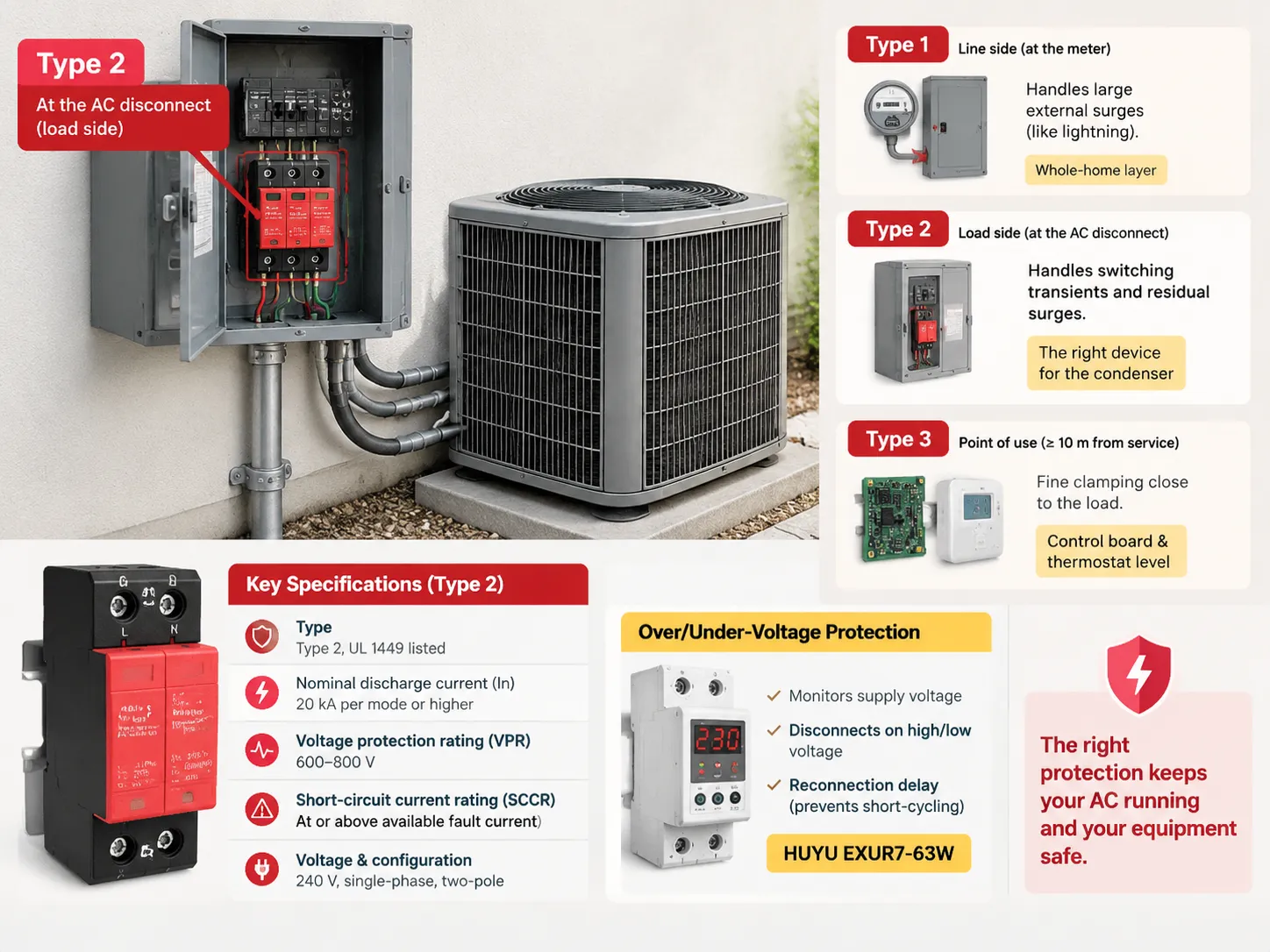
| Loại 1 | Phía dây nguồn của bộ ngắt dịch vụ, tại đồng hồ điện | Các đợt tăng lớn bên ngoài bao gồm dòng sét | Lớp bảo vệ toàn nhà, không đặc thù cho AC |
| Loại 2 | Phía tải của bộ ngắt, tại bộ ngắt thiết bị | Các đợt chuyển mạch, đợt tăng còn lại, các sự kiện phát sinh nội bộ | Thiết bị đúng tại bộ ngưng tụ |
| Loại 3 | Điểm sử dụng, ít nhất 10 m dây dẫn từ dịch vụ | Kẹp chặt tinh vi gần tải | Cấp độ bảng điều khiển và bộ điều nhiệt |
Thiết bị Loại 2 tại bộ ngắt thực hiện chức năng chính. Thiết bị này vẫn song song với tải và không tiêu thụ năng lượng trong sử dụng hàng ngày. Tuy nhiên, khi điện áp vượt quá ngưỡng đã đề cập, nó sẽ được kích hoạt. Đây là thiết bị mà hầu hết các nhà sản xuất HVAC đề cập khi họ muốn nhấn mạnh rằng bảo vệ chống tăng áp là một phần của điều kiện bảo hành lắp đặt của họ.
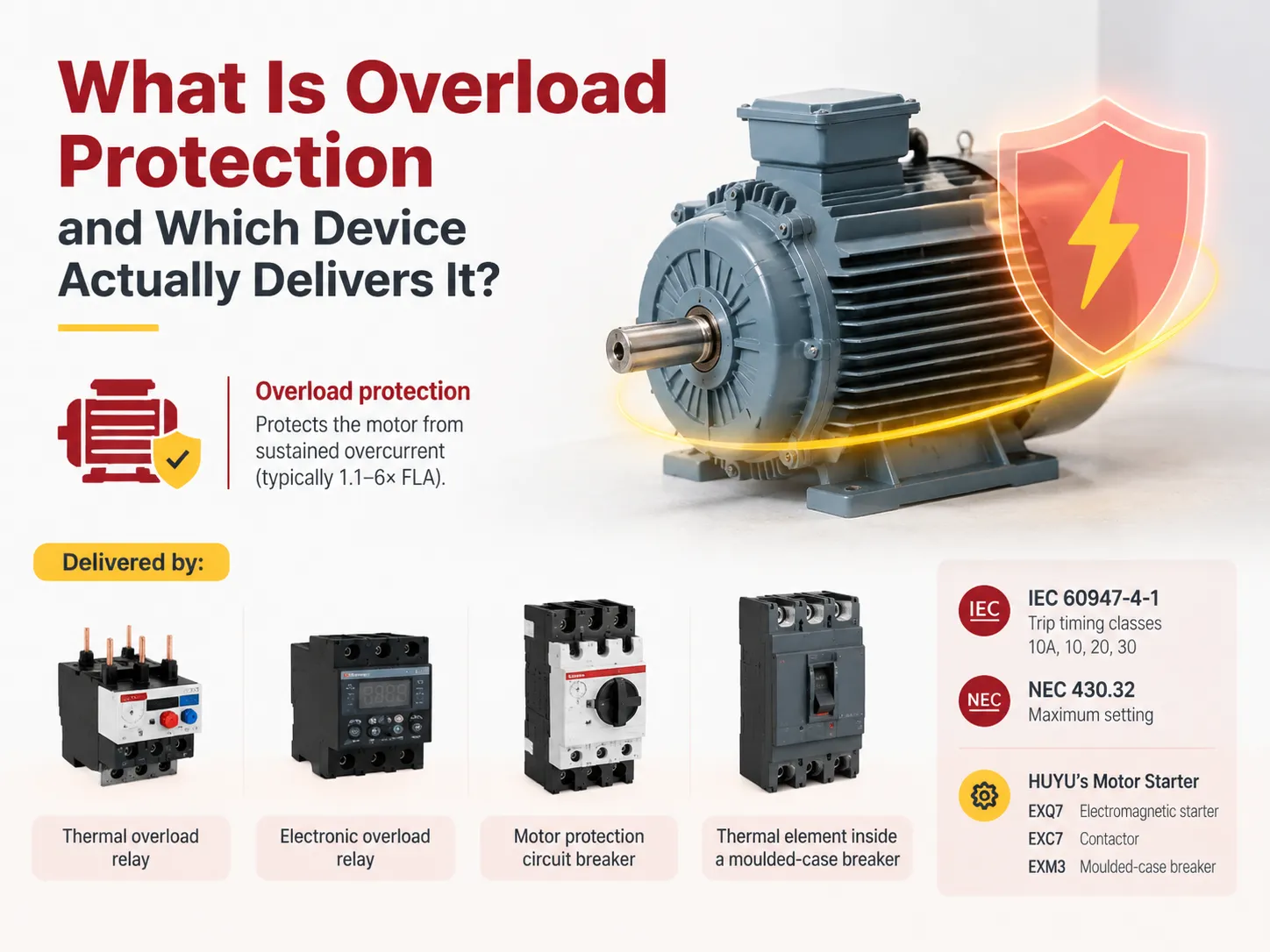
Việc sử dụng một loại thiết bị bảo vệ khác là cần thiết vì nó xử lý một vấn đề khác. Rơ le quá áp và thấp áp có thể giám sát điện áp và do đó ngắt kết nối máy nén trong trường hợp lệch khỏi cửa sổ điện áp. Ngoài ra, chúng cung cấp độ trễ thời gian để máy nén không bị ngắt mạch ngắn. HUYU’s Bộ bảo vệ đa chức năng EXUR7-63W được thiết kế cho nhiệm vụ đó, kết hợp cửa sổ điện áp với độ trễ kết nối lại mà máy nén cần.
Kích thước: Bốn con số quan trọng
Bỏ qua con số kA tiêu đề và định mức joule. Bốn thông số quyết định liệu thiết bị có thực hiện công việc hay không.
| Thông số kỹ thuật | Những gì cần tìm ở bộ ngắt AC | Tại sao |
|---|---|---|
| Loại | Loại 2, được liệt kê theo UL 1449 | Matches the location in the circuit |
| Nominal discharge current (In) | 20 kA per mode or higher | The repetitive-event rating, which is what actually wears the device |
| Voltage protection rating (VPR) | 600–800 V | Lower is better; this is the number the board actually sees |
| Short-circuit current rating (SCCR) | At or above the available fault current at the disconnect | An under-rated device is a fire risk, not a protector |
| Voltage and configuration | 240 V, single-phase, two-pole for a residential condenser | Wrong configuration means no protection or a fault |
The clamping number is a weak spot for inexpensive products. A product that has a clamping voltage of 1,200 volts has theoretically safeguarded the circuit while allowing it to pass three times more power than the circuit would ideally receive. A voltage in the 600-800 volt range is ideal for use in residential wall-mounted units or disconnects and any clamping below that cannot be achieved affordably by most homeowners.
The second configuration on the voltage protection relay is the voltage window, which must be configured based on the application rather than simply using the default settings. For example, a compressor that disconnects at 200 volts for three minutes works completely differently than a compressor that disconnects at that same voltage for just 30 seconds, especially during the summer months when the supply is lower than usual in the mornings.The relay in this EXUR7N over and under-voltage protector is adjustable across that range for exactly this reason.
What It Costs, and What the Alternative Costs
| Mục | Chi phí điển hình | Ghi Chú |
|---|---|---|
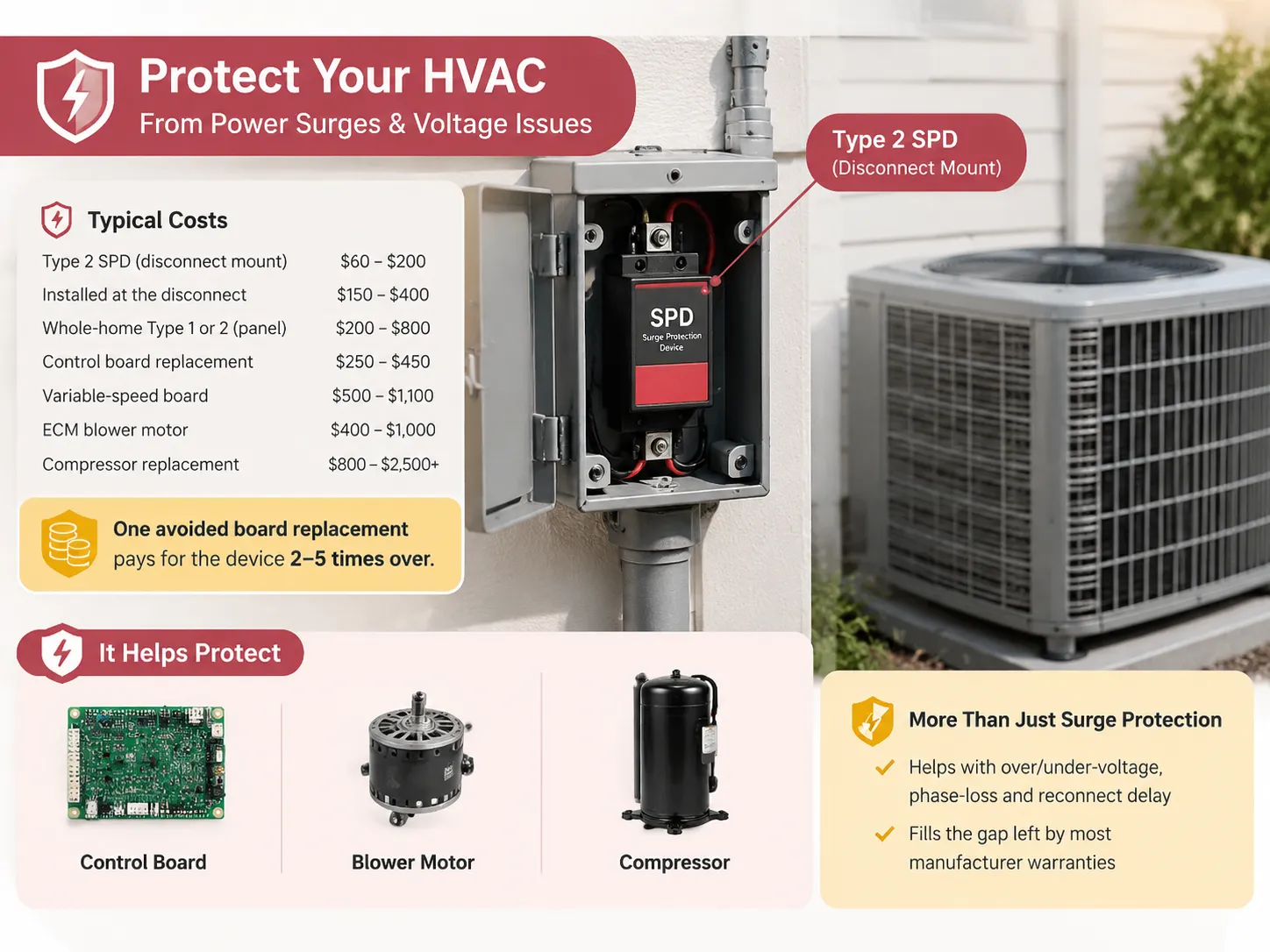
| Type 2 SPD, disconnect mount | $60–$200 | Device only |
| Installed at the disconnect | $150–$400 | 30–60 minutes of an electrician’s time |
| Whole-home Type 1 or 2 at the panel | $200–$800 | Layered protection, not a substitute |
| Single-stage control board replacement | $250–$450 | Installed |
| Variable-speed or communicating board | $500–$1,100 | Installed |
| ECM blower motor | $400–$1,000 | Installed |
| Compressor replacement | $800–$2,500+ | Parts alone in many cases |
Replacing a variable-speed board only once is enough in many cases, meaning that the investment pays for itself 2-5 times.
Most homeowners learn too late about the warranty issue. The majority of manufacturer warranties explicitly don’t cover any damage whatsoever due to surge or brownout; therefore, it doesn’t matter whether the system is one year old or ten. The device does not protect the warranty but simply bridges the gap that the warranty has events.
Whether the device also increases the value of the property is a separate and less certain issue, which is why it is advisable to keep these claims apart rather than leaving it up to the salesman. The evidence on value is examined in this look at whether a whole-home surge protector increases property value.
Brands, and Where HUYU Fits
In North America, the market for SPD both for residential and light commercial operations is limited which includes Square D and Schneider, Eaton, Siemens, Leviton, and some specialist manufacturers. In case of Type 2 device mounted directly on the disconnect, the only devices an electrical contractor offers for quotation are as they are crucially impacted by design.
The position of HUYU is both upstream and alongside in different respects. The firm manufactures low-voltage protection and switching devices and it has developed a various models of AC protection that mostly deal with voltage problems, including both surges and falls, loss of phases and reconnect delay for the device used for compressors. This is a whole different type of device rather than the surge clamping one.
Let’s make it clear: HUYU does not manufacture Type 2 module with UL 1449 certification suitable for installation in North America, therefore any homeowner from these geographies should buy one of those available there. HUYU manufactures the protection relay layer, the devices for surge protection for solar panels and the necessary switches and contactors both for an OEM and export equipment rather than being used for IEC standard equipment.
As a result, for OEM manufacturers of HVAC system, these devices are relevant, whereas if it comes to homeowners from the US who work on the installation of the system with a condenser, it is necessary to make a purchase of a designated module Type 2 and the voltage protection relay.
Installation and the Three Points
The complete system involves three locations according to their importance.
- The disconnecting device. A Type 2 surge protection device connected to the disconnect with the utmost shortness of leads and robustly bonded to the disconnect box. This is the most valuable individual item in HVAC systems.
- The main electrical panel. A Type 1 or Type 2 surge protection device suitable for the entire house. This device will filter the big surges before further flow through the house circuits and provide protection to all appliances in the house.
- The weatherproof heat pump and the control system. A Type 3 or a small Type 2 device at the heat pump plus the insulation of low-voltage control wires between the heat and condenser devices which is a long naked wire acting as a radio receiver.
The length of conductor is the key point of performance measurement in all points. Each inch of wire from the protected device to the protected point adds onto the voltage at the output of the device, so a device placed on the opposite side of the disconnect has much poorer performance than a device mounted to the right of the disconnect.
Installation of such equipment cannot be performed by a homeowner. The disconnect has a 240V casing and has live wires while its service terminals keep receiving energy even with the switch turned off.
Maintenance and Replacement
These devices are consumables. Every surge absorbed causes degradation of the metal oxide varistors leading to a service life of approximately five to ten years in normal circumstances, which may be shorter in a rural overhead feeder where there is a lot of switching going on.
Three habits need to be cultivated to make the protection work.
- Checking the indicator. A green light or any light showing means that the device is working. If it is dark or red that means that it has done its job. It’s impossible to know about the failed device in open unless the indicator has been checked.
- Replace after the event. Even if indicator looks normal a nearby lightning strike or an event on the grid may lead to the failure. The cost of changing a $100 device is lower than the cost of replacing a burned $900 circuit.
- Isolate before replacing. Although the SPD is connected in parallel with the load and the SPS is upstream the correct procedure involves breaking the circuit and checking it is not live before carrying out any actions.HUYU’s EXM3 moulded-case breaker is the sort of upstream device that makes that isolation possible on a larger packaged system, rather than relying on pulling a fuse block.
Mark installation date inside the switch box. This is the only option to know whether the device in front of you is two years old or twelve.
Câu hỏi thường gặp
Should you put a surge protector on an AC unit?
Of course, for an inverter or variable-speed system, since the control circuit and the inverter unit are quite costly, susceptible to damage from surges, as well as not being included in the warranty of the manufacturer. With regard to an older single-stage unit with simple controls, the aspect of protecting the whole house is better spent in this case. In view of the age of the system, neither alternative is considered to be sound financially at that point.
Is it safe to plug an air conditioner into a surge protector?
An air conditioning unit cannot be plugged in. A condenser installed centrally is directly wired into a 240 V circuit via a disconnect device, while a window type air conditioner requires constant power exceeding that which is generally permissible for most domestic extension cords. Further, the strip connected to a window air conditioning device may also be dangerous since its contacts are not rated for the inrush of power.
What is the best surge protector for HVAC?
A UL 1449-compliant Type 2 device, mounted at the outdoor disconnect, designed for nominal discharge current of 20 kA or higher and with a voltage protection rating between 600-800 V, and has a short circuit current rating equal to or exceeding the available fault current. Use it in conjunction with a device placed at the whole home panel and an over/under voltage relay having reconnect delay for compressor protection.
Will a power surge damage my AC unit?
It is possible for it to occur, and it usually happens gradually rather than suddenly. Varistors on an electrical circuit board deteriorate with each occurrence until the circuit board is unable to perform its functions, which is often attributed to aging. Direct damage from lightning strikes is exceptional; switching transient damage and grid recovery events occur much more often and are responsible for most of the damage.
Tài liệu tham khảo
- NFPA 70 — National Electrical Code, Article 242 and 285
- UL Solutions — UL 1449 Surge Protective Devices
- ABB — Surge Protective Devices for Buildings
- Leviton — Whole-Home and Point-of-Use SPD Range
- U.S. Department of Energy — Surge Protection Guidance
Kết luận
The Type 2 surge canceling devices are mounted on the outside part of the air conditioning units. The price of the installation is between $150 and $400. Air conditioning surge protective device is installed differently from the devices that can be connected directly. Once a control panel has been repaired, multiple times higher amount can be earned then spent on the device.
To protect the compressor voltage relay and reconnecting delay switch are needed. There are different cases of electricity surges and brownouts, which mechanism will be different in each case and the varistors will solve only one of the problems.