


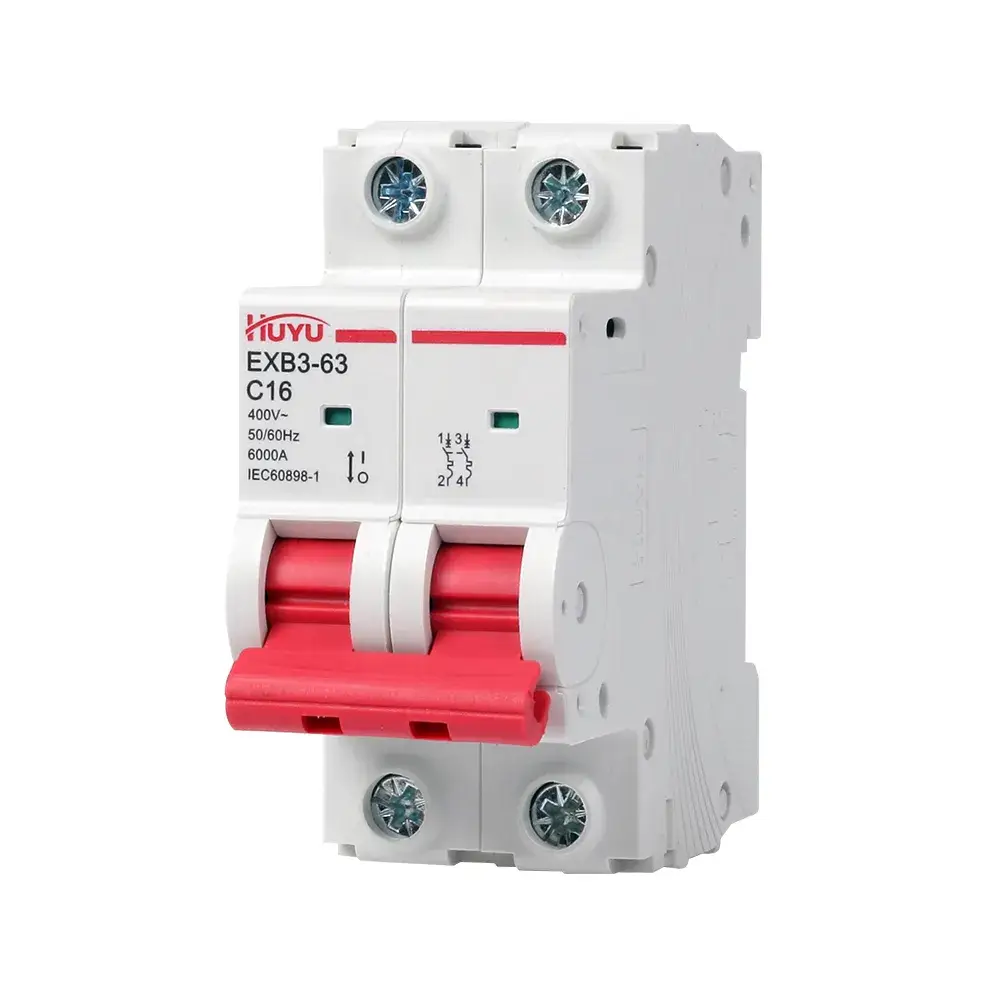


EXB3-63 – 63A AC MCB,1P to 4P
The EXB3-63 is a 63A AC MCB from the EXPLORER series, rated 1A–63A for AC 50/60Hz circuits up to 400V. Overload and short-circuit protection at 6kA Icu/Ics. Compliant with IEC 60898-1 & GB/T 10963.1. Pole options: 1P, 1P+N, 2P, 3P, 3P+N, 4P. Trip curves: Type B, C, D. 6kV impulse withstand. IP20 direct, IP40 in distribution box. Wide temperature range: -35°C to +70°C. 25mm² wiring, 2.0 N·m torque. 7 accessories: OF, SD, MX+OF, MN, MV, MVMN, MNs. Top or bottom wiring, TH35-7.5 DIN rail.
Standards: IEC 60898-1, GB/T 10963.1
Rated Current: 1A – 63A
Breaking Capacity: 6kA Icu/Ics
Poles: 1P, 1P+N, 2P, 3P, 3P+N, 4P
Curves: Type B, C, D
Accessories: OF, SD, MX+OF, MN, MV, MVMN, MNs
Protection: IP20 / IP40
Mounting: TH35-7.5 DIN Rail
Product Information
EXB3-63 63A AC MCB – Explorer Series Protection from 1A – 63A
If your installation includes items such as a 1A control circuit and a 63A sub-main, having a 1 product family to source from will make it easier for you to procure and lay out your panel. HUYU Electric has the EXB3-63 type device that will fulfill that need, being a 63 Amp MCB with discrete current ratings of 1A through 63A in a total of 6 pole configurations (1P, 1P+N, 2P, 3P, 3P+N, 4P) all with the same symmetric 6kA Icu/Ics breaking capacity in accordance with IEC 60898-1 and GB/T 10963.1.
The EXB3-63 provides more than just overcurrent protection. The EXB3-63 is designed for demand-type environments where additional capabilities may be required. This device has a 6kV impulse withstand rating allowing it to withstand voltage surges without any impact to the device. It also has an operating temperature range of -35°C to +70°C so it can be installed in unconditioned plant rooms or outdoor kiosks. It has an IP40 rating from an enclosure perspective when installed in a distribution box. The EXB3-63 is available with 7 accessory options (OF, SD, MX+OF, MN, MV, MVMN, MNs) for assisting with auxiliary indication, alarm signaling, remote tripping, and voltage-based protection requirements. For those End Users that currently source their 63A MCB from Schneider, ABB, Hager, Eaton, Siemens, Legrand, Chint or Havells, the EXB3-63 will meet equivalent specifications at factory direct OEM/ODM pricing with flexible private label terms.
Pole Configurations & Trip Curves – One Family, 1A to 63A
| Pole | Current Range | Curves | Where It’s Used |
|---|---|---|---|
| 1P | 1A – 63A | B, C, D | Single-phase lighting & socket circuits, AC 230V |
| 1P+N | 1A – 63A | B, C, D | Single-phase circuits with switched neutral, AC 230V |
| 2P | 1A – 63A | B, C, D | Double pole isolation, AC 400V (single-phase) |
| 3P | 1A – 63A | B, C, D | Three-phase motor & distribution, AC 400V |
| 3P+N | 1A – 63A | B, C, D | Three-phase circuits with neutral disconnect |
| 4P | 1A – 63A | B, C, D | Full four-pole isolation with neutral |
All six pole configurations share the same 6,000A Icu/Ics — a symmetrical design where service breaking capacity matches the ultimate rating, meaning the breaker remains fully operational after clearing a maximum fault. Type B covers resistive loads; Type C handles inductive equipment; Type D manages high-inrush applications. The 63A AC MCB current range extends from 1A to 63A in standard steps — one product series for circuits ranging from control wiring to main incomer protection.
Technical Specifications
| Product Model | EXB3-63 |
| Series | EXPLORER |
| Standards | GB/T 10963.1, IEC 60898-1 |
| Poles | 1P, 1P+N, 2P, 3P, 3P+N, 4P |
| Rated Current (A) | 1, 2, 3, 4, 6, 10, 16, 20, 25, 32, 40, 50, 63 |
| Rated Voltage | AC 230V (1P, 1P+N); AC 400V (2P, 3P, 3P+N, 4P) |
| Frequency | 50/60Hz |
| Breaking Capacity Icu/Ics | 6,000A (6kA) |
| Impulse Withstand Uimp | 6kV |
| Dielectric Test | 2000V (1 min, power frequency) |
| Tripping Curve | Type B (3In–5In), C (5In–10In), D (10In–20In) |
| Electrical Life | 10,000 cycles |
| Mechanical Life | 20,000 cycles |
| Operating Temperature | -35°C ~ +70°C |
| Storage Temperature | -35°C ~ +85°C |
| Anti-Humidity | 28 cycles, RH 90–96% at 55°C |
| Max. Altitude | ≤ 2,000m |
| Max. Wiring Capacity | 25mm² |
| Max. Torque | 2.0 N·m |
| Incoming Method | Top or bottom |
| Mounting | TH35-7.5 DIN Rail |
| Protection Degree | IP20 (direct); IP40 (in distribution box) |
| Pollution Degree | 2 |
| Accessories | OF, SD, MX+OF, MN, MV, MVMN, MNs |
| MOQ | 2,000 pcs per item |

Source 63A AC MCB at Factory-Direct Pricing
1P to 4P, 1A–63A, B/C/D curves, 6kA Icu/Ics, 6kV impulse, IP40. Seven accessories available. IEC/GB certified -35°C to +70°C. OEM branding and complete documentation. Request your wholesale quotation today.
MOQ 2,000 pcs • IEC 60898-1 / GB/T 10963.1 • Worldwide Shipping
Frequently Asked Questions
What is an AC mini circuit breaker?
An AC MCB (Miniature Circuit Breaker) is a type of circuit breaker specifically made for alternating current (AC) circuits. The AC MCB breaks an electric current using the natural zero-crossing point in the alternating current waveform (i.e., when an electric current goes from positive to negative at either 50 Hz or 60 Hz). The EXB3-63 is an AC MCB circuit breaker rated for use with 230 or 400 volts and operates at either 50 Hz or 60 Hz.
Can an AC circuit work without an MCB?
Yes — an AC circuit can operate without an MCB. However, it will not have any overcurrent or short-circuit protection. Electrical codes require that overcurrent protection is used on all final circuits (e.g., all circuits that feed electrical outlets). Without overcurrent protection (provided by an MCB such as the EXB3-63), a fault in the AC circuit could cause the wiring to overheat to the point of developing a fire, prior to receiving any upstream protection. The EXB3-63 MCB is compact and can be reset after having been tripped (after tripping due to a fault).
What are the differences between DC MCB and AC MCB?
The manner in which the two remove electrical current is the main difference. An AC MCB is designed to break electric current after the current naturally passes through zero in an AC circuit. In contrast, a DC MCB is designed to break electric current when the electric current does NOT naturally cross zero because it is constantly moving in one direction (with the exception of AC convertors). Therefore, DC MCBs use a stronger magnetic blowout coil to create a more powerful blowout of the electric current in a DC circuit. Also, DC MCBs tend to have a design and/or labeling to identify their polarity while AC MCBs have interchangeable line and load terminals. For example, using an AC circuit breaker such as the EXB3-63 on a DC circuit may cause the breaker to not extinguish the arc when the electrical contacts are opened and may damage the breaker as a result.
How can I identify whether an MCB is an AC or DC MCB?
You should review the markings on the MCB; for example, an AC MCB (such as the EXB3-63) will have an alternating current wave line (~) or AC next to the maximum voltage rating of the AC MCB. A DC MCB will have a solid line followed by a dashed line (⎓) or/DC next to the maximum voltage rating of the DC MCB. The EXB3-63 has been manufactured in accordance with IEC 60898-1; therefore, the markings and catalogue will clearly state it is an AC MCB rated for voltage and frequency — 230/400V, 50/60 Hz. If you are not certain whether a given MCB is AC or DC, you should always verify the type of electrical current before attempting to use the MCB.
No documents available for download at this moment.