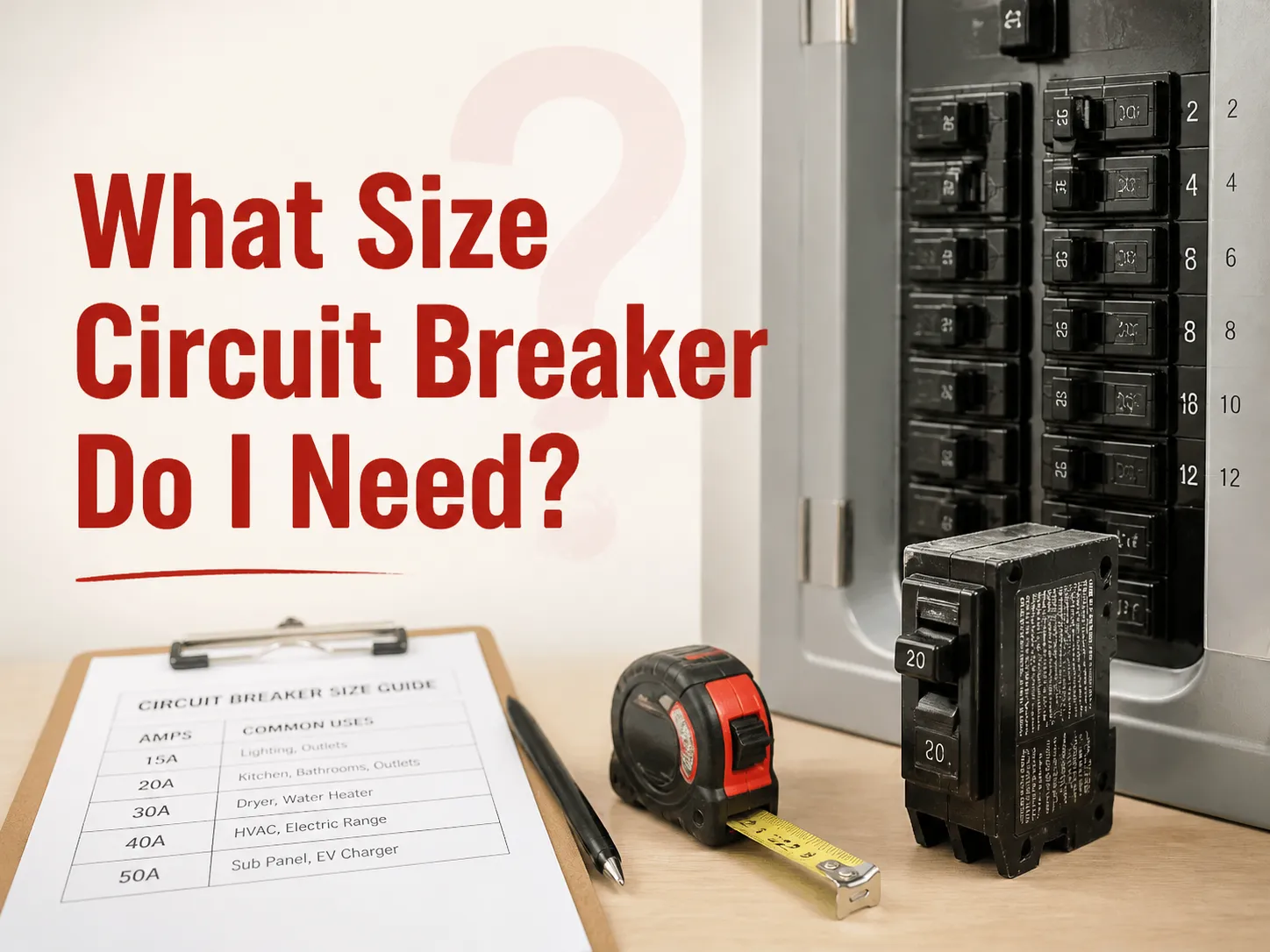

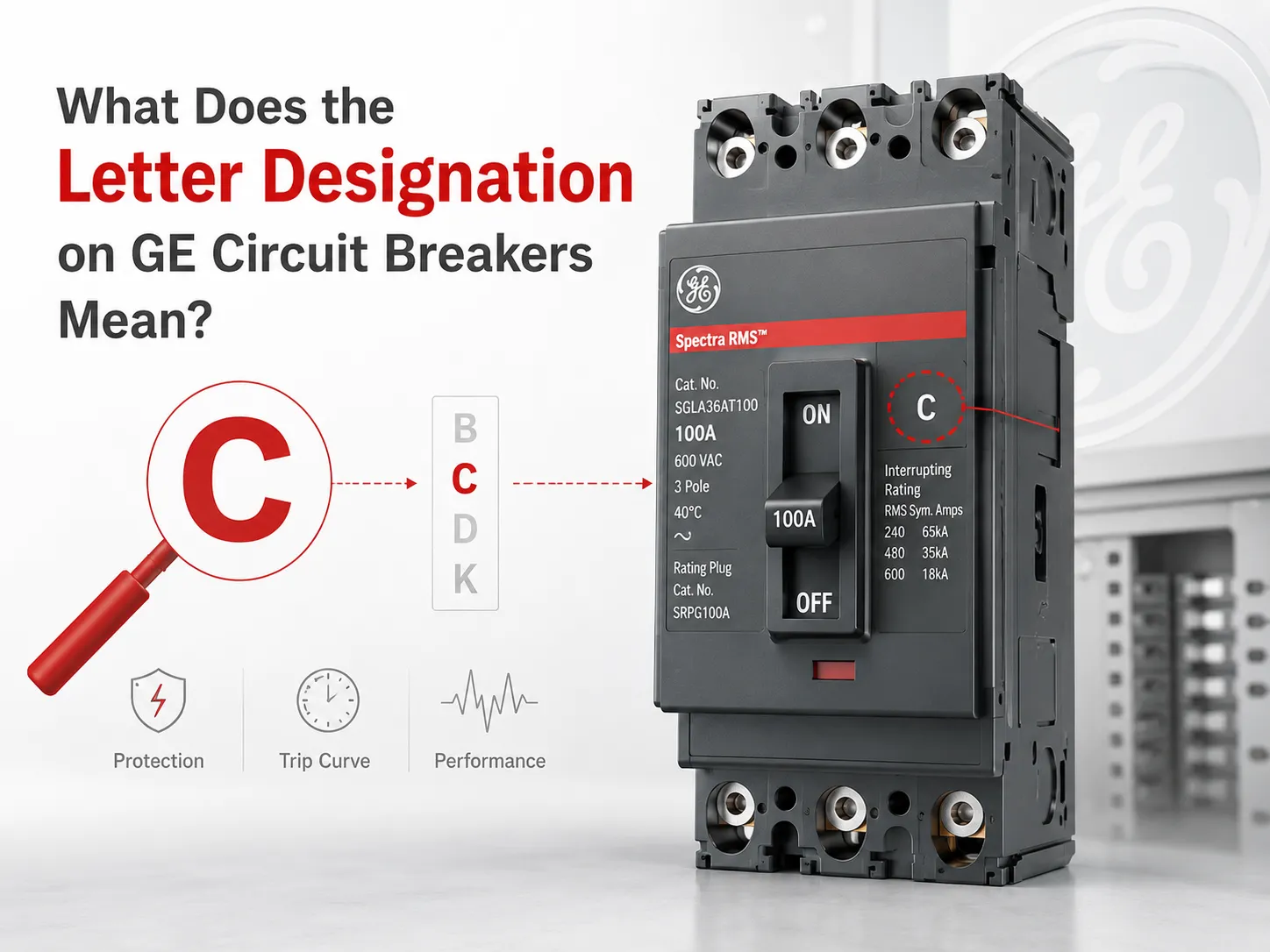
When you have been in front of a panel of electricity, looking for the circuit breaker that has burnt out, you have likely noticed some letters THQP, THQL, TQDL, and wondered what they actually mean. The letter designations used by GE on their circuit breakers are NOT random, but are, in fact, a shorthand code representing various features of the circuit breaker such as, shape and size, mounting style, interrupting capacity, and the type of service panel they are designed for. Knowing the meaning of these codes can help prevent you from ordering circuit breakers that won’t work properly, ensuring you don’t buy mis-matched parts that may not be safe to use, and giving you more confidence when making your purchases or installations.
Breaking Down the GE Circuit Breaker Naming System
The naming pattern for GE’s residential and light commercial circuit breakers families is quite simple, (but a bit strange). Once you understand what each letter means, you should be able to identify almost any part number by sight. Below is a summary of the most common prefixes you will see:
| Letter Prefix | Meaning | Typical Application |
|---|---|---|
| THQL | 1-inch wide, plug-in, 10kA interrupting capacity | Standard GE residential and light commercial load centers |
| THQP | ½-inch wide, plug-in, slim/tandem format, 10kA | Panels that accept tandem breakers; doubles circuits per slot |
| TQDL | 1-inch wide, bolt-on, 10kA | GE panels that use bolt-on connections (often commercial) |
| THHQL | 1-inch wide, plug-in, 22kA high interrupting capacity | Industrial or high-fault-current locations |
| THQB | 1-inch wide, bolt-on, 10kA, small frame | Certain commercial panels and switchboards |
| SELA / SFLA | Molded case, higher ampere ratings, adjustable trip | Industrial feeders and large equipment |
In the residential/commercial segment of molded-case thermal-magnetic circuit breakers the “T” in the designation typically identifies the circuit breaker as a molded-case thermal-magnetic circuit breaker. The “H” at the time of circuit breaker frame provides information about the size of the frame (usually 1 inch in width) and the “Q” indicates that this is a product in the “Q-Line” family of circuit breakers. The significant delineation occurs at the end of the designation: plug-in will have an “L”, bolt-on will have either a “D” (bolt on frame) or “B” (bracket-mounted) and tandem (half-width) will have a “P”. The digits following the letter designation indicate pole count and trip current; therefore, the letter designations alone typically provide the initial compatibility criteria.
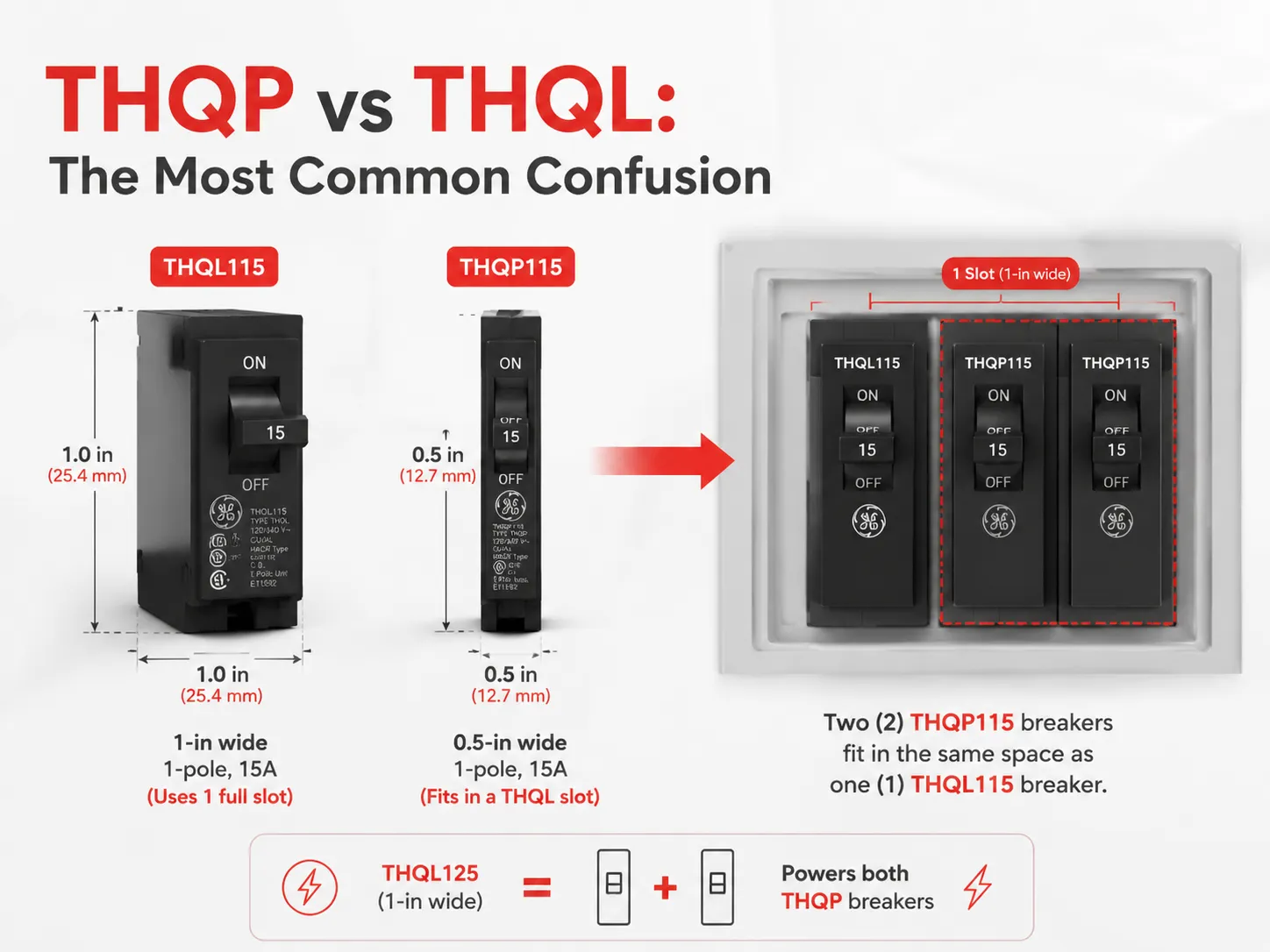
THQP vs THQL: The Most Common Confusion
People often ask, “What’s the reason GE uses both THQP and THQL?” The answer boils down to two physical only: A THQP circuit breaker is formed of THQLs and have half the width of a THQL. For example: A THQL115 is a 1-in wide, 1-pole, 15 amp circuit breaker that occupies one (1) full slot. On the other hand, A THQP115 is a 0.5-in wide, 1-pole, 15 amp circuit breaker that can fit into a standard (THQL) slot. Therefore, one (1) 1-in wide THQL can accommodate one (1) independent THQP circuit breaker in the same amount of width by using two (2) THQP circuit breakers. Thus: An 1-in wide THQL125 will provide power to both THQP circuit breakers.
This space-saving design comes with a restriction: THQP breakers can only be installed in panels that explicitly accept tandem breakers. Many GE load centers have only certain slots designated for tandem use. Attempting to force a THQP into a non-tandem slot can damage the bus bar and create a fire hazard. Before you buy, confirm that your panel model supports the THQP configuration — the panel label will list approved breaker types. For broader guidance on matching breaker ratings to your installation, see our article on what size circuit breaker you need.
Other Common GE Letter Designations and What They Stand For
The GE industrial circuit breakers also have their own distinct designations, separate from the Q-Line products designed for residential applications. Some examples of GE industrial circuit breakers you may encounter in a wider range of installations are:
TQDL & TQHL: TQDL’s “D” = bolt-on whereas “L” = plug-in (THQL). A TQDL115 is a 15A single pole bolt-on circuit breaker has direct connection to the bus bar. TQHL adds higher interrupting (22kA or 25kA); like the jump from THQL to THHQL. Generally found in commercial panelboards where additional vibration resistant & more secure connection are needed.
THQB & THHQB These breakers are typically used in GE A-Series panel boards as small, bolt-on breakers. They are both very similar except for the different mounting configuration of the TQDL series although they are all the same 1 inch wide. When using these breakers, always confirm the type of the panel board which requires either one or both to determine if you are using a ThQB style breaker.
Molded case circuit breakers in the larger frames (150A and above) known as SELA, SFLA and SGLA have adjustable thermal and magnetic trip settings. The letters in their names represent the frame size and series. The “S” in SFLA means Spectra RMS or previous generation series. Selecting the interrupting capacity (IC) correctly is just one part of a complete electrical protection strategy in an industrial environment that is at risk for catastrophic consequences from electrical faults as covered by the article comparing circuit breakers to surge protectors.
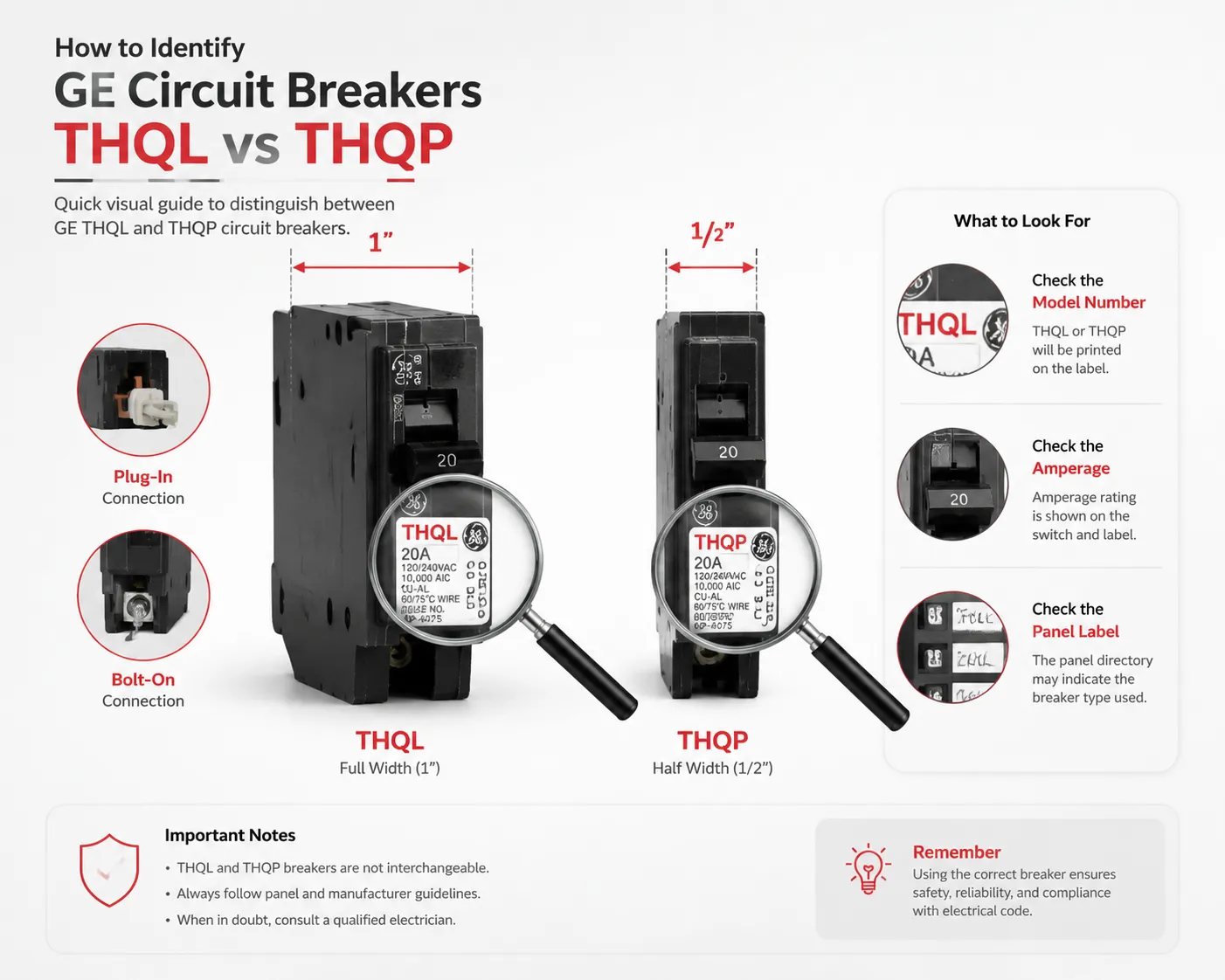
How to Identify Your GE Breaker Type When the Label Is Worn
Even though the writing on the breaker handle or on one side of it may not be legible anymore you can see what type of breaker it is by looking at the breaker itself:
- Width measurement: Are you inspecting a full 1-inch thickness per pole? If so, the panel is probably THQL or TQDL. A ½-inch thickness per pole indicates THQP.
- Examine how the connections are made to the circuit breaker bus. If there’s a metal clip that attaches to a circuit breaker blade it is a plug-in style circuit breaker, (For example, THQL and THQP). If there is a screw terminal or lug that is bolted to the circuit breaker bus then it is a bolt-on style circuit breaker, (For example, TQDL and THQB).
- Examine your electric panel label closely for UL-listed power circuit breaker specifications (listed by series). If it indicates “GE THQL/THQP” then you have your answer right here!
- Determine the amount of poles and amps: For example, a single pole 20 amp breaker ending with an identification of “120” can only be defined by its ampacity (or current capacity). Using the identification number makes sure that the breaker will connect properly within the GE panel. A competitor’s breaker should never be used in a GE panel because even though it fits properly mechanically (physically), it does not meet the required UL Listing.
Frequently Asked Questions
How to identify GE breaker type?
Examine the label on the side of the GE circuit breaker to determine the type of breaker. The type designation is the combination of letters prior to the number, e.g. THQL1120. If the label has been removed, measure the width of each pole; either 1″ for full-size where it plugs onto the bus-bar or 1/2″ for-tandem where it bolts onto the bus-bar. Also always check-between the breaker and panelboard label located inside the door, to find out which type of breakers are acceptable for that panel.
What do the letters mean on circuit breakers?
A circuit breaker’s model number shows the frame size, series of manufacturer, mounting method and interrupting rating. Letters shown on the GE breakers indicate that “TH” designates a thermal magnetic frame family, “Q” is the Q-Line series, “L” is the plug-in type, “P” indicates a tandem half width, “D” indicates a bolt on type and the second “H” before the “Q” means there will be a higher interuption capacity of 22 or 25 kA for example the THHQL.
What is the difference between GE THQP and THQL?
GE THQP & THQL differ in size and use. THQP can have up to two independent poles within one slot; THQL will take up the full width of its slot. You will not use THQP breakers unless they are for slots designed to accept them. THQL can use all GE Q-Line slots. They are both rated at 10kA interrupting capacity.
What are the 4 classifications of circuit breakers?
Circuit breakers typically are categorized based upon four basic characteristics: voltage class (low voltage, medium voltage, or high voltage); type of arc quenching medium used (air, vacuum, oil, or SF6 gas); type of mounting (plug-in, bolt-on, or draw out); and type of operating mechanism (thermal-magnetic, magnetic only, or electronic trip). Of these criteria for classification, the most meaningful for residential breaker lines made by a single manufacturer such as GE would be the frame size and mounting style for which the letter designation indicates directly.
By applying the proper decoding technique to the letter designation on a GE circuit breaker, you can quickly convert a series of confusing letters into the correct specification for that circuit breaker. The letter designation for each circuit breaker (e.g. THQP115 for a residential panel, TQDL for commercial panels, and THHQL for industrial applications) gives you an exact specification regarding what that specific circuit breaker is for and where it fits into the circuit breaker family. When purchasing a GE circuit breaker, make sure to match the type of circuit breaker to the label on the circuit breaker panel; do not mix circuit breakers from different series; and when you’re unsure about the circuit breaker type, verify with a vendor who understands GE’s naming convention. Having this information will enable you to quickly review the label on your GE circuit breakers to ensure your systems remain safe, compliant, and operational without unexpected events.