
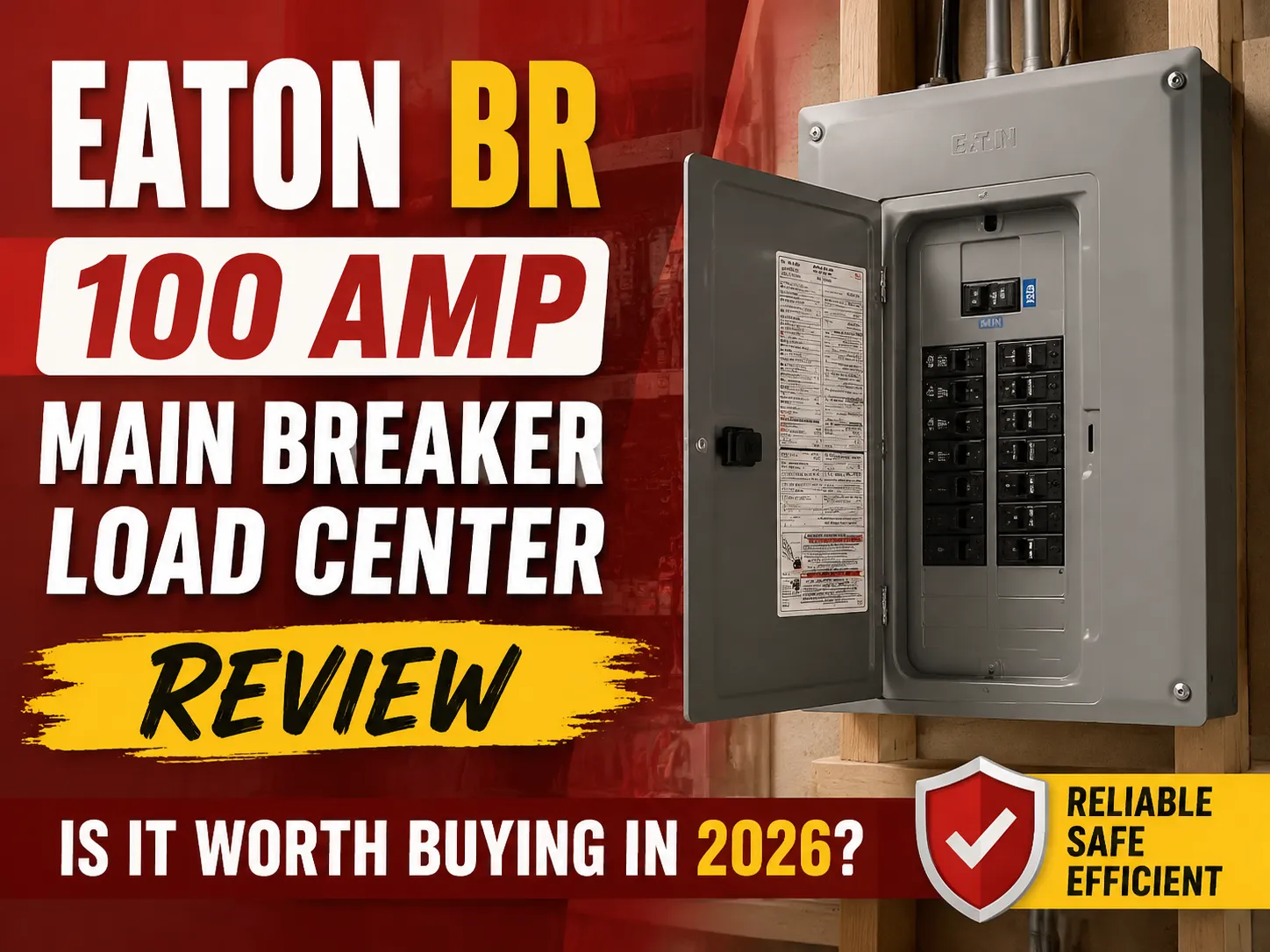
Usted está viendo o buscando todas las opciones disponibles para crear un centro de carga con interruptor principal para su garaje, casa pequeña, taller o adición de subpanel de 100 amperios. Hay algunos competidores destacados como Square D, Siemens, GE y Eaton. Una de las marcas más vendidas es el centro de carga con interruptor principal Eaton BR de 100 amperios. Sea como sea, probablemente se pregunte si es una buena inversión o simplemente una compra por el nombre de la marca. Esta reseña cubrirá las diversas características así como las limitaciones del panel Eaton BR de 100 amperios.
Respuesta rápida: El centro de carga con interruptor principal Eaton BR de 100 amperios es uno de los paneles residenciales más asequibles en 2026. El panel ofrece un interruptor principal de 100A, 120/240V monofásico, tiene de 10 a 12 espacios, permite hasta 24 circuitos, cuenta con neutro enchufable, tiene certificación UL y viene con una garantía de diez años. Ofrece una velocidad de instalación muy buena y tiene un precio aproximado de $80–$130. La principal ventaja del panel es la rapidez de instalación, así como el costo de los interruptores de la serie BR y la instalación de interruptores en tándem. El panel es mayormente adecuado para garajes, talleres, casas pequeñas, cobertizos e instalaciones de subpaneles. La principal desventaja es que Eaton utiliza barras colectoras de aluminio en lugar de cobre, en comparación con los paneles de alta gama.
¿Qué es el centro de carga con interruptor principal Eaton BR de 100 amperios?
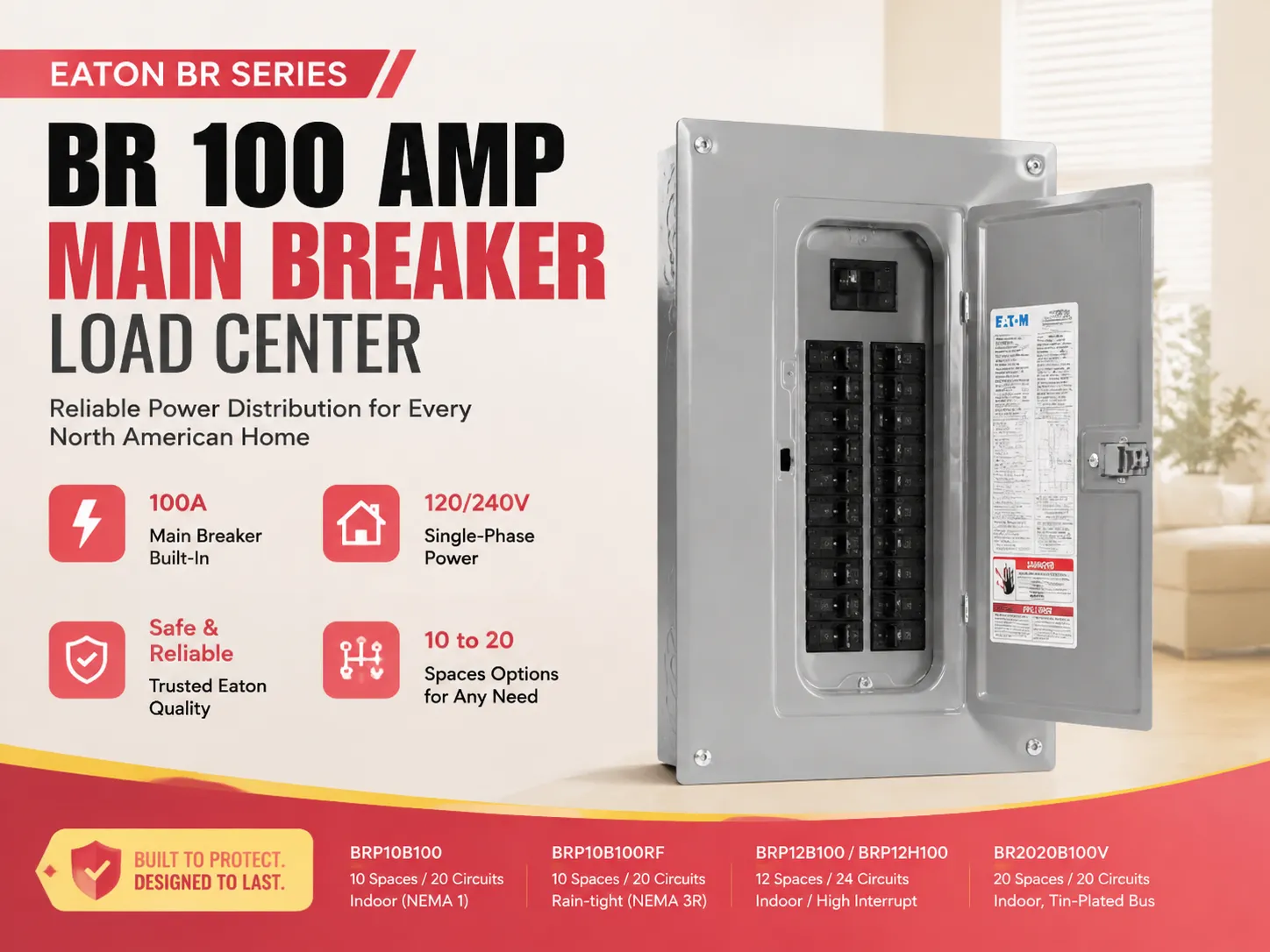
El centro de carga con interruptor principal Eaton BR de 100 amperios es la unidad de distribución eléctrica utilizada en hogares con el propósito de recibir energía de la compañía eléctrica. El término “interruptor principal” se refiere al hecho de que un interruptor con una capacidad nominal de 100 amperios está integrado dentro del centro de carga, sirviendo como desconexión del servicio. El interruptor permite apagar el suministro de energía a todo el edificio con un solo interruptor. La unidad utiliza energía monofásica estándar de 120-240V. El estilo específico del centro de carga que es más común entre los consumidores es:
| Modelo | Espacios / Circuitos | Caja | Precio típico |
|---|---|---|---|
| BRP10B100 | 10 espacios / 20 circuitos | Interior (NEMA 1) | $85–$110 |
| BRP10B100RF | 10 espacios / 20 circuitos | Resistente a la lluvia (NEMA 3R) | $95–$130 |
| BRP12B100 | 12 espacios / 24 circuitos | Interior (NEMA 1) | $85–$115 |
| BRP12H100 | 12 espacios / 24 circuitos | Interior, alta capacidad de interrupción (22 kAIC) | $90–$120 |
| BR2020B100V | 20 espacios / 20 circuitos | Interior, barra colectora estañada | $120–$170 |
La serie BR de Eaton es la opción económica de su serie premium CH, y ha sido un pilar del trabajo eléctrico residencial en Norteamérica durante décadas. Si desea entender mejor la línea de productos de la marca, nuestro artículo sobre si Eaton es lo mismo que Cutler-Hammer explica la historia de la empresa y la relación entre sus líneas de productos.
Especificaciones clave de un vistazo
| Especificación | Detalle |
|---|---|
| Clasificación de amperaje | Interruptor principal de 100A |
| Voltaje | 120/240V CA, monofásico |
| Espacios | 10 o 12 (dependiendo del modelo) |
| Máximo de circuitos | 20 o 24 (con interruptores en tándem/cuádruples) |
| Material de la barra colectora | Aluminio (estañado en algunos modelos) |
| Clasificación de interrupción | 10 kAIC (22 kAIC en modelos H) |
| Caja | NEMA 1 (interior) o NEMA 3R (resistente a la lluvia) |
| Rango de cableado | #6 a 1/0 AWG Cu/Al |
| Interruptor principal | Neutro enchufable, incluido |
| Certificaciones | UL 50, UL 67, listado UL |
| Garantía | Garantía limitada de 10 años |
| Dimensiones (modelo de 12 espacios) | 75″A x 14.31″A x 3.88″P |
| Peso | ~15 lb (10 espacios) a ~35 lb (12 espacios con cubierta) |
Por qué la gente lo compra: 6 características destacadas
El panel Eaton BR de 100 amperios se destaca por las siguientes razones:
El diseño Plug-On Neutral (PON) ahorra un tiempo significativo de instalación
El sistema BR plug-on neutral elimina la necesidad del pigtail que se requería para modelos antiguos de interruptores AFCI y GFCI. En lugar de usar un pigtail blanco para conectar cada interruptor a una barra neutral, los interruptores se encajan directamente en el bus neutral. Los electricistas han reportado una reducción en los tiempos de instalación de 15 a 30 minutos por panel. Los propietarios que opten por la auto-instalación también encontrarán el trabajo significativamente más fácil.
Todos los espacios aceptan interruptores tandem y quad
En contraste con algunos otros paneles que solo soportan el uso de interruptores tandem en espacios designados, cada espacio de polo en el panel Eaton BR acepta cualquier tipo de interruptor — estándar, tandem o quad. Si opta por un modelo de 10 espacios, disfrutará del beneficio de tener hasta 20 circuitos. Un panel de 12 espacios puede acomodar hasta 24 circuitos. Para un garaje o taller, esta opción crea más oportunidades.
Los interruptores Eaton están fácilmente disponibles
Los interruptores Eaton BR se encuentran entre los más populares en Norteamérica y pueden encontrarse en muchas tiendas minoristas incluyendo Home Depot, Lowe’s, Menard’s y suministros eléctricos. Los interruptores BR más comúnmente usados se venden a precios muy razonables ($5-$9 para interruptores estándar, y $35-$45 para AFCI o GFCI). Por lo tanto, si tiene un panel con interruptores BR, puede estar seguro de que los costos de mantenimiento no serán muy altos.
Instalación fácil
Eaton se encargó de añadir características convenientes que pueden cambiar significativamente la experiencia del instalador. Estas características incluyen pestañas de compensación para drywall auto-nivelantes que eliminan el calce, opción de colgado con ojo de cerradura que permite una instalación rápida en montantes, tornillos neutrales retraídos que facilitan el cableado, neutrales internos que proporcionan más espacio en la canaleta, etc.
Versiones para interior y exterior
Si necesita un panel para instalación exterior, el BRP10B100RF (NEMA 3R) tiene la cubierta resistente a la lluvia adecuada para instalar afuera — una solución perfecta para instalaciones que deben estar adyacentes al medidor o en un garaje.
Buena garantía
Eaton ofrece una garantía de 10 años para sus interruptores, que supera la garantía de 5 años ofrecida por los modelos Square D (Homeline) y Siemens.
Desventajas y limitaciones honestas
Todo producto tiene sus defectos. Esto es lo que debe saber antes de comprar el producto.
Barra colectora de aluminio: La serie BR incorpora una barra colectora de aluminio (el modelo reciente usa aluminio estañado). La ventaja del cobre sobre el aluminio es una mayor conductividad. Por ello, paneles costosos como Square D QO y Eaton CH prefieren cobre para sus productos. En la mayoría de los casos de aplicaciones residenciales, esto no importa, pero en un clima húmedo o costero, el cobre es la mejor inversión.
Bloqueo de marca: Después de instalar el modelo BR, nunca podrá usar otra marca de interruptores. Esa es una de las razones por las que la red de interruptores de reemplazo podría algún día dejar de existir — pero debido al número de consumidores, este riesgo es bajo.
No es una actualización de servicio para casas más grandes: 100 amperios serán suficientes para un garaje, un taller o una casa pequeña con electrodomésticos de gas. Sin embargo, las casas con calefacción eléctrica, coches eléctricos, jacuzzis o electrodomésticos eléctricos pueden necesitar 200 amperios. Nuestro artículo sobre si ahora se requiere una caja de interruptores de 200 amperios le ayuda a determinar cuál necesita.
No contar con medición inteligente: El BR es un panel de estilo antiguo, a diferencia de los paneles inteligentes Leviton o Span. Es posible añadir interruptores inteligentes o dispositivos de monitoreo, pero no están incluidos en este artículo.
Bordes interiores afilados: El panel automático que se discute tiene bordes metálicos interiores afilados. Al manipular cables, debe asegurarse de usar guantes apropiados.
Casos de uso recomendados: ¿Quién debería comprarlo?
El centro de carga principal Eaton BR de 100 amperios es ideal para:
| Aplicación | Por qué encaja |
|---|---|
| Garaje / taller independiente | 100A es suficiente para herramientas, iluminación y un tomacorriente para soldador; 10–20 circuitos cubren todo |
| Casa pequeña / ADU / cobertizo | Compacto, asequible y fácil de cablear como servicio principal o subpanel |
| Taller / espacio para hobbies | Muchos circuitos derivados de 120V y 240V caben con interruptores en tándem |
| Adición de subpanel | Alimentado desde un panel principal de 200A con un alimentador de 100A — común para ampliaciones y graneros |
| Casas pequeñas antiguas (calefacción a gas) | Servicio de 100A cubre hogares típicos con electrodomésticos a gas con margen para crecer |
| Pedestales exteriores / medidores | La versión NEMA 3R soporta exposición a la intemperie |
| Renovación / reventa de propiedad | Bajo costo mantiene los presupuestos del proyecto en línea mientras cumple con el código con interruptores AFCI/GFCI |
Antes de comprometerse, vale la pena entender cómo encajan los centros de carga en su sistema general. Nuestra guía sobre tendencias de actualización de paneles eléctricos residenciales para 2026 cubre lo que los propietarios están instalando este año, desde tipos de interruptores hasta protección contra sobretensiones para toda la casa.
¿Cuánto cuesta?
El precio depende del modelo, tipo de gabinete y lugar de compra. Aquí están los precios realistas de calle para 2026:
| Artículo | Rango de precios |
|---|---|
| Eaton BRP10B100 (panel interior de 10 espacios) | $85–$110 |
| Eaton BRP10B100RF (NEMA 3R de 10 espacios) | $95–$130 |
| Eaton BRP12H100 (interior de 12 espacios, 22 kAIC) | $90–$120 |
| Eaton BR2020B100V (panel de 20 espacios) | $120–$170 |
| Interruptor estándar BR (15/20A) | $5–$9 cada uno |
| Interruptor BR AFCI | $35–$45 cada uno |
| Interruptor BR GFCI | $35–$50 cada uno |
| Interruptor de función dual AFCI/GFCI | $40–$55 cada uno |
| Instalación profesional (panel 100A, solo mano de obra) | $500–$1,500 |
| Reemplazo completo de panel 100A (materiales + mano de obra) | $1,000–$2,500 |
Si está comparando presupuestos para reemplazo de panel, nuestro desglose de costo de reemplazo de panel eléctrico le ofrece un análisis detallado de los factores que influyen en la factura final — incluyendo tarifas de permisos y costos de mano de obra.
Eaton BR vs. Principales Competidores
Así es como el panel Eaton BR de 100 amperios se compara con los dos mayores rivales en la misma clase de precio.
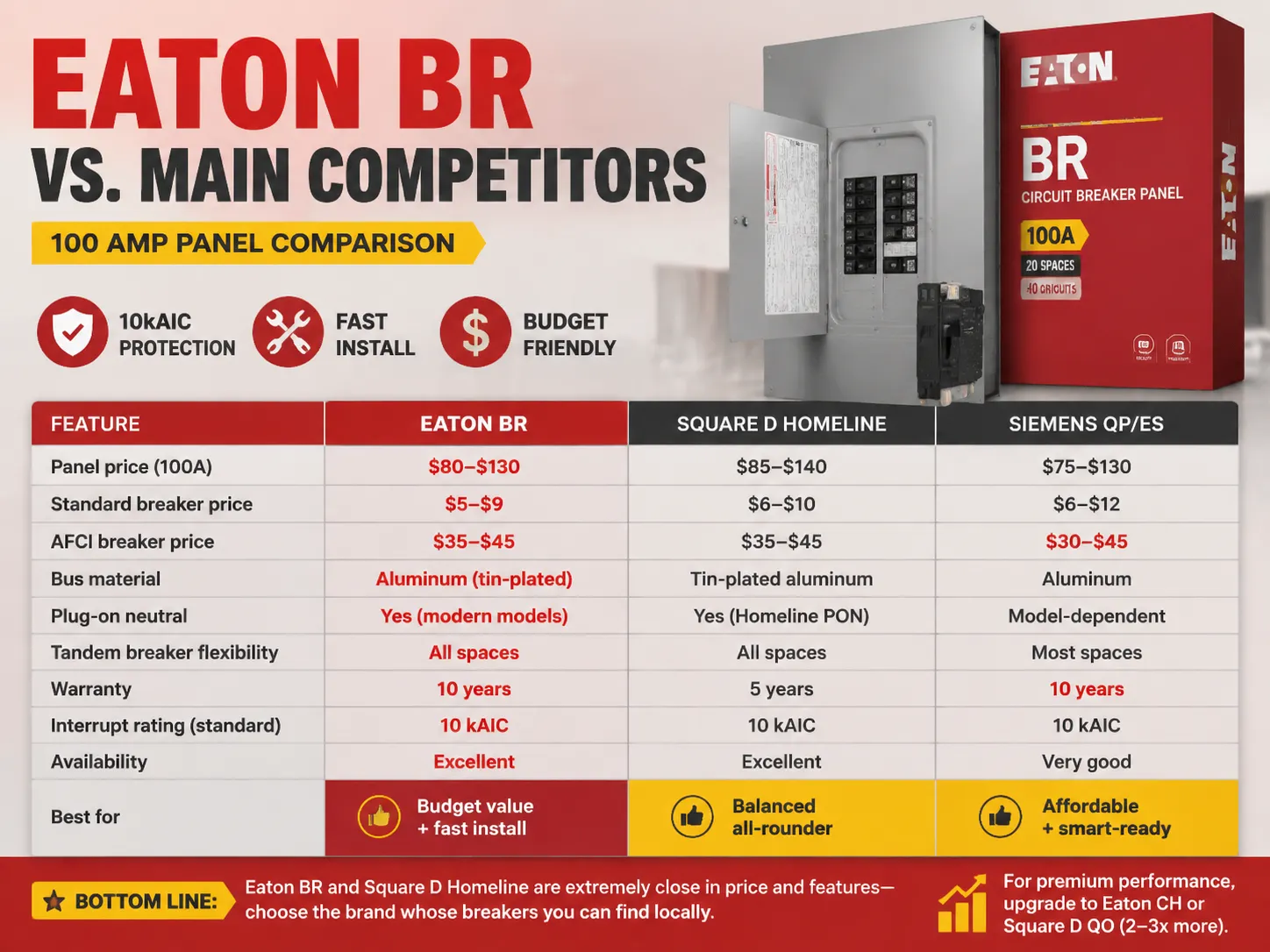
| Característica | Eaton BR | Square D Homeline | Siemens QP/ES |
|---|---|---|---|
| Precio del panel (100A) | $80–$130 | $85–$140 | $75–$130 |
| Precio del interruptor estándar | $5–$9 | $6–$10 | $6–$12 |
| Precio del interruptor AFCI | $35–$45 | $35–$45 | $30–$45 |
| Material del bus | Aluminio (bañado en estaño) | Aluminio bañado en estaño | Aluminio |
| Neutro enchufable | Sí (modelos modernos) | Sí (Homeline PON) | Depende del modelo |
| Flexibilidad de interruptor en tándem | Todos los espacios | Todos los espacios | La mayoría de los espacios |
| Garantía | 10 años | 5 años | 10 años |
| Clasificación de interrupción (estándar) | 10 kAIC | 10 kAIC | 10 kAIC |
| Disponibilidad | Excelente | Excelente | Muy buena |
| Mejor para | Valor económico + instalación rápida | Versátil equilibrado | Asequible + listo para smart |
Resumen de competidores: Al comparar el Eaton BR con el Square D Homeline, ambos tienen un precio similar y las mismas características, por lo tanto, la elección para la mayoría de los clientes depende de la disponibilidad de interruptores de cada marca en sus tiendas locales. Siemens afirma tener precios más bajos en interruptores AFCI y características impresionantes de compatibilidad con hogares inteligentes. Para quienes buscan algo más avanzado, las líneas Eaton CH y Square D QO pueden ser una buena opción, aunque son 2-3 veces más caras que BR y Homeline.
Alternativas: Otros modelos Eaton BR
Si el panel de 10–12 espacios no se ajusta a su plan, aquí están otras configuraciones Eaton BR que vale la pena considerar:
| Familia de modelos | Espacios / Circuitos | Mejor Para |
|---|---|---|
| BRP8 (8 espacios) | 8 / 16 | Subpaneles compactos, talleres pequeños |
| BRP10 (10 espacios) | 10 / 20 | Garaje estándar y taller |
| BRP12 (12 espacios) | 12 / 24 | Mejor equilibrio entre espacio y tamaño |
| BR2020 (20 espacios) | 20 / 20 | Talleres más grandes, ampliaciones |
| BR3030 / BR4040 (30–40 espacios) | 30–40 / 30–40 | Servicio completo para el hogar de 100A (raro) |
| Versiones BR 200A (BRP200) | 20–40 espacios | Actualizaciones completas de servicio 200A |
Para muchos trabajos de 100 amperios, no hay duda de que el modelo BRP12 de 12 espacios / 24 circuitos es, con mucho, la mejor opción, ya que es lo suficientemente espacioso para acomodar iluminación, receptáculos y varios circuitos de 240 voltios sin uso innecesario del espacio en la pared.
Guía de instalación y mantenimiento
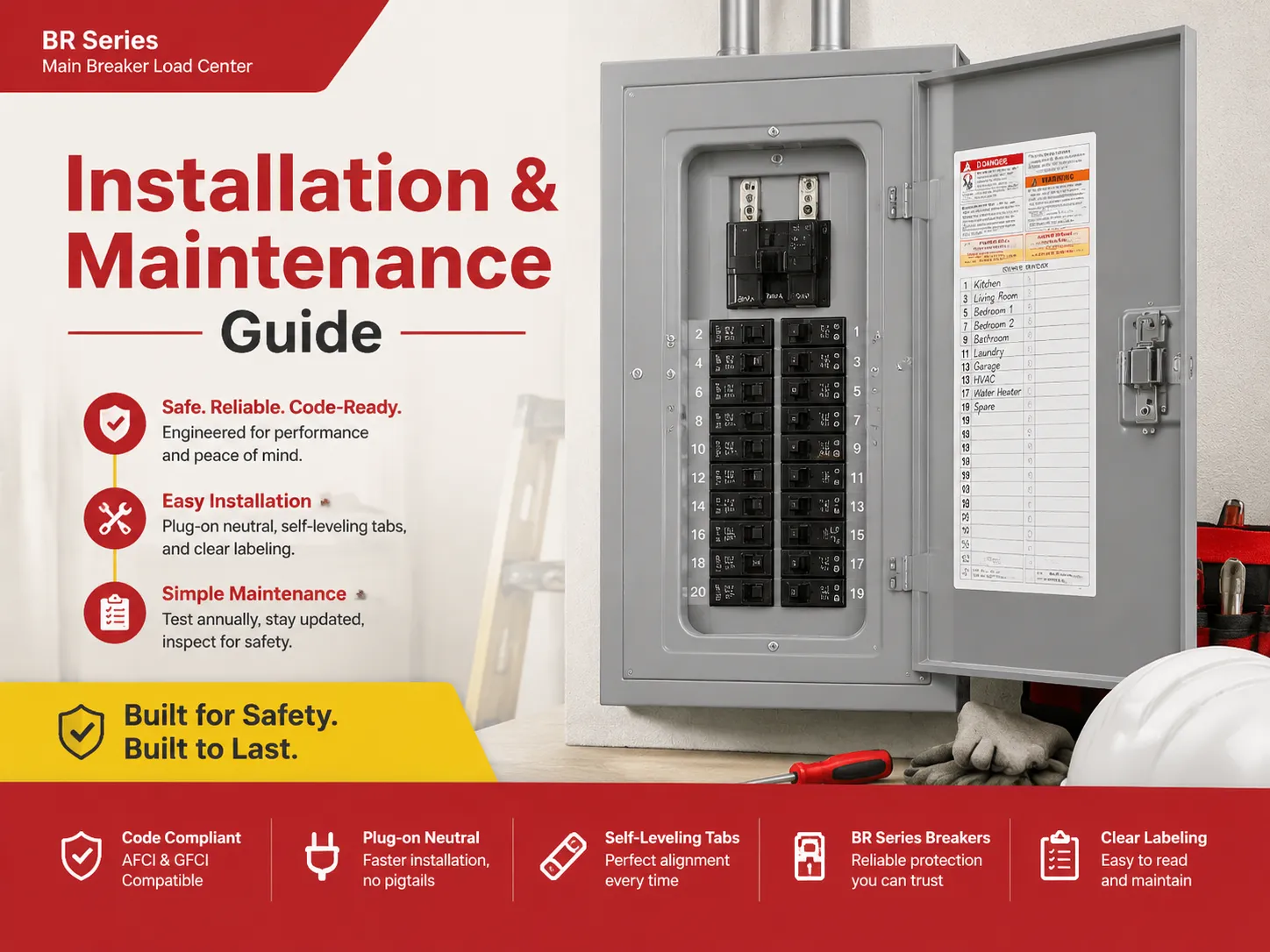
Resumen de instalación
- Planificación del circuito: Haga una lista de los circuitos derivados que necesitará y verifique qué cumplimiento relacionado tiene en los códigos de construcción locales (requisitos AFCI para circuitos de dormitorios y salas, requisitos GFCI para áreas húmedas, etc.)
- Desconecte la fuente de alimentación: Recuerde que aunque este es un panel de interruptores, el área no protegida siempre está energizada a menos que haya sido separada de la energía por la compañía eléctrica o un profesional autorizado. Abra los paneles de interruptores cuando no tengan energía.
- Fije el panel a la pared: Use uno de los colgadores tipo ojo de cerradura para colgar el panel y luego asegúrelo con tornillos. El sistema de auto-nivelación ayudará a evitar discrepancias en el drywall.
- Conecte los cables de servicio: Conecte los cables de la alimentación principal al terminal del interruptor (debe apretarse según las especificaciones, usualmente entre 25 y 50 in-lb). El calibre del cable debe estar entre #6 y 1/0 AWG de cobre o aluminio.
- Conecte el cable de tierra y el cable neutro: Según las leyes locales, el cable de tierra y el cable neutro están unidos en el panel principal y separados en el subpanel.
- Añada los interruptores de circuito derivados: Los interruptores pueden simplemente empujarse sobre el busbar. Los módulos AFCI y GFI tienen una salida especial que permite conectarlos directamente sin necesidad de cableado.
- Proceda con el cableado: Cada circuito derivado debe tener cables de fase, neutro y tierra conectados.
- Fije la cubierta y etiquete cada uno de los circuitos derivados instalados usando una etiquetadora que asigna números automáticamente según el orden en que se instalaron los circuitos.
- Prueba del panel: Recuerde volver a encender la energía y, después de que la energía esté encendida, asegúrese de verificar la funcionalidad de cada interruptor automático utilizando los botones especiales en los dispositivos de prueba AFCI y GFI.
Nota: Generalmente, en muchas regiones, la instalación del panel requiere permisos, así como acuerdos con la autoridad local. Mientras que el trabajo realizado en el lado de las ramas del panel no requiere un permiso, consulte los códigos eléctricos locales para más detalles.
Consejos de mantenimiento
- Prueba anual de los interruptores: Presione los botones de prueba AFCI/GFCI cada año y asegúrese de que el interruptor se dispare.
- Verifique el calor: Si la cara del panel o cualquier manija del interruptor se siente inusualmente caliente, esto podría significar que hay una conexión suelta — llame a un electricista.
- Actualice la leyenda: Actualice el cronograma del panel cada vez que agregue un circuito.
- Inspeccione la corrosión: En un entorno húmedo, revise los terminales, así como el bus, para detectar cambios de color durante la prueba anual.
Si está tratando de diagnosticar la salud de un panel existente antes de reemplazarlo, nuestra guía sobre cuánto duran los paneles eléctricos explica las expectativas de vida útil y las señales de advertencia que indican la necesidad de reemplazo.
Preguntas Frecuentes
¿Es el Eaton BR 100 amp load center un buen panel?
Absolutamente. El panel principal Eaton BR de 100 amperios es reconocido como uno de los mejores productos de bajo costo en el mercado. Cuenta con un interruptor principal de 100 amperios, así como de 10 a 12 espacios para acomodar de 20 a 24 circuitos con interruptores dobles. Utiliza un diseño moderno de neutro enchufable que está listado por UL y tiene un período de garantía de diez años. El precio típico para este panel de interruptores está entre $80 y $130. La única desventaja en comparación con marcas más caras como Square D QO o Eaton CH es que utiliza un bus de aluminio en lugar de cobre, lo cual rara vez es un problema para la mayoría de las aplicaciones residenciales.
¿Cuántos interruptores caben en un panel Eaton BR de 100 amperios?
Un panel Eaton BR estándar de 10 espacios puede aceptar un máximo de 10 interruptores automáticos de tamaño completo, o puede utilizar interruptores en tándem que pueden contar hasta 20 circuitos. El panel de 12 espacios puede aceptar 12 interruptores de tamaño completo o un máximo de 24 circuitos. La ventaja del panel BR es que permite usar interruptores en tándem y cuádruples en todos los espacios disponibles, por lo que efectivamente el número de circuitos aumenta sin un aumento correspondiente en el tamaño del panel. Sin embargo, debe tenerse en cuenta que la carga total que puede manejar está limitada a 100 amperios según el diseño del interruptor principal.
¿Puedo usar un panel Eaton BR de 100 amperios como subpanel?
¡Definitivamente! El centro de carga Eaton BR de 100 amperios puede usarse efectivamente como un subpanel alimentado desde el panel principal con 200 amperios. Para lograr esto, se debe retirar el tornillo de unión para separar neutro y tierra. Después de hacer esto, el interruptor alimentador de 100 amperios en el panel principal debe conectarse y los conductores alimentadores deben correr hacia él. El interruptor principal del subpanel ahora también actuará como un punto local de desconexión. También se recomienda verificar los códigos locales, ya que los requisitos de puesta a tierra para subpaneles podrían variar.
¿Cuál es la diferencia entre los paneles Eaton BR y CH?
Eaton BR es lo que se podría describir como la línea económica de productos residenciales, mientras que Eaton CH es una línea de alta gama. La línea CH utiliza barras colectoras de COBRE, tiene garantías limitadas de por vida y características de disparo ligeramente más rápidas, pero cuesta de 2 a 3 veces más que la línea BR. BR, por otro lado, utiliza barras colectoras de aluminio (plateadas en sus versiones más recientes), tiene un período de garantía de 10 años, y su precio para paneles de 100A está dentro de los límites de $80 – $130. Para casi todas las necesidades residenciales y comerciales ligeras, la serie BR es completamente suficiente en cuanto a calidad, siendo considerablemente más económica.
¿Es compatible el panel Eaton BR de 100 amperios con los interruptores Square D?
No, los interruptores no son intercambiables entre marcas. Un panel Eaton BR necesita interruptores Eaton BR (o equivalentes listados por UL diseñados para cumplir con las especificaciones BR). No se pueden usar interruptores Square D Homeline y nunca deben forzarse en un panel BR. El hecho de que una vez que eliges una marca de panel todas tus futuras compras de interruptores también deben coincidir con esa marca es una razón para hacer una elección cuidadosa de la marca del panel.
Referencias
- Especificaciones del producto Eaton BRP10B100RF — Hoja de especificaciones oficial de Eaton para el centro de carga con interruptor principal neutro enchufable BR 100A, incluyendo dimensiones, clasificaciones y certificaciones.
- Catálogo del centro de carga con neutro enchufable Eaton BR — Catálogo de productos Eaton que cubre toda la serie BR, tecnología PON y beneficios de instalación.
- Menards — Centro de carga Eaton BRP12H100 100A — Listado minorista que muestra precios reales, especificaciones y descripciones de características para el modelo de 12 espacios.
- NFPA 70 (Código Eléctrico Nacional) — El código regulador para la instalación de paneles eléctricos, desconectadores de servicio y requisitos de interruptores en los Estados Unidos.
- UL Solutions — El organismo de certificación de seguridad cuyas normas UL 50 y UL 67 cubren los recintos de centros de carga y la seguridad de tableros de distribución.
- Elegir la marca correcta de panel eléctrico (2026) — Comparación independiente de electricistas de paneles Eaton, Square D, Siemens y Leviton incluyendo referencias de precios y notas de garantía.
Conclusión: ¿Debería comprarlo?
Con una reputación como una opción principal, el centro de carga con interruptor principal Eaton BR 100 amperios ofrece gran valor a los clientes. Proporciona un panel bien construido listado por UL con su avanzada tecnología de neutro enchufable, flexibilidad de expansión con interruptores en tándem, disponibilidad de interruptores asequibles y una garantía de diez años.
Consíguelo si: estás cableando tu garaje, taller, casa pequeña, ADU o subpanel, y quieres una opción confiable sin gastar demasiado. El panel tiene una capacidad de 10-12 espacios / 20-24 circuitos adecuada para casi cualquier proyecto de 100 amperios.
Evítalo si: estás actualizando a una casa totalmente eléctrica que requiere un panel más grande de 200A, resides en una zona costera con alta humedad y necesitas un sistema de barra de cobre para proporcionar seguridad adicional (en este caso, puedes optar por Eaton CH o Square D QO), o si necesitas medición inteligente incorporada (Leviton es una opción en este caso).
Para la mayoría de los clientes, el panel Eaton BR 100 amperios es una elección inteligente ya que ofrece valor por tu dinero y es confiable a largo plazo con mantenimiento anual.