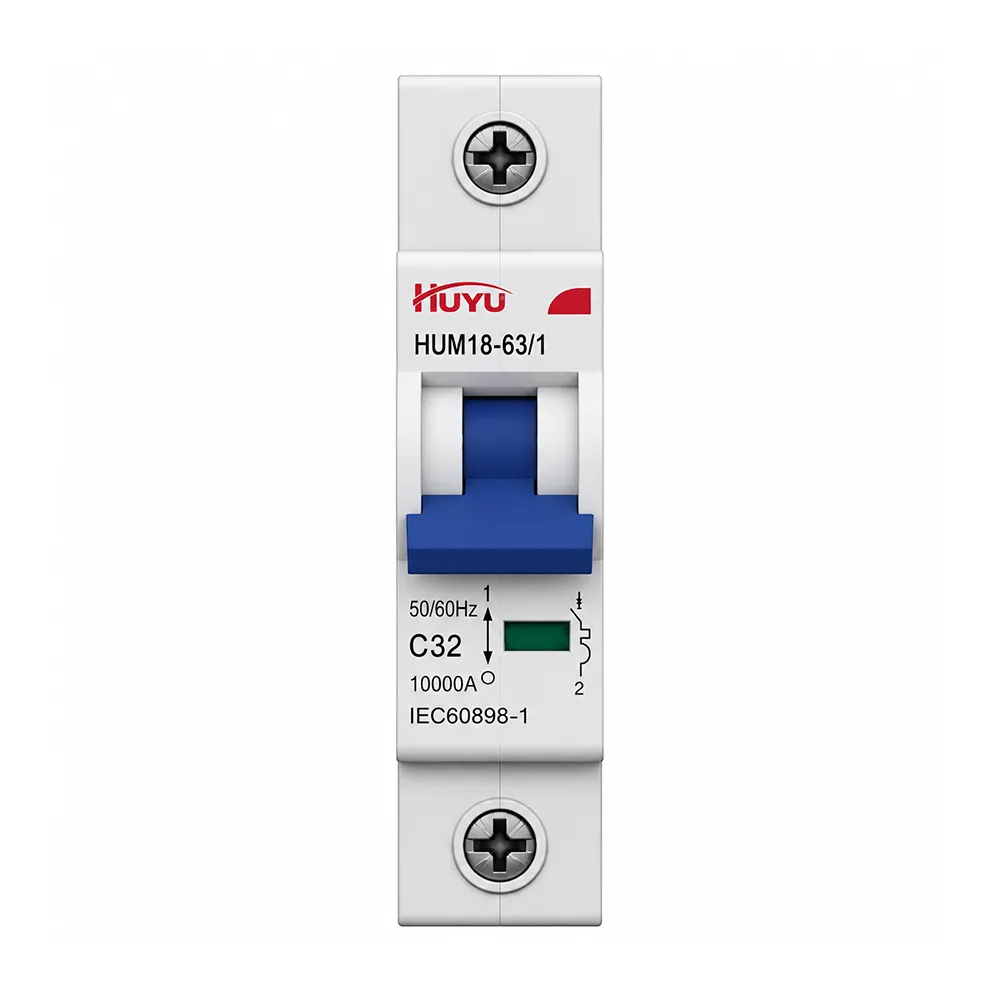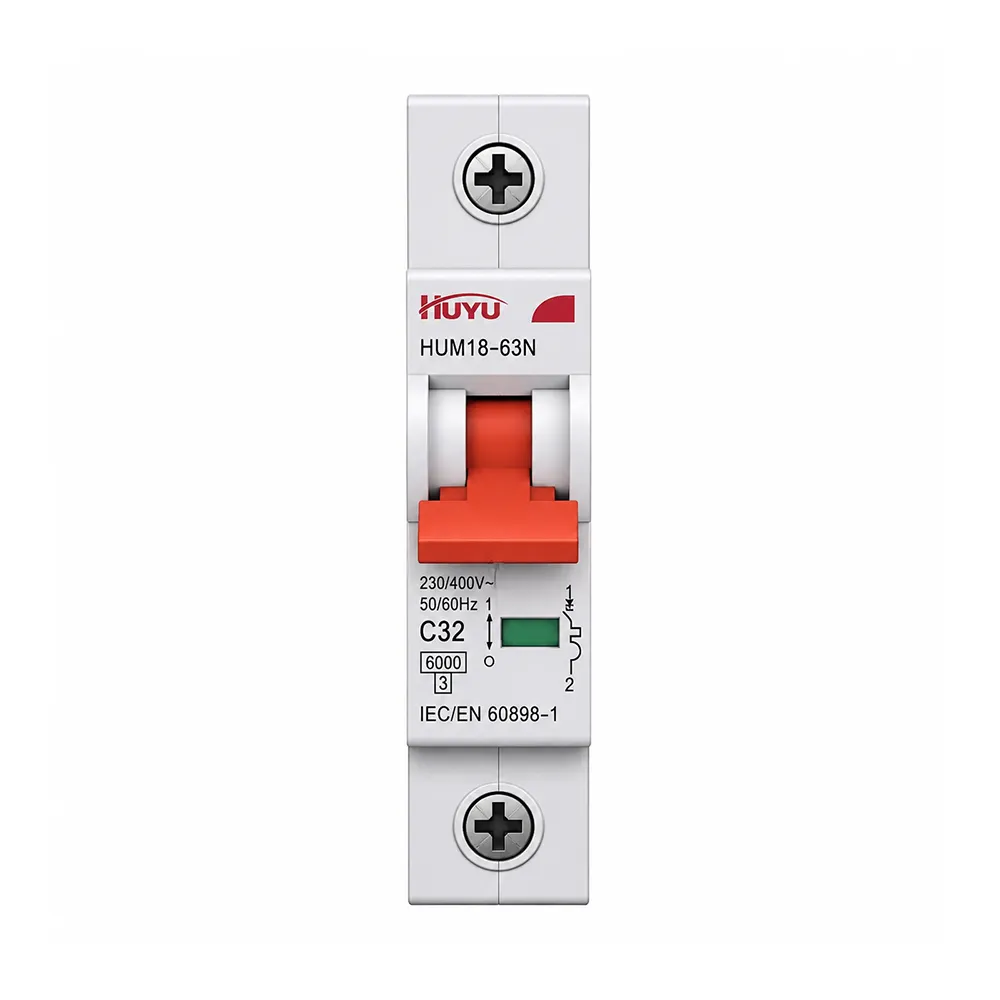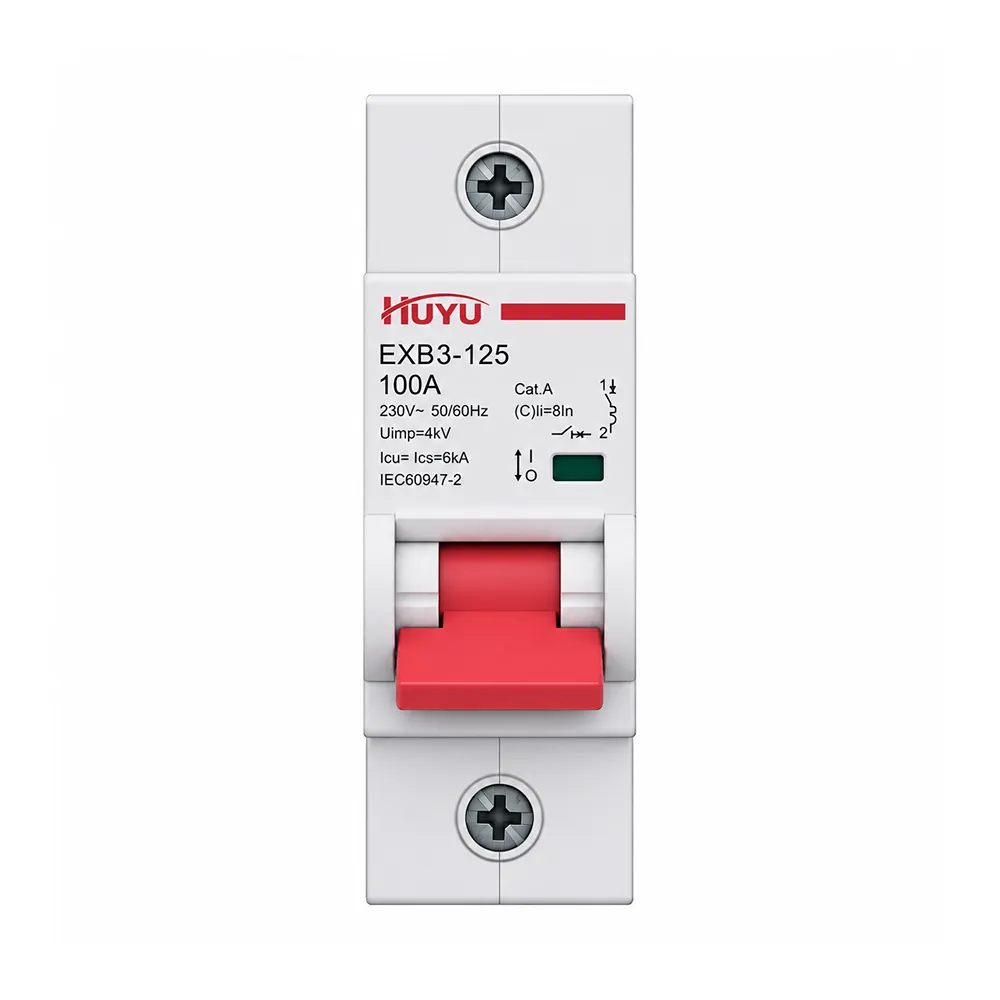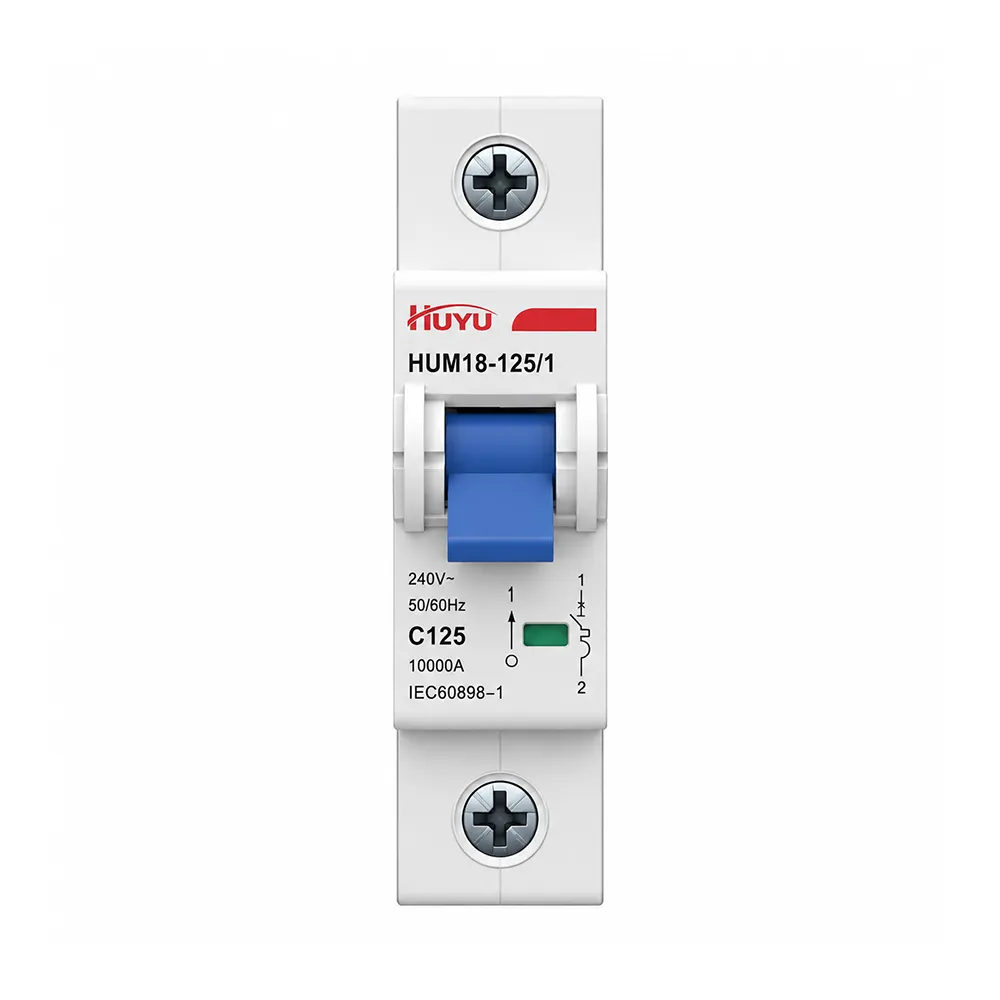

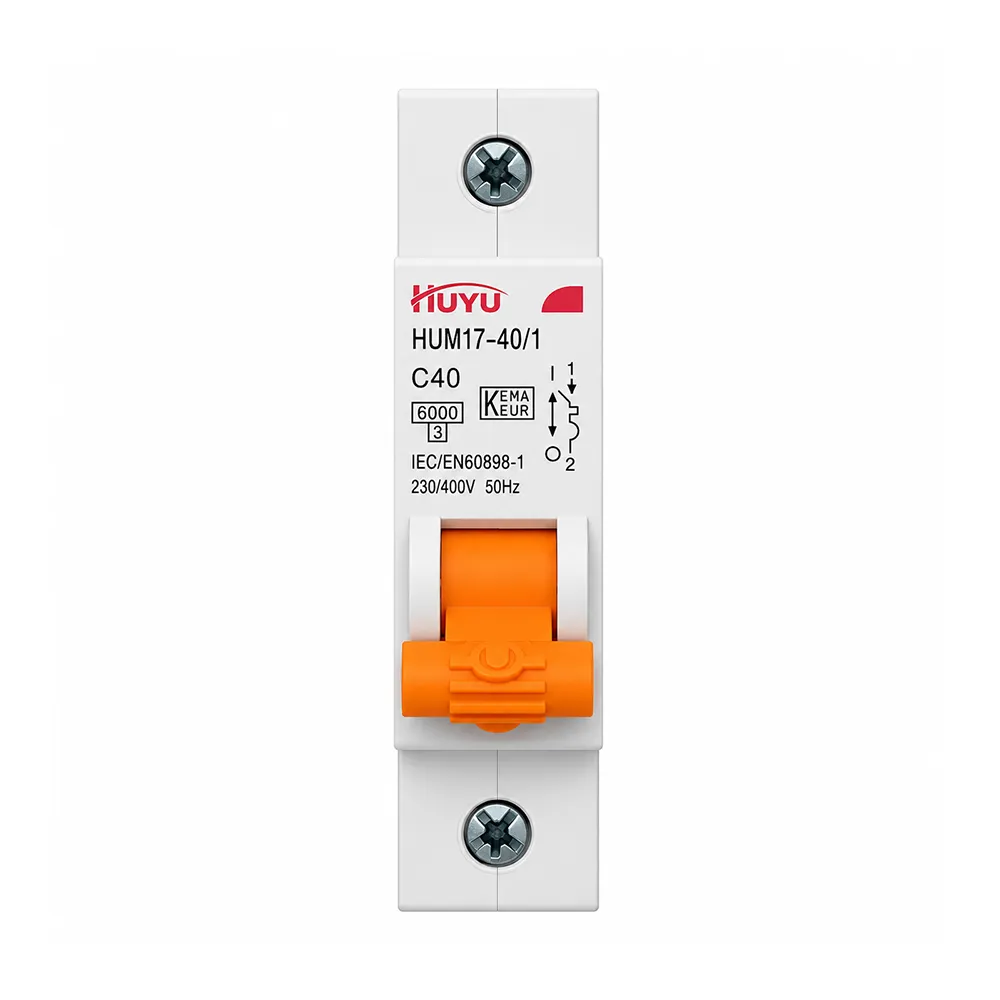
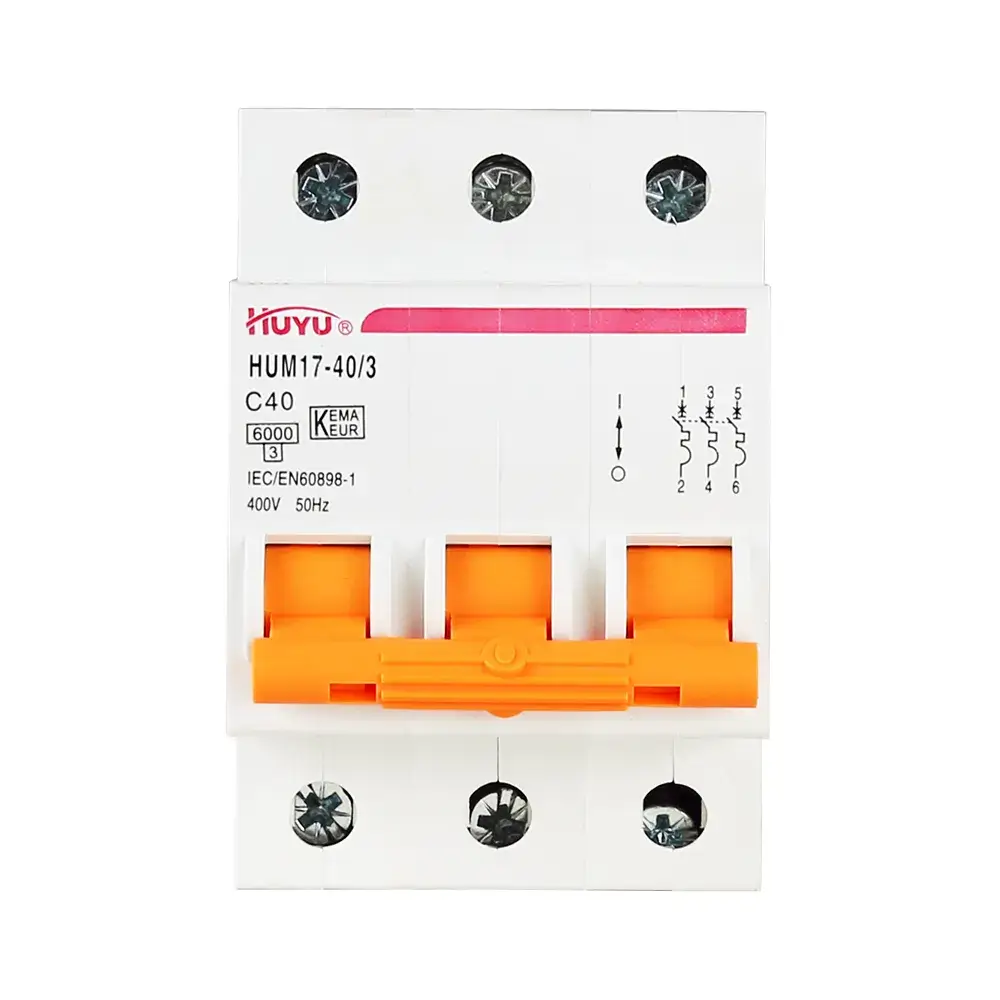
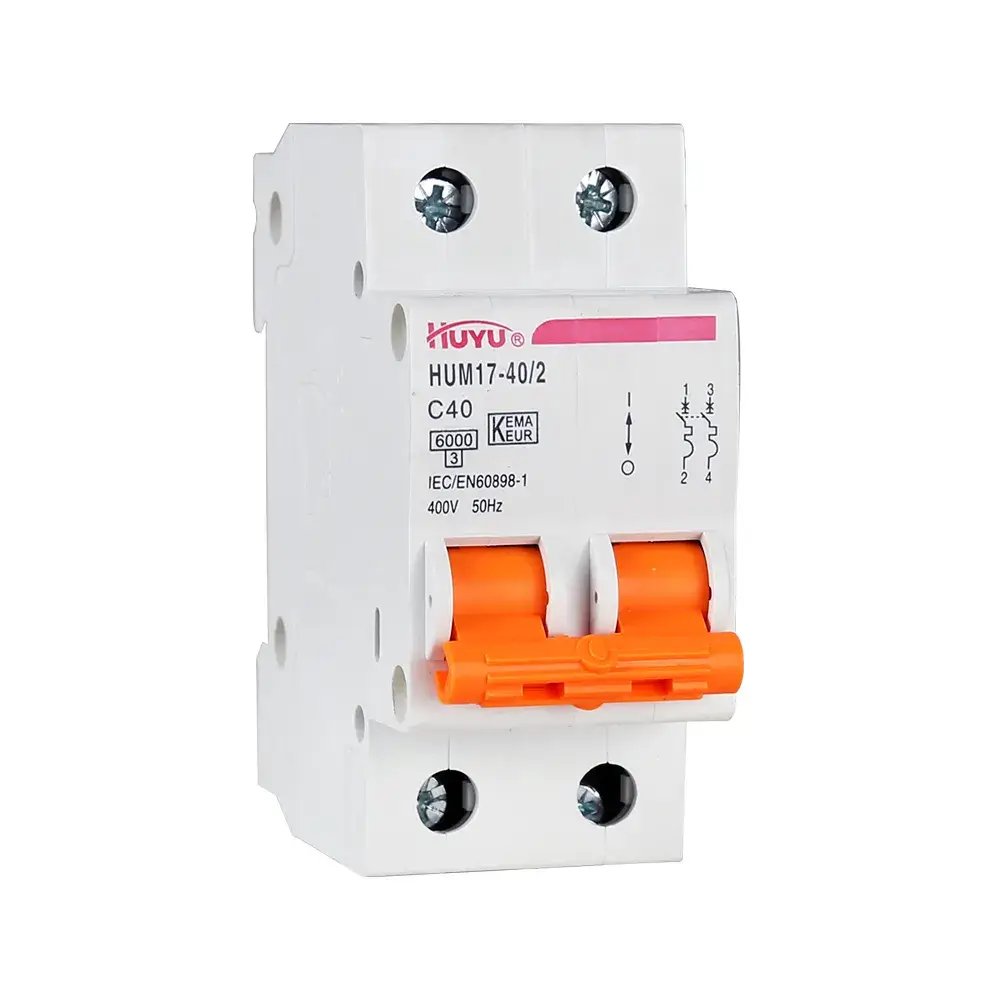
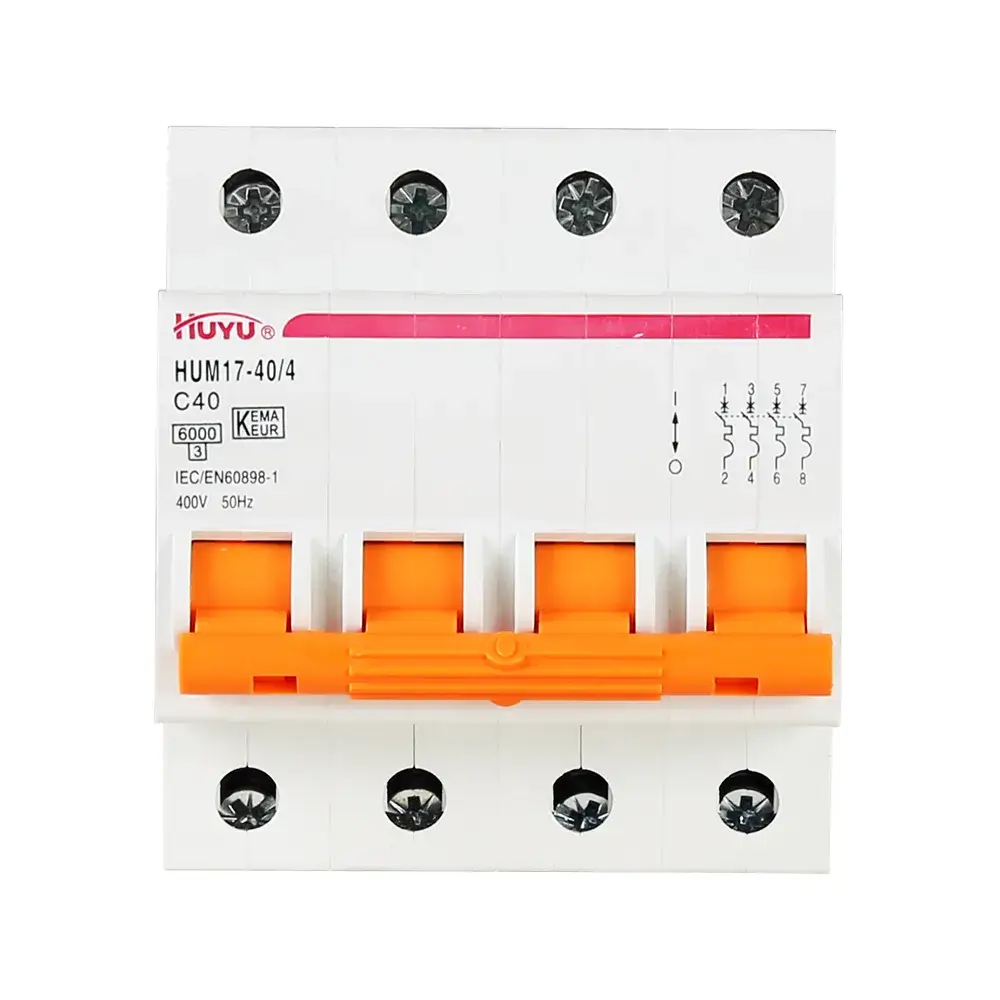
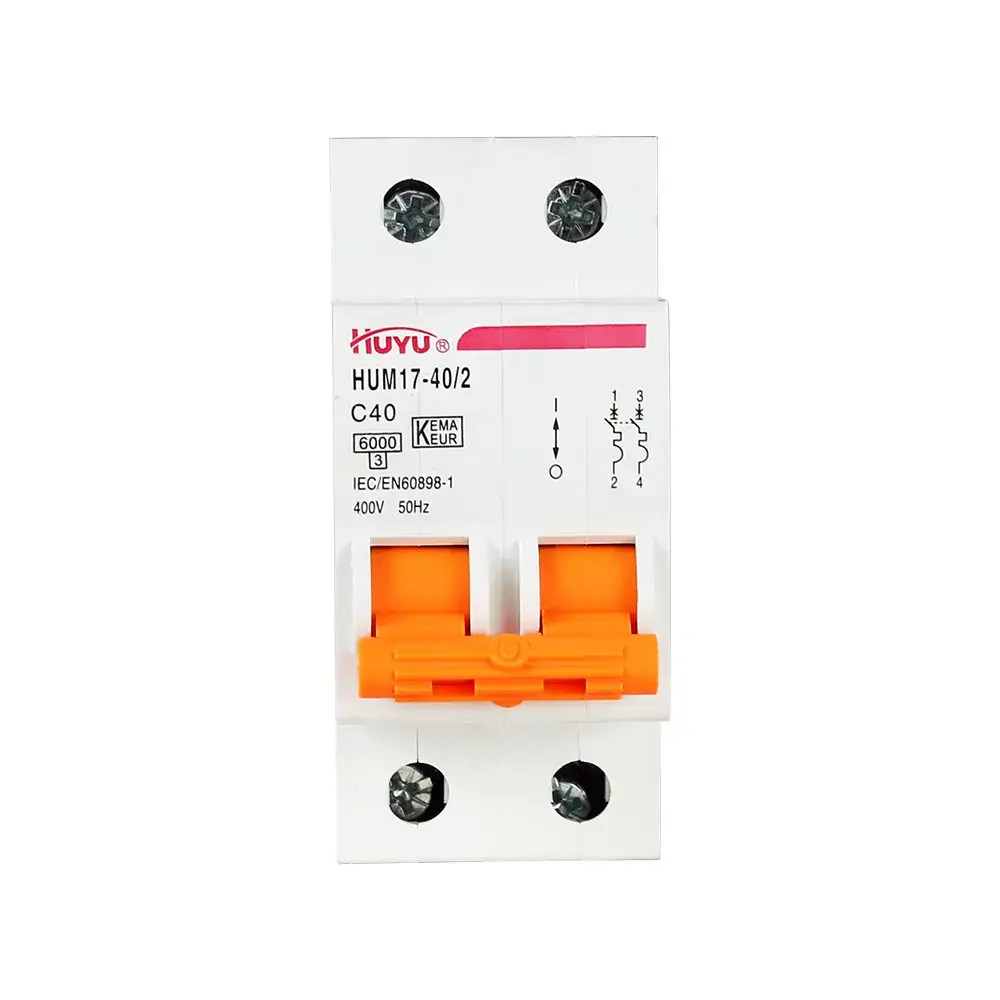
HUM17-40 MCB Electrical – 1P to 4P,6A-40A,Type B & C
The HUM17-40 is an MCB electrical device rated 6A–40A for AC 50Hz systems up to 400V. Provides overload and short-circuit protection with 6kA Icn. Compliant with IEC 60898-1 and GB/T 10963.1. Available in 1P, 1P+N, 2P, 3P, 3P+N, 4P with Type B & C curves. Wide operating range -35°C to +70°C. 20,000 mechanical / 10,000 electrical cycles. 10mm² wiring capacity, TH35-7.5 DIN rail mount. Compact design for residential, commercial, and light industrial distribution boards.
Standards: IEC 60898-1, GB/T 10963.1
Rated Current: 6A – 40A
Breaking Capacity: 6kA Icn
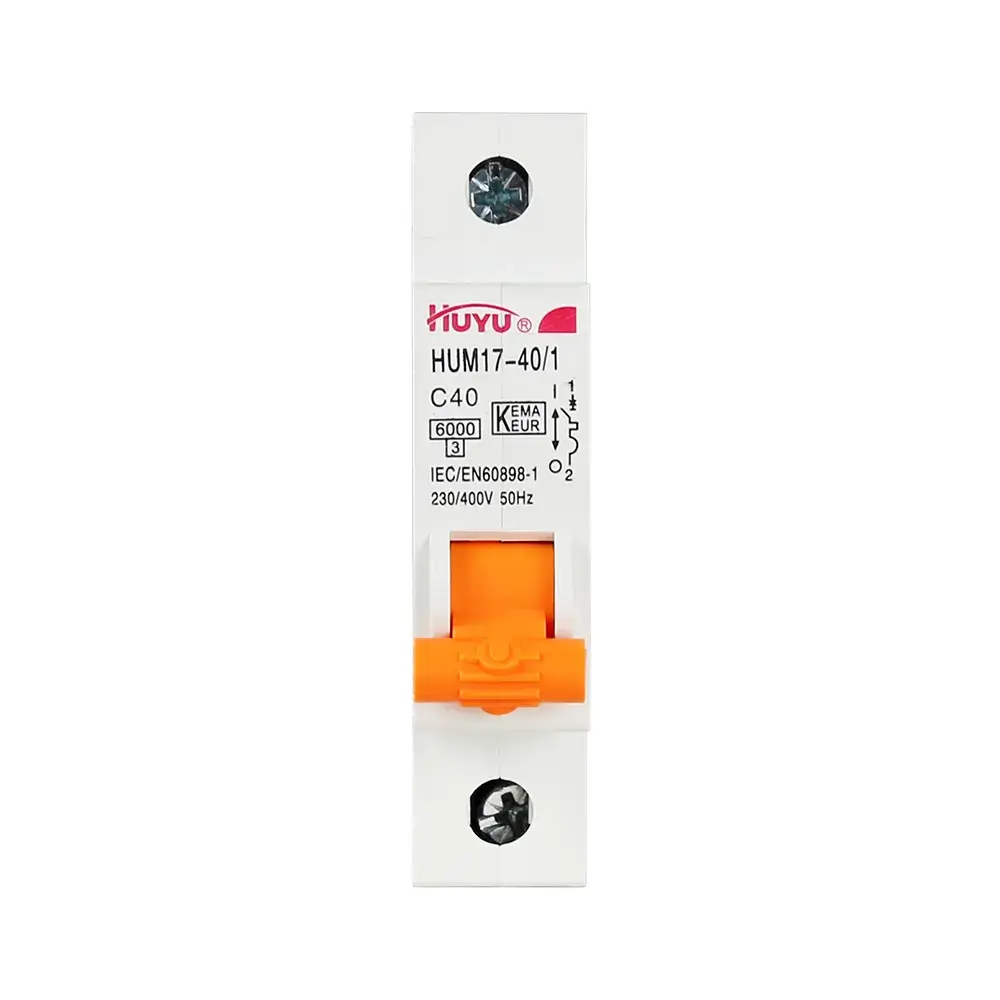
Poles: 1P, 1P+N, 2P, 3P, 3P+N, 4P
Curves: Type B, C
Mounting: TH35-7.5 DIN Rail
Product Information
HUM17-40 MCB Electrical Overview & Applications – Compact 40A Protection
MCB stands for Miniature Circuit Breaker — an essential device designed to safeguard electrical wiring and equipment against overcurrent damage. The HUM17-40 from HUYU Electric represents a basic yet effective MCB electrical solution engineered for AC 50Hz circuits up to 400V, available with current ratings ranging from 6A to 40A, and a reliable 6kA Icn breaking capacity in compliance with IEC 60898-1 and GB/T 10963.1 standards.
This practical MCB comes in six different pole configurations: single pole MCB for lighting circuits, dp MCB electrical (double pole) for 400V isolation, or options such as 3P and 4P MCBs for three-phase circuits. It fits well in both residential and light commercial electrical panels. With operating conditions between -35°C and +70°C, a mechanical endurance of 20,000 cycles, and a 10mm² terminal capacity, the HUM17-40 delivers a high-performance solution at factory-direct OEM/ODM pricing — presenting an affordable alternative to brands like Schneider Electric, ABB, Hager, Eaton, Siemens, Legrand, and Chint for wholesale buyers prioritizing cost efficiency and quality.
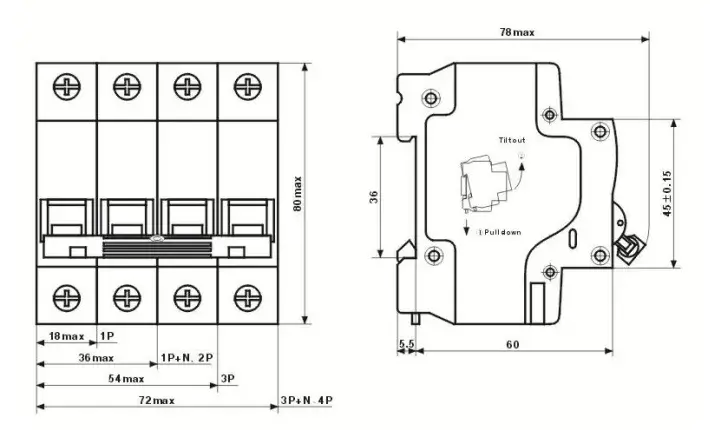
MCB Curves and Pole Configurations
| Pole | Current Rating | Curve Type | Applications |
|---|---|---|---|
| 1P | 6A – 40A | B, C | Lighting and socket circuits |
| 1P+N | 6A – 40A | B, C | Single-phase circuits with switched neutral |
| 2P | 6A – 40A | B, C | Double pole circuits — 400V isolation |
| 3P | 6A – 40A | B, C | Three-phase motor and distribution |
| 3P+N | 6A – 40A | B, C | Three-phase circuits with neutral disconnect |
| 4P | 6A – 40A | B, C | Four-pole full isolation |
All pole configurations feature a uniform 6,000A Icn rating. Type B curves trip at 3–5× rated current for resistive loads like lighting and heating, while Type C curves trip at 5–10× rated current for inductive loads like motors and fluorescent lamps. With fewer part numbers required for inventory, this series aligns with the market’s most commonly installed MCBs in residential and commercial setups.
HUM17-40: Installation Guide
The installation process of the HUM17-40 MCB is straightforward. Once mounted on a TH35-7.5 DIN rail inside a distribution board or consumer unit, it is wired between the main power source and the downstream circuit. Low current ratings such as 6A or 10A are used for lighting, whereas higher ratings like 32A or 40A are suited for cookers, showers, and sub-distribution. The MCB trips and isolates the specific circuit should the current exceed the predefined limit, keeping the rest of the panel active. The HUM17-40 can operate reliably in a wide range of conditions, from -35°C to +70°C, making it suitable for environments such as outdoor kiosks and rooftop installations. Moreover, it serves as a convenient disconnection point for infrequent manual switching during system servicing.
Technical Specifications
| Product Model | HUM17-40 Miniature Circuit Breakers |
| Standard | IEC 60898-1, GB/T 10963.1 |
| Poles | 1P, 1P+N, 2P, 3P, 3P+N, 4P |
| Rated Current (A) | 6, 10, 16, 20, 25, 32, 40 |
| Rated Voltage | AC 230/400V (1P); AC 230V (1P+N); AC 400V (2P, 3P, 3P+N, 4P) |
| Rated Frequency | 50Hz |
| Breaking Capacity Icn | 6,000A (6kA) |
| Insulation Voltage Ui | 500V |
| Impulse Withstand Uimp | 4kV |
| Tripping Curve | Type B (3In–5In), Type C (5In–10In) |
| Electrical Life | 10,000 cycles |
| Mechanical Life | 20,000 cycles |
| Operating Temperature | -35°C ~ +70°C |
| Humidity | RH ≤50% at +40°C; RH ≤90% at +20°C |
| Max. Altitude | 2,000m |
| Max. Terminal Capacity | 10mm² |
| Torque | 2.0 N·m |
| Mounting | TH35-7.5 DIN Rail |
| Pollution Degree | 2 |
| MOQ | 2,000 pcs |
Receive Factory-Direct Pricing for HUM17-40 MCB Electrical
Choose single pole, dp MCB, 3P, or 4P configurations — range from 6A to 40A with Type B & C trips. Certified by IEC/GB standards, operating at -35°C to +70°C. OEM branding and complete documentation available. Request your wholesale quotation to compare costs and lead times with your current supplier.
Minimum Order Quantity: 2,000 pcs • IEC 60898-1 / GB/T 10963.1 • Worldwide Shipping
OEM/ODM Supply – Your Reliable Source for Wholesale Buyers
Stock HUM17-40 – Your Go-To for Standard Circuits
The HUM17-40 meets the needs for standard current ratings (6A–40A) and pole configurations (1P–4P) in residential and light commercial applications, offering dual compliance with IEC/GB standards and a robust 6kA breaking capacity. Designed to fit into the most common distribution setups, it delivers dependable overcurrent protection when paired with RCCBs. For bulk buyers, we also offer private labeling, customized packaging, and comprehensive certification documentation.
How to Select the Right HUM17-40 MCB — Current, Curve & Pole
A practical step-by-step guide for choosing an appropriate MCB solution for your electrical circuit designs in residential and commercial applications.
1. Selecting Current Ratings
For lighting circuits, choose between 6A or 10A. Socket outlets typically require 16A or 20A. Electric showers, cookers, or air conditioning units demand 25A–40A. The HUM17-40 covers all these current ratings in seven steps. Remember to derate by approximately 8% for every 10°C above 30°C in high-temperature environments. When grouping multiple MCBs in a single panel, use a derate factor of 0.8–0.9 to account for heat buildup.
2. Type B or Type C Curve?
Type B MCBs trip at 3–5× the rated current, ideal for resistive loads like lighting and heating. Type C MCBs trip at 5–10× the rated current, making them suitable for inductive loads like motors, fans, and fluorescent lighting. For circuits experiencing nuisance tripping with Type B, switching to Type C often resolves the issue.
3. Choosing Pole Configuration: Single, Double, or Three-phase
Use single-pole MCBs for 230V lighting and socket circuits. Double-pole (DP) MCBs are necessary for 400V isolation or circuits requiring neutral and line disconnection. For three-phase systems, choose 3P, 3P+N, or 4P configurations based on specific needs. Mixing different pole types in a single panel is possible without misalignment.
4. Installation Guidelines
The HUM17-40 is designed for easy installation on a TH35-7.5 DIN rail. Ensure that the conductors connected to the terminals do not exceed the 10mm² capacity, and tighten terminal screws with a torque of 2.0 N·m. Rated for pollution degree 2 and temperatures ranging from -35°C to +70°C, it supports operation at altitudes up to 2000m without needing additional environmental enclosures for most applications.


Frequently Asked Questions
What is the MCB in electrical?
MCB stands for Miniature Circuit Breaker — an electrical protective device that automatically switches off a circuit when it detects an overload or short-circuit. In an electrical installation, it sits in the distribution board and protects individual circuits. Unlike a fuse, an MCB can be reset by flipping the switch back on. The MCB meaning in electrical engineering is essentially a resettable overcurrent protection device.
What are the four types of MCB?
The four common MCB types are defined by their trip curves: Type B (trips at 3–5× rated current, for resistive loads), Type C (5–10×, for inductive loads), Type D (10–20×, for high-inrush equipment), and Type A or K (for semiconductor protection, less common in residential use). The HUM17-40 is available in Type B and Type C, covering standard residential and commercial final circuits.
What is RCB and MCB?
RCB (Residual Current Breaker) is another term for an RCCB or RCD — it detects earth leakage current and protects against electric shock. An MCB protects against overcurrent. When comparing RCB vs MCB, the key difference is: RCB protects people from earth leakage, MCB protects wiring from overload and short circuits. For complete electrical protection, both are installed together in a consumer unit.
What is an RCD vs MCB?
An RCD (Residual Current Device) monitors the balance between live and neutral current. If leakage to earth is detected — for example, through a person — it trips within milliseconds. An MCB responds to overcurrent. The HUM17-40 provides the overcurrent protection side of the equation. For full safety in modern installations, it is paired with an RCCB or RCBO in the same distribution board.
No documents available for download at this moment.