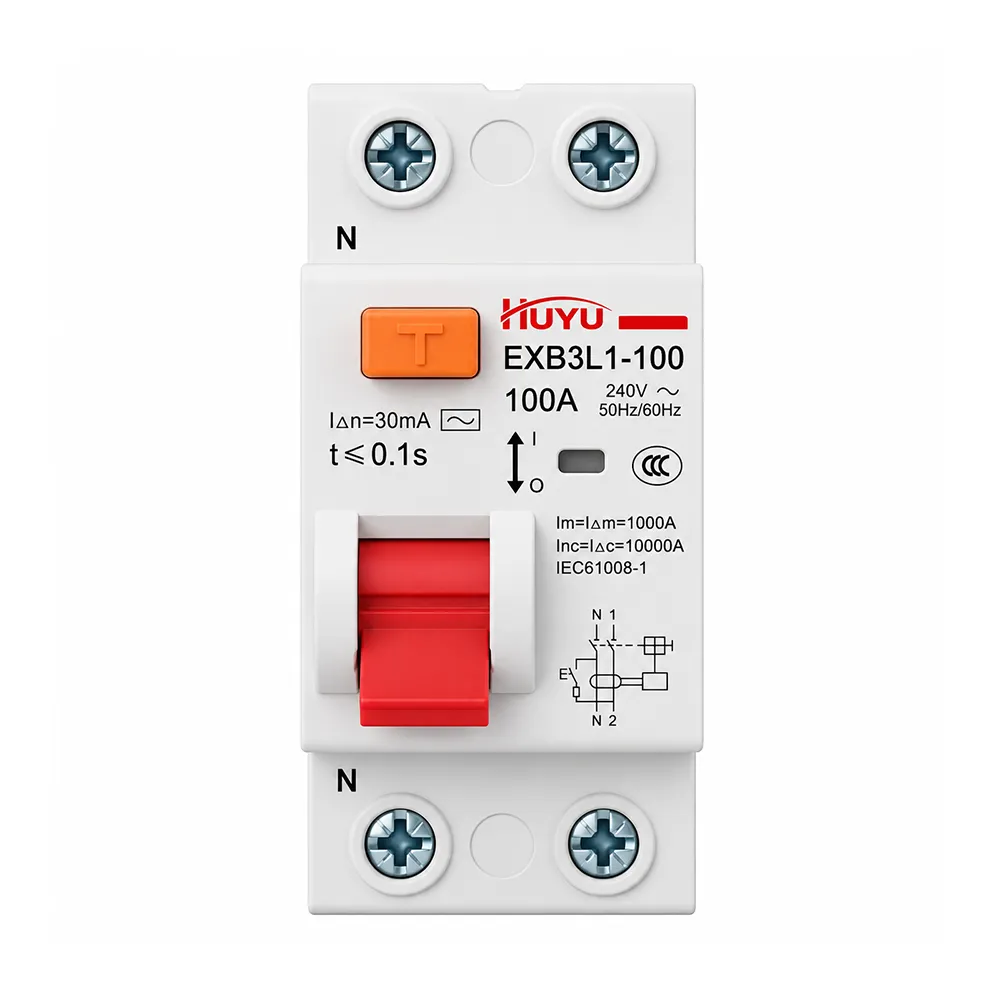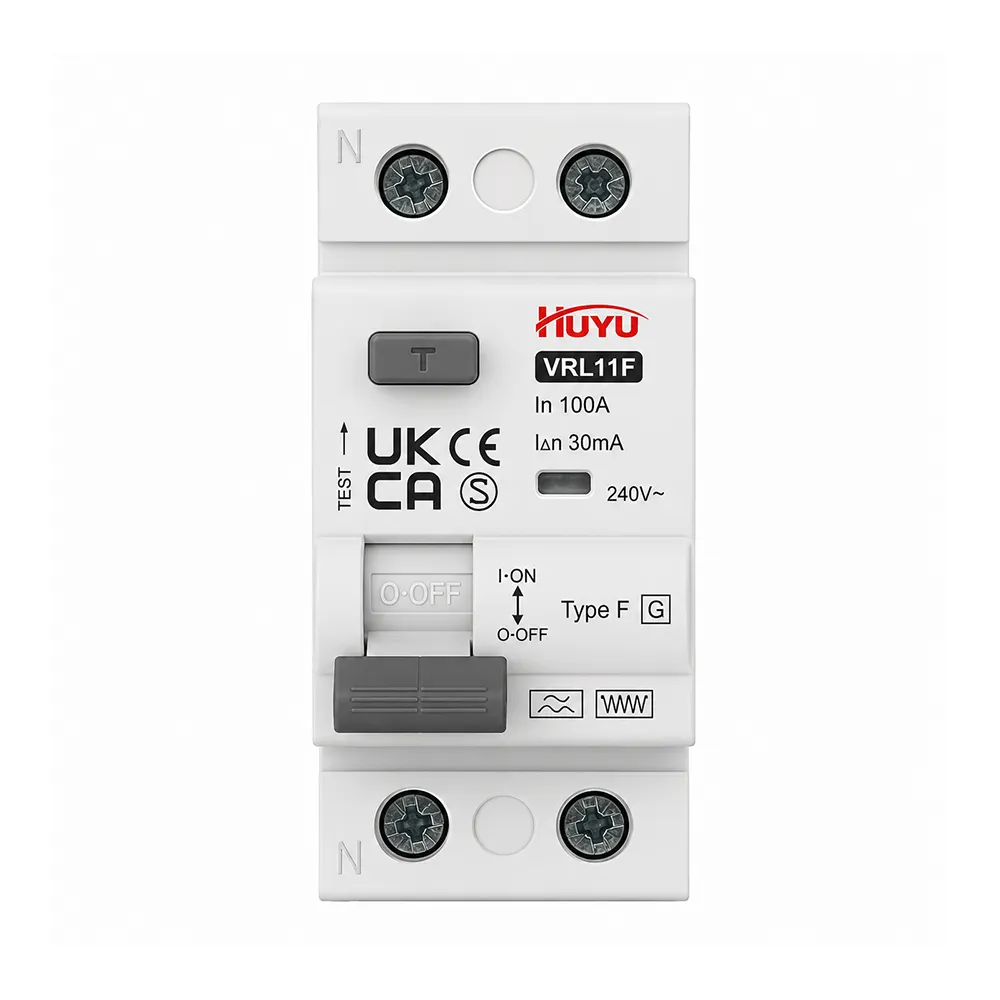

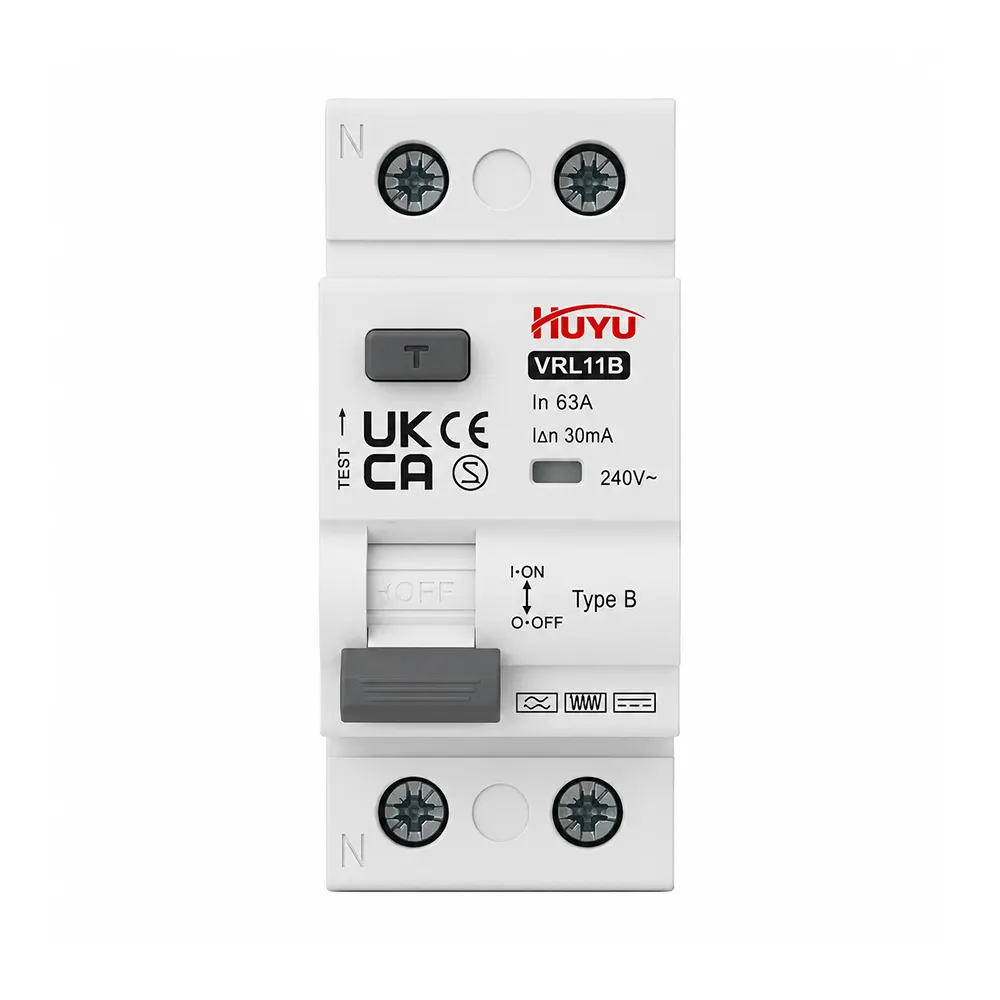
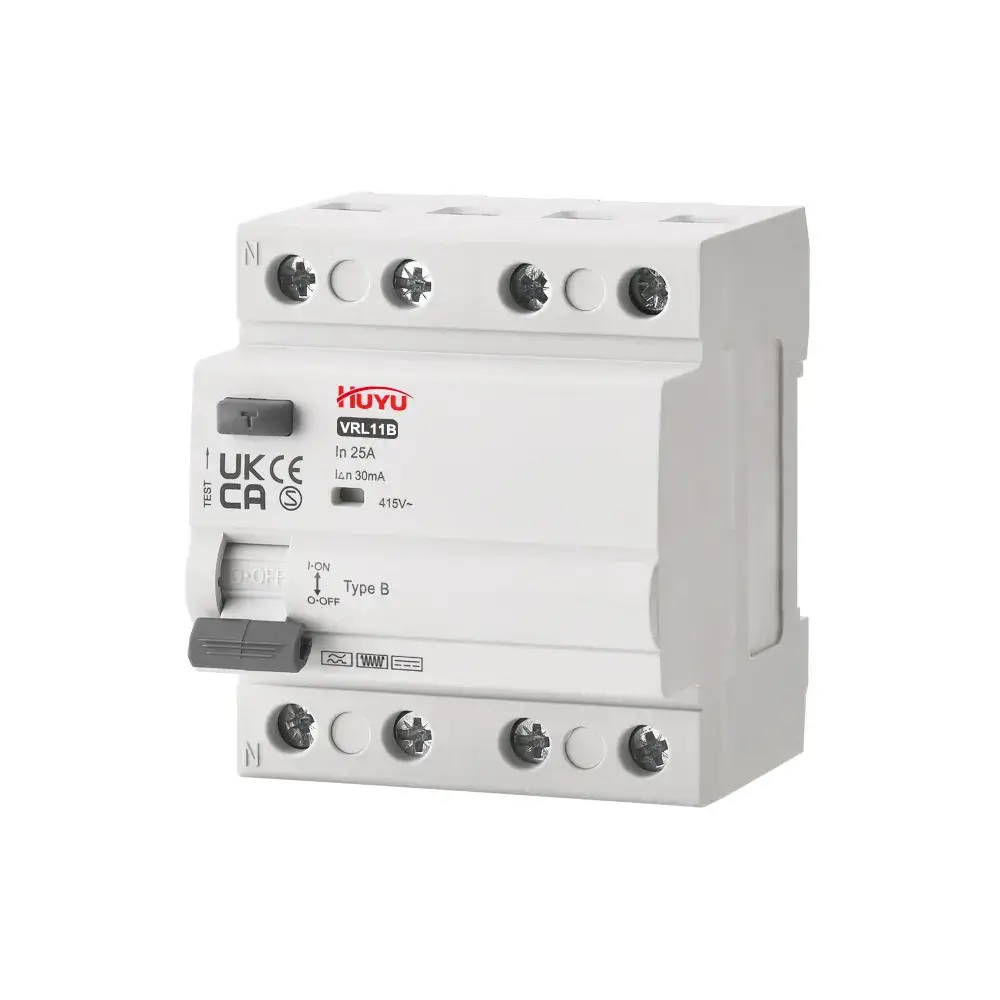
VRL11B Type B RCCB,100A 30mA 300mA,2P 4P
The VRL11B is a Type B RCCB detecting AC, pulsed DC, and smooth DC residual currents up to 100kHz. Rated 16A–100A with 30mA, 100mA, 300mA, or 500mA sensitivity. Compliant with IEC/EN 62423 & IEC/EN 61008-1. 2P & 4P. 10kA conditional short-circuit. Type B+ options available for high-frequency disturbance immunity. Electronic sensing. 25mm² wiring. -25°C to +50°C. TH35-7.5 DIN rail mount.
Standards: IEC/EN 62423, IEC/EN 61008-1
Rated Current: 16A – 100A
Residual Current: 30mA, 100mA, 300mA, 500mA
Detection: AC + Pulsed DC + Smooth DC (Type B/B+)
Conditional Short-Circuit: 10kA
Poles: 2P, 4P
Applications: EV Chargers, PV, VFD, Medical
Mounting: TH35-7.5 DIN Rail
Product Information
VRL11B Type B RCCB – Detects AC, Pulsed DC & Smooth DC Leakage for Modern Electrical Loads
In most cases, standard Type AC or Type A RCCBs will work for the majority of household circuits; however, if you are installing an EV charger, solar PV inverter, variable frequency drive, or medical imaging equipment, the residual current may contain smooth DC components that a Type A device cannot detect. HUYU Electric has introduced the VRL11B Type B RCCB, designed specifically for these applications. It can detect the full range of leakage (AC, smooth DC, and pulsed DC) from modern power electronics, up to 100 kHz using the IEC/EN 62423 standard and the IEC/EN 61008-1 standard, available in 2P (230V-240V) and 4P (400V-415V) models with ratings from 16A-100A with sensitivity options including 30mA, 100mA, 300mA, and 500mA.
The distinguishing feature of the Type B RCCB is the Type B+ variant, which adds immunity to high-frequency disturbance currents, commonly generated by inverter switching and power-line communication associated with EV charging applications. This is important because nuisance tripping on an EV charger will not only be inconvenient but will also usually stop a previously scheduled overnight charging session. The electronic sensing circuit is designed to provide consistent trip performance over the voltage and temperature rating range of these devices. For distributors and projects buying Type B RCCBs from Schneider (Acti9 iID), ABB (F200 B), Hager (CDB series), Eaton, Siemens, or Wylex, HUYU Electric provides factory-direct OEM/ODM pricing with full IEC 62423 documentation and private labels.
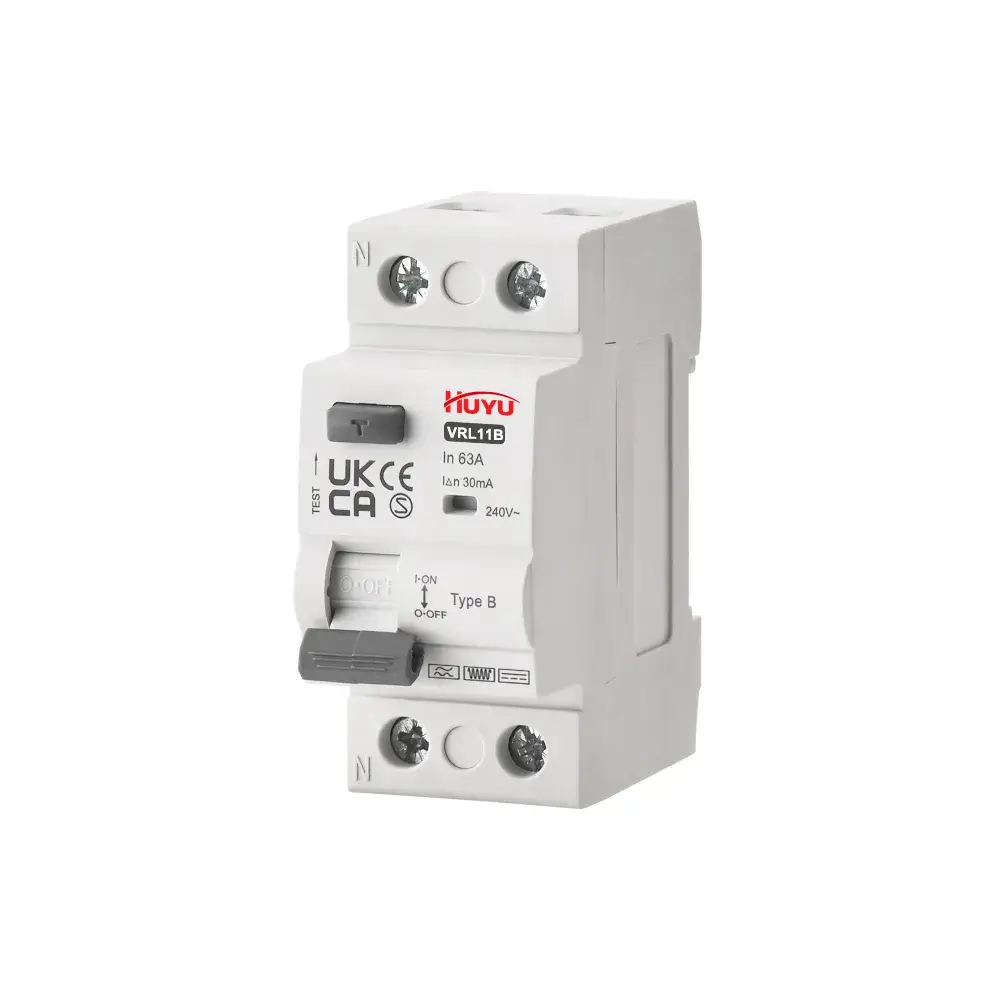
Type B RCCB Configurations – 2P & 4P, 30mA to 500mA, Type B+ Available
| Pole | Rated Current | IΔn Options | Type | Voltage | Key Application |
|---|---|---|---|---|---|
| 2P | 16A – 100A | 30, 100, 300, 500mA | B, B+ | AC 230/240V | Single-phase EV charger, residential PV inverter |
| 4P | 16A – 100A | 30, 100, 300, 500mA | B, B+ | AC 400/415V | Three-phase EV charger, VFD, commercial PV, medical |
All variants have a 10,000 A conditional short-circuit rating and electronic residual current detection. The Type B+ option has improved immunity to high-frequency disturbances and is therefore recommended for circuits with power-line communication (PLC), such as ISO 15118 compliant EV chargers. The sensitivity requirements of most recent developments with non-linear loads are satisfied by the 300mA Type B RCCB and 30mA Type B RCCB.
Type B RCCB vs Type A – Why Smooth DC Detection Matters
A Type A RCCB detects sinusoidal AC leakage and pulsating DC leakage up to 6mA. This covers the majority of residential circuits — washing machines, induction cooktops, LED lighting, and inverter air conditioners. However, a Type B RCCB like the VRL11B adds detection of smooth DC residual current, which occurs when a rectifier or inverter develops an insulation fault on the DC side. This is critical for:
- EV charging stations (IEC 60364-7-722 mandates Type B or equivalent for Mode 3 charging points).
- Solar PV inverters (transformerless inverters can inject DC leakage into the AC grid).
- Variable-frequency drives (the DC link can leak to earth through degraded motor insulation).
- Medical equipment (X-ray generators and MRI power supplies).
Installing a Type A RCCB on any of these circuits creates a protection gap — the device simply cannot detect the fault. The VRL11B closes that gap with Type B and Type B+ detection compliant with IEC 62423.
Technical Specifications
| Product Model | VRL11B Series (Type B / Type B+) |
| Standards | IEC/EN 62423, IEC/EN 61008-1, OVE E8601, VDE 0664-400 |
| Poles | 2P, 4P |
| Rated Current In (A) | 16, 25, 32, 40, 63, 80, 100 |
| Rated Voltage Ue | 2P: AC 230/240V; 4P: AC 400/415V |
| Frequency | 50/60Hz |
| Residual Current Type | Type B / Type B+ (AC + Pulsating DC + Smooth DC) |
| Residual Current IΔn (mA) | 30, 100, 300, 500 |
| Frequency Range for Residual Current | Up to 100kHz |
| Making & Breaking Im | 1,500A |
| Conditional S.C. Inc | 10,000A (10kA) |
| Impulse Withstand Uimp | 4kV |
| Insulation Voltage Ui | 500V |
| Electrical Life | ≥ 2,000 cycles |
| Mechanical Life | ≥ 4,000 cycles |
| Operating Temperature | -25°C ~ +50°C |
| Max. Wiring | 1–25mm² |
| Terminal Torque | 2.0–2.5 N·m |
| Mounting | TH35-7.5 DIN Rail (any position) |
| Protection Degree | IP20 |
| MOQ | 2,000 pcs per item |
Source Type B RCCB at Factory-Direct Pricing
2P & 4P, 16A–100A, 30mA–500mA. Type B/B+ for EV chargers, PV inverters, VFDs, and medical equipment. IEC 62423 compliant. 10kA conditional. OEM branding and complete documentation. Compare our Type B RCCB price and lead time to Schneider, ABB, and Hager.
MOQ 2,000 pcs • IEC/EN 62423 / IEC/EN 61008-1 • Worldwide Shipping
OEM/ODM Supply – Type B RCCB for EV, PV & Industrial Applications
VRL11B – Type B Protection for the Electrified Future
As EV charging infrastructure expands and solar PV installations grow, the demand for Type B RCCBs is increasing across residential, commercial, and industrial markets. If your customers currently install Schneider Acti9 iID (Type B), ABB F200 B-type, Hager CDB series, Eaton, Siemens, or Wylex Type B RCCBs, the VRL11B delivers equivalent IEC 62423 compliance with Type B+ high-frequency immunity as standard at a competitive factory-direct price point. The 30mA, 100mA, 300mA, and 500mA options cover everything from a domestic 7kW EV charger to a commercial 100A PV inverter feed. OEM laser marking, private-label packaging, and complete IEC/EN test documentation are standard for volume partners.
How to Choose a Type B RCCB – Current Rating, Sensitivity & Application
A practical guide to specifying the VRL11B for EV chargers, PV systems, VFDs, and medical equipment.
1. When Do You Need Type B Instead of Type A?
Type A RCCBs handle AC and pulsating DC leakage — suitable for standard household circuits and most commercial equipment. You need a Type B RCCB when the circuit feeds equipment that can produce smooth DC residual current during a fault. This includes EV charging stations (IEC 60364-7-722), transformerless PV inverters, variable-frequency drives, UPS systems, medical X-ray and MRI equipment, and industrial rectifier circuits. If you are unsure, check the equipment manufacturer’s RCD specification — if they require Type B, a Type A device will not provide adequate protection.
2. Choosing the Current Rating and Sensitivity
For a single-phase 7.4kW home EV charger: 32A or 40A 2P with 30mA. For a three-phase 22kW commercial EV charger: 32A 4P with 30mA. For a residential PV inverter feed: 25A or 32A 2P with 30mA or 100mA depending on local code. For a commercial PV string inverter: 40A–80A 4P with 100mA or 300mA. For medical equipment circuits: consult the equipment specification — 30mA or 10mA may be required. The VRL11B covers 30mA, 100mA, 300mA, and 500mA across 16A–100A ratings.
3. Type B vs Type B+ – Do You Need High-Frequency Immunity?
Type B detects AC, pulsating DC, and smooth DC residual currents. Type B+ adds immunity to high-frequency disturbances up to 100kHz — the kind generated by inverter switching noise and power-line communication (PLC) signals used in smart EV chargers. If the installation includes an EV charger that communicates with the vehicle via the power cable (ISO 15118), specify Type B+ to avoid nuisance tripping caused by communication signals rather than actual earth leakage.
4. Type B RCCB Brands Compared
The VRL11B joins a market served by Schneider (Acti9 iID B-type), ABB (F200 Type B), Hager (CDB series), Eaton, Siemens, and Wylex. All meet IEC 62423; the differences lie in Type B+ availability, sensitivity range, and price. The VRL11B includes Type B+ as standard across all ratings and sensitivities at factory-direct OEM/ODM pricing. For projects where brand specification is open or price-competitive, the VRL11B offers an alternative that meets the same international standard without the premium-brand price point.

Frequently Asked Questions
What is A type B RCCB?
A Type B RCCB is a residual current circuit breaker that detects three types of earth leakage current: sinusoidal AC (as Type AC does), pulsating DC (as Type A does), and smooth DC (unique to Type B). Smooth DC residual current can occur when a rectifier or inverter develops an insulation fault on its DC side. This makes Type B RCCBs essential for circuits feeding EV chargers, PV inverters, variable-frequency drives, UPS systems, and medical imaging equipment. The VRL11B is a Type B RCCB compliant with IEC 62423.
What is the difference between A type A and type B RCD?
A Type A RCD detects AC residual current and pulsating DC residual current up to 6mA. This is sufficient for standard household circuits with electronic appliances. A Type B RCD adds detection of smooth DC residual current — up to the rated IΔn — which Type A cannot detect. If smooth DC leakage flows through a Type A RCD, it can magnetize the sensing core and blind the device, preventing it from tripping on subsequent faults. For circuits with rectifiers, inverters, or EV chargers, Type B is the correct specification.
What is the difference between Type A and Type F RCCB?
Type A detects AC and pulsating DC leakage. Type F is a newer classification under IEC 62423 that adds detection of composite residual currents with frequencies up to 1kHz — designed for circuits with single-phase inverter-driven appliances such as heat pumps and washing machines. Type F does not cover smooth DC or the full 100kHz frequency range that Type B and Type B+ cover. The VRL11B’s Type B+ extends well beyond Type F, covering smooth DC and frequencies up to 100kHz for EV charger and industrial inverter applications.
What is the difference between B type and C type breakers?
This question is commonly asked about two separate things. For overcurrent trip curves (MCB/RCBO): Type B trips at 3–5× rated current for resistive loads; Type C trips at 5–10× for inductive loads. For residual current types (RCCB/RCD): Type B refers to the ability to detect AC, pulsating DC, and smooth DC leakage — the protection classification, not a trip curve. The VRL11B is a Type B residual current device; the “B” refers to its detection capability, not a magnetic trip curve. When buying overcurrent breakers, B and C refer to the trip curve; when buying RCCBs, the Type refers to the residual current detection range.
No documents available for download at this moment.