

United States Electrical Contractors
If an contractor in Northern Virginia is in need of 100 MW of electrical infrastructure to be constructed in 18 months, they do not hire a local electrician. Instead they seek the services of the biggest electrical contractors in the United States – either national or regional firms with the bonding capability and ability to develop, install and operate complex high voltage and highly reliable electrical systems. These contractors work on the wiring of the data centers, airports, hospitals, pharmaceutical companies, and solar plants in America. For the manufacturers and distributors working with them – circuit breaker producers, switchgear producers, wiring device manufacturers – these contractors represent the entrance to their project. Therefore it is crucial for anyone selling electrical goods in the USA to know who the key players are, what they do, and how they choose their suppliers. This guide describes the largest electrical contractors operating in the USA, gives an idea on their specialties and covers local contractors activities in key states.
Summary: Multibillion dollar national contractors, large regional specialists, and various thousands of local independent contractors are involved in serving the United States electrical contracting market. The biggest contractors are Quanta Services, EMCOR Group, M.C. Dean, Rosendin Electric, Cupertino Electric, MYR Group, and Helix Electric, and they seem to be specialists in different segments of the market from high-voltage transmission and distribution to data facility equipment. The electrical equipment used by these contractors, which includes switchgear, panel boards, circuit breakers, and protective devices, is made finalistic in accordance with UL certification, specification acceptance, distribution availability, and established relationships with manufacturers. Choosing a manufacturer which is a supplier in the market has to do with providing the required certificates, establishing connections with the electrical distributor of a necessary scale and offering a product that meets customers’ performance and documentation requirements.
The Electrical Contracting Landscape in the United States
Electrical contracting operates as a fragmented industry across the United States. The level of competition among the top companies are based on factors like geographical reach, technological specialization, and the availability of labor capacity. The top players in the industry usually engage in design-build operations, which encompass collaboration between engineers and the owner of the project during pre-construction, allowing optimization of the electrical design. Of the electrical work, the companies mainly perform activities like electricity distribution, lighting, alarm systems installation, and communications. Activities like the cable splicing installation are usually outsourced to subcontractors. The types of services provided by electrical contracting companies in the United States can be divided into segments like transfer and distribution (high voltage line activity), commercial and institutional (office towers, hospitals, university buildings etc.), data centers and mission-critical, industrial and manufacturing, and renewables (solar energy, thermal plants, etc.).
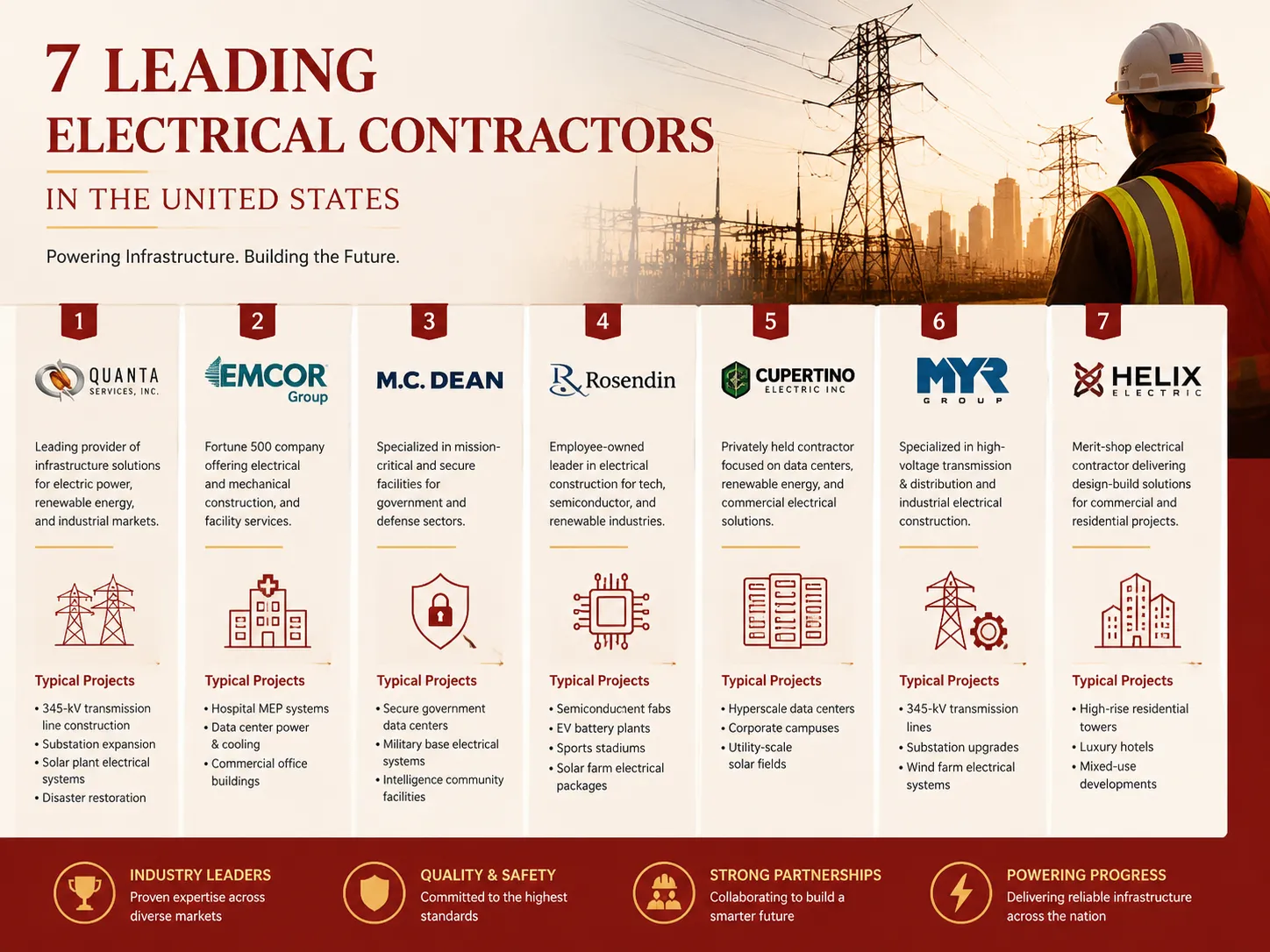
Seven Leading Electrical Contractors in the United States
1. Quanta Services (Houston, Texas)
Core strength: Quanta Services, the biggest electrical contractor across the US and among the most notable specialties contractors in the globe, earns in excess of $20 billion on a yearly basis. The operations of the company cover many fields, such as electric power transmission and distribution, renewable energy infrastructure, and pipeline and industrial services. In particular, the subsidiaries of Quanta Services include such companies as PAR Electrical, Irby Construction, and Sumter Utilities, which work on the high-voltage lines, substations, and underground networks that form the basic components of the electrical grid in North America. Being a leader in T&D construction, Quanta Services is always working on the large-scale and complicated grid modernization projects across the US.
Typical project: Construction of a 345-kV transmission line, extension of a substation, entire electrical systems of a solar power plant, recovery from disasters.
Price positioning: With a competitive advantage gained by its size and ability to deliver projects effectively, Quanta is preparing its bids and executing works of a quality only performed by a handful of other contractors.
2. EMCOR Group (Norwalk, Connecticut)
Core strength: EMCOR, a Fortune 500 firm, is involved in mechanical and electrical engineering, construction, facility management, and industrial maintenance across the United States and the United Kingdom. Its electrical subsidiaries include Dynalectric, Forest Electric, and Meadowlands Electric, which manage electrical systems, lighting systems, and life-safety systems applicable to commercial, health care, and institutional building. The company’s advantage lies in its extensive geographical territory, the provision of services both of electrical and mechanical nature in a single project, and a large number of long-term contracts in facilities maintenance enabling the firm to establish good client relations.
Typical project: Hospital mechanical and electrical fitting, data centre cooling and power system, commercial office tower basic structure.
Price positioning: At the mid-to-high level, EMCOR competes based on its technical capabilities, in-house service execution, and convenience of providing both mechanical and electrical services.
3. M.C. Dean (Tysons, Virginia)
Core strength: One of America’s largest private electrical contractors is M.C. Dean, which has a field of expertise in mission-critical and secure facilities. It is involved in designing, building, and maintaining electrical and electronic systems for data centres, government agencies, military bases, and intelligence centres. The company takes care of everything, from power distribution and lighting to building automation and cybersecurity systems integration. When it comes to the case of security clearance, reliability, and seamless systems integration, there is nowhere to turn but to M.C. Dean.
Typical project: Government data centre secured with military base electrical installation of intelligence community organization.
Price positioning: Pricey, as evident from security clearance levels and the engineering complexity involved as well as mission-criticality of operations.
4. Rosendin Electric (San Jose, California)
Core strength: As the biggest electrical contractor in the United States that is owned by its employees, Rosendin has its headquarters in Silicon Valley. It has carried out extensive electrical work in two industries: technology and semiconductor industries on the West Coast and several renewable energy projects in the region. The company enjoys great standing with NECA and the IBEW and is respected for its innovative methods in prefabrication, BIM based design, as well as building the world’s state-of-the-art semiconductor manufacturing plants.
Typical project: A factory making semiconductors, a battery factory for electric vehicles, a stadium for major sports leagues, and an electrical package for a solar farm.
Price positioning: The employee‑ownership model gives the workforce incentives that correspond to project results of large and technologically sophisticated projects.
5. Cupertino Electric (San Jose, California)
Core strength: Cupertino Electric is a contractor that is privately owned and focused in the data centre, renewable energy and commercial sectors. The data centre division has constructed large hyperscale centres in North America and has an engineering team that allows in-house design and construction to speed up the procurement lead time of complex projects. Cupertino has a reputation for scaling up quickly to take on large fast-track data centre developments.
Typical project: Electric infrastructure work in hyperscale data centres, power and lighting across corporate complexes, and utility-level solar fields.
Price positioning: In the mid and upscale areas, Cupertino’s know-how in design and construction gives it a premium advantage.
6. MYR Group (Henderson, Colorado)
Core strength: MYR Group, which is an electrical contractor with expertise in transmission and distribution systems and is publicly traded, conducts business through its subsidiary companies — Sturgeon Electric, L.E. Myers, and others. MYR Group constructs, operates, and updates the high-voltage transmission lines and substations that connect generating stations to load centers. The MYR Group also has a growing commercial and industrial electrical construction segment that provides a connection between the T&D and construction markets.
Typical project: 345‑kV transmission line construction, substation upgrade, wind farm electrical collection system.
Price positioning: The T&D business is highly competitive; MYR’s dedicated personnel and equipment makes it a strong contender in its market sector.
7. Helix Electric (San Diego, California)
Core strength: Helix Electric is among the biggest merit‑shop (non‑union) electrical contracting firms in the United States. It offers design‑build and design‑assist delivery solutions for various multifamily residential, hospitality, and commercial jobs, mainly in the West Coast and Southwest. The vertically integrated model of Helix Electric — which completes engineering, BIM coordination, prefabrication, and installation on its own — reduces threat to the schedule and cost for its clients.
Typical project: High‑rise residential tower, luxury hotel, mixed‑use development.
Price positioning: Affordable mid-range; Prefabrication capabilities of Helix reduces labor hours as well as installation cost.
Other Notable Electrical Contractors Across the United States
Beyond the seven largest national and regional firms profiled above, the United States is served by dozens of large and mid‑sized electrical contractors who lead their local markets and who are significant buyers of electrical equipment. The table below provides a quick reference to several more notable firms, their specialisations, and their primary geographic footprints.
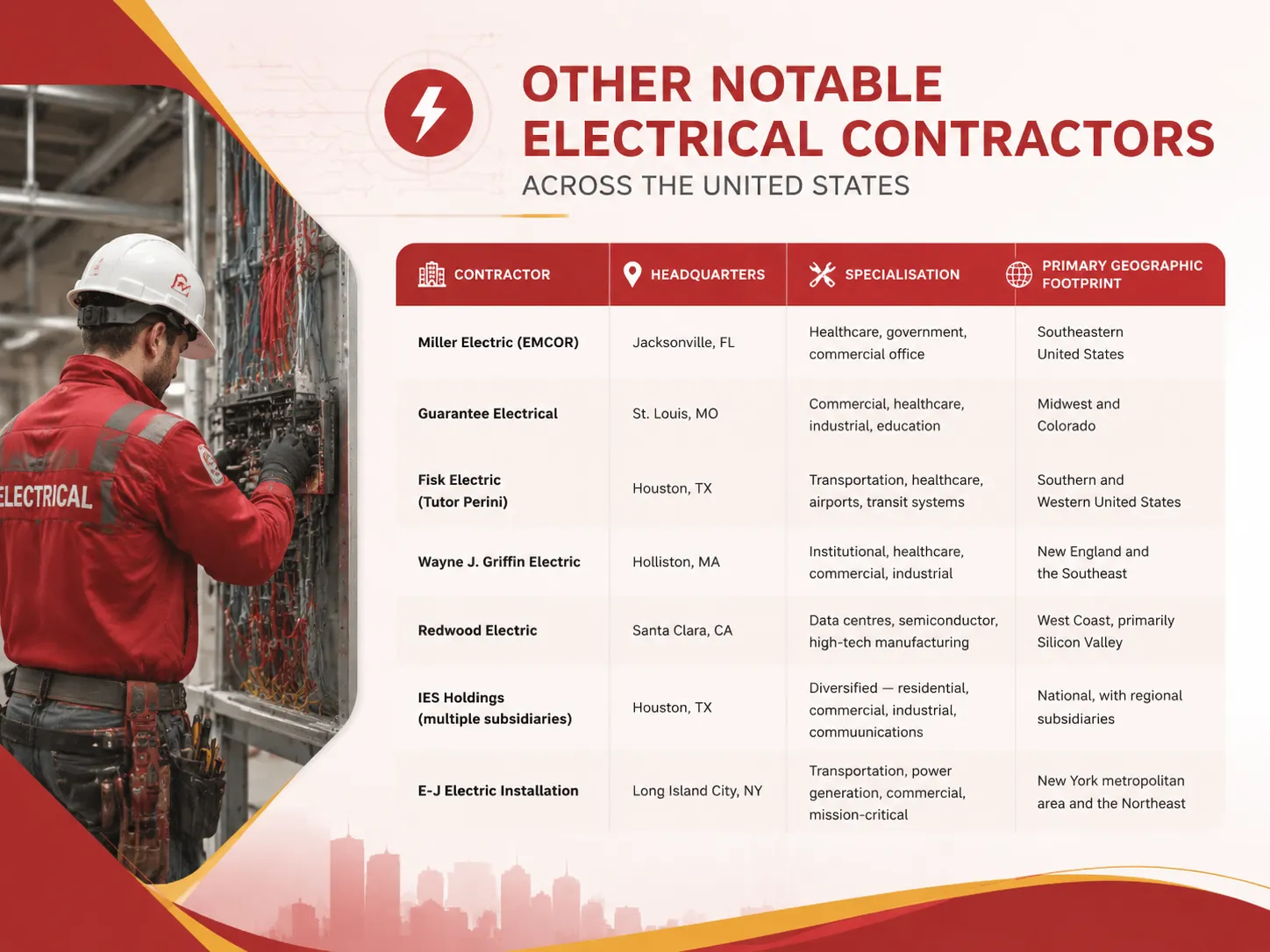
| Contractor | Headquarters | Specialisation | Primary Geographic Footprint |
|---|---|---|---|
| Miller Electric (EMCOR) | Jacksonville, FL | Healthcare, government, commercial office | Southeastern United States |
| Guarantee Electrical | St. Louis, MO | Commercial, healthcare, industrial, education | Midwest and Colorado |
| Fisk Electric (Tutor Perini) | Houston, TX | Transportation, healthcare, airports, transit systems | Southern and Western United States |
| Wayne J. Griffin Electric | Holliston, MA | Institutional, healthcare, commercial, industrial | New England and the Southeast |
| Redwood Electric | Santa Clara, CA | Data centres, semiconductor, high‑tech manufacturing | West Coast, primarily Silicon Valley |
| IES Holdings (multiple subsidiaries) | Houston, TX | Diversified — residential, commercial, industrial, communications | National, with regional subsidiaries |
| E-J Electric Installation | Long Island City, NY | Transportation, power generation, commercial, mission‑critical | New York metropolitan area and the Northeast |
Regional Electrical Contractor Hubs: A State‑by‑State Perspective
The electrical contracting market in the United States is not a singular, centralized entity. Instead, it is made up of various smaller markets at regional and state levels, all characterized by the dominating contractors, the labor environment, the building codes, local amendments, and the type of industries that provide impetus to construction activity in that market area. For those involved in electrical equipment manufacturing and distribution, the first step in developing a sales and specifications strategy is to thoroughly understand the regional state of the electrical contracting market, identifying who are the leading players in Texas, California, Florida, and Illinois. The coming articles in the series will provide information about major electrical contractors in different U.S. states and metropolitan areas, including contractors in Texas, California, Florida, Illinois, New York, and Mid-Atlantic states. Each article will provide detailed information on the leading contractors of a market area, their major projects, as well as information on the electrical equipment supply chain.
The Supply Chain: How Electrical Contractors Select Their Equipment
This list includes contractors who obtain their electrical equipment from a global supply chain. The panelboards they install are equipped with circuit breakers certified to UL 489 (or UL 1077). The switchgear utilized for commissioning is manufactured in the United States, Europe, and Asia. The conduit and different installation items (from fittings and wiring devices to relays) are certified as well, with UL and ETL certifications being verified by the quality control team of the contractor before installation takes place. The products sourced from the factory reach the contractor via electric distributors (Sonepar, WESCO, Graybar, and others) which package and deliver the equipment to contractors when necessary. Thus, any manufacturer intending to sell its products in the U.S. electrical contracting market should first make sure that their products are certified for this market. The next step includes connecting with the distributors providing services for contractors. If a product has not been certified by UL, or it is not available at the distributor who is usually selected by contractors, it is unlikely that it would be utilized on any major project, irrespective of its price and technical characteristics. For those who are interested in the certification process, please consult our guide that deals with the concept of UL 489 breakers to learn how the certification process works in the U.S.
For a company like HUYU, which makes low-voltage electrical protection devices (MCBs, MCCBs, RCDs, RCBOs, DC-rated circuit breakers, and surge protective devices), reaching the U.S. market involves the same distributor-contractor channel that other manufacturers use. HUYU’s collaboration with Eaton ensures high-quality engineering and rigorous product certification standards; thus its products, including UL-listed circuit breakers of the HUB9NEZ DC series, meet the requirements of U.S. contractors and engineering agencies. When participating in a bid for a solar farm, a battery storage facility, or a commercial building with complex protection needs, an electrical contractor has a supply-chain advantage if the company can offer certified products with competitive pricing and good lead times. HUYU provides this advantage through its certifications and technical documentation obtained from its manufacturing capacity.
How to Choose the Right Electrical Contractor for a Project
Choosing an electrical contractor for a major project is a decision that will determine the project’s timetable, budget, and longevity. Therefore, it is important to understand which companies that execute complex projects without delays and exceeding the budget.
- Bonding capacity and financial strength. Generally, it can be concluded that a company able to bond a $100 million project is financially stable and has experience getting big projects done. The bonding company evaluation of the contractor’s capability is an independent confirmation of its competence.
- Specific experience in your building type. A contractor who constructed twenty data centers already knows how to implement cooling, redundancy, and sequence of commissioning. A contractor who has built twenty hospitals is familiar with life-safety codes and infection-control processes. Experience with a specific facility type is more valuable than general experience.
- Self‑performance vs. subcontracting. A contractor who carries out the elementary electrical work – essence, illumination, fire protection – retains command over the merit, the timetable, and the safety of the task. A contractor who contracts out to numerous subcontractors is a construction manager, rather than a contractor, and success of the activity relies on the level of performance of the subcontractors involved in the project.
- Prefabrication and BIM capability. Using BIM-coordinated drawings, a contractor builds electrical assemblies in a controlled shop setting. As a result, the contractor decreases field labor hours and waste while also enhancing quality. This manifests as a tangible competitive edge in big projects.
- Safety record and EMR. An Experience Modification Rate (EMR) is a factor that indicates the contractor’s history of workers’ compensation claims. An EMR lower than 1.0 suggests a safer record than that of most contractors, while many clients refuse to hire companies whose EMR exceeds a certain level.
- Local labour and utility relationships. A contractor having good rapport with the local IBEW hall and the local utility can assure the project is completed with qualified electricians, and the utility utility interconnection happens without unnecessary delay.
Frequently Asked Questions
Who are the largest electrical contractors in the United States?
One can say that Quanta Services, EMCOR Group, M.C. Dean, Rosendin Electric, Cupertino Electric, MYR Group and Helix Electric are the largest electrical contractors in the United States. They can be heavily diversified in terms of services offered in the company, since they can range from large public organisations to private companies. Best data about the companies is available at Engineering News‑Record (ENR).
What type of electrical work do the largest contractors perform?
The leading electrical contractors focus on difficult large-scale undertakings: electrical high-voltage lines and substations, Electrification of multiple data centers, semiconductor production facilities, electric systems in medical centres, stadiums, airports, and massive renewable energy projects. They perform the work themselves and provide their own engineering services.
How do electrical contractors select their equipment suppliers?
Electrical contractors select their equipment based on a combination of specification acceptance (the product must be listed in the project’s electrical specification or approved as an equal by the consulting engineer), certification (the product must carry the correct UL, ETL, or CSA listing for the application), distributor availability (the product must be stocked by the contractor’s preferred electrical distributor), and established manufacturer relationships (a product that is new, unproven, or unsupported will struggle to gain acceptance). Price matters, but it is rarely the primary factor — a contractor will not install an uncertified or unsupported product at any price.
Which states have the largest concentration of electrical contractors?
California, Texas, Florida, New York, and Illinois have the largest concentrations of electrical contractors, reflecting the size of their construction markets and their populations. The West Coast (California, Oregon, Washington) is a hub for data centre and technology manufacturing electrical construction. The Gulf Coast (Texas, Louisiana) is a hub for industrial and energy‑related electrical work. The Northeast corridor (New York, New Jersey, Massachusetts) is a hub for commercial, institutional, and transportation electrical construction. Each of these regional markets will be profiled in detail in subsequent articles in this series.
References
- Engineering News‑Record (ENR) — Top 600 Specialty Contractors. The annual ranking of the largest specialty contractors in the United States, including electrical contractors, by revenue and market segment.
- Quanta Services — Electric Power and Pipeline Infrastructure. The world’s largest electrical contractor, with operations across transmission and distribution, renewable energy, and industrial services.
- EMCOR Group — Mechanical and Electrical Construction and Facilities Services. A Fortune 500 specialty contractor with electrical subsidiaries serving commercial, healthcare, and institutional markets nationwide.
- National Electrical Contractors Association (NECA). The industry association representing electrical contractors across the United States, providing labour relations, education, and industry advocacy.
The electrical contractors of the United States are the companies that build the power infrastructure for the data centres, the hospitals, the factories, and the renewable energy installations that the economy depends on. For the manufacturer of circuit breakers, switchgear, or wiring devices, these contractors are the end customer — the people who specify, purchase, and install the equipment. Understanding who they are, what they build, and how they select their supply chain is the foundation of a successful market entry strategy. In the articles that follow, this series will explore the contractor landscape state by state, providing the detailed, actionable intelligence that a manufacturer or a distributor needs to navigate the American electrical construction market with confidence. HUYU’s circuit breakers and protective devices, with their UL certifications and their competitive positioning, are built for that market — because the breaker that protects a circuit in a hospital, a data centre, or a solar farm must be trusted absolutely, from the factory floor to the jobsite.
United States Electrical Contractors
- Commercial electrical contractors
- Industrial electrical installation
- Electrical automation systems
- Control panel manufacturing
- Smart factory solutions