
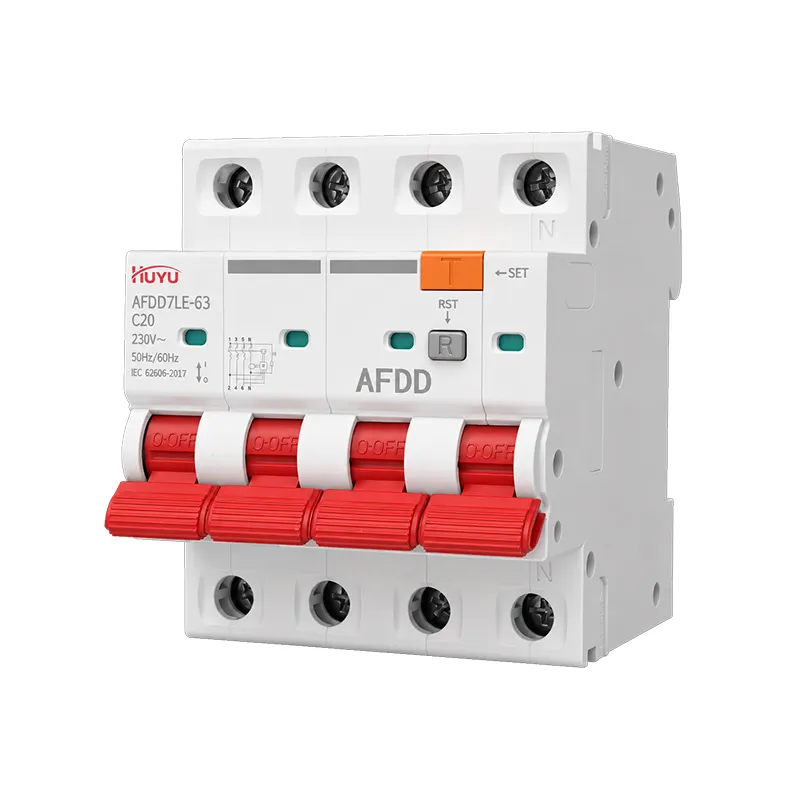
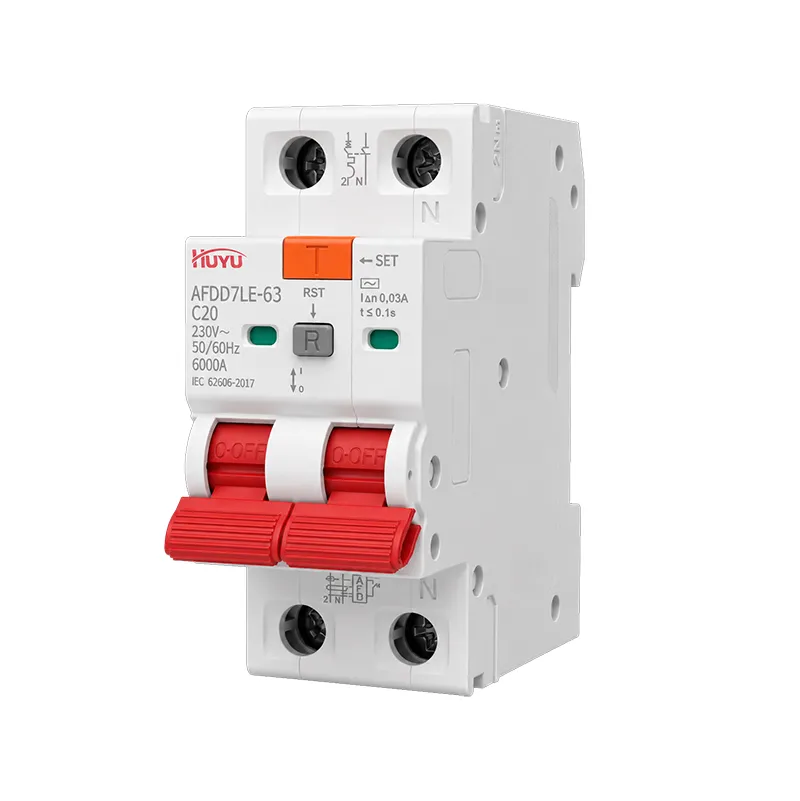
AFDD7LE-63 Arc Fault Detection Device (AFDD+RCBO)
Four-Way Protection in One DIN Module — Arc Fault, Leakage, Overload & Short Circuit
The AFDD7LE-63 is an arc fault detection device that integrates a residual current circuit breaker (RCBO) with an arc detection module, giving branch circuits one point of protection against serial and parallel arc faults, earth leakage, overload and short circuit. Available as a 2P unit rated AC230/240V or a 3P+N unit rated AC400/415V, with rated currents from 6A to 63A and residual sensitivities of 10/30/100/300mA.
Model
AFDD7LE-63 Series — Arc Fault Detection Device (AFDD+RCBO)AFDD7LE-63 2P / AFDD7LE-63 3P+N
IEC 62606 & IEC 61009-1 · CE approved · 6-63A · IΔn 10-300mA
Product Details
- Combines an RCBO with an arc detection module — covers serial/parallel arc faults, earth leakage, overload and short circuit in one unit.
- 2P version (AC230/240V, disconnectable N) and 3P+N version (AC400/415V, straight-through N); In 6-63A, IΔn 10/30/100/300mA, C curve.
- Four arc-detection modes via the multi-function T key (anti-interference / low / standard / enhanced) plus an in-service trip test.
- Icn 6000A; IP20; tested to IEC 62606 and IEC 61009-1; CE approved.
Product Information
Key Features & Typical Use
RCBO + Arc Detection in One Device
The AFDD7LE-63 couples a residual current circuit breaker with an arc detection module, so loose terminals, damaged insulation and aging cables that cause dangerous arc faults are handled by the same unit that covers leakage, overload and short circuit — no separate devices to coordinate.
2P & 3P+N Configurations
The 2P version with disconnectable N pole serves single-phase AC230/240V branch circuits, while the 3P+N version with straight-through N serves AC400/415V three-phase distribution, both covering 6 to 63A.
Adjustable Arc Detection Sensitivity
Press and hold the T key to step through four detection modes — anti-interference, low sensitivity, standard and enhanced — letting installers match the protection to the wiring conditions of each branch circuit.
Visible Status & Test Function
A green LED shows running status, a flashing red LED signals an arc-fault alarm, and a quick press of the T key performs a functional trip test of the breaking circuit without disconnecting the installation.
Specifications
| Parameter | Details |
|---|---|
| Series | AFDD7LE-63 (AFDD + RCBO) |
| Model Codes | AFDD7LE-63 2P | AFDD7LE-63 3P+N |
| Rated Voltage Ue | AC230/240V (2P) | AC400/415V (3P+N) |
| Rated Current In | 6 / 10 / 16 / 20 / 25 / 32 / 40 / 50 / 63A |
| Number of Poles | 2P (N-pole disconnectable) | 3P+N (N-pole straight through) |
| Residual Sensitivity IΔn | 10 / 30 / 100 / 300mA |
| RCD Type | AC, A |
| Tripping Curve | C |
| Short Circuit Breaking Capacity Icn | 6000A |
| Rated Insulation Voltage Ui | 500V (2P); 250V to earth / 500V phase-to-phase (3P+N) |
| Rated Impulse Withstand Uimp | 4000V |
| Mechanical & Electrical Endurance | 4000 cycles (2P) / 10000 cycles (3P+N) |
| Arc Detection Modes | Anti-interference / Low sensitivity / Standard / Enhanced |
| Rated Frequency | 50/60Hz |
| Protection Degree | IP20 |
| Ambient Temperature | -25°C to +40°C |
| Standards | IEC 62606, IEC 61009-1 |
| Approvals | CE |
AFDD7LE-63 — Arc Fault Protection for Branch Circuits, Built on an RCBO Platform
Arc faults are responsible for a large share of electrical fires: a damaged cable, a loose screw or a punctured insulation point creates a series or parallel arc that draws only a few amps — often below the threshold of a standard circuit breaker, yet hot enough to ignite surrounding material. The AFDD7LE-63 closes that gap by combining an arc fault detection device with an RCBO, so the same DIN module that protects against leakage, overload and short circuit also detects serial and parallel arc faults and trips within the protective curve.
With the 2P version for single-phase AC230/240V branch lines and the 3P+N version for AC400/415V three-phase distribution, and residual sensitivities from 10 to 300mA, the series covers the branch circuits of residential, commercial and light industrial installations. A multi-function T key enables four arc detection modes and an in-service trip test, while the green/red LED logic keeps the operating status readable at a glance.
As the arc fault detection device manufacturer behind the AFDD7LE-63, HUYU supplies wholesalers, distributors and electrical brands with factory-direct pricing, OEM panel printing and full IEC test documentation on every order.
Factory-Direct OEM / ODM Manufacturer
We Manufacture, You Brand
The AFDD7LE-63 is assembled at our own factory, where RCBO bodies and arc detection modules are combined, calibrated and tested on the production line. Every unit runs through electrical endurance checks and arc trip verification before packing, so distributors receive devices that match the ratings printed on the label.
Beyond the standard 2P and 3P+N models, we support project-specific needs: different residual sensitivities, coil-free electronic trip settings and custom current ratings on request.
- OEM branding — custom laser marking on the housing, plus your own labels and carton printing.
- ODM options — bespoke calibration of detection modes and residual current values for project tenders.
- EN/IEC documentation — test reports to IEC 62606 and IEC 61009-1 supplied with every order.
- MOQ — flexible wholesale quantities; mixed 2P and 3P+N models welcome in one container.
Buying Guide
Selecting an arc fault detection device starts with the supply system and the branch circuit load. Match the pole configuration to the circuit, then confirm the residual current sensitivity required by local electrical rules.
- Identify the circuit: single-phase AC230/240V branch → 2P model; three-phase AC400/415V branch → 3P+N model.
- Choose the rated current from 6-63A to suit the branch breaker upstream of your load.
- Select the residual sensitivity (10/30/100/300mA) and RCD type (AC or A) per your local standard.
- Confirm quantity, packaging and shipping terms with our sales team.
- Approve samples and any OEM marking artwork before mass production.
- Production with in-house electrical endurance testing and full trip-test reports.
- Global shipping — wholesale orders dispatched directly from the factory.
How We Support Your Business

OEM / ODM
Custom housing marking, labels and packaging built on the standard AFDD7LE-63 platform, with calibrated detection modes and full test documentation.
Housing marking · Custom packaging · IEC 62606 reports

Wholesale
Factory-direct pricing with flexible MOQ and reliable delivery for distributors stocking AFDD+RCBO protection for branch circuits.
Factory pricing · Flexible MOQ · Global shipping

Distributor Support
Dedicated account management, technical datasheets and priority production for partners adding arc fault protection to their low-voltage range.
Account manager · Technical docs · Priority lead times
Ready to Stock the AFDD7LE-63 Series?
OEM/ODM, wholesale pricing and distributor support — one enquiry gets you a factory-direct quotation for 2P and 3P+N arc fault detection devices, with full IEC 62606 / IEC 61009-1 test documentation.
Frequently Asked Questions
What is an arc fault detection device (AFDD)?
An arc fault detection device continuously analyses the current waveform of a circuit and recognises the high-frequency signature of an unwanted electrical arc — caused by damaged cables, loose terminals or ageing insulation. When such an arc is detected, the AFDD trips the circuit before the arc can ignite surrounding material. The AFDD7LE-63 adds this function on top of an RCBO, so one device covers arc faults plus leakage, overload and short circuit.
What is the difference between the AFDD7LE-63 2P and 3P+N versions?
The 2P version (AC230/240V, N-pole disconnectable) protects single-phase branch circuits. The 3P+N version (AC400/415V, N-pole straight through) is for three-phase distribution branches where the neutral is not switched. Both carry the same arc detection, leakage and overcurrent functions with 6-63A ratings.
Where should an AFDD+RCBO be installed?
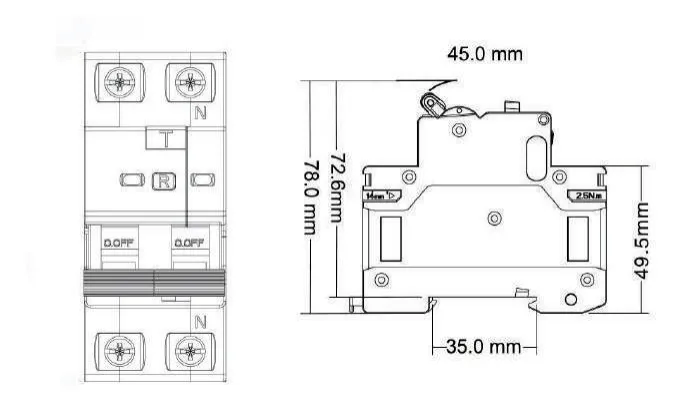
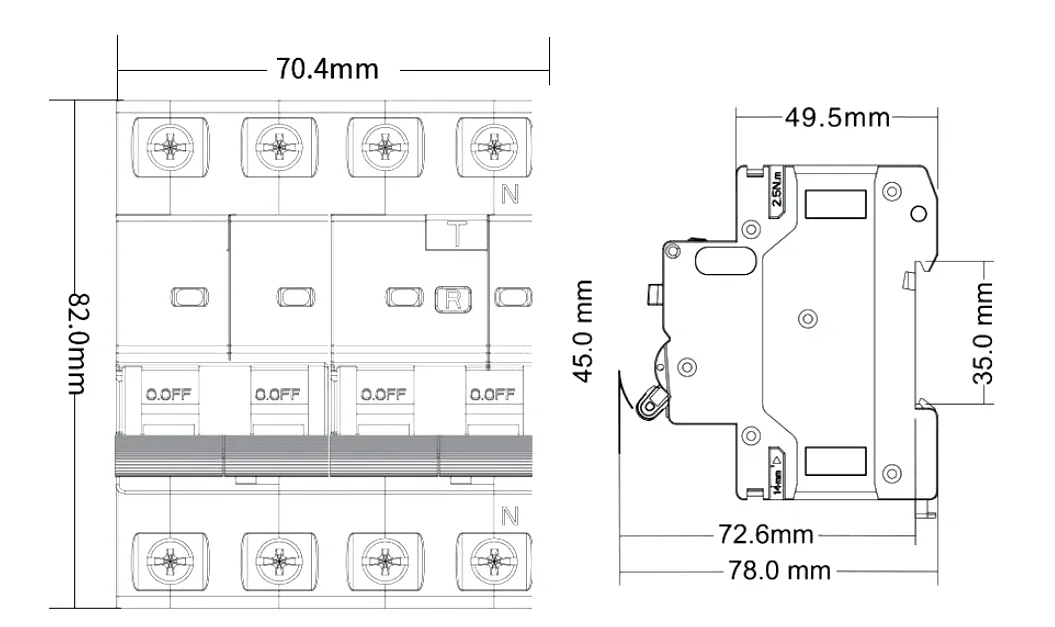
The AFDD7LE-63 is designed for branch circuits with higher fire risk: socket outlets in sleeping rooms, circuits feeding portable equipment, and locations with old or damaged cabling. Typical uses are final distribution boards in residential buildings, hotels, offices and small commercial premises, mounted on a standard 35mm DIN rail.
How does the four-mode arc detection setting work?
Press and hold the T key for about three seconds to enter the setting state, then press it repeatedly to step through four modes indicated by the number of green LED flashes: once = anti-interference, twice = low sensitivity, three times = standard, four times = enhanced (not recommended for general use). The setting takes effect immediately and exits automatically after ten seconds.
What certifications does the AFDD7LE-63 carry?
The series is CE approved and tested according to IEC 62606 (arc fault detection devices) and IEC 61009-1 (RCBOs). We can provide the corresponding type-test documentation for project submissions and market registration.