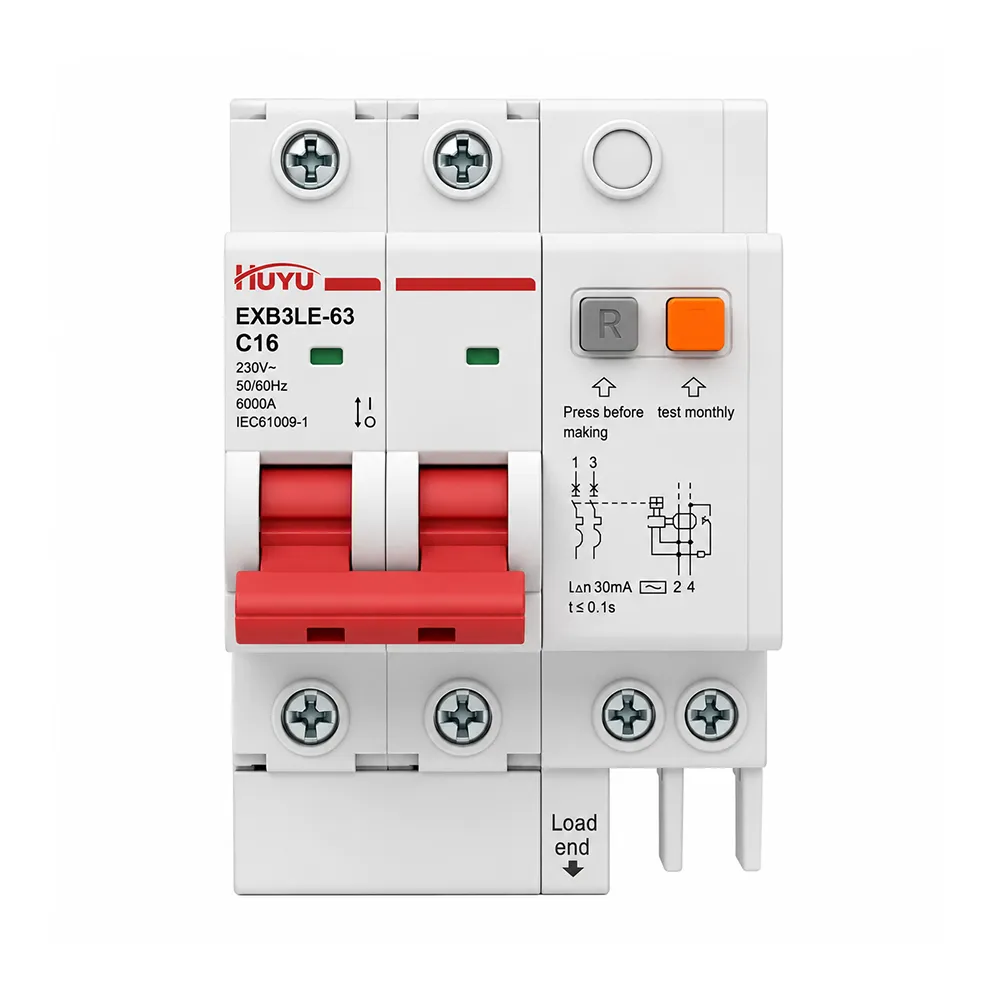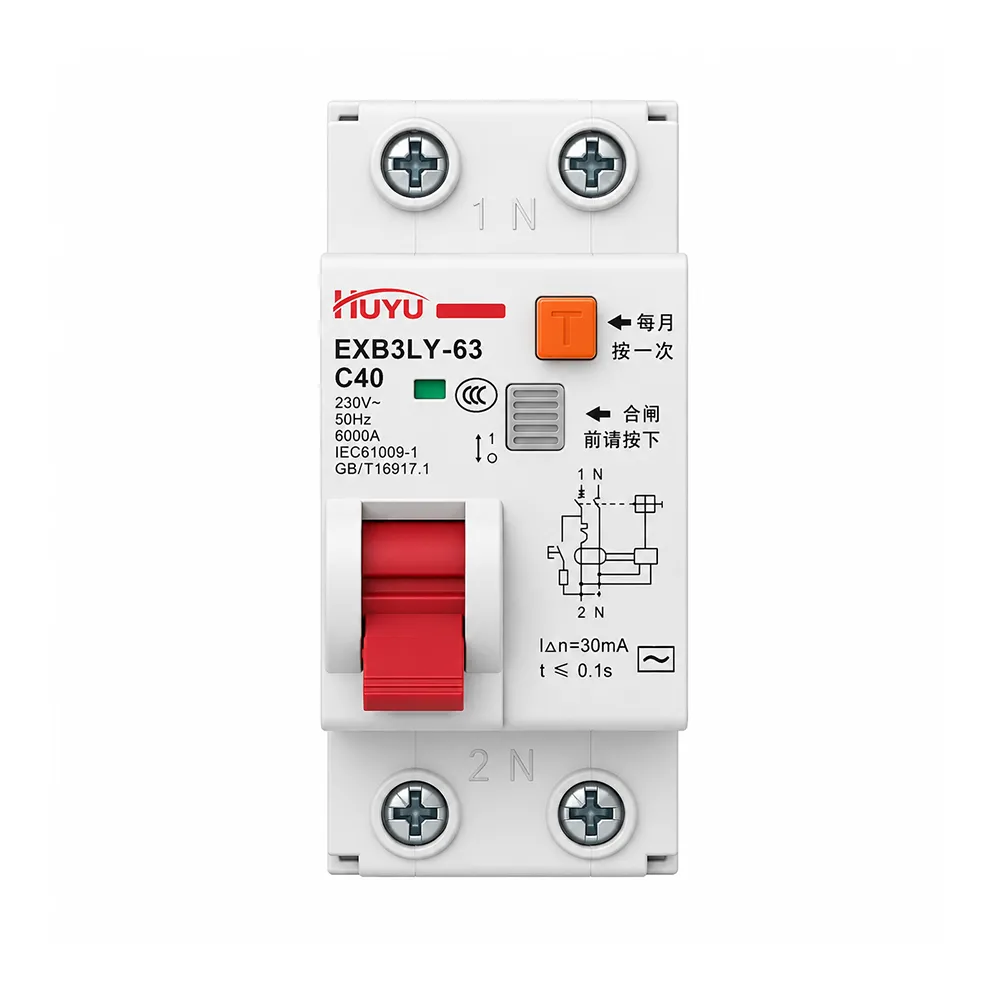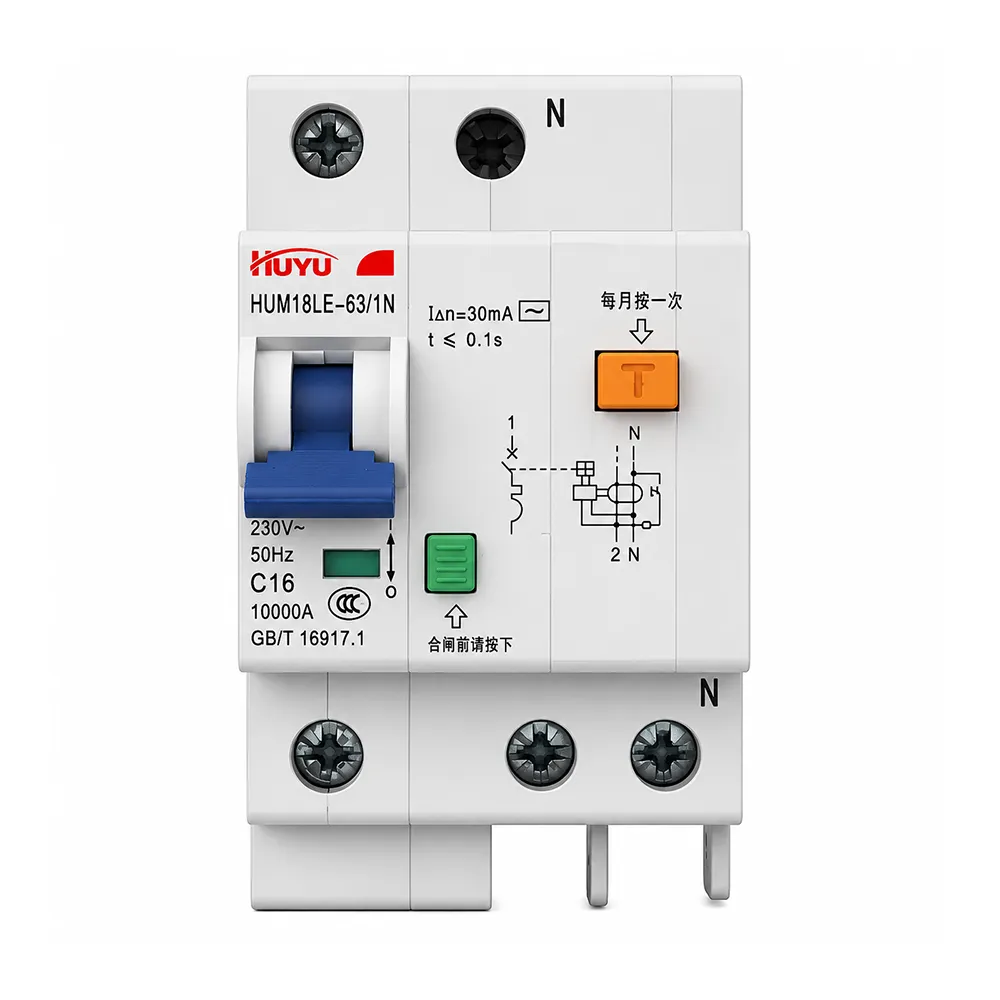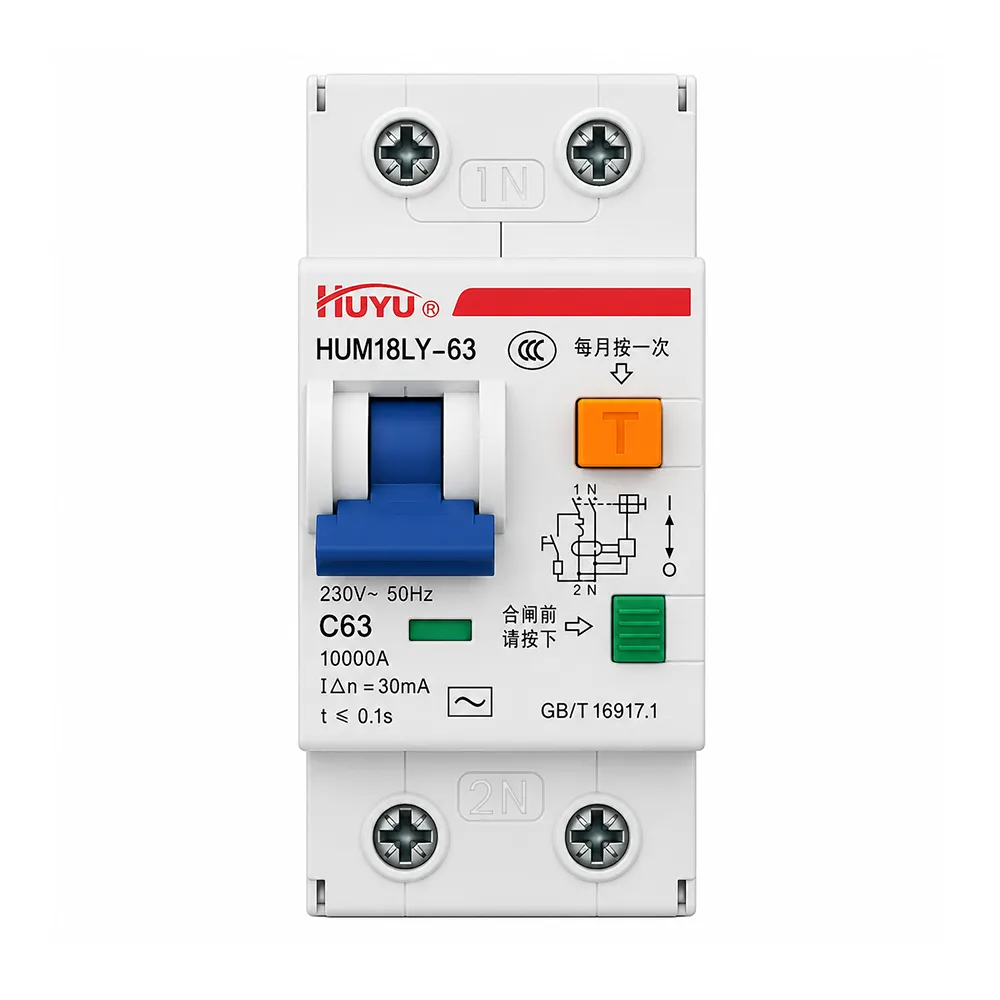

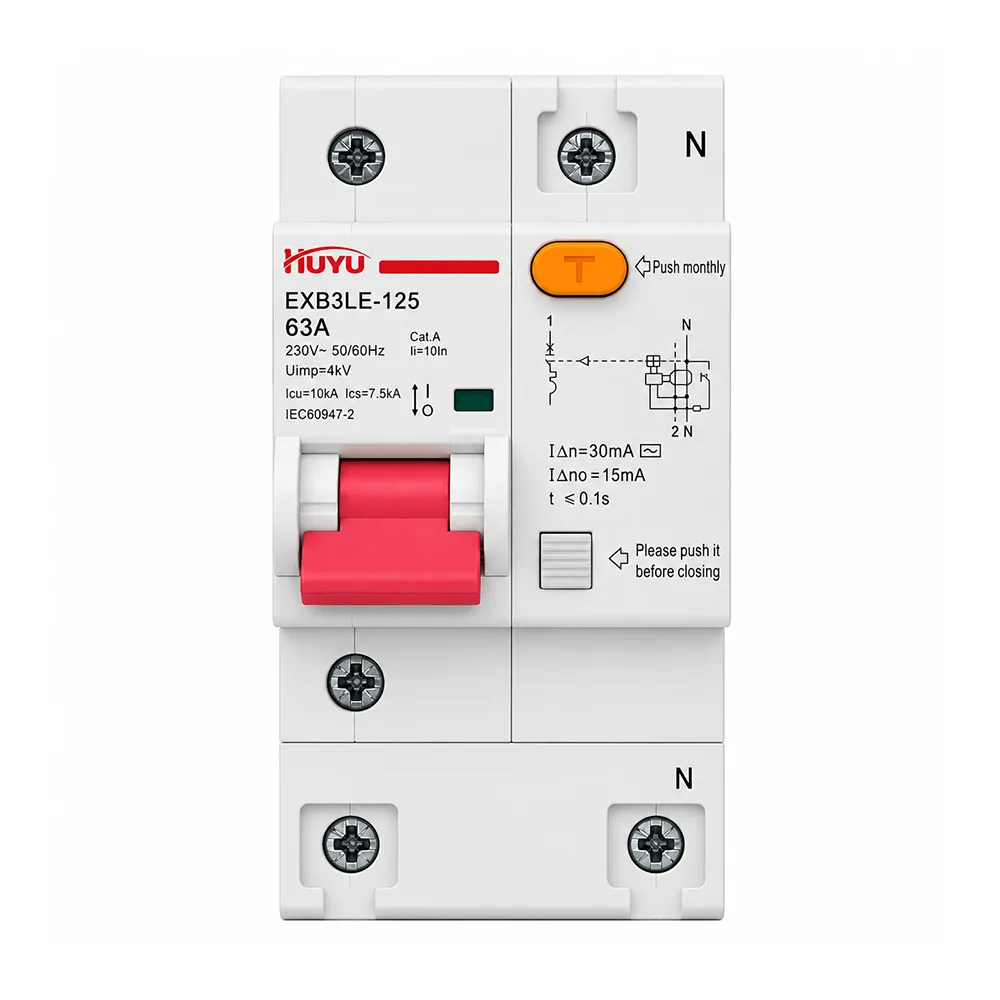
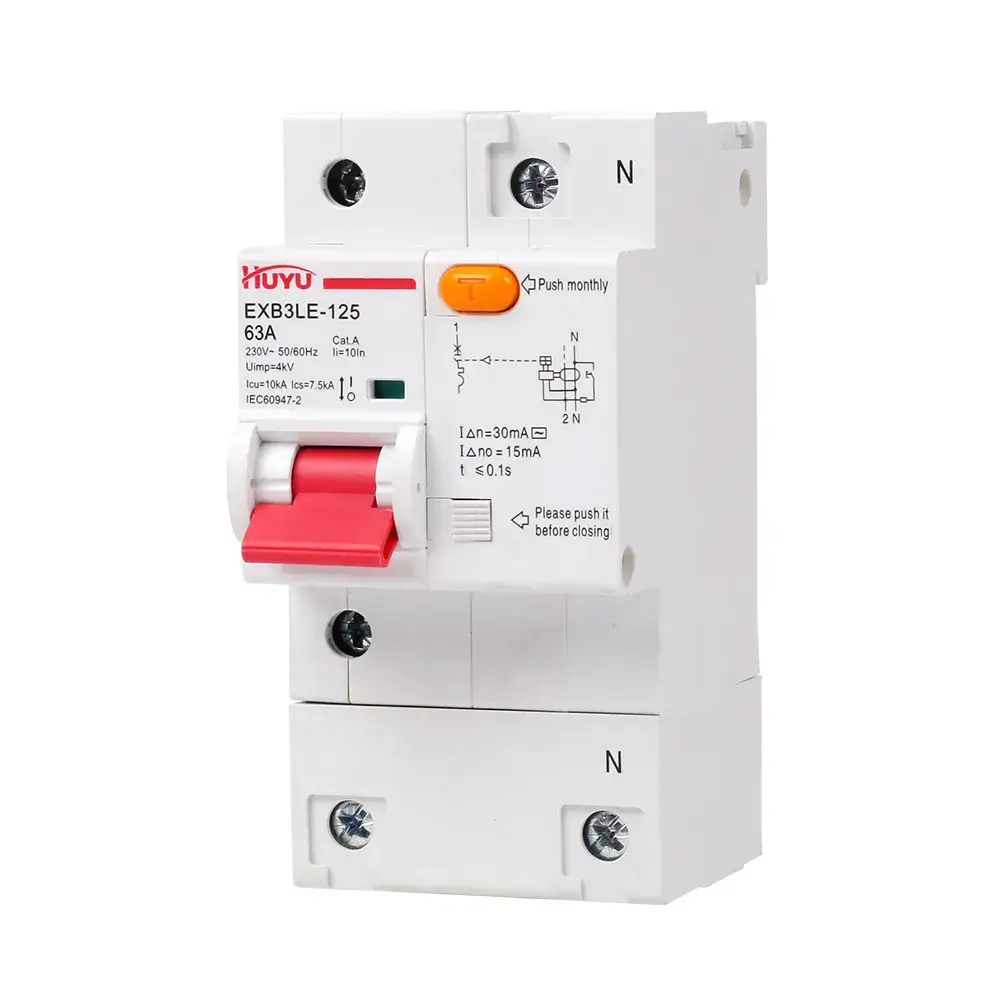
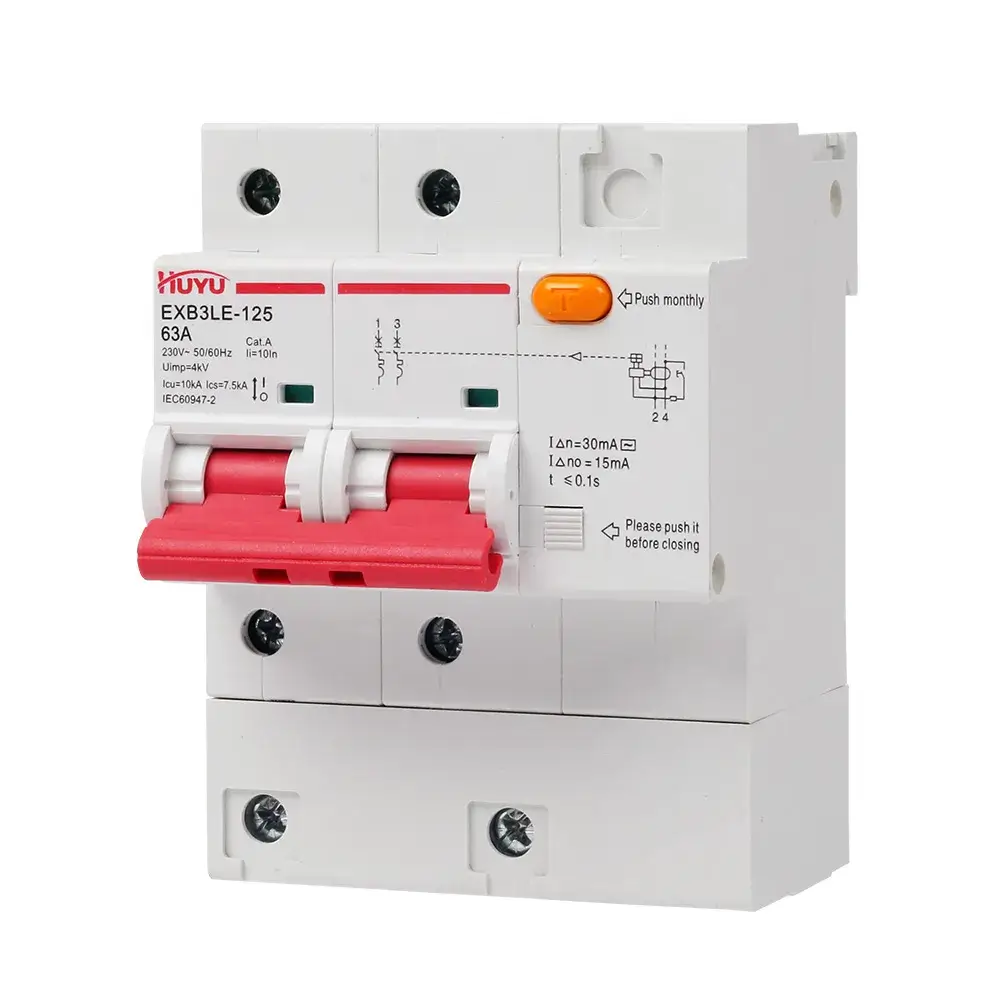
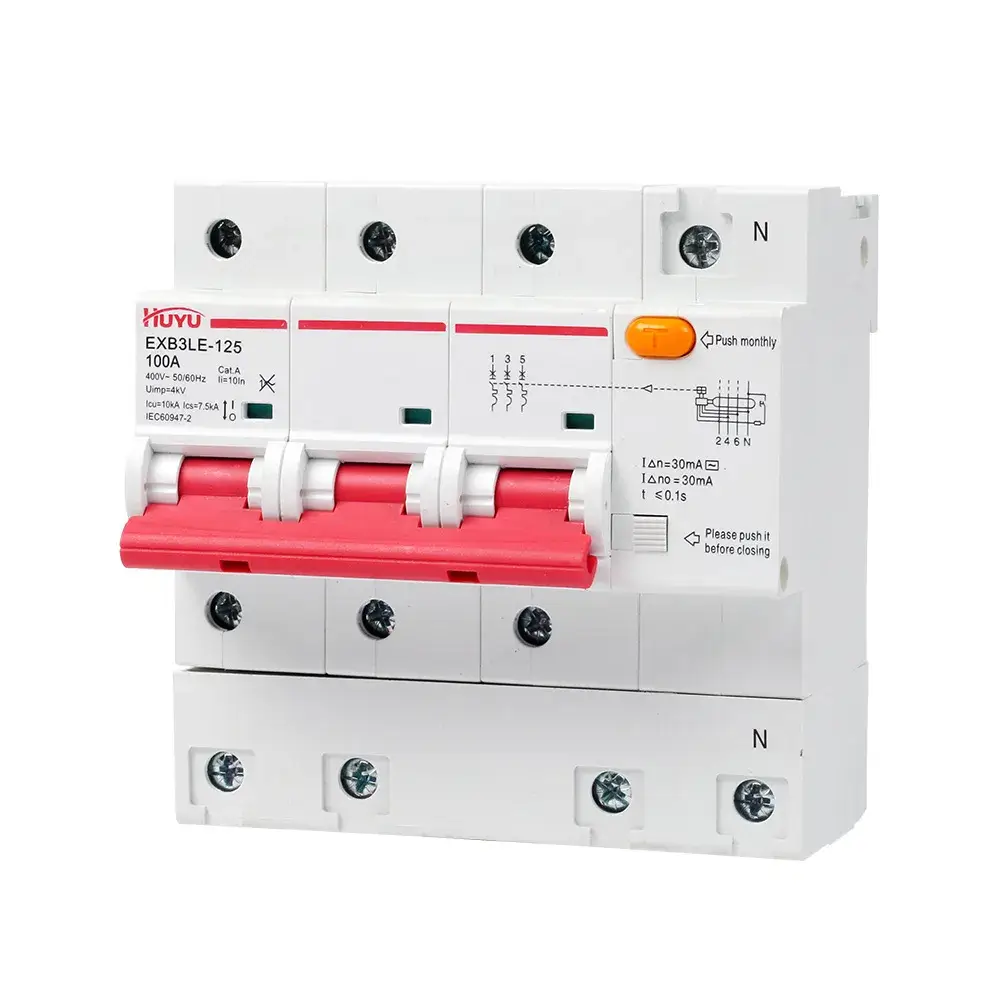
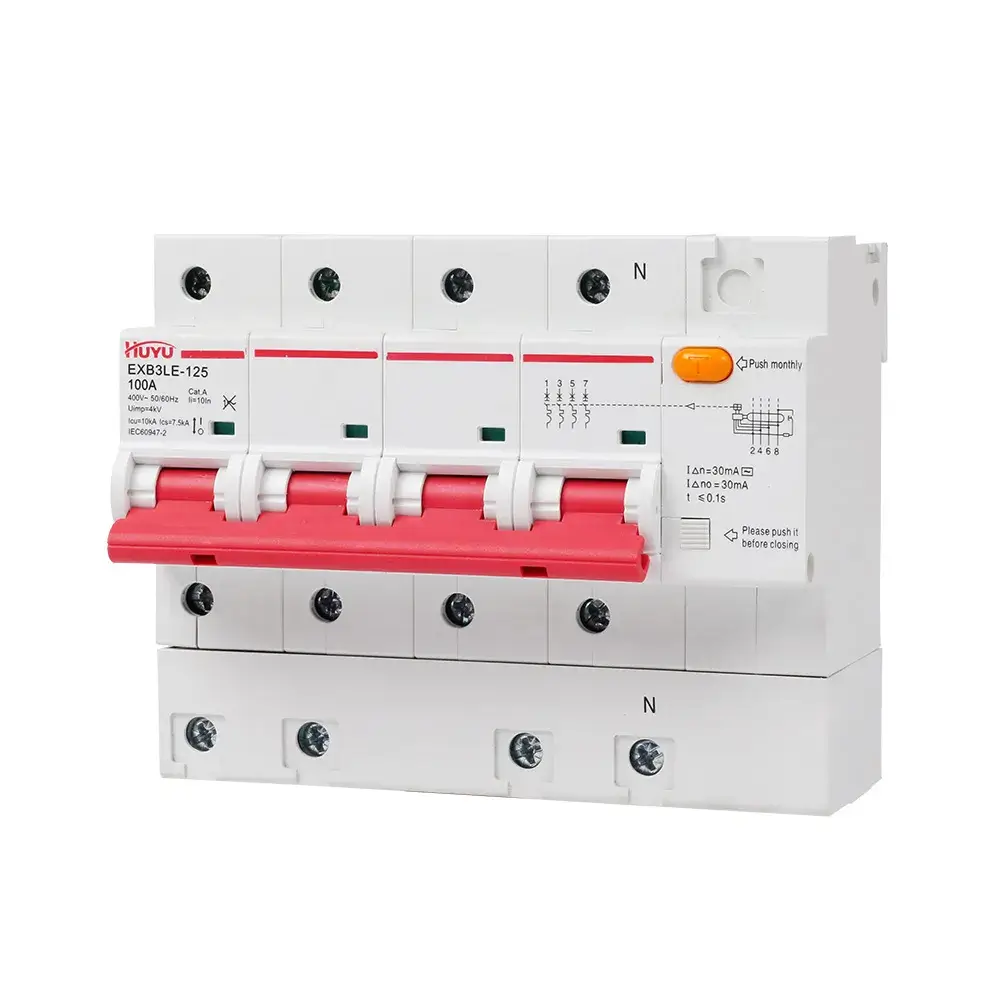
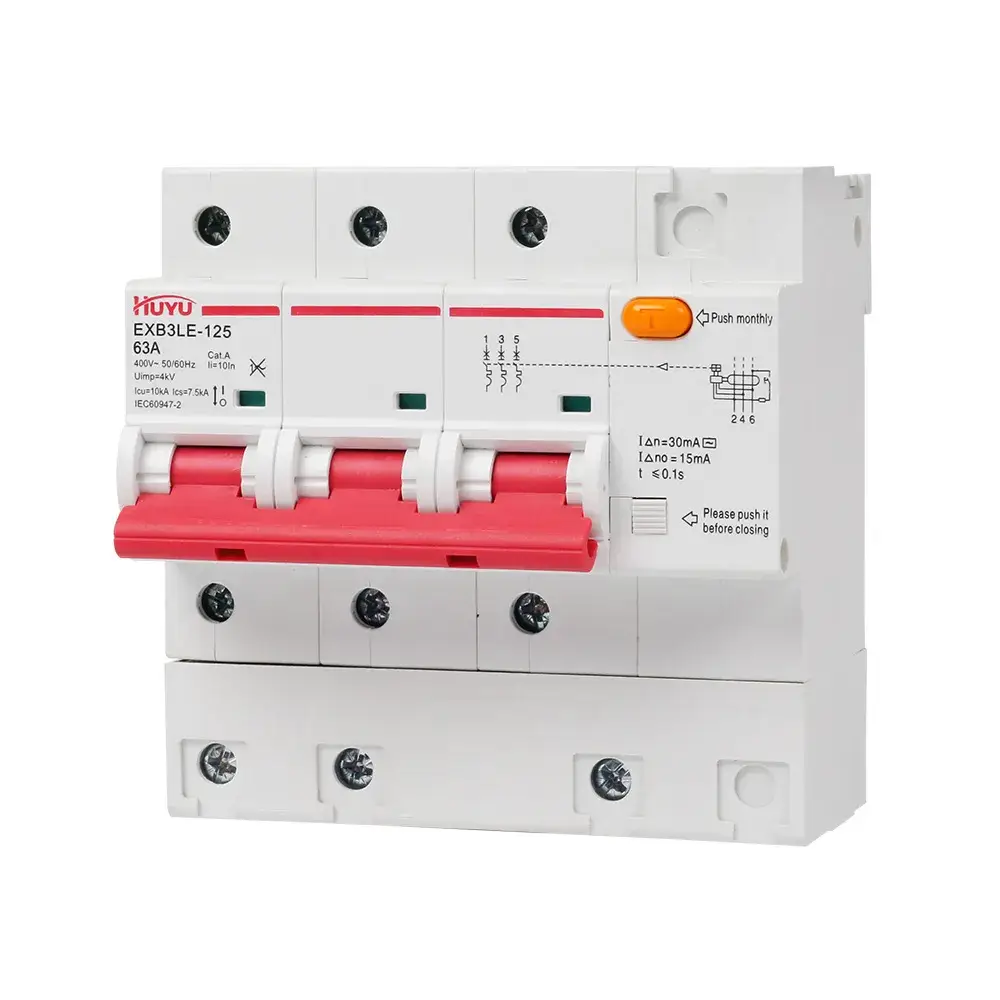
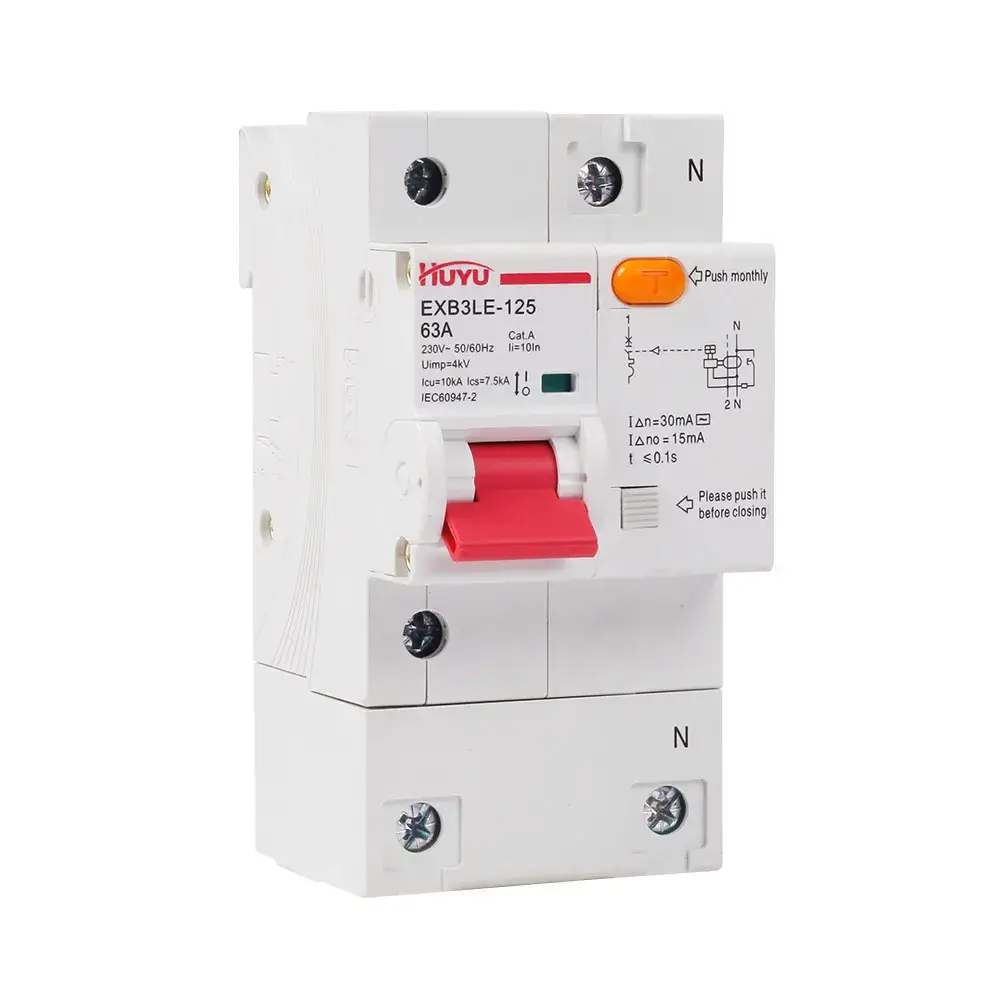
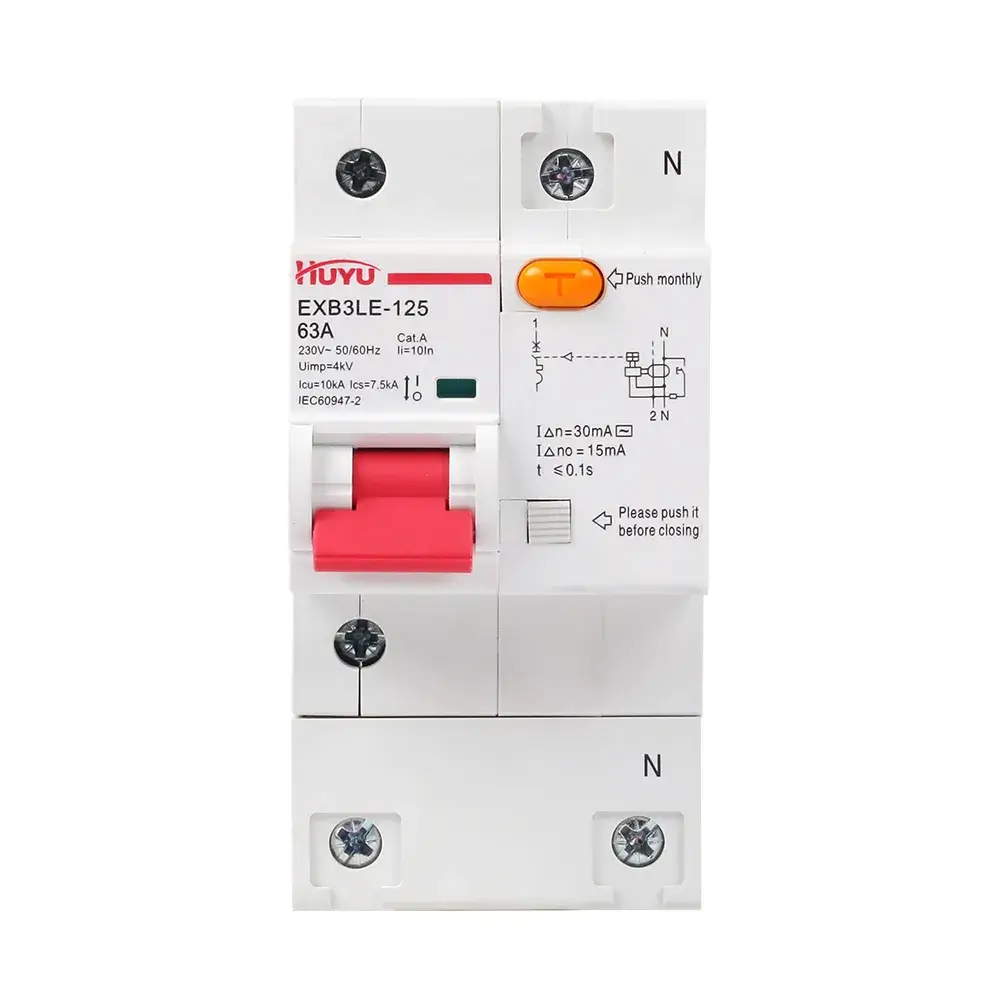
EXB3LE-125 – 125A RCBO Breaker 1P+N to 4P,Type AC
The EXB3LE-125 is a 125A RCBO breaker rated 63–125A at AC 230V/400V. Available in 1P+N, 2P, 3P, 3P+N, 4P. 10kA Icn breaking capacity. Residual current sensitivity 30–300mA, Type AC. B/C/D tripping curves. 20,000 ops mechanical life. IEC 60947-2, GB/T 14048.2. For distribution boards and industrial control panels.
Standard: IEC 60947-2, GB/T 14048.2
Rated Current: 63A – 125A
Poles: 1P+N, 2P, 3P, 3P+N, 4P
Rated Voltage: AC 230V (1P+N/2P) / AC 400V (3P/3P+N/4P)
Breaking Capacity: 10kA Icn / 7.5kA Ics
Residual Current IΔn: 30, 50, 75, 100, 150, 200, 300mA
Applications: Distribution boards, motor protection, industrial panels
Product Information
EXB3LE-125, 125A RCBO (Residual Current Breaker with Overcurrent Protection) – Comprehensive Protection for High Current Circuits
The EXB3LE-125 RCBO breaker from HUYU Electric’s EXPLORER series is designed for circuits requiring high current handling and comprehensive protection. Standard RCBOs typically max out at 63A, but the EXB3LE-125 offers rated currents from 63A to 125A, making it suitable for main incomer circuits and large sub-distribution systems. It integrates overload, short-circuit, and earth leakage protection into one unit, while also providing an isolation function for safe disconnection during maintenance tasks.
Available in 1P+N, 2P, 3P, 3P+N, and 4P configurations with a 10kA breaking capacity, the residual current circuit breaker provides seven sensitivity options from 30mA to 300mA. The B, C, and D tripping curves accommodate various loads, from resistive heating to high-inrush loads like motors and transformers. Manufacturers and electrical distributors sourcing from brands like Hager, Schneider, Eaton, or ABB may consider switching to HUYU’s OEM/ODM solutions, complete with IEC 60947-2 certification and private-label options.
Technical Specifications
| Parameter | EXB3LE-125 |
|---|---|
| Standards | IEC 60947-2, GB/T 14048.2 |
| Poles | 1P+N, 2P, 3P, 3P+N, 4P |
| Rated Current In | 63A – 125A |
| Rated Voltage Ue | AC 230V (1P+N, 2P) / AC 400V (3P, 3P+N, 4P) |
| Rated Frequency | 50/60Hz |
| Residual Current Type | Type AC |
| Rated Residual Operating Current IΔn | 30, 50, 75, 100, 150, 200, 300mA |
| Breaking Capacity Icn / Ics | 10kA / 7.5kA |
| Impulse Withstand Uimp | 4kV |
| Tripping Characteristics | B, C, D |
| Mechanical / Electrical Life | 20,000 / 6,000 (≤100A), 4,000 (>100A) |
| Operating Temperature | -35°C to +70°C |
| Protection Degree | IP20 (device) / IP40 (in enclosure) |
| Accessories | OF, SD, MX+OF, MN, MV, MVMN, MNs |
| MOQ | Contact for project quotation |
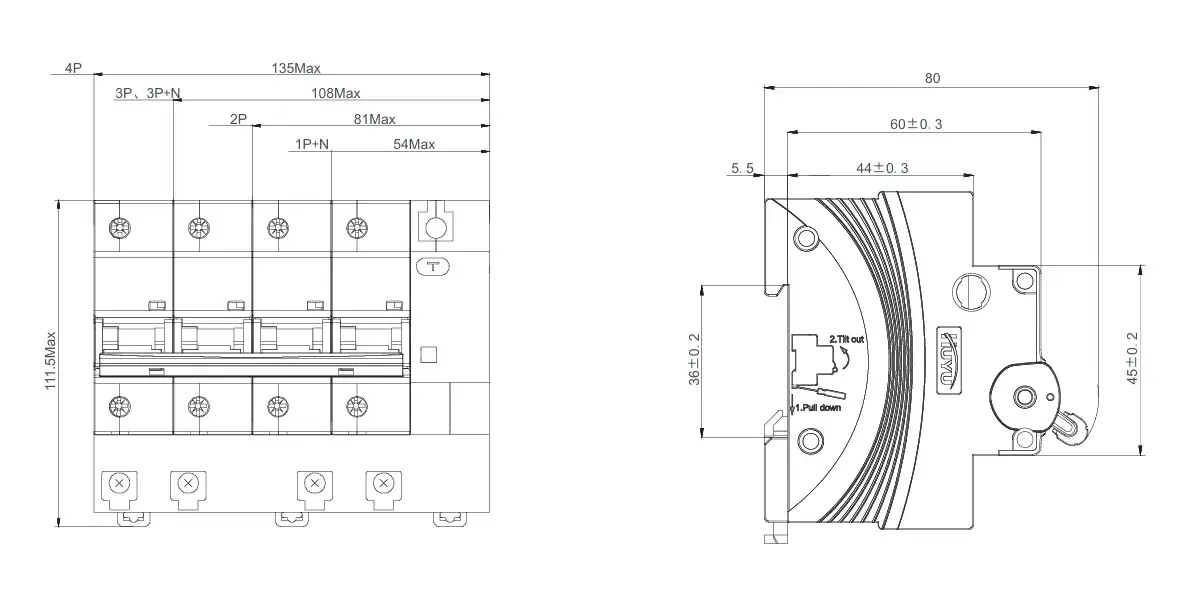
The EXB3LE-125 residual current circuit breaker with overcurrent protection is crafted to handle demanding circuits effectively. With its sturdy 125A frame and 10kA Icn breaking capacity, it is ideal for protecting sub-main circuits in commercial distribution systems, industrial control panels, and substantial motor units. Offering the ability to select from seven residual current sensitivity options (from 30mA for personnel safety to 300mA for fire safety), it allows tailored protection to match specific circuit risk requirements.
Comprehensive Protection in a Single Device
Traditional setups often require separate components for overcurrent (MCB) and earth leakage (RCD) protection, resulting in complicated wiring and significant space demand. The EXB3LE-125 RCBO compactly integrates both functions alongside an isolation feature as one streamlined device, simplifying designing electrical panels while avoiding coordination risks between separate protections. Furthermore, its B, C, and D tripping curves ensure coverage across load profiles: B for resistive circuits, C for mixed loads with modest inrush, and D for challenging high-inrush applications like motors or transformers. Its wide operational temperature range (-35°C to +70°C) ensures reliable function even in harsh environments, including unconditioned electrical enclosures and outdoor settings.
Request a Quotation for EXB3LE-125 RCBO Breakers – Factory Direct
63A–125A, 10kA Icn, Type AC, 30–300mA. 1P+N to 4P. B/C/D curves. IEC 60947-2. OEM/ODM with private labeling and full documentation. Contact us for pricing and lead time.
Project-Based Quotation • IEC 60947-2 • Worldwide Shipping
OEM/ODM Supply – 125A RCBOs for High-Current Distribution
EXB3LE-125 – The 125A RCBO That Fills a Gap in the Market
While many manufacturers offer RCBOs up to 63A, the EXB3LE-125 extends this range to 125A, addressing sub-main and large feeder applications. For electrical distributors and panel builders currently sourcing from Hager, Schneider Electric (Acti9), Eaton, ABB, or Wylex, the EXB3LE-125 provides an equivalent RCBO circuit breaker with competitive pricing and OEM flexibility. Its configurations—30mA RCBO for personnel protection on a 125A feeder or 100mA RCBO for fire prevention on a sub-main—are built for precision in every application. Factory-direct OEM/ODM supplies include tailored branding packages, private label designs, batch traceability, and IEC 60947-2 certified documentation.
How to Select an RCBO for Sub-Main and High-Current Circuits
Key selection criteria for the EXB3LE-125 in industrial and commercial distribution.
1. Choosing the Right Pole Configuration
Select 1P+N or 2P for single-phase 230V sub-mains. Choose 3P, 3P+N RCBO, or 4P for three-phase 400V circuits. The 3P+N and 4P configurations switch the neutral along with the phases, which is required in many distribution board standards where complete isolation of all live conductors is mandated.
2. Selecting Residual Current Sensitivity
The EXB3LE-125 offers seven IΔn values: 30mA for personnel protection in accessible circuits, 100mA for general sub-main protection, and up to 300mA for fire prevention in large feeders where lower sensitivity avoids nuisance tripping from aggregate cable leakage. Match the sensitivity to the risk assessment for the protected circuit.
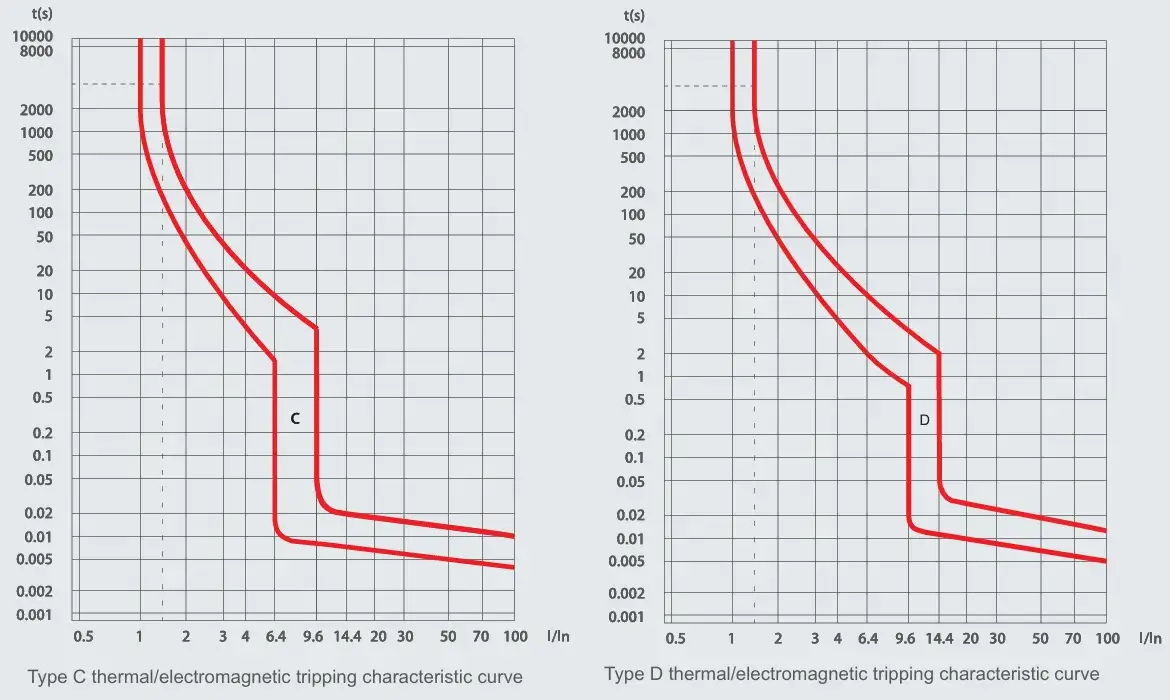
3. B, C, or D Tripping Curve?
Select the B curve for resistive loads with minimal inrush. Choose the C curve for general commercial and light industrial circuits with moderate inrush from fluorescent lighting, socket outlets, and small motors. Use the D curve for high-inrush loads such as large transformers, motor starting, and discharge lighting circuits. The D curve tolerates inrush currents up to 20× the rated current without tripping.
4. Breaking Capacity Verification
Verify that the 10kA Icn exceeds the calculated prospective short-circuit current at the point of installation. For sub-main circuits in commercial buildings, 10kA typically provides adequate margin. The 7.5kA Ics confirms the RCBO can be reused after clearing a fault at this level, reducing downtime and replacement costs.


Frequently Asked Questions
What is an RCBO?
An RCBO (Residual Current Circuit Breaker with Overcurrent protection) is a single device that combines the functions of an MCB (overload and short-circuit protection) and an RCD (earth leakage protection). In one compact unit, it protects against three fault types: overload, short circuit, and residual current to earth. The EXB3LE-125 RCBO breaker adds an isolation function, allowing safe disconnection during maintenance. Unlike using separate MCB and RCD devices, an RCBO saves DIN rail space and simplifies wiring while providing per-circuit earth leakage protection that avoids the nuisance tripping of a whole installation that can occur with a single upstream RCD.
What does RCBO stand for?
RCBO stands for Residual Current Circuit Breaker with Overcurrent protection. Breaking down the term: “Residual Current” refers to the detection of leakage current flowing to earth, which could indicate a fault or electric shock risk; “Circuit Breaker” describes its function as a switch that automatically opens under fault conditions; and “Overcurrent” indicates it also protects against overload and short-circuit currents. The EXB3LE-125 is an RCBO as defined by IEC 60947-2, providing all three protection functions plus isolation in a single DIN rail device.
How do you wire a RCBO?
Wiring an RCBO requires attention to the incoming and outgoing terminal designations. The supply (line) connects to the top terminals, and the load connects to the bottom terminals. For a single-pole RCBO, the line connects to the top terminal and the load to the bottom. For a 3P+N RCBO, each phase and the neutral connect to their respective top terminals, with the load connected to the corresponding bottom terminals. The functional earth wire (usually a white or grey flylead) must be connected to the earth bar in the distribution board — this powers the residual current detection circuit. Always de-energize the circuit before wiring, follow the wiring diagram on the device, and ensure the rated current and sensitivity match the circuit requirements. Installation must be performed by a qualified electrician in accordance with local electrical codes.
How to connect a RCBO?
To connect the EXB3LE-125 RCBO circuit breaker, first ensure the main switch is off and the circuit is de-energized. Mount the RCBO on the 35mm DIN rail in the distribution board. Connect the supply cables (line and neutral for single-phase; all three phases and neutral for three-phase) to the top terminals, torquing to the specified 3.5 N·m. Connect the load cables to the bottom terminals in the same sequence. Connect the functional earth flylead to the earth bar — this is essential for the residual current detection to operate. If using accessories such as an auxiliary contact (OF) or shunt trip (MX+OF), connect them according to the accessory wiring diagram. After all connections are made, close the enclosure, energize the circuit, and press the test button to verify correct operation. The test button should trip the RCBO immediately. Installation must be performed by a licensed electrician in compliance with local regulations.
No documents available for download at this moment.