
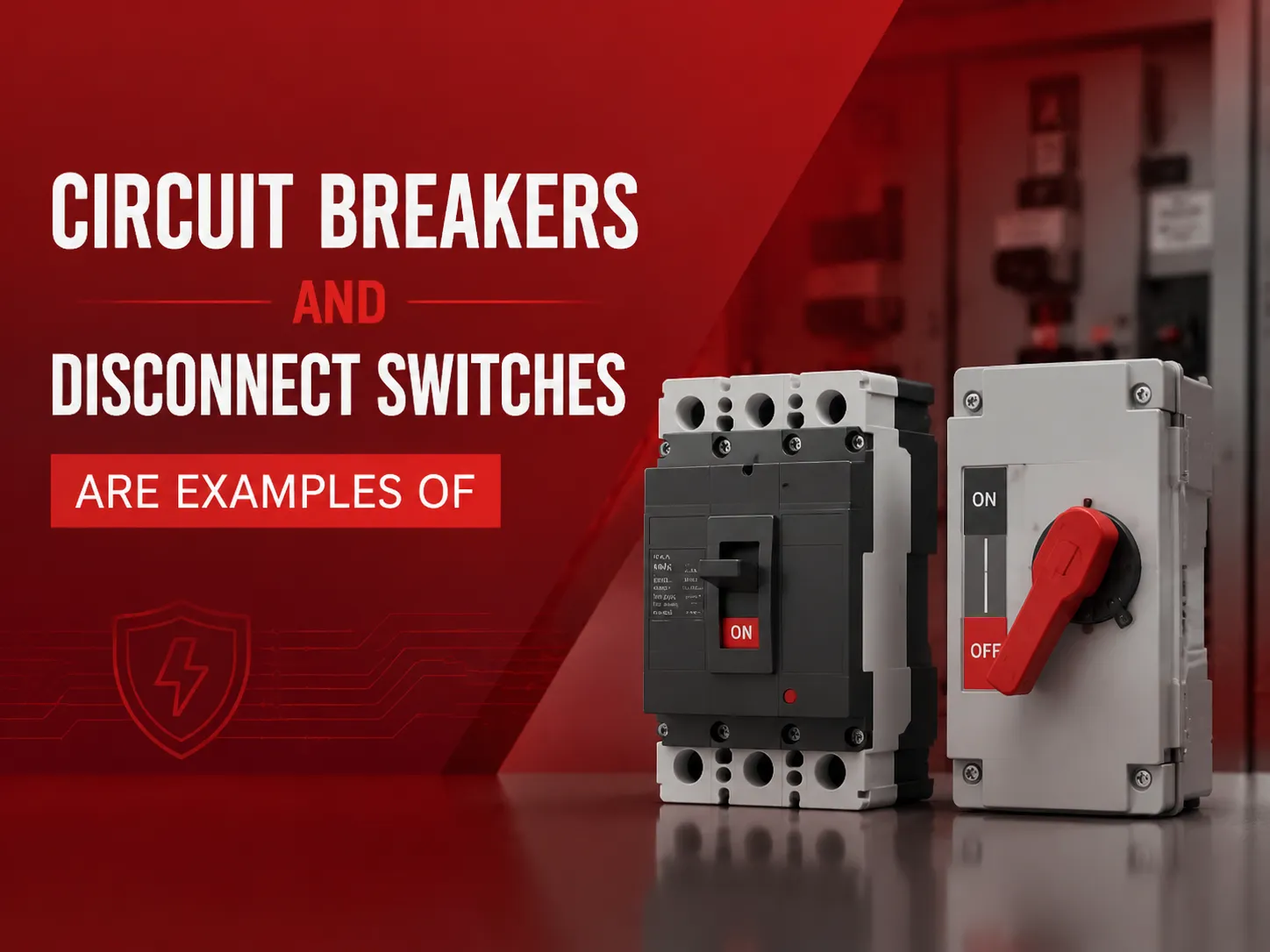
Electrical engineers will incorporate a circuit breaker and a disconnect switch in the motor control centre specifications. Both are located adjacent to each other in the panel, have handles, and can interrupt power to a load in the same way. However, these devices are used for two different purposes: circuit breakers are overcurrent protective devices and disconnect switches are isolation devices. It is important when designing electrical installations for safety and compliance with all applicable codes to be able to identify overcurrent protection devices from isolation devices and understand why both devices are required.
The Two Categories: Overcurrent Protection and Isolation
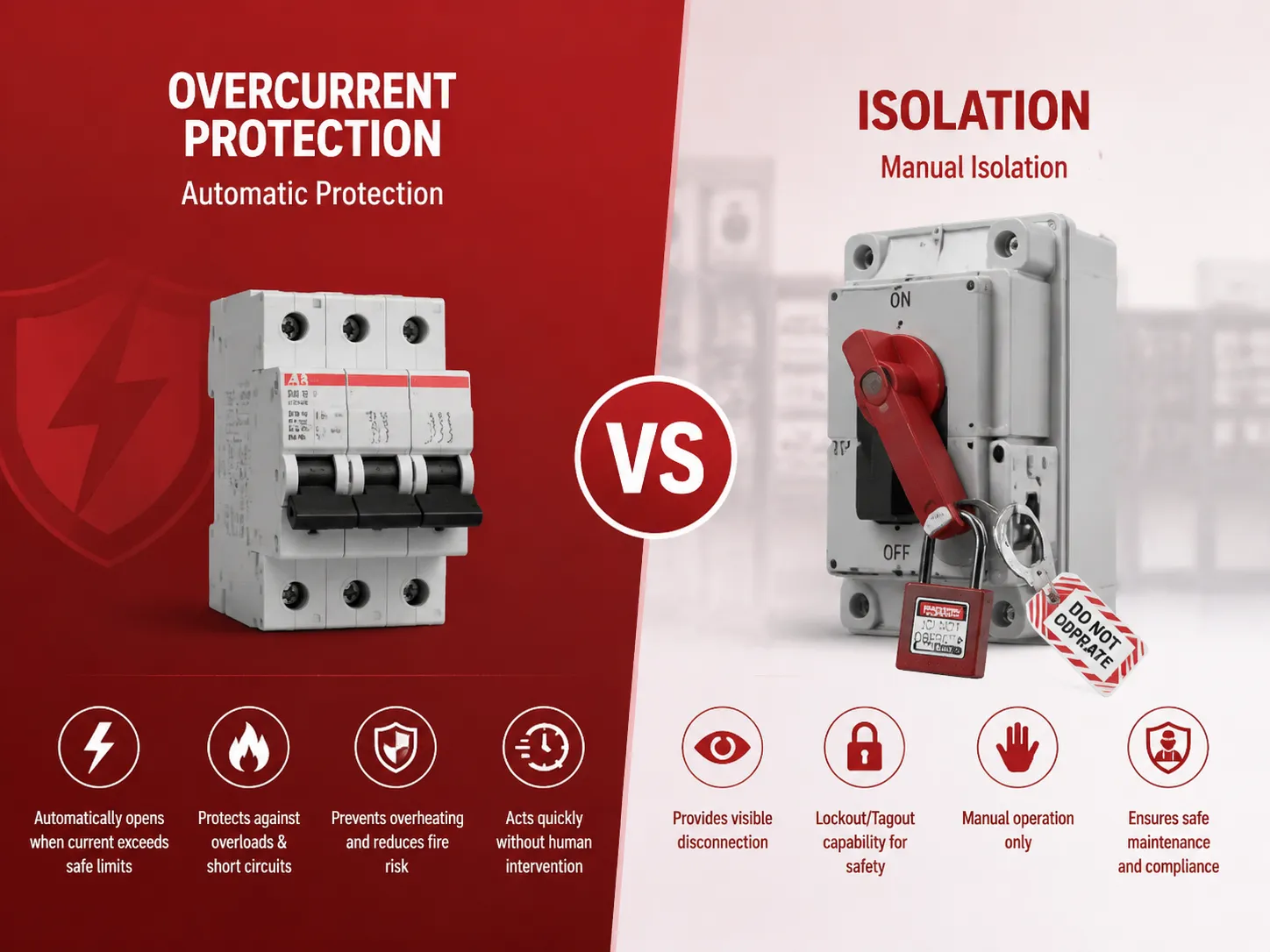
An overcurrent protective device is an automatically-opening circuit (the term is used interchangeably). If the current exceeds prescribed values, the circuit breaker opens (stopping the flow of electricity) without any human intervention. Under overload conditions (many appliances drawing current from a single circuit) and under short circuit conditions (live–to–neutral or live–to–ground), the device will open. The device will act quickly enough to prevent wires from overheating to the point where the wires ignite. The International Electrotechnical Commission establishes the standards for current-limiting circuit breakers, IEC 60947-2 for industrial circuit breakers, and IEC 60898 for residential circuit breakers. Every electrical system relies on circuit breakers as the automatic means of maintaining safety.
An isolator (or disconnect switch) is an isolation device that creates a visible disconnection in the circuit to confirm that the downstream equipment is safely without energy before work is performed. A disconnect switch can only be operated manually and cannot be tripped due to overcurrent. Its function is to open the circuit and keep the circuit open by providing a visible opening (gap) or indicating an open position. What differentiates a disconnect switch from a circuit breaker being used as a disconnect is the provision of lockout/tagout. The disconnect switch will have a hasp or other locking device that allows the user to put a padlock in the switch handle to prevent the switch from being closed during maintenance. This Lockout and Tagout feature is required under OSHA in the United States and under similar global regulations for safety in the workplace. Industrial electrical manufacturers including Eaton and Siemens produce both fusible and non‑fusible disconnect switches designed specifically for this safety function.
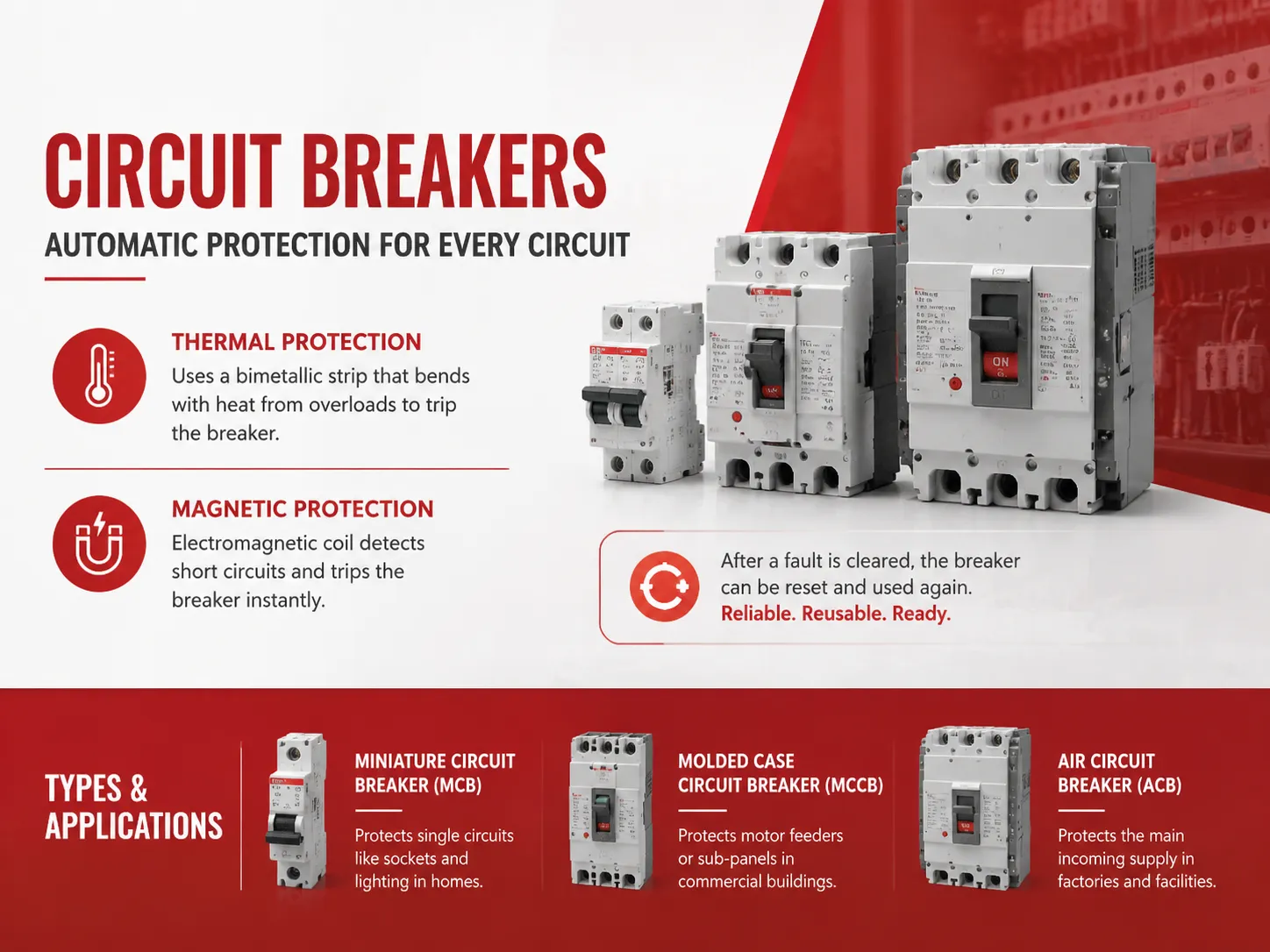
Circuit Breakers in Detail: Automatic Protection for Every Circuit
A circuit breaker is a device that has two protection functions. The breaker is designed to use a thermal element and bimetallic strip, which bends when heat is applied by an overload condition, to release its latch and trip the breaker. A breaker also has a magnetic element, which is an electromagnetic coil, which reacts instantly to a large current when there is a short circuit; as a result, a breaker can trip in milliseconds. After the fault is cleared, a breaker can be reset and used again; however, a fuse has to be replaced once it blows.
Different types of circuit breakers cover different applications from large to small. A miniature circuit breaker provides protection to a single socket or lighting circuit within the home. Molded Case Circuit Breakers provide protection to a motor feeder or sub-panel within a commercial building. Air Circuit Breakers provide protection to the factory’s main incoming supply. HUYU’s AC MCB range, including the HUM18‑63 miniature circuit breaker, provides this automatic protection for distribution circuits up to 63A with a 10kA interrupting capacity. For DC applications such as solar PV arrays and battery storage, HUYU’s DC MCBs and MCCBs are built to interrupt the sustained DC arc that an AC breaker cannot safely handle. Our article on DC MCB AC circuit compatibility explains the physics behind this distinction.
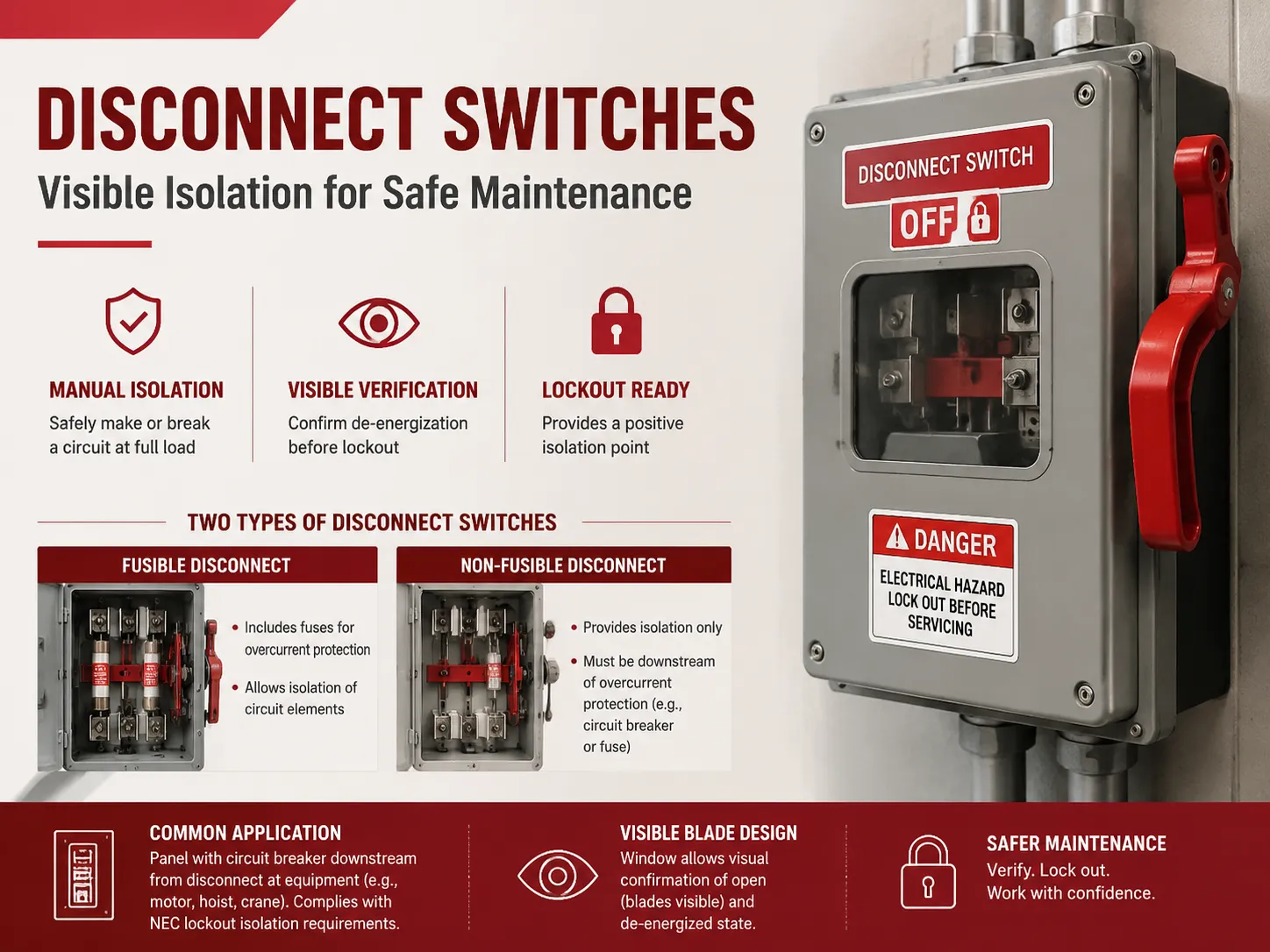
Disconnect Switches in Detail: Visible Isolation for Safe Maintenance
Although a disconnect switch has the same features as a large circuit breaker on the outside (with handles, panel mounting, and making and breaking the electrical circuit), they do not contain thermal or magnetic trip devices. As a manual switch, they can be used to make or break a circuit carrying its full load, but not to provide overload protection. A primary function of the disconnect switch is to provide a means for isolating a circuit so that one can positively verify that the circuit is dead (de-energized).
There are two types of disconnect switches: those with fuses (fusible disconnects) and those without (non-fusible disconnects). A fusible disconnect has fuses that protect against too much current (overcurrent) and also has a switch that allows for isolating circuit elements from one another. A non-fusible disconnect only protects against isolation and must be supplied from downstream from some other device that provides overcurrent protection (circuit breaker or fuse). In North America, commonly used non-fusible disconnects have a circuit breaker located in a panel that provides overcurrent protection, and the disconnect at the motor (overhead crane, hoist, etc.); this represents the required lockout isolation point per NEC. Enclosed versions of disconnect switches are available with a visible blade that can be seen through a viewing window; this type of design allows confirmation of de-energisation prior to lockout.
Key Differences Between Circuit Breakers and Disconnect Switches
| Characteristic | Circuit Breaker | Disconnect Switch |
|---|---|---|
| Primary function | Automatic overcurrent and short‑circuit protection | Manual isolation for safe maintenance |
| Operates automatically on fault? | Yes — thermal and magnetic trip | No — manual operation only |
| Lockout‑tagout provision | Some models include lockable handles; not universally standard | Integral part of the device; required by safety regulations |
| Visible break | Not usually; trip indication is by handle position or a flag | Visible‑blade designs available for positive confirmation |
| Resets after operation | Yes — simply flip the handle back to ON | Yes — but there is nothing to “reset” since it only opens manually |
| Typical standards | IEC 60898, IEC 60947‑2, UL 489 | IEC 60947‑3, UL 98 |
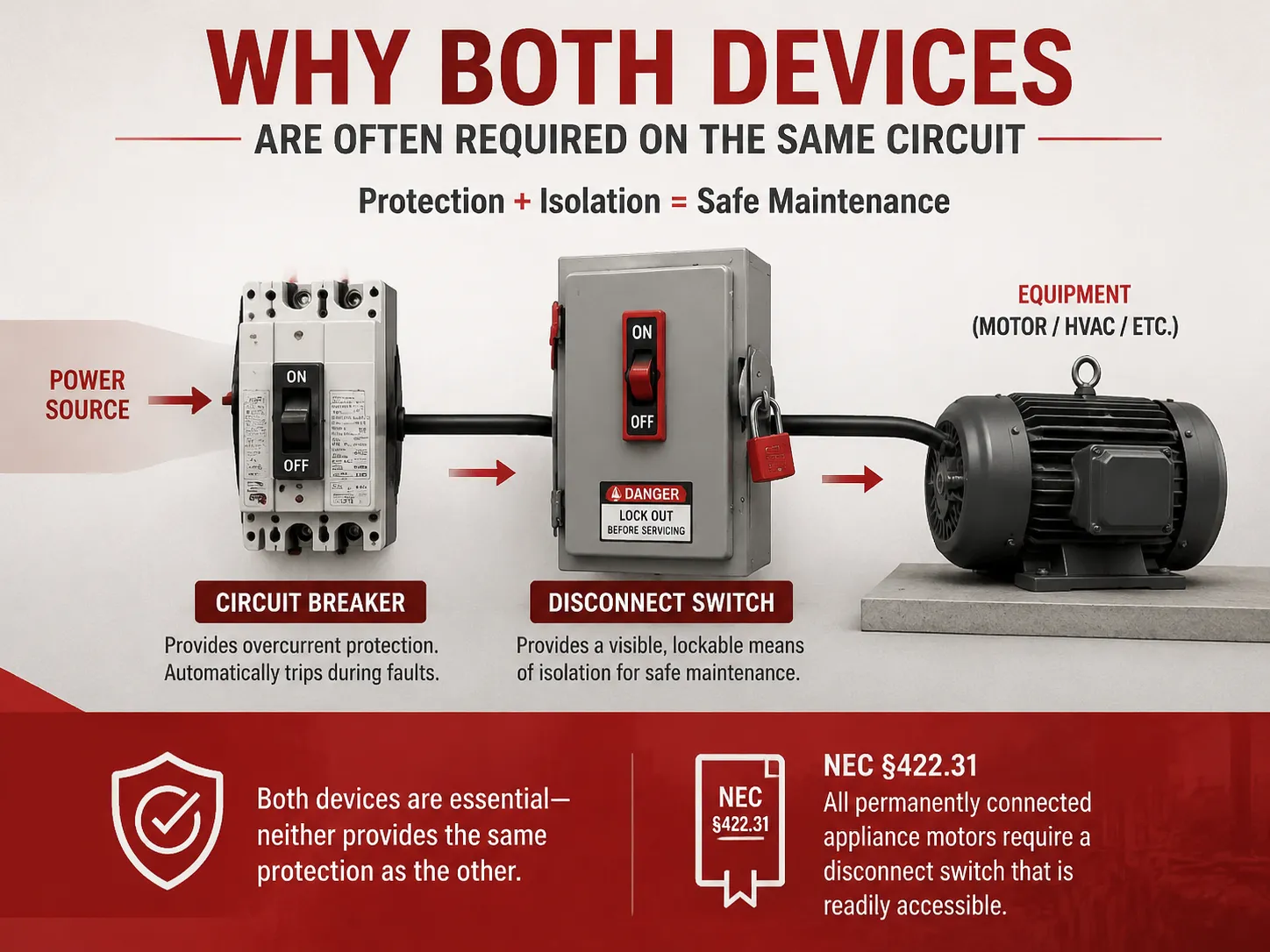
Why Both Devices Are Often Required on the Same Circuit
Having a circuit breaker and disconnect switch in series on the same feeder is common practice; the circuit breaker protects against automatic overcurrent while the disconnect allows for an isolated, lockable point for maintenance to occur. Both arrangements are typical in motor circuits, heating, ventilation, and air conditioning (HVAC), and for all electrically powered appliances that are permanently connected to the electrical system and require service or maintenance from time to time. According to NEC (National Electrical Code) §422.31, all permanently connected appliance motors need to have a disconnect switch readily accessible to them. Due to the fact that a circuit breaker may not always be within sight of the appliance motor, a local disconnect switch must be installed alongside the equipment to provide isolation when servicing occurs. Both devices are essential to providing safe maintenance of the equipment; neither device provides the same protection as the other.
An electric circuit breaker may be used as an overcurrent protector and as a disconnecting device, provided it meets the following conditions: It must be rated for disconnect use, and it must be located where it can be seen from the equipment. Disconnecting devices can never be used as overcurrent protectors unless the disconnecting device is a fusible disconnect using properly sized fuses; this difference is not just a matter of definition, but is enforced by the requirements of the electric code and by the physics of the flow of fault current through devices that do not interrupt the current.
Frequently Asked Questions
What are circuit breakers and disconnect switches examples of?
Circuit breakers and disconnect switches are examples of Isolating devices and overcurrent protective devices are separate categories of electrical equipment that perform different functions. For example, most breakers are designed to prevent overloads and short circuits (i.e., by tripping). Disconnect switches are manually operated, allowing for safe maintenance and providing isolation from power (an “isolation device”). Each type has its own set of standards defining how it should operate and its intended function.
What type of switch is a circuit breaker?
A circuit breaker is a never-failing circuit protection device. It may be operated by hand, but its primary feature is to break the circuit automatically when it recognizes an overload or short-circuit condition without human assistance.
What type of switch is a disconnect switch?
A disconnect switch separates a circuit from its source of electrical power. The switch is operated by the user manually, either to open or to close a circuit. The disconnect switch is primarily designed for safety and provides a physical indication of the separation between the circuit and its supply, which confirms that the circuit has been de-energised prior to starting any maintenance on the equipment that is supplied from that circuit.
Is a disconnect switch an energy isolating device?
An energy isolating device is defined as a disconnect switch by Occupational Safety and Health Administration (OSHA) regulations including ‘lock-out’ and ‘tag-indicator’ protocols where it protects the source of energy from your electrical devices. A disconnect switch connects your electrical circuit to your source of energy and may be locked in the open position so no accidently can be re-energised.
References
- Eaton — Disconnect Switches and Safety Switches — Product range and application guidance for fusible and non‑fusible disconnect switches.
- Siemens — Disconnect Switches and Circuit Breakers — Technical documentation on isolation and overcurrent protection.
- OSHA — Lockout/Tagout Standard (29 CFR 1910.147) — U.S. federal regulation requiring energy isolation devices for safe maintenance.
- Electrical Construction & Maintenance (EC&M) — Articles on disconnect switch selection, NEC requirements, and lockout‑tagout best practices.
Circuit breakers and disconnect switches are examples of two distinct but complementary categories: automatic overcurrent protection and manual isolation. The breaker opens on a fault in milliseconds, protecting the wire and the building. The disconnect switch opens when a worker turns it off, protecting the person who must work on the equipment. Both are essential to a complete and safe electrical system. HUYU supplies the circuit breakers — AC and DC, MCB and MCCB — that provide the automatic protection side of this equation, and we understand the isolation requirements that every installation must also meet.