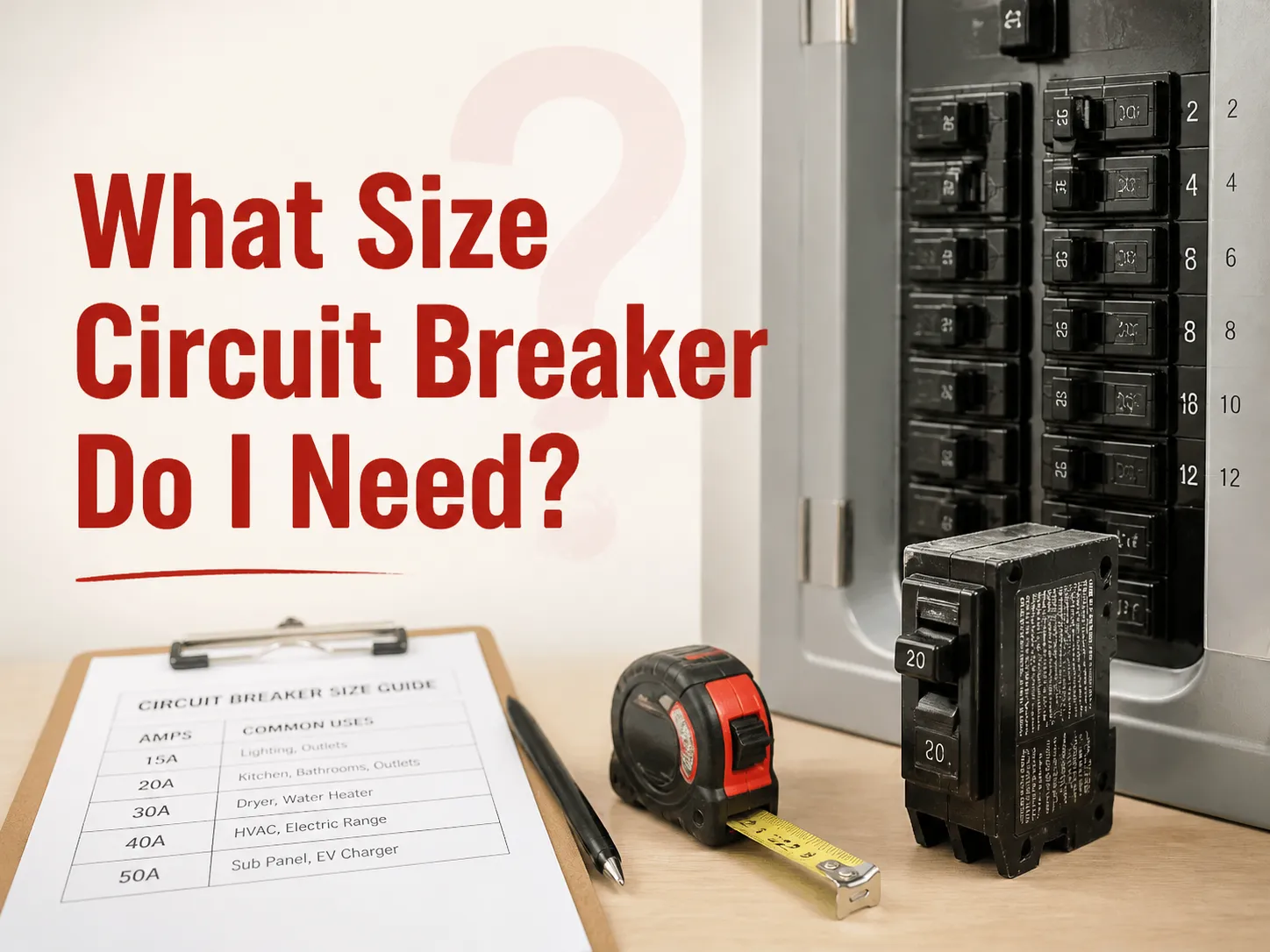

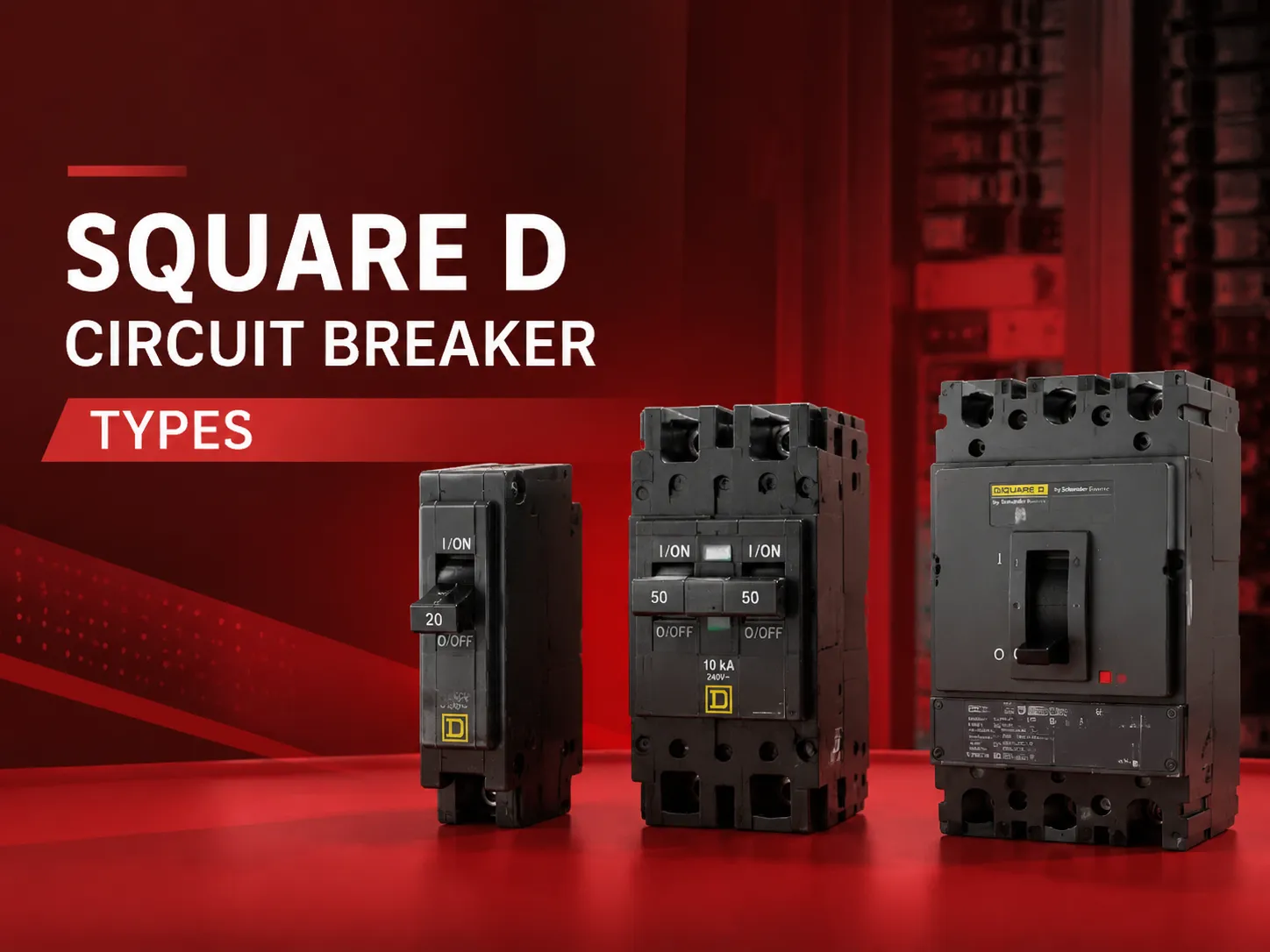
When a homeowner opens a Square D panel and needs a replacement circuit breaker, the first question is almost always the same: “Which one do I buy?” The panel door says Square D, but the electrical aisle offers QO, Homeline, tandem, AFCI, and GFCI — all carrying the same brand name, none interchangeable. The answer, in one sentence: Square D makes two distinct residential breaker families, QO and Homeline, and the one you need depends entirely on which family your panel belongs to. Understanding the difference, how to identify which one you have, and what each type is designed to do is the foundation of a safe replacement.
The Two Main Square D Breaker Families
Square D, now a brand of Schneider Electric, produces two primary residential breaker lines. They are not interchangeable, and a breaker from the wrong family will not seat correctly on the bus bar — or worse, it will appear to fit and create a high‑resistance connection.
| Feature | Square D QO | Square D Homeline |
|---|---|---|
| Visual identifier | Square window (Vis‑Trip indicator) on the breaker face | No window; solid face with a coloured handle |
| Quality tier | Commercial‑grade; also used in residential | Residential‑grade; built to a price point |
| Bus bar connection | Snap‑on jaw with a distinct profile | Plug‑on jaw with a different profile |
| Typical applications | Residential and light commercial panels | Residential panels, manufactured homes, light commercial |
| Price (standard 1‑pole 15A) | $8–$15 | $5–$10 |
| Interchangeable? | No. A QO breaker will not fit a Homeline panel, and vice versa. | |
QO Series: The Commercial Standard
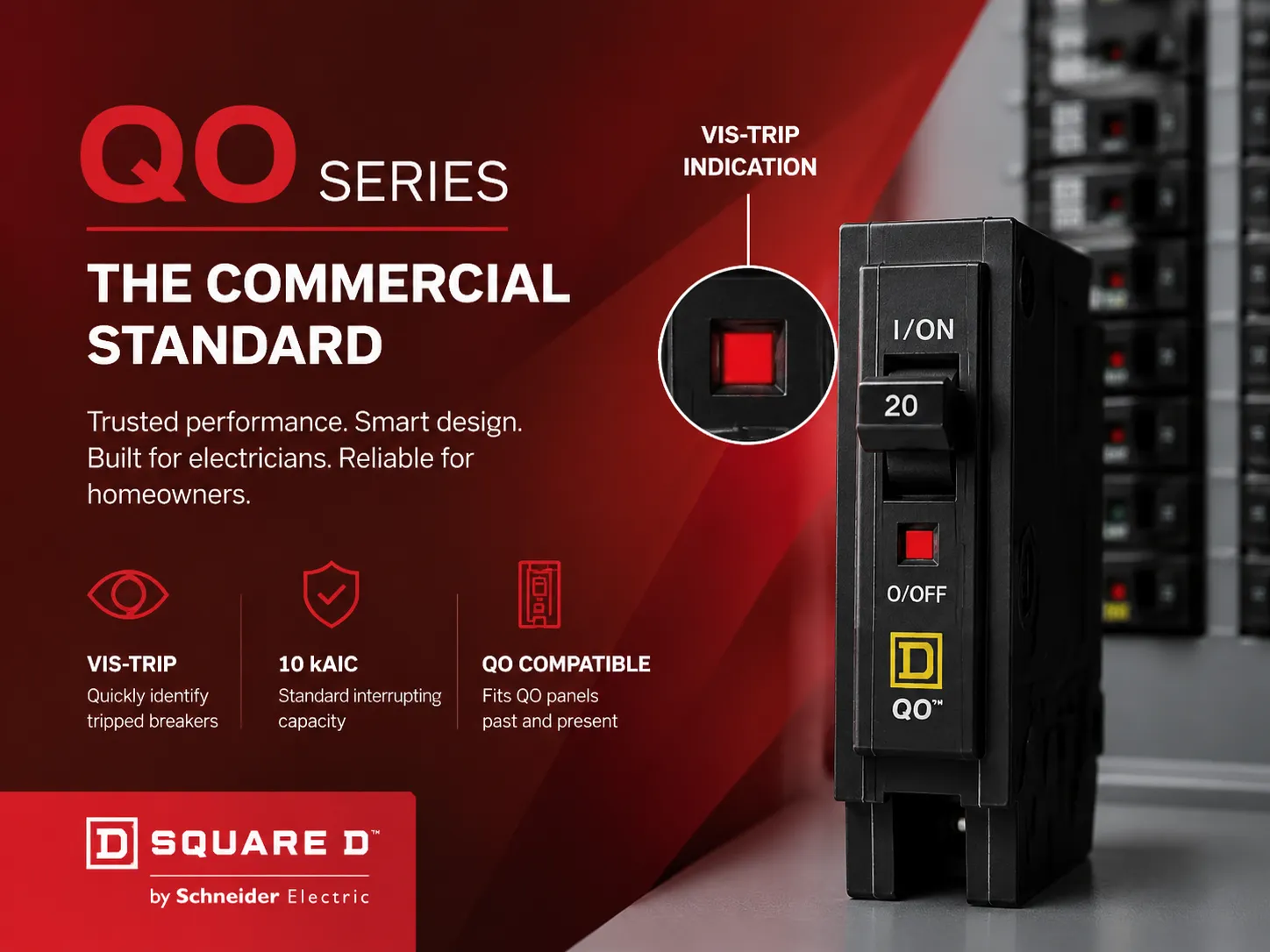
The Square D QO (Quality O-ning) Circuit Breaker has long been known as one of the best circuit breakers available in North American circuit boards due to its high quality and ease of use for both electricians and homeowners alike. The circuit breaker has a unique design that incorporates an easily visible “Vis-Trip” indication (or a small square window that turns red when the breaker “trips”). Whether you are an electrician or a homeowner, this design feature will allow you to quickly identify which circuit has tripped without having to illuminate each and every breaker box in your building. Knowing this information will save you time and frustration when looking for a breaker that has tripped on a dark and rainy morning, especially if the previous circuit had been labeled with an old and faded label.
QO circuit breakers are suitable for residential and light commercial applications. These breakers are standardly rated for 10 kAIC interrupting capability (with higher-rated versions available). They use copper bus bar connections and include all standard QO breaker types: single-pole, double-pole, tandem, ground fault circuit interrupter (GFCI), arc fault circuit interrupter (AFCI), and combination two-in-one (CAFI) in single snap-on form factors. The QO panel can only accept QO circuit breakers; the label on the panel describes which specific type would be acceptable in which slot and also which slots will accept tandem QO circuit breakers.
For many years, Square D has been producing their own QO Circuit Breakers (CB’s) which allow new-style CB to fit into older Style QO panels because of the common circuit breaker manufacturing design of the product over time. This is important when looking at a panel upgrade or retrofit; not all brands offer this capability. Therefore, Square D and QO is considered a very reliable choice to upgrade and/or retrofit an existing panel.
Homeline Series: Cost‑Effective Residential Protection
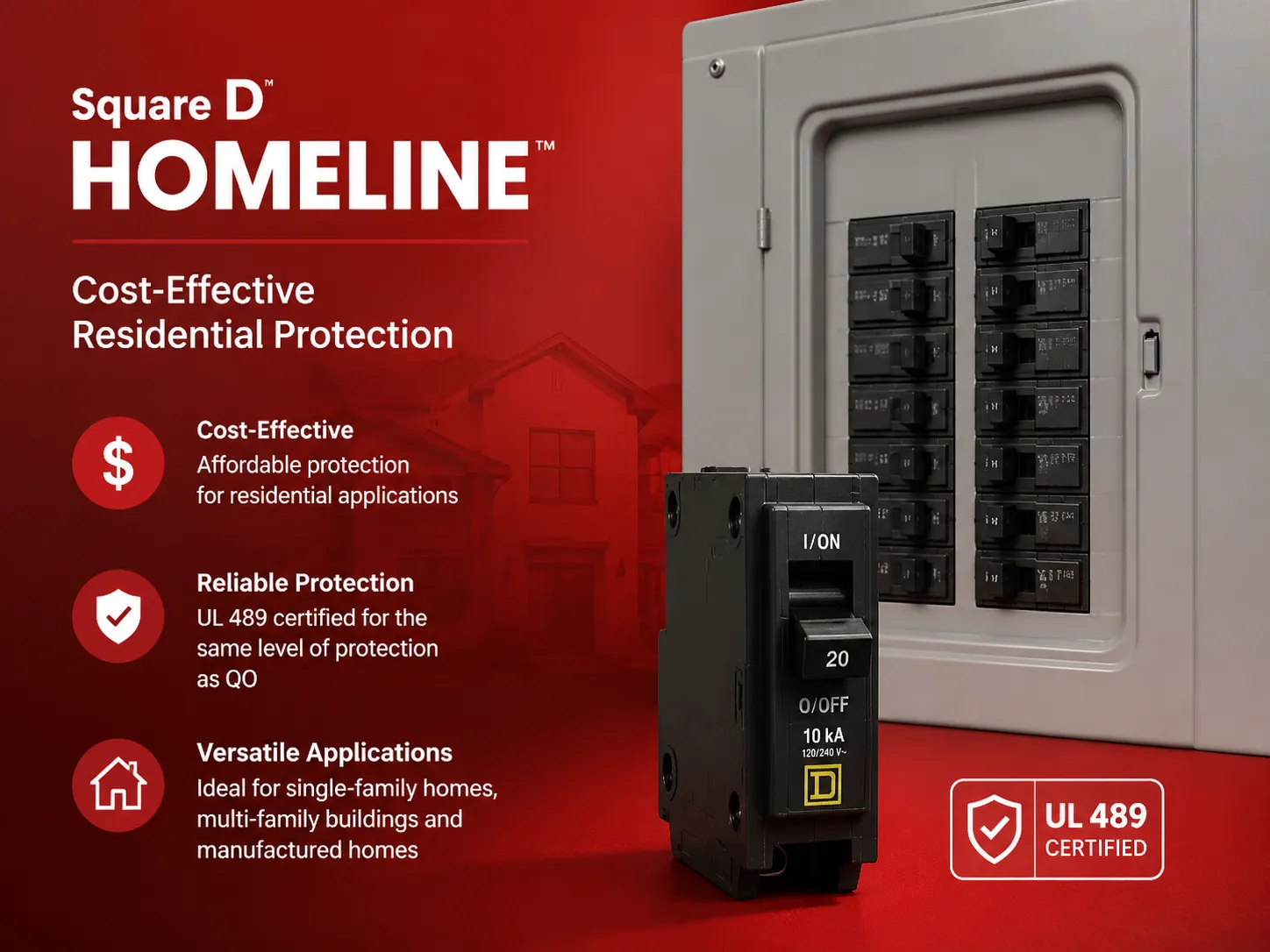
Square D’s Homeline product series is an affordable alternative to the competing QO range of products, both providing the same level of electrical protection; however, the Homeline product line has been manufactured to meet a low-priced residential price point, utilizing an aluminium component for the bus bar and a less complex design than QO. There is no Vis-Trip window on the Homeline breakers; instead, when the breaker trips, the handle will move into the centre/OFF position.
The Homeline line of panel boards have a wide variety of applications including single family residential homes, multi-family residential buildings and manufactured homes. Homeline panels use only Homeline circuit breakers. The GFCI, AFCI, and dual function GFCI/AFCI circuit breakers available in the Homeline line are the same as those available in the QO circuit breaker family. This results in a less expensive product based on material and design versus a QO circuit breaker with no reduction in the level of protection (UL489). For a deeper look at the certification that governs these devices, our article on what UL 489 breakers are explains the testing regime that both QO and Homeline breakers must pass.
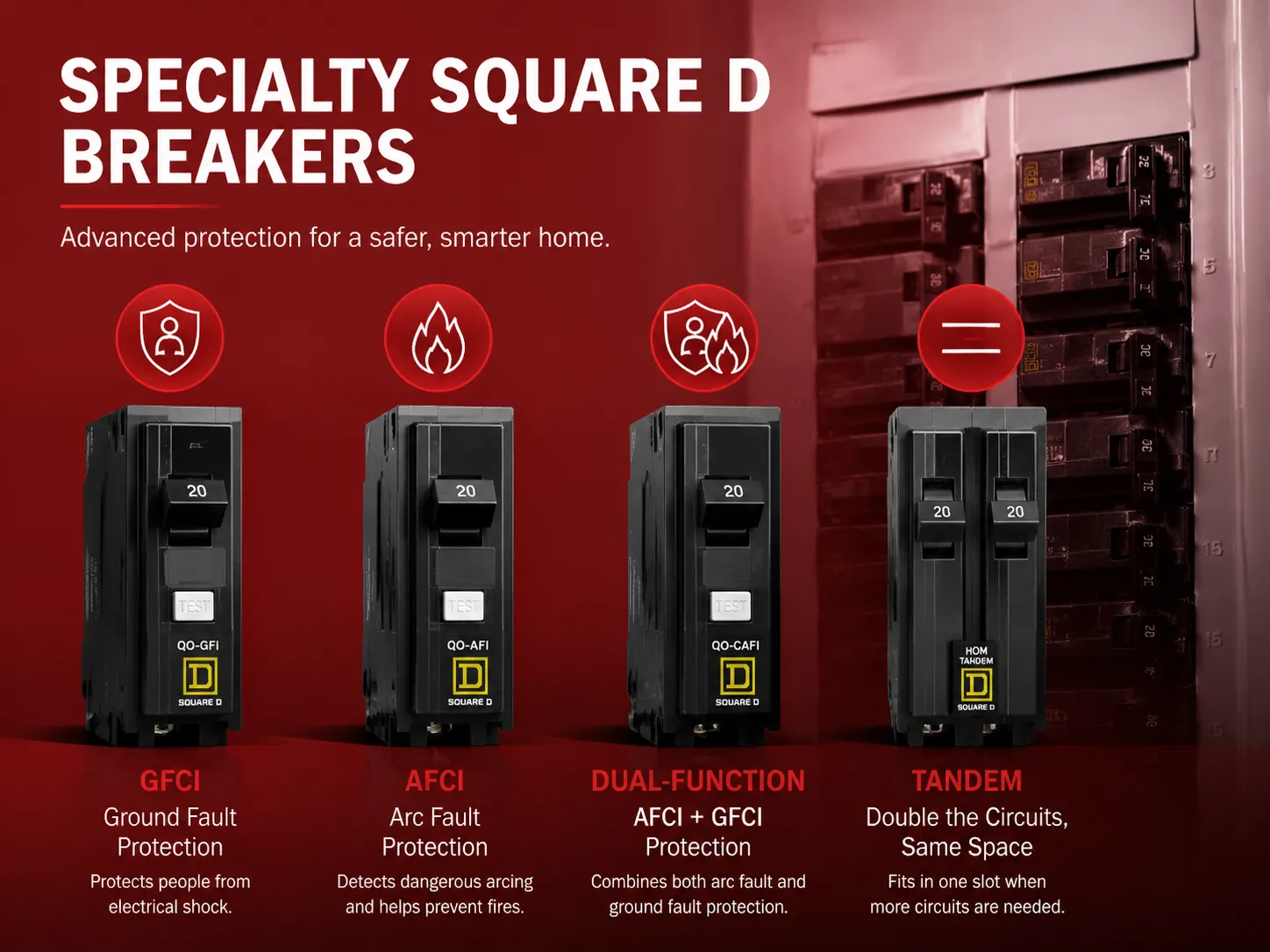
Specialty Square D Breakers: GFCI, AFCI, and More
There are numerous types of specialty circuit breakers found in both the QO series and Homeline series. Each has an overcurrent protection feature, but the specialty circuit breakers go beyond basic overcurrent by providing additional supplementary protection.
- GFCI breaker (QO‑GFI / HOM‑GFI): It guards you from a ground fault, which is when a person or water makes contact with an electrical wire or current. GFCI protection is required for electrical outlets in bathrooms, kitchens, garages, and outdoor circuits. When using the TEST button, it simulates a ground fault and will cause the breaker to trip every time.
- AFCI breaker (QO‑AFI / HOM‑AFI): Arc fault protection – An arcing situation occurs when there is a damaged wire, a loose connection or a cord has been pinched. Most appliances in new homes will have these arc fault circuit interrupter (AFCI) breakers which have electronics built within them to detect the signature of an arcing condition and will turn off electrical power before an arcing condition has had the chance to start a fire.
- Dual‑Function breaker (QO‑CAFI / HOM‑CAFI): Combination AFCI and GFCI protection devices offer the advantage of being used in new construction where both appliances need to meet code; for example kitchen countertop plugs are required to have both types of protection.
- Tandem breaker: Tandem breaker is defined as a double pole breaker that fits within a single breaker slot, for use when all slots in a breaker panel are full but more are needed. Only specified breaker panel slots can accept tandem devices; installing a tandem device into a non-tandem slot could overload the bus stab.
How to Know If You Have a QO or Homeline Panel
It only takes seconds before you know what you’re looking at. You can tell QO panels apart from Homeline by simply opening the panel door and looking at the breaker. If you see a small square window on the face of the breaker, it indicates that you are in a QO panel. If you do not see a window (i.e. a solid face), and the label on the panel says “Homeline”, then you have a Homeline. The panel label located on the inside of the door, contains information such as the panel type brand and the breakers approved for that panel. However, if the panel label is missing, you will need to perform a visual check for the presence of window(s).
The answer to the inquiry, “Are all Square D circuit breakers compatible with Square D electrical panels?” is unequivocally no! It is not possible to install a QO circuit breaker in a Homeline electrical panel or vice versa because there is no space for either of these types of circuit breakers to be matched up to the corresponding type of electrical panel. The only way that an improperly matched circuit breaker could be fit into an electrical panel would involve modification of either the circuit breaker or the bus bar of the electrical panel; both modifications would invalidate the UL listing of the electrical panel and create an extremely high risk of fire. For help matching the breaker’s amp rating to the circuit, our guide on what size circuit breaker you need explains the NEC‑based sizing process.
How to Tell If a Square D Breaker Is Bad
Like all other breakers, a Square D breaker can fail. Signs of failure include repeated tripping when subjected to a load that used to be okay, the breaker will not reset, the body of the breaker is warm or hot, there is a burning odour, visible burn marks or there is a buzz coming from the breaker. Additionally, the Vis-Trip window on a QO breaker provides an alternate diagnostic measure. When the Vis-Trip window is red but the breaker is in the ON position, this indicates that the internal trip mechanism has failed and that the breaker needs to be replaced. Finally, thermal imaging inspections, which many electrical maintenance programs recommend, can identify a hotspot at the terminal of a Square D breaker prior to the failure occurring. Step-by-step instructions on how to safely replace a breaker can be found in home improvement resources such as Family Handyman.
Are Square D Breakers Obsolete?
Square D QO and Homeline circuit breakers are designed for use in North America and have a long history of being produced from the 1990’s to present day. Schneider Electric, the manufacturer of all Square D products, provides replacement parts for circuits that use older technology even from years of manufacturing ago. Because Square D QO circuits are not going away anytime soon, they will be part of new construction as well as replacement project plans because replacement parts for these types of circuits will be available for as long as there is a supply of new QO panels.
For purchasers in search of dependable certified over-current protection for IEC compliant distribution systems, HUYU produces MCB’s. MCCB’s. RCCB’s and RCBO’s, which provide the same protection of overloads, short circuits, ground faults and arc faults within installations utilizing the IEC framework. Our product range, including the HUM18‑63 miniature circuit breaker, is built to the applicable international standards, with the testing and documentation that a modern electrical supply chain demands.
Frequently Asked Questions
What are the two types of Square D breakers?
Square D circuit breakers are classified into two primary categories, QO (which has a small square Vis-Trip window on the front) and Homeline (the front is solid, without a window). QO circuit breakers are for commercial applications and Homeline circuit breakers are for residential applications; they cannot be interchanged with each other.
How do you know if a Square D breaker is bad?
Replace a Square D breaker if you notice any of these symptoms; continuous tripping with no overload, cannot be reset, hot to the touch, buzzing when running (or after running), scorch marks, or Vis-Trip window is red and handle is on. Each of these conditions are reasons to change it out immediately!
Are Square D breakers obsolete?
No, Schneider Electric continues to produce, stock and support all Square D QO and Homeline circuit breakers in both the existing and new families of products. These circuit breakers are still being manufactured, so current production circuit breakers (QO and Homeline) will be fully interchangeable with older models of that family.
Do all Square D breakers fit Square D panels?
No, a QO style breaker will only fit a QO style panel, and similarly a Homeline style breaker will only fit a Homeline style panel. Any breaker that is placed into the wrong family is a violation of the electrical code and represents a possible fire hazard.
References
- Schneider Electric — Square D QO and Homeline Circuit Breakers — Official manufacturer product information and compatibility guidance.
- Home Depot — Square D Breaker Compatibility Guide — Retailer guidance on identifying and selecting the correct Square D breaker type.
- Family Handyman — How to Replace a Circuit Breaker — Practical homeowner guidance on safe breaker replacement and panel identification.
- Electrical Safety Foundation International (ESFI) — Home electrical safety resources and guidance on circuit breaker maintenance.
Square D circuit breaker types are divided into two families — QO and Homeline — each with its own panel, its own breaker design, and its own specialty devices for arc‑fault, ground‑fault, and dual protection. Identifying which one you have takes a glance at the Vis‑Trip window, and choosing the correct replacement means matching the type, the amp rating, and the required protection to the circuit and the panel label. With the right breaker in the right slot, a Square D panel will protect the building for decades. With the wrong breaker, it will not protect at all. HUYU supplies circuit breakers that meet the same international standards for installations around the world, because overcurrent protection is universal — and so is the need to get it right.