
When you switch on the power to your equipment after tripping a circuit breaker, you’re making an assumption that the circuit breaker will keep both your wiring and yourself safe. This assumption is validated by certification and testing, and for molded case circuit breakers in North America, the UL489 standard is the definitive standard. A UL489 circuit breaker is much more than just another component; it is a piece of equipment that has successfully passed an extensive series of overload, short-circuit, endurance, and environmental tests performed by a third-party testing laboratory. Knowing what the UL489 standard means and understanding how this standard compares to UL1077 or UL489B, as well as where to find UL-certified circuit breakers for specific applications, is extremely important for engineers, contractors, and anyone who specifies electrical protection products.
What Is the UL 489 Standard?
UL 489 sets the standards for Molded-Case Circuit Breakers (MCCBs), Molded-Case Switches (MCSs), and Circuit-Breaker Enclosures, according to UL Solutions. UL 489 describes the construction, performance, and testing requirements for circuit breakers used for the provision of overcurrent protection as branch circuits and short-circuit protection as a secondary method in residential, commercial, and industrial locations. A breaker must indicate that it is capable of:
- Carry its rated current continuously without exceeding specified temperature limits
- Interrupt overload currents according to its time‑current curve
- Safely clear a full‑rated short‑circuit fault (the breaker’s interrupting capacity, measured in kAIC) without case rupture, flame emission, or creating a fire hazard
- Endure thousands of mechanical and electrical operating cycles without degradation
A UL 489 breaker is one of the few overcurrent protective devices that are considered service-rated by the NEC. This means the breaker is acceptable as both a service main disconnect and a branch circuit breaker in a load center or panelboard where an inspector, insurance company and/or a building authority will view the UL489 as acceptable to meet the minimum safety standards required to be acceptable in North America.
For a deeper look at how breakers interact with other protection devices in a system, our comparison of circuit breaker vs surge protector explains why both layers are necessary for complete protection.

UL 489 vs. UL 1077: Branch Circuit Protection vs. Supplementary Protection
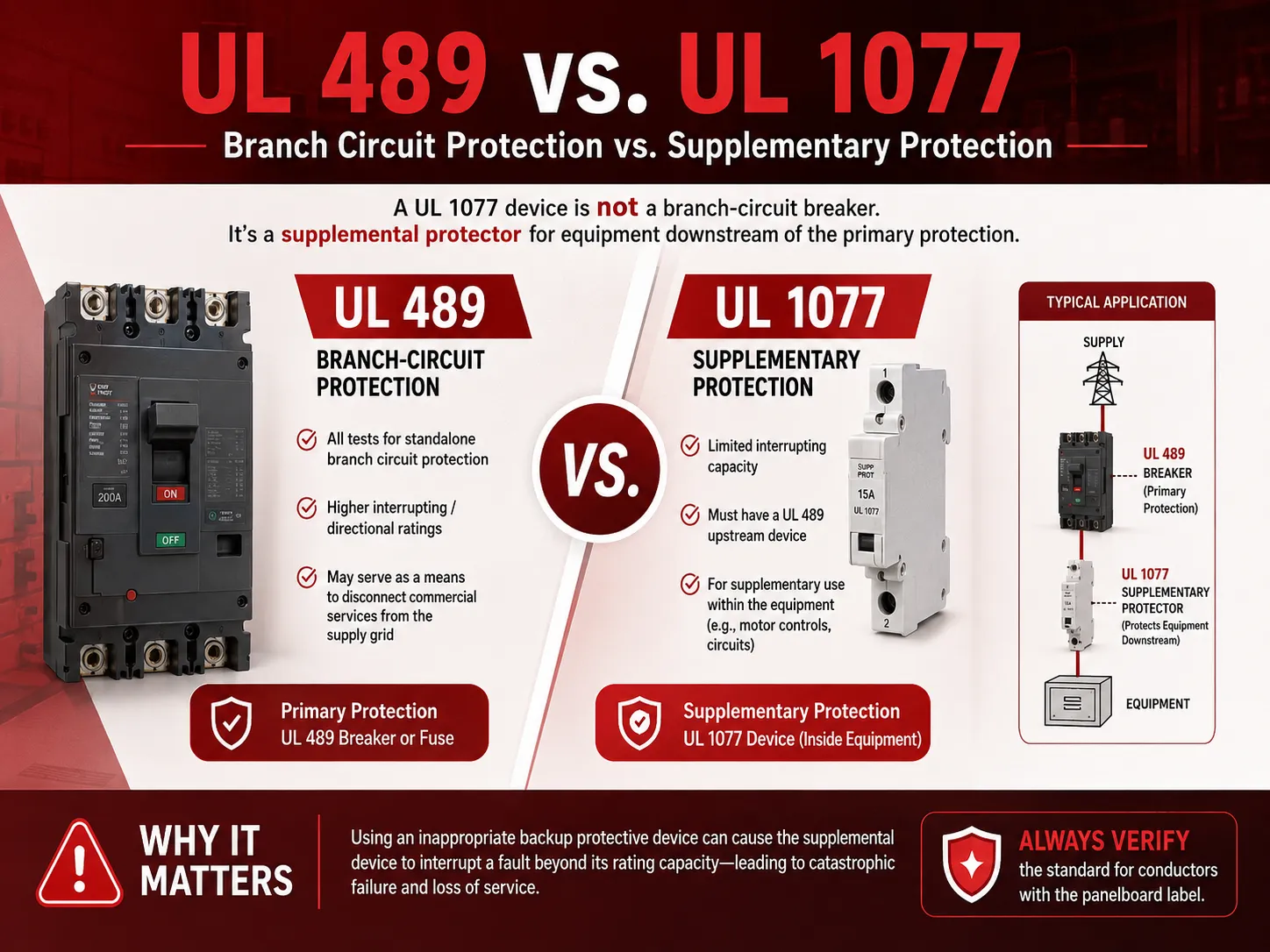
This is one of the biggest areas of misunderstanding. A supply-side UL 1077 listed device is not a branch-circuit breaker, but a supplemental protector intended to protect equipment downstream of the primary branch-circuit protection provided by a UL 489 breaker or fuse. You will typically find supplemental protectors inside the enclosure of a piece of equipment (for example: motor controls or circuits) and cannot be used as the only overcurrent device in a panelboard. Key differences:
- UL489: All tests performed for standalone protection of branch circuits; also can meet higher interrupting/directional ratings than previous generation breakers; may serve as a means to disconnect commercial services from the supply grid.
- UL 1077:: Limited interrupting capacity; must have a UL 489 upstream device and is for supplementary use within the equipment.
If you select a backup protective device that is inappropriate, there is potential for a hazardous scenario where the supplemental protective device may attempt to interrupt a fault beyond its rating capacity causing a catastrophic loss of service. Always verify the standard for the conductors with the panelboard label.
UL 489 vs. UL 508: Circuit Breakers vs. Industrial Control Equipment
The UL 508 standard does not cover circuit breakers but applies to industrial control equipment; however, devices such as motor circuit protectors or manual motor starters may have a UL 508 listing and are typically used together with a contactor and overload relay in a motor branch circuit. When tested as part of a combination motor controller, UL 508 devices can provide protection from both motor overload and short‑circuit conditions for a motor branch circuit; they cannot be used as a replacement for a circuit breaker in a panelboard because they do not provide general‑purpose circuit protection. The basic difference between UL 489 and 508 devices is that UL 489 is to protect feeder circuits and final circuits, whereas UL 508 only applies to the control of motors, and the definition of use of both devices is generally found within the NEC motor sections.
UL 489 vs. UL 489B: What Changes for DC and PV Applications?
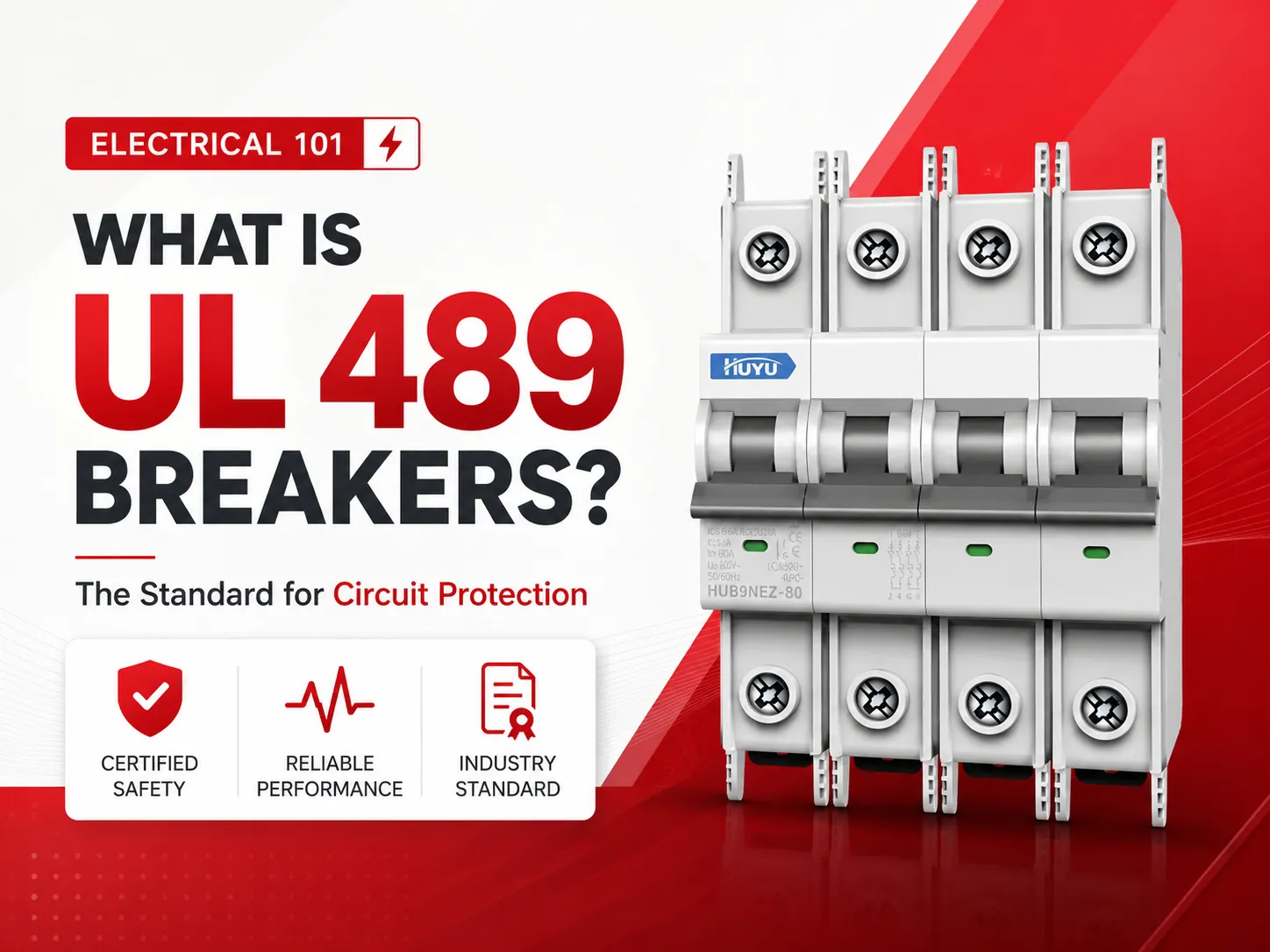
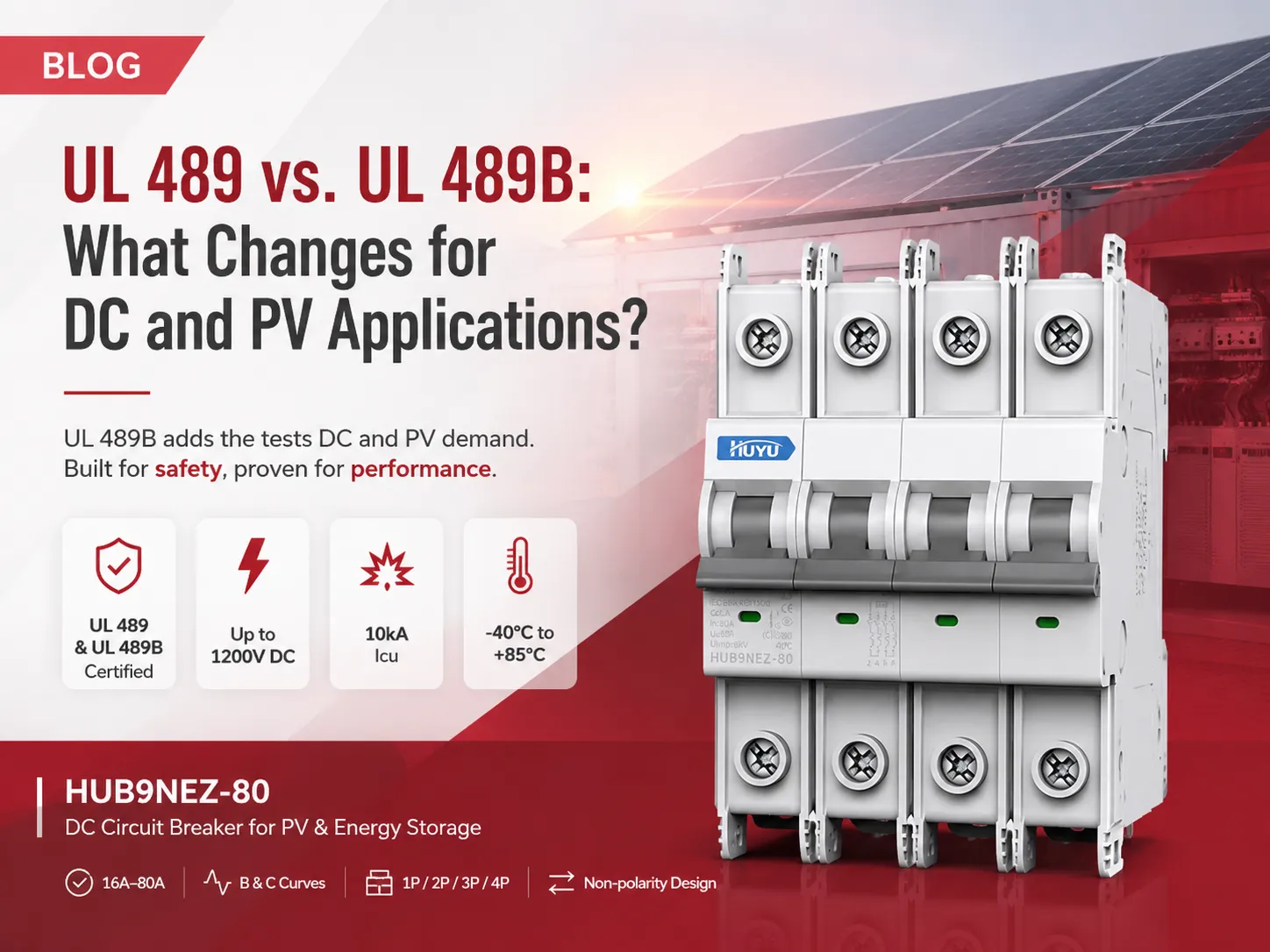
UL 489 is an additional standard specifically for molded case circuit breakers used in photovoltaic (PV) or certain DC applications. UL 489 works in conjunction with UL 489B to add additional specification related to the special problems related to DC circuits, e.g., the inability for the DC arc to extinguish at zero-crossing, the excessive constant current that is normally present in a solar array and the need for a circuit breaker to function properly over a larger temperature range. A circuit breaker classified under UL 489B has also undergone additional tests to determine its ability to interrupt the DC arc as well as to determine how well the circuit breaker would operate under the environmental conditions typically found on a rooftop or within a DC solar combiner box. Therefore, a circuit breaker that has been tested under both UL 489 and UL 489B can be considered as appropriate for use as a branch circuit DC protective device within a PV installation.This is where our own HUB9NEZ‑80 DC circuit breaker becomes directly relevant: it is a non‑polarity design rated from 16A to 80A, up to 1200V DC, with a 10 kA Icu, available in B and C trip curves and 1P/2P/3P/4P configurations. Its UL 489 and TUV certifications confirm it has passed the rigorous testing demanded for both general DC branch circuits and PV/energy storage applications.
What Brand of Electrical Panels Are Uninsurable?
The question typically deals with older residential panels that have a documented past of failing to function properly, which creates a risk of starting a fire. The two most common types of panels that are noted are the Federal Pacific Electric (FPE) Stab‑Lok, Zinsco / Sylvania and early Pushmatic panels. While the circuit breakers used in these panels may have been tested against the applicable UL 489 standard at the time they were manufactured; over the years they have shown failure to operate effectively when required to do so. Many home insurance companies will currently not insure homes that use these types of panels or require replacement to be covered. The lesson to be learned for modern day installations regarding safety and the ability to obtain insurance is that an acceptable UL 489 certified product that utilizes circuit breakers should come from an established manufacturer and have periodic inspection performed on it.
Why UL 489 Certification Matters for Your Project
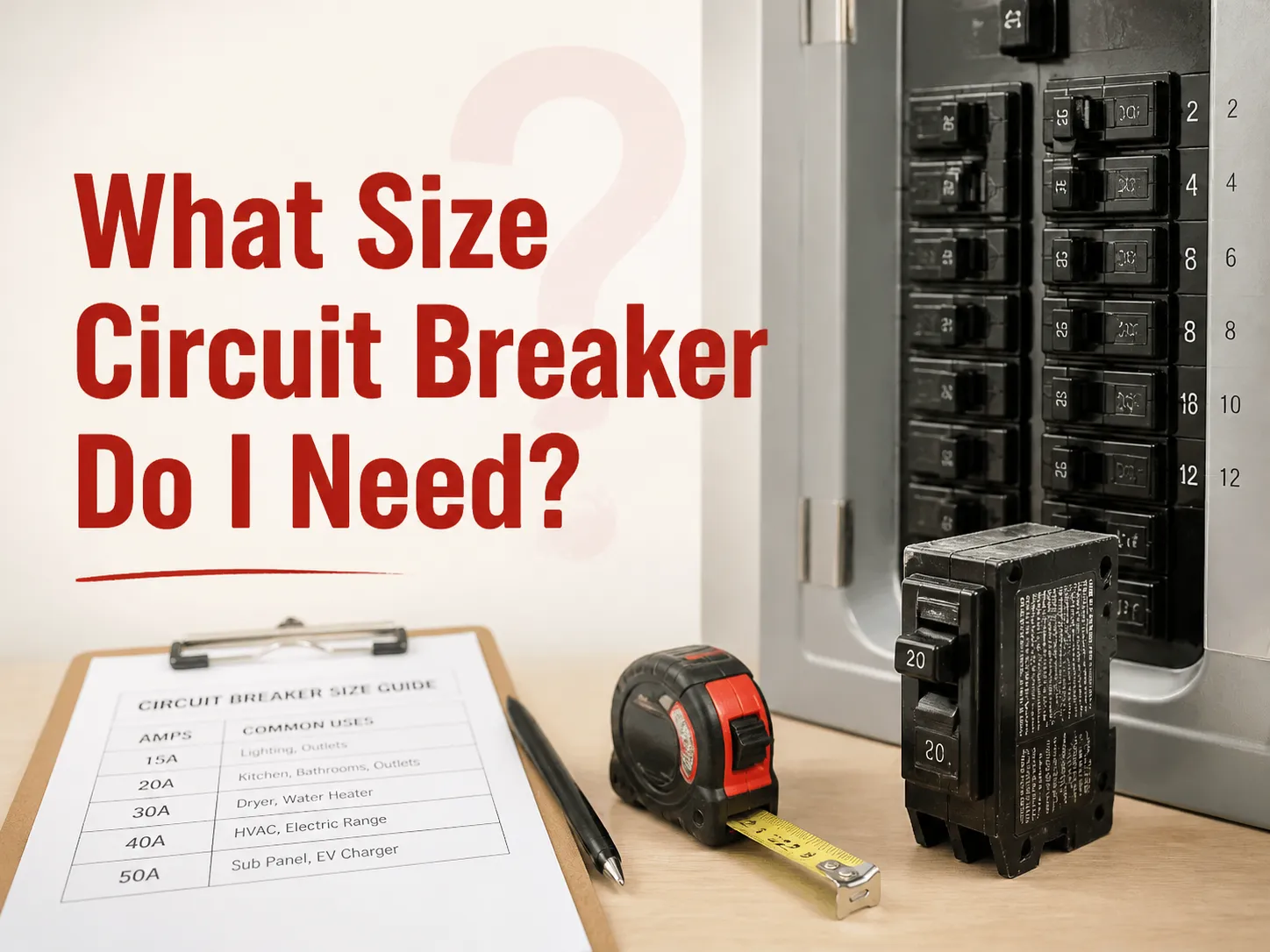
The use of a UL489 breaker is important for the protection of circuit functionality and compliance with code. It is a safeguard against insurance and liability claims for the owner of a building. It also allows OEMs and panelbuilders who export to North America to access North American markets. The UL489 certification mark on the breaker signifies that all individual components of that breaker – the contact mechanism, trip unit, molded case, terminal material, etc. – have undergone a series of tests to verify that they will function properly at their rated capacities. Therefore, regardless if you are creating a new service entrance; upgrading a subpanel; building a solar farm DC combiner, searching for the UL489 certification should not be seen as an alternative choice – it is essential․For help with sizing the correct breaker for your application, our guide on what size circuit breaker you need walks you through the calculation.
Frequently Asked Questions
What is the difference between UL 489 and 1077 breaker?
A UL 489 Circuit Breaker provides a certified protection device for use as a main or branch circuit breaker in any Panelboard, whereas a UL 1077 Device provides supplementary protection and must be installed downstream of a UL 489 Circuit Breaker or Fuse (i.e., UL 1077 Device cannot provide primary circuit protection). UL489 Breakers are tested at greater interrupting ratings than UL 1077 devices and can serve as a primary circuit protection device; however, UL 1077 devices cannot.
What is the difference between UL 508 and UL 489?
Completely different applications mean that UL 489 and UL 508 are not interchangeable or substitutive in terms of panelboards and branch-circuit breakers (MCCBs). UL 489 is a standard for MCCBs that can be used as branch circuit protection; whereas UL 508 is a standard for industrial control equipment, including motor circuit protectors when part of a listed combination motor controller. Therefore, even though UL 508 motor circuit protectors are the same size and shape as UL 489 MCCBs, they cannot be used as a substitute for a UL 489 MCCB in a standard panelboard.
What brand of electrical panels are uninsurable?
The two most well known brands of electrical panels that are considered to be “high risk” or “uninsurable” due to the fact that their breakers do not trip when they are supposed to are: Federal Pacific Electric (FPE) Stab-Lok panels and Zinsco/Sylvania panels. As of May 2020, many insurance companies will require that these panels be replaced prior to providing a homeowner policy. Older breakers may have been listed to earlier editions of Underwriters Laboratory® (UL) UL 489, however, their actual performance has made them unacceptable.
What is the difference between UL489 and UL489B?
The UL 489B Standard supplements the existing UL 489 Standard specifically for molded case circuit breakers used within photovoltaic (PV) direct current (DC) circuits due to the need for unique testing requirements related to DC arc interruption; extended temperature operation; and potentially other PV specific applications or conditions. A circuit breaker that is listed under both UL 489 and UL 489B is acceptable for providing protection for the DC branch circuits in both solar arrays and in battery energy storage systems.
What does UL stand for on a breaker?
UL stands for Underwriters Laboratories, now UL Solutions, an independent global safety science company. The “UL” mark on a circuit breaker means that a sample of that product has been tested and found to comply with the applicable UL standard (such as UL 489) for fire, electric shock, and related safety hazards. It is the recognized safety certification mark for electrical equipment in the North American market.
UL 489 breakers are more than just a mechanical switch. A UL 489 circuit breaker is an independent safety device that has been independently tested and proven to clear worst-case fault conditions without causing a fire, support rated amps 24/7/365 and provide the first line of fault current protection for an electrical system. Whether you are specifying a UL 489 circuit breaker for your AC panelboard or DC protection for a solar power application, you can be assured that each UL 489 circuit breaker has been tested to the requirements specified by regulations, inspectors and insurers. At HUYU, we sell only certified circuit protection products, such as our HUB9NEZ-80 DC circuit breaker (fully certified to UL 489 and TUV) because we believe that the circuit protection device will meet or exceed its stated specifications every time you use it.