
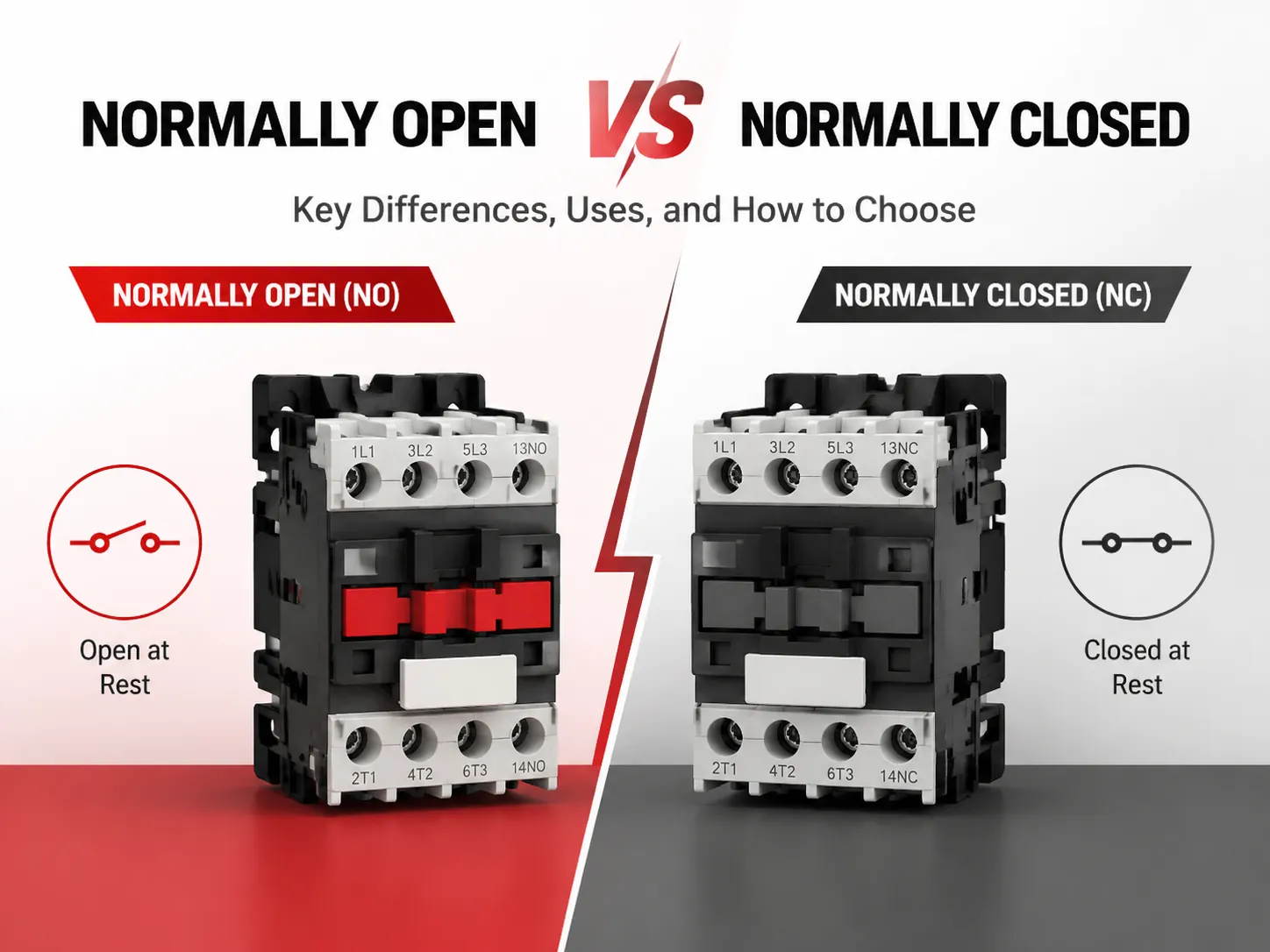
The primary difference between a normal open contactor and a normal closed contactor is their state when they are not powered. A normal open (NO) contactor will have open circuits and close when they are energized, while a normal closed (NC) contactor will have closed circuits and open when they are energized. As a result, NOs primarily function as a way of controlling electrical devices (including motors) and providing safety features through physical contact, whereas NC does the reverse. This technical document provides information on selecting the appropriate contactor based on application and required specifications.
Basic Definitions of a NO vs NC Contactor
Contactors are electromagnetically operated devices used for controlling very high-power circuit loads using very low-power signals. The term “normal” refers to the state of the device when voltage is not applied to the coil windings.
- Normal Open (NO) Contactor: The normally open contactor has its main circuit contacts open at all times until the coil is energized, at which time the created magnetic field causes the contacts to close, thereby permitting current to pass through the contactor. Normal open contactors are the most common type of contactor used for controlling motors, lighting, and heating.
- Normal Closed (NC) Contactor: The normally closed contactor has its main circuit contacts closed at all times until the coil is energized, at which time the created magnetic field causes the contacts to open, thereby stopping current from passing through the contactor.
These components are used in circuits to provide safety systems and either emergency shutoff or circuits that are not disabled until they are triggered. There are a large number of options available, making it important to compare the major characteristics of NO and NC contactors for selecting the best option.
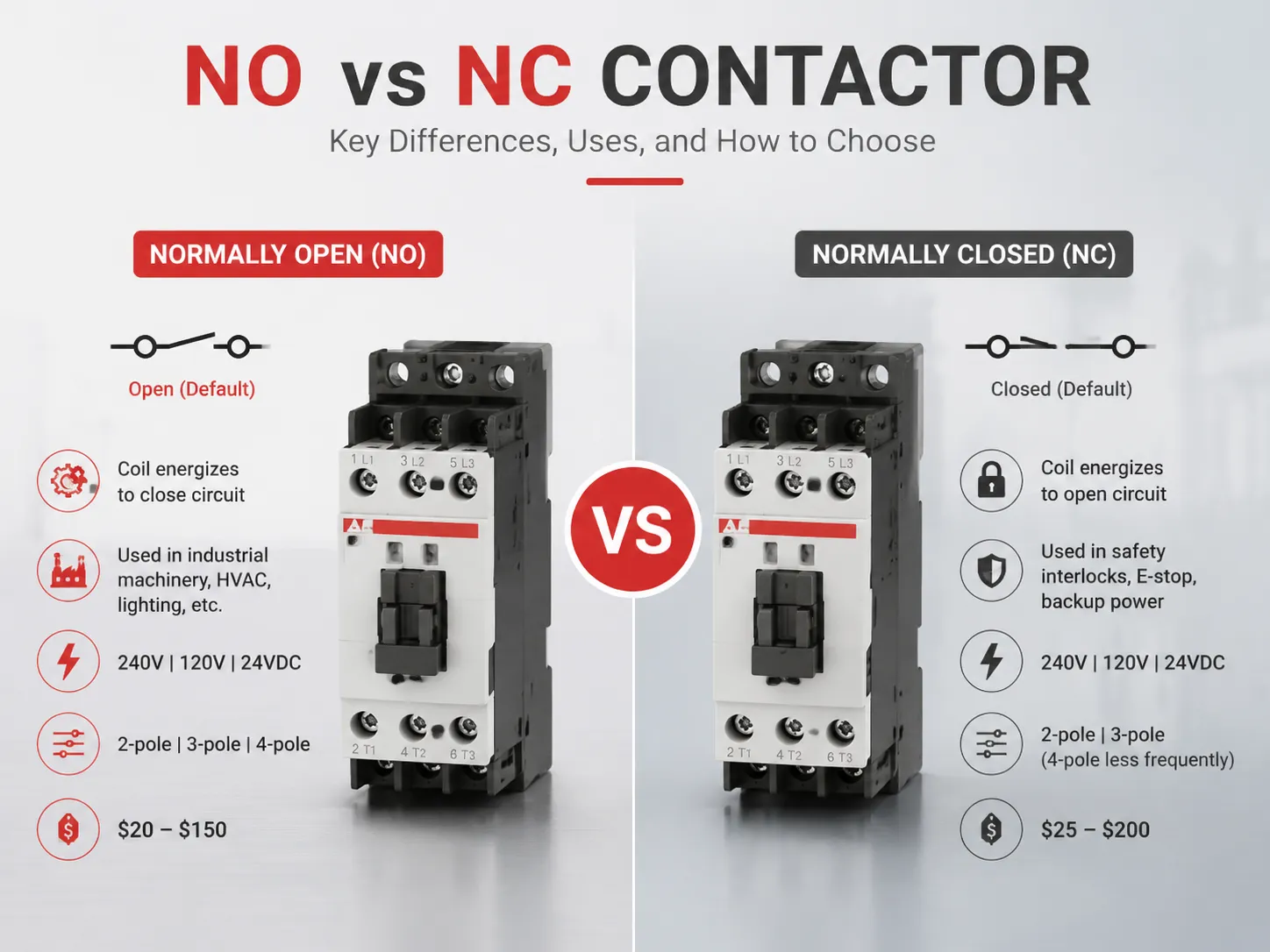
Key Differences Between NO and NC Contactors
| Condition | Normally Open (NO) Contactors | Normally Closed (NC) Contactors |
|---|---|---|
| Default Condition | Circuit open (no current flow) | Circuit closed (current flows) |
| Trigger | Coil push to close circuit | Coil push to open circuit |
| Use | Industrial machinery, HVAC units, Boolean logic, and lighting systems | Safety interlocks, emergency stop circuits, and backup power |
| Voltage Ratings | 240V, 120V, 24VDC | 240V, 120V, 24VDC |
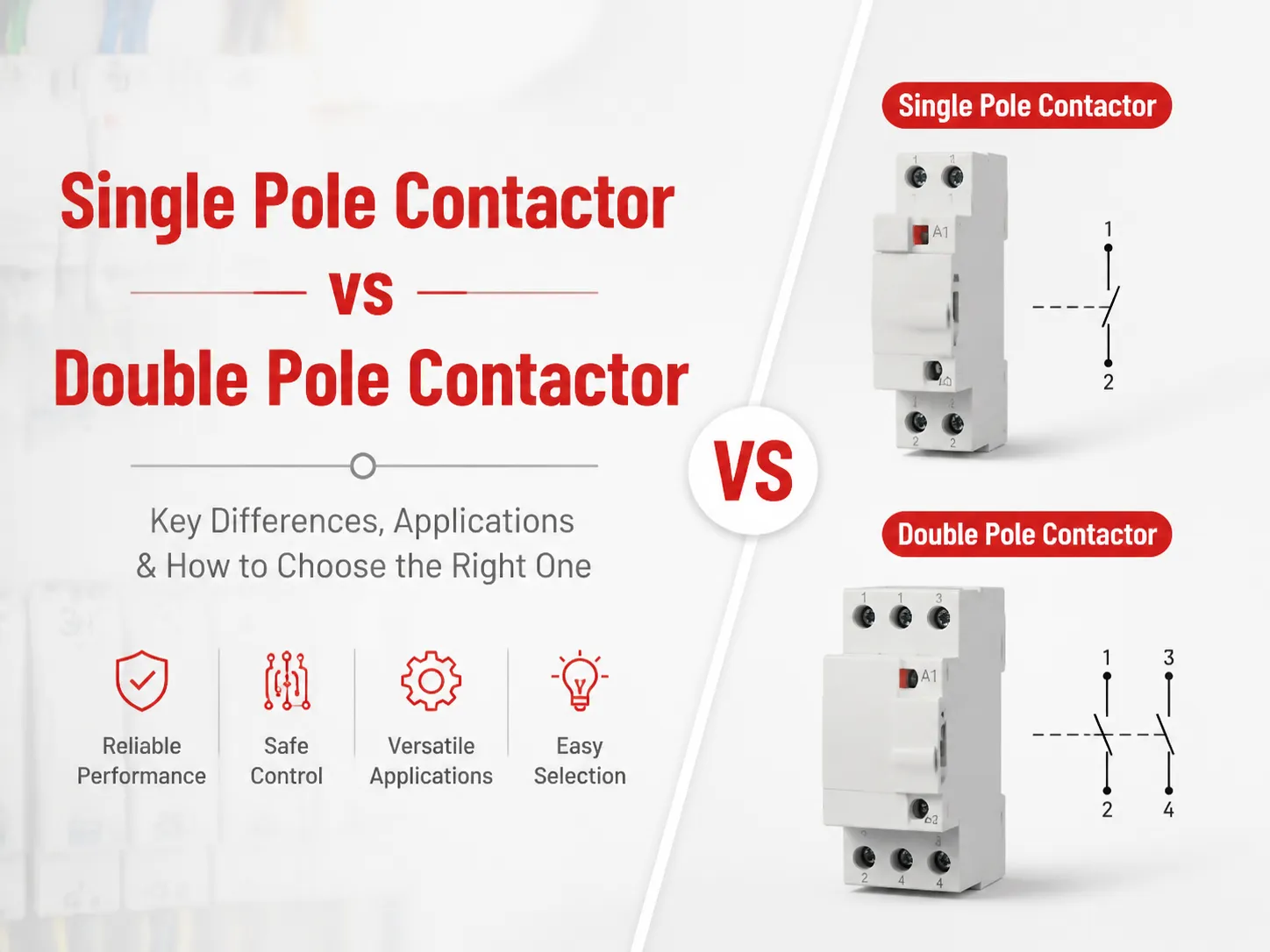
| Configuration | 2-pole, 3-pole, 4-pole | 2-pole, 3-pole (4-pole less frequently) |
| Cost | $20–$150 | $25–$200 |
Top Manufacturers of Normally Open and Normally Closed Contactors
The following brands are the most trusted worldwide for providing contactors:
- Schneider Electric: Manufacturer of 3-pole and 4-pole NO/NC contactors. Price Range: $30–$200.
- ABB: Manufacturer of compact NC contactors and high-power NO contactors used for safety and motor control applications. Price Range: $25–$180.
- Eaton: Manufacturer of economical NO and NC 2-pole and 3-pole contactors. Price Range: $20–$120.
- Square D: Manufacturer of HVAC equipment contactors with NO and NC options. Price Range: $25–$150.
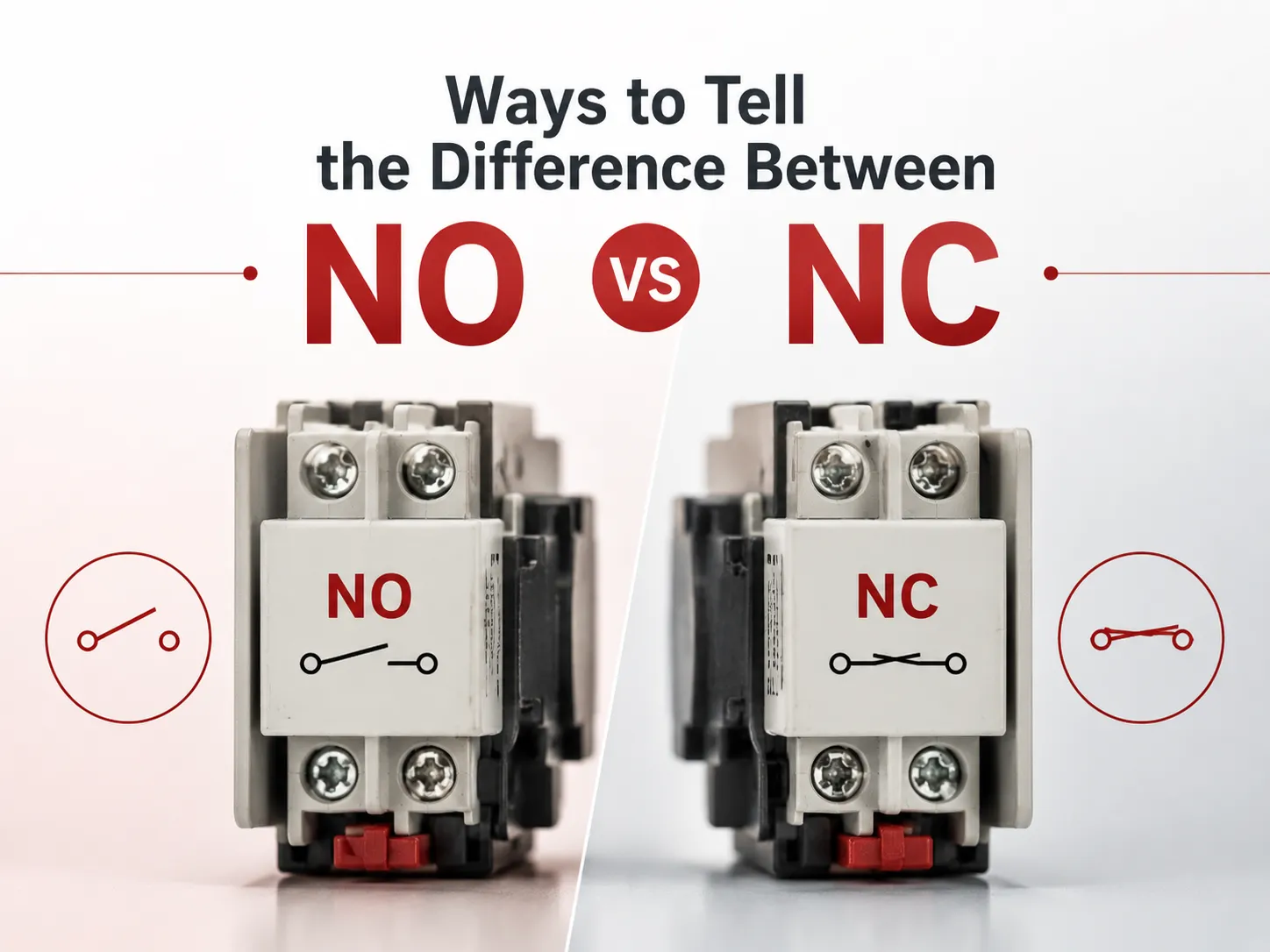
Ways to Tell the Difference Between NO and NC Contacts
Improperly installing NC and NO contacts can damage your system or create a safety hazard. Here’s how to tell them apart:
Check the Symbol: The difference between NC and NO is the symbol on contactor diagrams. Normally open will have “NO” or an open switch symbol (○/○), while normally closed will have “NC” or a closed switch symbol (●/●).
Sight Inspection: When powered down, there will be a gap between the metal plates of an NO contactor. In contrast, an NC contactor’s plates will be touching.
Multimeter Testing: With the multimeter set to continuity, place the probes on the contactor terminals. An NO contactor will have no continuity until it receives power. An NC contactor will have continuity until it receives power.
Labeling: Most contactors have “NO” or “NC” markings to simplify identification.
Frequently Asked Questions About NO/NC Contactors
What Happens if I Use an NC Contact Instead of an NO Contact?
If you attempt to use an NC contactor instead of an NO contactor, you may reverse the initial operation of the circuit. For example, if you install an NC contactor on a motor, the motor will run continuously until the coil is energized to stop it. This would be the opposite condition from what you’re trying to achieve, which is to “start on demand.” Improper use may cause damage to equipment, failed operation, or safety hazards. Always verify the type of contactor prior to installation.
How Can I Tell if a Contactor is Open or Closed?
First, make sure that power has been turned off to the contactor before checking the status of the contacts. Look at the main contact points of the contactor for visual verification: if the metal plates do not touch each other, the contactor is open (the circuit is off). If the plates are touching, the contactor is closed (the circuit is on). If you wish to check the status with power on using a digital multimeter, you can test for continuity across the main terminals—continuity means the contactor is closed, while no continuity means it’s open.
How Can I Tell if a Contactor is NO or NC?
To identify a contactor as either Normally Open (NO) or Normally Closed (NC), check the contactor nameplate and/or the wiring diagram for “NO” or “NC” markings. If unavailable, check with a digital multimeter in continuity mode. When de-energized, NO contacts will show no continuity, while NC contacts will show continuity. You can also observe the default state—NO contacts are open when de-energized, and NC contacts are closed.
How Do I Determine if a Contactor’s Contact Is Normally Open or Closed?
If individual contacts are not identified on the contactor’s wiring diagram, you can identify them by the symbols on each terminal or, if unmarked, by using a multimeter. With the contactor de-energized, NO contacts will show no continuity and NC contacts will show continuity. When the contactor is energized, NO contacts will close and show continuity, while NC contacts will open and show no continuity.
Choosing between a normally open contactor and a normally closed contactor depends on your circuit’s default state and intended function. Normally open contactors are widely used to control motors, lighting, and HVAC systems, closing circuits when energized to activate equipment. Normally closed contactors, on the other hand, keep circuits active by default and open only when energized, making them essential for safety systems, emergency shutdowns, and backup power setups.
Reliable manufacturers such as Schneider Electric, ABB, and Eaton offer numerous options across voltage ratings and pole configurations. To avoid mistakes, always verify the contactor type using visual inspection, multimeter tests, or manufacturer diagrams. A clear understanding of their differences and applications ensures optimal and safe electrical system operation.