
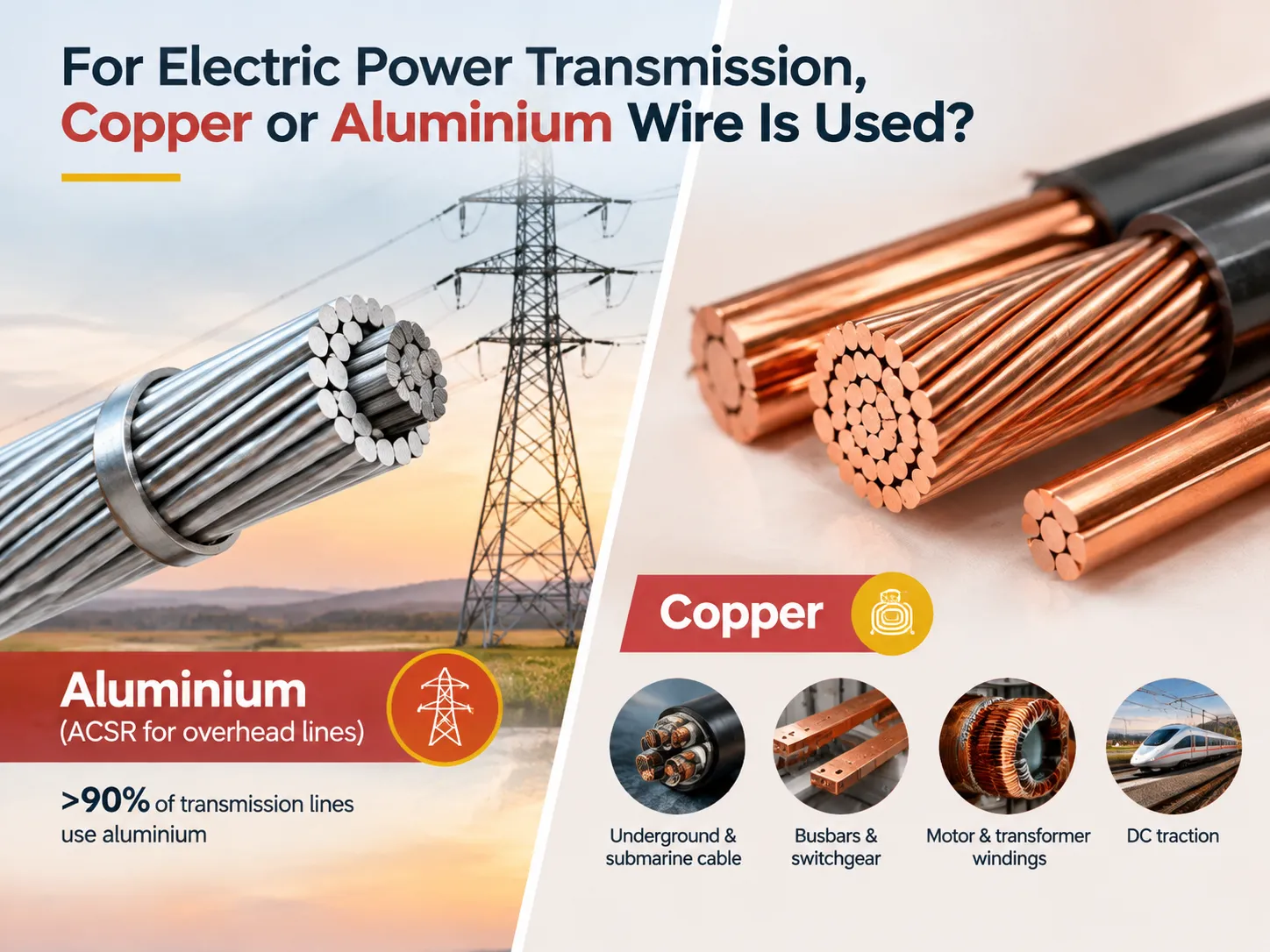
Cuando se observa una línea eléctrica, lo más probable es que esté hecha de aluminio, aunque en laboratorio el cobre es un mejor conductor. El factor determinante para el uso del aluminio no es la electricidad sino el peso, la extensión de los tramos y el precio. Este artículo describe los usos de cada material, explica por qué el aluminio ya ha prevalecido sobre el cobre en el caso de las líneas de transmisión aéreas pero aún compite con él en la transmisión subterránea y los equipos de conmutación, y describe a qué conduce esto en los puntos de terminación de la línea.
Respuesta corta: La mayor cantidad de transmisión eléctrica aérea se realiza a través de cables de aluminio, ya que representa más del 90% de los cables de transmisión de energía importados. Los cables de aluminio usados para la transmisión eléctrica se conocen comúnmente como ACSR, que se refiere a cable de aluminio con núcleo de acero. Los cables de cobre se utilizan en casos donde el espacio y la fiabilidad de las conexiones deben preferirse al peso del cable, como en la instalación de cables, barras colectoras, motores y transformadores. El aluminio transmite solo el 61% de la electricidad que el cobre y su costo es aproximadamente del 25-30% del costo del cobre, sin embargo, pesa un 70% menos que el cobre, lo que significa que un cable de aluminio con la misma resistividad que el cobre pesa aproximadamente la mitad porque tiene la misma resistencia eléctrica que el cable de cobre y es algo mayor en diámetro.
Los números que resuelven el argumento
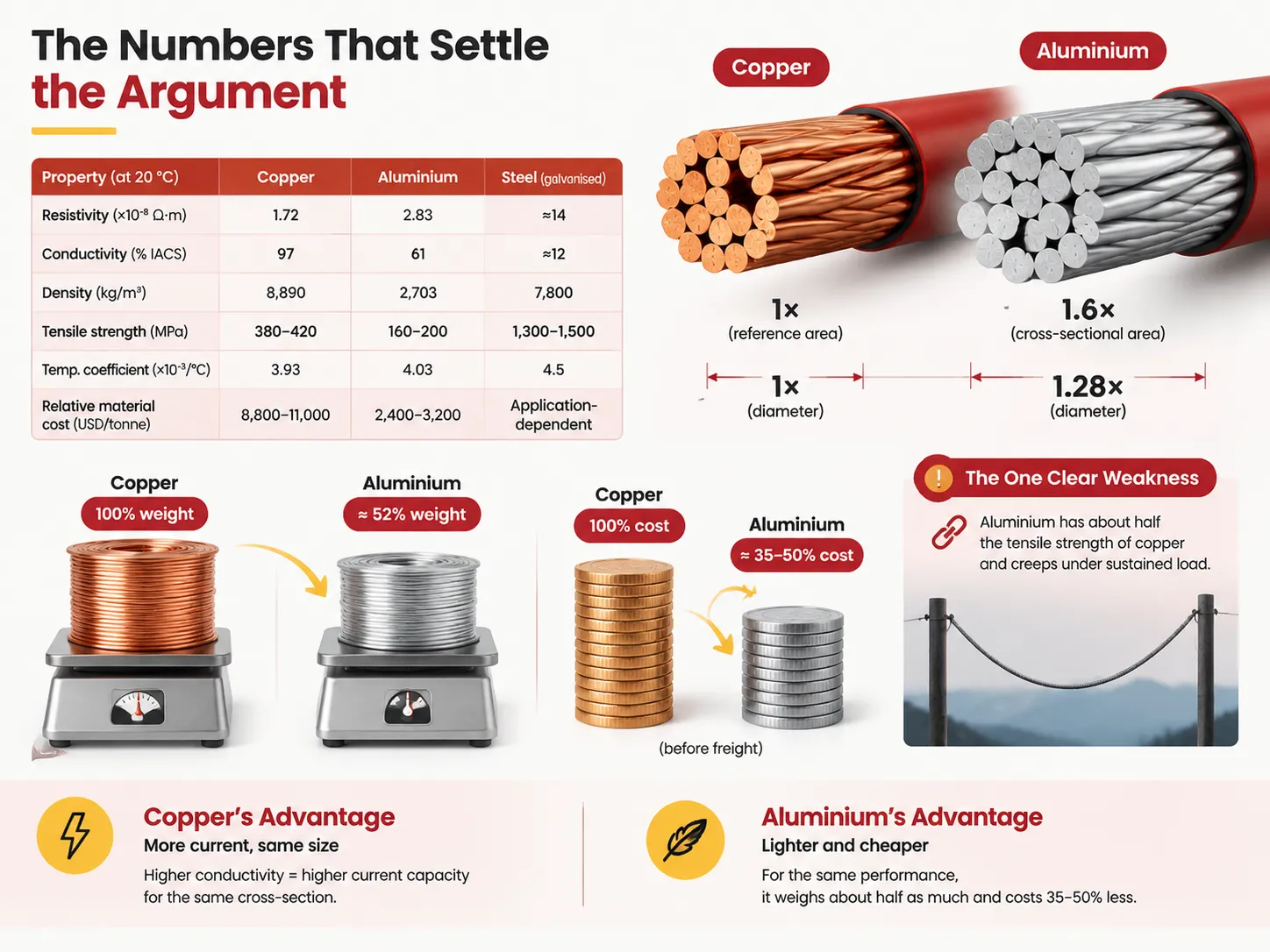
Los dos metales sobresalen en la conducción de electricidad, pero la diferencia es mucho menor de lo que la mayoría piensa cuando no comparamos cables del mismo tamaño sino cables de igual capacidad. El cobre es ganador porque es más volumétrico; el cobre puede transportar más electricidad para un cable del mismo área. El aluminio es ganador gracias a su peso específico; es significativamente más ligero y mucho más barato para la misma conductancia.
| Propiedad a 20 °C | Cobre estirado en frío | Aluminio estirado en frío | Acero galvanizado |
|---|---|---|---|
| Resistividad (×10-8 Ω·m) | 1.72 | 2.83 | aprox. 14 |
| Conductividad (1% IACS) | 97 (cobre recocido 100) | 61 | aprox. 12 |
| Densidad (kg/m³) | 8,890 | 2,703 | 7,800 |
| Resistencia última a la tracción (MPa) | 380-420 | 160-200 | 1,300-1,500 |
| Coeficiente de temperatura (×10-3/°C) | 3.93 | 4.03 | 4.5 |
| Costo relativo del material (indicativo 2026) | USD 8,800-11,000 por tonelada | USD 2,400-3,200 por tonelada | Dependiente de la aplicación |
En términos de ingeniería, las implicaciones se vuelven claras. Cuando se trata de resistencia eléctrica, el aluminio tiene aproximadamente 1.6 veces más área superficial que el cobre, que es aproximadamente 1.28 veces más ancho que el cobre. Sin embargo, a pesar del tamaño de este conductor, solo tiene aproximadamente la mitad del peso. Además, dado que los precios de las materias primas para la producción de aluminio son significativamente más bajos que los del cobre, un conductor de aluminio del mismo tamaño cuesta aproximadamente el 35-50% de su contraparte de cobre y también es un 52% más ligero por sí mismo.
Mientras que el aluminio tiene una gran desventaja en términos mecánicos. Su resistencia a la tracción es casi la mitad que la del cobre. Además, presenta desventajas bajo carga a largo plazo cuando sufre elongación.
Por qué el aluminio ganó la línea aérea
Al dividir las dos responsabilidades, el problema desaparece por completo. ACSR (Aluminium Conductor Steel Reinforced) consiste en hilos de aluminio en el exterior y un núcleo de acero y acero galvanizado en el interior. El núcleo de acero mantiene la tensión mientras que el aluminio es responsable de transportar la corriente. El acero casi no juega ningún papel desde el punto de vista eléctrico ya que se encuentra en el núcleo del conductor, con su densidad de corriente siendo la más baja en este tipo de conductor. El conductor se designa como 54/7, lo que significa que hay 54 hilos de aluminio alrededor de los 7 filamentos del núcleo de acero.
Cuando el conductor es ligero, la construcción de todo el sistema de transmisión es más económica. Los hilos más ligeros permiten tramos más largos entre los postes, lo que significa menos postes, cimientos más pequeños y menos terreno despejado. Según varias estimaciones de la industria, los ahorros en infraestructura cuando se utilizan sistemas totalmente de cobre pueden ser de hasta un 20-40%. En líneas más largas, esta ventaja supera todos los cálculos de eficiencia de conductividad.
Hay otro beneficio a considerar. Dado que el diseño de conductores de CA de resistencia igual es aproximadamente un 28% más ancho en diámetro, la carga eléctrica se distribuye en la superficie de manera más uniforme y se reduce el efecto de descarga corona. Lo que parece un exceso de tamaño en el sitio de construcción se convierte en un buen beneficio a nivel de voltaje de 400 kV.
| Conductor | Construcción | Fuente de resistencia | Dónde se utiliza |
|---|---|---|---|
| AAC | Filamentos totalmente de aluminio | Solo aluminio | Tramos cortos, barra de subestación, distribución urbana |
| AAAC | Filamentos de aleación de aluminio-magnesio-silicio | Aleación | Atmósferas costeras e industriales; sin corrosión bimetálica |
| ACSR | Aluminio sobre núcleo de acero galvanizado | Núcleo de acero | El estándar para transmisión aérea a nivel mundial |
| ACAR | Aluminio sobre filamentos de aleación de aluminio | Núcleo de aleación | Rutas sensibles a la corrosión que requieren más resistencia que AAC |
| ACSS | Aluminio recocido sobre núcleo de alta resistencia | Núcleo, esencialmente todo él | Aumento de capacidad en un derecho de vía existente; alta temperatura de operación |
Where copper still wins, and why
The underground cable is the last bastion of copper in the cable industry, and the reason for that is the issue of space. A trench, duct, or cable tray has a predetermined space, and any extra square millimeter of the conductor needs to be justified by digging, ducting, and pulling efforts. Wherever there is a need for a large cross-section, copper conductivity wins the competition. Underwater use creates one more rationale for copper use: strong construction for long supportless runs and at the entry points where cable is pulled.
In electrical devices the picture is even clearer. Busbars, motor and transformer windings, contactor coils, control wires are all made of copper, since the housing has a fixed size, and connection quality manifests itself more than price of metal. 3,200 A of electrical busbar made out of copper should have about 1.6 times smaller section made of aluminum which normally does not fit. DC traction (metro third rail and overhead systems, arc furnaces, electrolytic plants) remains with copper for the same purpose.
Then there is the conversion argument: any current system constructed from copper cannot be transitioned into aluminum without changing all the assumptions regarding ampacity, fault ratings and protection settings at the same time.
The failure modes that gave aluminium a bad name
Aluminium has gained a bad reputation that it has largely earned — but it is not the material’s fault. During a time of unprecedented copper costs, it was then assumed that the same technologies, devices, and torque values being used on copper would also work when using aluminium in homes in North America. Three properties then played into the situation.
First, aluminium reacts with oxygen and forms an oxide coating, which is an insulating material that has a melting point of around 2,072 °C; thus, it is good for corrosion-resistance and not good for screw terminals. Secondly, aluminium expands significantly more than copper during thermal cycles; therefore, the connection made is going to be loose after a great number of thermal cycling. Thirdly, since aluminium is anodic to copper, the presence of moisture causes galvanic corrosion of the contact whenever there is a direct contact of the two metals.
All these problems lead to one classic failure: a receptacle getting warm enough to develop arcs. The solutions for making modern aluminium wiring safe are oxide inhibiting compound applied directly at connections, CO/ALR-rated devices used especially for aluminium conductors, bimetallic transition connections between copper and aluminium, as well as torque values calculated and considered in respect of expanding properties of aluminium.
For anyone working on existing aluminium branch circuits, the diagnostic is heat rather than appearance. A termination that has begun to fail will usually show discoloured insulation, a scorched device or nuisance tripping long before it fails outright, and the same fingerprint — warmth under light load, then trips that make no sense — is how you catch a breaker that has gone bad at the other end of the circuit.
Matching the conductor to the voltage class
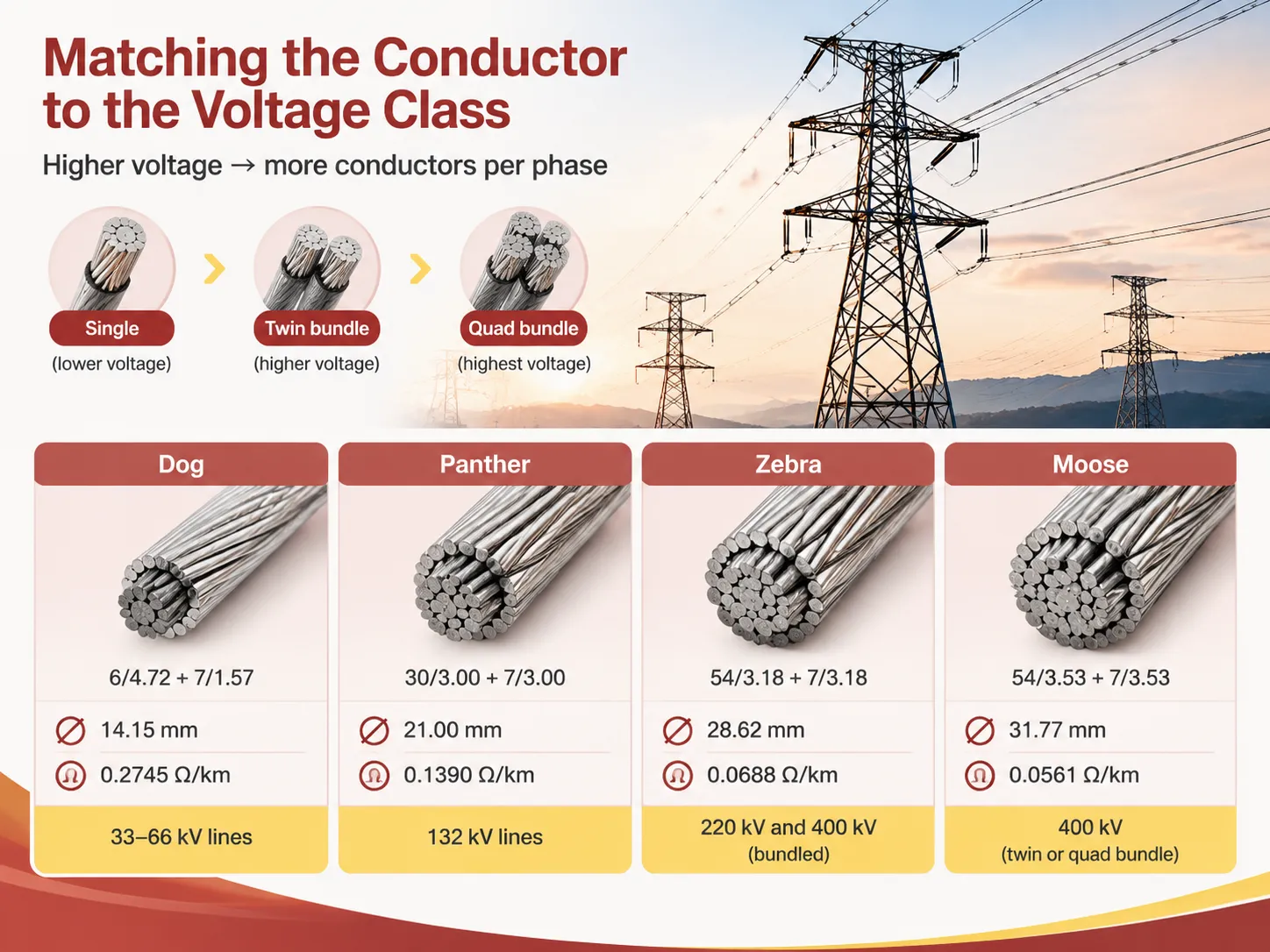
The way power is transmitted changes as the transmission voltage changes, and the change is caused by geometry and not economics.Above roughly 220 kV, lines carry more than one conductor per phase, and the same logic that governs the difference between high voltage and low voltage design decides how many. A 400 kV line commonly runs two or four sub-conductors per phase in a bundle rather than one very large conductor.
The change in power transmission has to do with inductance and corona effects. Inductance of a power line is determined only by the physical radius of the wire, and the increase of the radius of a single wire does not have much influence on inductance. To make it effective, wires are bundled into a number of smaller wires, therefore, the effective radius increases with the number of wires, while maintaining the electric field at the surface low enough to avoid corona. Hence, the aluminum content in the wires grows with voltage, and the design of the wires is done beforehand, thus it does not depend on the manufacturer.
| ACSR code name | Stranding Al / steel | Overall diameter | DC resistance at 20 °C | Uso típico |
|---|---|---|---|---|
| Dog | 6/4.72 + 7/1.57 | 14.15 mm | 0.2745 Ω/km | 33-66 kV lines |
| Panther | 30/3.00 + 7/3.00 | 21.00 mm | 0.1390 Ω/km | 132 kV lines |
| Zebra | 54/3.18 + 7/3.18 | 28.62 mm | 0.0688 Ω/km | 220 kV and 400 kV, bundled |
| Moose | 54/3.53 + 7/3.53 | 31.77 mm | 0.0561 Ω/km | 400 kV, twin or quad bundle |
These names are derived from national conductor catalogs, while the figures that follow — including diameter, stranding, resistance, and geometric mean radius — are key considerations in designing a line. The first aspect concerning the substance of the conductor is resolved far in advance of reviewing the conductor table.
Ampacity, temperature and terminal ratings
The lower conductivity of aluminium extends to the ampacity tables as well. With the same conductor size, aluminium is able to conduct around 78-80% of the ampacity of copper at the same temperature rating for insulation. For example, a 1/0 conductor rated at 75 °C presents an ampacity of 150 A in copper and an ampacity of 120 A in aluminium. In order to achieve the same ampacity level, it is necessary to use a larger conductor — the general rule is to use a conductor that is two AWG sizes larger than in copper.In the end, this brings the issue of the space —the aluminium conductor that conducts the required current requires different raceway sizes, different lugs and more space at the panel.
Two details in the code create most cases of errors in the field. The first one is the fact that ampacity depends on the temperature ratings of wiring and terminations. A 90 °C insulated conductor connected to a 75 °C rated terminal can only be used at the lower figure unless the assembly is listed otherwise, and that listing is exactly what a UL 489 molded case circuit breaker declares in its terminal temperature rating rather than in its marketing literature. The second detail is that aluminium connections must be made using connectors that are listed as suitable for aluminium wiring, using the aforementioned torque and the oxide inhibitor according to the specifications of the connector manufacturer.
What this means for switchgear and terminations
At this stage, the decision made by the conductor is no longer a decision regarding the wire, but one concerning the switchgear. The use of aluminium feeders requires that every piece of equipment connected to the wires is rated for both aluminium and copper; the termination equipment has to be bimetallic involving an aluminium and copper connection wherever aluminium is used with copper.
HUYU’s manufacturing line makes components such as MCBs, MCCBs, air circuit breakers, contactors, relays, current transformers, surge protection devices, automatic transfer switches and PV combiner boxes. We do not produce wire, thus we do not view it to be up to us to make the choice between aluminium and copper.What we do is supply equipment whose terminals are rated for both, with the torque and conductor-range data published — a DIN-rail interruptor automático miniatura is only a 63 A device to the extent its terminals accept the conductor you bring to it.
As we have learnt from our experience with failures in the field, it is important to remember that whenever a feeder changes material during a run, the junction of that change must be at a designated terminal or at a bimetallic connector — never half-way along a run with a split bolt and a piece of tape.
How to decide on a real project
| Aplicación | Material | Razón |
|---|---|---|
| Overhead transmission and distribution | Aluminium (ACSR / AAAC) | Weight, span length, tower cost, diameter and corona |
| Underground and submarine cable | Copper, sometimes aluminium for large LV | Cross-section is expensive; robustness at landing points |
| Switchgear busbars and control wiring | Cobre | Fixed enclosure volume; connection reliability |
| Motor and transformer windings | Copper; aluminium in cost-driven distribution units | Winding space, losses, heat dissipation |
| Building feeders, larger circuits | Aluminium for size and cost; copper for tight routes | Trade-off between metal cost and raceway space |
| Existing installations | Match what is already there | Avoid re-rating studies and mixed-metal terminations |
System-level decisions often push the answer one step further. On a large industrial site, the conductor material interacts with the distribution architecture — how many transformers, how long the MV runs, how much MV switchgear — which is why enterprise-scale distribution systems are designed as a whole rather than conductor by conductor, and why optimising the architecture usually saves more than the metal swap does.
Preguntas Frecuentes
Is aluminium or copper better for power transmission?
Aluminium is preferred for overhead lines by an enormous factor, with more than 90% of the global network employed in its use. Copper is better suited for underground lines, equipment, or situations where the cross-section is predetermined. They both have their strengths; the question then is which constraint applies to the situation in question.
Why is aluminium used instead of copper in overhead lines?
This is because an aluminium conductor with the same resistance weighs only approximately half as much and costs about 35-50% of the price of the copper equivalent. The fact that the weight is half makes the spans longer and more towers and smaller foundations are needed to properly support the structure.
Can copper and aluminium wires be connected directly?
Avoid using it in any damp or exterior area. Aluminium is electropositive to copper, which can cause galvanic action in the presence of moisture within the connection. Therefore, make sure to use special bimetal connectors designed specifically for the two metals.
Does aluminium wire carry less current than copper of the same size?
Indeed, typically the Copper rating is around 78 to 80 percent for the same insulation temperature of the insulation. If you want the same amount of current and voltage, you’ll use about two AWG sizes up which would require bigger conductors and therefore bigger sizes of both raceways and lugs as well.
What is ACSR and why is the steel core there?
The Aluminium Conductor Steel Reinforced (ACSR) is formed by placing a steel wire core at the centre of several layers of aluminum wires. The role of steel is to take the tensile stress that the hard drawn aluminum cannot manage on long spans, while the aluminum is responsible for carrying electrical current. Since steel is located in the central part of the conductor where the place for the electrical current is minimum, almost no electrical loss occurs.
Is aluminium wiring in a house dangerous?
Not per se, but it does require proper device installation. The mistakes that happened in the 1960s and 1970s can be attributed to the use of aluminum wire connectors with devices that were not rated for such conductors, but were utilized without the appropriate installation or proper torque. Nowadays, with the use of the oxide-inhibiting compound, the devices rated for CO/ALR rating, as well as bimetallic gadgets the process works correctly and efficiently under the condition that those requirements are fulfilled.
Referencias
- NFPA — NFPA 70 National Electrical Code, Article 310 and Table 310.16
- ASTM — B230/B230M Standard Specification for Aluminium 1350 Wire for Electrical Purposes
- ASTM — B232/B232M Concentric-Lay-Stranded Aluminium Conductors, Coated-Steel Reinforced (ACSR)
- IEC — IEC 61089 Round wire concentric lay overhead electrical stranded conductors
- IEEE — IEEE 738 Standard for Calculating the Current-Temperature Relationship of Bare Overhead Conductors
- UL Solutions — UL 486A-486B Wire connectors and UL 489 molded case circuit breakers
- Copper Development Association — Copper vs aluminium conductor comparison data
Conclusión
When it comes to electric power transmission, aluminum is the primary material used in this area for more than many decades. The reason for such a choice is because of the advantages of aluminum, which doesn’t have superior conductance properties but has only half the weight and lower cost thus prolonging the spans length and reducing the number of towers required. The steel core being used in ACSR has been responsible for eliminating the only serious disadvantage of aluminum. Copper is still used where weight is an advantage, namely in underground and underwater wiring as well as in windings and control circuits. Whatever metal is used, though, the connector in the end has to be of the right type, as well as the inhibitor and torque level. Most failures happen not during the operation of the wire itself, but at points where it crosses metal.