
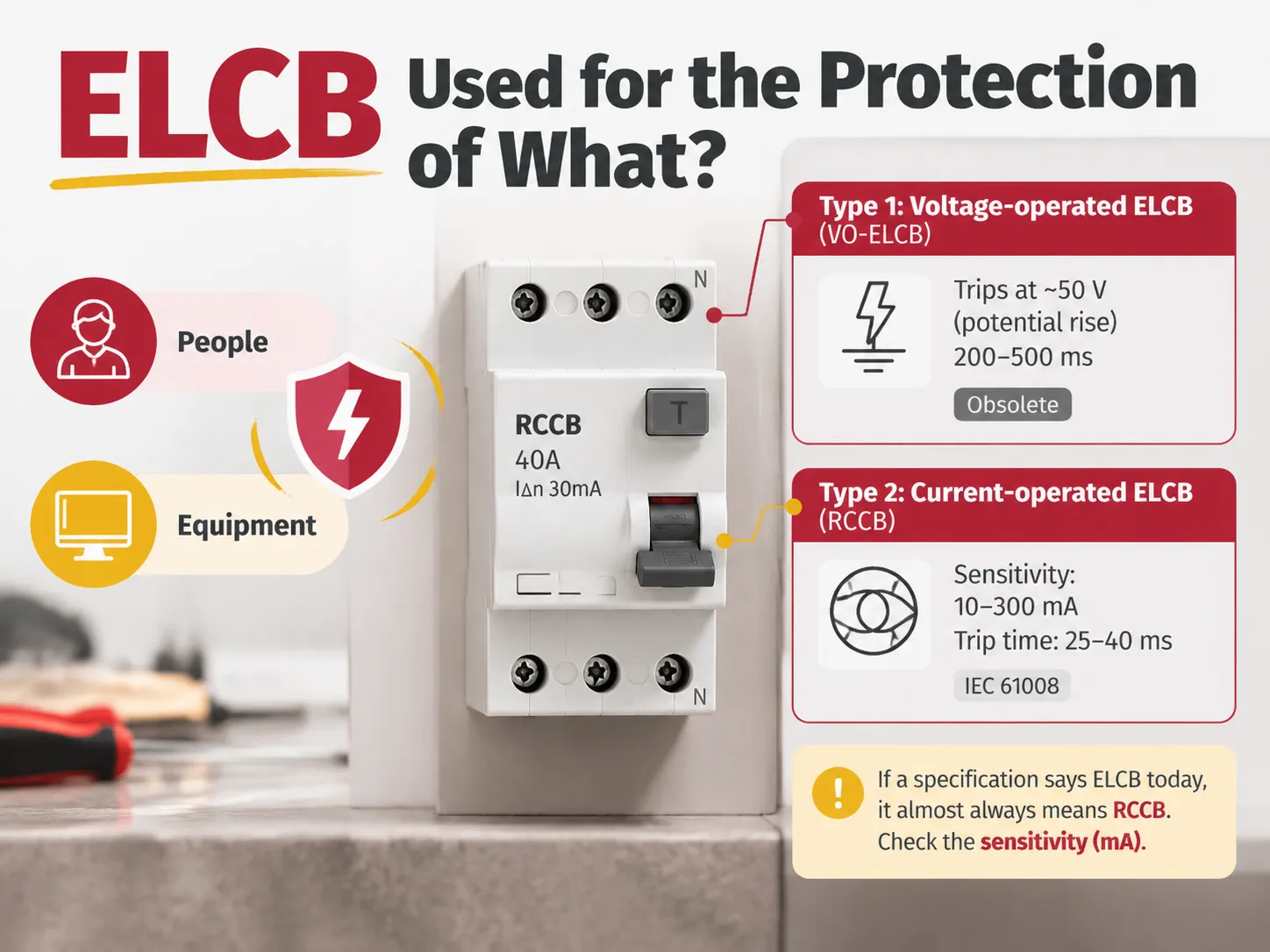
An ELCB protects people against electric shocks due to earth leakage, i.e., live currents leaking through damaged insulation materials, water, or even a human body. However, this name refers to two completely different instruments, and only one of them is produced today. The voltage-operated type protected against the presence of a raised voltage level at metal casings, while the current-operated type is what is now known as RCCB or RCD, and this device is the one providing protection against electric shock to the person standing on the ground.
Short response: ELCB means earth leakage circuit breaker, which is used for safeguarding people and devices against the impact of earth leakage current. There exist two main types. The voltage-operated ELCB (VO-ELCB) gets tripped in case of increase in potential between installation metallic parts and separate earth sensor electrode when the voltage reaches some value, about 50 V, taking around 200-500 milliseconds. This version is no longer in use. The second type is modern current-operated ELCB which is the contemporary RCCB governed by the standard IEC 61008. The sensitivity is selectable from 10 mA to 300 mA and trip time is from 25 to 40 ms. If any specification still states ELCB these days, it means RCCB in fact, and measured in mA.
Two Devices, One Name
The terminology is quite misleading, resulting in real dangers when both products had the same name in the industry. The correct approach is to differentiate by the measurements done by each device.
- Voltage-operated ELCB (VO-ELCB). It measures the potential between all metal structures of the installation – frames, conduits, boxes – and the distant isolated earth electrode. Once the potential increases to the value of around 50 V, the given device opens the main circuit.
- Current-operated ELCB. It compares the current going along the line with the current coming back along the neutral wire. Any discrepancy indicates that the current travels through some other way. Because of the confusion, this device was renamed as residual current device by the IEC and today it is purchased under the names of RCD, RCCB or RCBO.
In other words, the principle is the same in both situations – a latching relay is used, with the incoming electric supply being connected through the switch contacts, which means once the device trips it disconnects the installation and does not reconnect until it is reset.
Worth being precise about what “earth leakage” means, because it is the phenomenon both devices exist to catch: current that leaves the intended circuit and returns to earth by an unintended route. That is what a ground fault is and how it differs from a short circuit, and it is the specific hazard an ELCB was designed to interrupt.
How the Voltage-Operated Type Worked
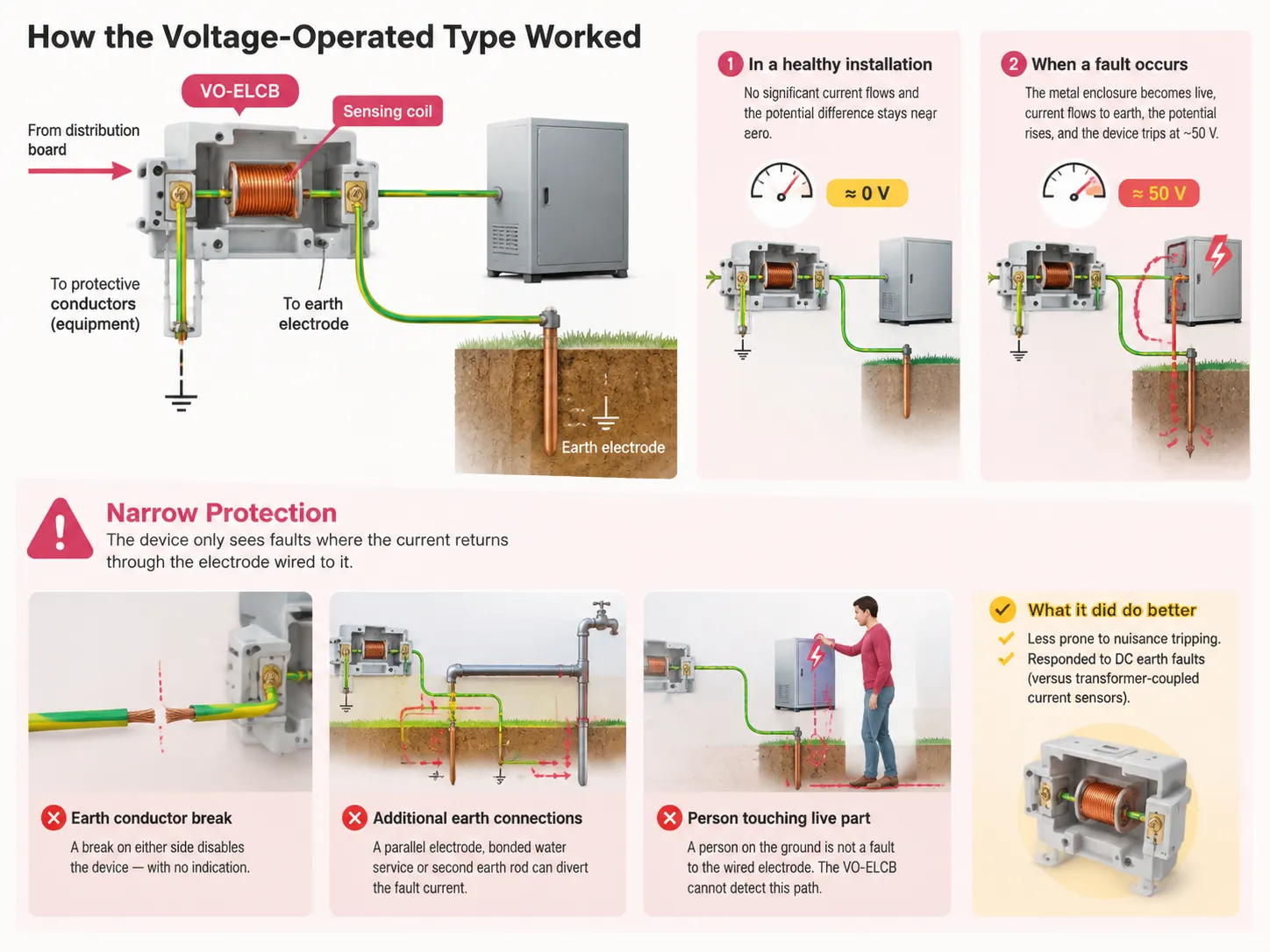
There are two earth terminals with a VO-ELCB and the earth conductor is intentionally routed through it. One terminal is connected to the conductors protecting equipment, and the other terminal is connected to the earth electrode. The sensing coil is located in between those two terminals.
If an installation is healthy, then no current flows along that path and the voltage (potential difference) remains at a very low value. If insulation fault occurs and a metal enclosure becomes energized, the fault current starts flowing to the earth through the earth electrode, the voltage at the metalwork rises above the remote earth reference, and sensing coil detects this rise causing the tripping of the device at the voltage of about 50 volts.
Pay attention to how limited the device’s coverage is. This device can only recognize faults when the current is conducted back through the connected electrode. In effect, this means:
- Regardless of where the failure happens in the earth conductor, the ELCB is rendered useless, with no signs to indicate this malfunction.
- Any other connection to earth in the protected system, such as a second earth electrode, connected pipes, etc., can cause the current to bypass the sensor and override the device.
- If a person on the ground comes into contact with any live wire, it does not go through the wired electrode, and hence will not be detected by the device. This is the limitation that forced the product out of the market.
There is one thing that makes this voltage actuated design better than others, and I have to mention it in the interest of honesty: it was less susceptible to false tripping, and it was capable of detecting DC earth faults that cannot be seen by an inductive device. However, these advantages do not justify the use of an appliance that works without the slightest sign of failure and fails to perform its main function.
Why ELCBs Fell Out of Use
Three issues are worth mentioning in the order of significance.
- Earth reliance. The normal functioning of voltage-based fire safety systems depends on proper, functional earth installation and the presence of an independent reference electrode. In older buildings, damaged and rusted down earth wires are one of the most common problems that electrical engineers face. If the device cannot signal a wire cut-off, it does not serve any safety purpose.
- Speed and sensitivity. The 50-V threshold and 200-500 ms disconnection time leave a wide margin of decision. The current-operated device disconnects at 30 mA in 25-40 ms, which is the time that makes survival possible. Therefore, the time and current problem involved in ventricular fibrillation physics leads to the loss of efficiency of ELCB.
- Standards took a different route. IEC 61008 defines technical requirements, performance, testing, and marking for residual current circuit breakers without built-in overcurrent protection, while IEC 61009 regulates the performance of those with overcurrent protection. However, the voltage-operated ELCBs are excluded from the list of safety requirements by modern standards, which means that they can only be identified by their violations during the next safety audit.
Accordingly, people in charge of maintaining buildings based on old ELCBs should understand that replacing them does not mean exchanging the equipment but upgrading the earth wiring system that was used along with the old units.The comparison that matters when you get there is between the current-sensing options, and how an RCCB and an RCBO differ in width, cost and whether a separate MCB is needed is the decision that actually comes up on a retrofit.
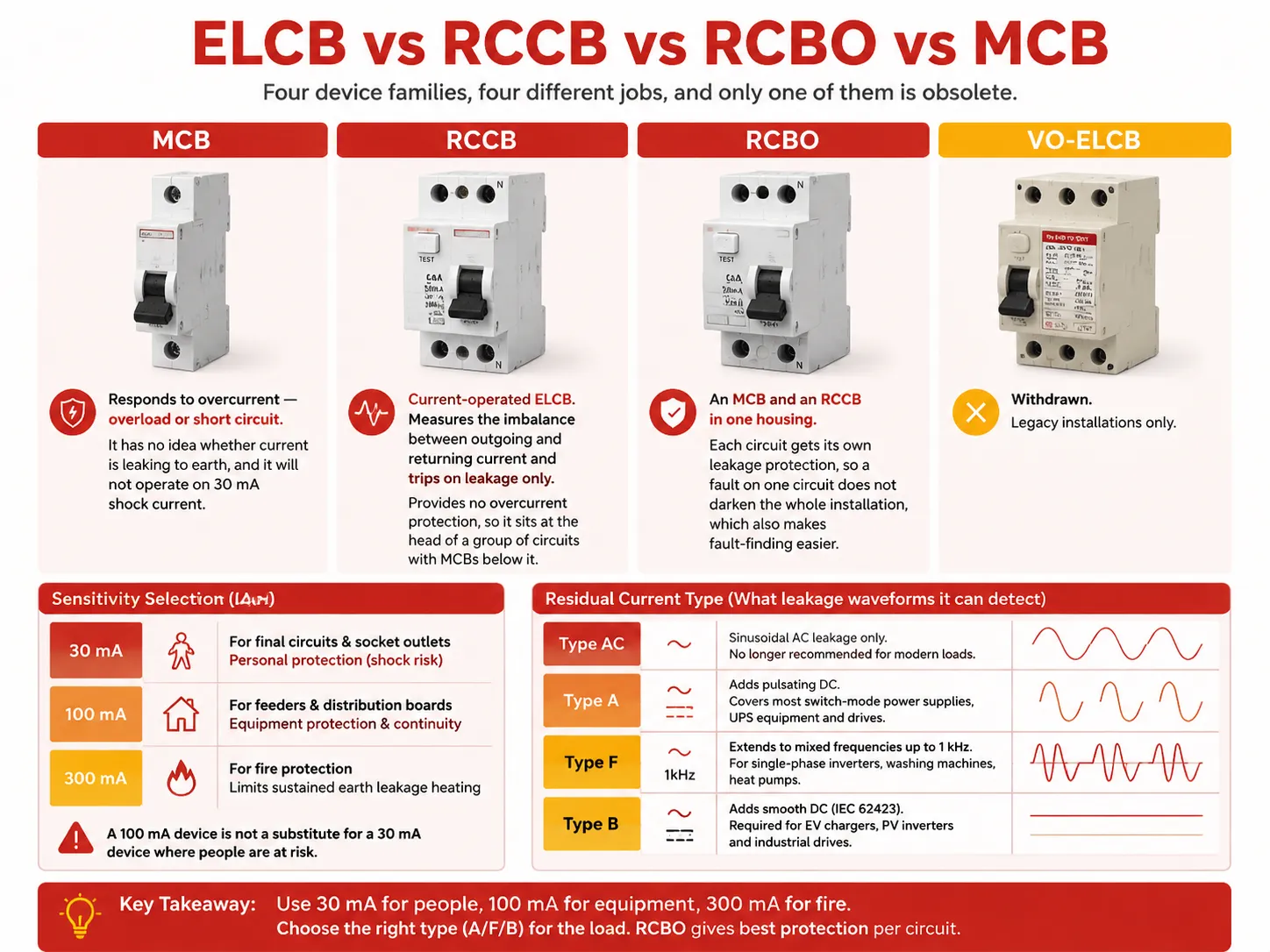
ELCB vs RCCB vs RCBO vs MCB
There are four types of devices, each with distinct functions, and only one has fallen into disuse.
- The MCB is an electro-mechanical switch designed to respond to excessive current in the circuit. It has a good response to faults caused by overloads or short circuits.However, it does not respond to any fault currents because these currents are too small to cause any meaningful operation of the device.
- The fault current device, or RCCB, is able to measure the disbalance between the fed-out current and the fed-back current and operate only in the case of leakage current.However, it provides no protection against any overcurrents and therefore sits higher in hierarchy, with MCBs being supplied below.
- RCBO is a combination of both MCB and RCCB as its advantage is that the circuit will always receive protection against fault current. This shields the system from complete outage even if one circuit has some fault.
- VO-ELCB is an obsolete device that was used in older systems.
Sensitivity selection is what decides whether the device will actually save lives. According to standards, 30 mA is chosen for final circuits supplying power to socket outlets and other places with danger for people; 100 mA for the device functioning in the feeding circuits; and 300 mA is required in case fire risk exists. It is imperative to remember that 100 mA device can never substitute a 30 mA device in any case. Devices like the two-pole RCCB range rated 16–125 A in Type AC and Type A versions are the modern alternative to a legacy ELCB at that same position in the board.
Another key distinction has emerged due to the changes in loads over time. The residual current types — A.C, A, F or B — refer to the types of leakage currents that the appliance can recognize. Type A.C only governs sine wave A.C leakage currents, and it is now obsolete for the application in recent electronic loads. Type A covers the pulsating D.C. currents that apply to most switch-mode PSUs, uninterruptible power supplies, and motors. Type F consists of several frequencies covering up to one kilohertz for some single-phase inverters, washing machines, and heat pumps. When it comes to type B, we are now guided by IEC 62423, which means that type B not only consists of smooth D.C. but is also the one required for e-vehicle chargers, photovoltaic inverters as well as industrial motors. Today specifying type A.C for the application is a clear misunderstanding, which becomes evident when the load that the appliance protects is not resistive anymore.
Where You Still Find Them
Voltage-operated Earth Leakage Circuit Breakers (ELCBs) are still in use in old residential and light commercial setups, as well as in some industrial places that are still using the original design and in nations where the use of this type was spread before the advent of the current-sensing devices. The fact that some of these devices are still being utilized complicates matters. That is because a device that seems to work correctly in a fully functional installation can be disabled by an earth fault at the very moment when it should work.
Current-operated ELCBs are on a different footing. Their use is widespread in fields such as electrical engineering and industrial technology in Southeast Asia and in India, even though the functional name of this type of devices has been changed into “current operated circuit breakers” (or “RCCBs” for short). A bill of quantities asking for an “ELCB” is always requesting an RCCB instead. To confirm whether a device is of mA type, it is necessary to check the datasheet for the expected quality measurement instead of checking its name on the packaging: if the device is rated in milliamps, it means it is of current operated type. The same naming convention runs through regional practice in places where earth leakage protection is being upgraded on older building stock, as in this look at how earth leakage protection is specified and retrofitted in the Philippines, where the local code framework and the equipment available on the market do not always line up.
Retrofitting an Older Installation
Changing an ELCB is not as simple as replacing one device with another. Five crucial checks need to be carried out; otherwise the ELCB will not behave properly, either tripping for the wrong reasons or not functioning at all.
- Earth system. In a VO-ELCB circuit, it is necessary to connect earth conductors through the device. In this case, it will be necessary to check earth connections instead of just relying on them.
- Neutral. Current-operated devices will detect all active lines. Therefore, in order to avoid nuisance tripping, there should be no connection to earth for neutral conductors downstream of the device and all the conductors must be separate without common grounds.
- Sensitivity and discrimination. It is essential to choose 30 mA for circuits with sensitive protection, while for a less sensitive circuit the device with rated current of 100–300 mA must be chosen.
- Type of load. Residual current type of the ELCB must be selected depending on the nature of the load. Gear with variable speed drive, inverter or any DC equipment requires the use of Type A, F or B devices instead of Type AC ELCBs.
- Overcurrent protection requirement in the same circuit. Availability of very limited space in the control panel may require the use of special modules that combine both functions. A 63 A MCB in 1P to 4P configurations with Type B, C or D trip curves is the overcurrent half of that pairing, and the trip curve is chosen against the inrush of whatever the circuit actually feeds.
One last piece of advice that should be considered by whoever advises on the work is to take advantage of the replacement of ELCB to inspect the earth system as a whole; the old device was the only installation where the proper functioning depended on this ground connection. If the ground connection was faulty, there would be no warning on the installation, while the new device would not be useful.
Preguntas Frecuentes
What does an ELCB protect against?
Earth leakage refers to a condition whereby the current escapes from the live wire through an unplanned route, possibly even via a human body. The voltage-operated earth leakages work when current gets back to earth through the metal parts of the equipment connected to its electrical earth, disconnecting at around 50 V. The current-operated earth leakages work against the leakage itself and are available at different dependence on current starting from 10 mA to 300 mA (standard is 30 mA for safety in a final circuit).
Why is ELCB no longer used?
The voltage-operated type of earth leakage circuit breaker has been eliminated due to its silent failure and inability to detect the important fault. Its operational principle only allows to detect the leakage flowing through its earth electrode, and any cut of earth conductor or any additional earthing in the circuit is going to be fatal for its proper function without giving any signal. Its current can’t be detected in case a human is touching the ground. Being at the level of around 50 V for cutting, and 200-500 ms for reaction, the voltage-operated type of ELCB does not provide appropriate level of shock protection. In comparison, the current-operated ELCBs are measuring the current imbalance directly, work independently of the integrity of paths to the earth and shut down within 25-40ms for 30 mA.
What is the difference between a GFCI circuit and an ELCB?
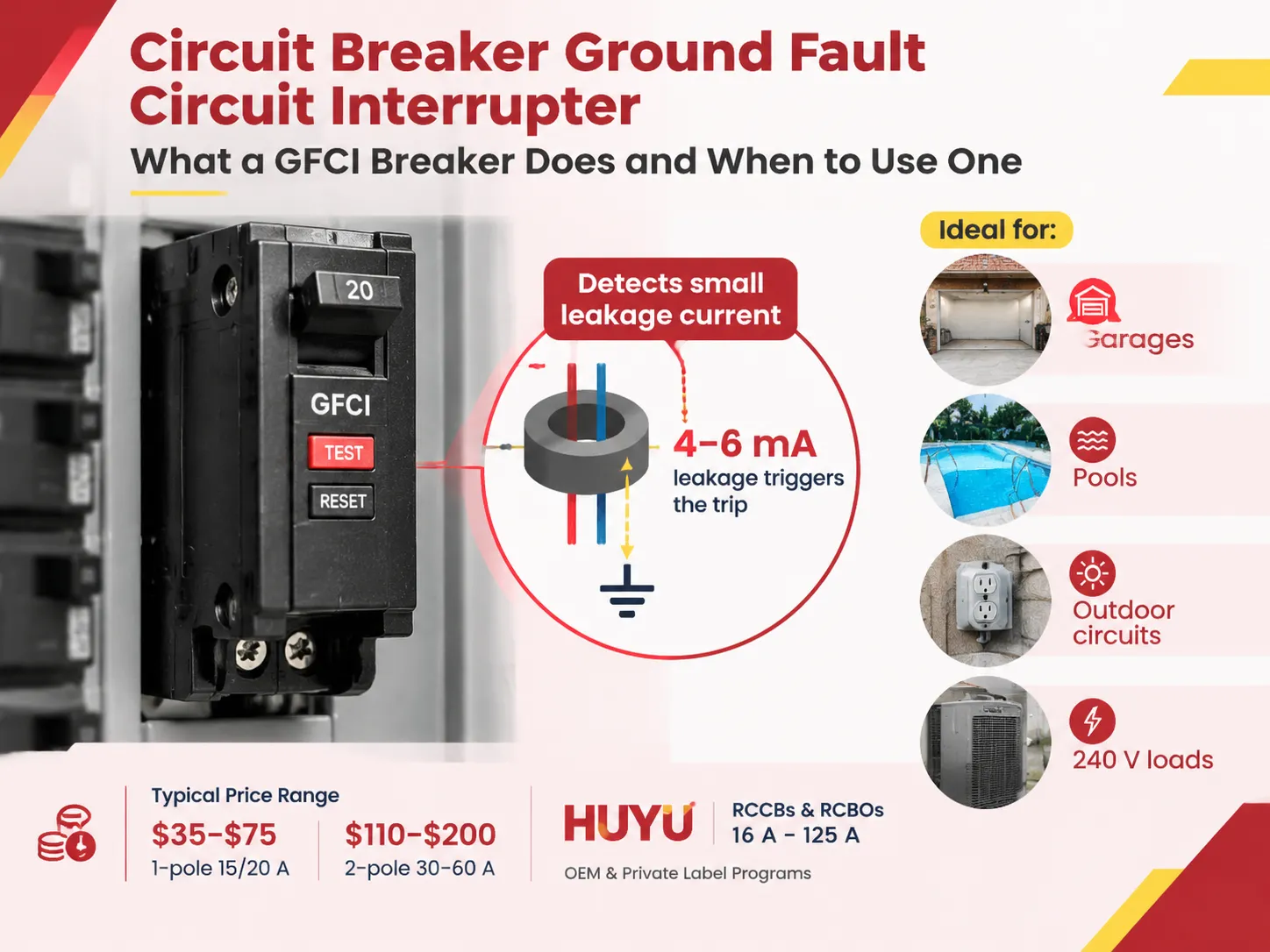
They tackle the same issue by employing a different threshold and different reference point. The GFCI is considered a Class A product by US UL standards and reacts to current leakage between 4 and 6 mA within 1/40 seconds countrywide public safety code guidelines mandatory application say bathrooms, kitchens, garages, outdoors and several other locations which are indicated and interpreted by electrical currents. The ELCB, on the other hand, stands for the current-operated RCCB following IEC 61008. The most common variant used in personal protection systems has sensitivity of 30 mA. It is also possible to use RCCB with grammatic errors of 100 mA and 300 mA for applications relating to electrical protection against electric shock and switchgear and circuits against overloads, respectively.
What are the two types of ELCB?
Electricity-operated and current-operated. The electricity-operated ELCB (EO-ELCB) detects an increase in voltage between the metal structure of installation and distant earthing electrode and operates when this falls outside the 50V range. The current-operating ELCB measures the difference between the current flow in the live wires and return on neutral, and operates due to the disparity in electric flow; this term was reassured by IEC which is the actual name we use in the market today appearing as RCCB, RCD or RCBO. Majority of devices available on the market are current-operated, and checking the selected units sensitivity in milliamp is the easiest choice to make.
Referencias
- International Electrotechnical Commission — IEC 61008 (RCCBs), IEC 61009 (RCBOs) and IEC 62423 (Type F and B)
- Normas y participación de UL — UL 943, Interruptores de circuito por falla a tierra
- NFPA 70, National Electrical Code — Article 210.8, ground-fault circuit-interrupter protection
- UL Solutions — electrical safety certification for protective devices
- Hager — residual current device selection and application guidance
Conclusión
The ELCB shows us how important it is to use correct terminology in electrical protection. One device detects a rise in voltage and only protects the metal connected to its own electrode. Another device, however, measures current imbalance and protects the person using the tool. The two devices have been called the same for many years, prompting the IEC to change the name of the survivor. When you come across a specification that states ELCB, the first thing to look for is its sensitivity, in milliamperes. If that is absent from the specification then you are looking at a device that should have been replaced by a current-operated circuit breaker ages ago.