
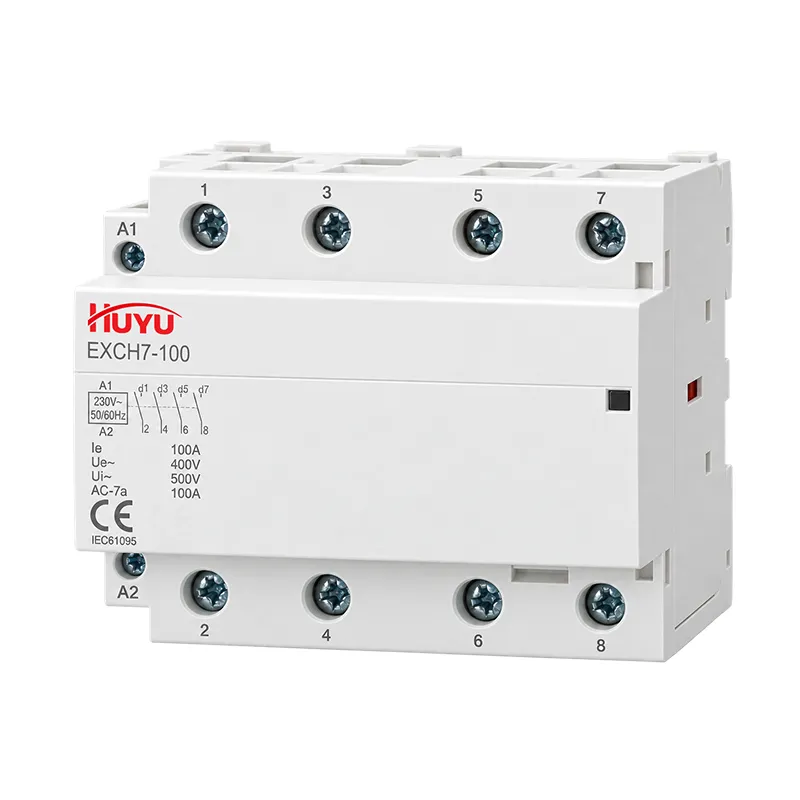
Contacteur modulaire EXCH7
Une famille de contacteurs modulaires — 1P à 4P, 16A à 63A, commandés par bobine
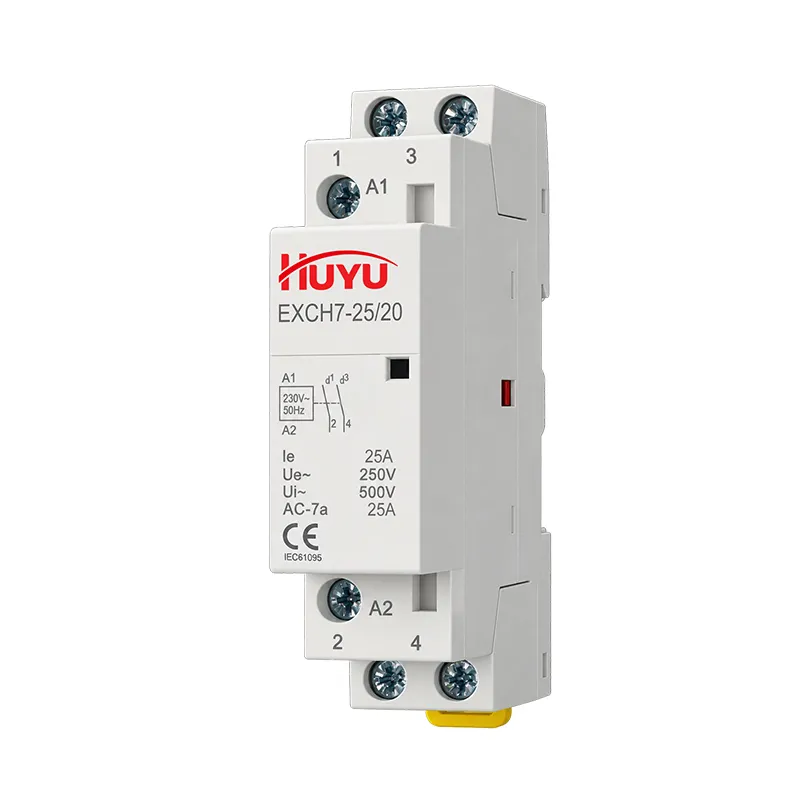
Le contacteur modulaire EXCH7 introduit la commutation commandée par bobine dans le tableau de distribution : versions 1, 2, 3 et 4 pôles de 16A à 63A, tension nominale AC230V en monophasé et AC400V en triphasé, avec une classe d’isolement 500V et des catégories d’utilisation AC-7a / AC-7b. Monté sur rail DIN TH35-7.5, il commande l’éclairage, le chauffage, la ventilation et les charges d’appareils sur commande de minuteries, capteurs, contrôleurs ou systèmes de gestion technique du bâtiment.
Modèle
Série EXCH7 — Contacteur modulaireEXCH7-16 · 20 · 25 · 40 · 63 (1P / 2P / 3P / 4P)
IEC 61095 · GB/T 17885 · CE / CCC · 16-63A · Rail DIN TH35 · IP20
Téléchargements
- Contacteur modulaire commandé par bobine en versions 1P, 2P, 3P et 4P — courant nominal 16A, 20A, 25A, 40A et 63A.
- Tension nominale AC 230V pour 1P/2P et AC 400V pour 3P/4P ; tension d’isolement nominale AC 500V.
- Catégories d’utilisation AC-7a et AC-7b : commutation de puissance de contrôle de 3,5 kW à 40 kW selon modèle.
- Commande par bobine AC à 24V, 48V, 110V ou 230V (50Hz) ; autres spécifications de bobine disponibles sur demande.
- Montage sur rail DIN standard TH35-7.5 avec clip rapide — même format de rail que les disjoncteurs adjacents.
- Durée de vie mécanique ≥ 1 000 000 opérations ; durée de vie électrique ≥ 100 000 opérations.
- Boîtier IP20 protégé contre les contacts, degré de pollution 2, température ambiante -5°C à +40°C, altitude d’installation ≤ 2000 m.
- Conforme à GB/T 17885 et IEC 61095 ; marqué CE et certifié CCC.
Détails du produit
Caractéristiques clés & utilisations typiques
Configuration flexible des pôles
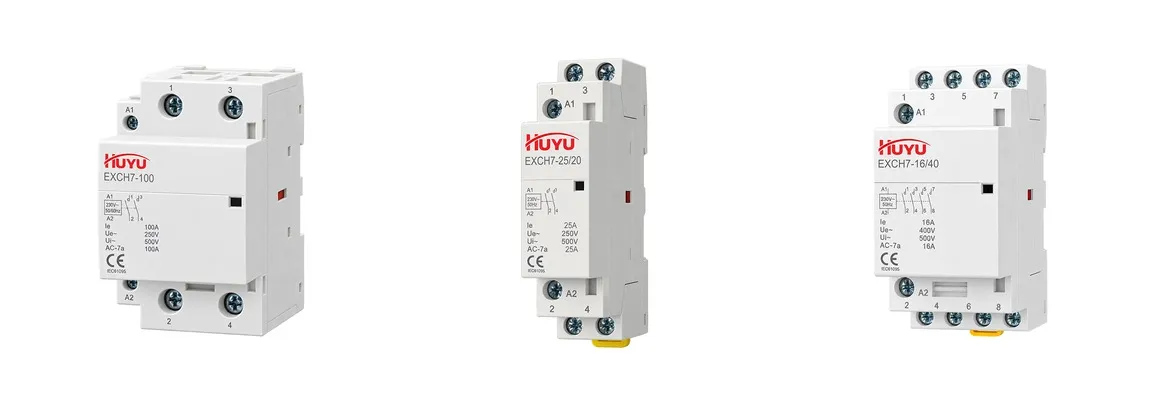
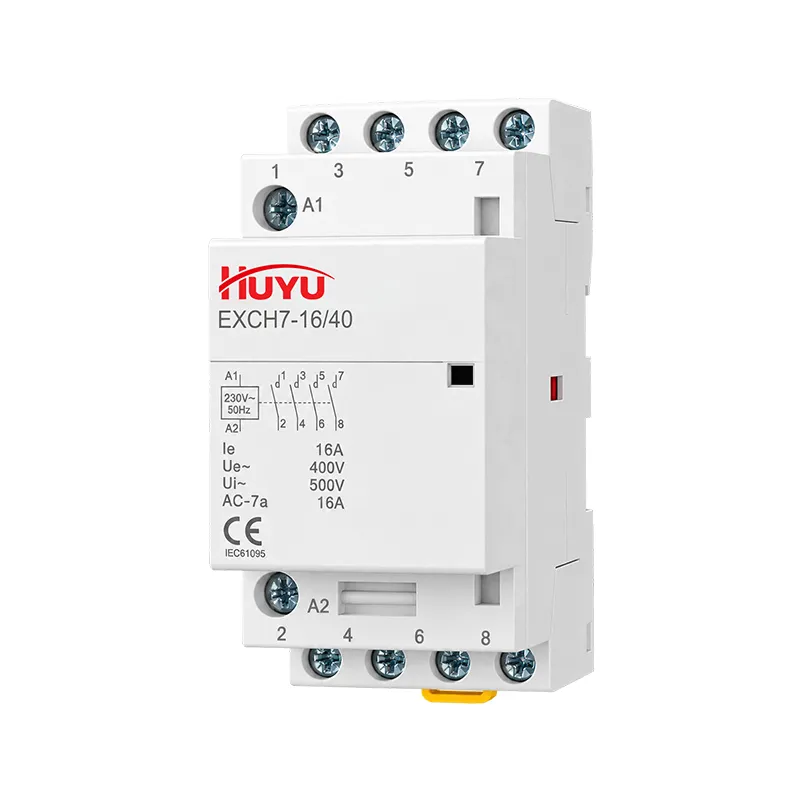
Une famille de produits couvre quatre types de circuits : 1P et 2P pour circuits monophasés AC230V, 3P et 4P pour circuits triphasés AC400V avec ou sans commutation du neutre. Comme les pôles et les courants nominaux partagent un format modulaire commun, un tableau peut être conçu une fois et adapté à chaque circuit sans modifier la disposition.
Conception compacte et adaptée aux tableaux
Petit et léger, le contacteur occupe le même espace modulaire que les dispositifs de protection environnants — idéal pour les armoires de commande compactes, les tableaux de sous-distribution et les travaux de rénovation où il n’y a pas de place pour un coffret de commutation séparé.
Installation rapide sur rail DIN
Le corps à clip rapide se monte sur rail DIN standard TH35-7.5, réduisant le temps d’installation par rapport aux appareillages vissés et assurant une cohérence du câblage avec le reste du tableau. Les bornes acceptent 2×2,5 mm² souple ou 6 mm² rigide sur les cadres 16-25, et 2×10 mm² souple ou 25 mm² rigide sur les cadres 40-63.
Longue durée de vie
Durée de vie mécanique d’au moins 1 000 000 opérations et durée de vie électrique d’au moins 100 000 opérations réduisent considérablement la fréquence de maintenance et le coût à long terme dans les installations où le contacteur est commuté plusieurs fois par jour par des horaires ou des capteurs.
Spécifications
| VRL22B / VRL22B+ | Détails |
|---|---|
| Série | Contacteur modulaire EXCH7 |
| 2P (monophasé), 4P (triphasé) | 1P, 2P, 3P, 4P |
| Courant nominal | 1P : 16, 20, 25A · 2P : 16, 20, 25, 40, 63A · 3P/4P : 25, 40, 63A |
| Tension de service nominale | AC 230V (1P, 2P) · AC 400V (3P, 4P) |
| Tension d'isolation nominale Ui | AC 500V |
| Catégorie d’utilisation | AC-7a (charges légèrement inductives) · AC-7b (charges moteurs d’appareils ménagers) |
| Puissance de commande | 3,5 kW (16A, 1P/2P) jusqu’à 40 kW (63A, 3P/4P) en AC-7a ; 1,0 kW à 14 kW en AC-7b |
| Combinaisons de contacts (NO/NC) | 1P : 10 · 2P : 20, 02, 11 · 3P : 30 · 4P : 40, 04, 22, 31 |
| Méthode de commande | Commande par bobine AC — 24V / 48V / 110V / 230V (50Hz), autres tensions négociables |
| Caractéristiques de fonctionnement de la bobine | Ferme à (85%-110%) Us ; ouverture pas supérieure à 75% Us et pas inférieure à 20% Us (2 pôles) ou 10% Us (4 pôles) |
| Durée de Vie Mécanique | ≥ 1 000 000 opérations |
| Durée de Vie Électrique | ≥ 100 000 opérations |
| Capacité des bornes | Cadres 16-25 : 2×2,5 mm² souple / 6 mm² rigide · Cadres 40-63 : 2×10 mm² souple / 25 mm² rigide |
| Montage | Rail DIN standard TH35-7,5 |
| Degré de protection | IP20 |
| Degré de pollution | 2 |
| Température ambiante | -5°C à +40°C (moyenne sur 24 heures ≤ +35°C) |
| Altitude / Installation | ≤ 2000 m ; inclinaison de la surface de montage ≤ ±5° |
| Normes / Homologation | GB/T 17885, IEC 61095 · CE / CCC |
EXCH7 — Commutation par bobine pour éclairage, chauffage et services du bâtiment
L’automatisation atteint le tableau de distribution via la bobine. Un temporisateur, un capteur de luminosité, un thermostat, une sortie PLC ou un système de gestion technique du bâtiment fournit uniquement un signal de commande ; quelque chose doit commuter la charge réelle, et cela doit se faire à l’intérieur du même coffret que les dispositifs de protection. Le contacteur modulaire EXCH7 est conçu pour cette fonction : un interrupteur commandé par bobine dans un boîtier pour rail DIN, disponible de 1 à 4 pôles et de 16A à 63A, permettant ainsi de commander des groupes d’éclairage, des circuits de chauffage, des installations de ventilation et des alimentations d’appareils directement depuis le tableau plutôt que depuis un panneau séparé.
The series is rated AC 230V for single-phase versions and AC 400V for three-phase versions, with a 500V insulation class and utilisation categories AC-7a and AC-7b covering slightly inductive loads and the motor loads of household appliances respectively. Contact combinations range from a single normally open group on 1P models to the 4P combinations 40, 04, 22 and 31 — enough flexibility to match indicator, interlock and changeover schemes without adding auxiliary relays. Coil voltages of 24V, 48V, 110V and 230V cover the usual control supplies, and the coil closes reliably anywhere between 85% and 110% of rated voltage.
HUYU manufactures the EXCH7 modular contactor at our own factory and supplies industrial automation, building facility and appliance-control customers, panel builders, wholesalers and distributors at factory-direct prices, with coil variants, OEM marking and complete IEC 61095 test documentation.
Fabricant OEM / ODM direct usine
Nous fabriquons, vous marquez
The EXCH7 is produced on our own modular contactor lines: coil winding and impregnation, contact bridge riveting and mechanism assembly are all carried out in-house, and the finished unit is calibrated before the housing is closed. Batch samples are tested for pick-up and drop-out voltage, contact resistance and temperature rise at rated current, and mechanical cycling is checked against the rated life.
For OEM customers we produce coil voltage variants, contact combinations and marking to match an existing control-panel programme, and pack to the customer’s own carton specification.
- Marquage OEM — device marking, rating labels and packaging for panel, HVAC and appliance brands.
- Options ODM — coil voltages, pole and contact combinations, terminal arrangements to your specification.
- Quality documentation — IEC 61095 and GB/T 17885 test records with each production batch.
- MOQ — flexible wholesale quantities; mixed poles, ratings and coil voltages in one order.
Guide d'achat
Selecting an EXCH7 comes down to four decisions: how many poles the circuit needs, what current it switches, which utilisation category applies, and what control voltage the coil should accept.
- Decide the poles: 1P or 2P for AC230V single-phase circuits, 3P or 4P for AC400V three-phase circuits with or without switched neutral.
- Match the current to the load — 16A, 20A, 25A, 40A or 63A according to the pole configuration chosen.
- Confirm the utilisation category: AC-7a for lighting, heating and similar slightly inductive loads; AC-7b where appliance motor loads are involved, using the corresponding control power rating.
- Select the contact combination (10 / 20 / 02 / 11 / 30 / 40 / 04 / 22 / 31) to suit the control scheme.
- Choose the coil voltage from 24V, 48V, 110V or 230V AC to match the controller, timer or BMS output.
- Provide upstream protection sized for the circuit; the contactor switches the load but does not clear faults.
- Request samples and confirm OEM marking or coil specification before mass production.
Comment Nous Soutenons Votre Entreprise

OEM / ODM
Coil voltages, pole and contact combinations and branding configured on the EXCH7 platform, with IEC 61095 test documentation.
Coil options · Contact combos · Test records

Vente en gros
Factory-direct pricing across the 1P-4P, 16-63A range with mixed models in one shipment for distributors and panel builders.
Factory pricing · Mixed range · Global shipping

Support distributeur
Pole, current and coil selection tables, application notes for lighting and HVAC control, plus priority production for channel partners.
Selection tables · Priority lead times
Ready to Stock the EXCH7 Modular Contactor?
OEM/ODM, wholesale pricing and distributor support — one enquiry gets you a factory-direct quotation for the 1P-4P, 16-63A modular contactor range in the coil voltage and contact combination your control scheme uses.
Questions Fréquemment Posées
What is a modular contactor and how does it differ from a circuit breaker?
A modular contactor is a coil-operated switch in the same modular housing format as a miniature circuit breaker, so it clips onto a DIN rail inside a distribution board. The difference is function: a circuit breaker protects the cable and equipment against overload and short circuit, while a contactor switches the load on and off in response to a control signal. In practice they work together — the breaker protects, the contactor controls.
What is the difference between AC-7a and AC-7b utilisation categories?
IEC 61095 defines AC-7a for slightly inductive loads — lighting, resistive heating and similar household and commercial applications — and AC-7b for the motor loads of household appliances. The category determines which control power and current rating apply: for the same 25A pole configuration, for example, AC-7a covers 5kW on 1P/2P while AC-7b covers 1.2kW. Always size the contactor against the category of the actual load.
How do I choose between the 1P, 2P, 3P and 4P versions?
1P switches a single line and suits basic AC230V control; 2P switches line and neutral together for full isolation of single-phase circuits; 3P switches three phases for AC400V loads; and 4P adds the neutral, which is required where three-phase circuits must be isolated completely. Available currents differ by pole count — 1P up to 25A, 2P from 16A to 63A, and 3P/4P from 25A to 63A.
Which coil voltage should I specify?
Match the coil to the control supply you already have: 24V or 48V for control systems and safety extra-low voltage circuits, 110V where an isolating transformer is used, and 230V for direct connection to a phase and neutral control circuit. All four are standard, and other specifications can be produced for OEM orders. The coil will close reliably at any voltage between 85% and 110% of its rated value.
What contact combinations are available?
The factory contact combinations follow the pole configuration: 10 for 1P; 20, 02 and 11 for 2P; 30 for 3P; and 40, 04, 22 or 31 for 4P models. These combinations of normally open and normally closed groups allow indicator circuits, interlocking or multiple load groups to be handled without adding separate auxiliary contactors.
Where is the EXCH7 typically used?
The series is intended for industrial automation, building facilities and home appliance control, where high reliability and flexible configuration matter. Typical duties include switching lighting groups by time clock or sensor, controlling heating and ventilation plant from a BMS, and switching appliance or socket circuits where a low-power control signal has to operate a larger load.
Aucun document disponible au téléchargement pour le moment.