
Ketika Anda bertanya kepada tiga teknisi listrik tentang ampacity kawat gauge 14, Anda akan mendengar tiga jawaban yang secara teknis valid: 15, 20, atau 25 ampere. Sejauh menyangkut tabel kode, kedua kelompok mengandalkan set data yang sama. Perbedaan penting adalah regulasi mana yang berlaku untuk sirkuit yang Anda tangani. Dalam kasus kawat 14 AWG, ini menjadikannya mungkin ukuran kawat paling penting dari semuanya, karena ada satu bagian kode tertentu yang sepenuhnya mengesampingkan tabel ampacity.
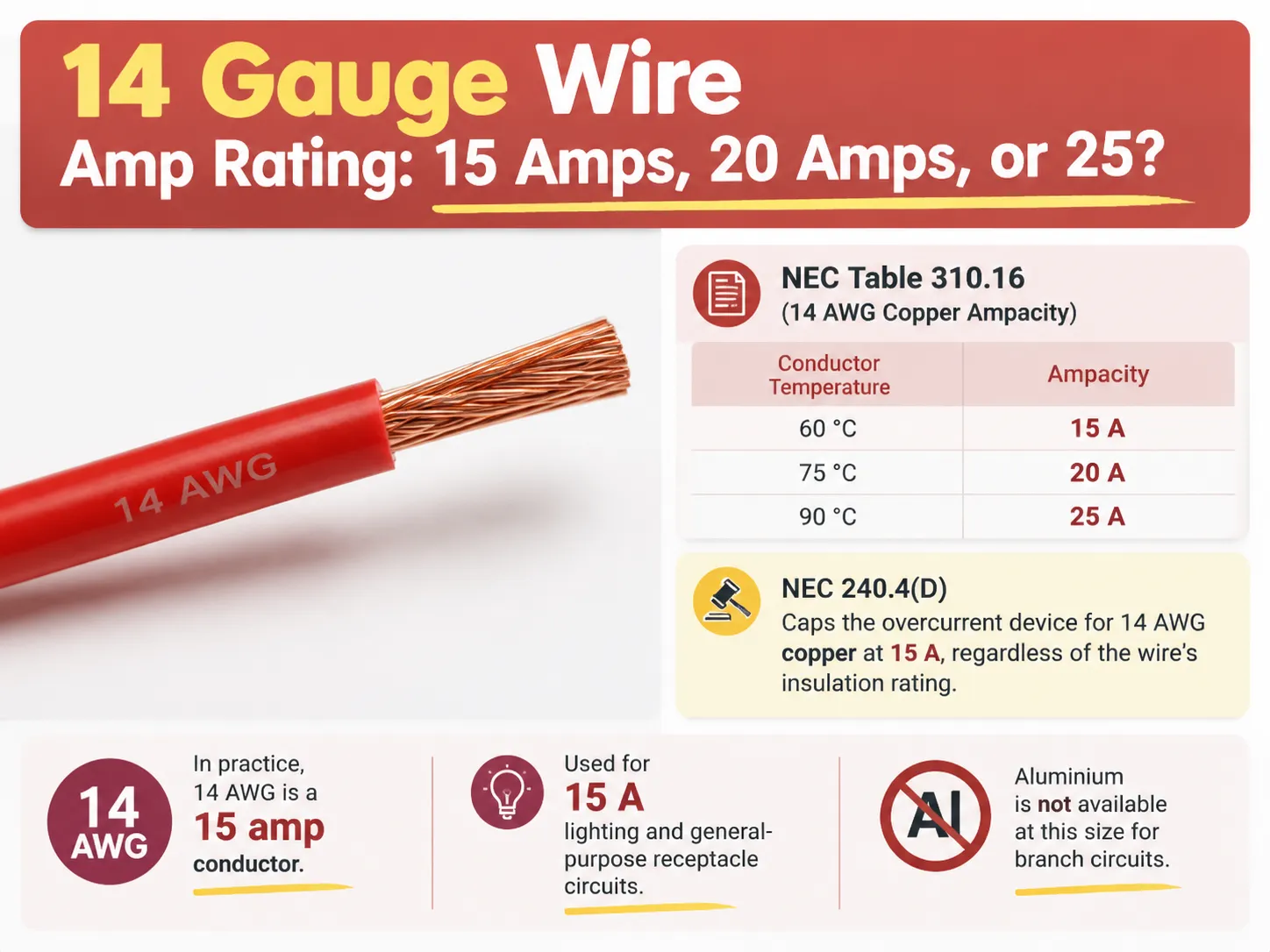
Singkatnya, menurut NEC Tabel 310.16, kawat tembaga 14 AWG yang dinilai pada 60 derajat Celsius memiliki ampacity 15A dan pada 75 derajat Celsius ampacity-nya meningkat menjadi 20A dan pada 90 derajat Celsius meningkat hingga maksimum 25A. Namun, menggunakan NEC 240.4D, dapat dilihat bahwa kawat tembaga 14 AWG dibatasi amperasenya hingga 15 terlepas dari rating isolasi. Karena batasan ini, kawat tembaga 14 AWG hanya dapat digunakan untuk sirkuit pencahayaan dan stopkontak. Selain itu, perlu disebutkan bahwa tidak ada kawat aluminium yang tersedia pada gauge ini untuk instalasi cabang.
Apa Itu 14 AWG Sebenarnya
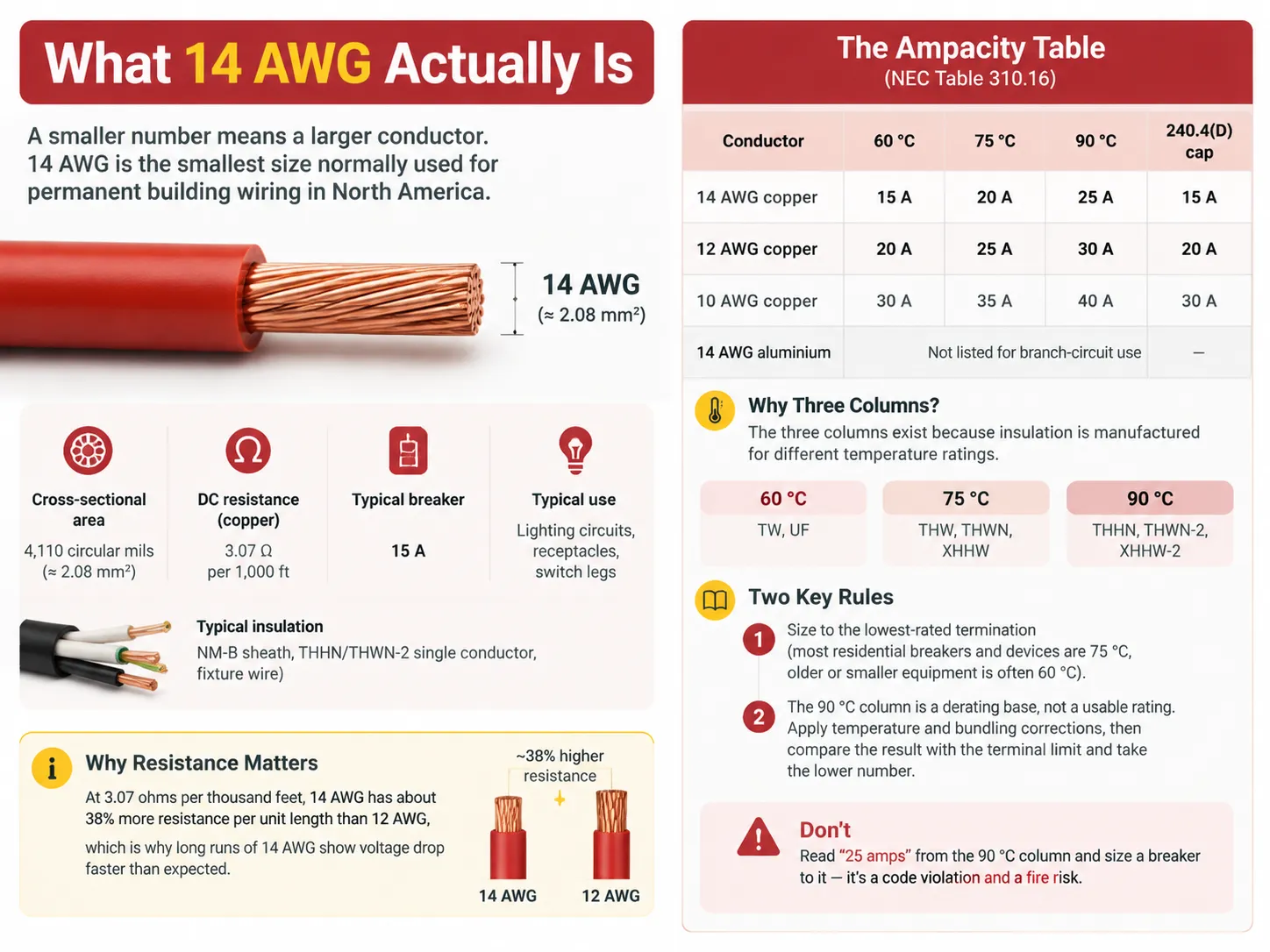
American Wire Gauge terbalik — dalam sistem ini, angka yang lebih kecil menunjukkan kawat yang lebih besar. Ukuran terkecil yang biasanya digunakan untuk instalasi permanen di Amerika Utara adalah 14 AWG, yang satu ukuran lebih kecil dari 12 AWG dan dua ukuran lebih kecil dari 10 AWG.
| Properti | Model |
|---|---|
| Luas penampang | 110 circular mils (sekitar 2,08 mm²) |
| Resistansi DC, tembaga | 3,07 Ω per 1.000 ft |
| Resistansi DC, aluminium | 5,06 Ω per 1.000 ft (jika tersedia) |
| Isolasi tipikal | Selubung NM-B, konduktor tunggal THHN/THWN-2, kawat fixture |
| Pemutus sirkuit tipikal | 15 A |
| Penggunaan tipikal | Sirkuit pencahayaan, stopkontak serbaguna, kaki saklar |
Kawat resistansi adalah yang melakukan tugas sebenarnya pada waktunya. 14 AWG memiliki resistansi 3,07 ohm/seribu kaki, yang hampir 381% lebih tinggi daripada 12 AWG. Jalur panjang 14 AWG menunjukkan penurunan tegangan lebih cepat dari yang diperkirakan – bahkan ketika arus masih dalam batas ampacity.
Tabel Ampacity, dan Mengapa Ada Tiga Kolom
Data ini diambil dari NEC Tabel 310.16, yang menyajikan nilai ampacity yang diizinkan dengan suhu lingkungan 30 °C dan menggunakan hingga tiga konduktor pembawa arus dalam satu pipa atau kabel.
| Konduktor | 60 °C | 75 °C | 90 °C | Batas 240.4(D) |
|---|---|---|---|---|
| Tembaga 14 AWG | 15 A | 20 A | 25 A | 15 A |
| Tembaga 12 AWG | 20 A | 25 A | 30 A | 20 A |
| 10 AWG tembaga | 30 A | 35 A | 40 A | 30 A |
| Aluminium 14 AWG | Tidak tercantum untuk penggunaan sirkuit cabang | — | ||
Tiga kolom dibuat karena tersedia isolasi dengan rating suhu yang berbeda. Misalnya, tipe TW dan UF dinilai 60 °C; tipe THW, THWN, dan XHHW dinilai 75 °C; dan tipe THHN, THWN-2, dan XHHW-2 dinilai 90 °C.
Dua peraturan menentukan kapan menggunakan sebuah kolom. Yang pertama, NEC 110.14(C), mengharuskan bahwa penentuan ukuran terminasi sebuah sirkuit didasarkan pada rating suhu terendah yang digunakan dalam sirkuit tersebut. Sebagian besar pemutus sirkuit dan terminal perangkat residensial diberi rating 75 °C dan perangkat yang lebih tua/lebih kecil sebagian besar diberi rating 60 °C. Peraturan kedua menetapkan bahwa 90 °C digunakan murni untuk tujuan derating daripada rating aktual, yaitu, digunakan untuk perhitungan suhu dan pengelompokan dan hanya setelah itu dibandingkan dengan rating terminal. Jadi jika 25 ampere diperoleh dari kolom 90 °C dan pemutus sirkuit diukur sesuai itu, maka melanggar kedua kode dan persyaratan keselamatan kebakaran, masing-masing.
4(D): Mengapa 14 AWG Selalu 15 Ampere
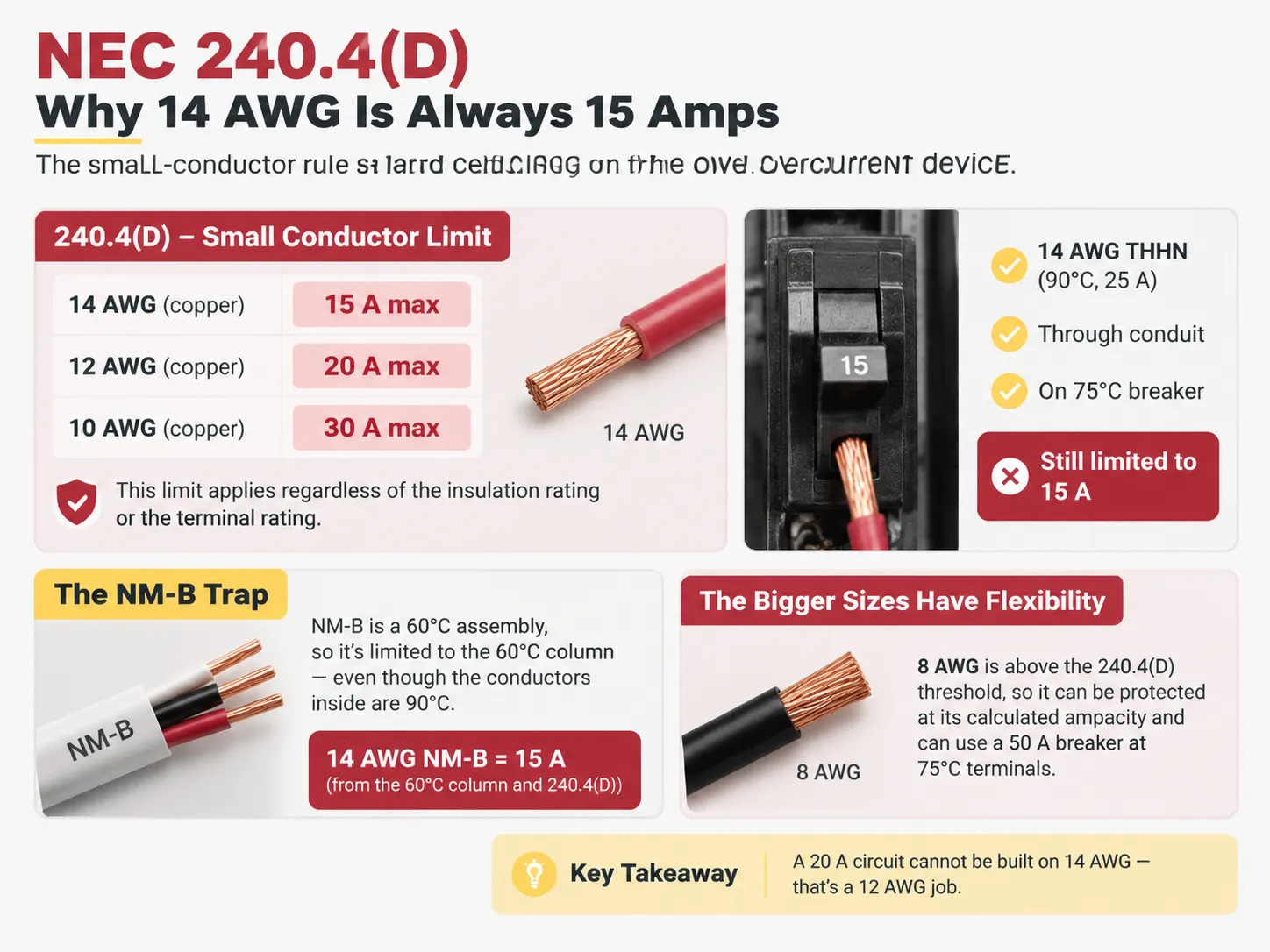
NEC 240.4(D) memperjelas masalah yang sedang dibahas. Standar konduktor kecil adalah batasan yang menetapkan batas pada perangkat pembatas arus untuk ukuran kawat terkecil:
- 14 AWG tembaga → maksimum 15 A
- 12 AWG tembaga → maksimum 20 A
- 10 AWG tembaga → maksimum 30 A
Batasan ini berlaku tanpa memandang jenis isolasi yang digunakan, atau jika sambungan terminal diberi rating di atas ampere maksimum untuk konduktor yang lebih kecil. Misalnya, Anda bisa menggunakan kawat 14 AWG THHN dengan rating 25 A dan menghubungkannya ke pemutus sirkuit 75°C, tetapi pemutus tersebut tetap dibatasi pada 15 A. Prinsip di balik aturan ini adalah bahwa ukuran kawat kecil biasanya berakhir pada terminal pemutus sirkuit tanpa kapasitas termal yang cukup.
Poin ini menandai perbedaan utama antara dua jenis konduktor di sini – 14 AWG tidak memiliki tingkat fleksibilitas yang sama seperti ukuran kawat yang lebih besar dalam hal ampacity dan penggunaan pemutus sirkuit.
Oleh karena itu, 14 AWG tidak dapat digunakan dalam sirkuit 20 A meskipun jalur kawatnya pendek dan terminalnya baik. Sebenarnya yang dapat digunakan adalah 12 AWG. Jika Anda sedang mempelajari logika pengukuran ukuran untuk pertama kalinya, metode dasar — perhitungan beban, kemudian konduktor, lalu proteksi — dijelaskan dalam penjelasan ini tentang bagaimana ampacity minimum sirkuit ditentukan.
Perangkap NM-B
Dalam instalasi listrik rumah, sebagian besar kawat 14 AWG berasal dari kabel NM-B, yang juga dikenal sebagai Romex. Kawat NM-B memiliki rating 60 °C, dan karena itu, menurut NEC 334.80, ampacity hanya dapat diukur dalam kolom 60 °C meskipun kawat THHN sendiri dapat beroperasi pada 90 °C.
Ini berarti ada dua batasan yang berlawanan yang berlaku. Pada baris 60 °C, ampacity diberi rating 15 ampere, dan menurut 240.4(D), juga 15 ampere. Oleh karena itu, saat menggunakan kawat 14 AWG dengan pemutus sirkuit 15 ampere, membiasakan diri dengan pasangan seperti itu tidak akan menimbulkan masalah dalam instalasi listrik rumah. Selain itu, jika Anda menemukan kawat yang sama (14 AWG THHN) dalam jenis proyek instalasi lain (seperti sistem conduit), ampacity tetap akan berada pada tingkat 15 ampere, karena peraturan yang sama 240.4(D) akan berlaku.
Sebagian besar instalasi listrik gagal ketika berhubungan dengan aturan derating. Karena kabel NM-B tidak dapat ditempatkan di kolom suhu yang lebih tinggi, hampir tidak mungkin untuk memperhitungkan efek koreksi suhu lingkungan dan penyesuaian pengikatan. Setelah kabel NM-B ditempatkan di loteng yang panas, ampacity-nya menurun, dan pemutus sirkuit tidak dapat mengkompensasi kehilangan ampacity ini. Bagaimana suhu lingkungan dan jumlah konduktor berinteraksi dengan tabel dasar dibahas dalam tinjauan ini tentang Persyaratan NEC untuk jenis kabel dan tegangan yang mereka bawa.
Tembaga Versus Aluminium pada Ukuran Ini
Ketidakhadiran pasar aluminium 14 AWG yang layak adalah fakta yang diketahui. Faktanya, dalam desain konduktor sirkuit cabang dan feeder, aluminium tidak masuk dalam daftar pendek ukuran kawat kecil. Alasannya adalah aluminium memiliki masalah besar dengan sambungan yang muncul pada akhir 1960-an dan 1970-an tepatnya sebagai akibat dari masalah sambungan dengan kawat ukuran kecil.
Aluminium menjadi layak mulai dari ukuran 8 AWG ketika penghematan berat dan material membenarkan pengenalan kawat yang lebih besar. Perlu dicatat bahwa kawat aluminium membawa arus hingga 20% lebih sedikit daripada kawat tembaga karena resistansi yang lebih tinggi, yang sekitar 65% lebih besar daripada tembaga.
Dengan demikian, kawat tembaga jelas tetap menjadi satu-satunya pilihan untuk segmen 14 AWG. Perbandingan yang lebih luas antara kedua material, termasuk di mana masing-masing benar-benar merupakan pilihan yang lebih baik, dijelaskan dalam penjelasan ini tentang mengapa tembaga dan aluminium digunakan untuk konduktor daya.
Derating: Ketika 14 AWG Tidak Lagi Cukup
Tabel mengasumsikan keberadaan tidak lebih dari tiga kawat yang menghantarkan arus listrik pada suhu lingkungan 30 °C. Asumsi ini biasanya tidak berlaku, dan bahkan dengan kawat 14 AWG, segera terjadi derating yang signifikan pada konduktor di bawah ambang 15 A, yang mengakibatkan menjadi tidak sesuai standar alih-alih hanya sesuai batas.
| Kondisi | Faktor | Applying to the 90 °C base (25 A) |
|---|---|---|
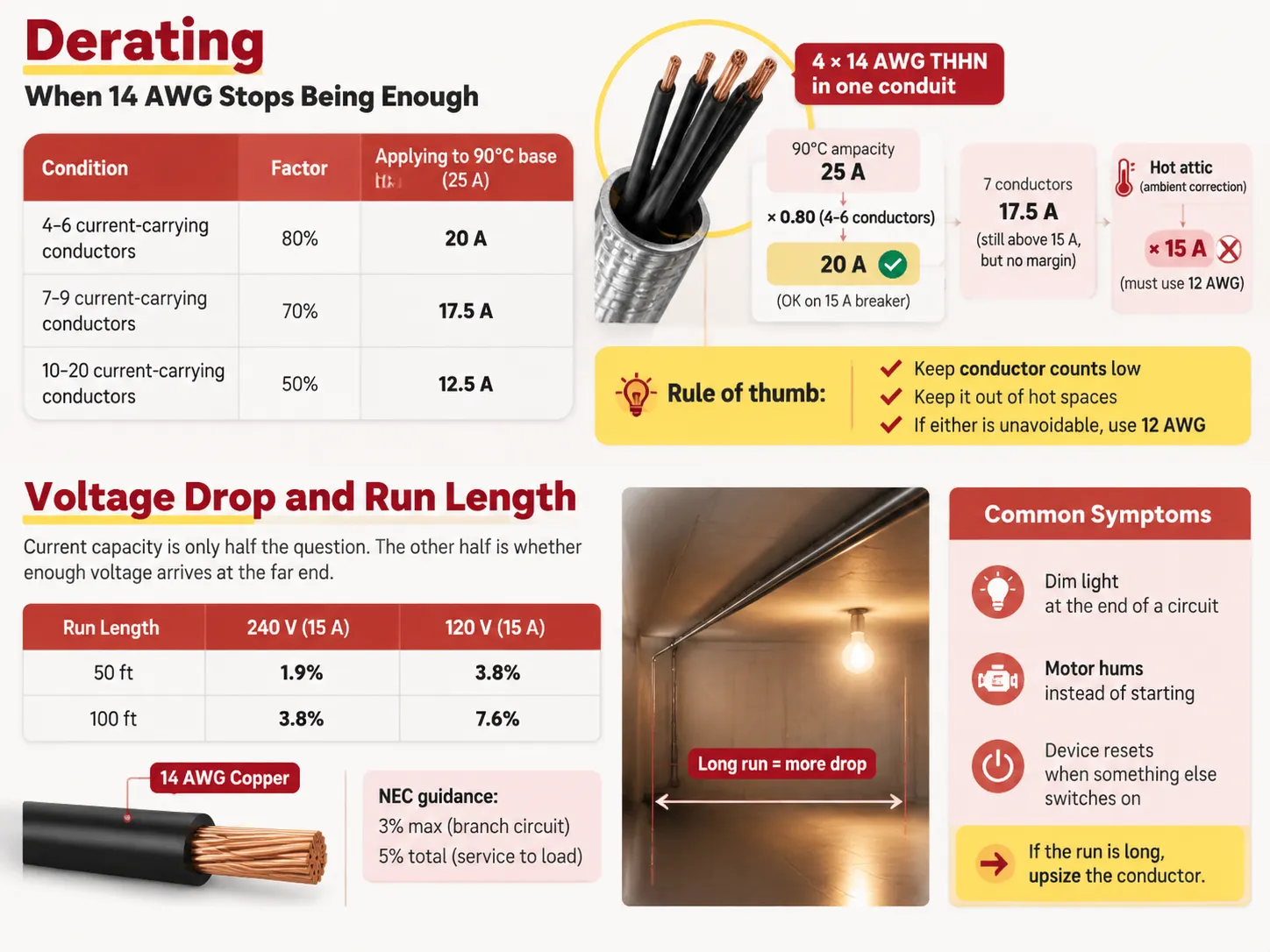
| 4–6 current-carrying conductors | 80% | 20 A |
| 7–9 current-carrying conductors | 70% | 17,5 A |
| 10–20 current-carrying conductors | 50% | 12.5 A |
Let’s examine a clear-cut example: four wires consisting of 14 AWG in the shared environment of one conduit. The amp rating of 25A multiplied with 0.80 gives 20A. That is still more than enough since the minimum needed is 15A which should be enough for a 15A breaker.When the number of wires forms up to seven, the amp rating drops down to 17.5A which is still more than 15A but the tolerance level is out of reach. If the space is too hot, which means more ampacity drops below the minimum required. In such a case, one has to switch to the thicker wire such as 12 AWG.
The simplicity of the case of 14 AWG wire is that, as soon as one exceeds wires count or temperature, it is better to switch to the better grade wire of 12 AWG.
Penurunan Tegangan dan Panjang Jalur
The current capacity forms only one side of the question; at the far end, one has to ask the other side-question: Do I have sufficient voltage?
In the case of a 15-A 240-V circuit, copper-sized 14 AWG shows a drop of about 1.9% up to 50 feet and 3.8% over 100 feet. Using a 120-V circuit means that the same drop would proportionally raise percentages by twofold.
Hence, 14 AWG is anyfavor large-maybe too large-for any wiring on long runs. Following the NEC’s guidance, a 3% drop on the branch circuit and a 5% drop from service to load are allowable. At 50 feet long, you hit 3% drop on branch circuits with 14 AWG wired for a 120V, which isn’t too shabby until you’re measuring cable length rather than the direct distance.
Long runs also account for a lot of mysterious defeat symptoms-the light dims at the end of the circuit, the motor hums instead of trying to start up, a device resets itself when something else clicks on. All three are voltage drop symptoms in borrowed clothes. If the run is long, use a larger conductor instead of tolerating the drop.
What 14 AWG Is Used For, and What It Is Not
| Suitable | Not suitable |
|---|---|
| 15 A lighting circuits | 20 A receptacle circuits (needs 12 AWG) |
| General-purpose receptacle circuits on a 15 A breaker | Kitchen small-appliance circuits, which must be 20 A |
| Switch legs and traveler wiring | Bathroom receptacle circuits, which must be 20 A |
| Smoke and CO alarm circuits | Laundry receptacle circuits |
| Short runs to fixed lighting | Water heaters, dryers, ranges, EV chargers, air conditioners |
| Low-draw device circuits | Any circuit where 240.4(D) would be exceeded |
In this way, it is the case that while 14 AWG is allocated to general lighting and general receptacles, any application that requires a fairly high fixed load is supported by its own circuit that is larger than that. Indeed, this allocation is intentional, for circuits that have general purposes cannot really be predicted so they remain small and numerous.
The formula for calculating load in a 15 A circuit is worth knowing by heart. 15 A units at 120 V equal 1800 W; since almost all interpretations of code limit continuous loads at 80%, 12 A or 1440 W of useful and continuous capacity is possible. That being said, 1500 W space heater is right at the edge and cannot allow anything else to be connected.The wattage side of the calculation is worked through in this guide to how many watts a 15 amp circuit can supply.
14 Versus 12: How to Choose
This is because the two sizes are so similar in terms of both their prices and performance that the choice is usually influenced by the “type of circuit,” rather than “doing the math.”
- Use the 14AWG wire size in wiring your 15 A lighting circuits and general-purpose receptacle circuits, as both the code and ampacity correspond, but the runs are medium.
- Use 12 AWG when wiring any of the 20 A type circuits: kitchens, bathrooms, laundry rooms, garages, outdoor receptacles, or when there are long runs and voltage drop is an important factor.
- Use 12 AWG whenever the installation situation requires the derating of the wire: hot attics, a lot of wires inside conduits, or cables bundled together.
- Use 12 AWG if there is a slight chance of needing a 20 A circuit in the future, as the price difference is very small, while the cost of retrofitting it later will be significant.
Final note about handling: The 12 AWG wire is stiffer and harder to place in a box, and therefore the number of what can be placed in the box is higher in its case. If you increase the size, check the volume of the box and breaker as well. The direct comparison of the two sizes, including where 12 AWG becomes mandatory, is set out in this guide to 12 gauge wire and what it is rated for.
FAQ
Can I put 20 amps on 14 gauge wire?
According to NEC 240.4(D), even if the columns show 20 A and 25 A for 14 AWG copper at 75°C and 90°C respectively, it does not mean that 14 AWG copper can carry more than 15 A. This limitation applies without regard to the thermal rating or terminal rating. To be able to utilize the 20 A circuit, one must use 12 AWG copper, which is also restricted to 20 A in accordance with the NEC limitations.
Can 14 gauge wire handle 1500 watts?
At 120 volts, 1500 watts uses 12.5 amps – under the 15-amp rating and over the 80% continuous load rule of about 12 amps. Therefore, although it will run under these circumstances, it runs the whole circuit at 1500 watts continuously and will run warm as the conductor runs without any margin. On the other hand, at 240 volts, this same load draws only 6.25 amps comfortably within limits.
Can a 14 gauge handle 30 amps?
Not at all. The maximum rating of 14 AWG copper in Table 310.16 is 25 A at an ambient temperature of 90 °C, so it cannot be used as a termination. Regarding the limitation imposed by 240.4(D), the maximum rating is 15 A. A 30 A circuit must use 10 AWG copper, which is limited to 30 A under the same regulation.
Should you run 12 or 14 gauge to 20 amp breakers in residential code?
Use 12 AWG. A 20A breaker on 14 AWG violates 240.4(D) and would leave the wire unprotected at its own limit. However, in reality, most residential 20A circuits — kitchen small-appliance, bathroom, laundry — are required to be 20A anyway. Thus, 12 AWG is standard for these rooms irrespective of breaker selection. 14 AWG should only be used for 15A circuits.
Referensi
- NFPA — NFPA 70 National Electrical Code, Table 310.16, Sections 240.4(D), 110.14(C) and 334.80
- Southwire — conductor resistance, ampacity and NM-B cable construction data
- NEMA — building wire standards and insulation temperature class definitions
- Grainger — current pricing and specification data for 14 AWG and 12 AWG building wire
- International Association of Electrical Inspectors — small-conductor overcurrent protection interpretation
- EC&M Magazine — ampacity adjustment factors and terminal temperature guidance
- Eaton — circuit breaker terminal ratings and residential load centre specifications
- US Department of Energy — residential wiring and electrical load guidance
Kesimpulan
14 AWG copper is rated 15 A at 60 °C; 20 A at 75 °C; and 25 A at 90 °C. However, under the code, you can use exactly one of those ratings for overcurrent protection: 15 A. That is how section 240.4(D) works, which is what makes this wire gauge the most predictable and least flexible when implementing wiring in residential buildings. You should use it for 15 A circuits in lighting and general-purpose receptacles, limit the number of conductors and ambient temperatures, be mindful of run lengths, and switch to 12 AWG the moment you need to implement a circuit rated for 20 A or if your run is long.