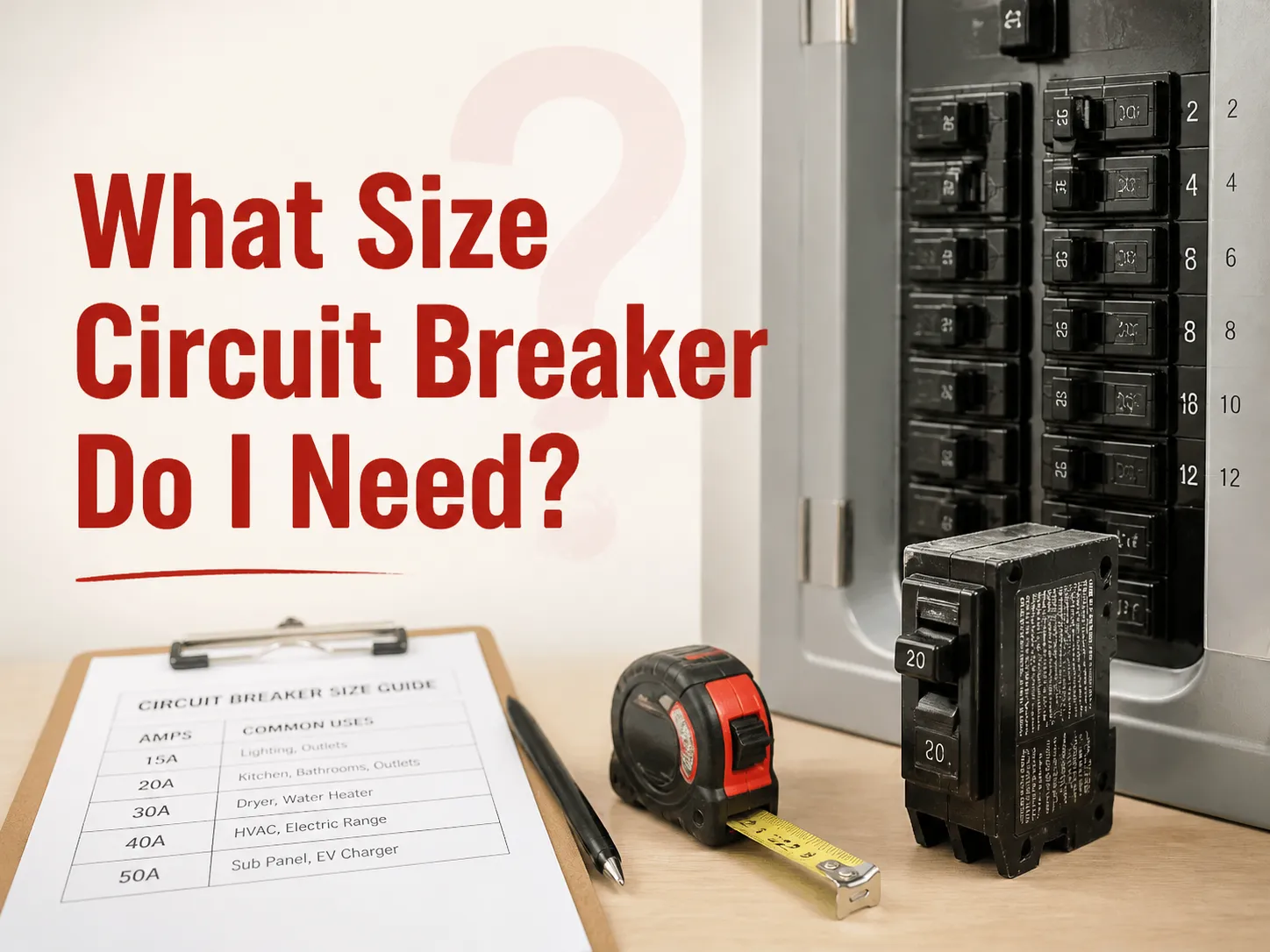

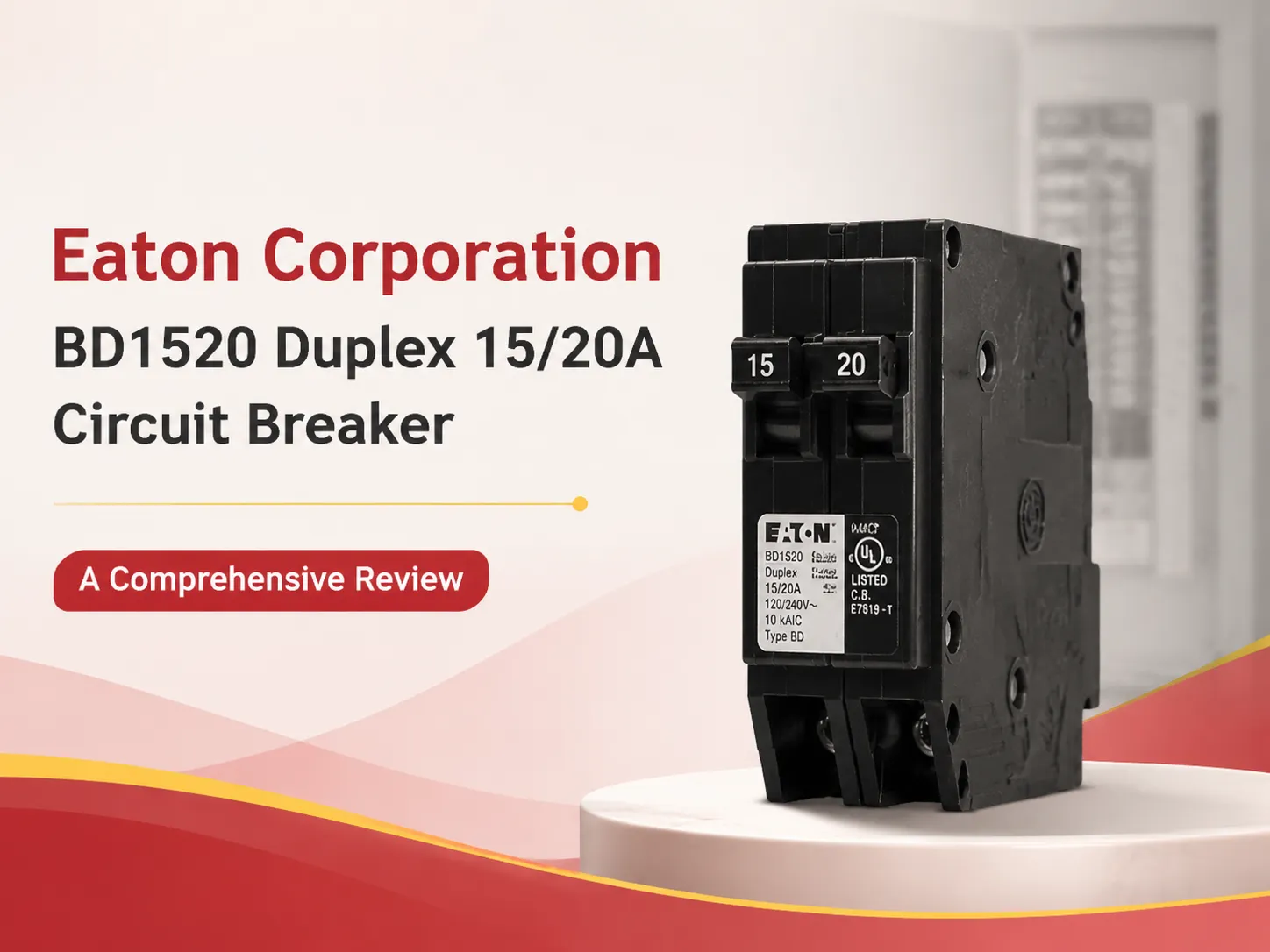
Quando um proprietário em Chicago solicitou a instalação de um novo circuito para seu escritório, o eletricista abriu a caixa de fusíveis apenas para descobrir que todos os slots estavam ocupados. A abordagem antiga para lidar com essa situação incluía a instalação de um subpainel ou a atualização do fornecimento elétrico. No entanto, em vez de empregar os métodos tradicionais neste caso, o eletricista usou um disjuntor Eaton BD1520. O disjuntor duplex BD1520 possibilita a instalação de 2 circuitos independentes de 15 e 20 ampères em um slot de caixa de fusíveis de uma polegada, oferecendo assim uma nova solução para um problema de espaço. O proprietário conseguiu obter o resultado necessário, e o projeto foi concluído de forma mais econômica do que as instalações comuns de painéis. Muitos eletricistas conhecem o disjuntor DB1502. O conhecimento completo deste dispositivo, suas vantagens e restrições, bem como seu custo e possibilidade de uso em substituição a outros dispositivos, permitirá que a pessoa que decide instalar um novo circuito economize uma quantia significativa de dinheiro.
Resumo: O Eaton BD1520 é um disjuntor de configuração duplex (disjuntor tandem) que mede 1 polegada de tamanho. Seu uso é recomendável para centros de carga da série Eaton BR. Os disjuntores BD1520 são fabricados para ter um disjuntor monopolar de 15 ampères e um disjuntor monopolar de 20 ampères, todos encapsulados em uma unidade que utiliza um espaço no painel. O disjuntor BD1520 é categorizado como não-CTL (significando que não possui o recurso de rejeição que impede o uso em painéis não compatíveis com tandem). Portanto, ele pode ser usado em qualquer slot do painel, independentemente de ser designado para disjuntores tandem ou não, desde que a classificação do painel e da barra coletora seja devidamente atendida.
O que o Eaton BD1520 Realmente É: As Especificações Que o Definem
O Eaton BD1520 não é apenas um disjuntor de 15 AMP e um disjuntor de 20 AMP colados juntos. É um dispositivo projetado que também é listado pela UL com características elétricas e mecânicas específicas. Algumas dessas características afetam onde ele pode ser usado e o que pode proteger. As especificações fornecidas na tabela abaixo precisam ser verificadas por um eletricista, empreiteiro ou proprietário informado antes de comprar ou usar o dispositivo.
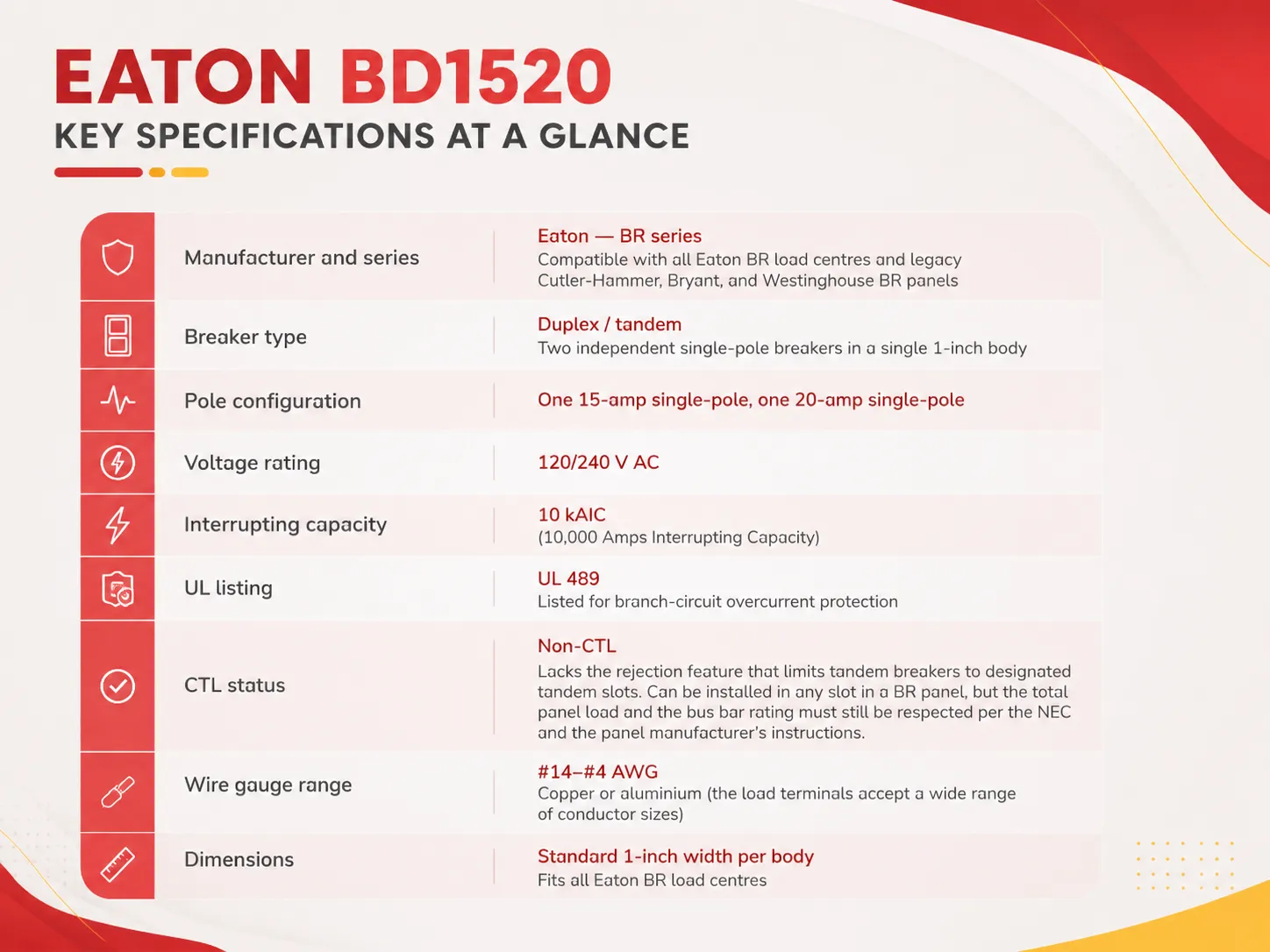
| Especificação | Valor do Eaton BD1520 |
|---|---|
| Fabricante e série | Eaton — série BR (compatível com todos os centros de carga Eaton BR e painéis legados Cutler-Hammer, Bryant e Westinghouse BR) |
| Tipo de disjuntor | Duplex / tandem — dois disjuntores monopolares independentes em um único corpo de 1 polegada |
| Configuração dos polos | Um monopolar de 15 ampères, um monopolar de 20 ampères |
| Classificação de tensão | 120/240 V CA |
| Capacidade de interrupção | 10 kAIC (Capacidade de Interrupção de 10.000 Amperes) |
| Listagem UL | UL 489 — listado para proteção contra sobrecorrente de circuito ramal |
| Status CTL | Não-CTL — não possui o recurso de rejeição que limita disjuntores tandem a slots designados para tandem. Pode ser instalado em qualquer slot em um painel BR, mas a carga total do painel e a classificação da barra coletora ainda devem ser respeitadas conforme o NEC e as instruções do fabricante do painel. |
| Faixa de bitola do fio | #14–#4 AWG cobre ou alumínio (os terminais de carga aceitam uma ampla gama de tamanhos de condutores) |
| Dimensões | Largura padrão de 1 polegada por corpo; compatível com todos os centros de carga Eaton BR |
Onde o BD1520 Pertence — e Onde Não Pertence
O Eaton BD1520 é especificamente projetado para um determinado problema: um painel da série BR que está cheio, mas ainda possui energia disponível para acomodar mais circuitos de 120 volts. O cenário típico é uma casa antiga com um painel BR de 100 amperes ou 150 amperes que precisa ser equipado para um novo circuito que atenda a um escritório doméstico, oficina na garagem, várias tomadas na cozinha ou até mesmo uma modernização do banheiro — tudo isso enquanto os cálculos de amperagem mostram que essa carga adicional estará bem dentro dos limites permitidos deste painel. A venda do BD1520 proporcionaria dois novos circuitos — 15 amperes e 20 amperes — que não necessitam de um único slot livre dentro do painel. Em situações em que o cliente precisa instalar apenas um ou dois circuitos, o BD1520 é a escolha mais econômica, pois uma unidade custa $25-50 e a instalação é simples o suficiente para que um eletricista competente a complete em tempo razoável.
O BD1520 possui algumas limitações que todos os instaladores devem estar cientes. Em primeiro lugar, ele não tem a capacidade de fornecer uma tensão de 240 volts. O disjuntor é projetado com os dois polos conectados à mesma fase da barra coletora, o que significa que a tensão gerada é igual a 0 volts. Qualquer aparelho de 240 volts, como secadora, aquecedor de água, carregador de veículo elétrico ou aquecedor de rodapé, requer um disjuntor bipolar que se conecta a duas barras coletoras em slots adjacentes. O BD1520 só pode operar no nível de 120 volts. Além disso, este dispositivo não aumenta a capacidade total de carga do painel. Se novos circuitos forem adicionados a um painel existente que já atingiu a capacidade máxima, o disjuntor principal disparará ou a barra coletora poderá sobrecarregar, levando a um risco de incêndio. Portanto, é essencial realizar cálculos em conformidade com o Artigo 220 do NEC antes de adicionar qualquer novo circuito, mesmo quando disjuntores tandem são usados. Adicionalmente, o BD1520 não é compatível com painéis da série Eaton CH, pois só se encaixa em quadros da série BR. A etiqueta no painel é a autoridade final, e se o modelo do disjuntor não estiver listado para o painel, ele não deve ser instalado. Para ajuda com o cálculo de carga que determina se um painel pode aceitar circuitos adicionais, nosso guia sobre qual tamanho de disjuntor você precisa percorre o processo baseado no NEC.
Como o BD1520 se Compara com as Alternativas
O Eaton BD1520 é uma das várias soluções para adicionar circuitos a um painel cheio, e a tabela abaixo o compara com as alternativas mais comuns nos critérios que importam em uma instalação residencial real.
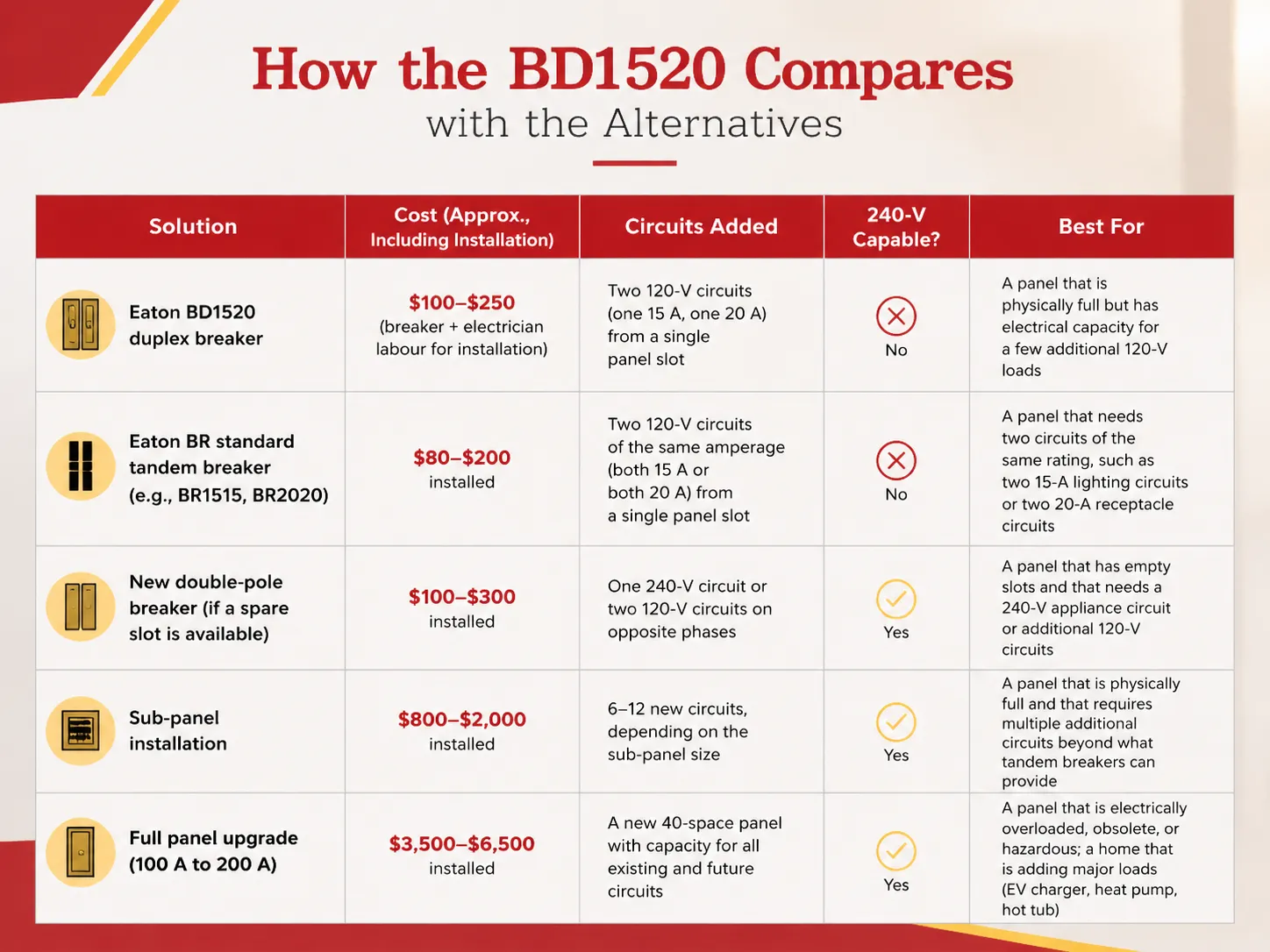
| Solução | Custo (Aproximado, Incluindo Instalação) | Circuitos Adicionados | Capaz de 240 V? | Melhor Para |
|---|---|---|---|---|
| Disjuntor duplex Eaton BD1520 | $100–$250 (disjuntor + mão de obra do eletricista para instalação) | Dois circuitos de 120 V (um de 15 A, um de 20 A) a partir de um único slot no painel | Não | Um painel que está fisicamente cheio, mas tem capacidade elétrica para algumas cargas adicionais de 120 V |
| Disjuntor tandem padrão Eaton BR (ex.: BR1515, BR2020) | $80–$200 instalado | Dois circuitos de 120 V com a mesma amperagem (ambos 15 A ou ambos 20 A) a partir de um único slot no painel | Não | Um painel que necessita de dois circuitos com a mesma classificação, como dois circuitos de iluminação de 15 A ou dois circuitos de tomadas de 20 A |
| Novo disjuntor bipolar (se houver um slot disponível) | $100–$300 instalado | Um circuito de 240 V ou dois circuitos de 120 V em fases opostas | Sim | Um painel que possui slots vazios e que necessita de um circuito para aparelho de 240 V ou circuitos adicionais de 120 V |
| Instalação de subpainel | $800–$2,000 instalado | 6–12 novos circuitos, dependendo do tamanho do subpainel | Sim (se um disjuntor alimentador bipolar for usado) | Um painel que está fisicamente cheio e que requer múltiplos circuitos adicionais além do que os disjuntores tandem podem fornecer |
| Atualização completa do painel (100 A para 200 A) | $3.500–$6.500 instalado | Um novo painel de 40 espaços com capacidade para todos os circuitos existentes e futuros | Sim | Um painel que está eletricamente sobrecarregado, obsoleto ou perigoso; uma residência que está adicionando cargas principais (carregador EV, bomba de calor, banheira de hidromassagem) |
Instalação e Conformidade com o Código: O que o Eletricista Deve Verificar
A instalação do Eaton BD1520 é um trabalho direto para um eletricista licenciado, mas requer os mesmos procedimentos de segurança e a mesma conformidade com o código que qualquer outra instalação de disjuntor. O eletricista deve verificar que o painel é um centro de carga da série Eaton BR (ou uma marca legada compatível), que o cálculo de carga do painel confirma que os circuitos adicionais não excederão a capacidade do painel ou do barramento, que o disjuntor está corretamente encaixado no barramento — o BD1520 se prende ao barramento BR como qualquer disjuntor padrão BR — e que os fios de carga estão corretamente dimensionados para a amperagem do circuito (fio de cobre 14 AWG para o circuito de 15 A, fio de cobre 12 AWG para o circuito de 20 A) e estão apertados conforme a especificação impressa no corpo do disjuntor. O eletricista também deve garantir que os circuitos estejam corretamente rotulados no diretório do painel, e que a instalação seja permitida e inspecionada conforme os requisitos do código local. Um BD1520 instalado em um painel que não é listado para ele, ou que é instalado sem um cálculo de carga que confirme a capacidade do painel, é uma violação do código e um risco de incêndio — e o disjuntor em si não é o perigo. O perigo é a instalação que excede os limites de projeto do painel. Para uma compreensão mais profunda da certificação que todo disjuntor em um painel residencial deve possuir, nosso artigo sobre quais são os disjuntores UL 489 explica os requisitos de teste e listagem que o BD1520, e todos os outros disjuntores no painel, devem atender.
Quanto Custa o BD1520 e Onde Comprá-lo
O Eaton BD1520 é um produto que pode ser facilmente adquirido em várias fontes, como casas de fornecimento elétrico, Home Depot e Lowe’s, e distribuidores elétricos online. qual tamanho de disjuntor você precisa explica o processo de dimensionamento baseado no NEC.
Perguntas Frequentes
O preço do disjuntor sozinho varia entre $25 e $50, dependendo da loja ou da quantidade adquirida.
O custo da instalação, juntamente com os custos de mão de obra para instalá-lo, pode elevar o custo total de $100 a $250.
O preço do BD1520 é comparável com outros disjuntores tandem e duplex da mesma classificação.
Se um proprietário deseja adicionar dois circuitos ao painel cheio, o custo da instalação do BD1520 seria em torno de 5% – 15% do custo total da substituição completa do painel.
Assim, seria muito atraente economicamente para aqueles proprietários que possuem seus painéis antigos ainda em boas condições e bastante capazes de suportar novas cargas.
Quanto à comunidade de empreiteiros elétricos e aqueles envolvidos na fabricação de painéis, a HUYU oferece todos os tipos de disjuntores – MCBs, RCBOs e Disjuntores DC – que cumprem os padrões internacionais (IEC, UL, TUV, CE).
Para ajuda na seleção do disjuntor correto para qualquer circuito, nosso guia sobre
Você pode substituir um disjuntor de 15 ampères por um de 20 ampères? Não, você deve sempre verificar se a fiação do circuito é classificada para 20 ampères. eram defeituosos, causando disparos indesejados e falhando em detectar falhas reais de arco. A Eaton negou as alegações, mas concordou com um acordo em 2022 que proporcionou compensação aos consumidores afetados. O processo envolveu modelos específicos de disjuntores AFCI e não afeta os disjuntores térmico-magnéticos padrão, como o BD1520. Um proprietário que está adquirindo um disjuntor Eaton AFCI deve verificar o número do modelo e a lista atual de produtos no Eaton site para garantir que o produto seja o design mais recente e esteja coberto pela garantia atual do fabricante.
Referências
- Eaton — Disjuntores Duplex/Tandem da Série BR, incluindo BD1520. Página oficial do fabricante com especificações, tabelas de compatibilidade e orientações de instalação.
- Home Depot — Disjuntor Duplex Eaton BD1520. Listagem do produto no varejo com preço, avaliações de clientes e informações de compatibilidade.
- UL 489 — Norma para Disjuntores em Caixa Moldada. A norma de segurança à qual o BD1520 está listado, que regula sua proteção contra sobrecorrente, capacidade de interrupção e resistência mecânica.
- NFPA 70 — Código Elétrico Nacional (NEC). O código de instalação elétrica que regula o uso de disjuntores tandem, o cálculo de carga que deve preceder sua instalação e os requisitos de listagem do painel que garantem uma instalação segura.
O Disjuntor duplex Eaton BD1520 é uma solução direcionada, prática e econômica para o proprietário que precisa adicionar um ou dois circuitos de 120 volts a um painel da série BR que está fisicamente cheio, mas eletricamente capaz. Não é uma solução para todas as situações. Não fornece 240 volts. Não aumenta a amperagem total do painel. Não substitui um painel em mau estado ou desatualizado. No entanto, onde o BD1520 se destaca é quando falamos de seu uso específico — voltado para painéis BR modernos com algumas cargas adicionais de 120 volts, e um orçamento não sofisticado o suficiente para uma atualização completa do serviço. Para um proprietário experiente disposto a realizar a instalação com um eletricista qualificado, esta é a maneira correta e segura de obter o que precisa a uma fração do custo. A HUYU pode produzir quaisquer disjuntores e outros dispositivos de proteção, como MCBs, RCBOs e disjuntores com classificação DC em todo o mundo, desde que o disjuntor correto seja obtido para o painel correto, assegurado de acordo com as regulamentações correspondentes.