
เบรกเกอร์วงจร Crouse-Hinds มีตำแหน่งที่แปลกในด้านไฟฟ้า แบรนด์นี้ยังคงดำเนินการอยู่ — เป็นหน่วยงานย่อยของ Eaton และรวมถึงโซลูชันอุตสาหกรรมสำหรับสภาพแวดล้อมที่รุนแรง — แต่หมายถึงรุ่นเบรกเกอร์วงจรที่ล้าสมัยซึ่งใช้ในที่อยู่อาศัยและสถานประกอบการเชิงพาณิชย์ขนาดเล็ก ผู้ที่เป็นเจ้าของอุปกรณ์ดังกล่าวประสบปัญหาเนื่องจากรุ่นดั้งเดิมหยุดผลิตไปนานแล้วและมีคำแนะนำที่ไม่ถูกต้องมากมายบนอินเทอร์เน็ต บทความนี้มีจุดมุ่งหมายเพื่อให้ข้อมูลเชิงลึกที่ครอบคลุมที่สุดเกี่ยวกับความหมายของเบรกเกอร์วงจร Crouse-Hinds รุ่นเทียบเท่าสมัยใหม่ที่ผ่านการทดสอบ UL และวิธีตรวจสอบความสอดคล้องของสินค้าปัจจุบันกับฉลากของอุปกรณ์ดั้งเดิม.
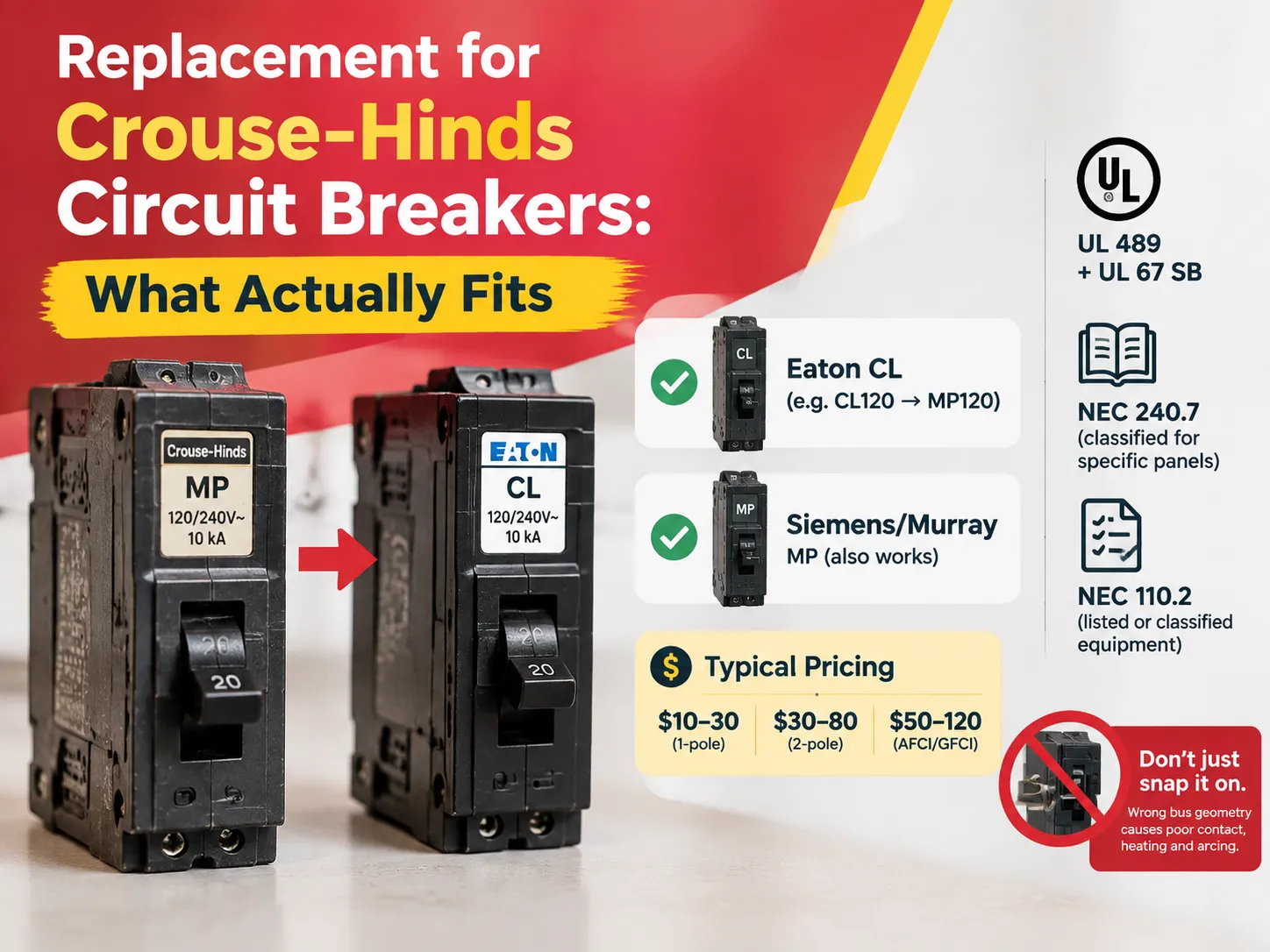
คำตอบสั้น: เบรกเกอร์วงจร Crouse-Hinds สำหรับที่อยู่อาศัยส่วนใหญ่มีการกำหนดค่าประเภท MP ขนาดหนึ่งนิ้ว และการเปลี่ยนทดแทนที่แนะนำคือซีรีส์ Eaton CL เนื่องจากได้รับการรับรอง UL (เช่น CL120 แทนที่ MP120 และ CL220 แทนที่ MP220) เนื่องจากแบรนด์ Murray ที่ผลิตประเภท MP ได้ถูกรวมเข้ากับ Siemens เบรกเกอร์ Siemens/Murray MP จึงเหมาะสมสำหรับการใช้งานในแผงเดียวกัน พื้นฐานทางกฎหมายขึ้นอยู่กับการจัดประเภท UL ตาม UL 489 และการขึ้นทะเบียนตาม UL 67 SB สำหรับประเภทแผงที่เกี่ยวข้อง ไม่ใช่ความเข้ากันได้ทางกายภาพ รหัสไฟฟ้าแห่งชาติระบุในบทความ 240.7 ว่าเบรกเกอร์วงจรที่ได้รับการจัดประเภทสามารถใช้ได้เฉพาะในแผงที่กำหนดไว้เท่านั้น ขณะที่บทความ 110.2 กำหนดข้อกำหนดของการใช้อุปกรณ์ที่ได้รับการขึ้นทะเบียนหรือจัดประเภท.
เบรกเกอร์ Crouse-Hinds คืออะไรจริงๆ
ความเข้าใจผิดเริ่มต้นจากชื่อแบรนด์ Crouse-Hinds ปัจจุบันเป็นแบรนด์ที่เป็นเจ้าของโดย Eaton และนำเสนอผลิตภัณฑ์รวมถึงกล่องกันระเบิด, โคมไฟ HVAC และฮาร์ดแวร์ที่เกี่ยวข้อง; อย่างไรก็ตาม ไม่ใช่ผู้จัดหาปัจจุบันของเบรกเกอร์โหลดสำหรับที่อยู่อาศัย ซึ่งหมายความว่าเมื่อผู้บริโภคค้นหาข้อมูลเกี่ยวกับเบรกเกอร์ทดแทน Crouse-Hinds พวกเขามักจะเห็นแผงเบรกโหลดจากปี 1965-1985.
มีคำอธิบายที่ชัดเจนว่าทำไมคำตอบที่ถูกต้องไม่สามารถเป็นเพียง Crouse-Hinds ได้ เส้นผลิตภัณฑ์ Murray ที่ผลิตเบรกเกอร์ประเภท MP ได้เปลี่ยนเจ้าของหลายครั้งก่อนที่จะหยุดผลิตโดย Murray และเทคโนโลยีของมันได้ไปถึง Siemens นอกจากนี้ การดำเนินงานเดิมของ Arrow-Hart และ Crouse-Hinds ถูกควบคุมโดย Cooper Industries ซึ่งถูกซื้อกิจการโดย Eaton ในปี 2012 ผลลัพธ์ของประวัตินี้สำหรับผู้รับเหมาและเจ้าของบ้านคือการออกแบบเบรกเกอร์ยังคงอยู่ผ่านการเปลี่ยนแปลงเจ้าของ.
ดังนั้น สิ่งที่ตามมาจากข้อเท็จจริงที่ให้มาคือมีสองประเด็นหลักที่ต้องพิจารณาเมื่อค้นหาวิธีแก้ไข ประการแรก คำตอบควรเป็นซีรีส์ Eaton CL หรือเบรกเกอร์ Siemens/Murray MP ซึ่งขึ้นอยู่กับข้อมูลที่ระบุไว้บนแผงก่อนหน้า ประการที่สอง การค้นหาข้อมูลควรอิงจากเอกสารของแผงมากกว่าจากกระทู้ในฟอรัม.
Listed vs Classified: ความแตกต่างที่ตัดสินทุกอย่าง
นี่คือแนวคิดที่สำคัญที่สุดในหัวข้อทั้งหมด และเป็นสิ่งที่มักจะสับสนในคำแนะนำออนไลน์.
เบรกเกอร์วงจรที่มี UL Listing หมายความว่าอุปกรณ์นี้ได้รับการทดสอบและพิจารณาเป็นผลิตภัณฑ์อิสระ เบรกเกอร์วงจรที่มี UL Classification หมายความว่ามันได้รับการทดสอบในขณะที่ใช้งานในแผงวงจรเฉพาะของผู้ผลิตรายอื่น ซีรีส์ classified ที่ Eaton ผลิตผ่านกระบวนการรับรองพร้อมกับ UL 489 สำหรับเบรกเกอร์แม่เหล็ก, UL 67 SB สำหรับโหลดเซนเตอร์และแผงวงจร, UL 943 สำหรับตัวตัดวงจรกราวด์ฟอลต์ และ UL 1699 สำหรับตัวตัดวงจรอาร์คฟอลต์ ดังนั้นบริษัทจึงประกาศว่ามีประเภทโหลดเซนเตอร์มากกว่า 750 ประเภทที่เข้ากันได้ รายการนี้ประกอบด้วยชื่อบริษัทเช่น General Electric, Thomas & Betts, ITE/Siemens, Murray, Crouse-Hinds และ Square D.
ทำไมจึงสำคัญกว่าการเข้ากันได้เพียงอย่างเดียว? เพราะแม้ว่าเบรกเกอร์จะสามารถเสียบเข้ากับบัสบาร์ได้ แต่ก็ยังอาจไม่ปลอดภัยในตำแหน่งนั้น ภูมิศาสตร์ของบัสสตาลากไมท์ของผู้ผลิตต่าง ๆ มีความคล้ายคลึงกัน ดังนั้นเบรกเกอร์จากภายนอกอาจติดตั้งได้ แต่พื้นที่สัมผัสและแรงกดอาจผิดพลาด ซึ่งนำไปสู่ความร้อนจากความต้านทานและการเกิดอาร์ค NEC 110.2 ระบุว่าอุปกรณ์จะดีเฉพาะเมื่อมีการ listed; NEC 240.7 ระบุว่าเบรกเกอร์ classified ต้องใช้เฉพาะในแผงวงจรของประเภทที่กำหนดตามการจัดประเภท หากผู้ตรวจสอบพบเบรกเกอร์ที่ไม่ listed ในแผง Crouse-Hinds การติดตั้งจะไม่ผ่านแม้ว่าจะดูเหมือนทำงานได้.
มีผลทางการค้าจากความแตกต่างนี้ การจัดประเภทออกให้สำหรับช่วงของแผงวงจร และนั่นคือเหตุผลที่มีช่องว่างในสายผลิตภัณฑ์ classified – ตัวอย่างเช่น Eaton’s CL ไม่รวมผลิตภัณฑ์ที่มีเรตติ้งเกิน 50 แอมป์หรือเบรกเกอร์ประเภทเฉพาะอื่น ๆ – ผลิตเฉพาะเบรกเกอร์ AFCI และ GFCI พื้นฐานเท่านั้น หากแผงวงจรต้องการเบรกเกอร์ที่มีเรตติ้ง 60 แอมป์ขึ้นไปหรือมีการกำหนดค่าที่ไม่เหมือนใคร คำตอบไม่ควรอยู่ที่เบรกเกอร์ classified แต่ควรเปลี่ยนแผงวงจร กรอบการรับรองเบื้องหลังผลิตภัณฑ์เหล่านี้เป็นกรอบเดียวกับที่ควบคุมเบรกเกอร์ที่จ่ายไฟให้แผงวงจรตั้งแต่แรก ซึ่งเป็นหัวข้อในคู่มือของเราเกี่ยวกับ ความหมายของการรับรอง UL 489 สำหรับเบรกเกอร์.
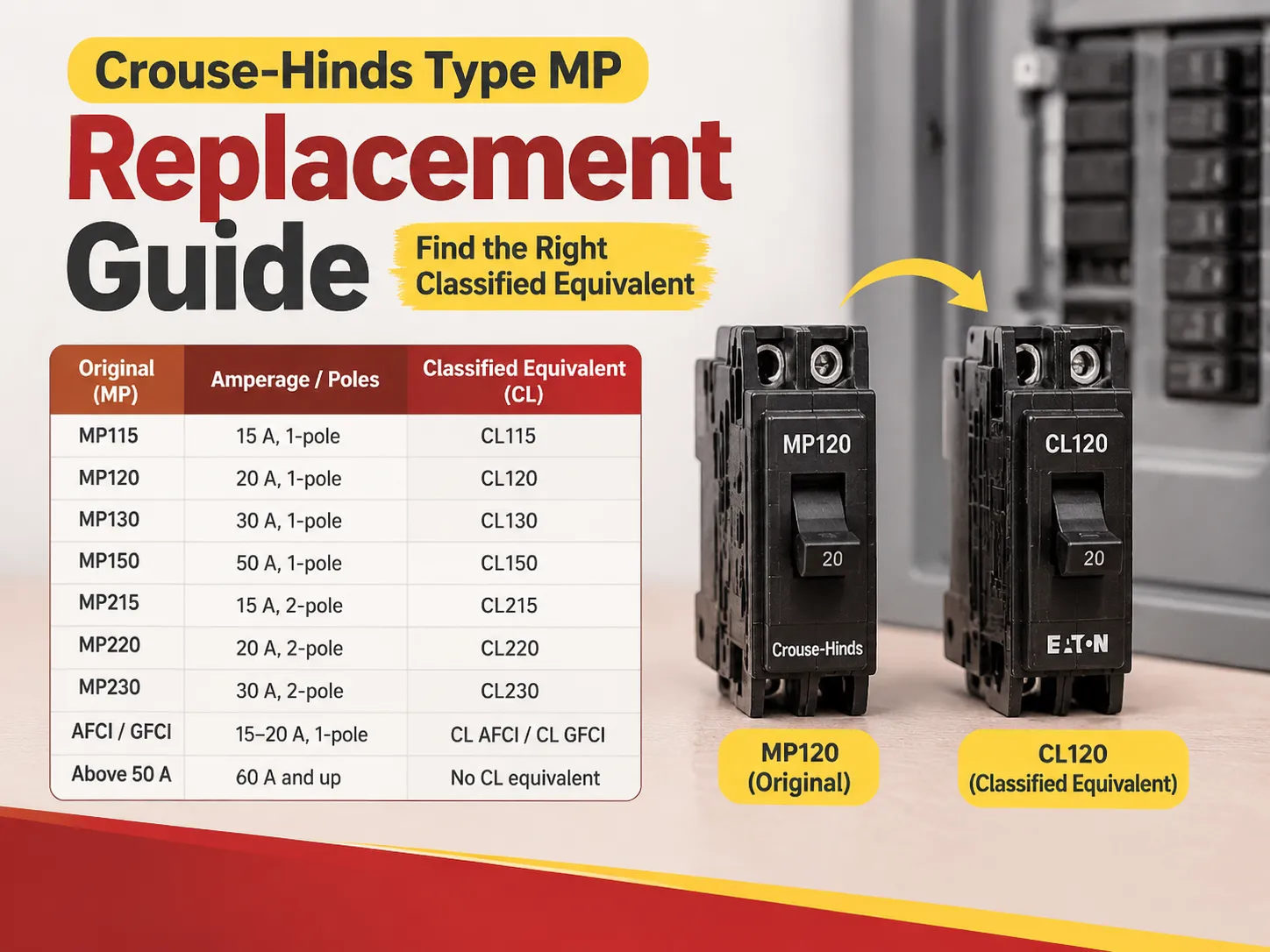
ตารางเปลี่ยนทดแทน
ภาพประกอบของเบรกเกอร์วงจร Crouse-Hinds MP สามารถพบได้ในตารางด้านล่าง พร้อมกับรุ่นเทียบเท่าของพวกเขา สิ่งสำคัญคือแรงดันไฟฟ้าที่กำหนด จำนวนขั้ว และความสามารถในการตัดวงจรของตัวทดแทนต้องไม่น้อยกว่าของเดิม.
| Crouse-Hinds Type MP (ต้นฉบับ) | แอมแปร์ / ขั้ว | Eaton CL classified เทียบเท่า | หมายเหตุ |
|---|---|---|---|
| MP115 | 15 A, 1 ขั้ว | CL115 | วงจรสาขามาตรฐาน; 10 kAIC |
| MP120 | 20 A, 1 ขั้ว | CL120 | ตัวทดแทนที่พบบ่อยที่สุดในแผงเหล่านี้ |
| MP130 | 30 A, 1 ขั้ว | CL130 | ตรวจสอบขนาดสายก่อนเพิ่มขนาด |
| MP150 | 50 A, 1 ขั้ว | CL150 | ที่ขีดจำกัดบนของช่วงที่จัดประเภท |
| MP215 | 15 A, 2 ขั้ว | CL215 | ทริปทั่วไป, 120/240 V |
| MP220 | 20 A, 2 ขั้ว | CL220 | ทริปทั่วไป, 120/240 V |
| MP230 | 30 A, 2 ขั้ว | CL230 | ปกติสำหรับเครื่องอบผ้าและแผงย่อยขนาดเล็ก |
| สาขา AFCI / GFCI | 15-20 A, 1 ขั้ว | ประเภท CL AFCI และ CL GFCI | ความพร้อมใช้งานแตกต่างกัน; ตรวจสอบรายการที่จัดประเภทสำหรับแผงของคุณ |
| มากกว่า 50 A | 60 A ขึ้นไป | No CL equivalent | The honest answer is usually a panel replacement |
This table comes with two caveats. The first is that Eaton’s classified line is not the only acceptable way to connect power; since Siemens has acquired the Murray design that resulted in the Type MP, the current type of Siemens manufactured Murray circuit breakers is also considered appropriate for use with panels indicative of the MP label. In case Siemens MP is used instead for replacement, it would be the closest thing of getting the original product, but the important advantage is that in this case the panel label should clearly indicate the use of board. The second caveat is that “same amperage” does not equal to “same breaker.” A replacement GFCI or an AFCI type breaker means different wiring direction on the load side. There are some other limitations for using two-pole replacements of the multilayered branch circuit as well.
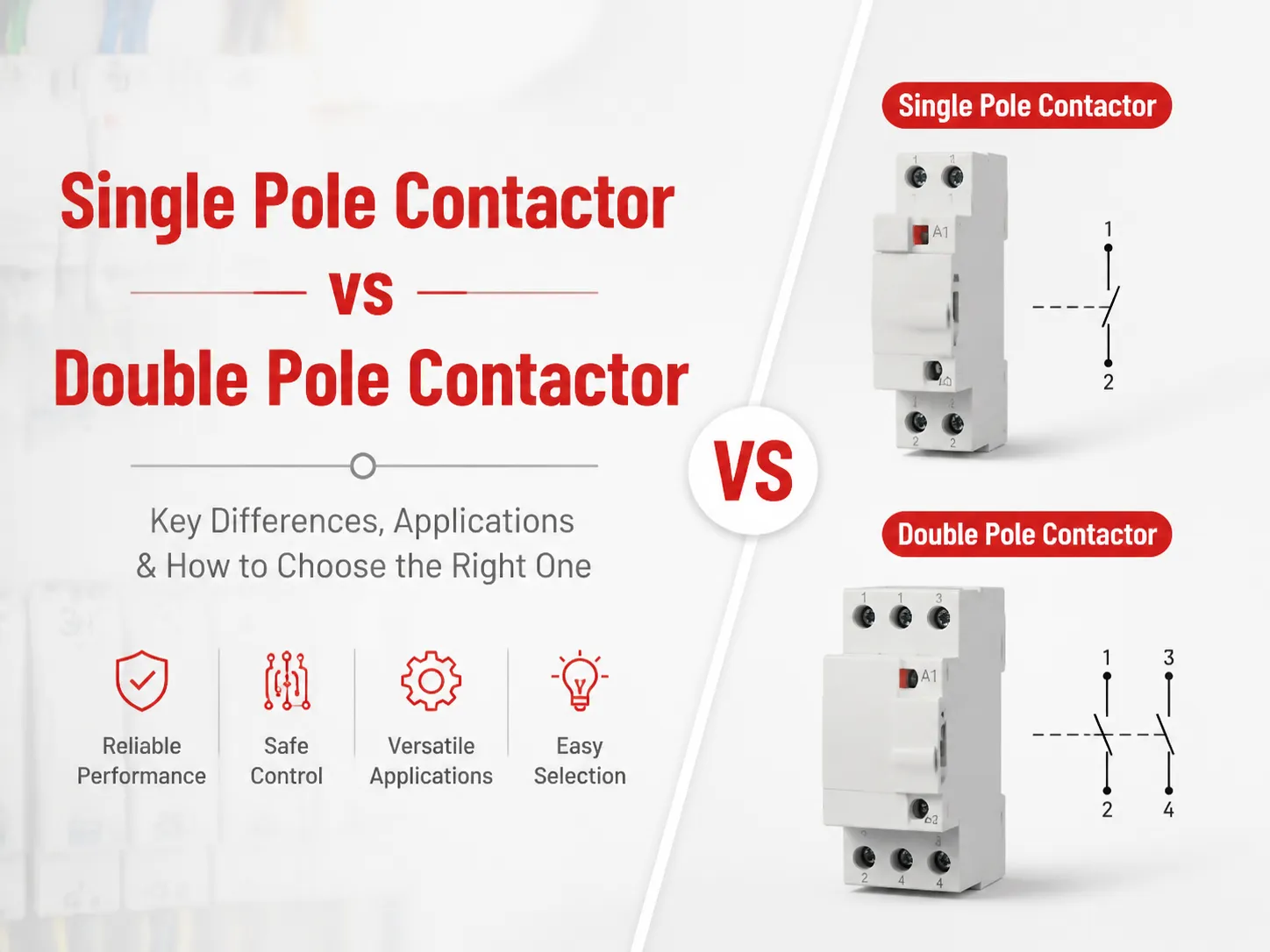
Pole count can be considered an issue since customers often improperly order circuit breakers. A single pole circuit breaker is designed simply for one leg of 120 volt circuit while two poles are used in 240 volt circuits and multiterminal branch circuits for enabling the simultaneous circuit shut down.The selection logic and the space implications are set out in our guide to single-pole versus double-pole breakers, and getting it wrong is the most common reason a replacement breaker has to be returned.
Where to Buy and What It Costs
Classified replacements are a general product, which is beneficial in terms of availability but doesn’t bode well for those searching for cheaper prices on less common items.
- The reliable first step in this case is an electrical distributor. They can cross-check the classified entry against the model of the panel and order the AFCI and GCFI variants that can’t be found in the major retailers.
- Home improvement stores have the usual CL types of the devices — usually 15 A, 20 A, or 30 A for the single-pole and 20 A, 30 A for the two-pole. This is easy and convenient, but the choice on the shelf tends to lack the unusual types.
- The online stores provide an alternative route for comparing the prices and looking up the catalogue where the exact model of the breaker is normally given.
- The approximate street prices for a classified replacement breaker are as follows. A single-pole 15 A or 20 A CL breaker goes for around $10-30. A two-pole 20 A or 30 A one costs approximately $30-80. The price for the AFCI and GFCI versions is generally around $50-120 due to the presence of the additional electronic equipment. If it exists in the classified category, the size of the ratings raises the price even higher.
By comparison, the cost of hiring an electrician to replace a breaker costs about $130-250, while the entire panel replacement costs a lot more.When the arithmetic starts to favour a new panel — and what that costs — is set out in our guide to ค่าใช้จ่ายการเปลี่ยนแผงไฟฟ้า, which is worth reading before you commit to chasing one hard-to-find breaker.
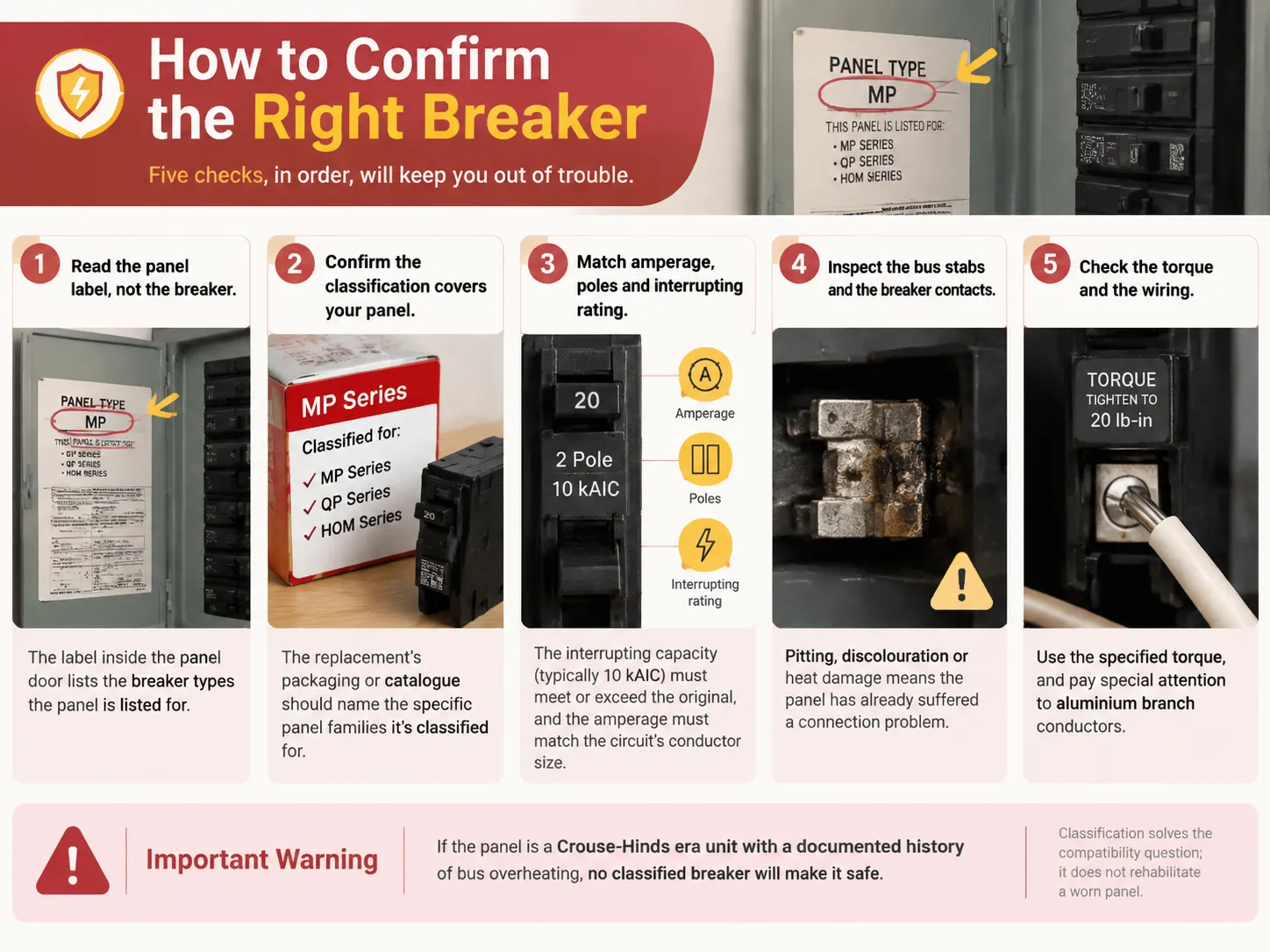
How to Confirm the Right Breaker
If you want to avoid problems, keep five essential checks in mind.
- Examine the label on the panel and not the breaker. You should look for its details. The label inside the panel shows you the types of breakers the panel is suitable for, and that is the information you are actually looking for. If it shows that this is a panel which allows for the use of MP series, then you can use the appropriate replacement, otherwise, it is better to seek expert opinions about the panel.
- Make sure that the classification applies to your panel. By examining a label or catalogue entry you should be able to see the panel families your replacement was made for, don’t believe anything saying “Compatible with most panels”.
- Check the similar specs with original one. Anyone should check the interrupting capacity of the circuit as it should not be lower than that of the original circuit.
- Bear in mind that it is crucial to make sure that bus stabs and breaker contacts are in good condition. If there are any signs of deformities at the stabs, and burnt contacts it means that the previous connection of the circuit failed.A breaker that has been running hot is worth diagnosing rather than simply swapping, using the checks in our guide to วิธีบอกว่าเบรกเกอร์เสีย.
- It is very important to check if torque indicators and wiring work properly. The breaker has every piece of information concerning terminal torque, and one of the reasons for nuisance tripping is loose terminations. You need to pay special attention to aluminum branches.
There is only one warning which should be highlighted in this case. The Crouse-Hinds panels have systems of connections which have already been overheated, and no classified breaker is able to protect the environment.
Where HUYU Fits
It is important to be honest about this matter to clarify the following: HUYU does NOT provide UL-approved substitutes for Crouse-Hinds Type MP panels, and a manufacturer that makes such claims is not being honest about its product. This kind of classification is assigned by UL for every type of panel and cannot be found in a catalogue of ordinary breakers.
What HUYU produces is the equipment for the second part of the market. If the project is about the installation of new equipment, not the repair of old panels – new subpanels, control boards for machines, OEM products, retrofitted distribution equipment – specifications will be different. HUYU produces an array of protection and distribution products having UL, KEMA, TUV, CE, and IEC certification, including an array of miniature circuit breakers starting from 1P up to 4P, and 63 A in B, C, and D curve. The HUM18-63N MCB range is representative of what a certified modern breaker line looks like when the buyer is specifying new rather than substituting old.
Following the recommendations in this regard is very simple. In the case one is operating a Crouse-Hinds panel, everyone has to purchase the panel-certified products. If one is preparing a new equipment specification, one must define the new certified product and mention that there are no lateral relations connected to the legacy. Getting these two things mixed up is what leads to having a sub-panel with devices from different manufacturers and questions from the inspector.
Repair the Panel or Replace It?
There is a point after which replacing breakers is no longer a good idea; and Crouse-Hinds’s systems reach that point before most. Panel replacement is merited under any of the following conditions: the panel label is unreadable or missing and no breakers can be proven classified for it; the bus is heat-damaged, pitted, or discolored; the required amp rating exceeds the rating allowed for the classified panel; the panel requires AFCI protection that cannot be found and the panel cannot be classified as such; the service ampacity is insufficient to accommodate modern demands; and you are already paying for an electrician to be present.
The determining factor in this case is usually the quantity of breakers that need to be replaced. Replacing a 1 20 A breaker in a working panel is small job. When replacing a number of breakers plus adding AFCI protection for a bedroom circuit finds the bus pitted, it is a complete panel project in disguise.
คำถามที่พบบ่อย
What breakers replace Crouse-Hinds?
The appropriate substitute for the one-inch Crouse-Hinds Type MP breaker is the Eaton CL series: CL120 replaces MP120, CL220 replaces MP220 and so on. Since Murray’s design for the Type MP passed on to Siemens, the current Siemens/Murray MP breakers can also be used when the MP series is called for in the panel label. The ease of utilization with these options relies upon the panel’s own listing: it has to describe either the original breaker type or a device cleared for use with it, not just one that fits the bus but is otherwise indeterminate.
Can I use a Siemens breaker in a Crouse-Hinds panel?
Yes, and the reason for this is that the Murray MP design has been taken over by Siemens. Though the Siemens breaker is a different type from the one involved, the Siemens/Murray MP breaker is still the successor of the original. Consult the panel label to determine if the MP designation is there and buy the MP family breaker.
ฉันสามารถใช้เบรกเกอร์ Eaton ในแผง Crouse-Hinds ได้หรือไม่?
Yes, as long as you opt for the classified line only and do not use the normal residential line of Eaton. The Eaton CL line is UL classified for Crouse-Hinds Type MP panels and hundreds of other load centers available in one- and two-pole breakers and backup models. The usual BR line does not qualify because it belongs to a completely different line. Such distinction can often go unnoticed when making an online order.
Can you provide a replacement chart for Crouse-Hinds circuit breakers?
The table is provided above to show some matching items: MP115 to CL115, MP120 to CL120, MP130 to CL130, MP150 to CL150, MP215 to CL215, MP220 to CL220, and MP230 to CL230, provided also as AFCI and GFCI models, and with subsequent capacity rating of over 50 A having no CL equivalent. Please consider any chart to be just a starting point of your search instead of granting permission to do so. The listing of the panel label should be treated as decisive as it shows which types of breakers are appropriate for that particular panel.
What if no classified breaker exists for my panel?
In that case, you should use only the original-type one if it is available. It is not acceptable to fit an unsuitable one that does not comply with the NEC codes. It must be clearly stated that no use of unlisted breakers is acceptable in any given instance.
อ้างอิง
- Eaton — Classified Circuit Breakers (UL Classified Replacement Breakers, Type CL and CHQ)
- NFPA — National Electrical Code, Articles 110.2 and 240.7
- UL Solutions — UL 489, UL 67 SB, UL 943 and UL 1699 Standards
- Siemens — Murray Type MP Circuit Breakers
สรุป
When it comes to swapping out a Crouse-Hinds breaker, it’s really more about finding what class you need instead of seeking a particular model. The previous breakers are no longer available under that name. Not only is the circuit breaker already decades old, but also there aren’t really any acceptable replacements other than the original type MP design as stipulated by Siemens/Murray or the Eaton CL series approved by UL for the panels in question. Anything else is a risk, as it’s going to be a warranty nightmare. Step 1 is checking the label on the panel first, and then look for the amperage, poles, and interrupting rating. Many people check the classified listing names of their panels in the third step, and they should check the bus at last before making that purchase. In case the label has been lost, pitting has appeared on the bus, or the amp rating you need can’t be found within the classified range, it’s wiser not to waste money on a new breaker at this time.