When you receive the specifications for a project and need an air circuit breaker, you may find yourself looking for “the top 10 companies making and selling circuit breakers.” The reason is simple: no matter how well advertised a company is, you want to spend your budget wisely and choose the most appropriate company for your field such that you can get the pricing and specifications right.In this article, you will find a summary of the ten most competent suppliers, arranged by skill levels. At the same time, we want to emphasize how important it is to check the valid certifications because a lack of a proper certification can cause a project to fail even if the pricing is right.
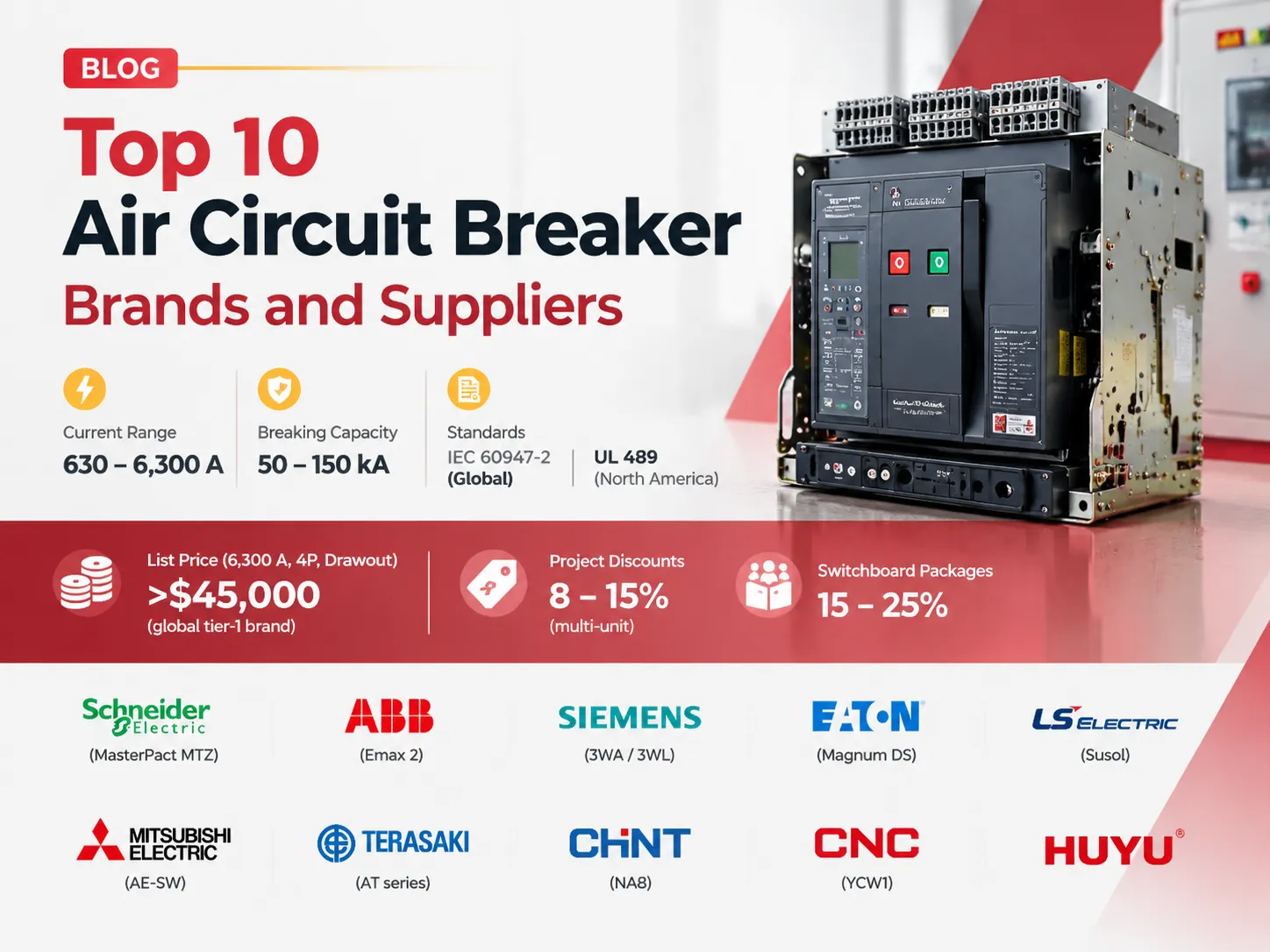
Short response: The ten air circuit breaker manufacturers and suppliers most commonly named in the specification process for industrial and utility projects are Schneider Electric (MasterPact MTZ), ABB (Emax 2), Siemens (3WA / 3WL), Eaton (Magnum DS), LS Electric (Susol), Mitsubishi Electric (AE-SW), Terasaki (AT series), Chint (NA8), CNC / Changshu Switch (YCW1), and HUYU. Normal nomenclature for these air circuit breakers ranges from 630 A to 6,300 A with breaking capacity ratings going from 50 kA to 150 kA. The IEC 60947-2, which is valid in the majority of countries, and UL 489 applicable to North America are two standards determining if an air circuit breaker is suitable for your project.
Air Circuit Breakers in One Paragraph
An air circuit breaker (ACB) is a type of circuit breaker that operates using air as the medium for quenching the arc rather than vacuum or the SF6 method. ACBs are mainly used in low-voltage switchgear applications ranging from 630 A to 6300 A. Generally, one can find ACBs in the incoming switchgear, bus tie, and generator protection applications.
ACBs can assume the “drawout” configuration, which is why they have not fallen to the competition from the smaller vacuum circuit breakers. In today’s world of technology, the capability to rack out a breaker and replace it with another one in seconds is worth more than the price of the equipment.
How This List Was Built
Four prerequisites, followed in this sequence.
- Range coverage. Will the maker actually produce ACBs in the operational range of 630 A to 6,300 A with sufficient breaking capacity or only within a limited scope?
- Certification breadth. Will they provide the same product family with the same IEC and UL certification documents? The use of IEC certifier eliminates the supplier from any project in North America.
- Accessory and retrofill ecosystem. Such as electronic trip units, communication devices, mechanical locks, cassettes and cradles, and whether the circuit breaker can be retrofitted into an existing panel by a different manufacturer.
- Service reality. Availability of spare parts, technical service in the buyer’s region, and lead times that are not completely derailed by an order backlog.
The cost is purposely omitted since it is determined by the above four points.What you are really looking for is whether the supplier is able to follow your project specifications.The practical issues you want to clarify with the factory, regardless of the number of units being purchased, are the same.That checklist is set out in more detail in this look at what distinguishes an air circuit breaker manufacturer worth working with.
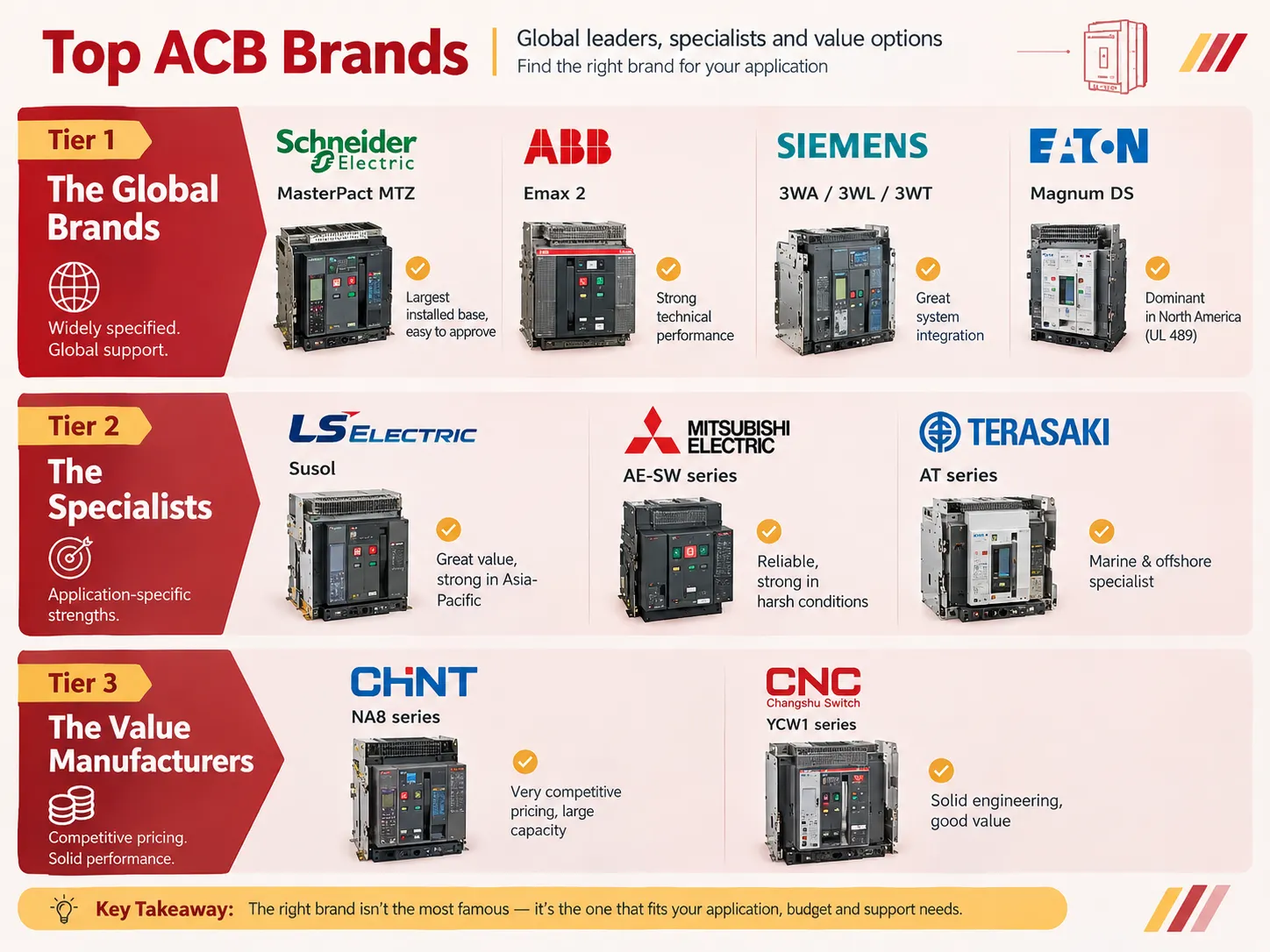
Tier 1: The Global Brands
These four are the benchmark. If your specification has been prepared by a consultant from Europe, North America, or the Gulf, one of these products is likely going to be mentioned in it.
Schneider Electric – MasterPact MTZ. This is the most preferred ACB family in the world. It comes in ratings varying between 630 A and 6300 A, breaking capacity of up to 150 kA, and possibly the largest ecosystem of accessories. The main features are provided by Micrologic trip units with integrated metering and communication systems, huge selection of cassettes, and a modular design that is intended to be updated in place as needed. Significant advantages – unmatched number of installed machines, high availability of the brand all over the globe, and ease of getting budget approval for this brand in a tender. Key disadvantages – the price is also related to the brand, and lead times for the assembled units can be quite long.
ABB – Emax 2. This brand belongs to the direct competitor and is equal on the technical side. Ekip trip units, capability rating of up to 6300 A, and the same models of drawout construction and communication features. ABB has offered the “smart breaker” marketing concept with built-in functions for power and energy measurement. Advantages – good technical documentation, good characteristics of the use of generators and bus tie equipment, and good product support in the industrial market. Key disadvantages – a price level similar to Schneider’s products.
Siemens – families 3WA, 3WL, and 3WT. The company offers a wider range of ACB names than many other manufacturers, with several families of products. Successful in Europe, strong in process and industrial applications, and regularly found in existing installations requiring new equipment. Advantages – excellent compatibility with Siemens switchboard products and technical documentation. Key disadvantages – family name can be confusing in practice.
Eaton – Magnum DS. Eaton has the strongest position in the North American market over these products, with a full UL 489 family of products and huge expertise in data centers and heavy manufacturing plants. Advantages – the most popular solution in the UL-required market, excellent documentation on the flash arc, and strong network of services in the USA. Key disadvantages – lower level of deployments in IEC first markets and local approach to making accessories compared to Schneider and ABB’s offerings.
Tier 2: The Specialists
It is notable that these three brands are competing based on their own strengths rather than being just the most recognizable brand in the industry.
The first company is LS Electric, a South Korean brand that has become a global company in low voltage switchgear and offers a broad range of ACBs of up to 6300A, alongside the IEC and UL certification. STRENGTHS: good value at high ratings, strong coverage in Asia-Pacific and the Middle East region, decent product quality. WEAKNESSES: limited service network coverage.
The second company is Mitsubishi Electric, a long-existing brand in Japan and Asia. It is known for its reliability when it comes to difficult operations, such as generator protection and marine application. STRENGTHS: conservative design margins, good reliability history, strong coverage in Japan and Asia. WEAKNESSES: high pricing and a limited array of accessories.
The last company to mention is Terasaki, a manufacturer that specializes in marine and other challenging applications. The company has unique approvals that make it the best and only solution for shocking, vibration, and aggressive salt environment of the sea. STRENGTHS: unique characteristics and relevant approvals. WEAKNESSES: niche manufacturer with low pricing for ordinary industrial solutions.
It is quite remarkable that brand strength depends on the application of the products rather than the brand itself. For instance, if a producer has excellent performance for commercial distribution boards, it may be unsuitable for ships and vice versa.Building a view of which brands genuinely deliver in which segments — rather than which ones advertise most — is the same exercise you’d run for any electrical component category, and the framing in this comparison of which electrical solution brands suit which applications applies directly to circuit protection.
Tier 3: The Value Manufacturers
This is where the conversation around pricing gets very interesting and where many buyers make the wrong assumptions.
Chint – NA8 series. China’s leading low-voltage producer of switches, with a complete range of low-voltage circuit breakers that now also includes the increasingly important UL certifications for its series of products. Strengths: low prices and vast production inputs and capacity; weakness: lag in acceptance among consultants who continue to regard any Chinese switchgear as “dubious” thing despite the existence of particular certification.
CNC / Changshu Switch – YCW1 series. A Chinese manufacturer of air circuit breakers with a long history and a large capacity serving home market. Strengths: solid and sensible engineering and good price; weakness: lacking experience with specific documentation required for export projects and overseas support.
The assumption one can challenge is that “value tier” means “low-performance thing.” It does not mean this at all, necessarily. The technology of circuit breakers is highly developed, and a properly certified value tier product will have exactly the same breaking capacity as that of tier-1 circuit breaker. The difference can be with regards to the range of accessories provided, the trip unit software, the level of communication, and the infrastructure and/or documentation provided.
Where HUYU Fits
To clarify our own position: HUYU is a supplier and maker in this category, thus we are part of this list and must point out the same caution as anyone else – test what we say against your specs and don’t take anything for granted.
We fall somewhere in the middle: our ACBs are available in the range from 630 A to around 4,000 A, IEC 60947-2 compliant and tested, with UL 489 options for customers from North America; we pay particular attention to the aspect that could be a problem for buyers – the quality of goods when they order them again and the time they have to wait for them. That is, we have a lot of clients with panel builders, contractors, distributors, and OEM programs that compel us to make sure everything is correct the first time as someone else’s engineers will verify it.
That means in practice that we are fine in situations when clients need ACBs in mass production as per a certain specification but less fine when clients have a special request. If you want to see the supply scope, configurations and the markets we work in, the details are on our air circuit breaker supply and configuration overview.
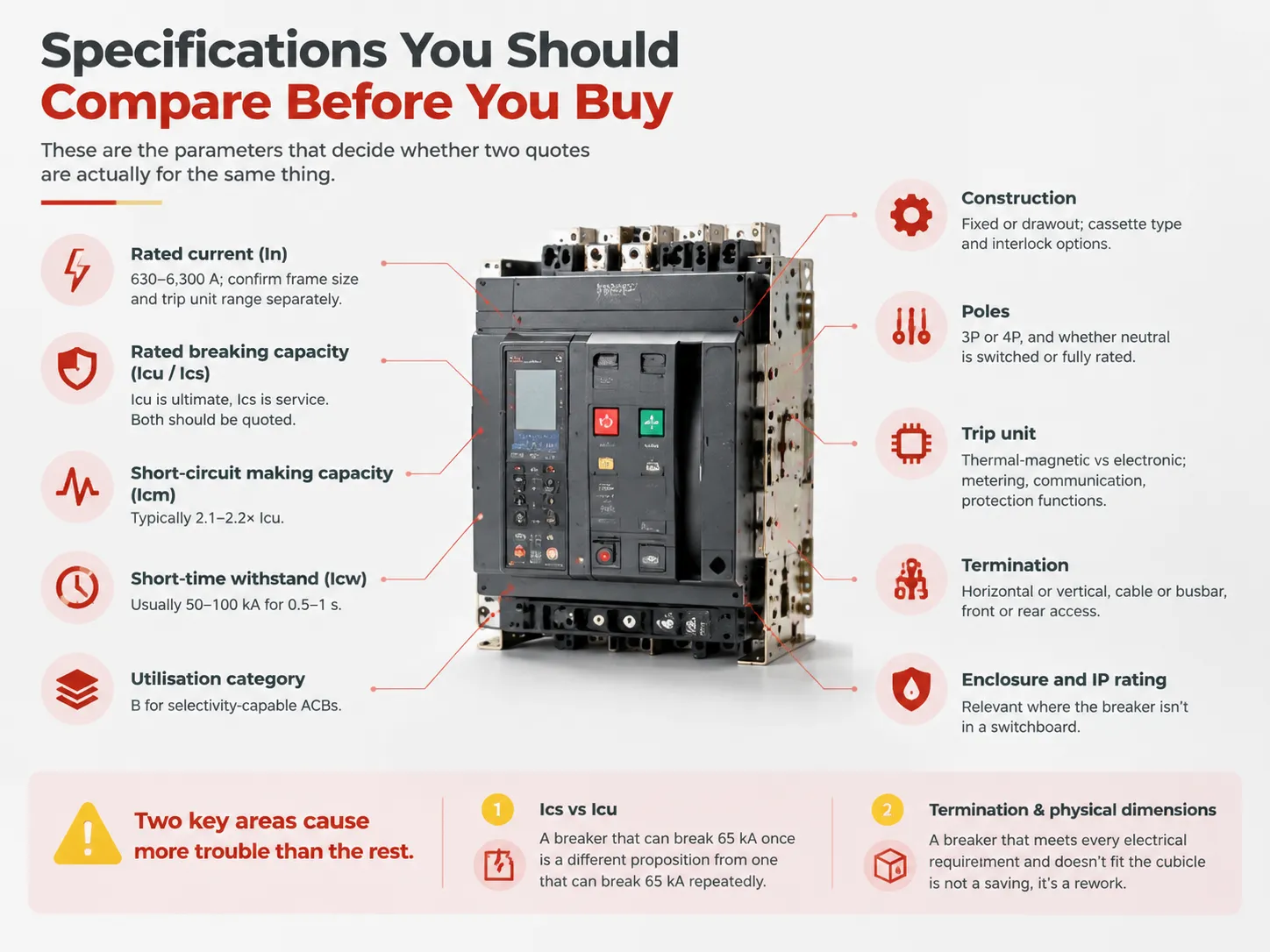
Specifications You Should Compare Before You Buy
Those are the criteria that help to say if two quotations are really for the same item. Without them, comparing pricing makes no any sense.
| Parametre | What to check | Why it matters |
|---|---|---|
| Rated current (In) | 630–6,300 A; confirm the frame size and the trip unit range separately | A 1,600 A frame with a 1,000 A trip unit isn’t the same product as a 1,000 A frame |
| Rated breaking capacity (Icu / Ics) | Icu is ultimate, Ics is service. Both should be quoted | Some suppliers quote Icu only. Ics is what you can break repeatedly |
| Short-circuit making capacity (Icm) | Typically 2.1–2.2× Icu | Determines the peak withstand the switchboard must tolerate |
| Short-time withstand (Icw) | Usually 50–100 kA for 0.5–1 s | Critical for selectivity and for coordination studies |
| Utilisation category | B for selectivity-capable ACBs | Category A breakers can’t provide the same discrimination |
| Yapı | Fixed or drawout; cassette type and interlock options | Drawout is normally mandatory for a main incoming position |
| Kutup | 3P or 4P, and whether neutral is switched or fully rated | Full-neutral 4P costing differs substantially from switched-neutral |
| Trip unit | Thermal-magnetic vs electronic; metering, communication, protection functions | The trip unit can cost more than the breaker on advanced configurations |
| Termination | Horizontal or vertical, cable or busbar, front or rear access | The most common source of a product that doesn’t fit the board |
| Enclosure and IP rating | Relevant where the breaker isn’t in a switchboard | Determines suitability for plant-floor or outdoor installation |
Two of them can cause more troubles than the others. The first one is Ics and Icu. The breaker with Ics rating of 65 kA might be good for one instance only while the Icu value will allow to interrupt 65 kA power a few times. The second important factor is very important – the breaker can meet all the electrical requirements and still be useless if it does not fit into the cubicle.
Standards and Certifications: What to Ask For
This is where the battle for project success starts, and while some say it all comes to business strategy, others point out that money wins at this stage.
IEC 60947-2 is an international standard that regulates circuit breakers used in industry. Any manufacturer that claims to adhere to this standard must submit a type test report obtained in an accredited laboratory and not merely a statement saying that the production processes are in compliance with the quality standards.
UL 489 is the North American version of the standard that deals with molded case circuit breakers and air circuit breakers. UL and IEC60947 are not interchangeable, which means that it does not entail that a circuit breaker, which design and testing were made according to IEC60947, will pass all UL requirements. Thus, one of the requirements may limit the potential suppliers even before an opportunity to compare costs has been presented to a customer.
The distinctions worth understanding are set out properly in this explanation of what UL 489 actually covers for breakers, and it’s worth reading before you send out an RFQ rather than after the quotes come back.
In addition to the two essential criteria, please ensure that you ask for:
- Test reports from an accredited laboratory that state the report number and date of issue.
- IEC 60947-2 Annexes where applicable: Annex B for isolation and Annex H for an integrated test method.
- Marine and offshore approvals by the classification societies, if required by the application.
- RoHS and REACH declarations on material contents as required by many European buyers.
- ISO 9001 on the process of manufacture, which is required but insufficient by itself.
- Arc-flash and coordination data so that the protection study can be carried out without guessing.
Make the request for the documents at the quotation stage and not at the time of deliver. A company that cannot provide a type test report within a few days of the request will probably not be able to provide it at all. The manufacturer’s certificate pack is a good indicator of how serious they are about the rest of the process.
Price Ranges and How Discounts Actually Work
List price is close to meaningless in this category. Here’s the structure underneath it.
| Purchase situation | Typical position versus list | Notlar |
|---|---|---|
| Single unit, up to 1,600 A | List price, sometimes 5–10% off | Small order; the supplier has no incentive to move much |
| Multiple units, one project | 8–15% off list | The normal commercial band for a project order |
| Complete switchboard or panel package | 15–25% off list | The breaker is bundled with enclosure, busbar and assembly |
| OEM or repeat programme | Negotiated annually, often below 25% off | Volume commitment in exchange for price and priority |
| Tier-1 brand, 6,300 A drawout 4P | Roughly $45,000–$70,000 list | Advanced trip units push this higher quickly |
| Value-tier brand, comparable rating | Often 30–50% below tier-1 | The gap narrows once trip units and accessories are matched |
There are three common misconceptions that purchasers make regarding this issue. The first misconception is that comparing a value-level quote with a basic trip unit against a Tier 1 quote containing a metering trip unit forms an actual price comparison. This simply is not true as it is regarded as a product comparison. Before entering the market it is important to define the exact functions of the trip unit. The second misconception is that it can be assumed that the discount percentage constitutes all the necessary information needed to make a decision. However, one should take into account the very fact that the payment terms, lead time, transportation, spare parts price and warranty help to a much greater extent that a few points of discount over a 25-year equipment life cycle. The third misconception is forgetting that the cassette, cradle and different accessories are usually sold separately, making such additional expenses very considerable in regard to the overall price of the breaker itself.
Choosing the Right Supplier by Industry
The right answer genuinely changes with the application. Here’s how the priorities shift.
| Industry | What dominates the decision | Supplier profile that fits |
|---|---|---|
| Utility substations and distribution | Type test evidence, coordination data, long-term spares | Tier-1 with an established service network and a 20-year spares commitment |
| Data centres | Selectivity, uptime, communication and monitoring | Tier-1 or strong tier-2 with mature trip unit communication and fast spares |
| Oil, gas and petrochemical | Certification, arc-flash documentation, hazardous-area compatibility | Established brands with process-industry references and full documentation |
| Marine and offshore | Classification society approvals, shock and vibration | Specialists in the marine segment; this is not a price-driven purchase |
| Commercial buildings and retail | Price, availability, standard configurations | Value-tier or tier-2 with good local distribution |
| Renewable generation and BESS | DC compatibility, cycling duty, coordination with inverters | Manufacturers with tested coordination studies for inverter-fed systems |
| Industrial manufacturing | Motor protection, selectivity, plant-level spare parts | Tier-2 with strong accessory range and a regional stockist |
| Export projects in emerging markets | Documentation quality, price, delivery reliability | Value-tier manufacturers with export experience and certified paperwork |
The point made in that table notice is that risk tolerance is essentially the main variable at play. A utility that purchases a 40-year asset with an outage cost that is measured in millions an hour is willing to pay a premium to have certainty. A contractor that is fitting out a shopping centre where the breaker is just one of the components in the switchboard is going to make the best decision based on the two main criteria, price and delivery. The error is made by trying to apply the experience gained in one field to another — overspecifying on a commercial project results in waste of budget, while underspecifying on a utility project can result in liabilities that are going to exist after the project done.
The last piece of common sense advice regardless of the sector you are operating in relates to the suppliers. Before you make your shortlist, ask all of the suppliers to provide you with the full documentation pack, which includes the type test report issued by an accredited laboratory, the certification of the rating and the material declaration. How fast they respond to you, and how complete their response is, allows you to judge their discipline.It is also the quickest way to find out whether the certifications and approvals behind a switchgear or breaker product are as comprehensive as the datasheet implies.
SSS
Which air circuit breaker brand is best?
The point made in that table notice is that risk tolerance is essentially the main variable at play. A utility that purchases a 40-year asset with an outage cost that is measured in millions an hour is willing to pay a premium to have certainty. A contractor that is fitting out a shopping centre where the breaker is just one of the components in the switchboard is going to make the best decision based on the two main criteria, price and delivery. The error is made by trying to apply the experience gained in one field to another — overspecifying on a commercial project results in waste of budget, while underspecifying on a utility project can result in liabilities that are going to exist after the project done.
The last piece of common sense advice regardless of the sector you are operating in relates to the suppliers. Before you make your shortlist, ask all of the suppliers to provide you with the full documentation pack, which includes the type test report issued by an accredited laboratory, the certification of the rating and the material declaration. How fast they respond to you, and how complete their response is, allows you to judge their discipline.
What’s the difference between IEC 60947-2 and UL 489?
There are two types of standards required by circuit breakers which cannot be substituted for each other. IEC 60947-2 refers to International electrical equipment standard followed in majority parts of the world and UL 489 refers to North American standard for molded case and air circuit breakers. In case of circuit breakers tested as per IEC 60947-2 standards may not be counted as acceptable in UL assembly requiring UL certified products since standards represent quite diverse field and half of regional markets may be unavailable for manufacturers who can work only according to one of the above standards.
How much does an air circuit breaker cost?
The spectrum of prices covers a very wide range because the range of ratings is also quite large. For example, a basic highly-rated pole mounted circuit breaker from a value brand may cost not more than a few hundred dollars, whereas a 6300 A drawout type 4 pole unit made by a global brand and fitted with a metering type of trip unit may cost around $45,000. Generally, the discounts are approximately 8-15% on multiple-unit orders and 15-25% on entire switchboard packages; discounts through OEM programs are negotiated on an annual basis. The main variables affecting price include rated current, breaking capacity, type of pole configuration, drawout vs. fixed type of construction, and, most importantly, type of trip unit.
Can I replace an old air circuit breaker with a different brand?
Prices vary greatly depending on the rated level. A basic brand name pole mounted circuit breaker may cost only a few hundred dollars, while a large global brand 6300 A drawout type 4 pole unit with a metering type of trip unit may cost approximately $45,000. There are average discounts of about 8-15% on the orders for numerous units and about 15-25% on total switchboard packages. Discounts due to OEM programs are negotiated yearly. The key factors determining price are the rated current, breaking capacity, type of pole configuration, drawout versus fixed construction, and, the most important, the type of trip unit.
How do I verify a supplier’s certifications are genuine?
Request documents rather than claims. Keep three main factors in mind. The first issue to consider is the source of the report that should come from accredited laboratory that is independent. The second factor is that the type of report has to be mentioned in the certificate. The last item is that the report must specify the required type of product in order to fulfill your order — for example, a certificate for a 6300 A installed unit will not work for a 4300 A installed unit. It is better to confirm the necessary information directly with the organization that issued the certificate.
Referanslar
- IEC 60947-2 — Low-voltage switchgear and controlgear, Part 2: Circuit-breakers — the governing international standard for ACBs
- UL Çözümleri — certification and listing information for circuit breakers and switchgear assemblies
- National Electrical Manufacturers Association (NEMA) — North American electrical equipment standards and industry reference data
- ABB — Emax 2 air circuit breaker range and technical documentation
- Siemens — low-voltage circuit breaker families including 3WA and 3WL
- Mitsubishi Electric — AE-SW series air circuit breakers
- LS Electric — Susol low-voltage circuit breaker range
- Chint — NA8 series air circuit breakers and low-voltage switchgear
Sonuç
To simplify obtaining an air circuit breaker, you should consider the selection of suppliers. Ten major suppliers fall into three categories for a good reason. Schneider, ABB, Siemens, and Eaton are industry leaders in this respect and are always chosen when a particular brand is mentioned in the specification or a project cannot afford any technical risks. LS Electric, Mitsubishi, and Terasaki always win because of their top-notch advantages – high value, reliability, and excellent marine operation characteristics, respectively. Chint, CNC, and other manufacturers that operate in the low-cost segment, including HUYU, offer good type-tested products at competitive prices.
The figures of importance are: 630 A to 6,300 A, Icu from 50 kA to 150 kA, IEC 60947-2 for the majority of markets, UL 489 for North America, project discounts around 8-15%, and switchboard package discounts around 15-25%.
Nevertheless, price is seldom the deciding factor for making a choice. The decision mainly depends on two questions. Is this supplier able to provide an appropriate certification for the project necessary in its documentation? Will it be able to fulfill the second order in the same quality? If these two issues are resolved, the brand choice will not cause any problems, regardless of the tier the brand belongs to.