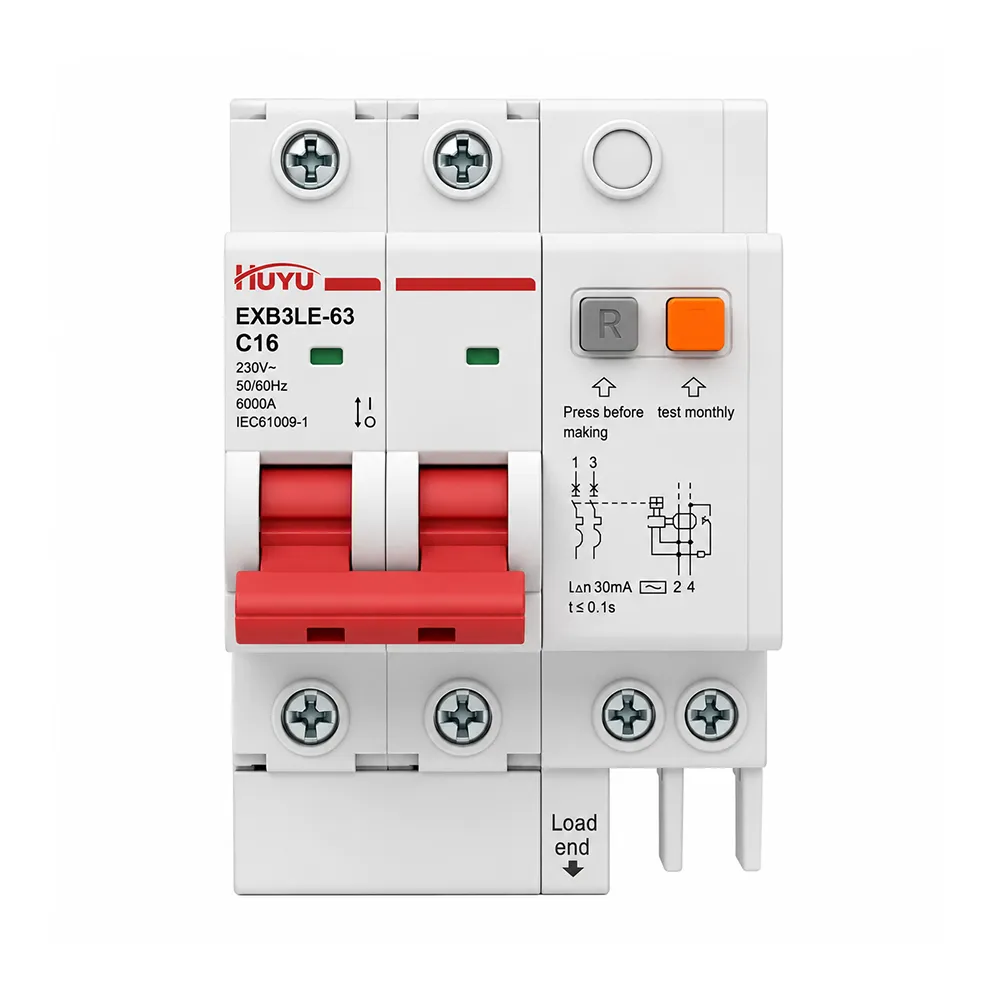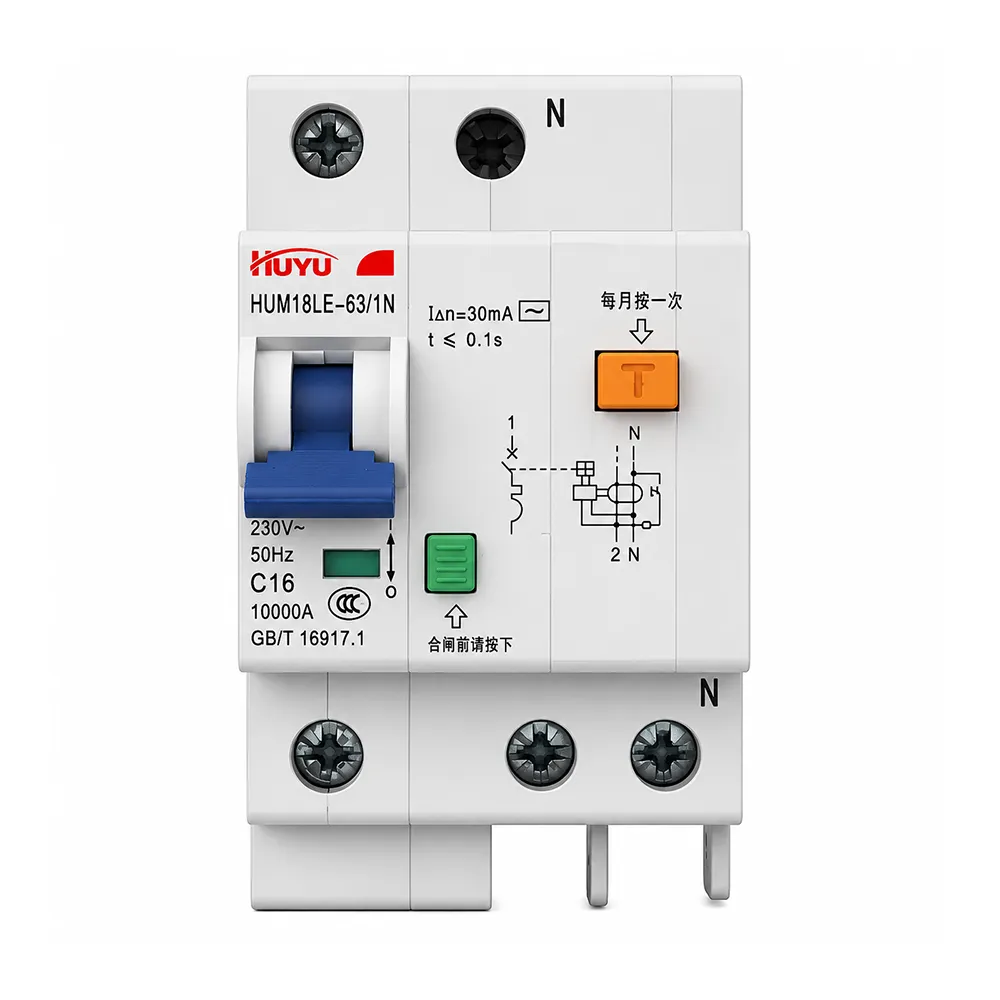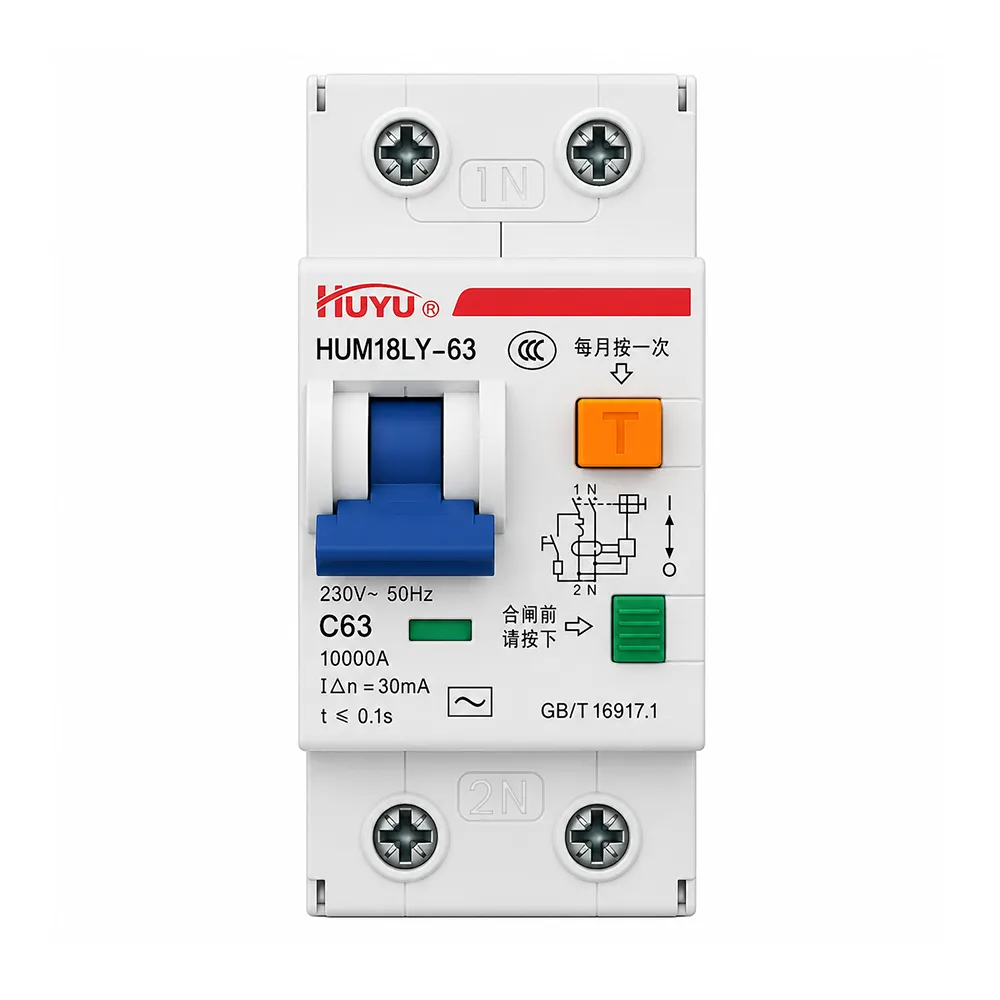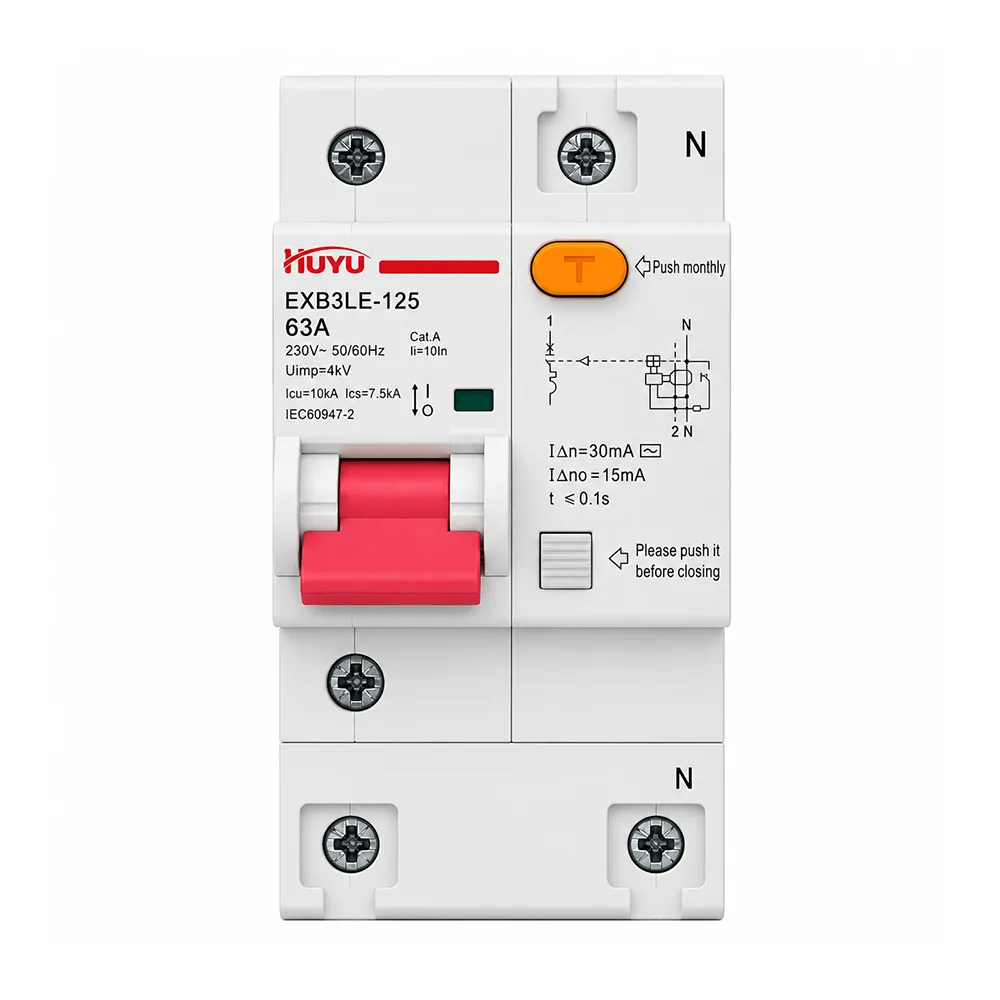

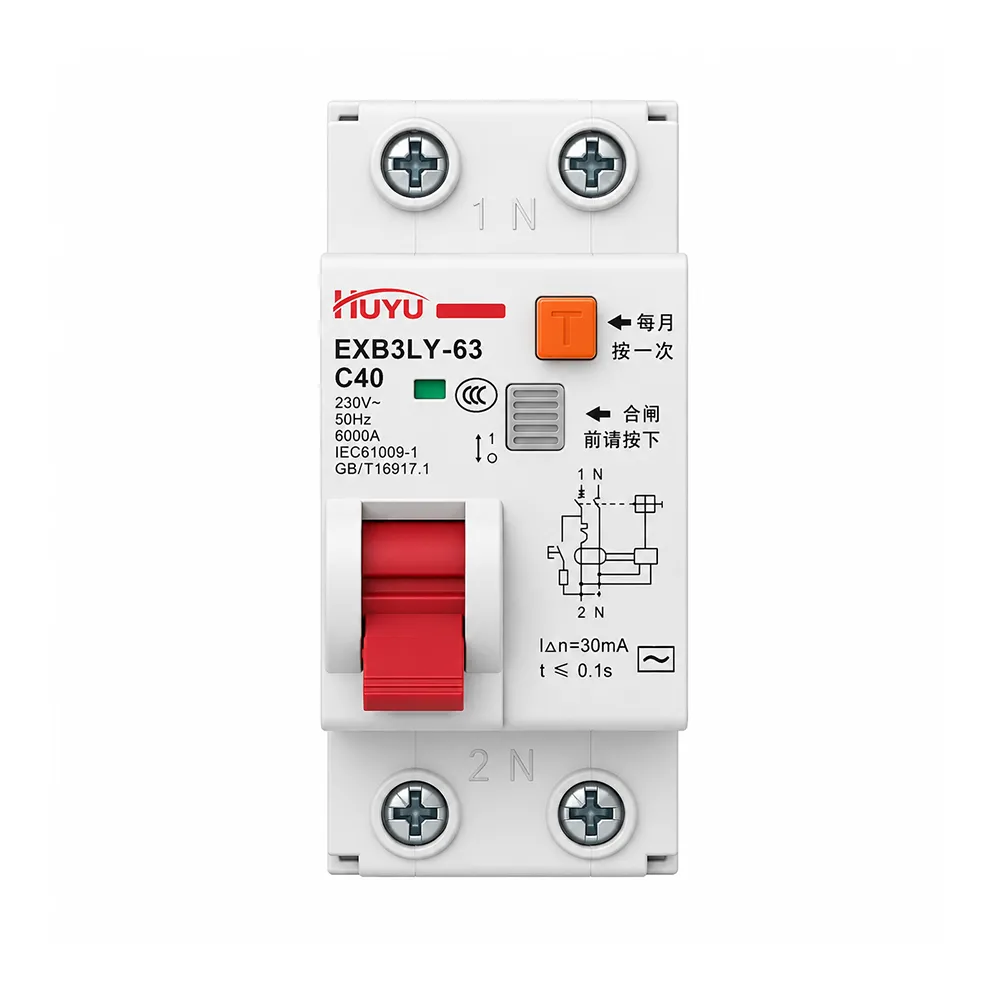
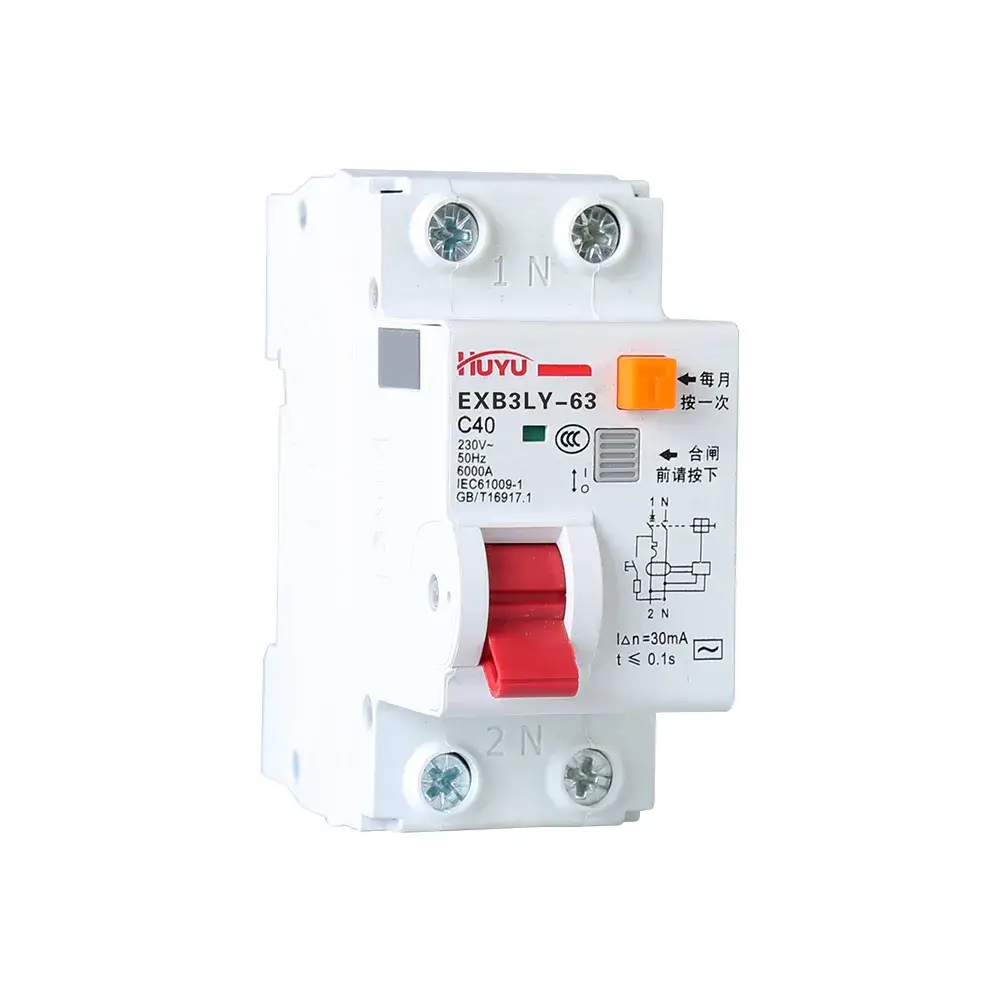


EXB3LY-63 RCBO – 63A 30mA 50mA,1P+N,Type AC B/C/D
The EXB3LY-63 is a 1P+N RCBO combining overcurrent, short-circuit, isolation, and earth leakage protection for AC 230V circuits. Rated 6A–63A with 30mA or 50mA residual current sensitivity. Compliant with IEC 61009-1 & GB/T 16917.1. Trip curves: B, C, D. Type AC. 6kA Icn/Ics symmetrical breaking. -35°C to +70°C. IP40 in enclosure. 7 accessories: OF, SD, MX+OF, MN, MV, MVMN, MNs. 25mm² wiring, TH35-7.5 DIN rail.
Standards: IEC 61009-1, GB/T 16917.1
Rated Current: 6A – 63A
Residual Current: 30mA, 50mA
Breaking Capacity: 6kA Icn/Ics
Poles: 1P+N
Voltage: AC 230V
Type: AC
Curves: B, C, D
Accessories: OF, SD, MX+OF, MN, MV, MVMN, MNs
Product Information
EXB3LY-63 1P+N RCBO – 4-in-1 Compact Protector for 230V Circuits
Every DIN rail module in a residential consumer unit or small commercial distribution board matters. The HUYU Electric EXB3LY-63 combines overload, short-circuit, isolation, and 30mA or 50mA earth leakage protection into a 1P+N RCBO — four functions in one compact module that would require two or more module widths with a separate MCB and RCD. It is suitable for AC 230V single-phase circuits up to 63A and complies with IEC 61009-1 and GB/T 16917.1.
What sets this RCBO apart from other bulkier alternatives is its details: a 6kA symmetrical Icn/Ics rating means the device will still be fully operational after a maximum-rated fault has cleared – no de-rating required, no need to replace it. It has Type AC residual current detection for domestic circuits that exhibit sinusoidal leakage. The thermal-magnetic trip unit has three different curve types (B, C, and D) to match different load profiles. 7 optional snap-on accessories – OF, SD, MX+OF, MN, MV, MVMN, MNs – allow remote monitoring and control of the basic protective function. Its operating range of -35°C to +70°C and an IP40 rating when mounted in an enclosure mean that it can be installed in unconditioned spaces that exceed the limits of a standard RCBO. For distributors currently stocking Hager, Schneider, Fusebox, Wylex, MK, Eaton, ABB, Legrand, Chint, or Crabtree RCBOs, HUYU Electric can offer factory direct OEM/ODM pricing with private label options, and will supply full compliance documentation.
Current Ratings & Trip Curves – 6A to 63A, B/C/D, 30mA or 50mA
| Pole | Rated Current | IΔn | Curves | Typical Circuit |
|---|---|---|---|---|
| 1P+N | 6A – 63A | 30mA, 50mA | B, C, D | 230V socket outlets, lighting, fixed appliances |
The EXB3LY-63 is purpose-built for single-phase 230V circuits — the most common configuration in residential and light commercial installations. Choose 6A or 10A for lighting circuits; 16A or 20A for general socket outlets; 25A or 32A for water heaters, air conditioning, and kitchen appliances; 40A–63A for electric showers, cookers, and sub-main feeds. Select 30mA IΔn for personal shock protection on socket circuits, or 50mA where slightly higher earth leakage tolerance is needed to avoid nuisance tripping on circuits with naturally higher background leakage. Type B, C, and D curves cover resistive, inductive, and high-inrush loads from a single product family.
30mA vs 50mA – Which Sensitivity Does Your Circuit Need?
The choice between 30mA and 50mA residual current sensitivity depends on what the circuit feeds and the level of protection required. A 30mA RCBO is mandated by wiring regulations for socket outlet circuits and circuits in rooms containing a bath or shower — it trips fast enough (within 40ms at 150mA) to prevent fatal electric shock. A 50mA device provides a slightly higher threshold, which can be useful for fixed equipment circuits where cumulative earth leakage from multiple appliances might cause unwanted tripping on 30mA, yet earth fault protection is still required. The EXB3LY-63 carries both options, so you can match the sensitivity to the circuit without changing product series.
Technical Specifications
| Product Model | EXB3LY-63 |
| Standards | IEC 61009-1, GB/T 16917.1 |
| Poles | 1P+N |
| Rated Current (A) | 6, 10, 16, 20, 25, 32, 40, 50, 63 |
| Rated Voltage | AC 230V |
| Frequency | 50/60Hz |
| Residual Current Type | Type AC |
| Residual Current IΔn (mA) | 30, 50 |
| Breaking Capacity Icn/Ics | 6,000A (6kA) |
| Impulse Withstand Uimp | 4kV |
| Tripping Curve | Type B, C, D |
| Electrical Life | 10,000 cycles |
| Mechanical Life | 20,000 cycles |
| Operating Temperature | -35°C ~ +70°C |
| Max. Wiring | 25mm² |
| Incoming Method | Top-in, bottom-out |
| Mounting | TH35-7.5 DIN Rail |
| Protection Degree | IP20 (direct); IP40 (in enclosure) |
| Accessories | OF, SD, MX+OF, MN, MV, MVMN, MNs |
| MOQ | 2,000 pcs per item |
Source 1P+N RCBOs at Factory-Direct Pricing
6A–63A, 30mA or 50mA, B/C/D curves, 6kA. Seven accessories. IEC 61009-1 / GB/T 16917.1 compliant. OEM branding and complete documentation. Request a quotation for your wholesale order.
MOQ 2,000 pcs • IEC 61009-1 / GB/T 16917.1 • Worldwide Shipping
OEM/ODM Supply – A Compact 1P+N RCBO for Volume Distribution
EXB3LY-63 – The Single-Phase RCBO That Simplifies Consumer Units
Most residential circuits in the world run on 230V single-phase. The EXB3LY-63 is built specifically for that application — a consumer unit RCBO in 1P+N format with all the protection functions needed for lighting, socket, and appliance circuits. If your customers currently install Hager, Schneider, Fusebox, Wylex, MK, Eaton, ABB, Legrand, Chint, or Crabtree single-phase RCBOs, the EXB3LY-63 matches IEC 61009-1 compliance while offering factory-direct pricing, 30mA and 50mA sensitivity choices from one product code, and an accessory ecosystem that supports auxiliary indication, alarm signaling, shunt tripping, and voltage-based protection — features typically found only on more expensive product lines. Private labeling, custom packaging, and complete IEC/GB test documentation are standard for volume orders.
How to Specify a 1P+N RCBO – Current, Sensitivity & Curve for 230V Circuits
A practical guide to selecting the correct EXB3LY-63 for residential and light commercial consumer units.
1. Choosing the Current Rating
Lighting circuits: 6A or 10A. General socket outlets: 16A or 20A. Water heaters and air conditioning: 25A or 32A. Electric showers, cookers, and sub-main feeds: 40A to 63A. The EXB3LY-63 spans this full residential range. When multiple RCBOs are grouped in a consumer unit, allow for thermal derating between adjacent devices — the 25mm² terminal capacity on the 63A model ensures cable sizing is never limited by the device.
2. 30mA or 50mA?
Under IEC wiring regulations, socket outlet circuits and circuits in rooms containing a bath or shower require 30mA residual current protection. This is the default choice for most residential circuits. Use 50mA on fixed equipment circuits where background earth leakage is higher — for example, circuits feeding multiple IT equipment racks, large heating elements, or older appliances with higher natural leakage — to avoid cumulative nuisance tripping while maintaining earth fault protection.
3. B, C, or D Curve?
Type B (3–5× In) for resistive circuits — incandescent lighting, electric heating, domestic cooker elements. Type C (5–10× In) for circuits with motors, compressors, fluorescent lighting, or any equipment producing a brief inrush current. Type D (10–20× In) for high-inrush loads such as large transformer-fed equipment. If a Type B RCBO is nuisance tripping on a motor start-up, switching to Type C usually resolves it without changing the protection level.
4. Installation Notes
The EXB3LY-63 clips onto a standard TH35-7.5 DIN rail, top-in bottom-out wiring. Terminal torque is 2.0 N·m with 25mm² maximum conductor capacity. IP20 when surface-mounted, IP40 inside a consumer unit. The -35°C to +70°C operating range handles unconditioned plant rooms and outdoor kiosks. Accessories snap on without tools — install during initial fitting or retrofit later. For circuits requiring remote monitoring, add an OF or SD contact; for voltage-based protection, fit an MN, MV, or MVMN release.




Frequently Asked Questions
What is an RCBO?
RCBO stands for Residual Current Breaker with Overcurrent. It is a single device that combines the functions of an MCB (overcurrent protection) and an RCD (earth leakage protection). Instead of installing two separate devices on each circuit, one RCBO handles both. The EXB3LY-63 adds a fourth function — isolation — making it a complete single-module solution for 230V circuits.
What is the difference between an RCBO and an MCB?
An MCB protects only against overcurrent — too much current flowing due to overload or short circuit. An RCBO provides the same overcurrent protection plus earth leakage detection. If current leaks to earth through a person or faulty insulation, the RCBO trips. This makes RCBOs mandatory for socket circuits in residential installations; an MCB alone does not provide this life-safety function.
What is the difference between an RCBO and an RCD?
An RCD detects earth leakage only — it has no overcurrent protection and must be used with a separate MCB or fuse. An RCBO integrates both, so one device on each circuit gives complete protection. In a consumer unit, using individual RCBOs instead of a single RCD protecting multiple MCBs means a fault on one circuit trips only that circuit — not the entire board.
What are the RCBO types (A, AC, B)?
The type refers to the kind of residual current the device can detect. Type AC responds to pure sinusoidal AC earth leakage — the standard for most household circuits with resistive and motor loads. Type A adds detection of pulsating DC leakage from circuits containing rectifiers or switch-mode power supplies. Type B handles smooth DC, needed for EV chargers and solar inverters. The EXB3LY-63 is Type AC, the correct choice for standard residential and commercial 230V circuits.
No documents available for download at this moment.