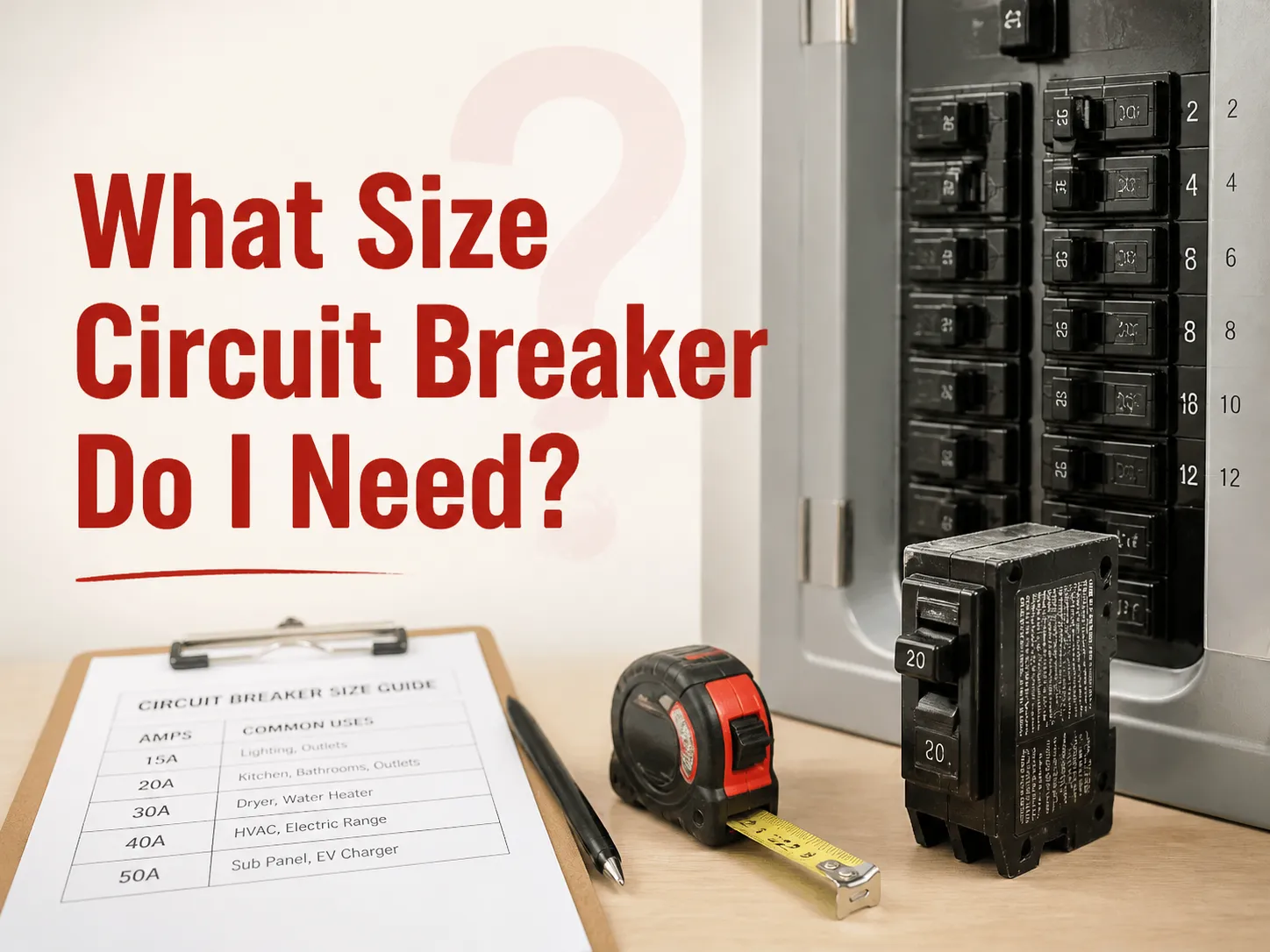

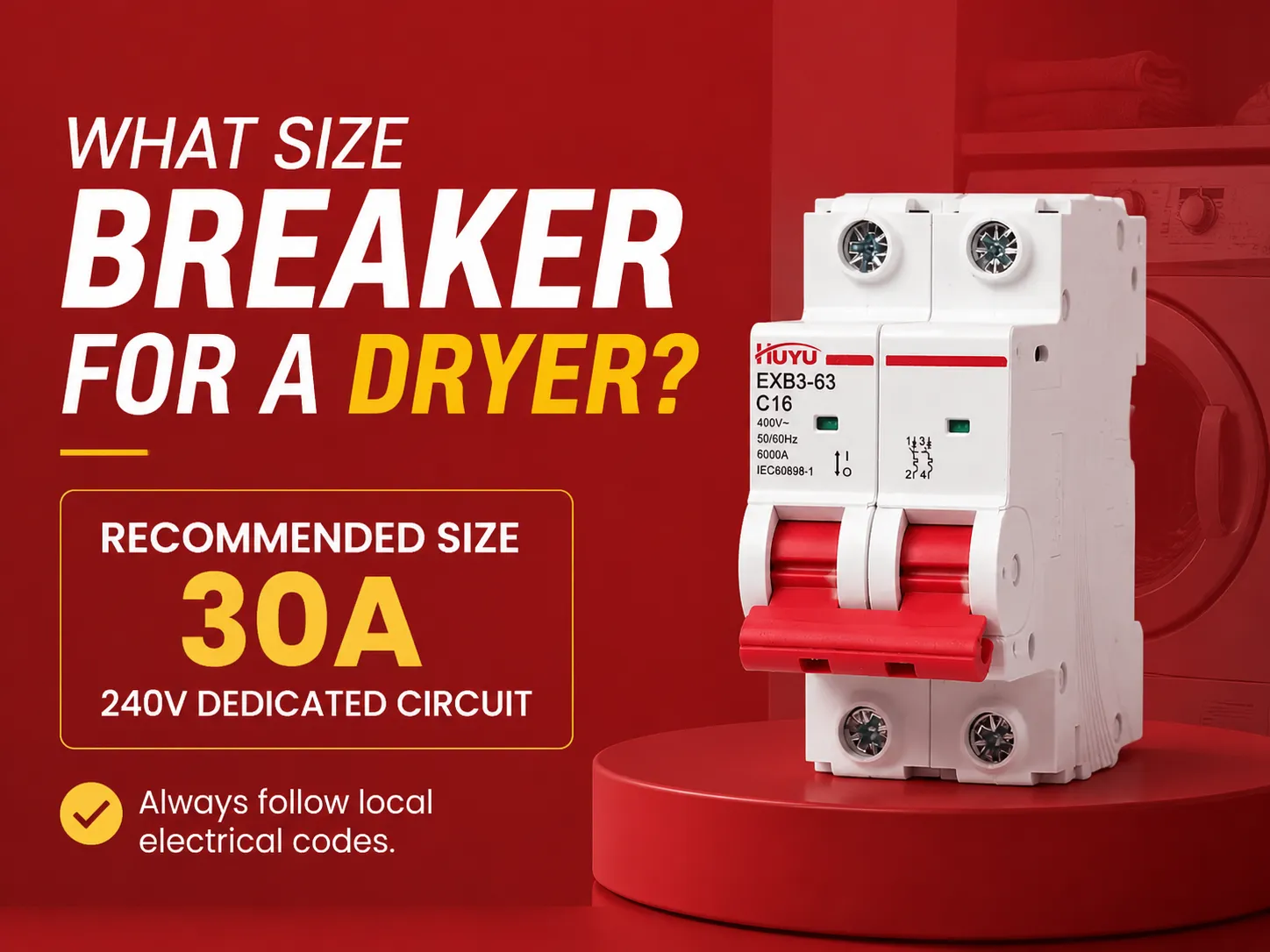
The homeowner in Seattle assumed that using his new electric dryer was easy. All he had to do was plug in the four-pronged cable and turn it on. But ten minutes into the first cycle, the breaker went off. After resetting the breaker, he tried again, but the breaker went off again. Though the dryer was new and plugged into an appropriate panel, the breaker was rated only 20 amps, which was insufficient for the dryer, so he needed to use a 30-amp rated double pole breaker typically installed for electric dryers in homes across North America. By choosing the right circuit breaker for dryers, you can prevent nuisance trips, as choosing the right size for a breaker requires consideration of the load rating, gauge of the wiring and rating of the receptacle.
The Short Answer: 30 Amps, Double‑Pole
In the US and Canada, the proper circuit breaker for a regular household electric dryer is a double-pole 30-amp breaker. This circuit breaker serves to protect 240-volt circuits which use 10 AWG (10-gauge) wire and connect to either a NEMA 10-30R or NEMA 14-30R (NEMA 14-30R has four prongs while NEMA 10-30R has three prongs). The dryer uses about 22 to 28 amps power depending on the model and the cycle, thus being well below the 80% load limit of 30-amp circuits (which is 24 amps). The double-pole configuration is essential since the dryer runs on 240 volts, which is achieved from two 120-volt circuits in a split electrical system of North America. Information from major appliance manufacturers such as Whirlpool and GE Appliances consistently specifies a 30‑amp circuit for residential dryers, and this is the standard embedded in the National Electrical Code (NEC) for dryer circuits.
Why a 30‑Amp, Double‑Pole Breaker Is Required
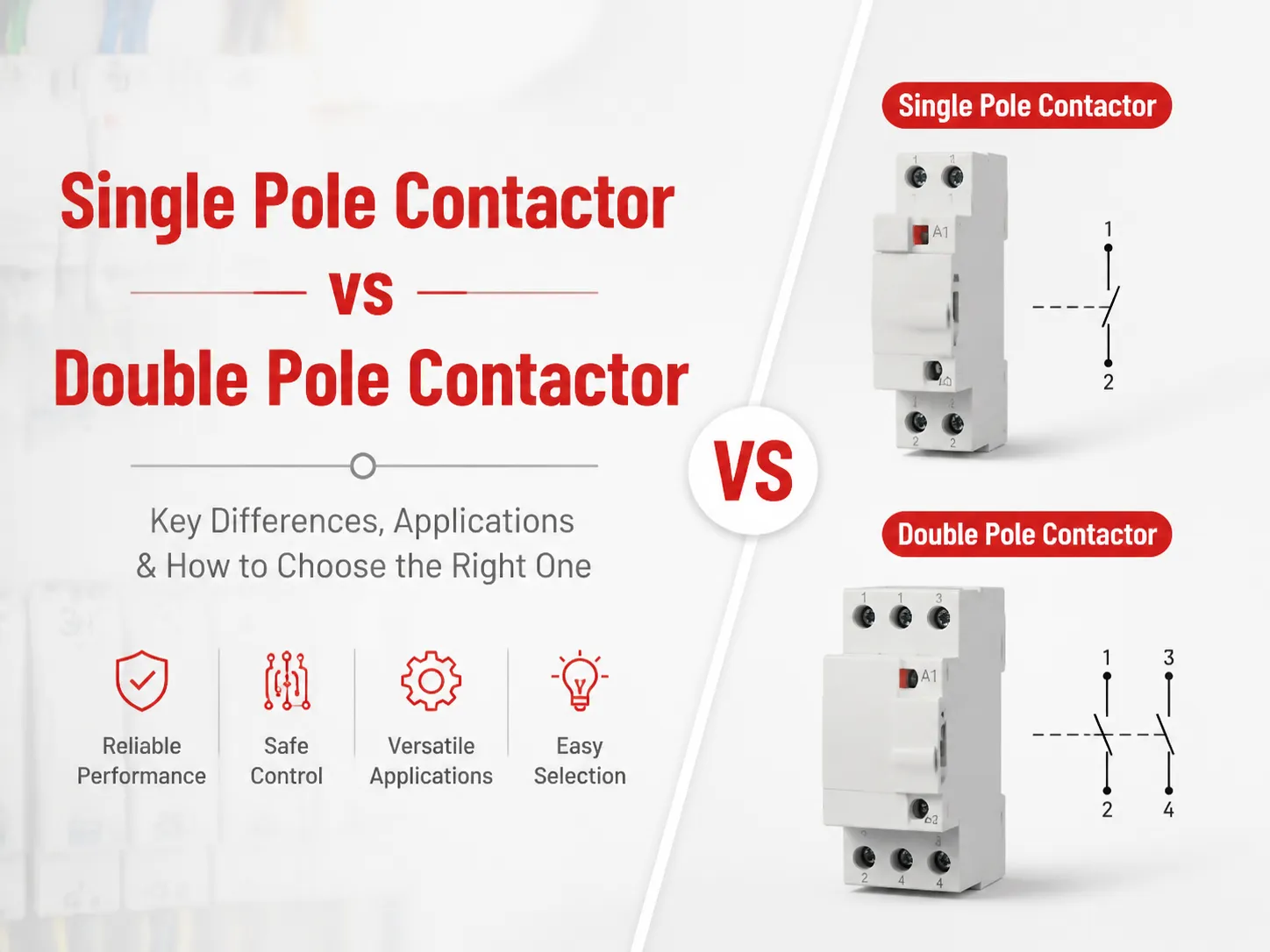
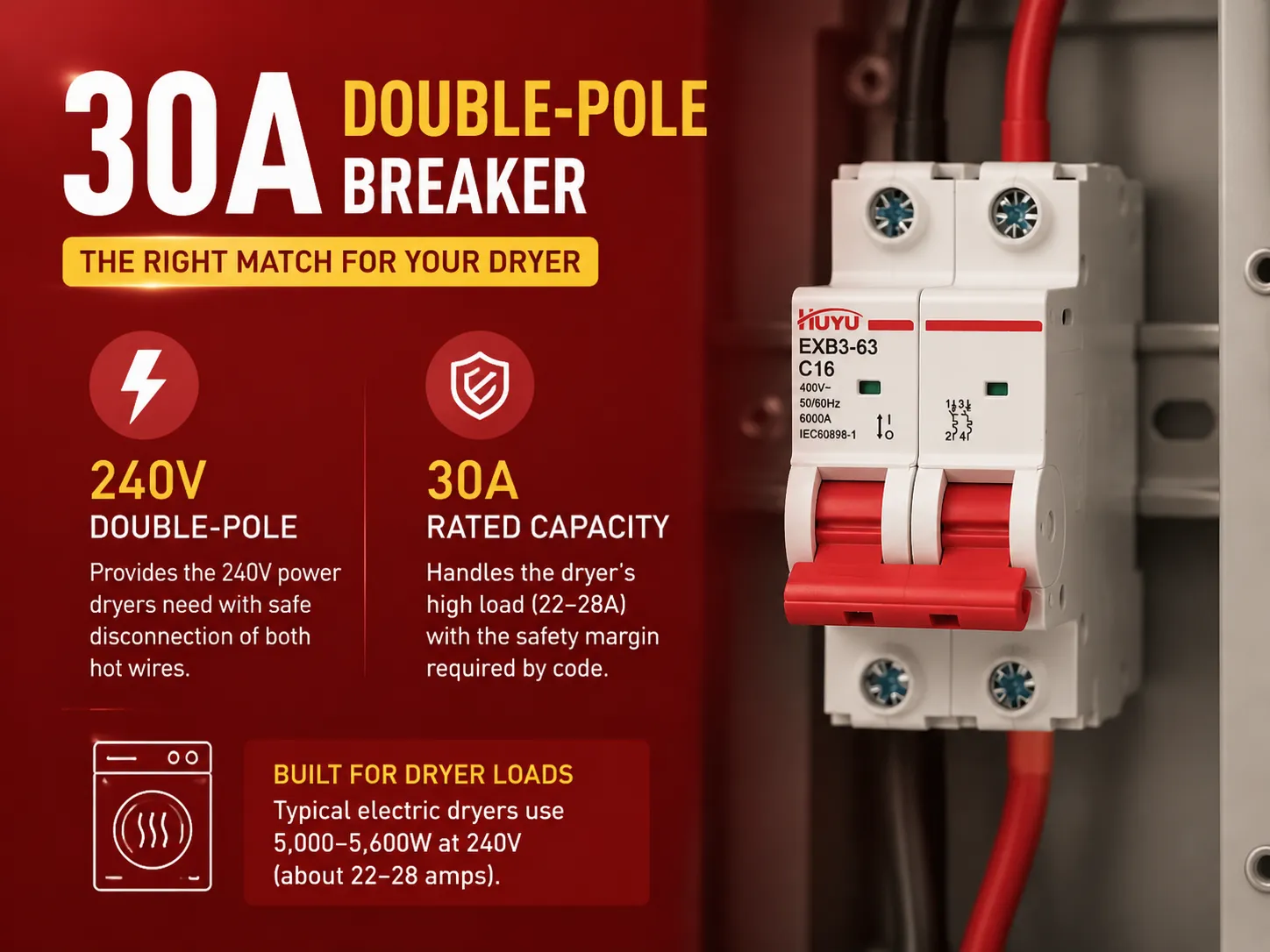
It is not an arbitrary rule. The requirement stems from electrical characteristics of the dryer, the capabilities of the wiring, and the safety margin as defined in the National Electrical Code. A double pole circuit breaker is used to supply 240 volts needed for the dryer to operate. There are single pole breakers used in a North American panel that will deliver only 120 volts to ground. This means that connecting a double pole breaker to two adjacent bus bars will create a 240 volt electric supply on the two wires. Using a double pole breaker also guarantees a disconnection of both wires if one of them is overloaded or shorted.
The 30 amp rating is necessary, given that the most significant load, the heating element of the dryer, consumes quite a lot of electricity. Usually, an electric dryer’s rating on a nameplate indicates a consumption of about 5,000 to 5,600 watts at the voltage of 240 volts, which is about 21 to 23.3 amps. The motor uses some amps too. The total amount becomes about 22-28 amps. Hence, a 20 amp circuit breaker will be overloaded by this appliance. A 25 amp breaker will be functioning under a strain, and this is not the standard practice. A 30‑amp breaker provides the correct protection. For help matching breaker ratings to other household circuits, our guide on what size circuit breaker you need explains the NEC‑based sizing process for all common load types.
Wire and Receptacle: The Complete Circuit
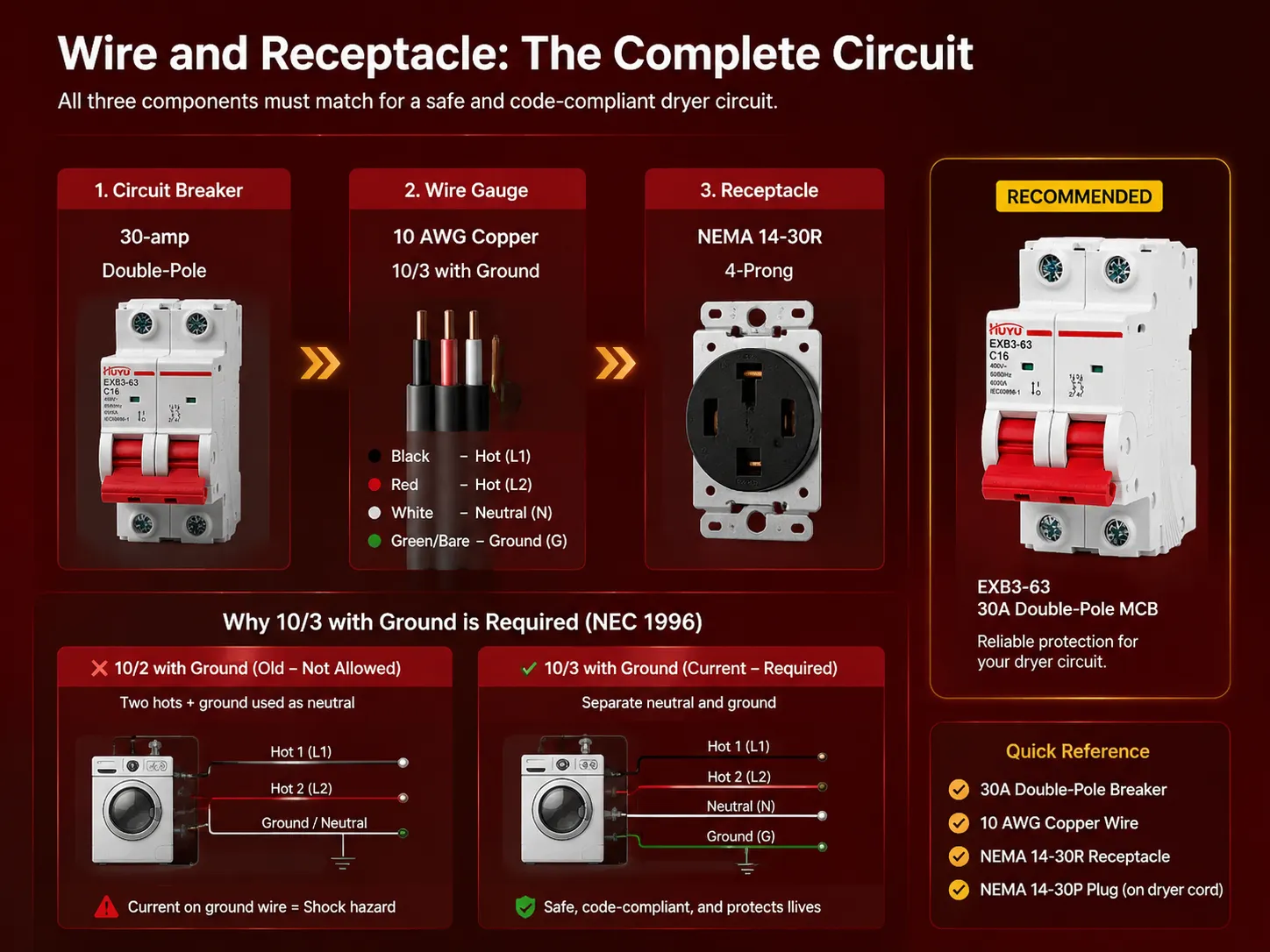
The breaker is only one part of the circuit. The dryer circuit also requires the correct wire gauge and the correct receptacle, and all three must match. The table below summarises the standard configuration for a residential electric dryer circuit.
| Component | Standard Specification | Notes |
|---|---|---|
| Circuit Breaker | 30‑amp, double‑pole | Standard trip curve; GFCI protection may be required by local code in some locations such as laundry areas in unfinished basements |
| Wire Gauge | 10 AWG copper | 10/3 with ground (four conductors: two hots, one neutral, one ground) for new installations; 10/2 with ground (three conductors, no neutral) was used in older installations and is no longer permitted for new dryer circuits per the NEC |
| Receptacle | NEMA 14‑30R (four‑prong) | Required for all new installations since the 1996 NEC; provides separate neutral and ground connections |
| Plug (on dryer cord) | NEMA 14‑30P (four‑prong) | Must match the receptacle; dryer cords are sold separately and must be installed on the dryer per the manufacturer’s instructions |
The wiring scheme is crucial from safety perspective, and the comparison of 10/2 wiring and 10/3 wiring needs special attention. In the past, older dryers’ circuits used 10/2 with ground installations before the NEC was changed in 1996; the wiring would include two insulated wires (both hot) and an uninsulated wire. In these installations, ground wire treaded as a ground wire and neutral wire at the same time. However, this wiring is no longer valid because it puts the current on the ground wire, which causes shock hazards. Hence, the current requirements specify that the wiring should include 10/3 with ground, which consists of four wires – two hot wires (usually black and red) and one wire with the neutral in white and one wire with ground (bare or green). The neutral wire conducts the current back from the 120 volt components, while the ground wire serves the need of fault protection. Hence, if the new dryer circuit is being installed today, it must be wired using 10/3.
Can You Use a 40‑Amp Breaker?
No. A 40-amp circuit breaker cannot be used on a dryer circuit using 10-gauge wire since it is against the code and also a fire hazard. The purpose of a circuit breaker is to protect the wiring and not the appliance. According to the National Electric Code (NEC) ampacity tables, 10 AWG wire can handle only a maximum of 30 amps. When 40-amp breakers are used on 10-gauge wires, the wire may catch fire first before the breaker does its job. A dryer that makes a 30-amp breaker trip has a problem, such as a defective heating element, faulty motor winding, or a wiring problem that needs repairs. By switching to a bigger breaker, the fault is concealed and made more dangerous. The only time a 40-amp breaker may be used is when the manufacturer states that it is essential and the entire circuit is constructed with 40-amp components. These cases are few and far in between, especially in well-built homes.
Additional Protection: GFCI, AFCI, and Surge Protection
In addition to the conventional 30-amp double-pole breaker, a range of devices designed for extra protection can be incorporated into the dryer circuit for safe operation. A device such as the GFCI breaker is explained as a tool that gives rise to ground fault protection; it is highly recommended in many local building regulations, especially in laundry rooms of unfinished basements or garages characterized by high humidity. The Type 2 SPD at the panel or Type 3 SPD at the receptacle protects electronic control panel from unexpected surges of electricity resulting in some of the most expensive damages. A thorough presentation of contemporary electric protective devices and technologies will be found in our article “What are UL 489 Breakers?”
The basic setup for the dryer unit involves using a standard double pole breaker of 30 amps such as HUYU’s models used in various industries. The breaker must comply with the requirements regarding the load of the electrical unit as well as be installed appropriately in accordance with the manufacturer’s manual. If the breaker is connected poorly to the bus bars, or the cables are not tightened enough, the unit will malfunction.
Frequently Asked Questions
Can I put a dryer on a 40 amp breaker?
No, unless the dryer maker specifically instructs the use of 40 amps, and the circuit is wired in accordance with 40 amps requirements (8 AWG copper wire). It violates the regulations and can lead to fire hazards to have a 40-amp circuit-breaker with 10-gauge wires since the wire may overheat before it triggers.
What size breaker do I need for a 240v dryer?
The typical 30-amp double-pole circuit breaker is necessary to operate a standard residential dryer at 240 volts. The configuration of the double pole allows 240 volts to be obtained through two 120-volt legs while the 30-amp rating is suitable for the dryer maximum average current of 22–28 amps.
Do I need 10 2 or 10 3 for dryer?
When installing a dryer circuit, you’ll require a 10/3 with ground cable that has four conductors; this consists of two hots, one neutral and one ground. Old installations had 10/2 with ground cable; this meant it was three conductors in total, but this is now prohibited in new installations since it effectively uses the ground wire as an active neutral conductor and thus creates a shock hazard.
Does a dryer need a 30 amp double-pole breaker?
Absolutely! A dryer requires a double-pole circuit breaker rated at 30 amps to be able to provide a voltage supply of 240 volts and that both hot legs can be disconnected together during any possible fault present on either of the legs. It is the configuration that is required by the National Electric Code (NEC) and given by manufacturers in their specifications.
References
- NFPA 70 (National Electrical Code) — Article 210 and Article 422. Requirements for branch circuits and appliance circuits, including dryer circuit specifications. National Fire Protection Association.
- Whirlpool — Dryer Installation Instructions. Manufacturer electrical requirements for residential electric dryers.
- GE Appliances — Dryer Electrical Requirements. Manufacturer specifications confirming the 30‑amp, 240‑volt circuit requirement.
- Family Handyman — How to Wire a Dryer Outlet. Practical homeowner guidance on dryer circuit wiring, breaker sizing, and receptacle installation.
The correct breaker size for a dryer is 30 amps, double‑pole, protected by 10‑gauge copper wire, and terminated at a four‑prong NEMA 14‑30R receptacle. This configuration has been the standard for decades because it matches the dryer’s electrical load, protects the wiring, and provides the separate neutral and ground that modern safety codes require. A properly sized breaker on a properly wired circuit is invisible — the dryer runs, the breaker holds, and the laundry gets done. A breaker that is the wrong size, or a circuit that is undersized, announces itself through tripped breakers, warm outlets, and the smell of overheating insulation. The right breaker is the one that never makes itself known. HUYU manufactures 30‑amp double‑pole breakers that meet the certification standards for residential panel installations, because the breaker that protects the dryer should be as reliable as the appliance it powers.