
When Sarah from Evanston connected her charger for the first time, the lights went out in her home that was built in the 1920s. The 100-amp service that supplied her home ceased to be effective. After inspection, an electrician explained that the system was maxed out, and the surge protector was old, while the service cables were not designed to sustain the operation of new devices. The service upgrade was quoted at $4,800. Was the price fair and viable, and for which services was this price charged? In cases of homeowners from Evanston with the same questions, the answer lies in a careful consideration of the costs and labor, and specific requirements stated in ComEd’s territory and Evanston city codes for getting the service.
What Drives the Cost of a 200‑Amp Upgrade in Evanston
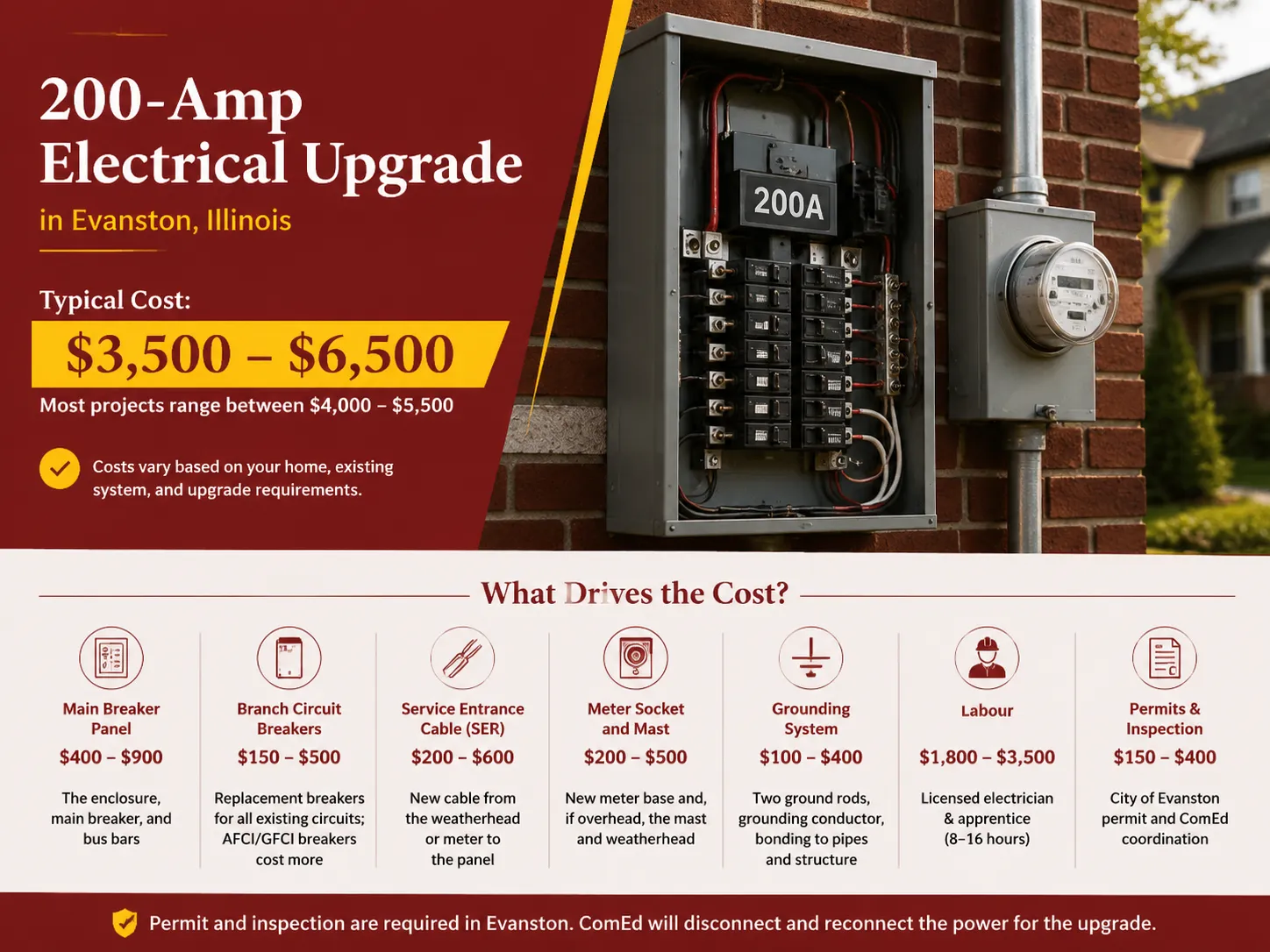
The total cost to upgrade an electrical service to 200 amps in Evanston, Illinois, typically ranges from $3,500 to $6,500 for a standard single‑family home, with most projects landing between $4,000 and $5,500. The final number depends on the condition of the existing service entrance cable, the accessibility of the panel location, the number of circuits required, and whether the upgrade is a straightforward panel swap or a complete service overhaul. The table below breaks down the major cost components and their typical ranges in the Chicago metro area, including Evanston.
| Cost Component | Typical Range (USD) | What It Covers |
|---|---|---|
| 200‑Amp Main Breaker Panel | $400 – $900 | The enclosure, main breaker, and bus bars; 30–40 spaces is standard |
| Branch Circuit Breakers | $150 – $500 | Replacement breakers for all existing circuits; AFCI/GFCI breakers cost more |
| Service Entrance Cable (SER) | $200 – $600 | New cable from the weatherhead or meter to the panel; 4/0 AWG aluminium or 2/0 AWG copper |
| Meter Socket and Mast | $200 – $500 | New meter base and, if overhead, the mast and weatherhead; underground services may require conduit replacement |
| Grounding Electrode System | $100 – $400 | Two ground rods, grounding electrode conductor, bonding to water pipe, gas pipe, and structural steel |
| Labour | $1,800 – $3,500 | Licensed electrician and apprentice, typically 8–16 hours; includes panel removal, new installation, reconnection of all circuits, and cleanup |
| Permits and Inspection | $150 – $400 | City of Evanston electrical permit and ComEd coordination for disconnect/reconnect |
In Evanston, an electrical permit is mandatory for service upgrades and the project must undergo review by the city’s Building Division. The power will be disconnected by ComEd at the pole or transformer to facilitate the service upgrade, before being reconnected once the inspections are completed and approved. Although disconnection and reconnection of service is usually factored into the electrician’s charges, a separate service application and/or meter spot fee may be applicable. It is advisable to contact the City of Evanston for the applicable fees and to verify service upgrade requirements with ComEd.
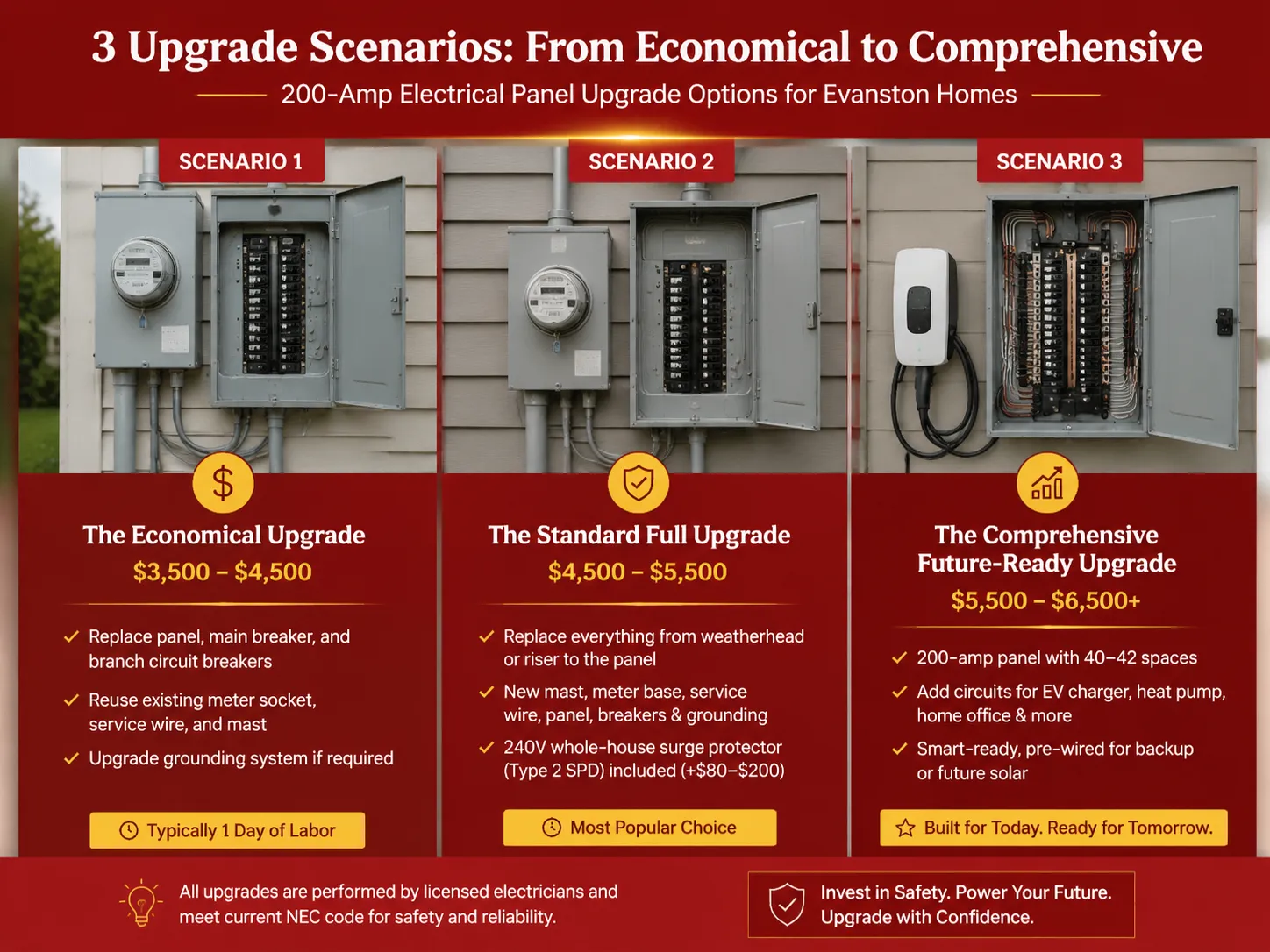
Three Upgrade Scenarios: From Economical to Comprehensive
Not all 200-amp upgrades necessitate replacing every single part. The scope of the upgrade, and how much it costs, depends on the age and condition of the installation. The three examples below represent some of the most popular ways Evanston homeowners go for it.
Scenario 1: The Economical Upgrade ($3,500–$4,500)
This is a panel replacement that includes the original meter socket, service wire, and mast. The wiring and mast are already operational and can manage up to a 200-amp service. In this case, the electrician will take out the old panel and main breaker, put in new branch circuit breakers, and connect the existing service wire. In case it is required, the grounding system is upgraded to meet code. This is feasible if the prior homeowner has done electrical upgrades beforehand or if the current service wire is 4/0 aluminum and the service entry is acceptable. The price can be attributed to the panel cost, the breakers, and one day of labor cost.
Scenario 2: The Standard Full Upgrade ($4,500–$5,500)
This option is the most frequently adopted option. The current service is 100 amps, the wiring is inadequate, and the meter base is original to the property. Now the electrician changes everything between the weatherhead or underground riser to the new 200 amp panel i.e. mast, meter base, service entrance wiring, panel, circuit breakers, and ground electrode system. All of the already established circuits will be reconnected and tagged. This is how much Sarah, our client in Evanston, is going to pay, and this cost reflects the whole process of up-to-code upgrade. The electrician will be adding whole house surge protector having a device of type 2 SPD at this ploption which adds another $80-200 to the price.
Scenario 3: The Comprehensive Future‑Ready Upgrade ($5,500–$6,500+)
This configuration provides homemakers with added capacity and advanced features because home charging stations, pumps, or solar systems are expected in the future. The installed unit is a 200-amp unit with a copper brim, which has forty or forty-two sockets. Although some circuits are added, such as a fifty-amp outlet for home charging devices, thirty-amp outlet for future heat pumps, as well as dedicated twenty-amp circuit for home office, the panels can be equipped with modern devices for smart sensors or can be pre-wired for transfer switches for future generation backups.
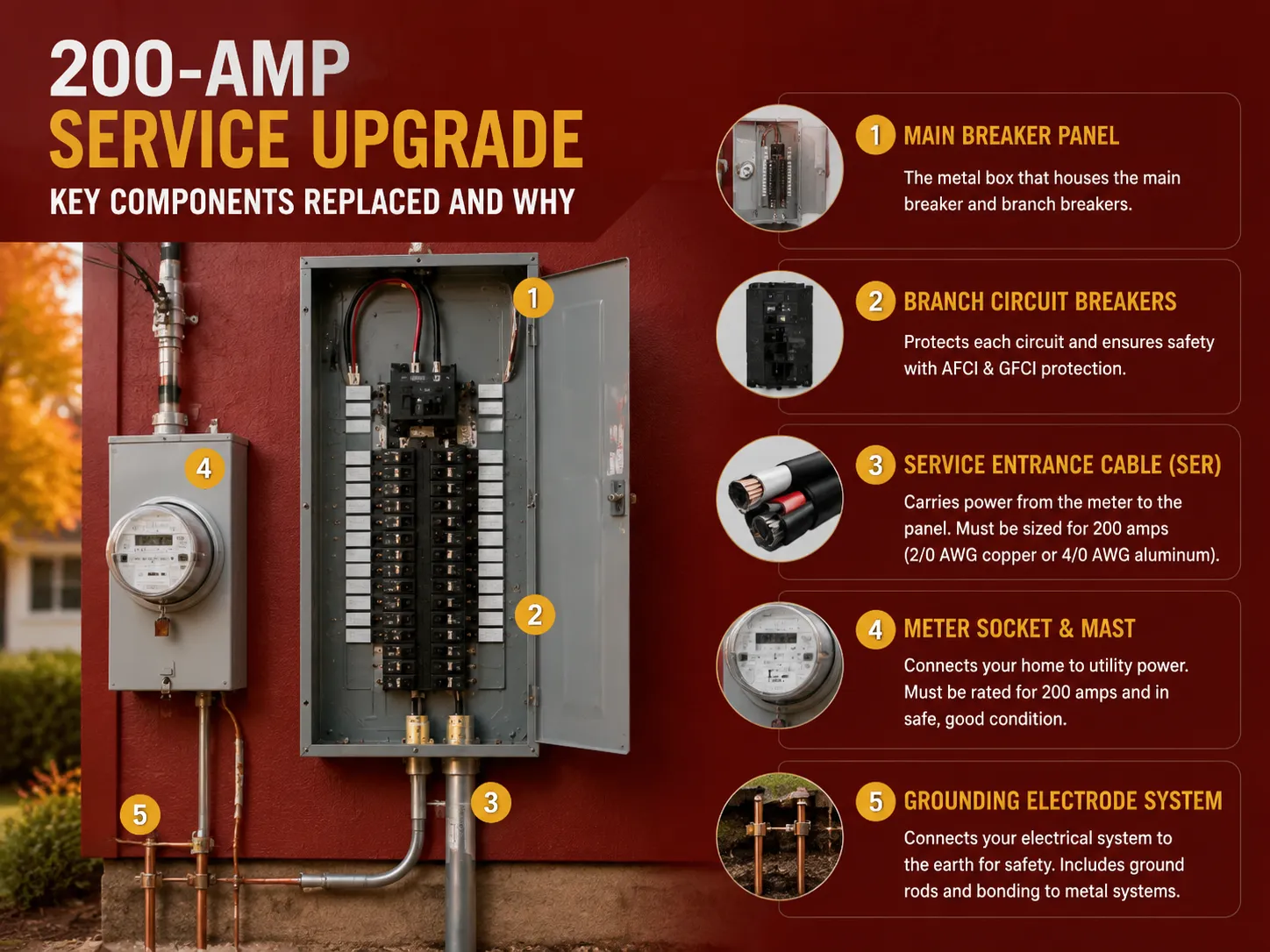
What Components Are Replaced and Why
Knowing what each of the items does enables the homeowner to assess the quotation and keep from paying for work that is not necessary. Any 200-amp upgrade must contain at least the main breaker panel and the branch breakers. The table below gives a description of the parts that are typically replaced.
- Main breaker panel: The metal box that encloses the main breaker and branch breakers. The 200 amp panel must be rated to allow 200 amps and have enough slots for existing and prospective circuits. At least a 30 space panel must be used and 40 space panel adds possibilities and room for further development.
- Branch circuit breakers: Every circuit in your home should utilize a breaker that is appropriate for the circuit’s wire type and load. Do not try to reuse any existing circuit breakers because they are either old, worn-out, or obsolete. In Evanston, it is mandatory to use AFCI protection in accordance with NEC regulations for all living area circuits and to use GFCI protection in wet areas like the bathroom, kitchen, and outdoors. It is a standard procedure to install new approved branch circuit breakers in homes. HUYU manufactures a line of circuit breakers such as AFCI, GFCI and dual circuit breakers that meets UL 489 standards required for residential panel installation. For a deeper look at the certification that governs these devices, our article on what UL 489 breakers are explains the testing and listing process.
- Service entrance cable (SER): It is the wire that goes from the electric meter to the electrical panel. As per the NEC, the cable used for a 200 amp residential service should be 2/0 AWG copper or 4/0 AWG aluminum. If the existing cable is smaller due to the previous service being 100 amps, it will need to be replaced.
- Meter socket and mast: Where your electricity comes to your house, the underground wires connect to the utility meter box and the pole that holds up the wires to your house. ComEd wants the utility meter rated for 200 amps, and it should be easy to read and replace. Any issues such as a broken or rusty meter box are a safety hazard and should be dealt with.
- Grounding electrode system: The relationship between the electrical system and the grounded earth. The currently enforced code specifies the use of a pair of ground rods, set at least six feet apart, and connected to the panel using a grounding electrode conductor. In addition to these two rods, the gas pipe, water pipe, and structural steel must also be linked to the ground system. An older home may have one ground rod or a damaged ground wire, which will require correction if it fails to meet the code.
How Long Does the Upgrade Take, and What About the Power Outage?
A full 200‑amp service upgrade in Evanston typically takes one full day for the electrician and an assistant, with the power off for 6 to 10 hours. The sequence is methodical. ComEd disconnects the service at the pole or transformer in the morning. The electrician removes the old panel, meter socket, and cable, then installs the new equipment, runs the new cable, and reconnects all circuits. The city inspector visits, often in the afternoon, to approve the work. ComEd then reconnects the service, and the power is restored. Planning for a day without electricity is essential — refrigerators and freezers will stay cold if kept closed, and a portable generator can keep a few lights and a refrigerator running if needed. The electrician will provide a timeline and coordinate the inspection and the utility reconnect.
Frequently Asked Questions
How much should a 200amp panel upgrade cost?
The cost of a standard 200-amp panel upgrade along with a full service entrance replacement in Evanston or Chicago area is about $4,000 to $5,500. A panel-only replacement wherein the service cable and meter socket are preserved will cost about $3,500 to $4,500. A full upgrade including the addition of circuits and smart features costs well over $6,000.
Is upgrading to 200 amp service worth it?
Indeed, a 200-amp electrical service upgrade results in more safety and improvement in the overall functionality of a home. This upgrade allows the installation of devices like car chargers, heat pumps, and various modern appliances. Recent home insurance companies are more likely to charge lower rates for homes with a modern electrical panel and electrical system, whereas homes with only 100 amps of power available will likely be flagged by buyers.
How much does it cost to upgrade from 100amp to 200amp service?
In Evanston, the expense of changing from 100-amp to 200-amp service is between $4,000 and $5,500, assuming everything gets replaced: the meter socket, panel, entrance cable, and grounding equipment. How much precisely will depend on the state of the present equipment and the location of the panel.
What does it take to upgrade to 200 amp service?
In order to upgrade to a 200-amp service system, it is necessary to change the main breaker panel, branch circuit breakers, service entrance cable, meter socket, and mast if it is located overhead. It’s also important to update the grounding system. There is a need for permits and inspections for the required works and for coordination with ComEd to carry out the service disconnect and reconnect processes.
References
- City of Evanston — Building and Inspection Services. Electrical permit requirements and fee schedules for residential service upgrades.
- ComEd — Residential Service Upgrade Requirements. The local utility’s specifications for 200‑amp service entrances and metering.
- This Old House — Electrical Service Upgrade Cost Guide. Homeowner‑focused guidance on the costs and process of upgrading a home’s electrical service.
- HomeAdvisor — Cost to Upgrade an Electrical Panel. Aggregated pricing data from electrical contractors across the United States, including the Chicago metro area.
The cost to upgrade electrical service to 200 amps in Evanston, Illinois, is an investment in the safety, capacity, and future readiness of your home. Whether you choose an economical panel replacement, the standard full upgrade, or a comprehensive future‑proofed installation, the work must be done by a licensed electrician, with a permit, and to the satisfaction of the city inspector and ComEd. The right breakers — listed, tested, and matched to their circuits — are the final, critical component that turns a new panel into a safe, reliable electrical system. HUYU supplies circuit breakers that meet those standards, because the device that protects the circuit is the one that never stops being relevant.