
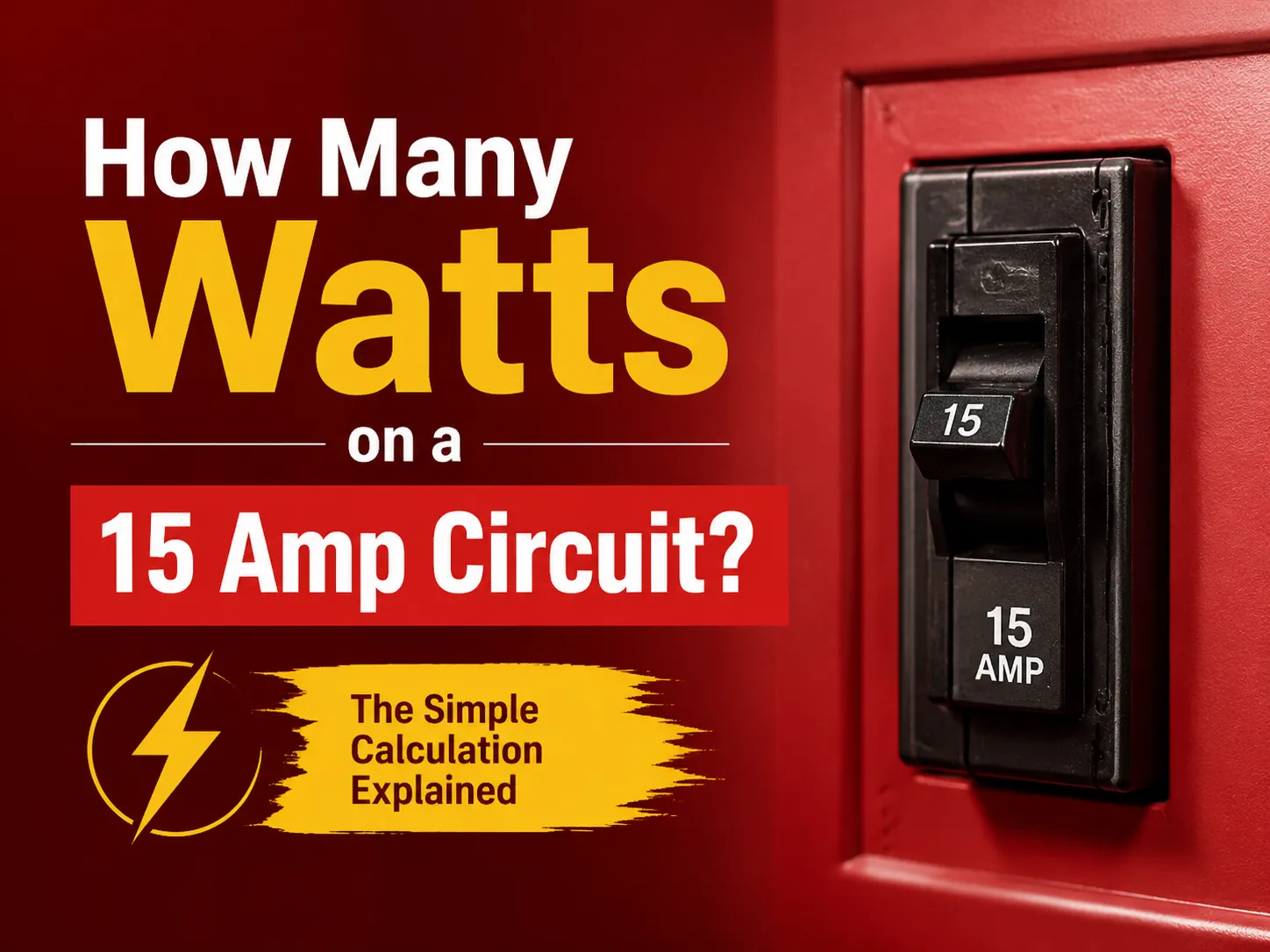
Last winter, a Chicago resident plugged in a 1,500-watt space heater in the living room and switched on the television and a lamp. After 20 minutes, the room was plunged into darkness. The circuit breaker rated at 15 amps tripped, and this was not due to any defect but because it performed as intended. The load was too high for a breaker to cope with, and the power was turned off to protect the cable behind the wall. How many watts can be plugged into a circuit with 15 amps is a very common query. The answer is simple, but the bigger picture is considerably more complex; it involves the 80% rule, the problem of continuous loads and the types of devices designed to protect the insulated wire.
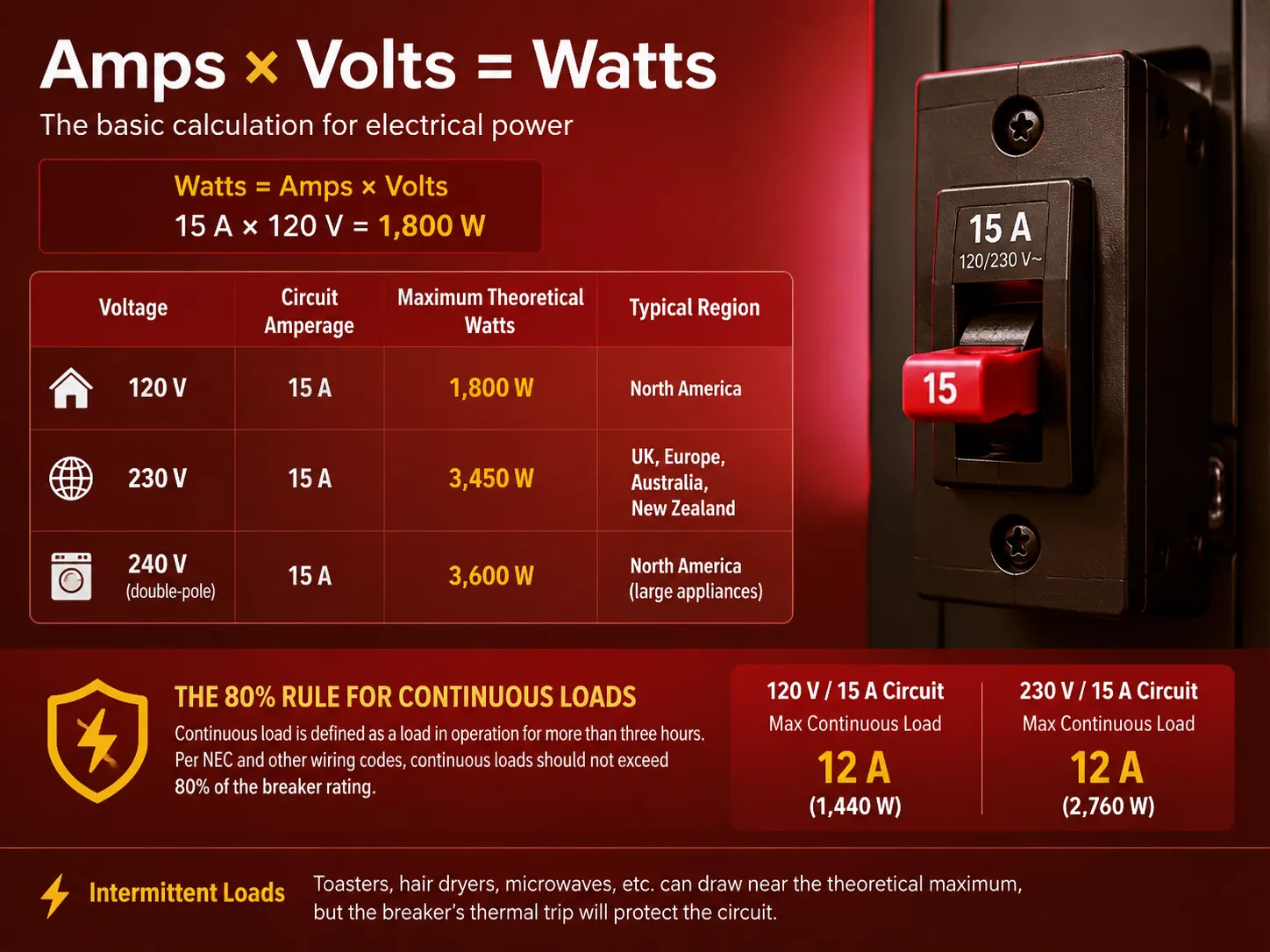
The Basic Calculation: Amps × Volts = Watts
A 15-amp circuit has a certain theoretical maximum wattage, which is determined by the voltage level. In North America, the usual single-pole 15-amp circuit breaker works at 120 volts. The formula to find its maximum wattage is:
Watts = Amps × Volts
1,800 watts = 15 amps × 120 volts
In Europe and the UK, the circuit of 15 amps running at 230 volts provides 3450 watts of electrical power. The circuit in Australia and New Zealand works the same way using the same amount of amps and the same voltage to achieve the same wattage of 3450 watts. What is helping in this situation is the voltage since it is the one that provides maximum power. The table below presents the theoretical maximum wattage for 15 amps circuits at the most widely used voltages around the world.
| Voltage | Circuit Amperage | Maximum Theoretical Watts | Typical Region |
|---|---|---|---|
| 120 V | 15 A | 1,800 W | North America |
| 230 V | 15 A | 3,450 W | UK, Europe, Australia, New Zealand |
| 240 V (double‑pole) | 15 A | 3,600 W | North America (large appliances) |
Nonetheless, this theoretical maximum is not the value that should be utilized for the application. The National Electrical Code (NEC) and similar wiring codes in the rest of the world provide a key rule to consider, which is the 80% rule for continuous loads. The National Fire Protection Association (NFPA), that publishes the NEC, states that continuous load is defined as a load, which is in operation for more than three hours, and imposes the limitation that this load should not, exceed 80% of the rating of the breaker. This implies that in a circuit with a voltage of 120 volts and current of 15 amps, the maximum continuous load equals 12 amps, which is equal to 1,440 watts. In a 230-volt circuit the maximum continuous load is equal to 2,760 watts. For example, a space heater, aquarium heater, or server rack should strictly follow this limitation. In case of intermittent loads, such as toasters, hair dryers, microwaves, etc., it is permissible to reach somewhere near the theoretical maximum, but despite this, thermal trip element of the breaker will work.
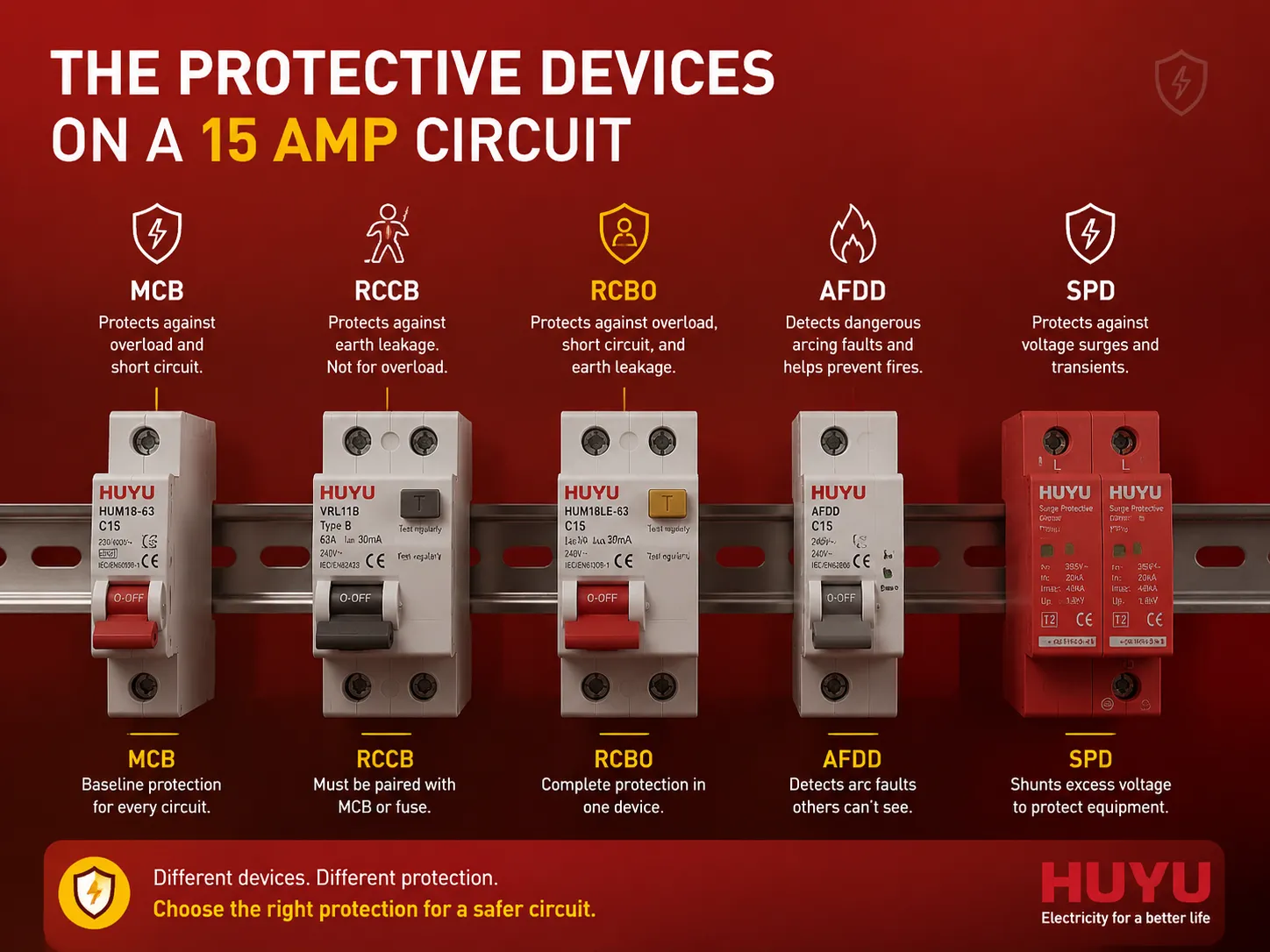
The Protective Devices on a 15 Amp Circuit
Not all 15 amp circuits have the same protective device. The breaker or protective device that is installed in the box at the back automatically disconnects when the amps reach 15. Different devices provide different levels of protection, and knowing the difference helps home owners, electricians, and facility managers to select the proper protection for each circuit. HUYU manufactures and provides various kinds of 15 amp protection devices for home, business, and industrial installations, each intended to serve different functions.
- Miniature Circuit Breaker (MCB): The standard thermal‑magnetic breaker that protects against overload and short circuit. A 15‑amp MCB carries up to 15 amps indefinitely and trips on a sustained overload above that, or instantly on a high‑current short circuit. This is the baseline protection device. HUYU’s HUM18‑63 miniature circuit breaker provides this protection in a DIN‑rail format, with a 10 kA interrupting capacity and B, C, and D trip curves to match different load types.
- Residual Current Circuit Breaker (RCCB): Protects against earth leakage — current that flows to ground through a person or water — but does not protect against overload. An RCCB on a 15‑amp circuit must be paired with an MCB or a fuse to provide complete protection. HUYU’s VRL11B Type B RCCB provides residual current protection for circuits where DC leakage may be present.
- Residual Current Breaker with Overcurrent (RCBO): Combines the functions of an MCB and an RCCB in a single device. A 15‑amp RCBO protects against overload, short circuit, and earth leakage simultaneously, and it occupies the same DIN‑rail space as a standard MCB. This is the most complete protection for a single final circuit. HUYU’s HUM18LE‑63 RCBO provides this combined protection, with the thermal trip calibrated to the circuit’s rated current.
- Arc Fault Detection Device (AFDD): Detects the unique electrical signature of an arc — the sparking that occurs when a wire is damaged, a connection is loose, or a cord is pinched — and trips before the arc can start a fire. AFDDs are increasingly required in residential circuits and are used alongside MCBs or RCBOs. They are sensitive enough to detect a series arc that a standard breaker would never see, because the arc current is lower than the breaker’s trip threshold.
- Surge Protective Device (SPD): Protects against voltage surges from lightning, utility switching, or large motor shutdowns. An SPD on a 15‑amp circuit shunts excess voltage to ground before it can damage the connected equipment. It does not provide overcurrent protection and must be used with a breaker. HUYU’s Type 2 SPD range provides this protection for distribution panels.
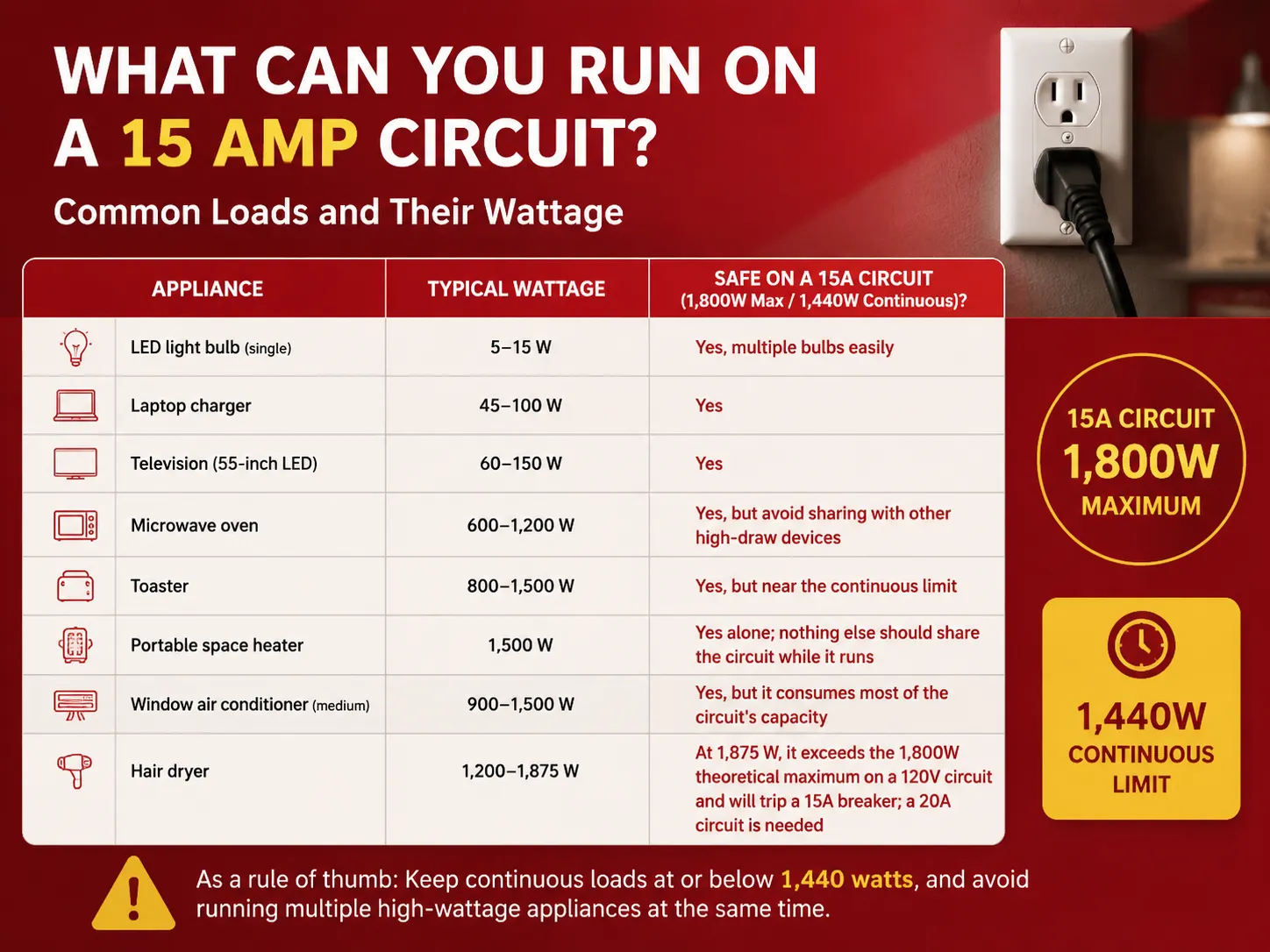
What Can You Run on a 15 Amp Circuit? Common Loads and Their Wattage
The table below lists common household appliances, their typical wattage, and whether they can safely run on a North American 120‑volt, 15‑amp circuit — alone, or in combination. The 1,440‑watt continuous limit is the yardstick for any appliance that may run for extended periods.
| Appliance | Typical Wattage | Safe on a 15A Circuit (1,800W Max / 1,440W Continuous)? |
|---|---|---|
| LED light bulb (single) | 5–15 W | Yes, multiple bulbs easily |
| Laptop charger | 45–100 W | Yes |
| Television (55‑inch LED) | 60–150 W | Yes |
| Microwave oven | 600–1,200 W | Yes, but avoid sharing with other high‑draw devices |
| Toaster | 800–1,500 W | Yes, but near the continuous limit |
| Portable space heater | 1,500 W | Yes alone; nothing else should share the circuit while it runs |
| Window air conditioner (medium) | 900–1,500 W | Yes, but it consumes most of the circuit’s capacity |
| Hair dryer | 1,200–1,875 W | At 1,875 W, it exceeds the 1,800W theoretical maximum on a 120V circuit and will trip a 15A breaker; a 20A circuit is needed |
Can You Put a 20‑Amp Outlet on a 15‑Amp Circuit?
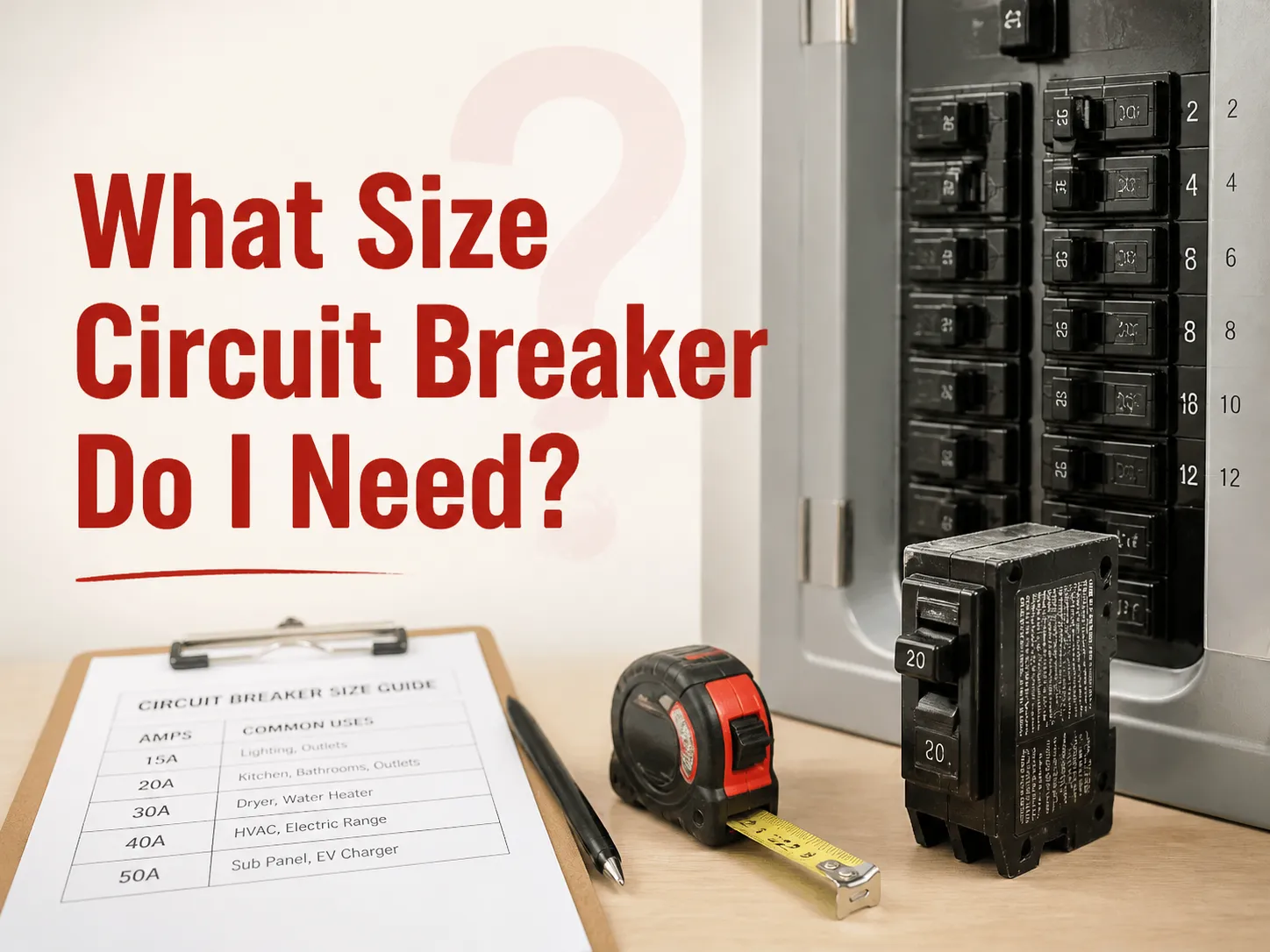
The National Electrical Code (NEC) allows one 15-amp outlet to be connected to a 15-amp circuit or a 15 or 20-amp outlet to a 20-amp circuit. A 20-amp outlet, which has a T-slot for neutral plug, may be used in a 15-amp circuit only if a 15-amp breaker is used and a 15-amp rated wire is used. This type of installation is not advisable since it may cause someone to plug in a 20-amp device and trip the circuit. The best installation is where the outlet is rated at 15 amps, the circuit at 15 amps, and the wire is of 14 AWG copper wire. For help selecting the correct breaker for a new or upgraded circuit, our guide on what size circuit breaker you need walks through the NEC‑based sizing process.
Frequently Asked Questions
Can you run 1500 watts on a 15 amp circuit?
Indeed, a load of 1,500 watts draws about 12.5 amps from a 120-volt circuit, which is within the limits of the 15-amp breaker. However, if the device is operated for three hours or more continuously, it breaks the 80% continuous-load rule of 1,440 watts and could eventually trip the breaker. It is safe to use 1,500 watts for a short duration, such as with a toaster or kettle.
How many watts can I run off a 15 amp breaker?
A 15 amp circuit breaker in the case of a 120 volt circuit is able to support a maximum of 1,800 watt load measured intermittently while supporting the maximum load of 1,440 for continuous operation. A similar 15 amp breaker in the case of a 230 volt circuit is able to support the maximum load of 3,450 watts intermittently and 2,760 watts in a continuous-load scenario. 80% of continuous load will be the practical limit in a regular day-to-day usage.
Can I use an 1800 watt appliance on a 15 amp circuit?
In a 120-volt circuit, an 1800 watt load is only 15 amps, which is the limit for that circuit. This means anything plugged into the circuit afterwards, such as a lamp or a phone charger, will exceed the limit of the circuits amperage and trip the breaker. In most cases, the breaker will work if the appliance is used only for short periods of time. For the sake of safety and code compliance, however, use of a 20 amp circuit is recommended.
Can I put a 20amp outlet on a 15amp circuit?
It is possible to install a 15-amp or a 20-amp receptacle on a 20-amp circuit according to NEC regulations, but installing a 20-amp style receptacle on a 15-amp circuit is not advisable because it suggests a rating that is above the actual rating of the circuit itself. The best approach is to ensure that the outlet rating matches that of the circuit breaker, which means using a 15-amp outlet on a 15-amp breaker.
References
- NFPA 70 (National Electrical Code) — Article 210.20. Requirements for continuous and non‑continuous loads on branch circuits. National Fire Protection Association.
- Electrical Safety Foundation International (ESFI) — Home Electrical Safety. Guidance on circuit loading, breaker sizing, and the 80% continuous‑load rule.
- U.S. Department of Energy — Appliance Energy Use Calculator. Reference data for typical appliance wattages and energy consumption.
- Leviton — Residential Receptacles and Circuit Ratings. Manufacturer guidance on matching receptacle amperage to circuit amperage and wire gauge.
The question how many watts on a 15 amp circuit has a simple numerical answer — 1,800 watts on a 120‑volt supply, 3,450 watts on a 230‑volt supply — but the number that matters in practice is the 80% continuous‑load limit and the specific protective device that sits in the panel. An MCB, an RCBO, or an AFDD on that circuit adds layers of protection beyond the amp rating, and the breaker’s job is to open the circuit before the wires inside the wall become the fuse. HUYU supplies the full range of 15‑amp protective devices — MCBs, RCCBs, RCBOs, and DC breakers — for residential, commercial, and renewable energy installations, because the circuit that powers a home or a factory must be protected by a device that opens exactly when it should, and holds exactly when it must.