
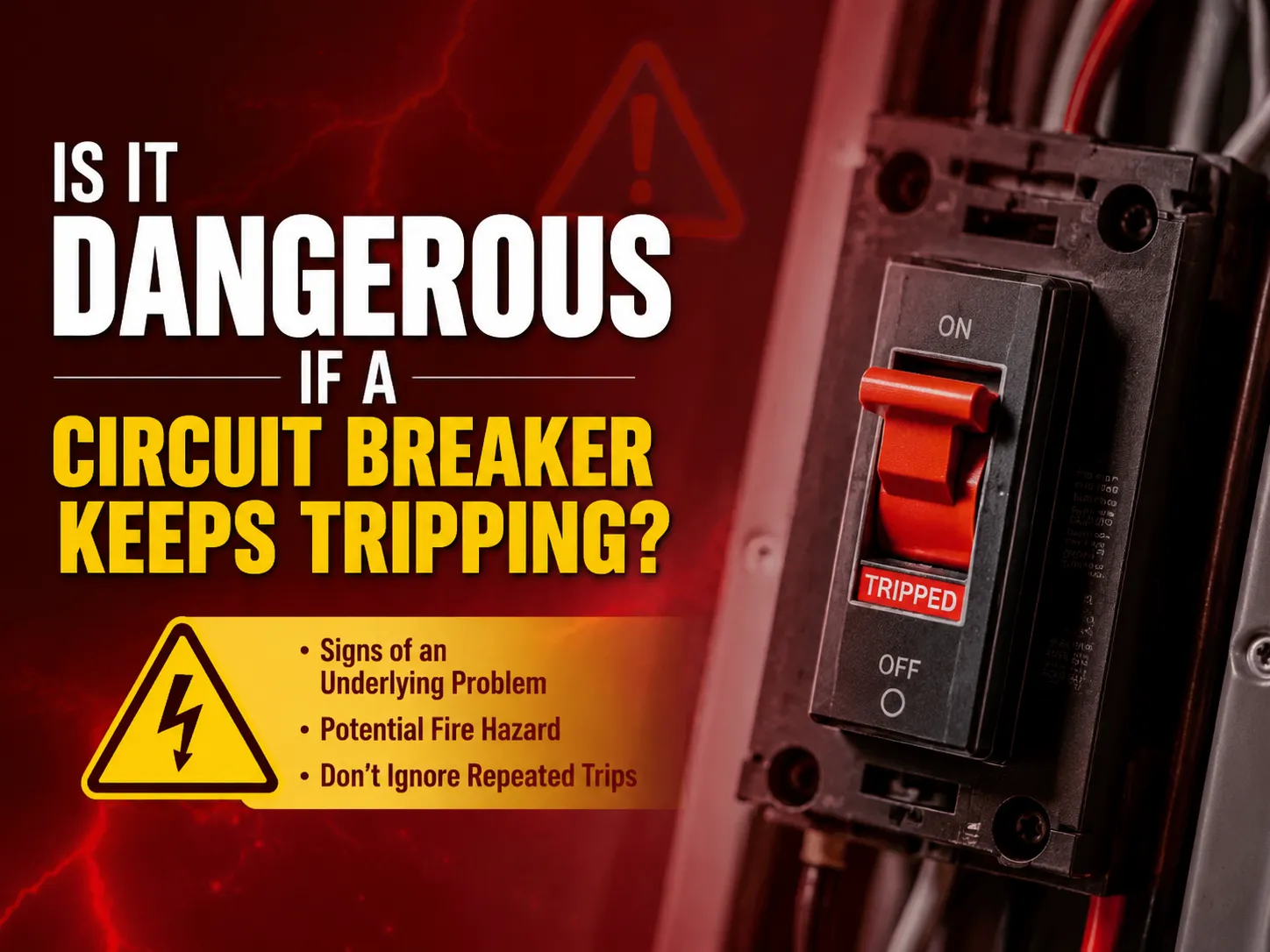
An Atlanta homeowner observed that her kitchen outlet’s 20-amp breaker had tripped three times in one month — each time being caused by the simultaneous use of the microwave and toaster. On each occasion, she had to walk to the breaker panel and reset it. The fourth time, however, the breaker had not just tripped but was warm to the touch with a slight smell of burning plastic nearby. The homeowner called the electrician, who discovered that the breaker’s internal contacts had been arcing for a long time, thereby damaging the bus bar at the same time. The breaker was malfunctioning, generating heat inside the panel instead of tripping in case of overload. The situation raised the question of whether it is dangerous when a breaker frequently trips. The answer is yes. Frequent tripping makes it obvious that something is wrong with the circuit.
Why a Breaker Trips: The Four Root Causes
A circuit breaker is a safety mechanism that works without any manual help. When the breaker trips, it is working correctly. It opens the circuit so the wires do not overheat or the fault situation does not worsen. To fully comprehend the danger, one should not think of the mere trip — it is necessary to understand what has caused the trip. It is important to point out that the repeated tripping is indicative of some underlying cause that may be more or less serious. There are four main causes of breaker tripping that vary from an overload to a fatal ground fault.
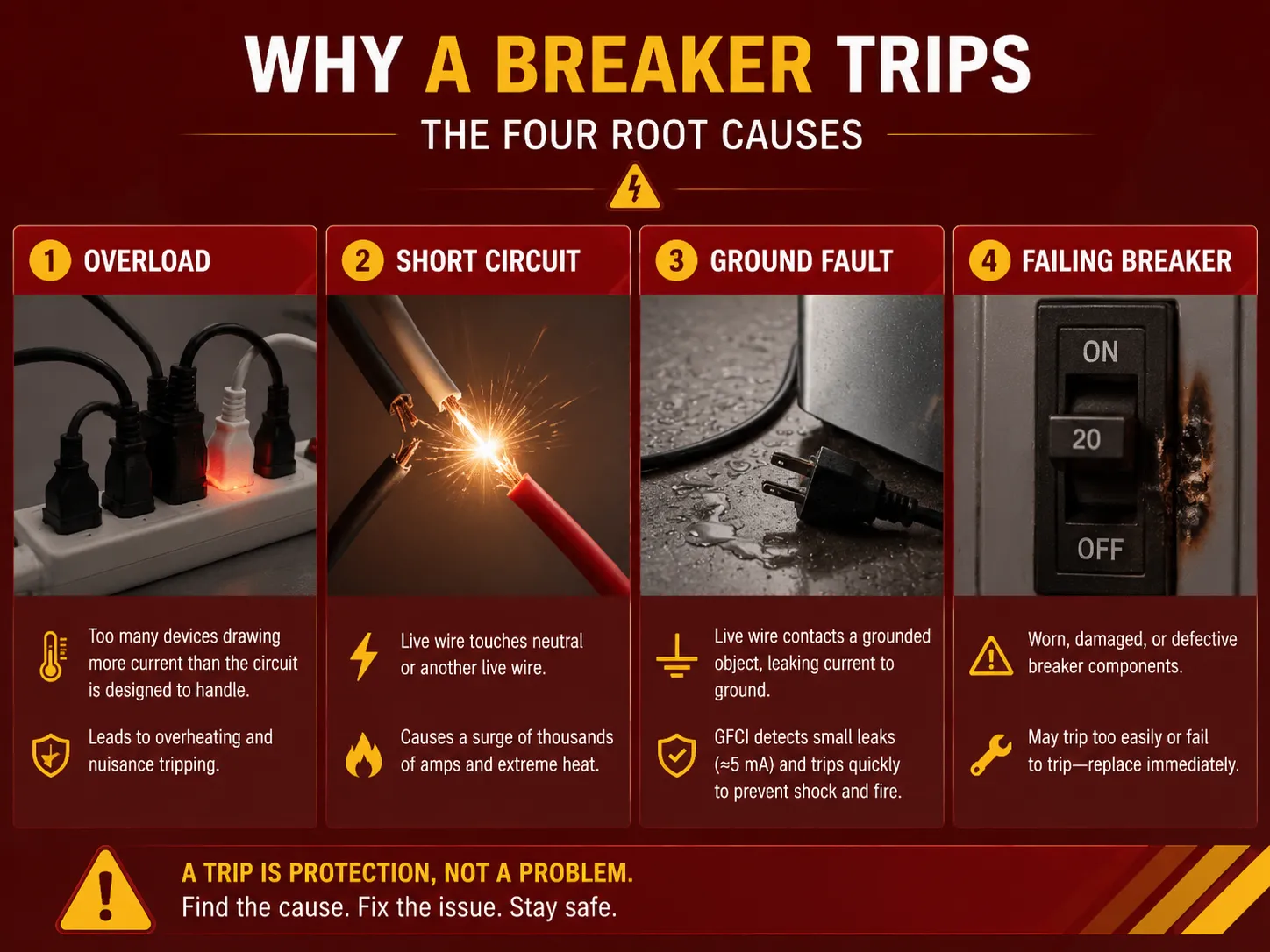
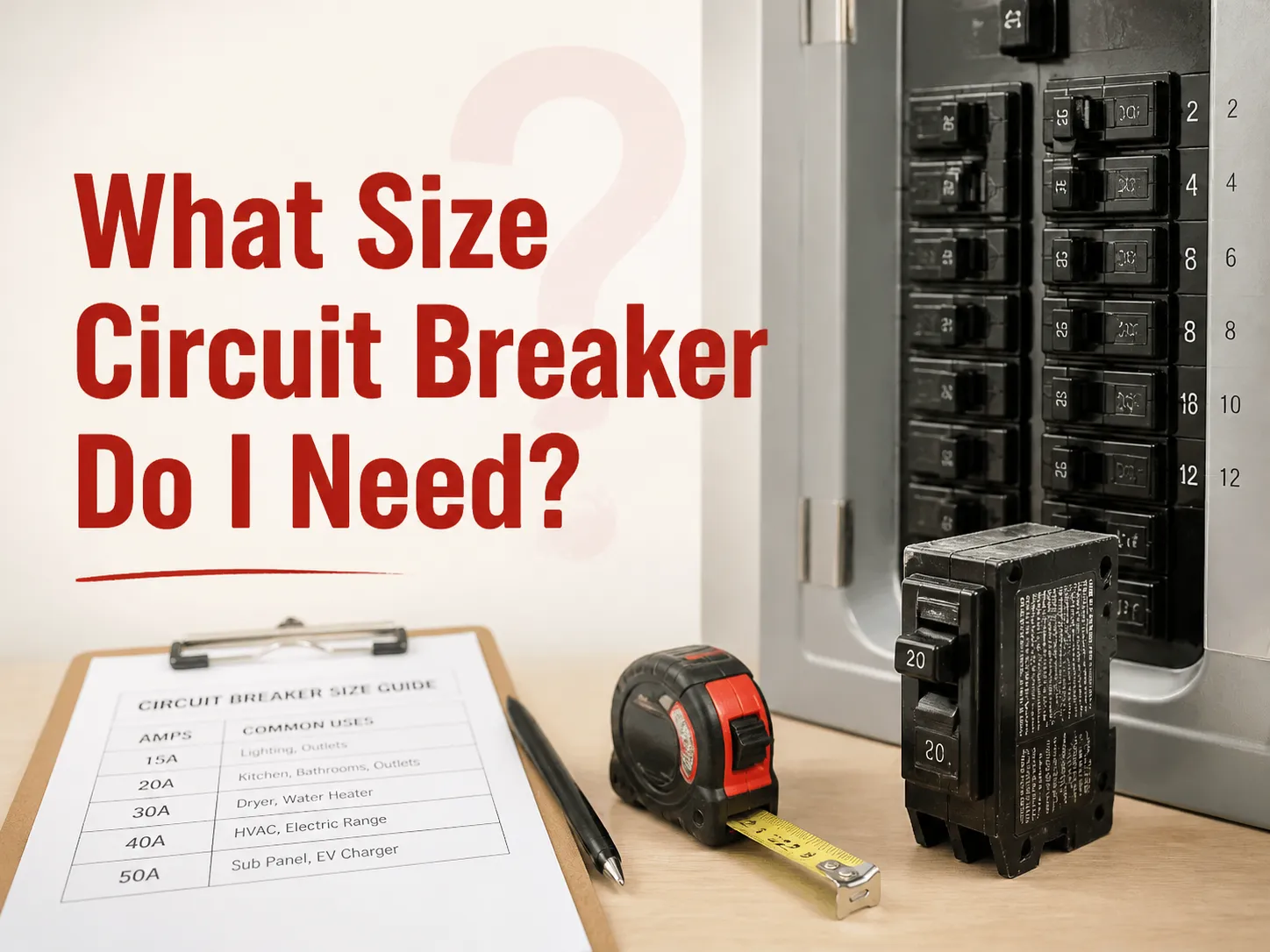
1. Overload. A circuit that is always carrying too many loads leads to nuisance tripping. While the nuisance tripping itself is not dangerous and the circuit breaker is simply protecting the circuit from overheating, the continuous excessive load may cause the breaker to be affected. The thermal element, or bi-metal strip, will start deviating from its calibrated position. Nuisance tripping occurs at a lower current level, and repeated heating and cooling will simply wear out the contacts. If you need help determining the correct load for a specific circuit, our guide on what size circuit breaker you need explains the NEC‑based calculation.
2. Short circuit. If a live conductor comes into contact with a neutral or another live conductor, the current will increase instantly to thousands of amps. The magnetic tripping action of the circuit breaker must be fast enough to stop the fault in milliseconds. A short circuit is a significant occurrence that produces tremendous heat at the fault location and within the circuit breaker. In case of a short circuit, if a homeowner tries to reset the tripping switch before investigating the cause of tripping, the short circuit is likely to be there. The circuit breaker will trip again on the first attempt to switch it back on. Repeated fault current flowing at this stage can weld the contacts or cause destruction of the bus bar, and in the worst case, start a fire.
3. Ground fault. A live electrical wire contacts a grounded object, such as the metallic body of an appliance, a box junction or even a person. Resulting current goes into the ground and creates the possibility of an electric shock as well as fire. A conventional breaker may or may not trip when there is a ground fault depending on the fault current because the ground path can possess enough resistance so that the current would not reach the magnetic trip threshold. This is the reason why the NEC requires installation of GFCI devices in bathrooms, kitchens, in garages, or outdoors. GFCI detects ground fault current on the 5 mA level and trips in a moment which is much faster than standard breaker. If GFCI breaker/receptacle keeps tripping it means that there is a fault in the circuit in the form of a faulty cord, wet connection or a faulty appliance, which must be detected and repaired.
4. A failing breaker. The breaker is broken, damaged, or has other defects. The thermal component has moved, the contacts are burnt due to multiple flashing, or the system has been damaged. The breaker that is failing can turn off at a much lower amperage than what is recommended, which will lead to false off trips, or even worse, the breaker may not work entirely. Failure symptoms of the breaker include warmth, buzzing, visible scorching, looseness or grit of the handle, or tripping without load. Any of these symptoms indicate that it is high time to replace the breaker. For a deeper understanding of the certification and testing that a quality breaker must pass, our article on what UL 489 breakers are explains the standards that every breaker in your panel should meet.
The Real Danger: What Happens When You Keep Resetting
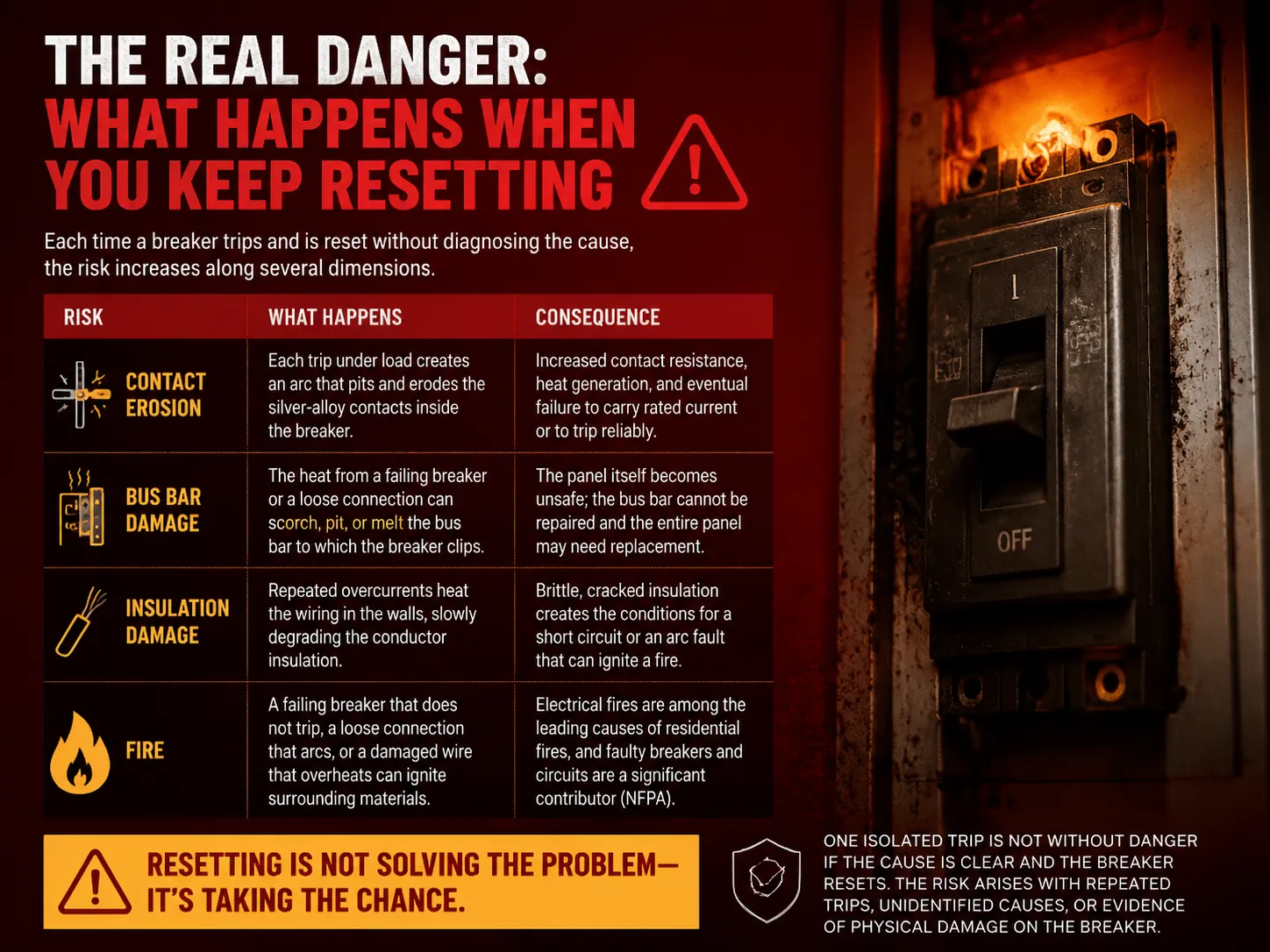
Each time a breaker trips and is reset without diagnosing the cause, the risk increases along several dimensions. The table below summarises the cumulative damage that repeated tripping can cause.
| Risk | What Happens | Consequence |
|---|---|---|
| Contact erosion | Each trip under load creates an arc that pits and erodes the silver‑alloy contacts inside the breaker | Increased contact resistance, heat generation, and eventual failure to carry rated current or to trip reliably |
| Bus bar damage | The heat from a failing breaker or a loose connection can scorch, pit, or melt the bus bar to which the breaker clips | The panel itself becomes unsafe; the bus bar cannot be repaired and the entire panel may need replacement |
| Insulation damage | Repeated overcurrents heat the wiring in the walls, slowly degrading the conductor insulation | Brittle, cracked insulation creates the conditions for a short circuit or an arc fault that can ignite a fire inside the wall |
| Fire | A failing breaker that does not trip, a loose connection that arcs, or a damaged wire that overheats can ignite surrounding materials | Electrical fires are among the leading causes of residential fires, and faulty breakers and circuits are a significant contributor. The National Fire Protection Association (NFPA) tracks these statistics annually |
One isolated trip is not without danger if the cause is clear and the breaker resets. The risk arises with repeated trips, unidentified causes, or evidence of physical damage on the breaker. Thus, resetting the breaker is not solving the problem but taking the chance.
How to Troubleshoot a Breaker That Keeps Tripping
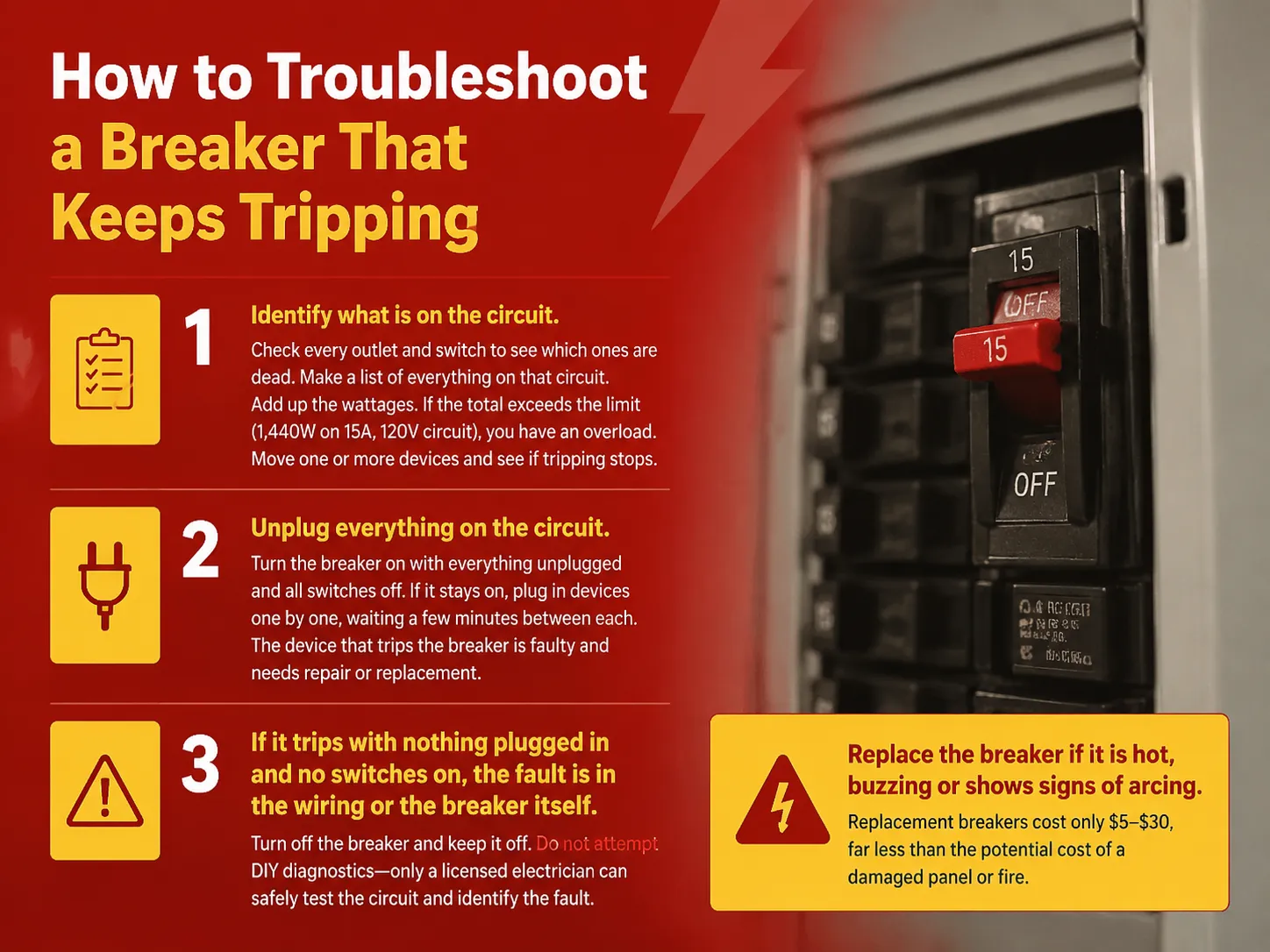
Repetitiveness is not the right approach when dealing with a circuit breaker that keeps tripping. The steps outlined below will help to identify the cause of the problem in most domestic cases and ascertain whether you need to consult an electrician or remedy the situation yourself.
- Identify what is on the circuit. Turn off the breaker and walk the house. Check every outlet and switch to see which ones are dead. Make a list of every appliance, light, and device that is connected to that circuit. Add up the wattages. If the total exceeds 1,440 watts on a 15‑amp, 120‑volt circuit (or the equivalent for your voltage and amp rating), you have an overload. Move one or more devices to a different circuit and see if the tripping stops.
- Unplug everything on the circuit. Switch the circuit breaker on with everything unplugged and all switches in off position. If the circuit breaker remains on, you will need to check which device is malfunctioning. Start plugging in devices one by one and wait a few minutes between each. The device that causes the circuit breaker to trip is faulty and needs to be repaired or replaced.
- If the breaker trips with nothing plugged in and no switches on, the fault is in the wiring or the breaker itself. Switch off the breaker and keep it that way. Do-it-yourself diagnostics should not be attempted — only a professional electrician can follow through the circuit, test insulation resistance, and discover if the failure is related to the circuit breaker, wiring itself, or junction box connection.
The breaker needs to be replaced if it is hot, buzzing or showing signs of arcing. Replacement breakers do not involve a big expense, costing only between $5 and $30, compared to the overwhelming cost incurred due to the damaged panel and fire. Family Handyman is a valuable home repair resource if you plan to carry out safe replacement of the breaker at the de‑energised panel on your own.
When the Breaker Needs More Than a Reset
There are cases where resetting the breaker is completely inappropriate. If the breaker trips as soon as it goes back to the reset position and makes a noise or shows a spark, it means there is a short circuit or a fault to the ground taking place, and repeating the reset means inviting an arc flash. If it is hot to touch, if there is a burning smell, or if the lever is loose, the breaker is already in failure mode and resetting it means gambling every time that it will reset the internal mechanism once more. If the tripping of the breaker is accompanied by flickering of lights somewhere else in the house, it can mean malfunctioning of the panel which needs a professional right away.
Frequently Asked Questions
How many times can a breaker trip before it’s bad?
There is no fixed number regarding this issue. A circuit breaker is designed to survive a certain number of full-rated interruptions of short-circuit current, which is usually 2 or 3, after which its contacts may be too worn out to carry load safely. A breaker that is tripped for the time on overload may have its thermal elements drifted too far. Any breaker that is warm to touch, makes buzzing sound, or has visible damage should be changed out, regardless on the number of trippings.
How do you fix a breaker that keeps tripping?
Find and repair the source of the tripping. If it was due to a circuit overload, use alternative circuits for the devices. If it was caused by a single appliance, repair or replace it. If it trips without any load or there is a defect in the breaker, get a licensed electrician to investigate and replace it if needed. It is not enough to keep resetting it.
Can a breaker that keeps tripping cause a fire?
Certainly. The fact that a circuit breaker continues to trip is an indication of an overload, a fault, or a malfunctioning breaker. Each of these situations generates heat that causes damage not only to the breaker but also to the wiring and the panel. A malfunctioning breaker that should have tripped, or a loose connection that is arcing, could become a fire hazard. The frequent tripping cannot be disregarded.
Should I be concerned if a breaker trips?
An isolated event where the cause of the power surge is evident — such as overloading the circuit by connecting a few too many devices — is not really anything to worry about, but it does show that you’re nearing the limits of the circuit’s power supply. But if the circuit breaker starts to trip over and over again, does so for no apparent reason, or does it quickly with a loud bang and sparks, you’d better have the problem inspected by an electrician.
References
- National Fire Protection Association (NFPA) — Electrical Fire Cause Data. Annual statistics and analysis on the role of electrical distribution equipment in residential fires.
- Electrical Safety Foundation International (ESFI) — Home Electrical Safety. Consumer guidance on recognising and responding to electrical hazards, including repeated breaker tripping.
- Family Handyman — Troubleshooting Circuit Breaker Problems. Practical homeowner guidance on diagnosing and resolving common breaker issues.
- Eaton — Circuit Breaker Diagnostics and Replacement. Manufacturer information on breaker failure modes, testing, and when to replace a breaker.
Is it dangerous if a circuit breaker keeps tripping? When a breaker tripped, it indicates a hazardous situation that requires fixing. An overload condition poses risks for the wiring; a short circuit damages a breaker; and ground fault can harm people around. If a breaker continues to fail, it won’t be able to trip any longer, which will turn the wiring into a fuse for the circuit. A breaker should warn you about problems by creating a trip. Resetting a breaker means nothing if the original trouble is not solved. HUYU is devoted to delivering circuit breakers, which work properly: they trip when it is necessary and stay closed when it is needed.