
A resident of a house constructed in a Chicago suburb in the 1970s turned on both the microwave and the toaster hoping to enjoy the expected outcome: a brief buzz indicating that food was being heated. However, light bulbs dimmed, microwave shut down, and the old and unrevised breaker tripped again for the third time during the month. The resident reset the breakage once again. She had no idea that the busbar connected to the breaker was corroded, contacts of the main breaker were damaged due to long service, and the panel itself was nearing its end. The question of how long electrical panels function is not just informative, it is the most important figure for the safety of every circuit in the house.
The Expected Service Life of a Residential Electrical Panel
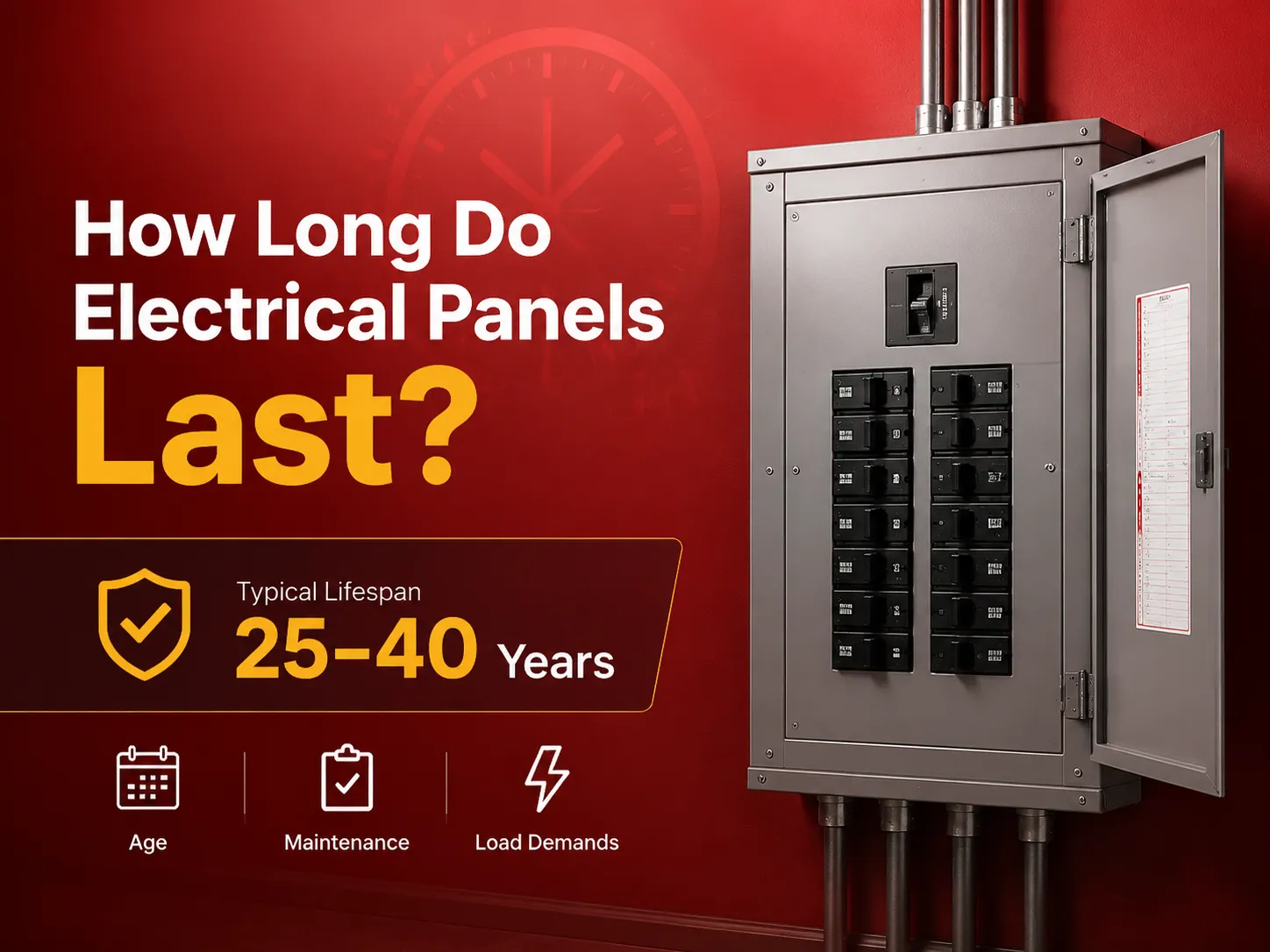
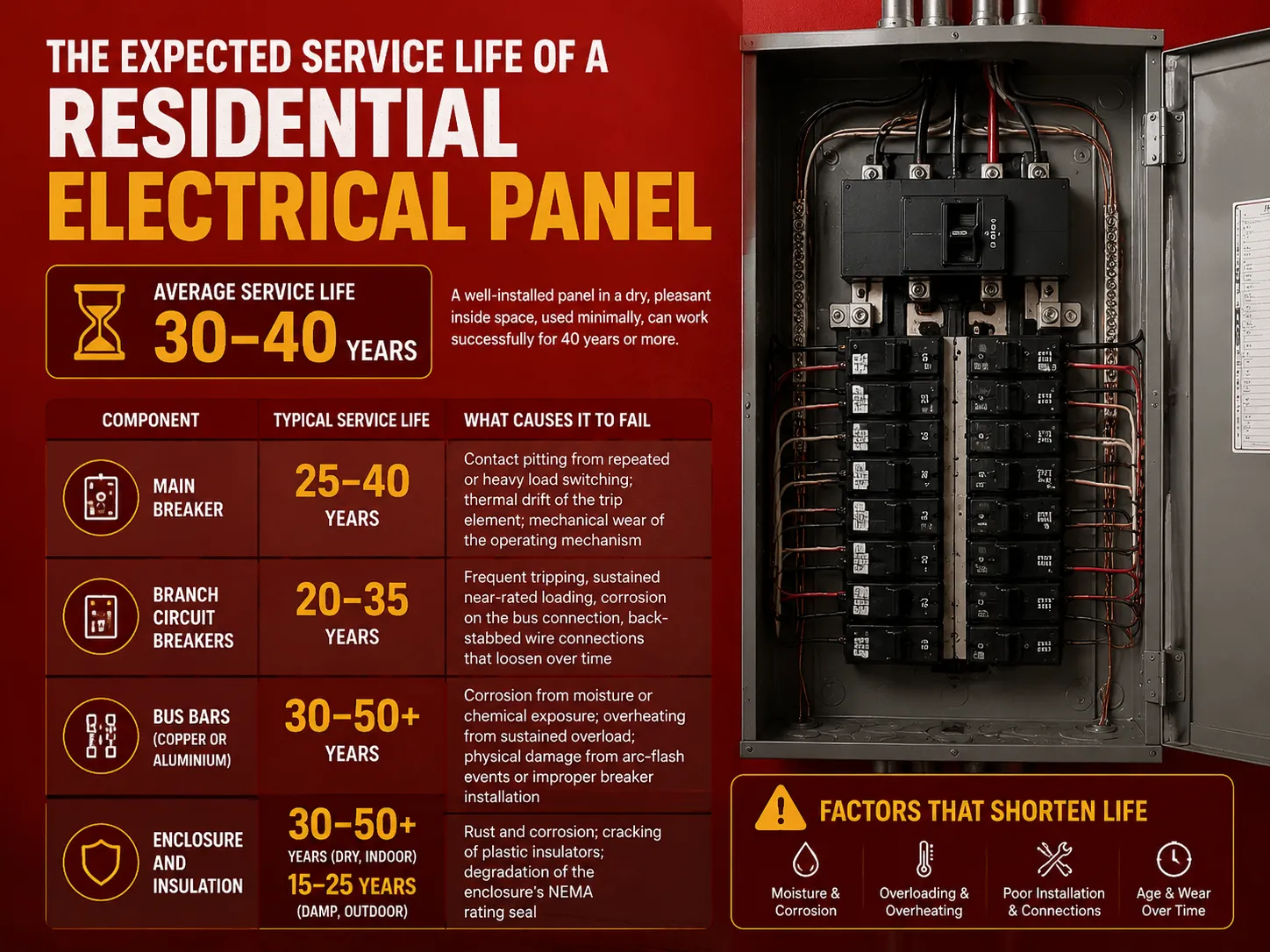
A solid electrical panel in a dry, pleasant, inside space, used minimally and installed rightly can work successfully for 40 years or more. This same electrical panel placed in a coastal garage where the situation is humid and salty air, frequently loaded close to its specified value may need changing in less than 25 years. Reports from International Association of Certified Home Inspectors show that the average working time of electrical panels in houses of the USA is about 30-40 years. During this period, insulation of wires, mechanical characteristics of bus bars, and work capacity of switches are assumed to be stable.
The panel does not exist as a singular part that has a definitive lifespan. Instead, it is made up of multiple worn parts that age differently. The table which follows highlights the parts of home panel and how long they normally last.
| Component | Typical Service Life | What Causes It to Fail |
|---|---|---|
| Main breaker | 25–40 years | Contact pitting from repeated or heavy load switching; thermal drift of the trip element; mechanical wear of the operating mechanism |
| Branch circuit breakers | 20–35 years | Frequent tripping, sustained near‑rated loading, corrosion on the bus connection, back‑stabbed wire connections that loosen over time |
| Bus bars (copper or aluminium) | 30–50+ years (if not overloaded or corroded) | Corrosion from moisture or chemical exposure; overheating from sustained overload; physical damage from arc‑flash events or improper breaker installation |
| Enclosure and insulation | 30–50+ years (dry, indoor); 15–25 years (damp, outdoor) | Rust and corrosion; cracking of plastic insulators; degradation of the enclosure’s NEMA rating seal |
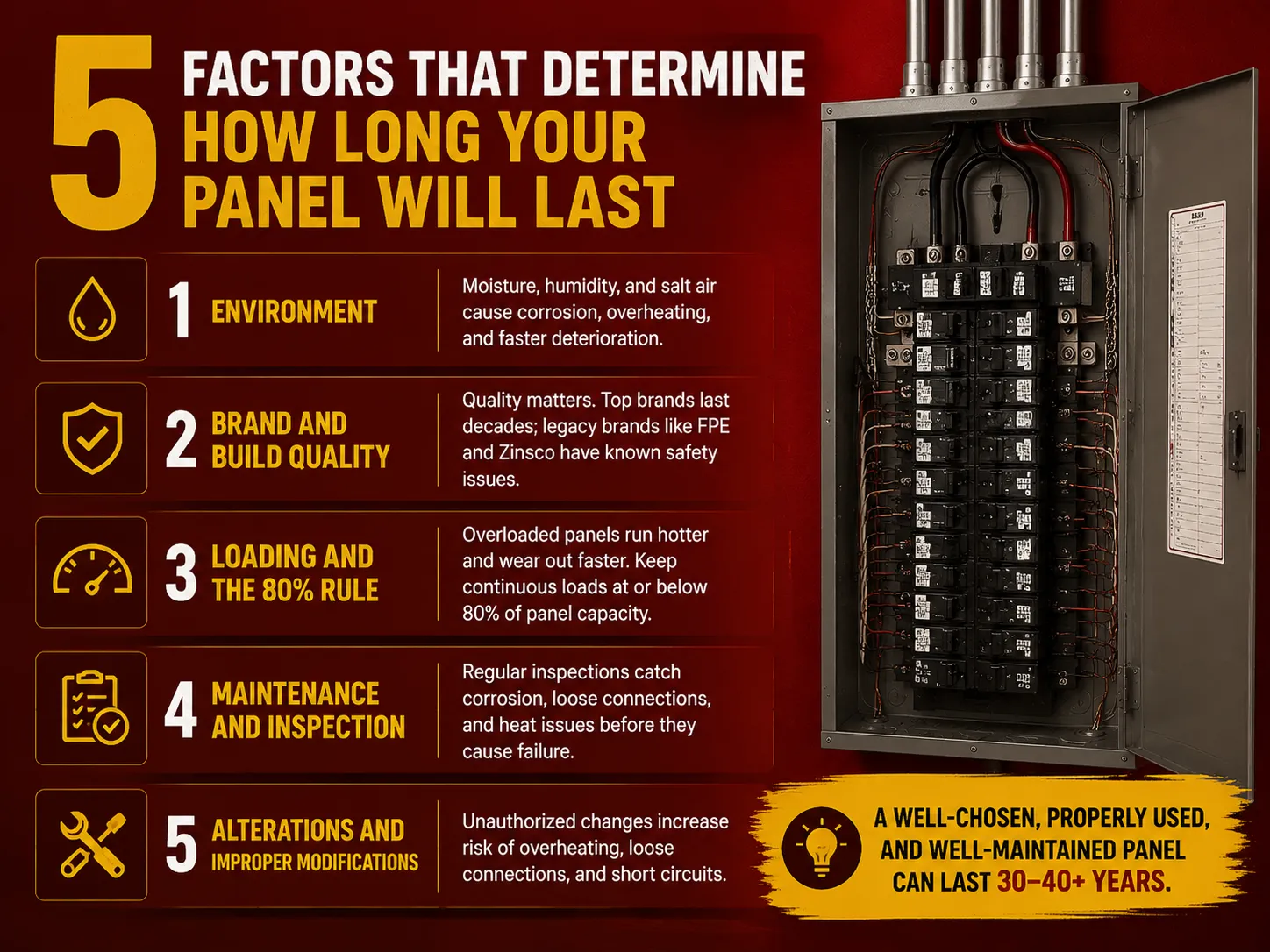
Five Factors That Determine How Long Your Panel Will Last
There is no specific lifespan for a home electrical panel. Everyone needs to know that its lifespan depends on several factors which constantly interact with each other. Thus, it is important for owners or inspectors to understand the inspection process for a particular electrical panel.
1. Environment. Moisture is detrimental to all electrical equipment. An electrical panel that is placed in a moist basement or a coastal garage that faces the salty air will corrode faster compared to one placed in a dry utility room. The corrosion process affects the bus bars in a way that increases the resistance generating heat, which leads to further corrosion — a vicious cycle that leads to the bus bars’ destruction and the overheating failure of the connected breaker switches. An electrical panel placed indoors in a dry location can last for over 40 years but the same panel placed in humid or salty air must be replaced within 20 years.
2. Brand and build quality. Not all electrical panels have the same aging process. The leading North American brands such as Square D (Schneider Electric), Eaton (Cutler-Hammer), GE, and Siemens have generally performed well over time, and many panels manufactured in the 1970s and 1980s still work safely today. However, there are some legacy brands with poor trip failure records who cannot be deemed safe even today. Federal Pacific Electric (FPE) Stab-Lok panels may have been found in millions of houses built somewhere between the 1950s and the 1980s, however, the makers of the product have been accused of not working correctly. Those FPE products often do not provide the proper response to overload situation since the circuit breakers fail to trip. At the same time, many Zinsco panels may still be found in homes built between the 1960s and the 1970s, but such products exhibit the same issues as the FPE products since the circuit breakers would display properly but the circuit would still be energized. So these companies are now forced to implement safety measures since many companies refuse to provide coverage for such products. U.S. Consumer product safety commission provides detailed information about safety hazards associated with legacy panel products.
3. Loading and the 80% rule. A constantly loaded panel tends to be hotter than a panel that is lightly loaded. Heat speeds up the degradation of each part of the box. Every electrical part suffers heat degradation the way that the breaker contacts, the insulated bus bars, and the plastic body of the breakers do. The NEC has a special maximum load requirement for apparatuses that work continuously for longer than three hours. A 100‑ampere panel loaded with 90 amperes of electric current will work for a shorter period of time than the same panel loaded with only 50 amperes. The stress on the panel depends on the load calculation and not the number of used breakers. For help performing a residential load calculation, our guide on what size circuit breaker you need covers the NEC‑based method.
4. Maintenance and inspection. A panel that does not get opened, checked, or serviced deteriorates much faster than one that gets some maintenance every now and then. Dust and dirt that accumulate inside the enclosure retain moisture and create a path for conductivity between the busbars. If a bad connection isn’t treated, it creates heat and arcing, which eventually lead it to failure. Ideally, annual inspection to check for indication of corrosion, discoloration, and smell of burning, as well as thermal imaging scan once every couple of years, must be performed.
5. Alterations and improper modifications. A panel that has undergone many modifications, e.g., an addition of a breaker here, wires getting doubled-up there, or a tandem breaker getting pushed into a slot not meant for it, is a panel that is no longer functioning according to its original design. Each modification not made according to the specification of the manufacturer and NEC raises the chances for bus bar overheating, loose connections, or a short circuit. A panel that is heavily modified but is functioning properly should be replaced not based on years of use but on the condition of the equipment.
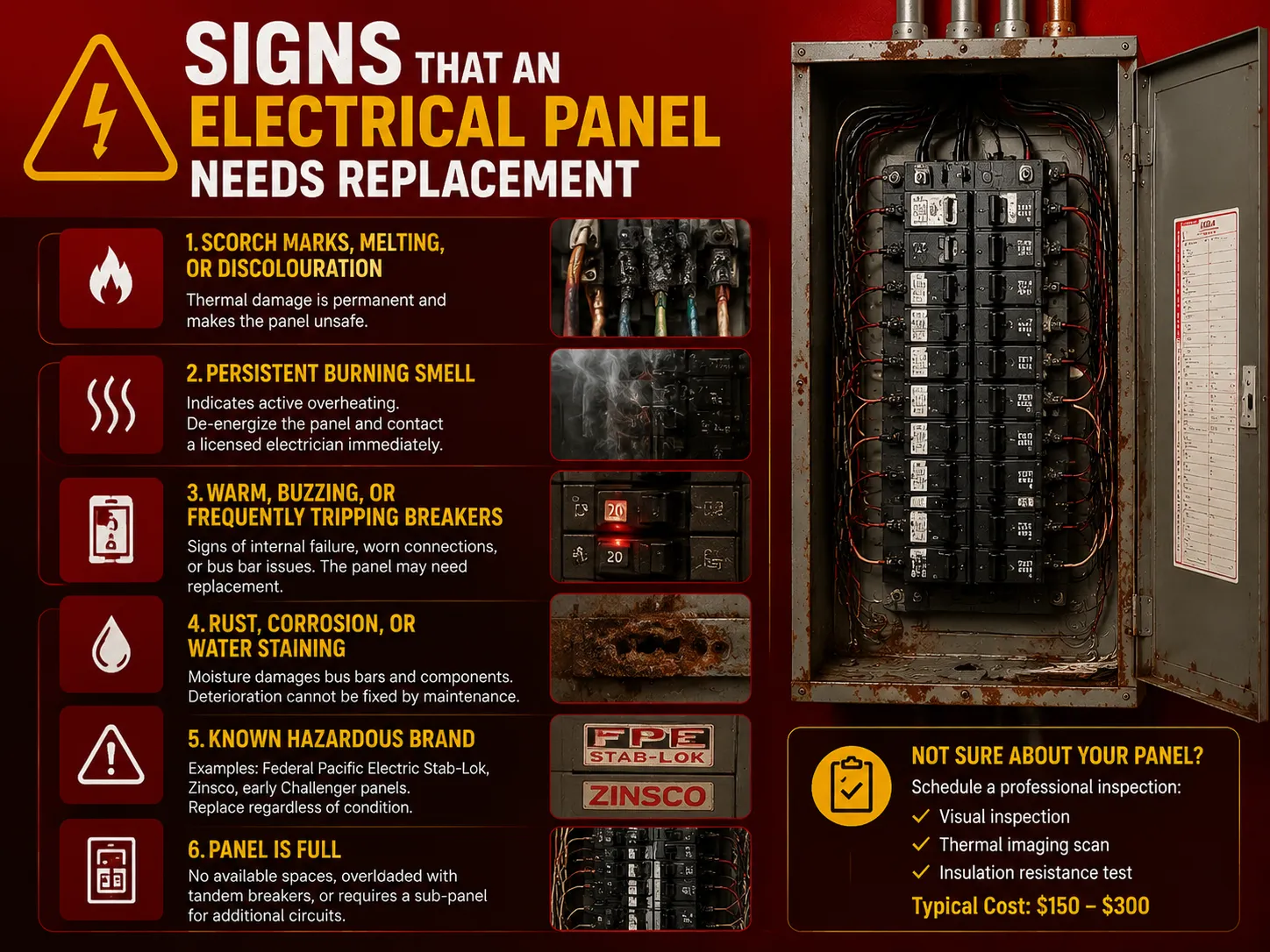
Signs That an Electrical Panel Needs Replacement
An electric panel should not just be replaced because it is an old one. For instance, a Square D QO panel that is 35 years old and is located in a cool, dry place where it is being used with load just a little will still function well for the next ten years. Age should not be the only factor for deciding on the replacement of a panel, one has to be guided by the condition of the panel in making the decision of replacing the panel. Here, we are going to highlight the unmistakable signs indicating the need of replacing the panel.
- Any visible scorch marks, melting, or discolouration The thermal destruction is permanent, and it becomes unsafe when damage to any of the components of the breaker panel occurs.
- A persistent burning smell in close proximity to the panel. This indicates that the panel is actively overheating, and immediate de-energization of the panel and contacting a licensed electrician is necessary.
- Breakers that are warm, buzzing, or that trip repeatedly Clearly shows no signs of excess current. These indicate either beginning internal failure of the contact or a worn out connection at the bus bar and the defective breakers – as well as possibly the panel – will have to be replaced.
- Rust, corrosion, or water staining The moisture that managed to go past the bus bar barrier must have adversely affected the state of the bus bars, the deteriorating condition of which cannot be remedied by maintenance.
- The panel is a known hazardous brand – Unsafe electrical panels include Federal Pacific Electric Stab-Lok panels, Zinsco panels, and some early Challenger panel designs. Regardless of their condition, these should be replaced and many insurers now request this replacement as a condition of providing coverage.
- The panel is physically full, the system has reached its maximum limit for circuits, and more circuits cannot be fitted into the panel. A panel crammed with tandem breakers or needs a sub-panel to be able to accept a single circuit is no more good for the home which it supplies power.
In case a homeowner is unsure of the quality of an old panel, the person can enlist a licensed electrician to conduct a thorough visual inspection, thermal imaging scan, and insulation resistance test, which will help in determining the condition of the panel. Inspection by an expert usually costs between $150 to $300, which is not that much considering the possible expense of fire or replacement of a panel that could have been avoided. Advice on the inspection process and replacement of the panel can be found in different home improvement magazines like This Old House.
What a Replacement Panel Costs and What It Involves
The pricing of changing an electrical panel will depend on the amperage, state of the service entrance cable, and the intricacy of the project. A simple panel-only swap – installation of a new enclosure, a new main breaker, and new branch breakers, all while reusing the existing service cable and meter socket – can often cost between $1,500 and $3,000. A full-service upgrade from 100 amps to 200 amps, encompassing a new meter socket, mast, service entrance cable, and grounding system, typically comes in at a cost of about $3,500 to $6,500. The price includes not only the installation of the panel and the breakers, but also labor and permitting fees to get the whole process on the road. However, the cost varies depending on the region and ease of access to the panel location. Replacing an electrical panel is not a simple DIY project – you will need to pull the meter or work with an energy supplier to implement the disconnect, and you will require not only the proper permits but also inspections performed afterward. A properly licensed contractor will have to carry out this procedure, and you, as a homeowner, have a right to receive a copy of the approval inspection as well as a clear list of all the operating circuits.
Replacing a panel allows the installation of new protective devices that were not available at the time of installation of the original panel. You can use AFCI breakers in living area circuits to provide arc fault protection required by the NEC. GFCI breakers can be added to bathroom, kitchen and outdoor circuits. Additionally, you can install a whole-house surge protective device at the panel in order to protect each downstream circuit from voltage surges. HUYU manufactures all types of protective devices for the modern panel — MCBs, RCDs, RCBOs, AFDDs, SPDs — with the certifications and documentation needed to pass the electrical inspector and the home insurance company. Our article on what UL 489 breakers are explains the certification framework that every breaker in a replacement panel must meet.
Frequently Asked Questions
How often should you replace an electrical panel?
There should not be a fixed time for changing an electrical panel. The electrical panel that has been well preserved and is produced by a reliable brand can last anywhere from 30 years to over 40 years. The decision to change it depends on the condition of the panel. You will know if you need to change it if it shows signs of rust or overheating or if it is a brand notorious for being dangerous. It is good practice to have a professional examine the panel at least every few years to be aware of how it is faring.
How to tell if an electrical panel needs replacing?
The indications that an electrical panel requires changing may include the following: scorch marks or melting, constant burning odor, warm or buzzing breakers, rust or water marking inside enclosure, as well as the panel being of a faulty brand such as FPE Stab-Lok, or Zinsco. Any of these signs can call for a prompt action of specialists.
What is the 80% rule for electrical panels?
According to the 80% rule, under no circumstance can a circuit breaker be loaded to more than 80% of its rated current. This provides the breaker with protection from thermal drift and prolongs the service life of the distribution board by mitigating the amount of heat that accelerates aging of components. For continuous loads, this is a mandate of the NEC and a commendable practice to follow for all circuits.
What is the life expectancy of a residential electrical panel?
When used normally, a residential electrical panel has a life of about 30 to 40 years. However, if the panel is subjected to moist or corrosive conditions or is made by a company known for making inferior equipment, its life expectancy may be considerably lower. The three vital components of the panel, the main breaker, the branch breakers, and the bus bars, all age differently, and any of them may lead to the end of the life of the panel.
References
- International Association of Certified Home Inspectors (InterNACHI) — Electrical Panel Life Expectancy. Industry guidance on the expected service life of residential electrical panels and the inspection criteria for aging components.
- U.S. Consumer Product Safety Commission (CPSC) — Federal Pacific Electric and Zinsco Panel Safety. Government documentation on the known failure modes and fire risks of legacy hazardous panel brands.
- This Old House — When to Replace an Electrical Panel. Homeowner‑focused guidance on recognising the signs of a failing panel and understanding the replacement process.
- Eaton — Residential Load Centre and Circuit Breaker Service Life. Manufacturer information on the design life, testing, and expected service life of residential electrical panels and breakers.
An electrical panel that is properly specified, correctly installed, and adequately maintained can protect a home for 30 to 40 years — and sometimes longer. Each type of gear has a shelf lifetime; therefore, the components that wear out more quickly are the ones that suffer from excessive usage, which causes aging. Should the board have symptoms of age, such as warmth, noise, discoloration, or frequent trips, it is high time to replace it. The cost of replacement in an ordinary environment — one day of work, one new cabinet, and one set of current circuit breakers — is only a fraction of the expense incurred in case of unplanned replacement.