
A homeowner from Sydney realized that the 16‑amp circuit breaker of the lights in the bedroom had tripped three times within a period of 2 weeks – the cause of this problem was not that there were some devices functioning in this room as it always happened at night when no electrical appliances were active. While resetting the breaker for the fourth time she was unable to do so. The expert found the reason of this malfunction being a disconnected neutral wire inside the junction box in its ceiling. Because of the process of expansion and contraction which has been happening for a long time, a screw terminal in the junction box has become loose, and there occurred the arc of electricity jumping through the gap causing the circuit breaker to trip and disconnect the power.
The Three Root Causes When No Load Is Present
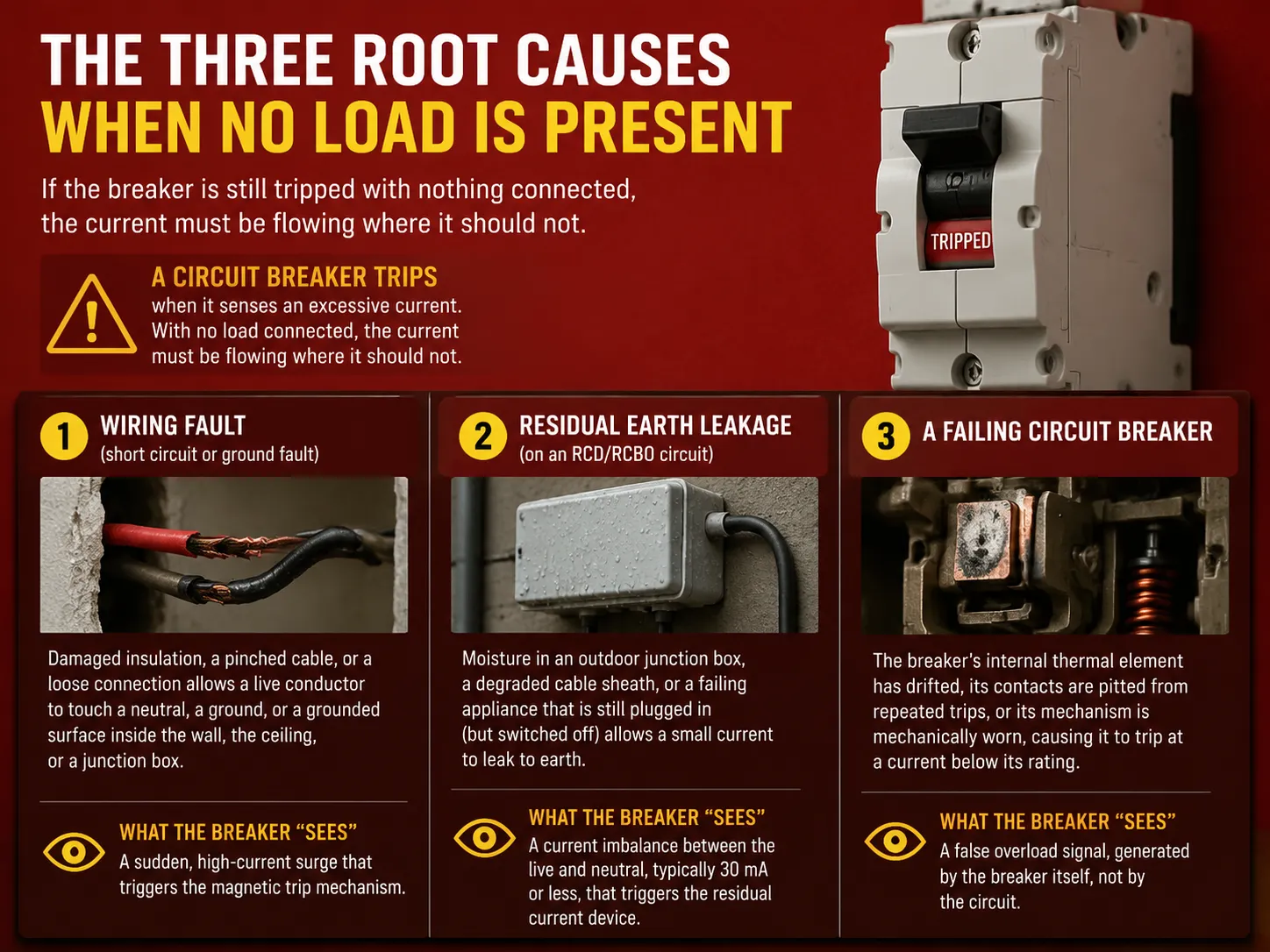
A circuit breaker operates by detecting abnormal current, either in the form of an overload or of a short circuit. When no equipment is connected to that circuit and no appliances are on, there should be no current flowing. If the breaker trips anyway, then there is current where it should not be. There are three major reasons for this phenomenon leading to the need for different tests in each case.
| Cause | What Happens | What the Breaker “Sees” |
|---|---|---|
| Wiring fault (short circuit or ground fault) | Damaged insulation, a pinched cable, or a loose connection allows a live conductor to touch a neutral, a ground, or a grounded surface inside the wall, the ceiling, or a junction box | A sudden, high‑current surge that triggers the magnetic trip mechanism |
| Residual earth leakage (on an RCD/RCBO circuit) | Moisture in an outdoor junction box, a degraded cable sheath, or a failing appliance that is still plugged in (but switched off) allows a small current to leak to earth | A current imbalance between the live and neutral, typically 30 mA or less, that triggers the residual current device |
| A failing circuit breaker | The breaker’s internal thermal element has drifted, its contacts are pitted from repeated trips, or its mechanism is mechanically worn, causing it to trip at a current below its rating | A false overload signal, generated by the breaker itself, not by the circuit |
How to Diagnose the Fault Methodically
When a circuit breaker goes off and nothing is attached to the circuit, the urge to continuously reset the circuit must be resisted. Resetting the circuit applies full voltage to the fault, which may exacerbate the issue further. For instance, an erratic connection might spark in the wrong way or a failed circuit breaker might heat its contacts again. Therefore, the right option here is to perform a procedure with the main switch off and using a non-contact testing device. And if the procedure does not seem safe, it is always better to call an electrician.
Identify every device on the circuit. Shut down the circuit breaker and inspect the premises. Investigate which lights, outlets, and stationary devices aren’t working anymore. Search outside lights, junctions in the attic, heating under the flooring, and fans in the washroom, as all these appliances can consume electricity from the same circuit as other, more visible appliances. For instance, the circuit powering one bedroom may also be supplying a socket outdoors that the owner has never used and doesn’t know that exists. This outdoor socket, which gets wet almost constantly, has a good chance of causing leakage to the ground.
Unplug everything, and turn off every switch — including fixed appliances. Evergreen phrase “Nothing plugged in” should be taken literally: there should not be a plug of a phone charger in the socket, a lamp with an OFF switch, an oven with a digital clock, or a boiler connected to the circuit. An appliance that is switched off can still leak current to the ground if there is an insulation fault inside it. If the circuit breaker does not trip at this stage, the fault is in one of the devices – plug one after another until the break trips.
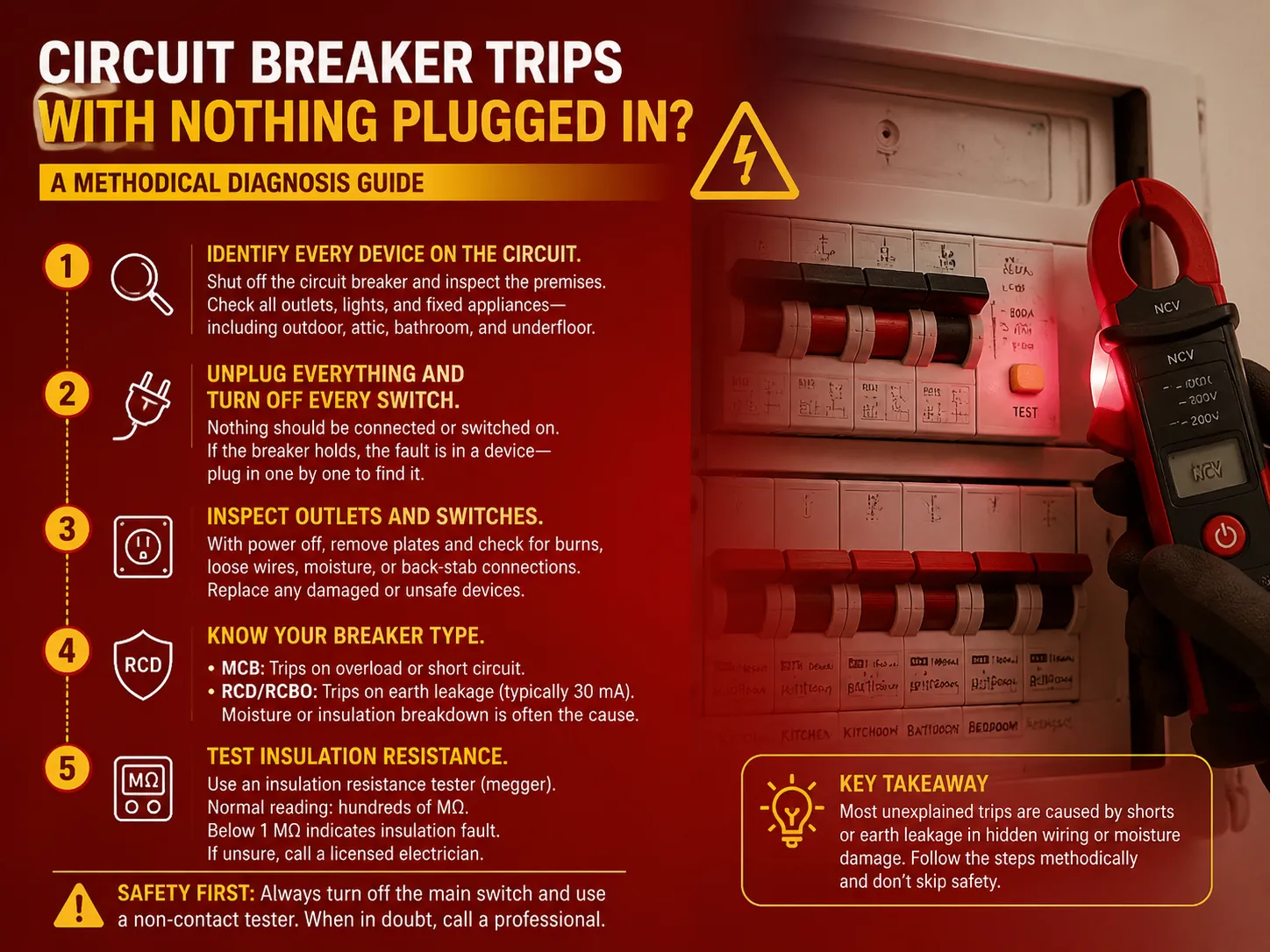
If the breaker still trips with everything unplugged and switched off, visually inspect every accessible outlet and switch on the circuit. It is advisable to turn off the main breaker prior to performing an inspection. Unscrew each plate and pull out the outlets and switches. Look for any signs of fires, misshaped plastic, burning smell, loose wires, or any evidence of water damage. A back-stabbing connection is often an origin of electric failures. A wire in such a connection is not secured inside using screws but rather pushed into a special hole. Over time, a spring in such a machine becomes weaker, which can cause the connection to fail for several months before going out completely. If back-stabbing connection is found at one of the switches or outlets, one should replace it by a brand new device and connect wires by using screws.Our guide on how to replace a damaged wall socket covers the safe procedure.
Different Breaker Types, Different Trip Behaviours
Not every circuit breaker trips for identical reasons. The kind of protective device mounted on the circuit dictates the type of fault that instigates a trip, hence it is necessary to know the distinctions for solving the problem.HUYU’s RCBO range, such as the HUM18LE‑63 RCBO, combines both overcurrent and residual current protection in a single device, ensuring that both overload and earth‑leakage faults are detected.
AFDD (Arc Fault Detection Device). Trips on the unique electrical signature of an arc. An AFDD can detect a loose connection that is arcing intermittently — a fault that a standard MCB and an RCD would both miss, because the arc current is too low to trip the breaker and the current is not leaking to earth. AFDDs are increasingly required in residential circuits in many jurisdictions, and they are a key part of the fire‑protection strategy in modern electrical installations.
Standard MCB (Miniature Circuit Breaker). MCBs are designed to prevent overloads and short circuits only. It’s almost certain that a standard MCB is tripping due to a short circuit when nothing is plugged in somewhere in the circuits, as a live-to-neutral or live-to-earth contact must have occurred somewhere in the fixed wiring.
A standard MCB will not trip on a small earth leakage current, which is the reason circuits supplying bathrooms, kitchens, and outdoors are now being protected by RCDs or RCBOs.
RCD (Residual Current Device) or RCBO (Residual Current Breaker with Overcurrent). Earth leakage tripping is commonly 30 mA for protection of human life. An RCD or RCBO that trips out when nothing is plugged into it is responding to current leakage. The reason for the trip is usually due to moisture or breakdown of insulation somewhere in the circuit.
If the visual inspection reveals nothing, test the circuit’s insulation resistance. In order to conduct an insulation resistance test, it is important to have an insulation resistance tester (commonly known as a megger). However, this tool is not owned by most homeowners. The testing has to be carried out when the electrical circuit is not powered and has no load connected. The tester generates a high voltage direct current (usually 250 or 500 volts) which is measured with the insulation resistance. A normal circuit should read hundreds of megohms. A reading of below 1 megohm means that the insulation is damaged or has moisture or a carbon track, thus providing a path for leakage current. It is also important to point out that in such a case the help of a licensed electrician is usually necessary, as tracing the low insulation resistance to the exact spot, that is the right junction box or cable length would require experience, test equipment and the ability of handling potentially damaged circuit safely.
When the Breaker Itself Is the Fault
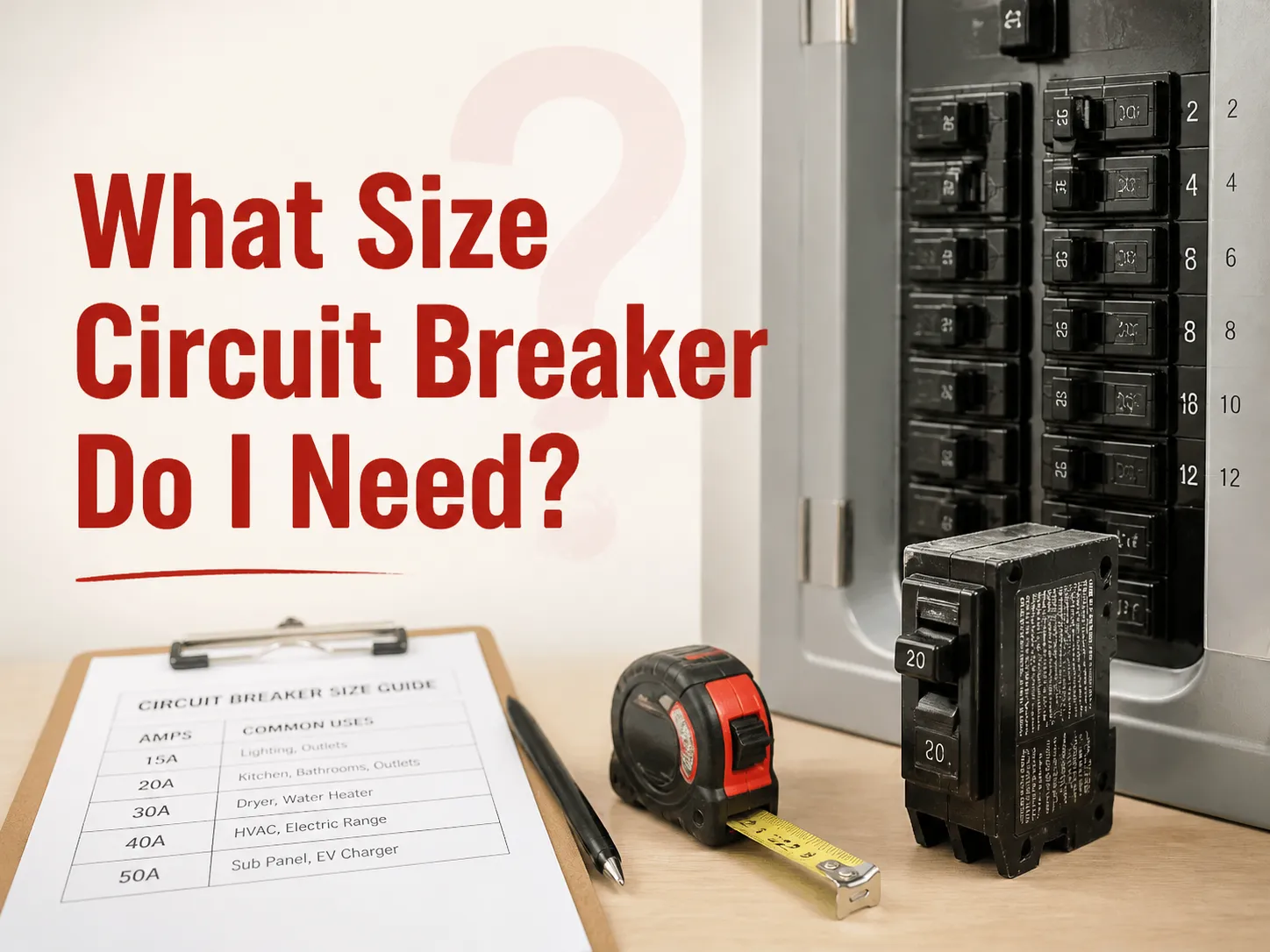
Assuming that testing of circuit wiring yields positive results and there are no signs of moisture or damage indications, it is possible that the breaker has failed. When thinking of a breaker, it is a device that only has a limited lifespan; some of the signs that indicate that a breaker is failing include: the breaker feels hot; there is a buzzing sound; the handle of the breaker seems loose and gritty; and most importantly — the breaker continues tripping constantly despite a lack of current flowing through it. Replacing such a breaker should not be too costly, as replacement costs between $5 to $50. Furthermore, the replacement can be done easily by a person with good do-it-yourself skills as long as electricity is turned off from the main breaker before the replacement.For help identifying the correct replacement breaker for your panel, our guide on what size circuit breaker you need covers the ampacity and trip‑curve selection for standard circuits. And for a complete understanding of the certification framework that ensures every breaker meets its published specification, our article on what UL 489 breakers are explains the testing and listing process.
Prevention: How to Avoid the Next Unexplained Trip
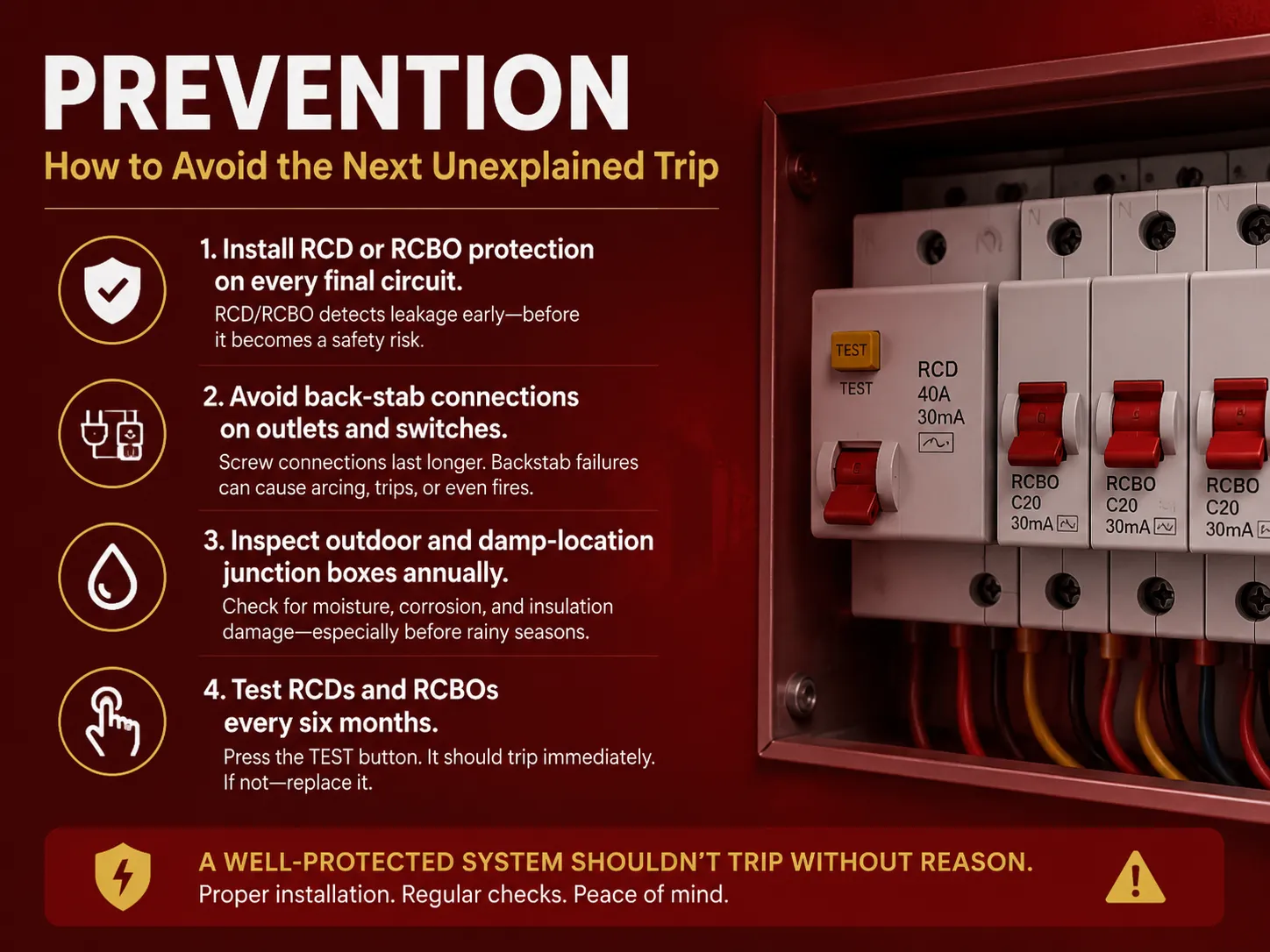
An electrical system that is properly installed, properly protected and regularly checked should not trip without reason. The following practices help to minimize the chances of an unexplained trip, which can disturb a home, cause damage to appliances and undermine trust in the electrical system:
- Install RCD or RCBO protection on every final circuit. An electrical circuit provided protective measures only through a standard miniature circuit breaker (MCB) does not raise any alarms regarding an impending ground fault until the fault current is sufficiently high to actuate the breaker due to overcurrent condition, which is usually late for effective remedial action. However, the residual current device (RCD) protection detects electrical leakage current at an early stage, often before the ground fault becomes a threat to safety.
- Avoid back‑stab connections on outlets and switches. Screw connection is more long-lasting connection type. If backstab connection fails, it creates an arc that can trip the circuit break and if the circuit breaker does not operate it can cause fire.
- Inspect outdoor and damp‑location junction boxes annually. Moisture accumulation and insulation damage are most likely to occur at an outside light, an outlet and a junction box in an unheated attic or crawl space. By inspecting these locations visually before the rainy season and after a long period of downpour, you will spot the signs before the circuit breaker does.
- Test RCDs and RCBOs every six months. By pushing the TEST button, the appliance must trip immediately. If it has not done so, this indicates the failure of the appliance and it must be exchanged. The manufacturers and wiring regulations specify this as a requirement on their part and it is simple periodic test in electrical safety.
Frequently Asked Questions
How do I find out what’s tripping my breaker?
Turn off every appliance connected to the circuit by unplugging them and switching them off — even things like the boiler and the extractor fan. If the breaker still operates, you will have to reconnect them in reverse order and try them one by one until the breaker trips.
If the breaker still trips with nothing plugged in, check all sockets and switches for any burn marks, loose wiring, and dampness from condensation. If you don’t find a reason, you should contact an electrician for help.
How do you fix a breaker that keeps tripping?
To fix the problem, remove the cause of the fault. The problem may be caused by an overloaded circuit, defective appliance, wiring fault or failed breaker. Do not reset a breaker repeatedly; resetting it only sends power to the fault and makes it worse. If you cannot find the cause of the problem or if the breaker shows signs of heat, buzzing or damage, contact a licensed professional electrician to do the work.
Is a tripped breaker a fire hazard?
A single noticed trip of the circuit breaker is not a fire threat. Instead, it is the work of the circuit breaker. But if the circuit breaker has been tripped repeatedly, trips without load, or if it has obvious signs of damage (excessive heat, sound of buzzing, or burns), it poses a fire hazard. In this case, the tripped breaker gives a warning about a problem, which may be (an unsecured connection, damaged cable, or an unsecured circuit breaker) capable of causing a fire if not rectified.
References
- National Fire Protection Association (NFPA) — Electrical Fire Cause Data. Annual statistics and analysis on the role of electrical distribution equipment in residential fires.
- Electrical Safety Foundation International (ESFI) — Home Electrical Safety. Consumer guidance on recognising and responding to electrical hazards, including repeated breaker tripping and arc fault detection.
- Eaton — Circuit Breaker Diagnostics and Troubleshooting. Manufacturer guidance on identifying failure modes in residential and commercial circuit breakers.
- Fluke Corporation — Insulation Resistance Testing Basics. Technical guidance on using insulation resistance testers to diagnose wiring faults.
A breaker that keeps tripping with nothing plugged in is not a mystery, and it is not an annoyance to be endured. It is the earliest possible indication that something isn’t quite right with the circuit — whether it is wires that are damaged or a junction box that is wet or even the circuit breaker that is malfunctioning, just because the circuit breaker has tripped, it is not able to just be reset. Diagnosis of the circuit is needed, the error is to be traced, and the defect is to be rectified. The response of the homeowner should involve performing a series of actions, starting from unplugging all appliances that are in use and looking at each part of the circuit that has some visibility, but if something is not clear, then an electrician should be called. Similarly, the electrician should act in a methodical way. HUYU is a supplier of devices that provide warning — it produces MCB, RCD, RCBO, and AFDD protective devices.