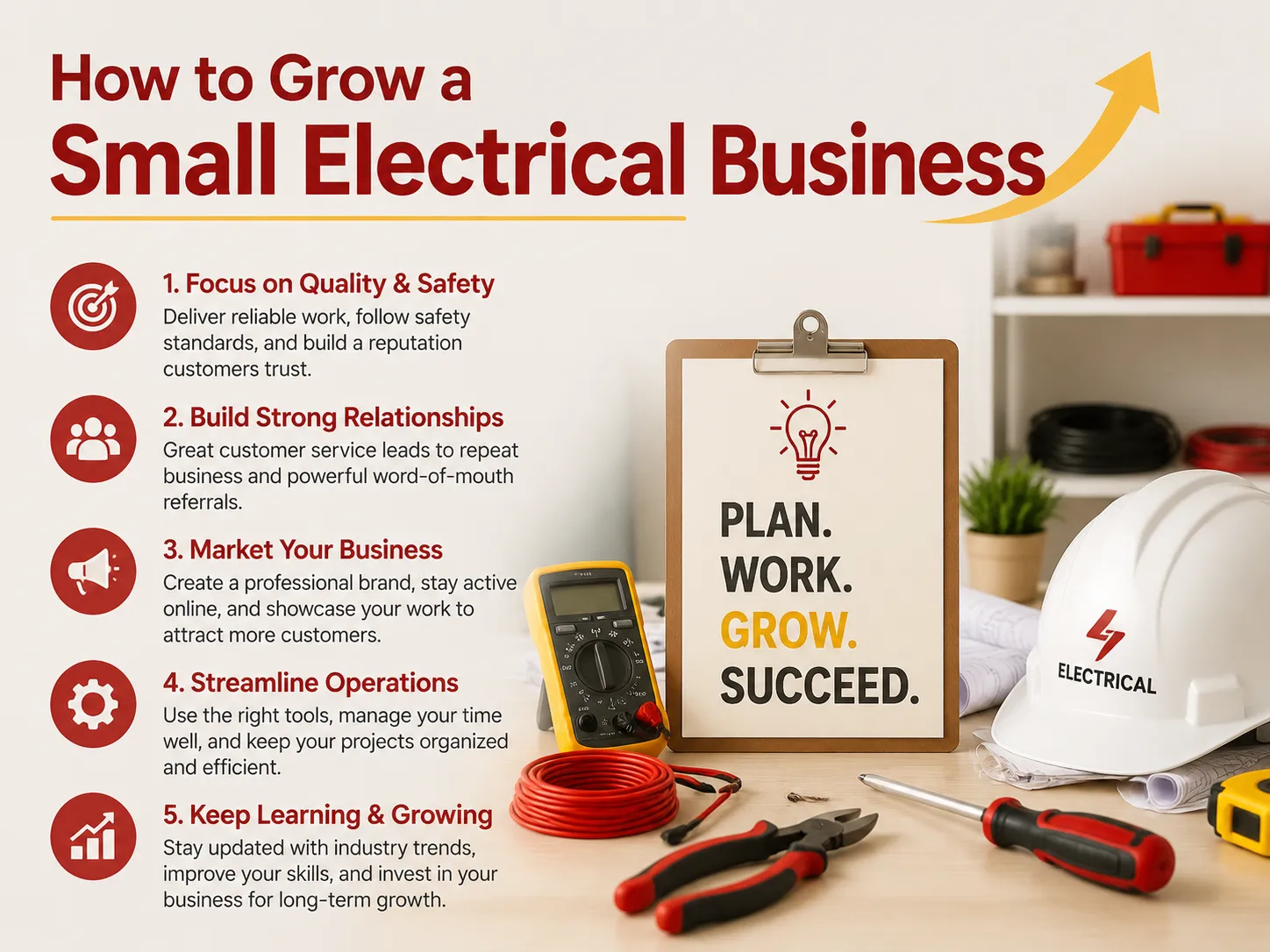
At the end of the fifth year in operation, a small contractor in electrical engineering based in Leeds reviewed the performance of his company and found his situation to be a familiar situation: the work was going on steadily, the number of devoted clients was increasing but the amount of money earned seemed to be insufficient compared to the number of hours worked. The man was busy, but everything he was doing did not provide him with a significant profit. The breakthrough came when he stopped thinking about himself as a mere electrician and started considering himself as a small business owner. After making such a shift three years later, he was able to double his revenue and to buy another van for his work. The story of this electrical engineer shows everybody who works in electrical engineering how the life can change with the right choice.
The Growth Bottlenecks That Keep Small Electrical Businesses Small
Each small electrical business has encountered similar challenges. Many of the companies that have one owner eventually become too dependent on him or her. The company faces capacity constraints, which result in poor product offering. They have too few large clients who can change. To grow, the business has to overcome these issues, which can involve expansion capacity, offering new products, and finding ways to reach new customers beyond the owner’s network.
Product Strategy: AC, DC, and the Hybrid Future
What a small electrical firm decides to sell is the most important strategic choice. The electrical business is changing fundamentally. For many years, AC-only products, which encompassed various goods like miniature circuit breakers, distribution boards, RCDs, and MCBs, prevailed. They are still the most used goods today and will remain so for many more years. Nevertheless, the fastest-growing markets are related to DC products, including solar photovoltaic protection systems, battery energy storage disconnects, electric vehicle charging solutions, and DC breakers and isolators. Thus, by adding DC protection products to the line of products, a small electrical player makes a marketing move.
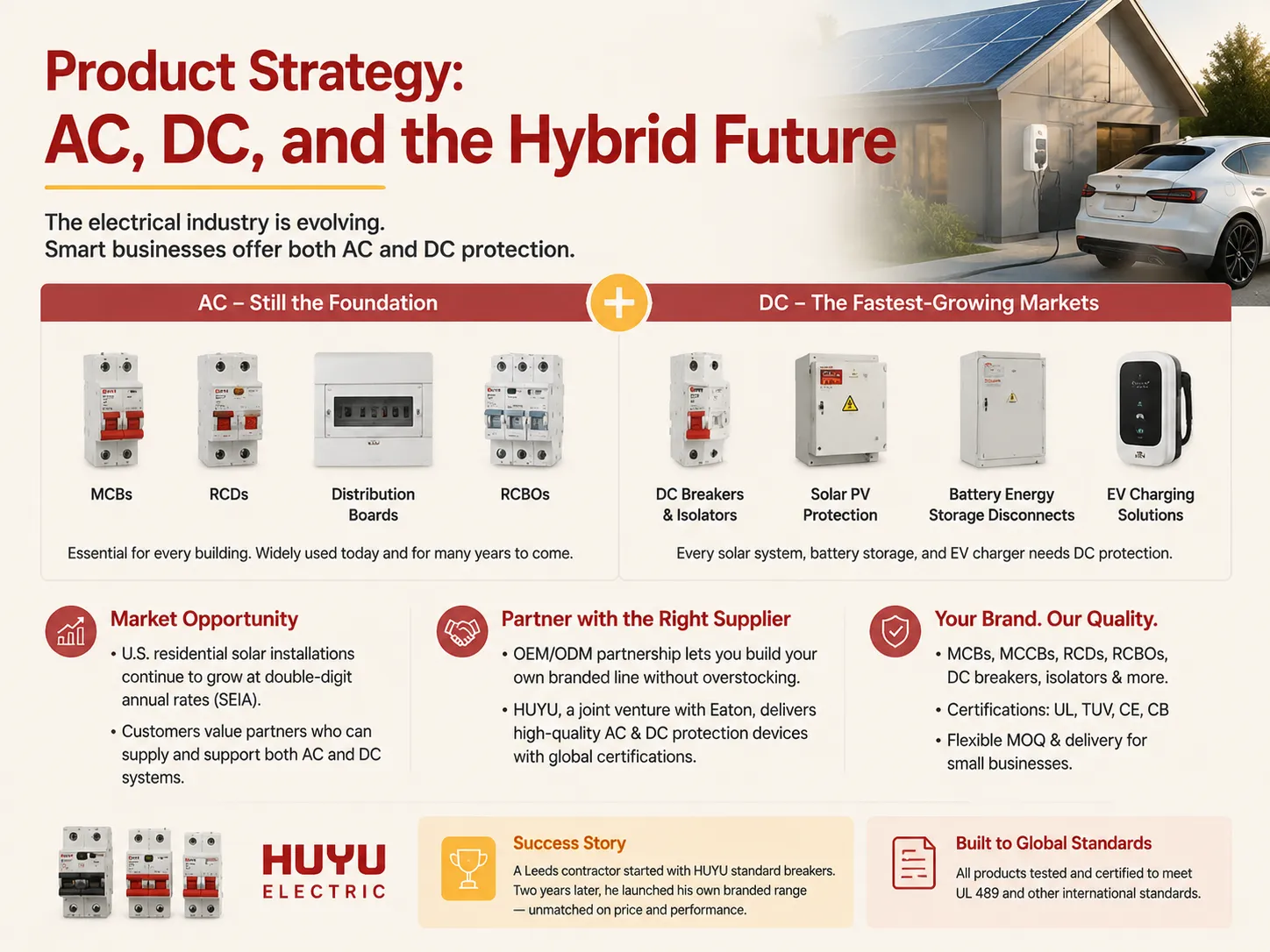
According to the Solar Energy Industries Association (SEIA), residential solar installations in the United States alone continue to grow at double‑digit annual rates, and every solar installation requires a dedicated DC circuit protection strategy. An electrician who can install and maintain both AC and DC systems, or a distributor who can supply both, is more valuable than one who can only handle one.
The important point for a small business is how to obtain these products without overinvesting in inventory. This is where the connection with the supplier is very useful. A company producing OEM and ODM enables a small electrical company to create its own branded product line of MCBs, RCBOs, or DC breakers. For example, HUYU, which produces low voltage protection devices, is an example of such a company. HUYU is a joint venture with Eaton. As a result, HUYU is a company which produces high-quality products due to the collaboration with a world-class electrical company.
Whether you are just a small distributor or an emerging electricity brand, you can count on HUYU to produce your customized range of AC and DC protective devices: from miniature circuit breakers to molded case circuit breakers, RCDs, RCBOs, and DC isolators; all of which can be made under your own brand logo with the necessary certifications (UL, TUV, CE, CB), as well as the flexibility of delivery time and volume that a small business requires. This was precisely the way the Leeds contractor did it: he began by stocking standard HUYU circuit breakers, established a relationship with the engineering team and two years later had his own branded consumer unit and protective devices that no one else was able to match on price and specifications. If you want to learn more about the certification framework that each circuit breaker has to comply with before it can be sold, our article indicates how UL 489 breakers are being tested and listed to make sure that a product is certifiable.
Marketing and Customer Acquisition: Online, Offline, and the Local Advantage
A small electrical company’s growth depends on being discovered by customers who are not in the companies’ contact list. The ways to reach out to local electrical contractors are not the same as for distributors, but there is common ground.

Online presence. The primary concern for contractors is local searching, which means they should have an optimized Google Business Profile, a basic site with a detailed description of the services they provide, and regular customer reviews. When someone searches for “electricity supplier near me,” contractors who show up in the local list get the phone calls.
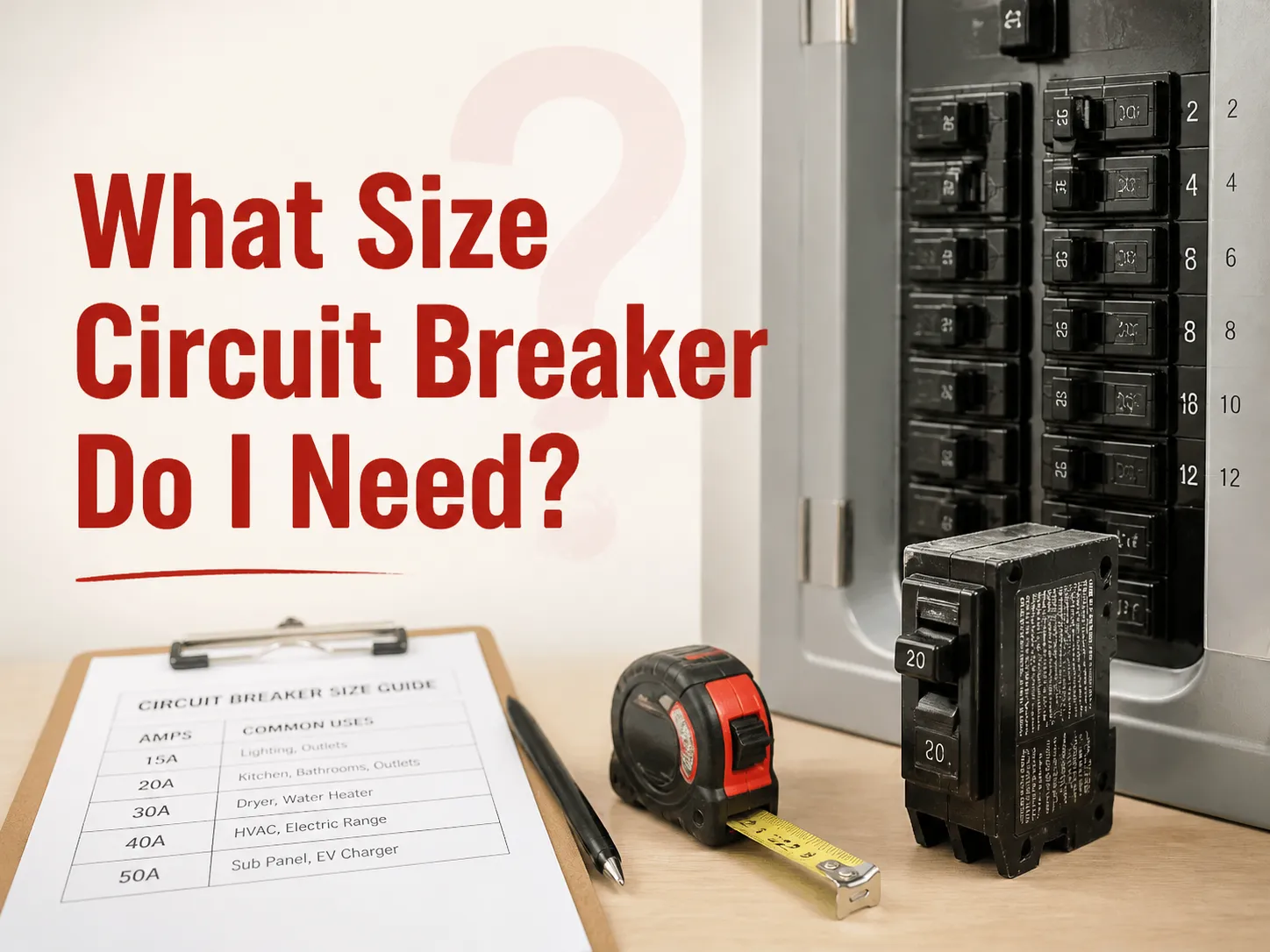
For a distributor or a brand, the priority shifts to product‑level search: detailed product pages, technical content that answers the questions engineers and buyers are asking, and a presence on B2B platforms such as Thomasnet, Alibaba, and industry‑specific trade directories. A distributor who publishes a blog post answering “what size breaker for a dryer” or “are tandem breakers safe” attracts the exact buyer who needs that breaker, and who is ready to purchase. Our guide on what size circuit breaker you need is an example of the kind of content that connects a technical question with a product solution.
Offline relationships. It is the relationships that a contractor has with local builders, property managers, and insurance adjusters that provide them with work. A single contractor with a small house‑builder can obtain a lot of new construction wiring tasks. A contractor with a property management company can get many maintenance works or emergency calls. In a similar manner, a distributor’s business depends on relationships with electrical wholesalers, OEM procurement managers, and export buyers. By participating in trade fairs and exhibitions in the field of electrical technology, people make connections that will guarantee sales.
Operational Efficiency: Systems That Scale Beyond the Owner
Without the presence of the owner, a company can no longer be termed a company, but instead, becomes a job. Thus, in order to expand a small electrical business, one needs to set up very simple systems that will allow other people to perform the same job effectively. Specifically, in the case of contractors, this means having quoting worksheets that are used by an estimator, checklists for installation that can be used by apprentices, and customer management software where all calls, quotes, and follow-ups are recorded. As for distributors, this will include having an inventory management system that sends alerts when stocks fall below a certain mark, a logistics partner who oversees the fulfillment stage, and an entire library of product data sheets that allow customers to get specifications about the goods. Consequently, the owner is transformed from a job performer into a manager, who oversees the working systems at first, and later starts building relationships and strategising for future business growth.
Certification, Compliance, and the Trust Barrier
Trust is of utmost importance in the electrical sector. If a certain electrical breaker has failed to trip, the consumer unit does not comply with local regulations regarding wiring, or the manufacturer could not provide the certificate required by law, it would be enough for ruining the company’s business and exposing it to legal repercussions. Small electrical contractors who are getting their devices from a vendor that does not have enough relevant certificates are building their house on a shaky ground. A vendor that can prove that it has relevant certificates in full and in a reliable manner and can prove the documents referring to the quality of its source components and audits which are required by the buyer is the vendor that protects both its own and its customers’ business.
Frequently Asked Questions
How to make $200,000 as an electrician?
To earn $200,000 per year as an electrician, one must transition from conventional pay on an hour-by-hour basis into a business ownership model, specializing in high-demand sectors (industrial controls, EV charger installation, solar PV, home automation), hiring employees to scale up the number of billable hours, and generating various recurring sources of income (maintenance contracts, resale of private-label products via a trustworthy OEM/ODM partner).
Will AI replace electricians?
The answer is no, since AI won’t replace electricians. The activity of installing, maintaining, and repairing electrical systems, including tasks such as working in confined places, pulling cables, making connections, and finding failures using measuring equipment, requires human thinking, manual dexterity, and fast adaptation to unexpected developments occurring on the spot – yet, these features are unique to a human being and cannot be duplicated by AI and robotics technologies. Of course, AI may influence how electricians think when designing systems, quoting, and organizing their business, but it is unlikely that an electrician will be replaced.
How to make $100,000 a year as an electrician?
An experienced electrician working in a thriving economy may earn over $100,000 per year based solely on salary making use of overtime in high-paying sectors like industrial maintenance. Other options available to an electrician include: becoming a licensed master electrician and starting their own contracting business, working in emergency call outs, or pursuing a career as an electrical inspector or project manager.
Is electrical business profitable?
Absolutely, an electrical company can be incredibly profitable. Construction firms operate with gross profit margins between 20%-50% based on the work type and region. Electrical distribution and private label sales backed up by an OEM/ODM manufacturer can achieve even higher margins on the product side.
References
- Solar Energy Industries Association (SEIA) — Residential Solar Market Data. Annual data on the growth of the residential solar and storage market in the United States, driving demand for DC circuit protection.
- National Fire Protection Association (NFPA) — National Electrical Code (NEC). The foundational standard for electrical installation in North America, including the latest requirements for DC circuits, AFCI/GFCI protection, and surge protection that drive product demand.
- U.S. Bureau of Labor Statistics — Electricians Occupational Outlook. Employment projections, wage data, and industry trends for the electrical trade.
- International Electrotechnical Commission (IEC) — Standards for Low‑Voltage Electrical Equipment. The international standards that govern the design, testing, and certification of circuit breakers, RCDs, and other protective devices sold globally.
Growing a small electrical business is a deliberate process of breaking the bottlenecks that hold it back: narrowing the product range to match the market’s direction, building an online and offline presence that reaches new customers, and partnering with suppliers who can provide the certified, differentiated products that turn a commodity offering into a brand. The contractor in Leeds who started his own range of consumer units, due to an OEM relationship with a manufacturer who understood the certification environment and was able to deliver, did not put in more hours but worked on the right tasks. HUYU provides manufacturing capabilities, rigorous certification process, and a flexible OEM/ODM approach, allowing the small business to transform into a real brand and become a company that grows by establishing systems, relations, and scalable products.