
Contactor Modular EXCH7
Una familia de contactores modulares — 1P a 4P, 16A a 63A, controlados por bobina
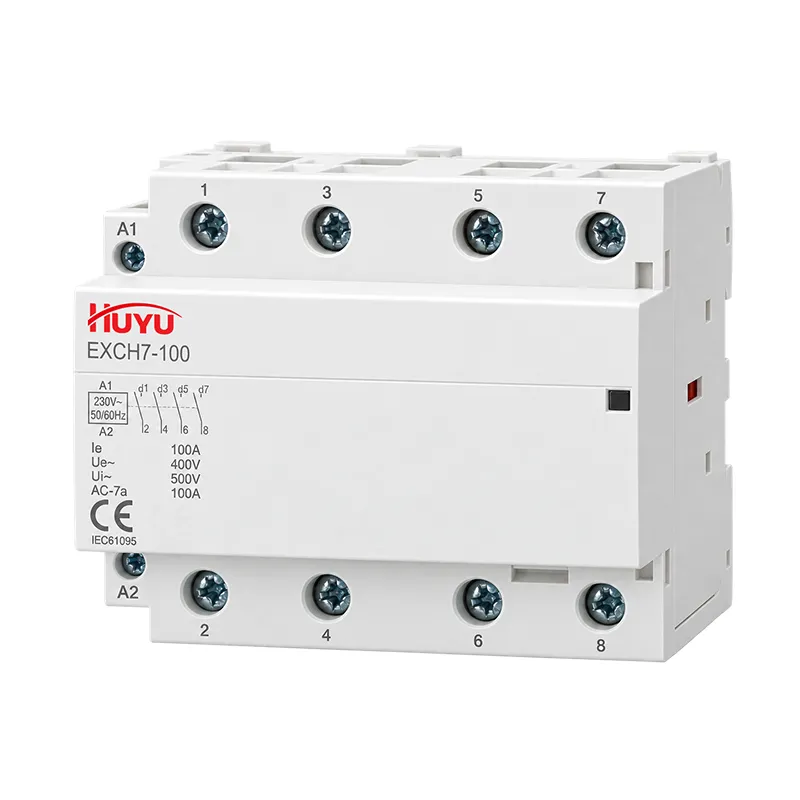
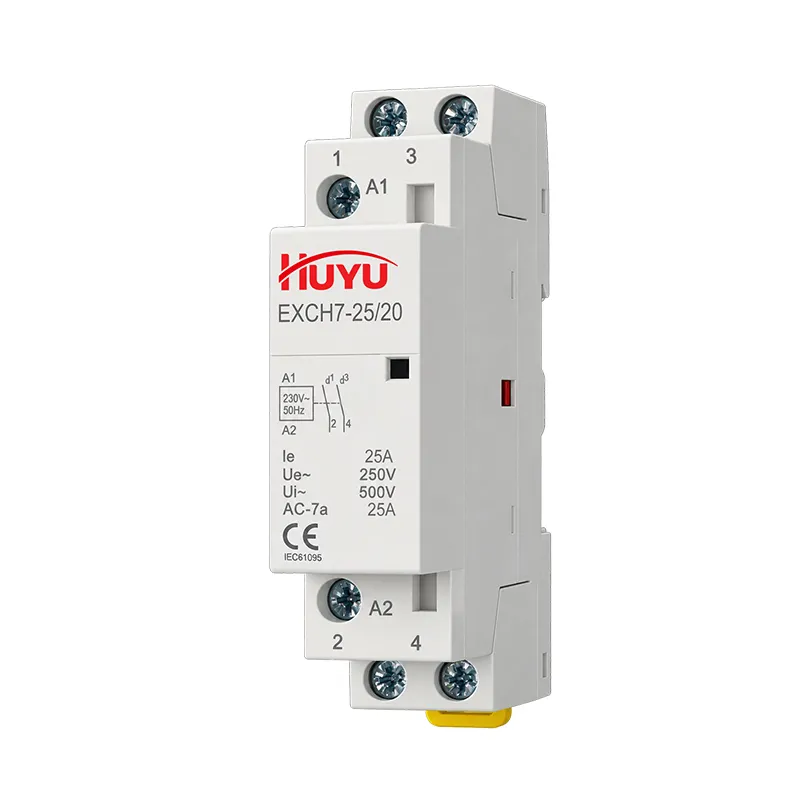
El contactor modular EXCH7 introduce el conmutador operado por bobina en el cuadro de distribución: versiones de 1, 2, 3 y 4 polos de 16A a 63A, con tensión nominal AC230V en monofásico y AC400V en configuraciones trifásicas, con clase de aislamiento 500V y categorías de utilización AC-7a / AC-7b. Montado en riel DIN TH35-7.5, conmuta cargas de iluminación, calefacción, ventilación y electrodomésticos bajo comando de temporizadores, sensores, controladores o sistemas de gestión de edificios.
Modelo
Serie EXCH7 — Contactor modularEXCH7-16 · 20 · 25 · 40 · 63 (1P / 2P / 3P / 4P)
Solicitar Cotización al por Mayor
IEC 61095 · GB/T 17885 · CE / CCC · 16-63A · riel DIN TH35 · IP20
Detalles del Producto
- Contactor modular controlado por bobina en versiones 1P, 2P, 3P y 4P — corriente nominal 16A, 20A, 25A, 40A y 63A.
- Tensión nominal AC 230V para 1P/2P y AC 400V para 3P/4P; tensión nominal de aislamiento AC 500V.
- Categorías de utilización AC-7a y AC-7b: conmutación de potencia de control desde 3,5kW hasta 40kW según modelo.
- Control de bobina AC a 24V, 48V, 110V o 230V (50Hz); otras especificaciones de bobina disponibles bajo pedido.
- Montaje en riel DIN estándar TH35-7.5 con clip rápido — mismo formato de riel que los interruptores automáticos adyacentes.
- Vida mecánica ≥ 1.000.000 operaciones; vida eléctrica ≥ 100.000 operaciones.
- Carcasa IP20 segura contra contacto, grado de contaminación 2, ambiente -5°C a +40°C, altitud de instalación ≤ 2000m.
- Cumple con GB/T 17885 e IEC 61095; marcado CE y certificado CCC.
Información del Producto
Características Clave y Uso Típico
Configuración flexible de polos
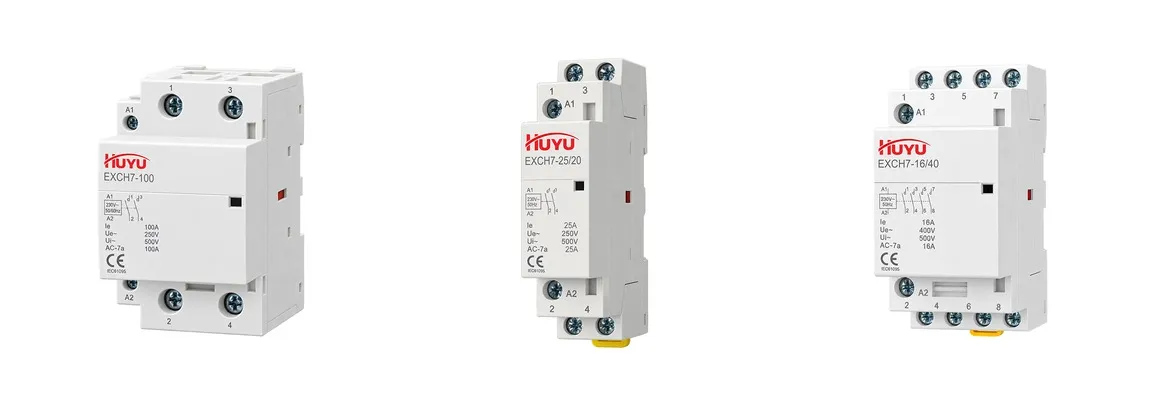
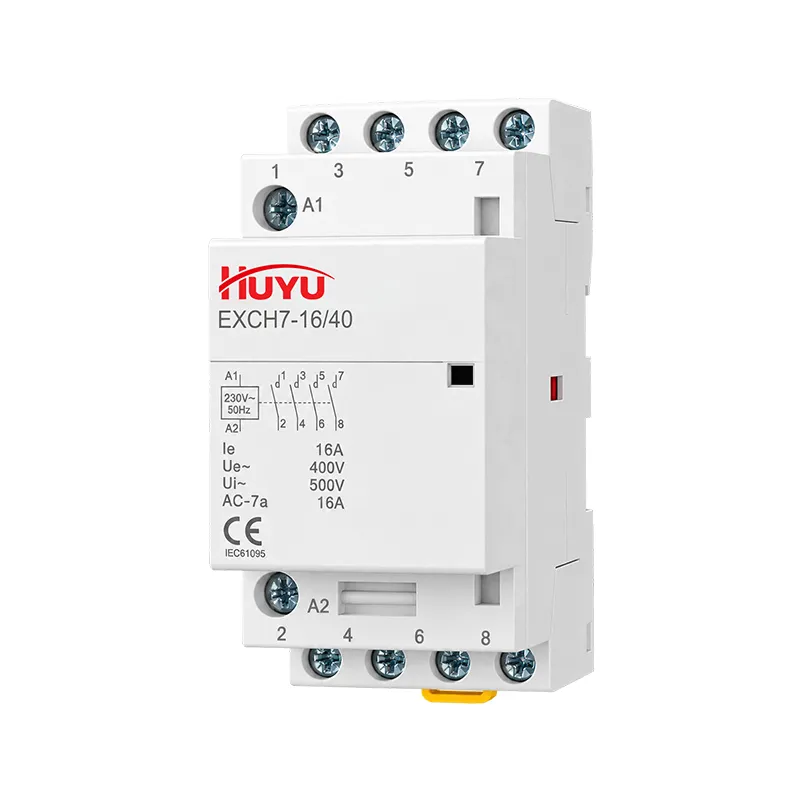
Una familia de productos cubre cuatro tipos de circuitos: 1P y 2P para circuitos monofásicos AC230V, 3P y 4P para circuitos trifásicos AC400V con o sin conmutación de neutro. Debido a que los polos y las corrientes nominales comparten un formato modular común, un panel puede diseñarse una vez y adaptarse a cada circuito sin cambiar la disposición.
Diseño compacto y amigable para paneles
Pequeño y ligero, el contactor ocupa el mismo espacio modular que los dispositivos de protección circundantes — ideal para armarios de control compactos, subcuadros de distribución y trabajos de retrofit donde no hay espacio para un recinto de conmutación separado.
Instalación rápida en riel DIN
El cuerpo con clip rápido se monta en riel DIN estándar TH35-7.5, reduciendo el tiempo de instalación en comparación con equipos de conmutación fijados con tornillos y manteniendo el cableado consistente con el resto del cuadro. Los terminales aceptan cable flexible 2×2,5mm² o rígido 6mm² en marcos 16-25, y cable flexible 2×10mm² o rígido 25mm² en marcos 40-63.
Larga vida útil
Vida mecánica de al menos 1.000.000 de operaciones y vida eléctrica de al menos 100.000 operaciones reducen sustancialmente la frecuencia de mantenimiento y el costo a largo plazo en instalaciones donde el contactor se conmuta por horarios o sensores muchas veces al día.
Especificaciones
| Parámetro | Detalles |
|---|---|
| Serie | Contactor Modular EXCH7 |
| Número de Polos | 1P, 2P, 3P, 4P |
| Corriente Nominal | 1P: 16, 20, 25A · 2P: 16, 20, 25, 40, 63A · 3P/4P: 25, 40, 63A |
| Tensión nominal de funcionamiento | CA 230V (1P, 2P) · CA 400V (3P, 4P) |
| Voltaje de aislamiento nominal Ui | CA 500V |
| Categoría de utilización | AC-7a (cargas ligeramente inductivas) · AC-7b (cargas de motor de electrodomésticos) |
| Potencia de control | 3,5 kW (16A, 1P/2P) hasta 40 kW (63A, 3P/4P) en AC-7a; 1,0 kW a 14 kW en AC-7b |
| Combinaciones de Contactos (NA/NC) | 1P: 10 · 2P: 20, 02, 11 · 3P: 30 · 4P: 40, 04, 22, 31 |
| Método de Control | Control de bobina AC — 24V / 48V / 110V / 230V (50Hz), otros voltajes negociables |
| Características de Operación de la Bobina | Cierra a (85%-110%) Us; apertura no mayor que 75% Us y no menor que 20% Us (2 polos) o 10% Us (4 polos) |
| Vida Mecánica | ≥ 1.000.000 operaciones |
| Vida Eléctrica | ≥ 100.000 operaciones |
| Capacidad de Terminal | Marcos 16-25: 2×2,5mm² flexible / 6mm² rígido · Marcos 40-63: 2×10mm² flexible / 25mm² rígido |
| Montaje | Riel DIN estándar TH35-7.5 |
| Grado de Protección | IP20 |
| Grado de contaminación | 2 |
| Temperatura ambiente | -5°C a +40°C (promedio 24 horas ≤ +35°C) |
| Altitud / Instalación | ≤ 2000m; inclinación de la superficie de montaje ≤ ±5° |
| Normas / Aprobación | GB/T 17885, IEC 61095 · CE / CCC |
EXCH7 — Conmutación Controlada por Bobina para Iluminación, Calefacción y Servicios de Edificios
La automatización llega al cuadro de distribución a través de la bobina. Un temporizador, sensor de luz diurna, termostato, salida PLC o sistema de gestión de edificios proporciona solo una señal de control; algo debe conmutar la carga real, y debe hacerlo dentro del mismo recinto que los dispositivos de protección. El contactor modular EXCH7 está diseñado para esa posición: un interruptor operado por bobina en una carcasa para riel DIN, disponible de 1 a 4 polos y de 16A a 63A, para que grupos de iluminación, circuitos de calefacción, plantas de ventilación y suministros de aparatos puedan controlarse desde el cuadro en lugar de desde un panel separado.
The series is rated AC 230V for single-phase versions and AC 400V for three-phase versions, with a 500V insulation class and utilisation categories AC-7a and AC-7b covering slightly inductive loads and the motor loads of household appliances respectively. Contact combinations range from a single normally open group on 1P models to the 4P combinations 40, 04, 22 and 31 — enough flexibility to match indicator, interlock and changeover schemes without adding auxiliary relays. Coil voltages of 24V, 48V, 110V and 230V cover the usual control supplies, and the coil closes reliably anywhere between 85% and 110% of rated voltage.
HUYU manufactures the EXCH7 modular contactor at our own factory and supplies industrial automation, building facility and appliance-control customers, panel builders, wholesalers and distributors at factory-direct prices, with coil variants, OEM marking and complete IEC 61095 test documentation.
Fabricante OEM / ODM directo de fábrica
Nosotros fabricamos, usted marca
The EXCH7 is produced on our own modular contactor lines: coil winding and impregnation, contact bridge riveting and mechanism assembly are all carried out in-house, and the finished unit is calibrated before the housing is closed. Batch samples are tested for pick-up and drop-out voltage, contact resistance and temperature rise at rated current, and mechanical cycling is checked against the rated life.
For OEM customers we produce coil voltage variants, contact combinations and marking to match an existing control-panel programme, and pack to the customer’s own carton specification.
- Marca OEM — device marking, rating labels and packaging for panel, HVAC and appliance brands.
- Opciones ODM — coil voltages, pole and contact combinations, terminal arrangements to your specification.
- Quality documentation — IEC 61095 and GB/T 17885 test records with each production batch.
- MOQ — flexible wholesale quantities; mixed poles, ratings and coil voltages in one order.
Guía de Compra
Selecting an EXCH7 comes down to four decisions: how many poles the circuit needs, what current it switches, which utilisation category applies, and what control voltage the coil should accept.
- Decide the poles: 1P or 2P for AC230V single-phase circuits, 3P or 4P for AC400V three-phase circuits with or without switched neutral.
- Match the current to the load — 16A, 20A, 25A, 40A or 63A according to the pole configuration chosen.
- Confirm the utilisation category: AC-7a for lighting, heating and similar slightly inductive loads; AC-7b where appliance motor loads are involved, using the corresponding control power rating.
- Select the contact combination (10 / 20 / 02 / 11 / 30 / 40 / 04 / 22 / 31) to suit the control scheme.
- Choose the coil voltage from 24V, 48V, 110V or 230V AC to match the controller, timer or BMS output.
- Provide upstream protection sized for the circuit; the contactor switches the load but does not clear faults.
- Request samples and confirm OEM marking or coil specification before mass production.
Cómo apoyamos su negocio

OEM / ODM
Coil voltages, pole and contact combinations and branding configured on the EXCH7 platform, with IEC 61095 test documentation.
Coil options · Contact combos · Test records

Venta al por mayor
Factory-direct pricing across the 1P-4P, 16-63A range with mixed models in one shipment for distributors and panel builders.
Factory pricing · Mixed range · Global shipping

Soporte para distribuidores
Pole, current and coil selection tables, application notes for lighting and HVAC control, plus priority production for channel partners.
Selection tables · Priority lead times
Ready to Stock the EXCH7 Modular Contactor?
OEM/ODM, wholesale pricing and distributor support — one enquiry gets you a factory-direct quotation for the 1P-4P, 16-63A modular contactor range in the coil voltage and contact combination your control scheme uses.
Preguntas Frecuentes
What is a modular contactor and how does it differ from a circuit breaker?
A modular contactor is a coil-operated switch in the same modular housing format as a miniature circuit breaker, so it clips onto a DIN rail inside a distribution board. The difference is function: a circuit breaker protects the cable and equipment against overload and short circuit, while a contactor switches the load on and off in response to a control signal. In practice they work together — the breaker protects, the contactor controls.
What is the difference between AC-7a and AC-7b utilisation categories?
IEC 61095 defines AC-7a for slightly inductive loads — lighting, resistive heating and similar household and commercial applications — and AC-7b for the motor loads of household appliances. The category determines which control power and current rating apply: for the same 25A pole configuration, for example, AC-7a covers 5kW on 1P/2P while AC-7b covers 1.2kW. Always size the contactor against the category of the actual load.
How do I choose between the 1P, 2P, 3P and 4P versions?
1P switches a single line and suits basic AC230V control; 2P switches line and neutral together for full isolation of single-phase circuits; 3P switches three phases for AC400V loads; and 4P adds the neutral, which is required where three-phase circuits must be isolated completely. Available currents differ by pole count — 1P up to 25A, 2P from 16A to 63A, and 3P/4P from 25A to 63A.
Which coil voltage should I specify?
Match the coil to the control supply you already have: 24V or 48V for control systems and safety extra-low voltage circuits, 110V where an isolating transformer is used, and 230V for direct connection to a phase and neutral control circuit. All four are standard, and other specifications can be produced for OEM orders. The coil will close reliably at any voltage between 85% and 110% of its rated value.
What contact combinations are available?
The factory contact combinations follow the pole configuration: 10 for 1P; 20, 02 and 11 for 2P; 30 for 3P; and 40, 04, 22 or 31 for 4P models. These combinations of normally open and normally closed groups allow indicator circuits, interlocking or multiple load groups to be handled without adding separate auxiliary contactors.
Where is the EXCH7 typically used?
The series is intended for industrial automation, building facilities and home appliance control, where high reliability and flexible configuration matter. Typical duties include switching lighting groups by time clock or sensor, controlling heating and ventilation plant from a BMS, and switching appliance or socket circuits where a low-power control signal has to operate a larger load.
No hay documentos disponibles para descargar en este momento.