
Cuando una pareja de Portland compró un bungalow de los años 40, eran conscientes de la necesidad de nuevos gabinetes en la cocina y un nuevo azulejo en el baño. Sin embargo, no sabían que su proyecto eléctrico resultaría ser el proyecto más importante de la casa. El sistema eléctrico consistía en la caja de fusibles original de 60 amperios, y en lugar de enchufes de tres clavijas, los tomacorrientes del dormitorio tenían enchufes de dos clavijas, sin proporcionar ninguna conexión a tierra. La cocina tenía solo un circuito para el refrigerador, microondas y tostadora. También se descubrió que un propietario anterior había “mejorado” el cableado en el garaje, conectando una serie de extensiones a los montantes de la pared.
El sueño de la pareja de tener una estufa de inducción, un calentador de agua con bomba de calor y un cargador de vehículos eléctricos en el garaje ahora era absolutamente imposible sin una revisión eléctrica completa. No están solos en ver frustrado este sueño: cada propietario, negocio y administrador de instalaciones enfrenta las mismas dificultades al renovar un edificio. El sistema eléctrico es el sistema circulatorio del edificio, y si el sistema está obsoleto y es deficiente, todo lo demás se vuelve precario. Por lo tanto, esta guía presenta un conjunto integral de ideas sobre cómo llevar a cabo una renovación eléctrica, desde actualizaciones de seguridad obligatorias hasta expansiones de capacidad modernas, integraciones de hogares inteligentes y adaptaciones industriales, proporcionando estimaciones de costos necesarias, opciones de productos y recomendaciones prácticas.
Resumen:La renovación eléctrica se refiere a más que un solo proyecto; más bien, es una amplia variedad de posibles mejoras. Algunas de estas mejoras se refieren a modificaciones para la seguridad, como cambiar un par de tomacorrientes que no funcionan o instalar un dispositivo GFCI en el baño, mientras que las renovaciones mayores pueden implicar la actualización completa del servicio eléctrico en un edificio, lo que significa que todo el panel eléctrico, los circuitos derivados y todos los demás dispositivos tendrían que ser reemplazados.
La Renovación con Prioridad en la Seguridad: Protegiendo a las Personas y la Propiedad
Cuando se trata de las ideas de renovación, eléctrica más importantes estas se centran principalmente en. La la seguridad más en las que en la conveniencia o la capacidad. El. principal de desafío la las Asociación Nacional de Protección contra Incendios (NFPA), conveniencia radica en los las peligros que los a representa en a la y capacidad. electricidad que existen en muchas la viviendas o y edificios comerciales. la Según fuera algunos específico electricidad renovación. El peligros renovaciones de seguridad incluyen la remoción de peligrosos electricidad paneles (Federal Pacific Electric Stab–Lok y los paneles Zinsco han sido encontrados de edificios ineficientes y poco fiables, por lo tanto haciendo el reemplazo obligatorio independientemente de la situación los las panel; un reemplazo completo del panel cuesta entre $1,500 – $6,500 dependiendo del amperaje y el alcance los del trabajo), introduciendo protección contra fallas a tierra circuito interruptor (GFCI) en baños, cocinas, garajes, receptáculos exteriores, etc. (un receptáculo GFCI cuesta entre $10 – $25 y puede ser instalado en en aproximadamente 15 minutos) también instalando también protección contra arco fallas a tierra circuito interruptor (AFCI) protección (las AFCI circuito interruptores cuestan $35–$60 cada uno) y teniendo un dispositivo de protección contra sobretensiones que requiere $80–$200 en completa instalación.

The Capacity Renovation: Upgrading for Modern Electrical Loads
Panel upgrades rank among the easiest and most common electrical renovations in residential and light commercial properties. An old or obsolete panel can be replaced with an up-to-date 200-amp or larger service panel. The basic reasons for panel upgrades are not new—they include the use of an electric vehicle (EV) charger that requires its own 50-amp service, an electric heat pump that substitutes a gas furnace, an induction range that replaces a gas stove, several computers in a home office, and a workshop with power tools and a dust collector. For a detailed breakdown of the costs, the components, and the three upgrade scenarios—economical, standard, and future‑ready—our guide on costo de reemplazo de panel eléctrico provides a complete analysis.
Capacity renovations go beyond panel replacement and might also involve installation of new circuits tailored for appliances that are required by the building. For example, a 50 amp circuit for charging electric vehicles, a 30 amp circuit for heat pump water heater, a 20 amp circuit for a home office or a workshop—each dedicated circuit guarantees availability of full capacity without having to share the breaker with any other load. One dedicated circuit costs from $300 to $800 which depends on length of cable left, ease of the walls and ceiling and circuit’s amperage. Therefore, for homeowners planning to buy an electric vehicle or install a heat pump, implementing dedicated circuits becomes cheaper during large scale renovation project than at later stage as a separate task since all conditions are met already.
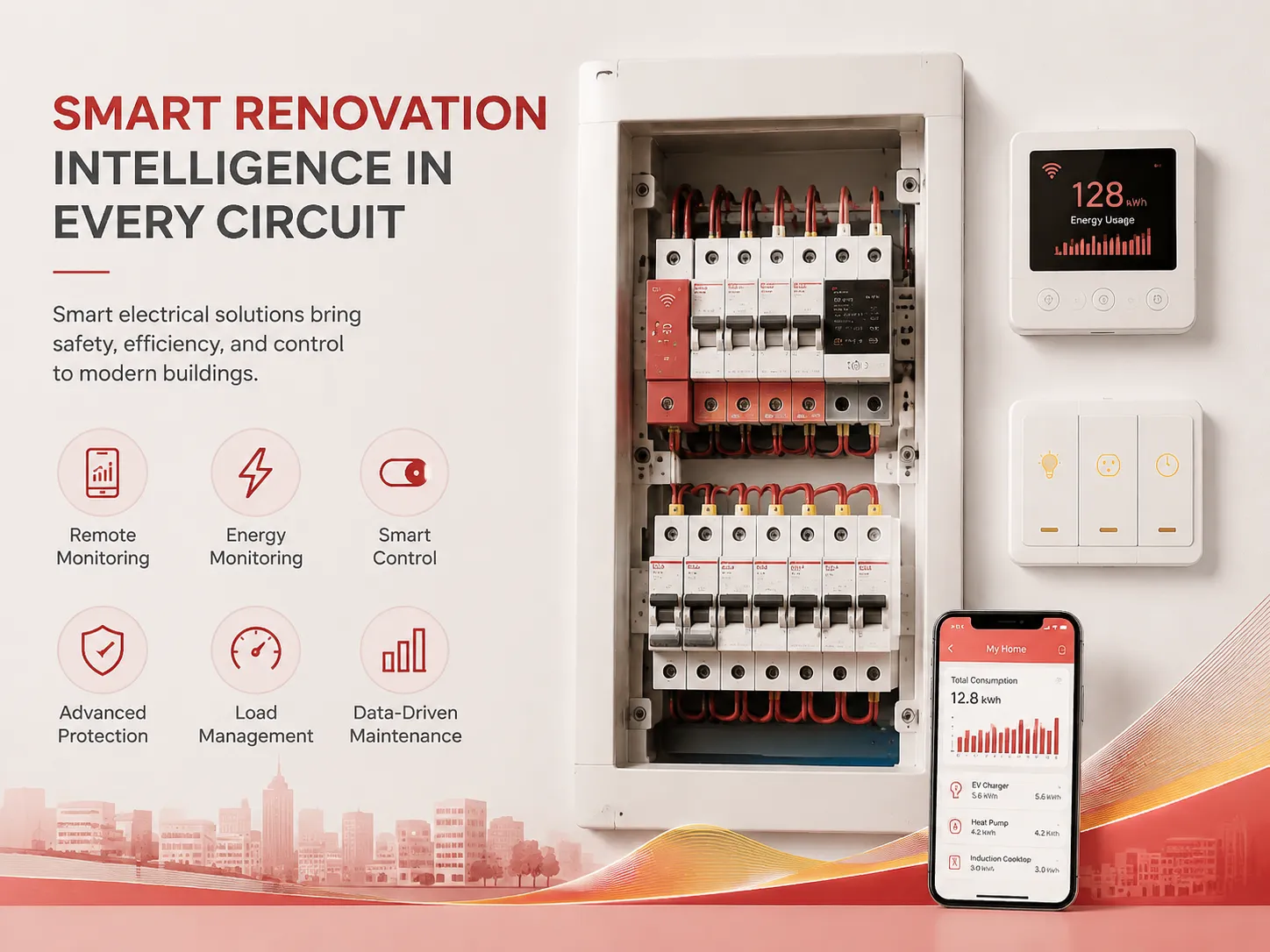
The Smart and Connected Renovation: Intelligence in Every Circuit
Optimal electrical remodeling also introduces a convenient transparency and control functionality which is impossible to achieve with conventional panels. There are several contemporary solutions applied for this task. The most essential ones are smart circuit breakers that enable the remote monitoring and controlling of electrical systems, which allows acquiring real-time info about energy consumption, informing about any modifications in current; energy monitoring systems that connect to the panel and provide a full overview of energy consumption within the building as well as mapping circuits consuming the highest amount of energy; smart switches that allow controlling minimal loads remotely and scheduling the operation of the appliances; and load management systems that make it possible for a 200-amp panel to run an EV charger, heat pump and induction cooktop at the same time without overloading the system. For a deeper look at the smart‑switch ecosystem and how it integrates with Google Home, our article on works with Google Home smart light switches covers the brands, the compatibility requirements, and the installation considerations.
A smart renovation in a commercial or industrial building includes smart safety tools such as automatic circuit breakers and Residual Current Circuit Breakers (RCBOs) that deliver data on electricity quality using a Building management system or SCADA platform. For example, information about electricity consumption allows a building manager to see that a particular motor is consuming more current than is usual, which enables him or her to schedule maintenance before the motor breaks down. Actually, it is the trend of electrical products development nowadays: the smart renovation gives new capabilities to existing distribution boards and the investment in smart devices is an investment in data that modern facility management needs. For a broader look at the trends shaping electrical distribution systems, our article on residential electrical panel upgrade trends covers the technologies that are moving from early adoption to mainstream, and the same trends apply to commercial and industrial facilities at a larger scale.
What an Electrical Renovation Costs—and How to Plan It
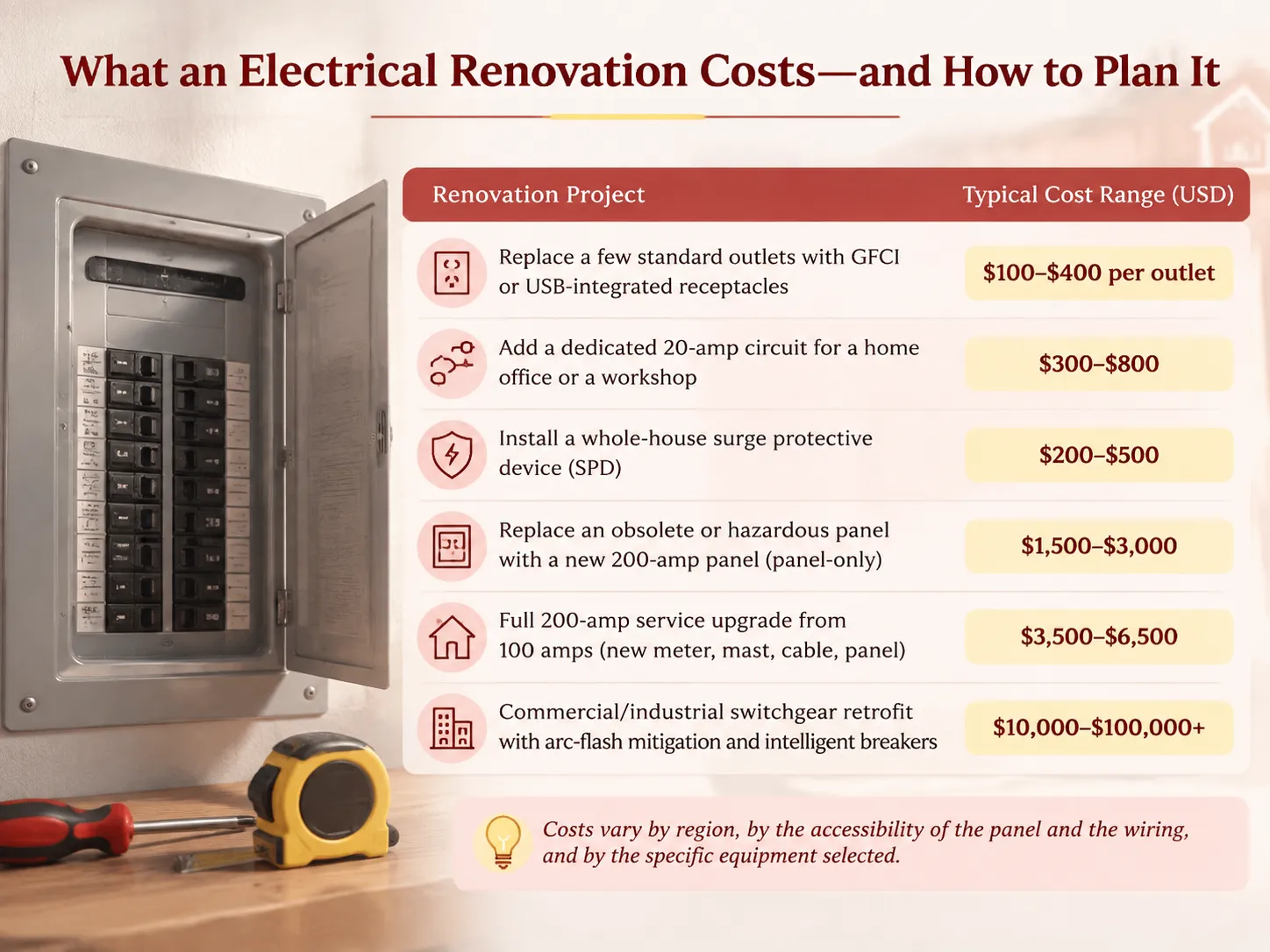
The cost of an electrical renovation spans a wide range, and the table below provides a practical reference for the most common projects, based on mid‑2025 pricing in the United States. The costs include labour, materials, and the permit, and they vary by region, by the accessibility of the panel and the wiring, and by the specific equipment selected.
| Renovation Project | Rango de costo típico (USD) | Lo que incluye |
|---|---|---|
| Replace a few standard outlets with GFCI or USB‑integrated receptacles | $100–$400 per outlet | The device, the labour, and the verification of the existing wiring. A GFCI or a USB outlet costs $10–$50; the labour is typically $80–$150 for the first outlet and less for additional outlets on the same visit. |
| Add a dedicated 20‑amp circuit for a home office or a workshop | $300–$800 | The breaker, the cable, the outlet, the labour to run the cable, and the patch and paint of the drywall. The cost varies with the length of the cable run and the accessibility of the walls. |
| Install a whole‑house surge protective device (SPD) | $200–$500 | The SPD ($80–$200), the labour to install it at the panel, and the verification of the grounding system. An SPD is the most cost‑effective protection for every electronic device in the building. |
| Replace an obsolete or hazardous panel with a new 200‑amp panel (panel‑only, same service) | $1,500–$3,000 | The panel, the main breaker, the branch breakers, the labour, and the permit. The existing service entrance cable and meter socket are reused. |
| Full 200‑amp service upgrade from 100 amps (new meter, mast, cable, panel, grounding) | $3,500–$6,500 | The complete service entrance, the new panel, the new breakers, the grounding electrode system, the labour, the permit, and the utility coordination. This is the standard renovation for a home that is adding major electrical loads. |
| Commercial/industrial switchgear retrofit with arc‑flash mitigation and intelligent breakers | $10,000–$100,000+ | Engineered solution; cost depends on the switchgear size, the arc‑flash study, the breakers and relays, and the integration with the facility’s control and monitoring systems. |
How to Plan and Execute an Electrical Renovation
A successful electrical renovation follows a structured process that begins with a professional assessment and ends with a documented, inspected, and labelled installation. The steps are as follows.
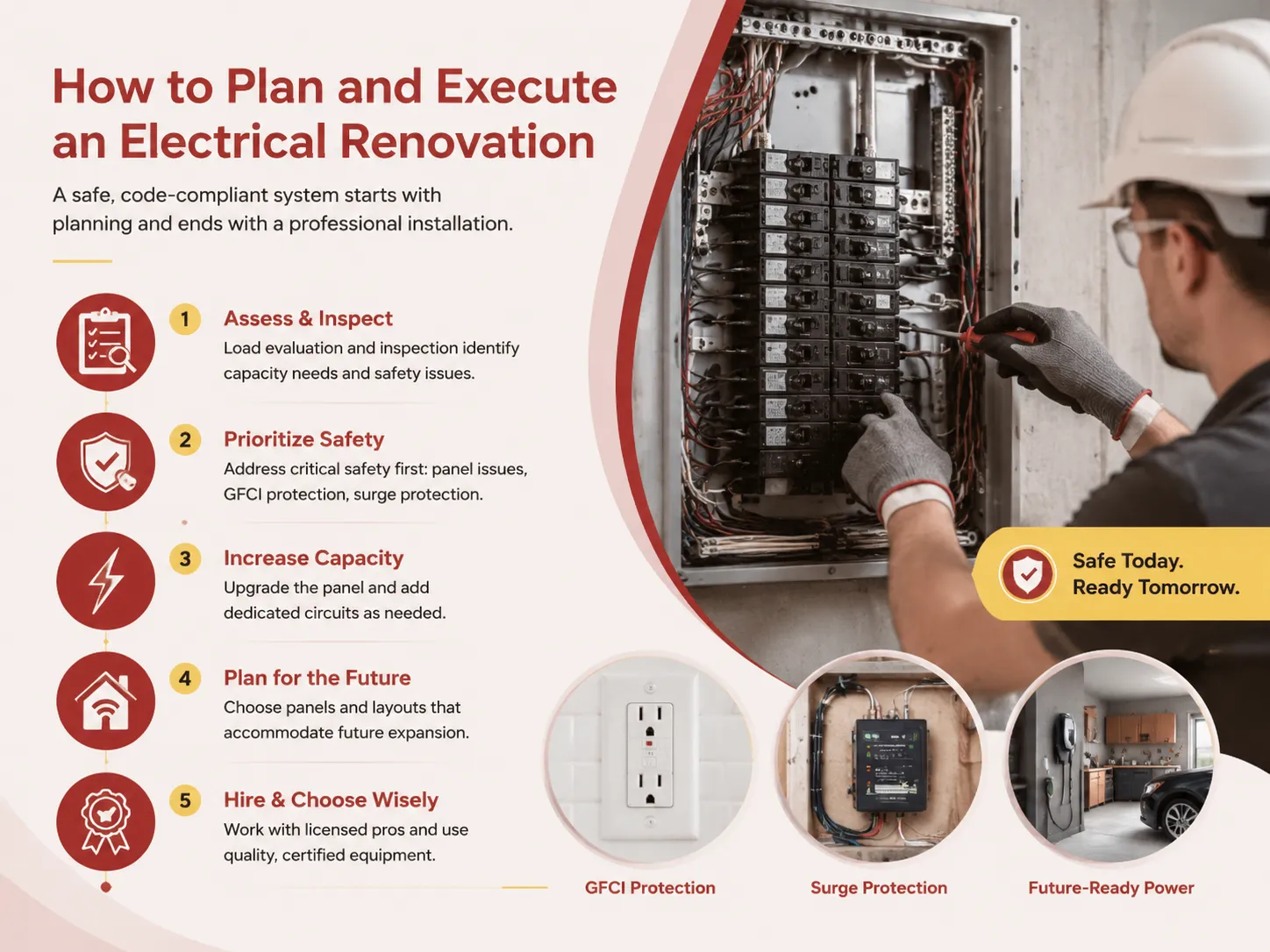
- Begin by obtaining a load evaluation and conducting a professional inspection. A certified electrician will do the load evaluation according to the NEC in order to determine the existing load, the load that could be used with the current systems, and the needed load for the planned expansions. Furthermore, the electrician will also check the present service panel, service disconnect, ground system, and some portions of the branch-circuit wiring for failure or corrosion. The cost of this assessment (between $150 and $400) is just a small portion of the cost of poor renovation decisions that resulted in either excessive structural modifications or insufficient construction.
- When it comes to renovations, your budget must first be allocated for safety concerns and concerns about capacity should be dealt with second. Your first priority when spending on renovations should be the projects that will protect lives and buildings, i.e. replacing the faulty panel, providing GFCI protection, and installing a surge protector. The second stage should involve the work that will improve the capacity needed for the building: an upgrade of the electrical panel and the installation of a dedicated circuit. The third stage, if possible, will involve the work aimed at improvement of comfort and elegance: installation of USB outlets, smart switches, and fancy finishes.
- Look ahead to the future even if you’re not spending money on upgrades right now. When the panel is being upgraded, your electrician can use a 40-space panel instead of the existing 30-space panel, which will allow you to add more circuits later. When installing a dedicated circuit in the garage for your electric vehicle charger, the electrician can add a sub-panel as opposed to just a connection, which will accommodate a workshop in the future. The incremental cost of the upgrades is very low when done at the same time as the current project.
- Before you begin your electrical renovations, choose a qualified and licensed electrical contractor—the first important step in the renovation process. Always check the credentials of the contractor you choose to work with. Your electrical renovation does not qualify as a handyman project. The contractor must be experienced, licensed, and insured to take care of the kind of renovation work needed. The contractor will also be responsible for submitting the permit, disconnecting the utility, and providing the customer with a written warranty. It’s important to verify the references and perform a minimum due diligence on the contractor based on the online license checking and looking at their previous work. Industry platforms such as HomeAdvisor y el Asociación Nacional de Contratistas Eléctricos (NECA) can connect a homeowner or a facility manager with qualified professionals.
- Choose the equipment — the panel, the breakers, and wiring devices — taking into account certification, availability, and long-term support. It is a must for the panel and the breakers to have a proper listing (UL, ETL, or CSA) for the market. The brand should be popular with numerous electrical wholesalers ensuring quick availability of replacement breakers. The wiring devices — plugs, switches, and dimmers — should be made by a manufacturer, who has been producing his products for a long time and keeping the same design providing for matchable equipment in the future. For help identifying the correct breaker type and amperage for each circuit, our guide on qué tamaño de interruptor automático necesita walks through the NEC‑based sizing process. And for a complete understanding of the certification that every breaker in the new panel must carry, our article on qué son los interruptores UL 489 explains the testing and listing framework that ensures a breaker will protect the circuit reliably.
Preguntas Frecuentes
¿Qué es la regla 6 12 en electricidad?
The 6 -12 rule (NEC Article 210 -52) describes how widely apart electrical outlets should be located in homes. Outlets must be located where any wall of 2 feet wide must feature at least one outlet, where no portion of the wall should be located more than 6 feet from an outlet, and where outlets should be placed not more than 12 feet apart. When doing the electrical work, the 6 -12 rule serves as a minimum but in kitchens, home offices, and entertainment spots, it is best to exceed them if possible so as to avoid the mess of extension cords and surge protectors.
How much would it cost to rewire a 2000 square foot house?
The cost of rewiring a 2,000-square-foot residence ranges from $8,000 to $15,000 depending on factors such as how easy the walls are to access (finished walls vs. open studs), the number of circuits being wired, the type of equipment chosen, and the labor rate in the area. The cost is driven primarily by labor needed to push the cable through the current walls of the house, and can be higher if the walls are made of plaster.
What are the latest trends in electrical services?
Presently, the trends observed in electrical services are the use of energy monitoring and smart circuit breakers in the electrical panels, increasing demand for 200 and 400 amp service due to EV chargers and heat pumps along with whole-house surge protection having become a standard feature rather than an optional addition. Apart from that, the applications of DC circuit protection in the area of solar PV and battery storage are growing. These trends are documented in our article on residential electrical panel upgrade trends.
¿Puedo actualizar mi panel eléctrico sin volver a cablear mi casa?
Absolutely. A panel upgrade consists of changing the enclosure, the main breaker, and all the branch breakers, but the original branch circuit wiring in the walls remains undisturbed in most cases and is hooked to the new breakers after the upgrade, as long as it is copper, in good shape, and appropriately sized for the circuit amperage. The service entrance cable is commonly replaced during an amperage upgrade, but the branch circuit wiring is not, unless the wiring is damaged or not large enough.
Referencias
- Asociación Nacional de Protección contra Incendios (NFPA) — Código Eléctrico Nacional (NEC). The foundational standard for electrical installation in the United States, governing every aspect of an electrical renovation from the panel to the receptacle.
- Electrical Safety Foundation International (ESFI) — Home Electrical Renovation Safety. Consumer guidance on the safe planning and execution of electrical renovations, including the identification of legacy hazardous equipment.
- National Electrical Contractors Association (NECA) — Finding a Qualified Electrical Contractor. Industry association providing resources for locating licensed, insured electrical contractors for renovation projects of any scale.
- HomeAdvisor — Electrical Renovation Cost Guides. Aggregated pricing data from electrical contractors across the United States, providing benchmark costs for common renovation projects.
Un electrical renovation is the one renovation that every other renovation depends on. The new kitchen requires the special circuits that are needed for the induction range and the microwave to work. The new electric vehicle charger will not work without the special breaker and power panel that include that device. Similarly, the grounded and surge protected outlets that are required for the computers and the computer monitors to work well should be in the new home office. Thus, the electrical system in any building is the basis for all other systems, and making changes to it is probably the best investment either a contractor or an owner of the building can make. HUYU produces circuit breakers and protective devices that constitute the core of all power panels, switchgears and motor control centers made for modern electrical upgrades.