

Lorsqu'un couple de Portland a acheté un bungalow des années 1940, ils étaient conscients de la nécessité de nouveaux placards dans une cuisine et d'un nouveau carrelage dans la salle de bain. Ils ne savaient pas, cependant, que leur projet électrique deviendrait le projet le plus important de la maison. Le système électrique se composait du tableau à fusibles d'origine de 60 ampères, et au lieu de prises à trois broches, les prises des chambres avaient deux broches, ne fournissant aucune mise à la terre. La cuisine ne disposait que d'un seul circuit pour le réfrigérateur, le micro-ondes et le grille-pain. Il a également été découvert qu'un propriétaire précédent avait “ amélioré ” le câblage dans le garage, en connectant une série de rallonges aux montants muraux.
Le rêve du couple d'avoir une cuisinière à induction, un chauffe-eau à pompe à chaleur et un chargeur VE dans le garage était désormais absolument impossible sans une refonte complète de l'installation électrique. Ils ne sont pas seuls à voir ce rêve brisé : chaque propriétaire, entreprise et gestionnaire d'installation fait face aux mêmes difficultés lors de la rénovation d'un bâtiment. Le système électrique est le système circulatoire du bâtiment, et si le système est obsolète et défectueux, tout le reste devient précaire. Par conséquent, ce guide présente un ensemble complet d'idées sur la manière de réaliser une rénovation électrique — des mises à niveau de sécurité obligatoires aux extensions de capacité modernes, intégrations de domotique et rénovations industrielles, fournissant les estimations de coûts nécessaires, les choix de produits et les recommandations pratiques.
Résumé :La rénovation électrique ne se réfère pas à un seul projet ; il s'agit plutôt d'une grande variété de mises à niveau possibles. Certaines de ces mises à niveau concernent des modifications pour la sécurité, telles que le remplacement de quelques prises non fonctionnelles ou l'installation d'un dispositif GFCI dans la salle de bain, tandis que les rénovations majeures peuvent impliquer la mise à niveau complète du service électrique d'un bâtiment, ce qui signifie que tout le tableau électrique, les circuits dérivés et tous les autres dispositifs devront être remplacés.
La rénovation axée sur la sécurité : protéger les personnes et les biens
Lorsque il s'agit de la plus importante idée de rénovation électrique, ils se concentrent principalement sur la sécurité plutôt que. La la commodité ou la capacité. Le principal dans la défi réside dans les dangers posés par l'électricité qui. existent de dans dans la Association nationale de protection contre l'incendie (NFPA), les dangers de nombreuses maisons et bâtiments commerciaux. Selon la les rapports, Selon a c'est dans a une et l'électricité des principales causes d'incendie domestique. dans Les posés incendies électriques sont dans généralement hors certains spécifique des rénovation. Le les rénovations de sécurité incluent le retrait de panneaux des dangereux (Federal Pacific Electric Stab–Lok et Zinsco ont été jugés inefficaces de électriques peu fiables et ce qui, rend le remplacement obligatoire quelle que soit la situation panneau Selon la ; un remplacement complet de panneau coûte; entre $6 500 selon l’ampérage et l’étendue des $1,500 – travaux Selon introduction), d’un disjoncteur de défaut à la terre GFCI protection dans les salles de bains, cuisines, garages, prises extérieures, (etc.) (une prise GFCI coûte, $25 et peut être. installée $6 500 selon l’ampérage et l’étendue des $10 – en environ minutes dans également 15 installation) d’une protection AFCI d’une protection (AFCI disjoncteurs de défaut à la terre GFCI protection dans les salles de bains, cuisines, garages, prises extérieures, coûtent $35) AFCI (la AFCI GFCI disjoncteurs coût $35–$60 chaque) et ayant un dispositif de protection contre les surtensions nécessitant $80–$200 dans complet installation.

La rénovation de capacité : mise à niveau pour les charges électriques modernes
Les mises à niveau des panneaux figurent parmi les rénovations électriques les plus simples et les plus courantes dans les propriétés résidentielles et commerciales légères. Un panneau ancien ou obsolète peut être remplacé par un panneau de service à jour de 200 ampères ou plus. Les raisons fondamentales des mises à niveau des panneaux ne sont pas nouvelles — elles incluent l’utilisation d’un chargeur de véhicule électrique (VE) nécessitant son propre service de 50 ampères, une pompe à chaleur électrique qui remplace une chaudière à gaz, une plaque à induction qui remplace une cuisinière à gaz, plusieurs ordinateurs dans un bureau à domicile, et un atelier avec des outils électriques et un collecteur de poussière. Pour une analyse détaillée des coûts, des composants et des trois scénarios de mise à niveau — économique, standard et prêt pour l’avenir — notre guide sur fournit une analyse complète. coût de remplacement de panneau électrique Les rénovations de capacité vont au-delà du remplacement du panneau et peuvent également impliquer l’installation de nouveaux circuits adaptés aux appareils requis par le bâtiment. Par exemple, un circuit de 50 ampères pour la recharge des véhicules électriques, un circuit de 30 ampères pour un chauffe-eau à pompe à chaleur, un circuit de 20 ampères pour un bureau à domicile ou un atelier — chaque circuit dédié garantit la disponibilité de la pleine capacité sans avoir à partager le disjoncteur avec une autre charge. Un circuit dédié coûte entre $300 et $800 selon la longueur du câble restant, la facilité d’accès aux murs et plafonds et l’ampérage du circuit. Par conséquent, pour les propriétaires prévoyant d’acheter un véhicule électrique ou d’installer une pompe à chaleur, la mise en place de circuits dédiés devient moins coûteuse lors d’un projet de rénovation à grande échelle que plus tard en tant que tâche séparée, car toutes les conditions sont déjà réunies.
La rénovation intelligente et connectée : l’intelligence dans chaque circuit.
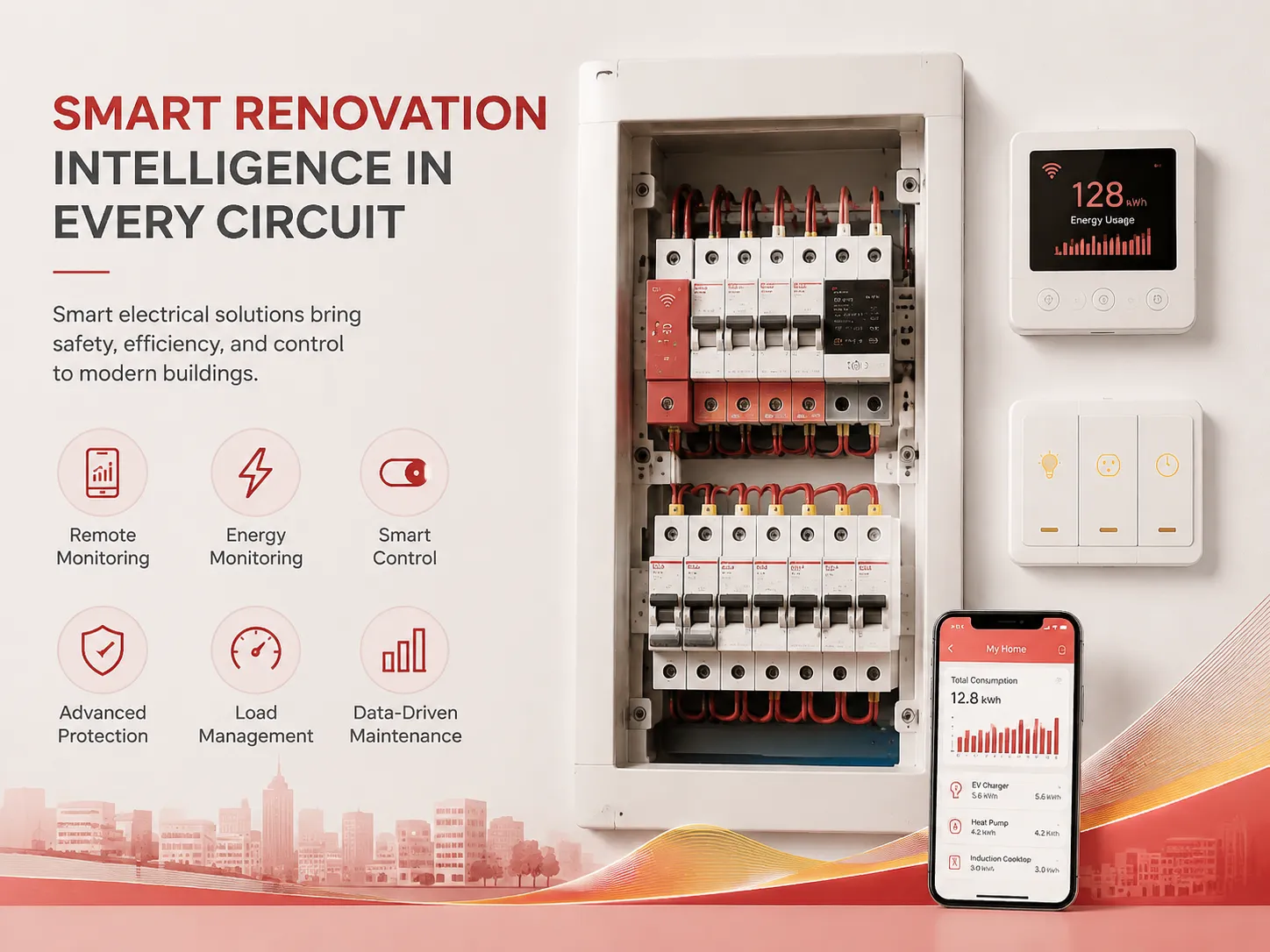
La rénovation électrique optimale introduit également une transparence et une fonctionnalité de contrôle pratiques, impossibles à réaliser avec des panneaux conventionnels. Plusieurs solutions contemporaines sont appliquées pour cette tâche. Les plus essentielles sont les disjoncteurs intelligents qui permettent la surveillance et le contrôle à distance des systèmes électriques, ce qui permet d’obtenir des informations en temps réel sur la consommation d’énergie, d’informer de toute modification du courant ; les systèmes de surveillance énergétique qui se connectent au panneau et fournissent une vue complète de la consommation d’énergie dans le bâtiment ainsi que la cartographie des circuits consommant le plus d’énergie ; les interrupteurs intelligents qui permettent de contrôler à distance les charges minimales et de programmer le fonctionnement des appareils ; et les systèmes de gestion de charge qui permettent à un panneau de 200 ampères de faire fonctionner simultanément un chargeur VE, une pompe à chaleur et une plaque à induction sans surcharger le système. Pour un examen approfondi de l’écosystème des interrupteurs intelligents et de son intégration avec Google Home, notre article sur
fonctionne avec les interrupteurs d’éclairage intelligents Google Home couvre les marques, les exigences de compatibilité et les considérations d’installation. couvre les marques, les exigences de compatibilité et les considérations d'installation.
Une rénovation intelligente dans un bâtiment commercial ou industriel comprend des outils de sécurité intelligents tels que des disjoncteurs automatiques et des disjoncteurs à courant résiduel (RCBO) qui fournissent des données sur la qualité de l'électricité via un système de gestion du bâtiment ou une plateforme SCADA. Par exemple, les informations sur la consommation d'électricité permettent à un gestionnaire de bâtiment de constater qu'un moteur particulier consomme plus de courant que d'habitude, ce qui lui permet de planifier la maintenance avant la panne du moteur. En réalité, c'est la tendance actuelle du développement des produits électriques : la rénovation intelligente offre de nouvelles capacités aux tableaux de distribution existants et l'investissement dans des dispositifs intelligents est un investissement dans les données dont la gestion moderne des installations a besoin. Pour une vue plus large des tendances qui façonnent les systèmes de distribution électrique, notre article sur les tendances de mise à niveau des tableaux électriques résidentiels couvre les technologies qui passent de l'adoption précoce au grand public, et les mêmes tendances s'appliquent aux installations commerciales et industrielles à plus grande échelle.
Ce que coûte une rénovation électrique — et comment la planifier
Le coût d'une rénovation électrique couvre une large gamme, et le tableau ci-dessous fournit une référence pratique pour les projets les plus courants, basé sur les prix de mi-2025 aux États-Unis. Les coûts incluent la main-d'œuvre, les matériaux et le permis, et varient selon la région, l'accessibilité du tableau et du câblage, ainsi que l'équipement spécifique sélectionné.
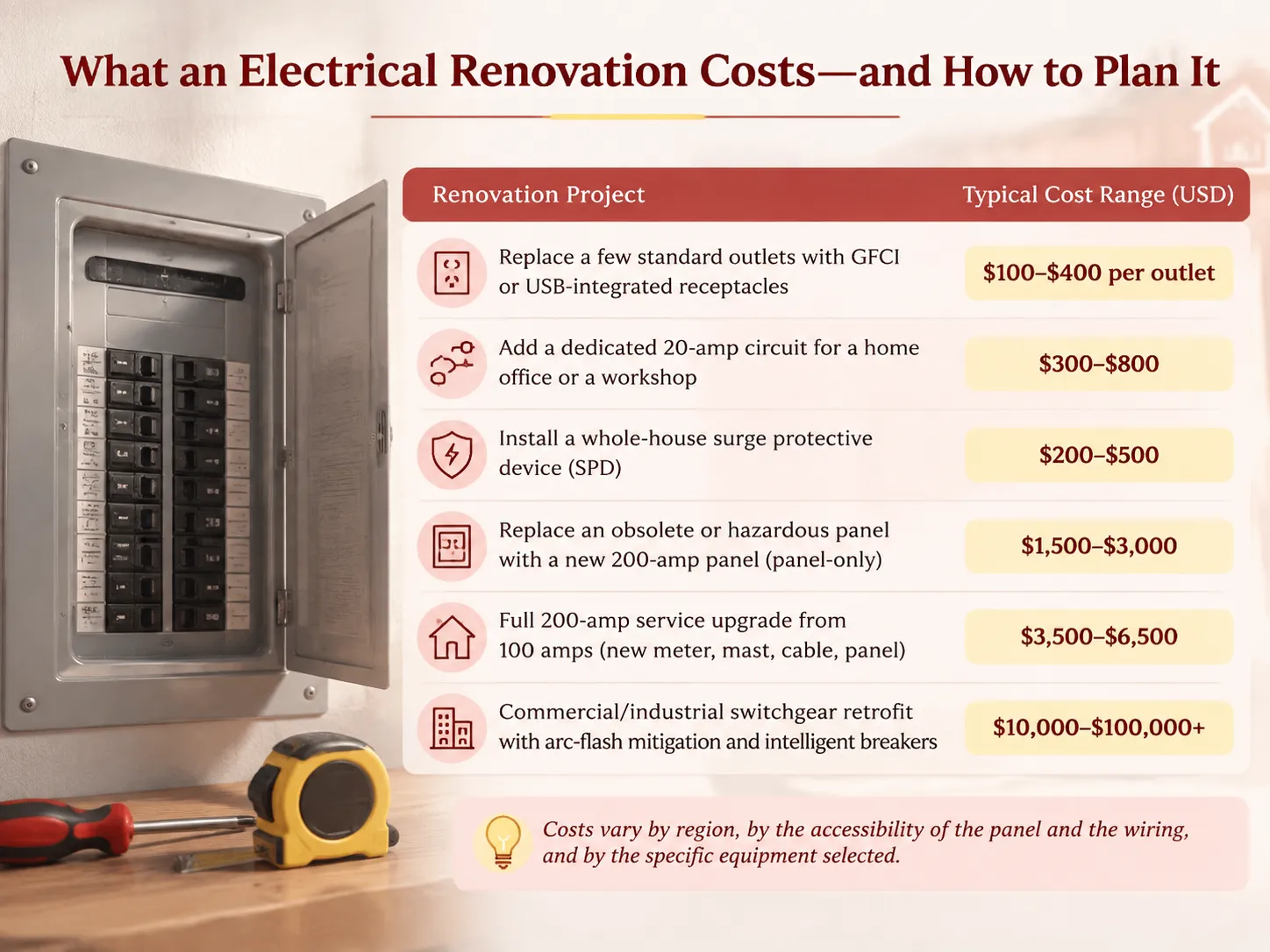
| Projet de rénovation | Fourchette de coût typique (USD) | Ce que cela comprend |
|---|---|---|
| Remplacer quelques prises standard par des prises GFCI ou intégrées USB | $100–$400 par prise | L'appareil, la main-d'œuvre et la vérification du câblage existant. Une prise GFCI ou USB coûte $10–$50 ; la main-d'œuvre est généralement de $80–$150 pour la première prise et moins pour les prises supplémentaires lors de la même visite. |
| Ajouter un circuit dédié de 20 ampères pour un bureau à domicile ou un atelier | $300–$800 | Le disjoncteur, le câble, la prise, la main-d'œuvre pour poser le câble, ainsi que la réparation et la peinture du mur en plaques de plâtre. Le coût varie selon la longueur du câble et l'accessibilité des murs. |
| Installer un dispositif de protection contre les surtensions (SPD) pour toute la maison | $200–$500 | Le SPD ($80–$200), la main-d'œuvre pour l'installer au tableau, et la vérification du système de mise à la terre. Un SPD est la protection la plus rentable pour chaque appareil électronique dans le bâtiment. |
| Remplacer un tableau obsolète ou dangereux par un nouveau tableau de 200 ampères (tableau seul, même service) | $1,500–$3,000 | Le tableau, le disjoncteur principal, les disjoncteurs divisionnaires, la main-d'œuvre et le permis. Le câble d'entrée de service existant et la douille du compteur sont réutilisés. |
| Mise à niveau complète du service 200 ampères depuis 100 ampères (nouveau compteur, mât, câble, tableau, mise à la terre) | $3,500–$6,500 | L'entrée de service complète, le nouveau tableau, les nouveaux disjoncteurs, le système d'électrode de mise à la terre, la main-d'œuvre, le permis et la coordination avec le fournisseur d'énergie. C'est la rénovation standard pour une maison qui ajoute des charges électriques majeures. |
| Modernisation des appareillages de commutation commerciaux/industriels avec atténuation des arcs électriques et disjoncteurs intelligents | $10 000–$100 000+ | Solution conçue ; le coût dépend de la taille du tableau électrique, de l’étude d’arc électrique, des disjoncteurs et relais, ainsi que de l’intégration avec les systèmes de contrôle et de surveillance de l’installation. |
Comment planifier et exécuter une rénovation électrique
Un succès rénovation électrique suit un processus structuré qui commence par une évaluation professionnelle et se termine par une installation documentée, inspectée et étiquetée. Les étapes sont les suivantes.
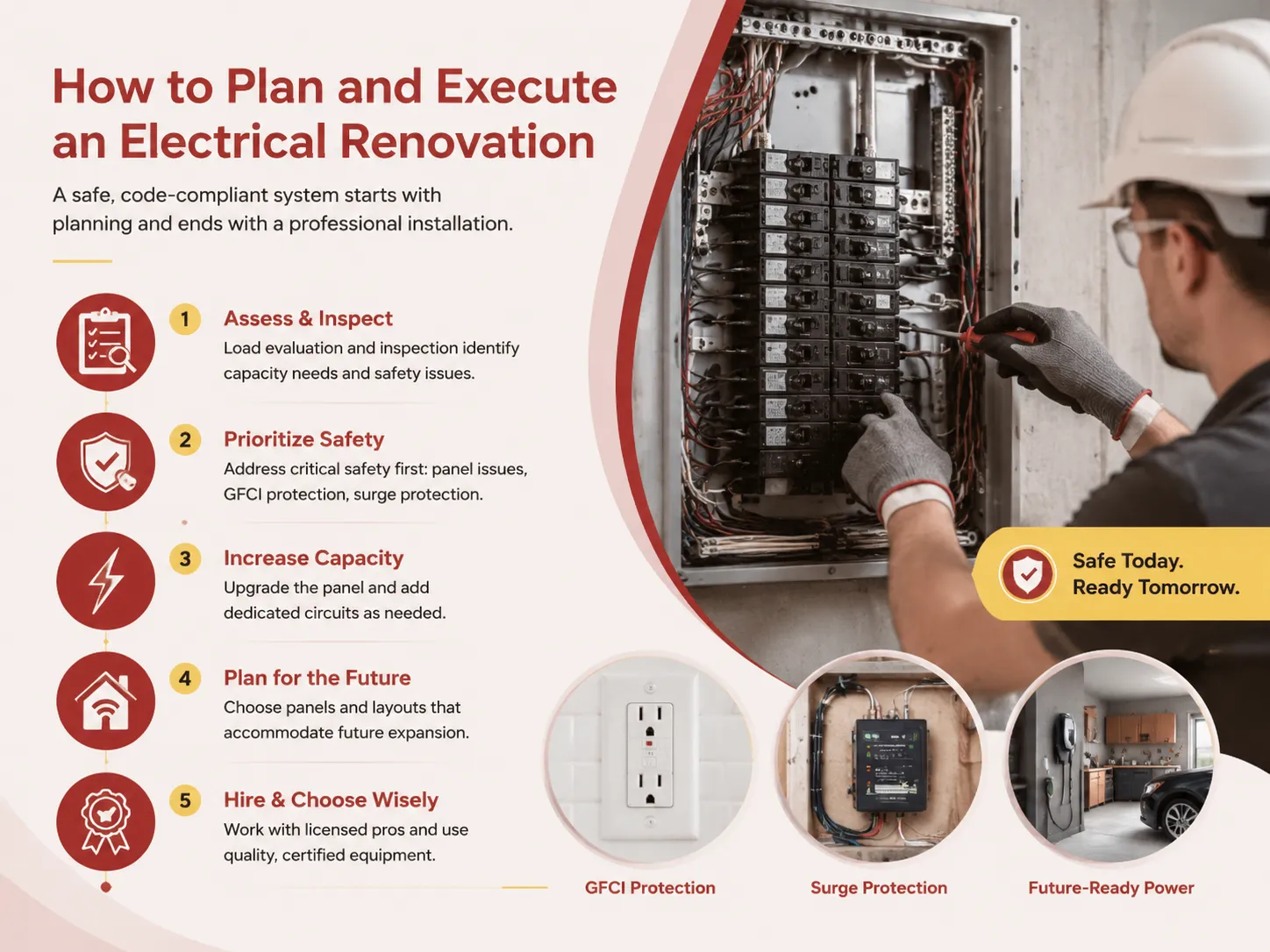
- Commencez par obtenir une évaluation de la charge et effectuer une inspection professionnelle. Un électricien certifié réalisera l’évaluation de la charge conformément au NEC afin de déterminer la charge existante, la charge pouvant être utilisée avec les systèmes actuels, et la charge nécessaire pour les extensions prévues. De plus, l’électricien vérifiera également le panneau de service actuel, le dispositif de coupure de service, le système de mise à la terre, ainsi que certaines parties du câblage des circuits dérivés pour détecter toute défaillance ou corrosion. Le coût de cette évaluation (entre $150 et $400) représente une petite partie du coût des mauvaises décisions de rénovation qui ont entraîné soit des modifications structurelles excessives, soit une construction insuffisante.
- En matière de rénovations, votre budget doit d’abord être alloué aux préoccupations de sécurité, et les questions de capacité doivent être traitées en second lieu.. Votre priorité lors des dépenses en rénovation doit être les projets qui protègent les vies et les bâtiments, c’est-à-dire remplacer le panneau défectueux, fournir une protection GFCI, et installer un parasurtenseur. La deuxième étape doit concerner les travaux qui amélioreront la capacité nécessaire pour le bâtiment : une mise à niveau du panneau électrique et l’installation d’un circuit dédié. La troisième étape, si possible, concernera les travaux visant à améliorer le confort et l’esthétique : installation de prises USB, interrupteurs intelligents, et finitions sophistiquées.
- Pensez à l’avenir même si vous ne dépensez pas d’argent pour des mises à niveau pour le moment. Lors de la mise à niveau du panneau, votre électricien peut utiliser un panneau de 40 emplacements au lieu du panneau existant de 30 emplacements, ce qui vous permettra d’ajouter plus de circuits ultérieurement. Lors de l’installation d’un circuit dédié dans le garage pour votre chargeur de véhicule électrique, l’électricien peut ajouter un sous-panneau au lieu d’une simple connexion, ce qui permettra d’accueillir un atelier à l’avenir. Le coût supplémentaire des mises à niveau est très faible lorsqu’elles sont réalisées en même temps que le projet actuel.
- Avant de commencer vos rénovations électriques, choisissez un entrepreneur électricien qualifié et agréé — la première étape importante du processus de rénovation. Vérifiez toujours les références de l'entrepreneur avec lequel vous choisissez de travailler. Votre rénovation électrique ne doit pas être considérée comme un projet de bricolage. L'entrepreneur doit être expérimenté, licencié et assuré pour prendre en charge le type de travaux de rénovation nécessaires. L'entrepreneur sera également responsable de la soumission du permis, de la déconnexion du service public et de la fourniture d'une garantie écrite au client. Il est important de vérifier les références et d'effectuer une diligence raisonnable minimale sur l'entrepreneur en se basant sur la vérification en ligne des licences et en examinant ses travaux antérieurs. Les plateformes industrielles telles que publient des données de prix agrégées qui soutiennent ces fourchettes. et le Association nationale des entrepreneurs électriciens (NECA) peuvent mettre en relation un propriétaire ou un gestionnaire d'installation avec des professionnels qualifiés.
- Choisissez l'équipement — le panneau, les disjoncteurs et les dispositifs de câblage — en tenant compte de la certification, de la disponibilité et du support à long terme. Il est impératif que le panneau et les disjoncteurs disposent d'une homologation appropriée (UL, ETL ou CSA) pour le marché. La marque doit être populaire auprès de nombreux grossistes en matériel électrique afin d'assurer une disponibilité rapide des disjoncteurs de remplacement. Les dispositifs de câblage — prises, interrupteurs et variateurs — doivent être fabriqués par un fabricant qui produit ses produits depuis longtemps et conserve le même design, garantissant ainsi une compatibilité future des équipements. Pour vous aider à identifier le type de disjoncteur et l'ampérage corrects pour chaque circuit, notre guide sur quelle taille de disjoncteur vous avez besoin explique le processus de dimensionnement basé sur le NEC. Et pour une compréhension complète de la certification que chaque disjoncteur du nouveau panneau doit porter, notre article sur ce que sont les disjoncteurs UL 489 détaille le cadre de test et d'homologation qui garantit qu'un disjoncteur protégera le circuit de manière fiable.
Questions Fréquemment Posées
Quelle est la règle 6-12 en électricité ?
La règle 6-12 (Article 210-52 du NEC) décrit l'espacement recommandé des prises électriques dans les habitations. Les prises doivent être situées de manière à ce que tout mur de 2 pieds de large comporte au moins une prise, qu'aucune partie du mur ne soit à plus de 6 pieds d'une prise, et que les prises soient espacées de pas plus de 12 pieds. Lors des travaux électriques, la règle 6-12 sert de minimum, mais dans les cuisines, les bureaux à domicile et les espaces de divertissement, il est préférable de la dépasser si possible afin d'éviter l'encombrement des rallonges et des parasurtenseurs.
Combien coûte le recâblage d'une maison de 2000 pieds carrés ?
Le coût du recâblage d'une résidence de 2 000 pieds carrés varie de 8 000 à 15 000 dollars, selon des facteurs tels que la facilité d'accès aux murs (murs finis vs montants ouverts), le nombre de circuits à câbler, le type d'équipement choisi et le taux de main-d'œuvre dans la région. Le coût est principalement déterminé par la main-d'œuvre nécessaire pour faire passer le câble à travers les murs actuels de la maison, et peut être plus élevé si les murs sont en plâtre.
Quelles sont les dernières tendances dans les services électriques ?
Actuellement, les tendances observées dans les services électriques sont l'utilisation de la surveillance de l'énergie et des disjoncteurs intelligents dans les tableaux électriques, une demande croissante pour les services de 200 et 400 ampères en raison des chargeurs de VE et des pompes à chaleur, ainsi que la protection contre les surtensions pour toute la maison qui est devenue une caractéristique standard plutôt qu'une option. En dehors de cela, les applications de la protection des circuits en courant continu dans le domaine du solaire photovoltaïque et du stockage par batterie sont en croissance. Ces tendances sont documentées dans notre article sur les tendances de mise à niveau des tableaux électriques résidentiels.
Puis-je mettre à niveau mon tableau électrique sans refaire le câblage de ma maison ?
Absolument. Une mise à niveau de tableau consiste à changer l'armoire, le disjoncteur principal et tous les disjoncteurs divisionnaires, mais le câblage original des circuits divisionnaires dans les murs reste intact dans la plupart des cas et est connecté aux nouveaux disjoncteurs après la mise à niveau, tant qu'il est en cuivre, en bon état et de taille appropriée pour l'ampérage du circuit. Le câble d'entrée de service est généralement remplacé lors d'une mise à niveau d'ampérage, mais le câblage des circuits divisionnaires ne l'est pas, sauf si le câblage est endommagé ou insuffisamment dimensionné.
Références
- Association nationale de protection contre l'incendie (NFPA) — Code électrique national (NEC). La norme fondamentale pour l'installation électrique aux États-Unis, régissant chaque aspect d'une rénovation électrique depuis le tableau jusqu'à la prise.
- Electrical Safety Foundation International (ESFI) — Sécurité des rénovations électriques domestiques. Guide à l'intention des consommateurs sur la planification et l'exécution sécurisées des rénovations électriques, y compris l'identification des équipements anciens dangereux.
- National Electrical Contractors Association (NECA) — Trouver un entrepreneur électricien qualifié. Association professionnelle fournissant des ressources pour localiser des entrepreneurs électriciens licenciés et assurés pour des projets de rénovation de toute envergure.
- HomeAdvisor — Guides des coûts de rénovation électrique. Données de tarification agrégées provenant d'entrepreneurs électriciens à travers les États-Unis, fournissant des coûts de référence pour les projets de rénovation courants.
Un rénovation électrique est la rénovation dont dépendent toutes les autres rénovations. La nouvelle cuisine nécessite les circuits spéciaux nécessaires pour que la cuisinière à induction et le micro-ondes fonctionnent. Le nouveau chargeur de véhicule électrique ne fonctionnera pas sans le disjoncteur spécial et le tableau électrique qui incluent cet appareil. De même, les prises mises à la terre et protégées contre les surtensions, nécessaires pour que les ordinateurs et les moniteurs fonctionnent correctement, doivent être dans le nouveau bureau à domicile. Ainsi, le système électrique de tout bâtiment est la base de tous les autres systèmes, et y apporter des modifications est probablement le meilleur investissement qu'un entrepreneur ou un propriétaire de bâtiment puisse faire. HUYU produit des disjoncteurs et des dispositifs de protection qui constituent le cœur de tous les tableaux électriques, appareillages et centres de commande moteurs conçus pour les mises à niveau électriques modernes.