

Dans presque chaque maison, entreprise ou usine se trouve un élément critique de sécurité que la plupart des gens tiennent pour acquis ; le panneau électrique contient nos émotions (à la fois les bonnes et les mauvaises) ainsi que quelques interrupteurs qui n'ont probablement jamais été utilisés jusqu'à ce qu'il se produise un événement comme une surtension ou que quelqu'un trébuche sur son aspirateur. C'est également l'endroit où un appareil peut “sauter” et entraîner la coupure de courant dans toute la pièce, y compris tous les équipements électriques — cet interrupteur est connu sous le nom de disjoncteurs. En fait, même s'ils ne sont pas souvent sollicités au quotidien, les disjoncteurs sont l'équipement le plus important de votre système électrique.
En conclusion, les disjoncteurs empêchent la circulation d'une quantité excessive d'électricité en coupant l'alimentation électrique en cas de surintensité due à une charge excessive ou si un utilisateur a créé une situation où un circuit électrique est défectueux. Les mécanismes utilisés dans les disjoncteurs permettent aux utilisateurs de couper l'énergie excessive sans avoir à acheter de nouveaux fusibles ; cependant, une fois qu'un disjoncteur a été déclenché, il doit être réarmé avant d'être réutilisé. Les types de caractéristiques des disjoncteurs sont : la quantité de courant que le disjoncteur peut supporter, les tensions nominales, la capacité de coupure, le nombre de pôles nominal dans un disjoncteur et les caractéristiques de déclenchement.

Qu'est-ce qu'un disjoncteur exactement ?
Le disjoncteur est un composant électrique qui se connecte à la fois au système de distribution électrique (alimentation) ainsi qu'à la distribution de l'électricité via le câblage électrique vers les dispositifs électriques dans tout le bâtiment (éclairages, prises). Les fonctions principales du disjoncteur incluent la surveillance du système électrique et la déconnexion de l'alimentation électrique de ce circuit électrique lorsqu'il détecte une quantité de courant dangereuse. Le disjoncteur protège également le câble environnant contre la surchauffe, protège les dispositifs électriques connectés au circuit contre les dommages, et enfin protège les personnes qui pourraient entrer en contact avec le circuit contre les chocs électriques ou les brûlures.
Une façon de visualiser le disjoncteur est de penser à la manière dont un agent de sécurité opérerait devant une boîte de nuit. Lors d'une nuit normale, l'agent de sécurité “laisserait” passer les invités normaux, quotidiens, sans aucun problème. Cependant, s'il y avait une foule inattendue qui se précipitait vers la porte (une surtension de courant non désirée), ou si quelqu'un tentait de forcer son entrée dans la boîte de nuit (dans le cas d'un court-circuit), l'agent de sécurité fermerait immédiatement la porte. L'agent reste disponible pour remplir sa fonction de protéger les invités (le but principal d'utiliser un disjoncteur plutôt qu'un fusible). Une fois la situation stabilisée, l'agent peut laisser un autre invité entrer dans le club, tout comme le disjoncteur peut être réarmé pour permettre à l'alimentation électrique de circuler à nouveau.
Le disjoncteur existe depuis très longtemps. Thomas Edison a breveté son premier système automatique d'interruption de circuit en 1879 pour l'utiliser dans les systèmes d'éclairage qu'il a développés. Les premiers types à lame de couteau et à cartouche ont commencé à apparaître vers 1900. En 1924, Hugo Stotz a conçu et construit le premier disjoncteur miniature thermo-magnétique véritable combinant les deux mécanismes de déclenchement en un seul petit appareil. Le design de 1924 est toujours utilisé aujourd'hui et les disjoncteurs miniatures disponibles à l'achat utilisent exactement les mêmes deux fonctions que les disjoncteurs originaux.
Comment fonctionne un disjoncteur ?
Les deux capteurs détectent respectivement les surintensités et les courts-circuits instantanés. Le capteur thermique détecte un courant excessif via des dispositifs sensibles à la température (thermistances) qui deviennent inutilisables lorsqu'ils dépassent leur température nominale admissible. Le capteur magnétique détecte la présence d'un courant important (comme celui trouvé dans les courts-circuits). En plus de détecter les conditions de surintensité, le capteur thermique protège contre les dommages aux équipements causés par une surchauffe excessive due à des situations de surcharge prolongée, tandis que le capteur magnétique protège contre les dommages aux équipements dus à une montée rapide du courant dans les conditions de court-circuit.
Le design thermo-magnétique est le plus largement utilisé. Le mécanisme de déclenchement de nombreux interrupteurs électriques fonctionne selon le même principe que ce design de disjoncteur ; lorsque le courant dépasse un certain niveau, il déclenche un circuit électronique qui ouvre l'interrupteur. Certains mécanismes de déclenchement électroniques permettent à l'utilisateur d'ouvrir ou de fermer manuellement le circuit à l'aide d'un interrupteur à bascule. En revanche, la plupart des disjoncteurs électriques utilisent des mécanismes de déclenchement mécaniques qui ouvrent et ferment automatiquement le circuit.
| Type de défaut | Ce qui se passe | Élément de détection | Temps de réponse |
|---|---|---|---|
| Surcharge (par exemple, trop d'appareils sur un même circuit) | Le courant dépasse modestement la valeur nominale ; la chaleur s'accumule sur plusieurs secondes ou minutes | Bande bimétallique qui se plie lorsqu'elle chauffe, libérant le verrou | De quelques secondes à quelques minutes — lent et dépendant de la chaleur, ce qui est intentionnel |
| Court-circuit (le fil phase touche le neutre ou la terre) | Le courant monte instantanément à des centaines ou milliers d'ampères | Solénoïde électromagnétique qui tire sur le verrou pour l'ouvrir | Une demi-période ou moins (environ 8-16 millisecondes) |
Le délai dans la caractéristique thermique d'un disjoncteur est une caractéristique souhaitable, pas un défaut. Lorsqu'un moteur démarre, il tire momentanément un courant plusieurs fois supérieur à son courant de fonctionnement normal ; par conséquent, la bande bimétallique doit avoir été soumise à des périodes prolongées de chaleur avant de déclencher (ouvrir les contacts) afin que le courant de démarrage ne provoque pas de déclenchements intempestifs. Cependant, la force électromagnétique générée par un court-circuit franc est si forte qu'elle provoque le déclenchement du disjoncteur en moins d'un cycle AC avant que le câblage ne puisse surchauffer et/ou provoquer un incendie.
Ouvrir les contacts d’un disjoncteur n’est qu’une partie de l’arrêt du flux de courant important. Lorsqu’un disjoncteur interrompt un flux de courant important, le processus d’arc électrique ionise l’air entre les contacts lorsqu’ils s’ouvrent et crée un arc électrique qui continuera à conduire à moins d’être interrompu. C’est la raison pour laquelle les disjoncteurs sont conçus avec un contrôle d’arc afin de pouvoir étirer, refroidir et séparer les arcs électriques des points d’interruption. Les disjoncteurs sont classés avec un pouvoir de coupure (mesuré en kA) qui aide à déterminer le courant de défaut maximal pouvant être interrompu en toute sécurité par le disjoncteur. Un disjoncteur résidentiel a généralement un pouvoir de coupure de 5-10 kA tandis qu’un disjoncteur industriel à boîtier moulé aura une classification de 25-100 kA. Choisir un disjoncteur avec un pouvoir de coupure inférieur au courant de défaut disponible constitue une violation grave des règles de sécurité et ne permettra pas de couper les défauts, mais pourrait au contraire provoquer une explosion.

Courbes de déclenchement : ce que signifient les lettres B, C et D
Les disjoncteurs miniatures (MCB) ont une lettre devant la valeur nominale du courant (B16, B32, etc.) pour indiquer la courbe de déclenchement. La courbe de déclenchement détermine la surcharge (déclenchement instantané) que le déclencheur magnétique (déclenchement instantané) tolérera avant d’ouvrir le contact. Utiliser la bonne courbe de déclenchement est important lors du choix du MCB adapté à la charge car :
| Courbe | Seuil de déclenchement instantané | Charges typiques | Remarques |
|---|---|---|---|
| Type B | 3-5 × courant nominal | Charges résistives : éclairage, chauffages, prises dans les environnements résidentiels | Le plus sensible ; pas pour moteurs ou transformateurs |
| Type C | 5-10 × courant nominal | Petits moteurs, pilotes fluorescents et LED, charges commerciales générales | Le choix général le plus courant |
| Type D | 10-20 × courant nominal | Transformateurs, gros moteurs, équipements de soudage, machines à fort courant d’appel | Tolère les fortes pointes de démarrage sans déclenchements intempestifs |
| Type K / Z | Spécialisé | Protection des semi-conducteurs (Z), protection des moteurs (K) | Applications industrielles de niche |
Utiliser la bonne courbe de déclenchement pour une charge peut être le facteur décisif pour savoir si vous bénéficierez d’une protection efficace avec un MCB ou si vous serez frustré par le nombre de fois où le MCB vous coupera l’alimentation. Si un circuit de gros moteur utilise un MCB de type B, il peut déclencher en continu lors du démarrage du moteur ; si un circuit d’éclairage utilise un MCB de type D et qu’un défaut survient, il peut mettre trop de temps à déclencher et protéger le câblage. Veillez à ce que le MCB ait la courbe de déclenchement appropriée pour la charge qu’il protège ; en cas de doute, il est généralement plus sûr d’utiliser la courbe de déclenchement supérieure suivante plutôt que d’augmenter la valeur nominale du courant sur la même courbe.
Les principaux types de disjoncteurs
Les disjoncteurs peuvent être classés en différentes catégories selon leur mode de fabrication (type de construction), leur fonction (mode de fonctionnement), leur tension nominale et le nombre de pôles. Voici les différents types de disjoncteurs que vous rencontrerez en utilisation.
| Type | Nom complet | Valeur nominale typique | Où on le trouve |
|---|---|---|---|
| MCB | Disjoncteur miniature | 0,5-125 A | Tableaux de distribution résidentiels, petits tableaux commerciaux |
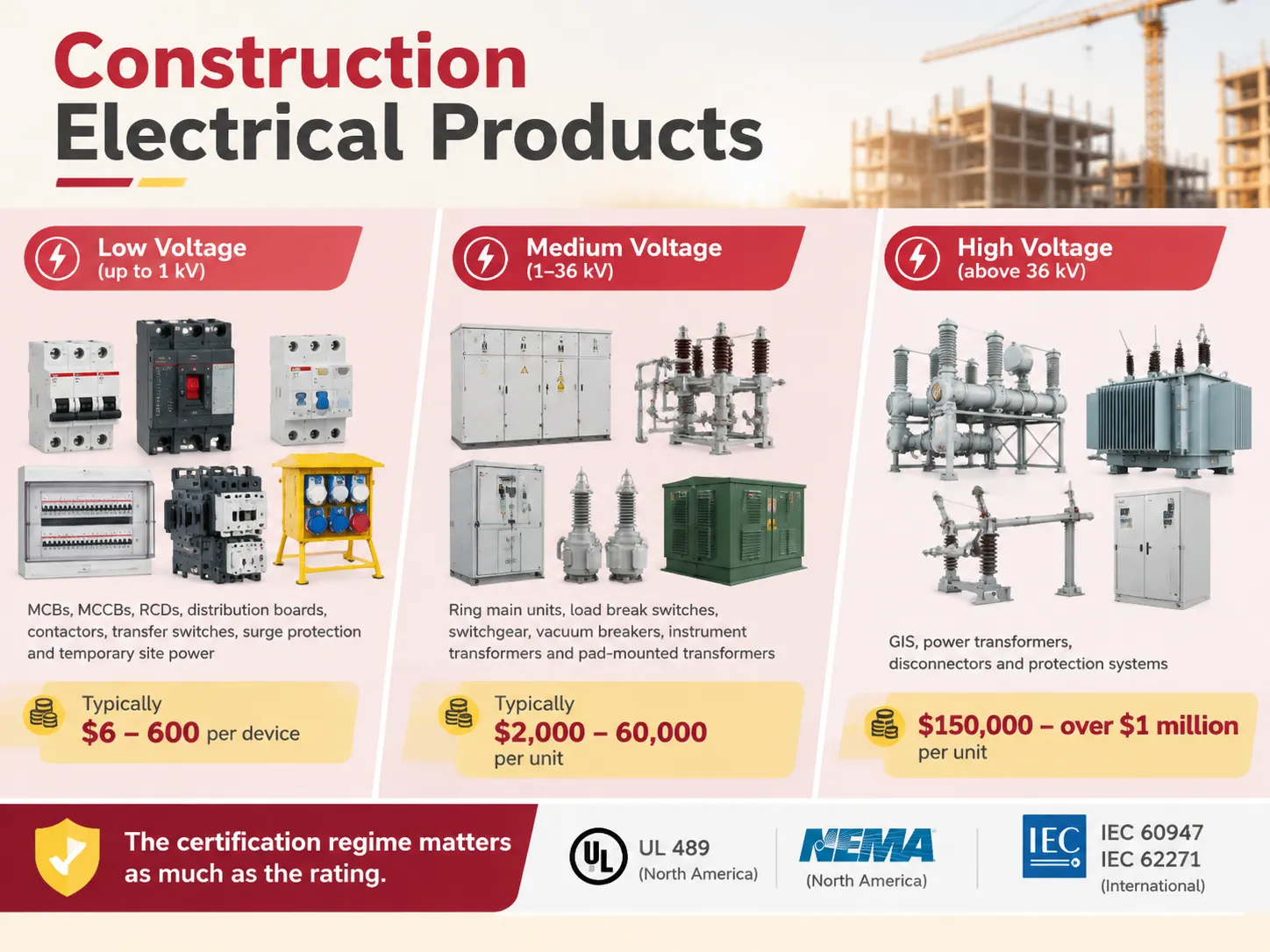
| MCCB | Disjoncteur à boîtier moulé | 16-1 600 A | Panneaux commerciaux, alimentations industrielles, grands systèmes CVC et machines |
| ACB | Disjoncteur Air | 400-6 300 A | Appareillage industriel, générateurs et arrivées principales, centres de données |
| VCB | Disjoncteur à vide | Jusqu'à la classe 40 kV | Distribution moyenne tension, postes électriques, commutation de moteurs |
| RCCB / ELCB | Disjoncteur différentiel / Protection contre les fuites à la terre | 25-100 A, sensibilité 30-300 mA | Protection contre les chocs sur prises et zones humides |
| RCBO | Disjoncteur différentiel avec protection contre les surintensités | 6-63 A | Combine MCB + RCCB dans un seul module |
| GFCI / AFCI | Interrupteur différentiel de défaut à la terre / Interrupteur différentiel de défaut d’arc | 15-50 A | Cuisines, salles de bains, extérieurs aux États-Unis (GFCI) ; chambres, espaces de vie (AFCI) |
| SF6 / Huile | Disjoncteur isolé au gaz ou à l'huile | Haute tension | Réseaux de transmission, postes haute tension |
Il y a deux points majeurs de confusion : Premièrement, les RCCB et RCBO ne sont pas des dispositifs de protection contre les surintensités comme la plupart des gens le pensent ; ce sont plutôt des dispositifs qui détectent le courant de fuite à la terre (à travers une personne ou l'isolation), ils interrompent donc le circuit environ trente millisecondes après la survenue de la fuite. Par conséquent, selon les normes actuelles, toutes les prises doivent être équipées de RCCB ou RCBO. Deuxièmement, dans le câblage résidentiel américain, les fonctions des AFCI et GFCI sont souvent combinées dans un même dispositif lorsque cela est requis dans les chambres et espaces de vie selon les dispositions du code actuel. La relation entre ces dispositifs différentiels et de surintensité est expliquée plus en détail dans notre guide RCCB vs RCBO.
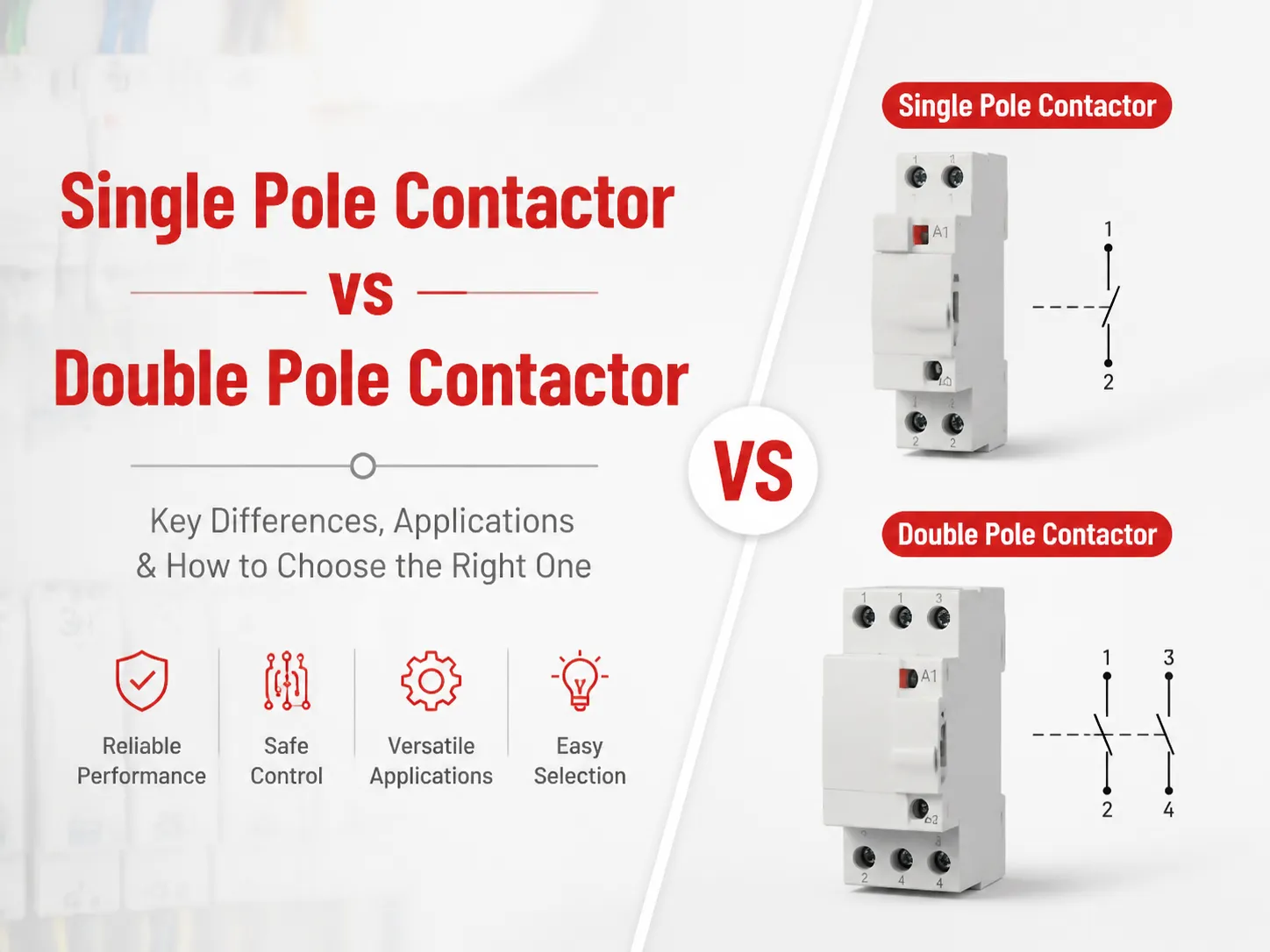
Les disjoncteurs peuvent avoir une configuration monopolaire (une phase 120 V), bipolaire (deux phases pour les appareils/prises 240 V en Amérique du Nord) ou tripolaire/quadripolaire (trois phases pour l’alimentation industrielle/commerciale). Les disjoncteurs monopolaire assurent la protection contre les surintensités pour les circuits dérivés en 120 volts ; les disjoncteurs bipolaires assurent la protection contre les surintensités pour les charges en 240 volts telles que les sèche-linge, les cuisinières, les chauffe-eau et les chargeurs de véhicules électriques, et déclenchent les deux phases simultanément. Beaucoup des erreurs les plus courantes commises par les bricoleurs sont dues à une sélection incorrecte du nombre de pôles, il est donc recommandé de faire appel à un professionnel expérimenté pour les installations de tableau/les mises à niveau de logement, car il a réalisé ce processus des centaines de fois auparavant.

Disjoncteur vs fusible : quelle est la différence ?
Mis à part leur fonction commune de protection des câblages et équipements, chaque type possède un mode de fonctionnement unique. La capacité d’un fusible à protéger contre une surcharge repose sur un conducteur métallique qui fond à un courant supérieur à sa capacité, créant une coupure physique dans le circuit électrique. Dans un disjoncteur, ce processus s’effectue par un mouvement mécanique de l’interrupteur. Cette différence constitue la base des comparaisons entre ces deux types d’appareils de protection.
| Propriété | Fusible | Disjoncteur |
|---|---|---|
| Après un déclenchement | Élément détruit — doit être remplacé | Réarmement par basculement de la poignée — réutilisable |
| Vitesse de réponse | Extrêmement rapide (bonne limitation du courant) | Rapide, mais légèrement plus lente qu’un fusible équivalent en cas de défauts très importants |
| Protection contre la manipulation | Facile à contourner en installant un fusible plus grand ou une pièce métallique derrière | Plus difficile à contourner ; les déclenchements sont visibles et récurrents |
| Réarmable à distance ? | Non — remplacement physique | Certains types industriels peuvent être réenclenchés électriquement |
| Coût par événement | Pièce bon marché, mais chaque défaut nécessite un nouveau fusible | Coût initial plus élevé, coût quasi nul par déclenchement |
| Discrimination/sélectivité | Bonne ; les fusibles se coordonnent bien en série | Nécessite un calibrage précis entre les unités amont et aval |
| Où ils sont préférés | Protection des semi-conducteurs, sites industriels à forte capacité de défaut, certains secteurs automobile/maritime | Partout ailleurs — résidences, distribution commerciale et industrielle |
La plupart des utilisateurs concluraient qu’une mise à niveau d’un tableau à fusibles vers un tableau à disjoncteurs est le meilleur retour sur investissement. Un fusible ne fournit aucune indication de surcharge répétée du circuit et offre donc des opportunités de réparations dangereuses et/ou non sécuritaires ; en revanche, avec un disjoncteur, l’utilisateur peut clairement identifier le circuit qui a déclenché et peut simplement le réarmer. Les disjoncteurs offrent également une protection contre les défauts à la terre et les défauts d’arc, des fonctionnalités qu’aucun type de fusible ne peut offrir. Dans certains cas, un fusible surpassera un disjoncteur, notamment lorsqu’il s’agit de très forts courants de défaut ou du besoin d’une limitation rapide du courant tout en protégeant des équipements électriques sensibles ; cependant, dans les bâtiments, les disjoncteurs sont le meilleur choix depuis de nombreuses années.
Disjoncteur vs interrupteur : quelle est la différence ?
Une manette de disjoncteur est souvent confondue avec un interrupteur car elles sont similaires, mais ce sont des types d’appareils différents. Un interrupteur (par exemple, interrupteur d’éclairage, sectionneur, contacteur) est destiné à être utilisé ou actionné régulièrement (vous l’allumerez/éteindrez de nombreuses fois), et il n’a aucune capacité de détection. Un disjoncteur, en revanche, est destiné à un service peu fréquent et est spécifiquement conçu pour déclencher automatiquement lorsqu’il détecte un défaut en coupant automatiquement le courant.
En raison de ces différences, il existe deux règles de base. Premièrement, un interrupteur ne vous protège pas des défauts ; il ne peut que contrôler votre circuit, et donc le circuit provenant d’un interrupteur doit être protégé par d’autres dispositifs en amont de l’interrupteur. Deuxièmement, un disjoncteur n’est pas destiné à être utilisé pour des commutations quotidiennes ; ses contacts ne sont pas conçus pour des milliers d’opérations, et chaque fois que vous le déclenchez manuellement, la durée de vie de ce disjoncteur diminue. Si vous souhaitez disposer d’un dispositif de commutation tout en fournissant une certaine forme de protection, le produit idéal serait un sectionneur avec fusible ou disjoncteur, ou un disjoncteur moteur de protection (pour les circuits machines). Du côté haute tension, cette différence se retrouve également dans les postes de transformation, où ils utilisent des sectionneurs séparés pour la commutation (ils ne commutent que lorsqu’il n’y a pas de courant) et des disjoncteurs pour interrompre les courants de défaut.
Disjoncteur principal vs disjoncteur divisionnaire : quelle est la différence ?
Les gens confondent fréquemment les deux types de disjoncteurs dans un tableau (le principal et le divisionnaire) car ils coupent tous deux l’électricité d’un tableau ; cependant, ils remplissent des fonctions totalement différentes. Le disjoncteur principal coupe l’alimentation de l’ensemble du tableau depuis le réseau électrique, tandis que les disjoncteurs divisionnaires (les longues rangées de manettes de 15 et 20 ampères) protègent chaque circuit individuel (par exemple, cuisine, chambres, unité de climatisation, sèche-linge). Selon la taille de la maison d’une personne et la quantité d’électricité utilisée chaque jour, beaucoup constateront que le disjoncteur principal sera calibré entre 100 et 200 ampères dans une maison.
Comprendre la distinction entre ces deux disjoncteurs est essentiel en raison de leur rôle dans la protection contre les chocs électriques et les incendies. Le disjoncteur principal protège les conducteurs de service, offrant aux pompiers et/ou aux électriciens un moyen sûr unique de couper l'alimentation d'un bâtiment, tandis que les disjoncteurs divisionnaires protègent les fils plus petits situés dans les murs qui alimentent chaque pièce spécifique ; ainsi, lorsqu'un court-circuit ou une défaillance électrique survient dans un disjoncteur divisionnaire, cela peut potentiellement ne couper que l'alimentation d'une seule pièce au lieu de toute la maison. Lorsqu'une personne entend “ le disjoncteur principal a sauté ”, cela indique généralement que soit la consommation totale d'électricité a dépassé la capacité de service, soit qu'une défaillance électrique importante s'est produite entre le disjoncteur principal et les disjoncteurs divisionnaires. Par conséquent, avant de réenclencher le disjoncteur principal, il convient de débrancher suffisamment d'appareils ou d'équipements électroniques pour ramener la consommation totale d'électricité en dessous de la capacité maximale du tableau de disjoncteurs.

Quelles marques fabriquent des disjoncteurs ?
Il existe deux catégories distinctes de fabricants dans l'industrie des disjoncteurs : les acteurs mondiaux avec une présence étendue en Amérique du Nord et en Europe, et les entreprises spécialisées dans des produits de niche dont les produits certifiés sont présents dans le monde entier.
| Marque | Marché résidentiel | Connu pour |
|---|---|---|
| Square D (Schneider Electric) | États-Unis / France | Panneaux QO et Homeline — les disjoncteurs résidentiels les plus installés en Amérique du Nord |
| Eaton (incl. Cutler-Hammer) | États-Unis / Irlande | Séries BR et CH, gamme commerciale et industrielle robuste |
| Siemens | Allemagne | Large portefeuille industriel et résidentiel, gamme résidentielle MP/QP |
| ABB | Suisse / Suède | Gamme Tmax MCCB, standard industriel mondial, disjoncteurs SACE |
| Leviton | États-Unis | Disjoncteurs résidentiels plus une gamme croissante de disjoncteurs intelligents/connectés |
| General Electric (maintenant partie des marques ABB/Smart Breaker) | États-Unis | Panneaux THQL/THQB hérités encore courants dans les maisons anciennes |
| Legrand / Hager / Chint / HUYU et fabricants mondiaux certifiés similaires | Europe / Chine | Gammes complètes de MCB/MCCB/RCBO certifiées selon IEC 60898 et IEC 60947, fournissant les marchés OEM et projets dans le monde entier |
Lors de l'achat de disjoncteurs, la règle la plus importante concernant la compatibilité des produits est qu'en Amérique du Nord, les disjoncteurs sont spécifiques au tableau. Par exemple, un disjoncteur Square D ne s'adaptera pas à un tableau Eaton, et tenter d'en installer un dans un tableau pour lequel il n'est pas destiné crée non seulement une violation du code, mais aussi un risque d'incendie réel. Pour éviter ce problème, il suffit d'assortir le disjoncteur de remplacement au nom du fabricant et à la série du tableau existant (voir notre Guide de référence Eaton vs. Cutler-Hammer pour la compatibilité des produits) ou, si vous choisissez de changer de marque, vous pouvez simplement remplacer l'ensemble du tableau. Les disjoncteurs de différents fabricants sont compatibles et peuvent être montés sur des rails DIN dans les marchés hors Amérique du Nord (c'est-à-dire les marchés IEC), et donc des entreprises comme HUYU peuvent distribuer leurs disjoncteurs miniatures certifiés (MCB) dans plus de 100 pays. Pour les clients industriels et projets, la certification est bien plus importante que le logo du produit ; la certification pour l'Amérique du Nord est UL 489 pour les disjoncteurs, IEC 60898 pour les MCB, IEC 60947-2 pour les disjoncteurs moulés (MCCB) et les disjoncteurs à air (ACB), ainsi que les rapports de test certifiés pour ces certifications.
Combien coûtent les disjoncteurs ?
Le prix des disjoncteurs varie plus que celui de nombreux autres types de composants électriques car les disjoncteurs peuvent aller de $6 (pièce de rechange résidentielle) à plus de $100 000 (transmission). Par conséquent, lors de l'élaboration d'un budget pour un projet, il est utile d'avoir une ventilation des fourchettes de prix possibles dans chaque catégorie pour chaque année jusqu'en 2026 :
| Type de disjoncteur | Coût de la pièce (typique) | Coût installé (électricien) |
|---|---|---|
| Disjoncteur thermique-magnétique monopolaire standard (15-30 A) | $6-18 | $130-250 incluant l'appel de service |
| Bipolaire (30-100 A) | $10-40 | $150-300 |
| Disjoncteur GFCI | $40-100 | $200-350 |
| AFCI ou combinaison AFCI/GFCI | $30-100 | $175-350 |
| Disjoncteur intelligent avec surveillance énergétique | $50-300+ | $250-500 |
| MCB (IEC, 6-63 A, rail DIN) | $3-25 | Varie selon le marché |
| MCCB (100-1 600 A) | $45-1,600+ | Prix projet |
| ACB (630-6 300 A) | $800-5,000+ | Prix projet |
| Disjoncteur moyenne/haute tension | $5,000-100,000+ | Projets de postes électriques |
Les principaux facteurs de prix sont l'ampérage, la capacité de coupure, les fonctions de protection et la marque. Un disjoncteur thermique-magnétique basique de 20 A à $6-12 comparé à une unité combinée AFCI/GFCI à $50-100 représente environ un multiplicateur de cinq à huit fois — justifié par les microprocesseurs et capteurs à l'intérieur de l'unité intelligente. Le tableau complet des coûts — incluant le remplacement du tableau et lorsque l'échange d'un disjoncteur $200 se transforme en une mise à niveau du tableau $2 000-4 000 — est détaillé dans notre guide des coûts de remplacement des disjoncteurs.

Comment choisir le bon disjoncteur
Pour sélectionner un nouveau disjoncteur, suivez ces cinq étapes DANS L'ORDRE : chaque étape limite et restreint vos options pour l'étape suivante.
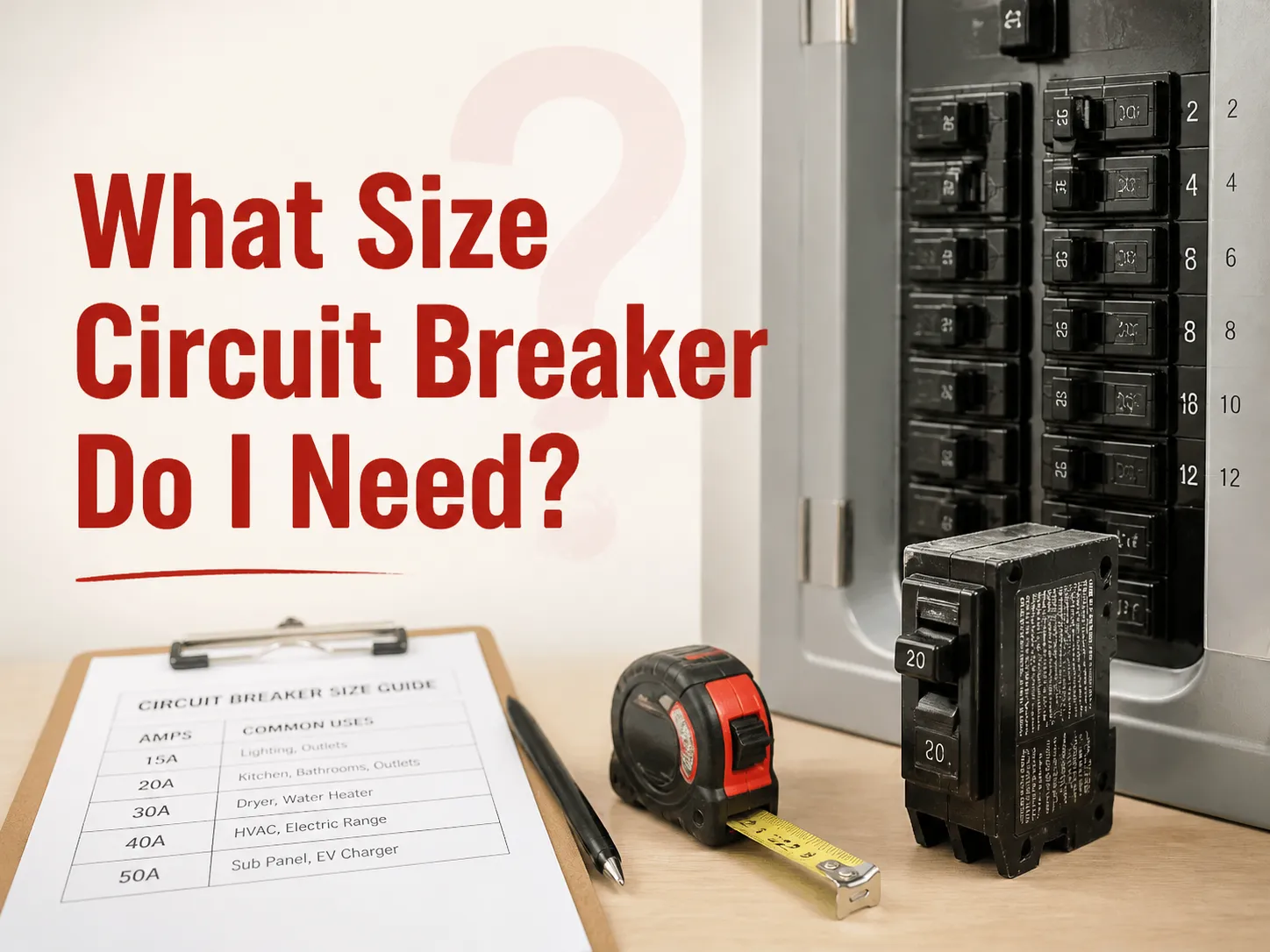
- La capacité en ampères du fil = ampérage du disjoncteur, PAS ampérage de l'appareil ! Les normes industrielles stipulent que le disjoncteur est là pour protéger le fil, donc le disjoncteur ne doit JAMAIS dépasser la capacité en ampères de ce fil. Par conséquent, un disjoncteur de 15 ampères protège un fil en cuivre 14 AWG, un disjoncteur de 20 ampères protège un fil 12 AWG, et un disjoncteur de 30 ampères protège un fil 10 AWG. NE JAMAIS augmenter la capacité d’un disjoncteur pour éliminer les déclenchements intempestifs avant d’avoir vérifié la taille du fil ; c’est l’une des principales causes d’incendies domestiques.
- 80% of Breaker’s Rating is Maximum Continuous Load: The National Electrical Code requires circuit breakers to be rated for continuous (3-hour or more) loads at no more than 80% of the breaker’s capacity. A continuous 12 amps (1,440 watts at 120 volts) on a 15 amp breaker are fine, and 16 amps (1,920 watts) on a 20 amp breaker are fine. For an explanation of how to perform the calculation converting watts-to-amps for continuous loads, please see our 15-Amp Circuit Capacity Guide.
- Type Matches Hazard: A Ground Fault Circuit Interrupter (GFCI) circuit breaker must be used on receptacles located in kitchens, bathrooms, garages, and outside. An Arc Fault Circuit Interrupter (AFCI) breaker must be used in bedrooms and living areas under current code. Lastly, a motor or transformer circuit must use the proper trip curve (usually C or D) to minimize nuisance trips during startup.
- Number of Poles = Voltage: A single pole breaker is used on 120-volt branch circuits; a double pole breaker is used on 240-volt loads and on disconnects from the service panel; a breaker for a three-phase system must be either a three- or four-pole breaker.
- Interrupting Rating and Certifications: The interrupting or breaking capacity (kA) of a circuit breaker must be adequate for the available fault current at the main panel, and ONLY certified devices (in North America, the certification mark is UL 489; in the rest of the world, the certification marks are IEC 60898/60947) should be purchased from authorized dealers. Counterfeit breakers are an increasing problem. When counterfeit breakers fail, it is usually during a fire.
Installation, resetting, and replacement
Resetting a tripped circuit breaker is something every homeowner ought to be aware of. When a circuit breaker trips, it will revert to the middle or OFF position on its handle. To reset the circuit breaker, turn the handle completely to the OFF position, and then fully back to the ON position. If after you have reset the circuit breaker it does not trip again, it is likely that the overload causing the circuit breaker to trip was an isolated event. If the circuit breaker trips again immediately after being reset, you most likely have a larger electrical issue, and you should stop attempting to reset the breaker and investigate the problem further.
Circuit breakers do eventually wear out, and the wear will usually result from a mechanical failure in the latching mechanism or the electrical contacts rather than a failure of the sensing mechanism (the electronic part). A circuit breaker that is very hot, buzzing or humming, has a burnt smell, and/or has tripped many more times than it previously did, or has failed to trip completely, is likely going to need to be replaced. Testing a faulty breaker is fairly easy if you have access to a multimeter; you’ll need to check that the breaker will hold the correct amount of current load and trip when it is supposed to. But if a circuit breaker begins showing any of the above warning signs, it will be in your best interest to replace it instead of trying to continue using it until it finally does fail on you.
Replacing a circuit breaker in a panel that is live has some inherent risk involved. Depending on the configuration of your panel and where the service lugs (terminals) on your circuit breaker panel are mounted, the service lugs remain energized even when the main has been turned OFF. In the vast majority of cases in the United States, it is against the law to rewire or replace a circuit breaker while working on the live side of the service because there is a high likelihood that an arc flash will occur if you come into contact with the energized lugs while doing so. The cost of hiring an electrician to replace a circuit breaker is typically between $130-$250 to provide you with peace of mind and protection against the risk of an arc flash. The same professional judgment should be applied on the panel level: whether or not your aging 100 A service is capable of handling the entire electrical load of a modern home, and whether or not the current code requires you to have a panel rated at 200 A, is a question that you should be able to have answered by a licensed electrician after a load calculation has been performed, not a guess.
Why does a circuit breaker keep tripping?
A repeatedly tripping breaker is not the source of the problem; it is an indication of a problem. A tripped breaker indicates that there is something wrong with the electrical circuit or with what is connected to it. Identifying the cause of the problem means understanding the following four major categories of electrical faults or problems.
- Overloaded circuit – Too many appliances or devices drawing power from a single circuit are causing an overload of electrical current. The solution to this is to balance the load on the circuit or to install a new circuit for the additional high-wattage electrical devices, and not to use a higher-rated circuit breaker.
- Court-circuit – An electrical short happens when an energized wire touches either a neutral or ground wire. This condition can happen inside an appliance or in an extension cord when either the cord or the appliance is damaged. A short circuit will usually trip instantly, and there may be a burnt smell associated with it.
- Ground Fault – A ground fault occurs when current leaks to ground (earth) through a person, water, or damaged insulation on an electric wire. Ground fault protection devices (GFCIs and RCCBs) are critically important to ensure the safety of people using electricity.
- A Breaker Failure – After decades and thousands of operations, a breaker eventually will wear out and will no longer trip and will fail to hold on to its rated current.
Diagnosing which family you are in — and why a breaker that “trips for no reason” almost always has a reason — is exactly what our circuit breaker tripping guide walks through step by step. It is important to note: If a breaker trips when an appliance is plugged in, the appliance is most likely the cause. If a breaker trips when nothing is connected, suspect either the wiring or the breaker and call a licensed electrician to investigate further; do not experiment with either the wire or the breaker.
FAQ
How do I reset a circuit breaker?
To reset the circuit breaker(s), locate the circuit breaker that tripped (the lever/circuit breaker will be in between the OFF/ON position) Move the lever fully to the OFF position, and then move it firmly to the ON position. If the circuit breaker(s) remains in the ON position, then the trip was probably a temporary overload. However, if the circuit breaker(s) immediately or shortly thereafter trips again, do not reset the circuit breaker(s) again and contact a professional to determine why the circuit breaker(s) keep tripping.
What’s the difference between a circuit breaker and a fuse?
Fuses protect electrical circuits by melting a wire (metal element), and therefore, when a fuse is blown it has to be replaced every time. Circuit breakers protect electrical circuits by using a mechanical switch to open the circuit. This allows circuit breakers to be reset and reused many times. Additionally, circuit breakers have the ability to provide both ground fault protection and arc fault protection which fuses cannot; therefore, circuit breakers have replaced fuses in virtually all modern buildings.
What is the difference between a main breaker and a circuit breaker?
The term circuit breaker refers to all circuit breakers. The main breaker is a circuit breaker that is larger than the others (typically 100-200 amps) that disconnects the entire electrical service from the utility company. Branch circuit breakers are the smaller circuit breakers that are used to protect individual circuits in the building. All circuit breakers will trip automatically in response to electrical faults, however, the main circuit breaker protects the conductors that carry the electrical service, while branch circuit breakers protect single circuits.
What is the difference between a circuit breaker and a switch?
A switch is a manual control device that is intended for frequent operation, without providing any protective function. A circuit breaker is a protective device that will automatically open the circuit if there is an overload condition or short circuit and is not intended to be used thousands of times a day. A switch does not provide protection for a circuit; a circuit breaker is not intended for daily use. Some devices are designed to have both functions; therefore, these products are referred to as switch-disconnectors or motor-protective devices.
Références
- Schneider Electric — What Is a Circuit Breaker?
- Eaton — Circuit Breaker Fundamentals
- RealPars — Circuit Breakers Explained
- Family Handyman — How Circuit Breakers Work
- NFPA — National Electrical Code (NEC)
Conclusion
A circuit breaker protects every electrical system from excessive voltage and current. It is a switch that automatically responds to excessive voltage and/or current (i.e. thermal and magnetic overload) and opens the circuit as fast or faster than a fused circuit. If you are new to circuit breakers, it is important to understand the thermal/magnetic trip mechanism that opens the breaker, the trip characteristics of breakers of types B, C, and D according to their rated load and type of electrical load, how do MCBs, MCCBs, RCBOs differ; when and why you should use circuit breakers instead of fuses; and to what extent you should use the main breaker with regard to branch circuit breakers; how to determine the correct certification for the circuit breaker and the manufacturer of the circuit breaker to ensure compatibility with your circuit breaker panel; and how to use the ratings of circuit breakers to size correctly the circuit breaker for your installation. All of the above may be obtained from the circuit breaker manufacturer or an electrical contractor, and if not, you must refer to a qualified electrical contractor to obtain such information to ensure your equipment remains protected by the circuit breakers. Assuming that you have taken advantage of the above information, you can expect your circuit breaker(s) to continue protecting all of your equipment for many years to come until such time as the circuit breakers have reached their rated life (which they do not use) and have provided the necessary protection for each piece of your equipment.