
Biasanya, manajer fasilitas tidak memilih kontraktor listrik mereka berdasarkan kampanye pemasaran apa pun. Mereka memiliki motivasi berbeda untuk membuat pilihan – misalnya, mereka mungkin memiliki penyewa yang harus segera dipasang dan merasa perlu memilih kontraktor listrik atau harus melakukannya karena masalah lain seperti kegagalan inspeksi atau panel distribusi penuh. Saat mencari kontraktor listrik untuk proyek mereka, manajer fasilitas hanya memiliki tiga sumber daftar pendek. Itu bisa berupa saran dari kontraktor umum, saran dari distributor, atau seseorang yang menelepon tepat di pagi hari.
Apa yang ditawarkan perusahaan, perusahaan mana yang menyediakan layanan pada tingkat apa, berapa biaya layanan tersebut pada tahun 2026, bagaimana penawar yang berkualifikasi berbeda dari penawar murah, mengapa jawabannya dapat berubah tergantung apakah proyek dilakukan di Eropa atau Amerika Utara.
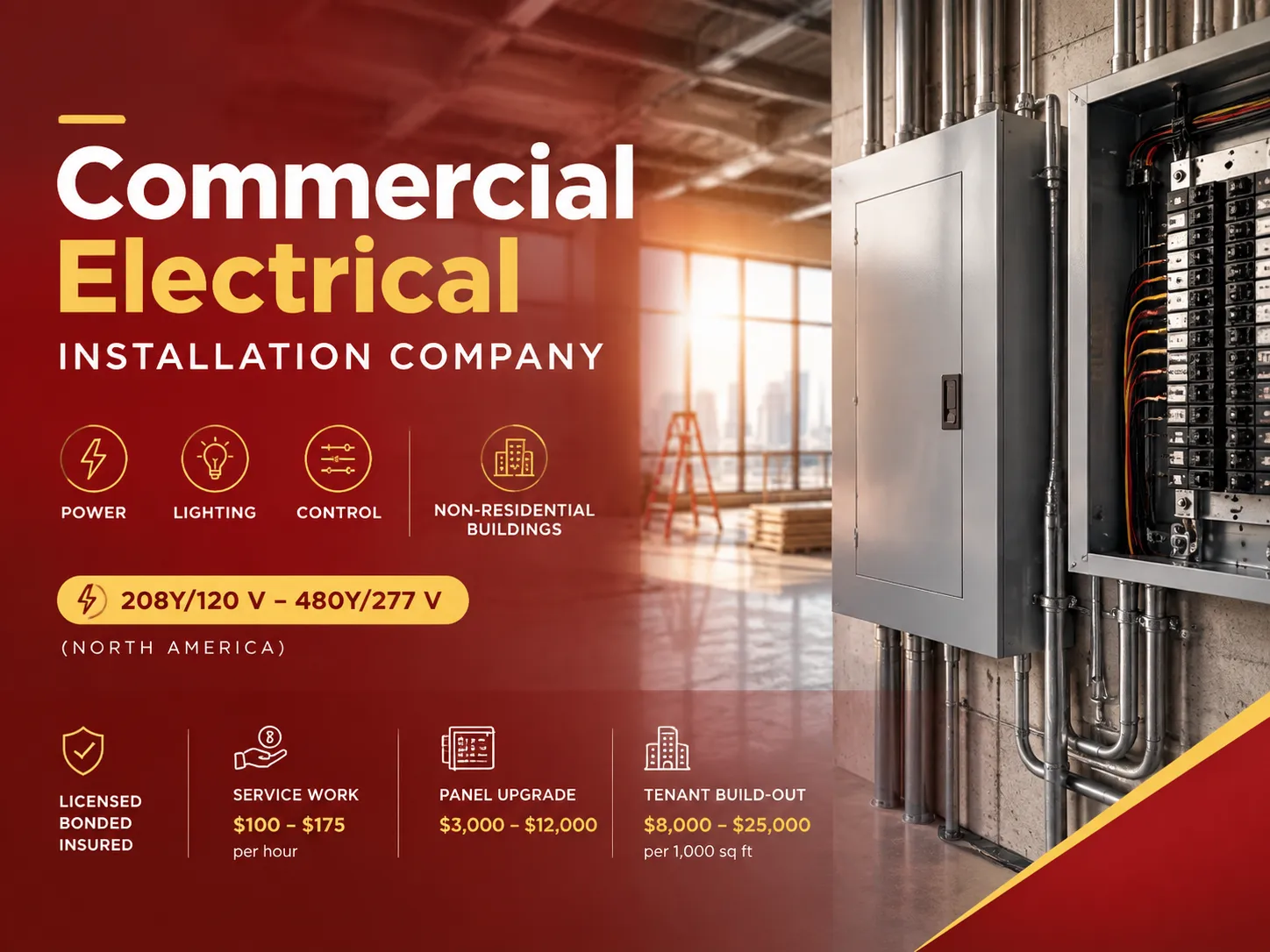
Jawaban singkat: Kontraktor listrik adalah bisnis yang melakukan desain, pemasangan peralatan, pengujian, dan pengoperasian sistem listrik di properti bisnis. Di Amerika Utara, sistem tegangan rendah beroperasi dalam rentang tegangan nominal 208Y/120 V hingga 480Y/277 V, yang berarti perusahaan harus mendapatkan lisensi, jaminan surety, dan cakupan asuransi yang tepat sesuai dengan persyaratan negara bagian. Layanan yang diberikan dapat mencapai 100-175 dolar per jam, dari biaya peningkatan panel layanan komersial yang mungkin berkisar antara 3.000 hingga 12.000 dolar sementara pembangunan penyewa dapat berkisar dari 8.000 hingga 25.000 dolar, per seribu kaki persegi ruang. Namun, dalam beberapa kasus perusahaan nasional mungkin terlalu mahal, karena pemegang lisensi terpercaya di tingkat lokal bisa lebih cepat dan lebih murah daripada korporasi besar. Dalam konteks ini HUYU bekerja dengan perakitan sistem tegangan rendah, seperti sistem distribusi, kontraktor, dan pemutus sirkuit.
Apa yang Sebenarnya Dilakukan Perusahaan Instalasi Listrik Komersial
Yang menentukan ruang lingkup adalah okupansi, bukan luas lantai. Misalnya, kantor medis seluas 40.000 kaki persegi dan gudang distribusi yang juga 40.000 kaki persegi sama dalam luas lantai tetapi sangat berbeda dalam persyaratannya. Yang pertama akan membutuhkan stopkontak tanah terisolasi, perangkat kelas rumah sakit, sirkuit untuk jalur keluar darurat, dan beberapa cara untuk transfer generator. Yang terakhir akan membutuhkan pencahayaan high-bay, sirkuit leveler dermaga, dan beban motor yang substansial.
Kontraktor selalu bertanggung jawab atas pintu masuk layanan dan distribusi utama, feeder dan sirkuit cabang, daya dan pencahayaan, pemanasan dan pendinginan, pembumian dan pengikatan, serta penekanan lonjakan. Menggunakan model desain-dan-bangun, kontraktor yang sama juga melakukan perhitungan beban, membuat diagram satu garis, dan mengembangkan studi hubung singkat dan koordinasi yang diperlukan untuk kepatuhan desain. Namun, dalam kasus model desain-tawar-bangun, pekerjaan ini dilakukan oleh insinyur, meninggalkan kontraktor hanya dengan proses konstruksi.
Perbedaan antara bangunan komersial dan residensial terletak pada jenis sistem yang digunakan dan bukan pada kualitas pengerjaan. Bangunan komersial menggunakan daya 3-fase: 208Y/120 V pada bangunan komersial dan 480Y/277 V pada bangunan yang lebih modern. Selain itu, metode pengkabelan melibatkan penggunaan conduit dan konduktor terpisah daripada kabel. Akhirnya, sistem dirancang dan diukur berdasarkan perhitungan permintaan sesuai dengan NEC Artikel 220. Perangkat dan rakitan di dalam lini distribusi tersebut memiliki standar masing-masing — UL 489 untuk pemutus sirkuit tipe moulded-case, UL 1066 untuk pemutus sirkuit daya tegangan rendah, UL 891 untuk switchboard, UL 1558 untuk switchgear — dan seluruh set tersebut tercakup dalam panduan layanan listrik komersial.
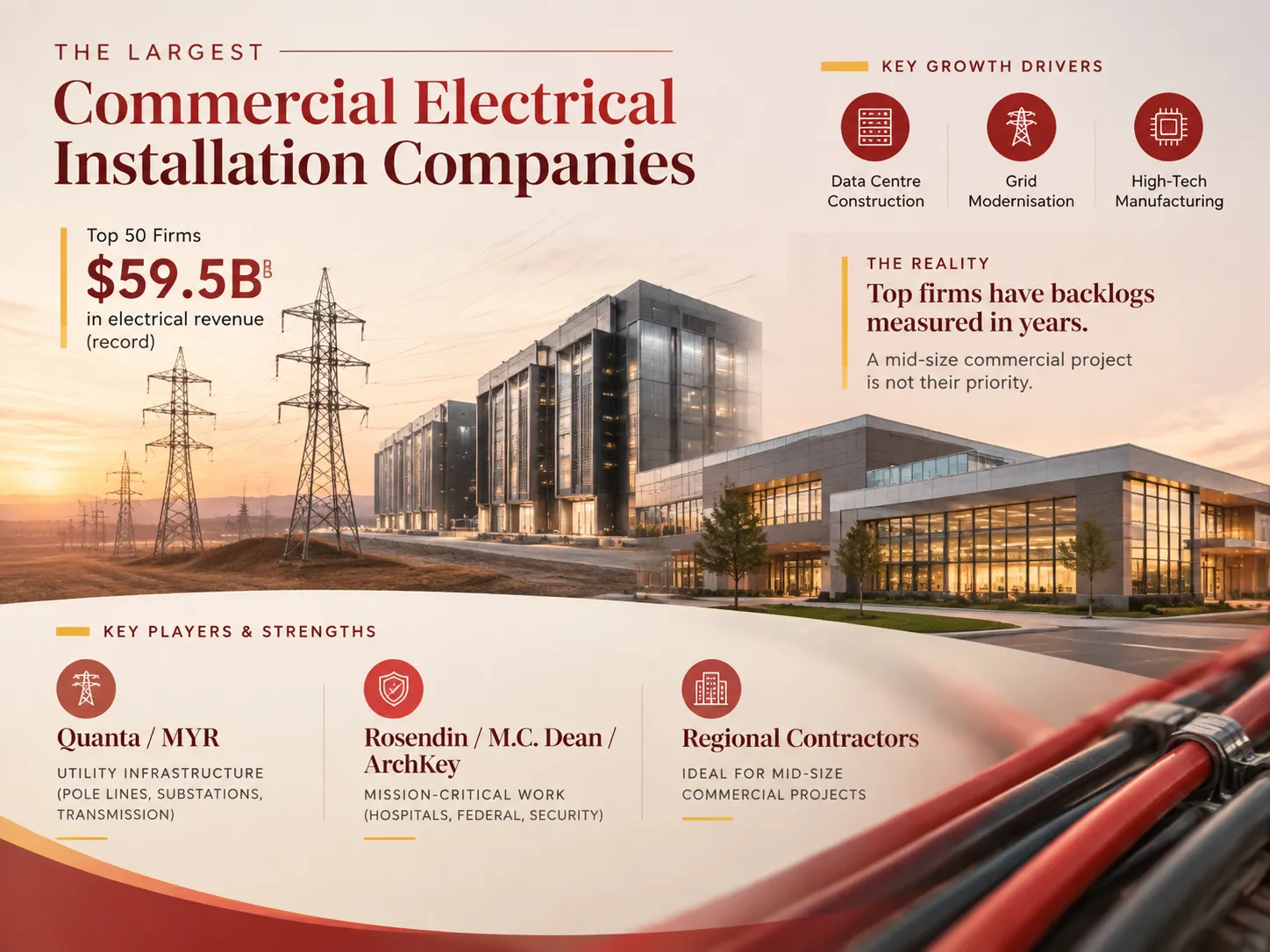
Perusahaan Instalasi Listrik Komersial Terbesar
Angka skala yang ditampilkan diambil dari daftar 50 kontraktor listrik teratas EC&M dan daftar 600 kontraktor spesialis teratas ENR, berdasarkan keuntungan akun tahunan aktual. Total pendapatan yang diperoleh oleh 50 kontraktor teratas pada siklus terakhir mencapai jumlah tertinggi sebesar $59,5 miliar, yang terutama didorong oleh proyek terkait pusat data, modernisasi jaringan, dan manufaktur teknologi tinggi. Konsentrasi ini sangat penting bagi klien: kontraktor teratas sebenarnya memiliki backlog panjang yang berarti mereka sama sekali tidak memprioritaskan proyek komersial berukuran menengah.
| Perusahaan | Kantor Pusat | Pendapatan listrik 2025 | Di mana mereka paling kuat |
|---|---|---|---|
| Quanta Services | Houston, TX | $13,5 miliar | Transmisi, distribusi, energi terbarukan skala utilitas |
| Rosendin Electric | San Jose, CA | $3,7 miliar | Pusat data, semikonduktor, desain-bangun |
| Grup EMCOR | Norwalk, CT | $3,6 miliar | Institusional, perawatan kesehatan, jaringan dan komunikasi |
| MYR Group | Thornton, CO | $3,4 miliar | Jalur T&D plus komersial dan industri |
| Everus Construction Group | Bismarck, ND | $2,8 miliar | Listrik utilitas dan industri |
| IES Holdings | Houston, TX | $2,5 miliar | Layanan industri, infrastruktur |
| MMR Group | Baton Rouge, LA | $2,3 miliar | Instrumentasi dan kontrol, industri berat |
| M.C. Dean | Tysons, VA | $1,9 miliar | Misi-kritis, federal, sistem keamanan |
| ArchKey Solutions | St. Louis, MO | $1,7 miliar | Teknologi, perawatan kesehatan, pendidikan |
| Faith Technologies (FTI) | Menasha, WI | $1,4 miliar | Prefabrikasi, kontrol industri |
| Instalasi Listrik E-J | Long Island City, NY | $1,36 miliar | Institusional metro New York dan transit |
| Helix Electric | San Diego, CA | $957 m | Multifamily, perhotelan, tenaga surya |
Memahami cara membaca tabel lebih penting daripada menghafalnya. Quanta dan MYR terutama menyediakan utilitas – jalur tiang, gardu induk, dan transmisi – yang merupakan lini pekerjaan berbeda dibandingkan dengan pemasangan kabel di rumah sakit. Rosendin, M.C. Dean, dan ArchKey beroperasi di lingkungan misi-kritis di mana biaya downtime klien lebih besar daripada biaya konstruksi. Jika sebuah proyek melibatkan renovasi kantor seluas 60.000 sq ft termasuk peningkatan panel, ketiganya tidak akan kompetitif dan kontraktor yang kompetitif adalah kontraktor lokal yang mungkin belum pernah Anda dengar. Peringkat yang sebanding dari pemain terbesar berdasarkan tenaga kerja daripada pendapatan ada dalam rincian kontraktor listrik terbesar di AS.
Jenis Perusahaan yang Sebenarnya Dibutuhkan Proyek Anda
Industri ini memiliki lima model bisnis yang dikenal luas yang masing-masing menawar dengan cara yang sangat berbeda. Kesalahan paling sering dan mahal dalam pemilihan ini adalah memilih jenis yang salah; sebuah perusahaan yang unggul dalam satu jenis mungkin secara struktural tidak mampu melakukan jenis lain.
| Jenis perusahaan | Kontrak tipikal | Di mana mereka menang | Di mana mereka kesulitan |
|---|---|---|---|
| EPC nasional / kontraktor utilitas | Gardu induk, transmisi, tenaga surya skala utilitas | Kapasitas bonding, kedalaman rekayasa, kru multi-negara bagian | Pekerjaan bangunan kecil; ukuran proyek minimum mengecualikannya |
| Kontraktor komersial regional | Kantor, sekolah, ritel, kesehatan, fit-out | Pengetahuan kode lokal, hubungan dengan inspektur, harga kompetitif | Rekayasa internal terbatas; mungkin memerlukan insinyur eksternal |
| Spesialis layanan dan pemeliharaan | Waktu dan material, perjanjian pemeliharaan | Waktu respons, stok suku cadang, pekerjaan inspeksi berulang | Pekerjaan penawaran; kru kecil, tanpa bonding proyek besar |
| Integrator industri dan kontrol | Kontrol motor, PLC, VFD, daya proses | Komisioning, pemecahan masalah, waktu produksi aktif | Pekerjaan arsitektural dan sensitif terhadap finishing |
| Desain-bangun sumber tunggal | Lingkup penuh dari konsep hingga komisioning | Titik akuntabilitas tunggal, kompresi jadwal | Transparansi harga lebih rendah; perubahan desain dikenakan biaya |
Dalam kasus fasilitas yang beroperasi tanpa henti seperti pabrik, ruang server, atau pusat medis, salah satu solusi terbaik adalah menyewa dua kontraktor, satu untuk pekerjaan konstruksi dan satu lagi untuk mengelola peralatan. Mengontrak kedua penyedia ke perusahaan yang sama biasanya menghasilkan kinerja buruk di kedua area.

Kredensial yang Sebenarnya Bermakna
Proses memperoleh lisensi untuk beroperasi sebagai kontraktor di Amerika Utara ditangani di tingkat negara bagian, provinsi, atau pemerintah lokal, bukan di tingkat nasional. Ini berarti bahwa karena seorang kontraktor listrik dilisensikan untuk melakukan pekerjaan terkait aktivitas tertentu di satu negara bagian atau provinsi tidak berarti mereka dapat otomatis beroperasi di yurisdiksi tetangga tanpa memerlukan lisensi. Selain lisensi, juga penting untuk memverifikasi informasi berikut:
- Lisensi kontraktor listrik di yurisdiksi terkait — misalnya lisensi C-10 di California atau lisensi master electrician di yurisdiksi yang melisensikan individu daripada perusahaan. Perlu diingat bahwa lisensi tersebut harus diverifikasi di situs web dewan lisensi terkait, bukan pada kop surat kontraktor.
- Keanggotaan NECA — National Electrical Contractors Association. Organisasi ini merupakan indikator keanggotaan dalam badan tenaga kerja dan standar terkait, tetapi tidak berarti kontraktor tersebut telah memperoleh sertifikasi keselamatan.
- Afiliasi dengan program magang JATC — Joint Apprenticeship and Training Committee bertanggung jawab untuk melatih para elektrisi terkait dan mengumpulkan jam kerja mereka di sektor tersebut. Harap dicatat bahwa kontraktor listrik independen mungkin memiliki program magang yang berbeda yang mungkin sama kredibelnya.
- Daftar UL 508A — kontraktor harus memiliki daftar ini jika perusahaan membuat panel kontrol sendiri; jika tidak, panel tidak dapat dijual tanpa daftar ini.
- Sertifikasi dari NABCEP — ini hanya berlaku ketika individu terkait melakukan pekerjaan pada sistem tenaga surya dan penyimpanan energi.
- Catatan yang membuktikan penyelesaian kursus pelatihan NFPA 70E oleh personel kontraktor yang akan bekerja dengan instalasi listrik. Pastikan Anda diberikan log pelatihan yang terbaru.
- Sertifikasi ISO 9001, 14001 dan 45001 — ini terkait dengan sistem kualitas, lingkungan, dan kesehatan kerja yang diterapkan oleh kontraktor.
- Sertifikat asuransi dan tanggung jawab — ini merujuk pada asuransi tanggung jawab umum dan cakupan kompensasi pekerja yang dimiliki kontraktor listrik terkait harga pekerjaan.
Kualifikasi lain yang tidak terkait dengan keselamatan adalah pengendalian biaya: ini adalah dokumentasi siklus kode yang diberlakukan oleh yurisdiksi Anda. Untuk perusahaan yang pengalaman saat ini dicatat hingga dua edisi kode terakhir, maka mereka harus mempelajari kembali apa yang harus dilakukan dan bagaimana melakukannya, dengan biaya yang lebih besar untuk anggaran Anda. Catatan kami tentang batas resistansi untuk instalasi listrik bangunan komersial menunjukkan seberapa cepat persyaratan tersebut berubah.
Biaya Instalasi Listrik Komersial pada 2026
Dalam survei harga yang dilaporkan pada 2026, seorang magang dikenakan biaya antara $45 dan $85, pekerja perjalanan dikenakan biaya antara $75 dan $165, dan master atau spesialis industri dikenakan biaya antara $100 dan $225 sesuai tren pasar. Jumlah total yang dibayarkan oleh klien kepada kontraktor akan terdiri dari upah, tunjangan karyawan, asuransi, dan biaya lainnya. Pada proyek komersial, penagihan dapat meningkat hingga 20% lebih tinggi daripada pekerjaan residensial yang dilakukan di fasilitas yang sama karena lebih banyak asuransi, upaya dokumentasi, dan durasi pembayaran. Perusahaan dengan tenaga kerja berserikat di negara bagian Midwestern dan Northeastern cenderung menagih sekitar 20% hingga 40% lebih tinggi daripada pesaing mereka.
| Item pekerjaan | Kisaran tipikal 2026 | Catatan |
|---|---|---|
| Jam kerja pekerja perjalanan yang ditagihkan | $100–$175 | Most contractors bill at firm rate, not individual wage |
| Minimum service call | 2–4 hours billed | Often plus a $75–$195 dispatch fee |
| After-hours or weekend emergency | 1.5–2.0× rate | Storm and restoration work quoted on site |
| Commercial service panel upgrade, 200–400 A | $3,000–$12,000 | Rises to $12,000–$28,000 at 600–800 A |
| Three-phase power installation | $5,000–$20,000+ | Utility coordination time is a variable cost |
| New circuit installation | $300–$1,200 per circuit | Conduit and ceiling access drive the spread |
| LED lighting retrofit, per 1,000 sq ft | $1,500–$6,000 | Per-fixture: $85–$285 installed |
| Tenant electrical build-out, per 1,000 sq ft | $8,000–$25,000 | Includes materials, labour, permits, inspection |
| Commercial EV charger, Level 2 | $2,500–$7,500 per port | DC fast charging: $45,000–$120,000 |
| Standby generator, 100–500 kW installed | $55,000–$180,000 | Transfer switch and fuel storage additional |
| Permits and inspection fees | $300–$2,000 | Multi-point inspections add rounds |
| Load study and panel inspection | $500–$1.500 | Cheapest line on the list; most often skipped |
There are three factors accounting for differences between two quotations for a project of the same nature. First is the age of the building and status of the wiring: obsolete feeder sizes, aluminium branch circuits and hidden junction boxes all relate to labour costs. The second is whether the work can be done live or requires a shutdown: a shutdown is a cost for the client as much as for the contractor. The third factor is access: the height of the ceiling, whether it is finished or whether any lift required will be of greater significance than the equipment.Panel and service pricing specifically is detailed in our cost breakdown for electrical panel replacement.
How to Vet a Bidder Before the Contract Is Signed
The sequence to verify that minimizes the number of financial transactions.
- Check the license number with the issuing authority by looking it up on its official records. Compare the license number of the company, its type, and expiration date with those on the license certificate. A valid license that does not have the necessary coverage is worse than not having a license at all, as it will be discovered during the inspection.
- Get a copy of the insurance policy directly from the insurers. The certificates must state the name of the contractor as the recipient. Ask explicitly if the workers’ compensation insures everyone who will spend time on the job, including subcontractors.
- Figure out who is supposed to run the project. The “face” in the sales meeting will not be the one who is in charge. So ask them for the foreman’s name and license class, and how many projects the foreman is currently managing.
- Ask for a detailed breakdown; not just a total sum. The quote must contain all the items such as raw materials, labors, permits, temporary power, etc. For instance, you will get nothing from a quote like “15000 for electric works.”
- Ask for written exclusions. The exclusions usually include drywall repair after wiring completion, painting, coordination work with the utility company, building permits, and the temporary power cost during the construction. Each one of those is going to appear in the change orders later.
- Get at least three quotes and compare them. You will usually find that quotes may vary significantly – on an average they may differ by 30-50%. A quote on the low end of the scale deserves explanation rather than being taken for granted.
- Require necessary test results as a deliverable. Accepting the final outcome without getting results of insulation resistance, earth continuity, polarity, and loop impedance tests creates problems with the installation.
- Check the progress of two reference projects of the same size. Ask the last client two questions: was the final invoice within the 10% of the total sum; and were the inspections passed?
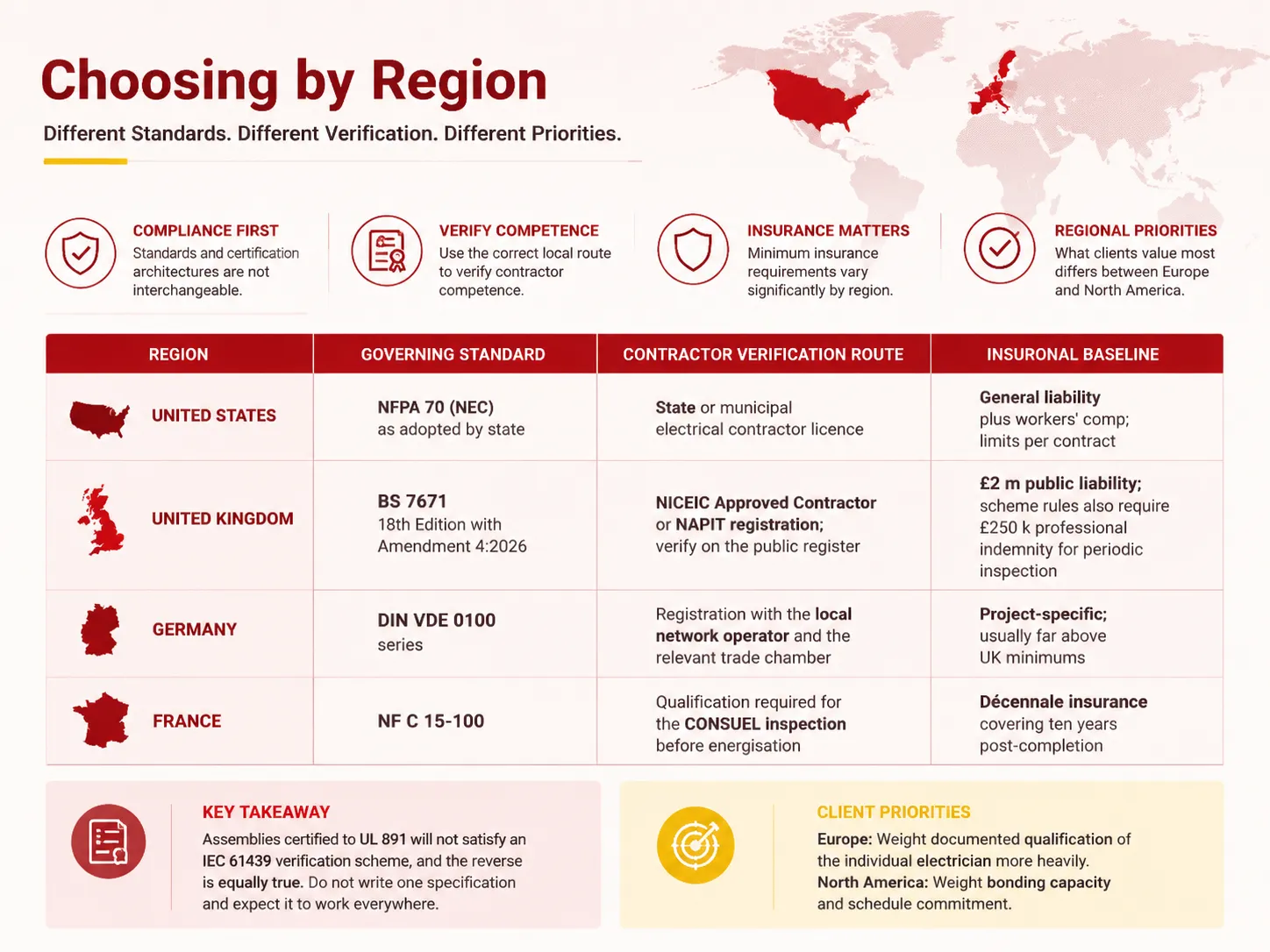
Choosing by Region: United States, United Kingdom and the EU
The differences in selection criteria are greater than most consumers believe since the compliance structure is not the same. North America follows the National Electrical Code (NFPA 70), which is adopted state by state with local amendments, and is certified to UL standards, while Europe follows IEC 60364 via its national wiring regulations and certifies equipment using IEC 61439 series which is different than UL 891 and UL 1558 in construction principles.
| Wilayah | Standar pengatur | Contractor verification route | Insurance baseline |
|---|---|---|---|
| Amerika Serikat | NFPA 70 (NEC) as adopted by state | State or municipal electrical contractor licence | General liability plus workers’ comp; limits per contract |
| Inggris Raya | BS 7671, 18th Edition with Amendment 4:2026 | NICEIC Approved Contractor or NAPIT registration; verify on the public register | £2 m public liability; scheme rules also require £250 k professional indemnity for periodic inspection |
| Jerman | DIN VDE 0100 series | Registration with the local network operator and the relevant trade chamber | Project-specific; usually far above UK minimums |
| Prancis | NF C 15-100 | Qualification required for the CONSUEL inspection before energisation | Décennale insurance covering ten years post-completion |
Two important outcomes can be noted. Firstly, in the UK the most important filter that leads to registration is the registered competent-person scheme: the NICEIC registers and certifies nearly 33,000 businesses, conducts audits of some works by each company on an annual basis and obliges them to have the most recent version of the wiring regulations in possession. Consequently, public sector clients insist on the fact that only competent-person scheme registered firms can appear on tender lists. Secondly, in France it is impossible to energize any installation until it is inspected by CONSUEL, meaning that the contractor is certified by a third party before the client receives the service, which control does not exist in most regions of the USA.
When purchasing something that might be subjected to various national regulations, take care not to write one common specification. In the USA assemblies which were verified in accordance with UL 891 certification can be considered compliant with IEC 61439 regulations, and vice versa.
Red Flags and Contract Terms Worth Pushing Back On
Very low bids, those that appear more than 30% below the second lowest bid, are a clearly sign of a problem and invariably indicate one of four issues: use of unlicensed contractors, a lapse in the insurance certificate, the fact that permit fees were not included in the estimate, or avoidance of issues to come later due to incorrect substitution of materials after contract award. All four issues impact the owner eventually, with issues related to the latter usually occurring during failure investigation.
In addition to what has been mentioned above, we should also pay attention to contracting firms that would either not do the permitting under their name, answer scope questions without documents but verbally, or require a deposit of sums that are more than the cost of materials ordered. From a purely contractual standpoint, three items deserve scrutiny in the contract. The retainage clause states that part of the payment is held until the project is in compliance with the standards; the change-order clauses determine the payments in advance of the actual work; the completion and testing clause specifies the documents submitted by the contractor as proof of compliance so that the owner can get these documents in the end.
FAQ
How much does an electrician charge for commercial work?
In 2026, it is expected that commercial work in the U.S. cost around $100–$175 an hour for a licensed journeyman, while master electricians and industrial specialists charge $145–225 in areas with high costs. The majority of commercial contractors charge at a fixed rate which covers all the overhead and costs of insurance rather than simply billing for the person’s pay. Normally there will be a minimum charge of 2–4 hours for a service call and an application of 1.5–2.0 multiplier with a trip charge in case of after-hours call the client receives. Pricing for the projects is considered separately where the service of 200–400 A increases the expenses from $3,000 to $12,000, and for a tenant build-out the prices vary between $8,000 and $25,000 for 1,000 square feet.
Why is Romex not allowed in commercial buildings?
Though non-metallic sheathed cable is not completely forbidden, the list of permitted uses is limited. NEC Article 334 describes the requirements for the use of non-metallic sheathed cable. It is outlined in Section 334.10 that it may be used in one- and two-family dwellings, in addition to other types of buildings of Type III, IV and V constructions — that means wood-framed buildings and heavy-timber buildings, but must be used behind some fire-resistant barrier or inside the areas that are unlikely to be damaged. Section 334.12 bans the use of the cable in Type I and Type II construction due to the fact that this included buildings are made of steel and concrete and includes commercial buildings, such as theatres, motion picture studios, garages and battery rooms, including the places that are located above dropped ceilings in non-residential buildings. Additionally, there may not be the possibility to use the non-metallic cable in constructed concrete or in wet locations. The protection is referred to as justification — a non-metallic coat neither provides mechanical protections nor has any fire protection features in comparison to MC cable or conduit. In most cases, when making the buildings of commercial purposes, this cable is neglected due to the type of construction of it.
Is there a difference between commercial and residential electricians?
Certainly, it is structural in nature rather than cosmetic. The work of the residential electricians is nearly all within the basic single-phase 120/240 V systems with the usage of sheath cables and the dimensions of circuits calculated from the standard dwelling load calculation. On the other hand, the commercial electricians operate with the three-phase systems such as 208Y/120 V and 480Y/277 V systems using conduit and individual conductors and determining their services based on the commercial demand. They should also have experience with motor operations, electric generators, transformer systems, etc. The industrial electricians represent the last specialization that is aimed at machines and conversion of electric energy into another type of work. Many middle-sized companies have all three kinds of work but it is worth being sure of the crew you get because the company might have license but the crew on the site might not have any necessary skills.
What are the three types of electrical installation?
These installations are divided into residential, commercial and industrial categories, and they vary in terms of voltage category, type of wiring and type of potential risks. Residential installations include homes and other dwellings such as homes using low-voltage single-phase AC systems with voltages of 120 or 240-volt, armoured cables, distribution boards and systems to charge electric cars. Commercial installations cover operating buildings from offices to hotels, hospitals and schools with three-phase voltage range from 208 volts to 480 volts, trunks for wiring and systems supplying electric energy for CCTV, ventilation and air conditioning. Industrial installations include plants and other heavy industry sites where large amount electrical power used for running heavy machinery results in losses in a case of a power outage.
Referensi
- NFPA — NFPA 70 National Electrical Code
- NFPA — 70E Standard for Electrical Safety in the Workplace
- UL Solutions — Product safety standards and listings
- Asosiasi Kontraktor Listrik Nasional (NECA)
- EC&M Magazine — Top 50 Electrical Contractors ranking
- ENR — Top 600 Specialty Contractors
- Biro Statistik Tenaga Kerja AS — Prospek Pekerjaan Elektrisi
- NICEIC — Approved Contractor scheme requirements
- IET — BS 7671 Requirements for Electrical Installations
- UK Health and Safety Executive — Electrical safety guidance
Kesimpulan
The ideal commercial electrical installation contractor is one with the proper license for the task, equipped with a competent team trained in the technology used in the facility, and ready to provide the documents necessary to confirm their credentials on the register, not just in a brochure. Size makes a poor indicator of suitability; the top revenue companies are engaged in building transmission lines and data centers, not performing your service upgrade.
Three things must be followed in any project. First, check credentials with the proper authorities before making the first payment rather than after. Second, demand that you receive all “as built” documentation, designs of the panels, and testing results before transferring last payment rather than as an afterthought. Finally, make sure three bidders provide you with the detailed scope of work since differences between the bids reveal the risk associated with a project better than any single price does. If you follow all the above, electrical work will become no more than what it is supposed to be in a project.