
Thông thường, các quản lý cơ sở không chọn nhà thầu điện dựa trên bất kỳ chiến dịch tiếp thị nào. Họ có những động cơ khác nhau để đưa ra lựa chọn – ví dụ, họ có thể có một khách thuê cần hoàn thiện gấp và cảm thấy cần phải chọn nhà thầu điện hoặc phải làm như vậy do một vấn đề khác như thất bại trong kiểm tra hoặc bảng phân phối đầy. Khi tìm kiếm nhà thầu điện cho dự án của mình, các quản lý cơ sở chỉ có ba nguồn để lập danh sách rút gọn. Đó có thể là lời khuyên của nhà thầu tổng hợp, lời khuyên của nhà phân phối hoặc một người gọi điện ngay từ sáng sớm.
Những gì các công ty cung cấp, công ty nào cung cấp dịch vụ ở mức độ nào, chi phí của các dịch vụ đó vào năm 2026 là bao nhiêu, sự khác biệt giữa các nhà thầu đủ điều kiện và các nhà thầu giá rẻ, lý do câu trả lời có thể thay đổi tùy thuộc vào việc dự án được thực hiện ở châu Âu hay Bắc Mỹ.
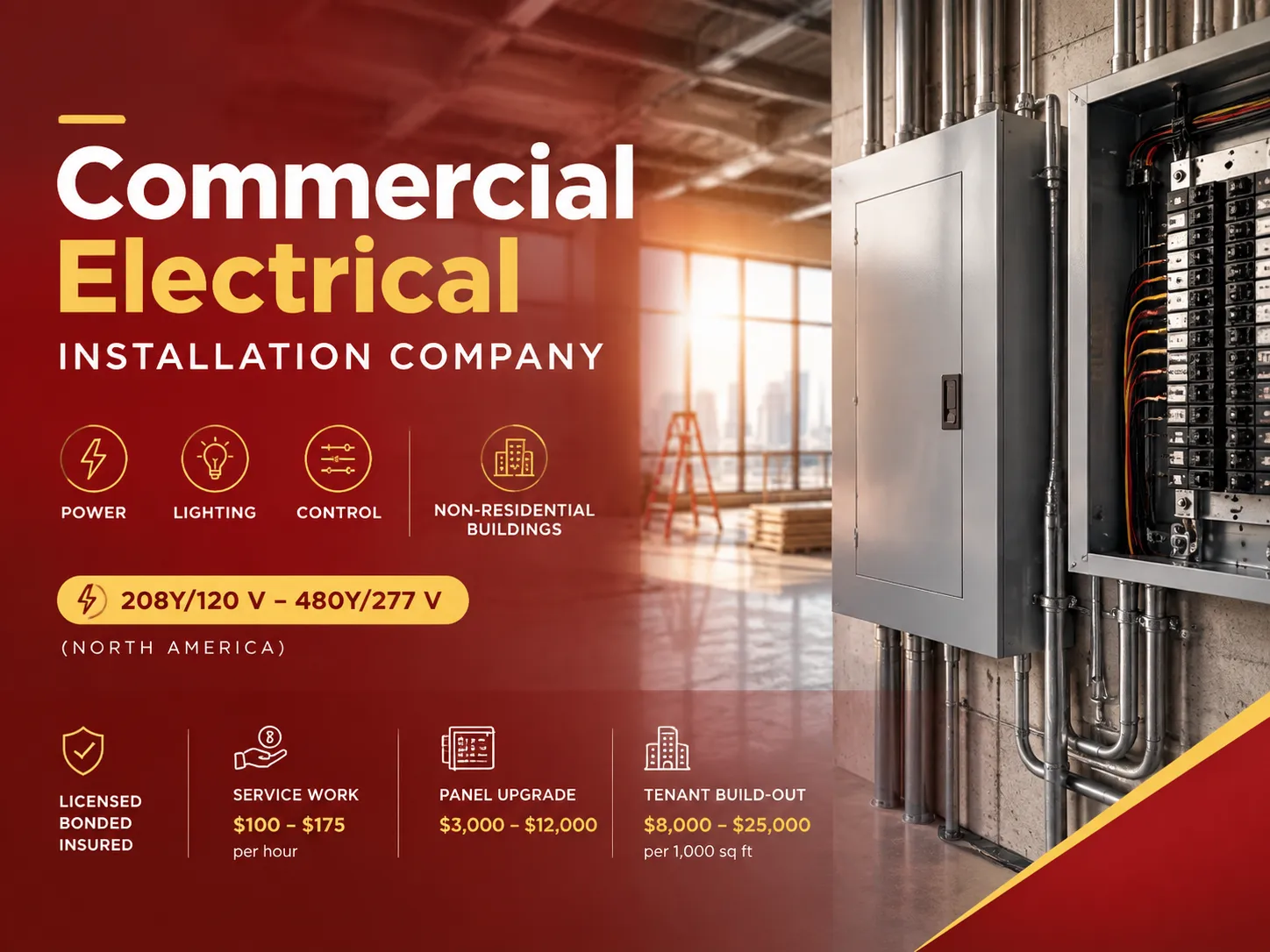
Trả lời ngắn gọn: Nhà thầu điện là một doanh nghiệp thực hiện thiết kế, lắp đặt thiết bị, kiểm tra và vận hành các hệ thống điện trong các tài sản thương mại. Ở Bắc Mỹ, các hệ thống điện áp thấp hoạt động trong phạm vi điện áp danh định từ 208Y/120 V đến 480Y/277 V, có nghĩa là các công ty phải có giấy phép, bảo lãnh đảm bảo và bảo hiểm phù hợp theo yêu cầu của bang. Các dịch vụ cung cấp có thể có giá từ 100 đến 175 đô la mỗi giờ, trong khi nâng cấp bảng dịch vụ thương mại có thể tốn từ 3.000 đến 12.000 đô la và hoàn thiện khách thuê có thể từ 8.000 đến 25.000 đô la, trên mỗi nghìn bộ vuông diện tích mặt bằng. Tuy nhiên, trong một số trường hợp, các công ty quốc gia có thể quá đắt đỏ, vì một nhà thầu được cấp phép đáng tin cậy ở cấp địa phương có thể nhanh hơn và rẻ hơn một tập đoàn lớn. Trong bối cảnh này, HUYU làm việc với lắp ráp các hệ thống điện áp thấp, như hệ thống phân phối, nhà thầu và bộ ngắt mạch.
Công ty Lắp đặt Điện Thương mại Thực sự Làm Gì
Việc sử dụng mới là yếu tố xác định phạm vi, chứ không phải diện tích mặt bằng. Ví dụ, một văn phòng y tế có diện tích 40.000 bộ vuông và một kho phân phối cũng có diện tích 40.000 bộ vuông có diện tích bằng nhau nhưng yêu cầu rất khác nhau. Văn phòng y tế sẽ cần ổ cắm đất cách ly, thiết bị đạt chuẩn bệnh viện, mạch điện cho lối thoát hiểm khẩn cấp và một số phương tiện chuyển đổi máy phát điện. Kho phân phối sẽ cần chiếu sáng cao tầng, mạch điện cho bệ nâng dock và tải động cơ lớn.
Nhà thầu luôn chịu trách nhiệm về cửa vào dịch vụ và bảng phân phối chính, các mạch cấp nguồn và nhánh, điện năng và chiếu sáng, hệ thống sưởi và làm mát, nối đất và liên kết, cũng như bảo vệ chống sét. Sử dụng mô hình thiết kế và xây dựng, cùng một nhà thầu cũng thực hiện tính toán tải, tạo sơ đồ một dòng và phát triển các nghiên cứu ngắn mạch và phối hợp cần thiết để tuân thủ thiết kế. Tuy nhiên, trong trường hợp mô hình thiết kế-thầu thầu-xây dựng, công việc này do các kỹ sư thực hiện, để nhà thầu chỉ còn lại quá trình xây dựng.
Sự khác biệt giữa các tòa nhà thương mại và dân cư nằm ở loại hệ thống được sử dụng chứ không phải ở chất lượng tay nghề. Các tòa nhà thương mại sử dụng nguồn điện 3 pha: 208Y/120 V trong các tòa nhà thương mại và 480Y/277 V trong các tòa nhà hiện đại hơn. Ngoài ra, phương pháp đi dây bao gồm việc sử dụng ống dẫn và các dây dẫn riêng biệt thay vì cáp. Cuối cùng, hệ thống được thiết kế và định kích thước dựa trên các phép tính nhu cầu theo NEC Điều 220. Các thiết bị và bộ phận bên trong dòng phân phối đó tuân theo các tiêu chuẩn riêng của chúng — UL 489 cho cầu dao vỏ đúc, UL 1066 cho cầu dao mạch điện áp thấp, UL 891 cho bảng điều khiển, UL 1558 cho thiết bị chuyển mạch — và toàn bộ bộ tiêu chuẩn được bao gồm trong hướng dẫn dịch vụ điện thương mại.
Các công ty lắp đặt điện thương mại lớn nhất
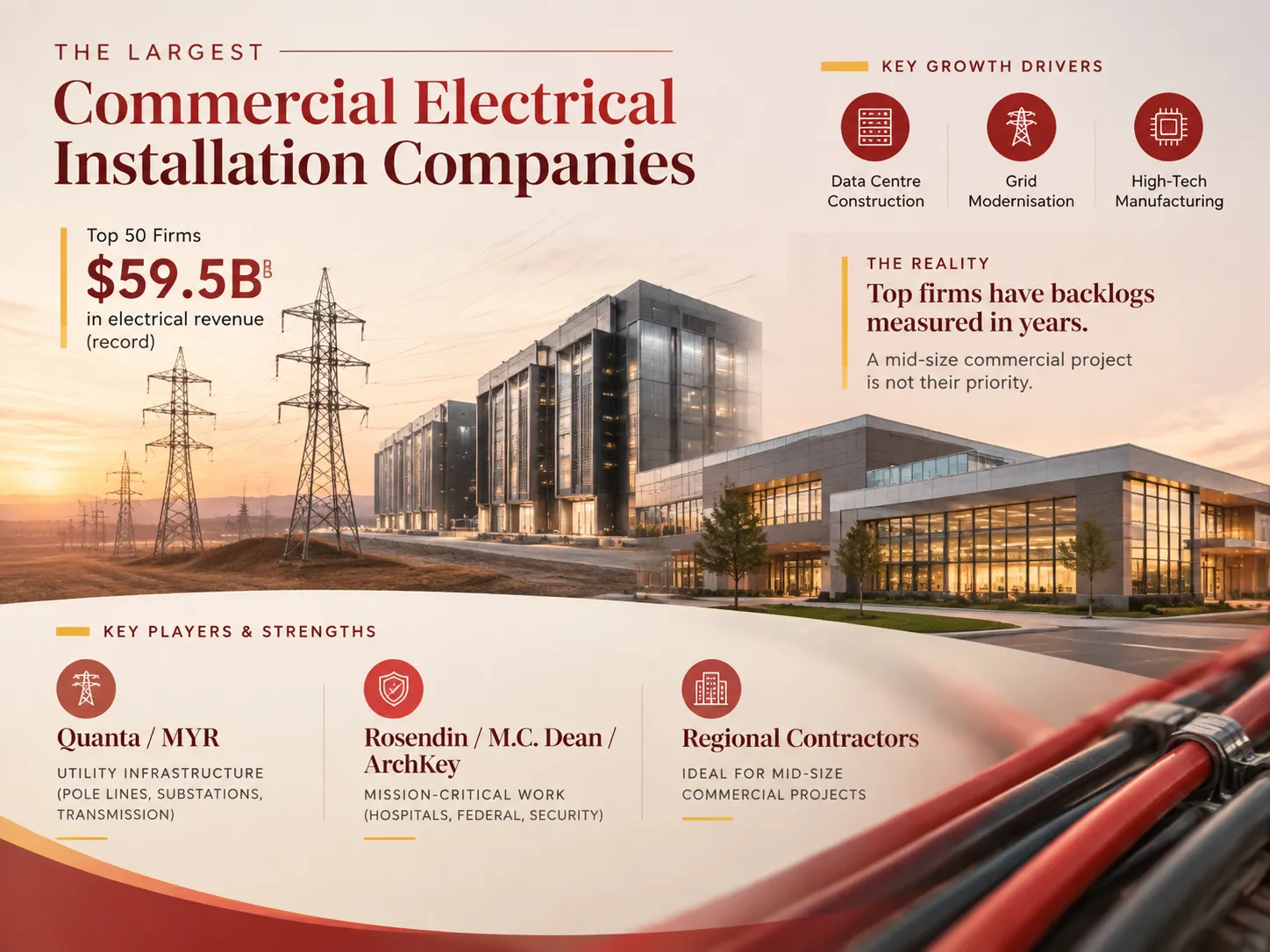
Các con số quy mô được lấy từ danh sách 50 nhà thầu điện hàng đầu của EC&M và danh sách 600 nhà thầu chuyên ngành hàng đầu của ENR, dựa trên doanh thu thực tế hàng năm. Tổng doanh thu của 50 nhà thầu hàng đầu trong chu kỳ vừa qua đạt mức kỷ lục $59,5 tỷ, chủ yếu được thúc đẩy bởi các dự án liên quan đến trung tâm dữ liệu, hiện đại hóa lưới điện và sản xuất công nghệ cao. Sự tập trung này đặc biệt quan trọng đối với khách hàng: các nhà thầu hàng đầu thực sự có danh sách công việc tồn đọng dài, có nghĩa là họ không ưu tiên các dự án thương mại quy mô trung bình.
| Công ty | Trụ sở | Doanh thu điện năm 2025 | Nơi họ mạnh nhất |
|---|---|---|---|
| Dịch vụ Quanta | Houston, TX | $13,5 tỷ | Truyền tải, phân phối, năng lượng tái tạo quy mô tiện ích |
| Rosendin Electric | San Jose, CA | $3,7 tỷ | Trung tâm dữ liệu, bán dẫn, thiết kế - xây dựng |
| EMCOR Group | Norwalk, CT | $3,6 tỷ | Cơ sở giáo dục, chăm sóc sức khỏe, mạng lưới và truyền thông |
| MYR Group | Thornton, CO | $3,4 tỷ | Đường dây T&D cùng thương mại và công nghiệp |
| Everus Construction Group | Bismarck, ND | $2,8 tỷ | Điện tiện ích và công nghiệp |
| IES Holdings | Houston, TX | $2,5 tỷ | Dịch vụ công nghiệp, cơ sở hạ tầng |
| MMR Group | Baton Rouge, LA | $2,3 tỷ | Thiết bị đo lường và điều khiển, công nghiệp nặng |
| M.C. Dean | Tysons, VA | $1,9 tỷ | Hệ thống quan trọng, liên bang, an ninh |
| ArchKey Solutions | St. Louis, MO | $1,7 tỷ | Công nghệ, chăm sóc sức khỏe, giáo dục |
| Faith Technologies (FTI) | Menasha, WI | $1,4 tỷ | Lắp ráp sẵn, điều khiển công nghiệp |
| E-J Lắp đặt điện | Long Island City, NY | $1,36 tỷ | Khu vực đô thị New York, cơ sở giáo dục và giao thông công cộng |
| Helix Electric | San Diego, CA | $957 m | Đa gia đình, khách sạn, năng lượng mặt trời |
Hiểu cách đọc bảng quan trọng hơn việc ghi nhớ nó. Quanta và MYR chủ yếu cung cấp tiện ích – đường dây cột, trạm biến áp và truyền tải – đây là một lĩnh vực khác so với việc đi dây cho bệnh viện. Rosendin, M.C. Dean và ArchKey hoạt động trong môi trường nhiệm vụ quan trọng, nơi chi phí ngừng hoạt động của khách hàng cao hơn chi phí xây dựng. Nếu một dự án bao gồm cải tạo văn phòng 60.000 sq ft bao gồm nâng cấp bảng điều khiển, không ai trong ba công ty này có thể cạnh tranh và nhà thầu cạnh tranh sẽ là một công ty địa phương mà bạn có thể chưa từng nghe đến. Bảng xếp hạng tương đương các nhà thầu lớn nhất theo lực lượng lao động thay vì doanh thu có trong phân tích các nhà thầu điện lớn nhất tại Mỹ.
Loại công ty mà dự án của bạn thực sự cần
Ngành có năm mô hình kinh doanh nổi tiếng, mỗi mô hình đấu thầu rất khác nhau. Sai lầm phổ biến và tốn kém nhất trong việc lựa chọn này là chọn sai loại; một công ty xuất sắc ở một loại có thể không thể thực hiện loại khác về mặt cấu trúc.
| Loại công ty | Hợp đồng điển hình | Nơi họ thắng | Nơi họ gặp khó khăn |
|---|---|---|---|
| Nhà thầu EPC quốc gia / tiện ích | Trạm biến áp, truyền tải, năng lượng mặt trời quy mô tiện ích | Năng lực bảo lãnh, chiều sâu kỹ thuật, đội ngũ đa tiểu bang | Công việc xây dựng nhỏ; kích thước dự án tối thiểu loại trừ họ |
| Nhà thầu thương mại khu vực | Văn phòng, trường học, bán lẻ, chăm sóc sức khỏe, hoàn thiện nội thất | Kiến thức mã địa phương, quan hệ với thanh tra, giá cả cạnh tranh | Kỹ thuật nội bộ hạn chế; có thể cần kỹ sư bên ngoài |
| Chuyên gia dịch vụ và bảo trì | Thời gian và vật liệu, hợp đồng bảo trì | Thời gian phản hồi, kho phụ tùng, công việc kiểm tra định kỳ | Công việc đấu thầu; đội nhỏ, không có bảo lãnh dự án lớn |
| Nhà tích hợp công nghiệp và điều khiển | Điều khiển động cơ, PLC, VFD, nguồn quy trình | Vận hành, khắc phục sự cố, thời gian hoạt động sản xuất | Công việc kiến trúc và nhạy cảm với hoàn thiện |
| Thiết kế-xây dựng nguồn đơn | Phạm vi đầy đủ từ ý tưởng đến vận hành | Điểm chịu trách nhiệm duy nhất, rút ngắn lịch trình | Ít minh bạch về giá; thay đổi thiết kế được tính phí |
Trong trường hợp cơ sở hoạt động liên tục như nhà máy, phòng máy chủ hoặc trung tâm y tế, một trong những giải pháp tốt nhất là thuê hai nhà thầu, một cho công việc xây dựng và một cho quản lý thiết bị. Việc ký hợp đồng cả hai nhà cung cấp cho cùng một công ty thường dẫn đến hiệu suất kém ở cả hai lĩnh vực.

Chứng chỉ thực sự có giá trị
Quá trình cấp phép hoạt động như nhà thầu tại Bắc Mỹ được xử lý ở cấp bang, tỉnh hoặc chính quyền địa phương thay vì cấp quốc gia. Điều này có nghĩa là việc một nhà thầu điện được cấp phép thực hiện công việc liên quan đến một hoạt động nhất định ở một bang hoặc tỉnh không có nghĩa là họ có thể tự động hoạt động ở khu vực lân cận mà không cần giấy phép. Ngoài việc cấp phép, cũng quan trọng để xác minh các thông tin sau:
- Giấy phép nhà thầu điện trong khu vực pháp lý liên quan — ví dụ giấy phép C-10 ở California hoặc giấy phép thợ điện chính trong các khu vực cấp phép cho cá nhân thay vì công ty. Lưu ý rằng giấy phép này nên được xác minh trên trang web của hội đồng cấp phép liên quan thay vì trên tiêu đề thư của nhà thầu.
- Thành viên NECA — Hiệp hội Nhà thầu Điện Quốc gia. Tổ chức này là chỉ số về thành viên trong các cơ quan lao động và tiêu chuẩn tương ứng, nhưng không có nghĩa là nhà thầu đó đã nhận được chứng nhận an toàn.
- Liên kết với chương trình học nghề JATC — Ủy ban Học nghề và Đào tạo Chung chịu trách nhiệm đào tạo các thợ điện tương ứng và thu thập số giờ làm việc của họ trong ngành. Lưu ý rằng các nhà thầu điện độc lập có thể có các chương trình học nghề khác nhau nhưng cũng có thể đáng tin cậy.
- Danh sách UL 508A — nhà thầu nên có danh sách này nếu công ty tự sản xuất bảng điều khiển; nếu không, các bảng điều khiển không thể được bán mà không có danh sách này.
- Chứng nhận từ NABCEP — chỉ áp dụng khi cá nhân tương ứng thực hiện công việc trên hệ thống năng lượng mặt trời và lưu trữ năng lượng.
- Hồ sơ chứng minh hoàn thành khóa đào tạo NFPA 70E của nhân sự nhà thầu sẽ làm việc với các thiết bị điện. Đảm bảo bạn được cung cấp nhật ký đào tạo hiện tại.
- Chứng nhận ISO 9001, 14001 và 45001 — liên quan đến hệ thống chất lượng, môi trường và an toàn lao động mà nhà thầu áp dụng.
- Giấy chứng nhận bảo hiểm và trách nhiệm — đề cập đến bảo hiểm trách nhiệm chung và bảo hiểm bồi thường lao động mà nhà thầu điện có liên quan đến giá trị công việc.
Một tiêu chuẩn khác không liên quan đến an toàn là kiểm soát chi phí: đây là tài liệu về chu kỳ mã mà khu vực pháp lý của bạn đang áp dụng. Đối với một công ty có kinh nghiệm hiện tại được ghi nhận đến hai phiên bản mã mới nhất, họ sẽ phải học lại cách làm và làm thế nào để làm, với chi phí cao hơn cho ngân sách của bạn. Ghi chú của chúng tôi về giới hạn điện trở cho lắp đặt điện tòa nhà thương mại cho thấy các yêu cầu đó thay đổi nhanh như thế nào.
Chi phí lắp đặt điện thương mại năm 2026
Trong các khảo sát giá báo cáo năm 2026, một học viên được tính phí từ $45 đến $85, một thợ điện hành nghề được tính phí từ $75 đến $165, và một thợ điện chính hoặc chuyên gia công nghiệp được tính phí từ $100 đến $225 theo xu hướng thị trường. Tổng số tiền khách hàng trả cho nhà thầu sẽ bao gồm tiền lương, phúc lợi nhân viên, bảo hiểm và các chi phí khác. Trong các dự án thương mại, hóa đơn có thể cao hơn đến 20% so với công việc dân dụng thực hiện trong cùng một cơ sở do có nhiều bảo hiểm, nỗ lực tài liệu và thời gian thanh toán hơn. Các công ty có lực lượng lao động thuộc công đoàn ở các bang Trung Tây và Đông Bắc có xu hướng tính phí cao hơn khoảng 20% đến 40% so với đối thủ cạnh tranh.
| Hạng mục công việc | Phạm vi điển hình năm 2026 | Ghi Chú |
|---|---|---|
| Giờ làm việc của thợ điện hành nghề được tính phí | $100–$175 | Most contractors bill at firm rate, not individual wage |
| Minimum service call | 2–4 hours billed | Often plus a $75–$195 dispatch fee |
| After-hours or weekend emergency | 1.5–2.0× rate | Storm and restoration work quoted on site |
| Commercial service panel upgrade, 200–400 A | $3,000–$12,000 | Rises to $12,000–$28,000 at 600–800 A |
| Three-phase power installation | $5,000–$20,000+ | Utility coordination time is a variable cost |
| New circuit installation | $300–$1,200 per circuit | Conduit and ceiling access drive the spread |
| LED lighting retrofit, per 1,000 sq ft | $1,500–$6,000 | Per-fixture: $85–$285 installed |
| Tenant electrical build-out, per 1,000 sq ft | $8,000–$25,000 | Includes materials, labour, permits, inspection |
| Commercial EV charger, Level 2 | $2,500–$7,500 per port | DC fast charging: $45,000–$120,000 |
| Standby generator, 100–500 kW installed | $55,000–$180,000 | Transfer switch and fuel storage additional |
| Permits and inspection fees | $300–$2,000 | Multi-point inspections add rounds |
| Load study and panel inspection | $500–$1.500 | Cheapest line on the list; most often skipped |
There are three factors accounting for differences between two quotations for a project of the same nature. First is the age of the building and status of the wiring: obsolete feeder sizes, aluminium branch circuits and hidden junction boxes all relate to labour costs. The second is whether the work can be done live or requires a shutdown: a shutdown is a cost for the client as much as for the contractor. The third factor is access: the height of the ceiling, whether it is finished or whether any lift required will be of greater significance than the equipment.Panel and service pricing specifically is detailed in our cost breakdown for electrical panel replacement.
How to Vet a Bidder Before the Contract Is Signed
The sequence to verify that minimizes the number of financial transactions.
- Check the license number with the issuing authority by looking it up on its official records. Compare the license number of the company, its type, and expiration date with those on the license certificate. A valid license that does not have the necessary coverage is worse than not having a license at all, as it will be discovered during the inspection.
- Get a copy of the insurance policy directly from the insurers. The certificates must state the name of the contractor as the recipient. Ask explicitly if the workers’ compensation insures everyone who will spend time on the job, including subcontractors.
- Figure out who is supposed to run the project. The “face” in the sales meeting will not be the one who is in charge. So ask them for the foreman’s name and license class, and how many projects the foreman is currently managing.
- Ask for a detailed breakdown; not just a total sum. The quote must contain all the items such as raw materials, labors, permits, temporary power, etc. For instance, you will get nothing from a quote like “15000 for electric works.”
- Ask for written exclusions. The exclusions usually include drywall repair after wiring completion, painting, coordination work with the utility company, building permits, and the temporary power cost during the construction. Each one of those is going to appear in the change orders later.
- Get at least three quotes and compare them. You will usually find that quotes may vary significantly – on an average they may differ by 30-50%. A quote on the low end of the scale deserves explanation rather than being taken for granted.
- Require necessary test results as a deliverable. Accepting the final outcome without getting results of insulation resistance, earth continuity, polarity, and loop impedance tests creates problems with the installation.
- Check the progress of two reference projects of the same size. Ask the last client two questions: was the final invoice within the 10% of the total sum; and were the inspections passed?
Choosing by Region: United States, United Kingdom and the EU
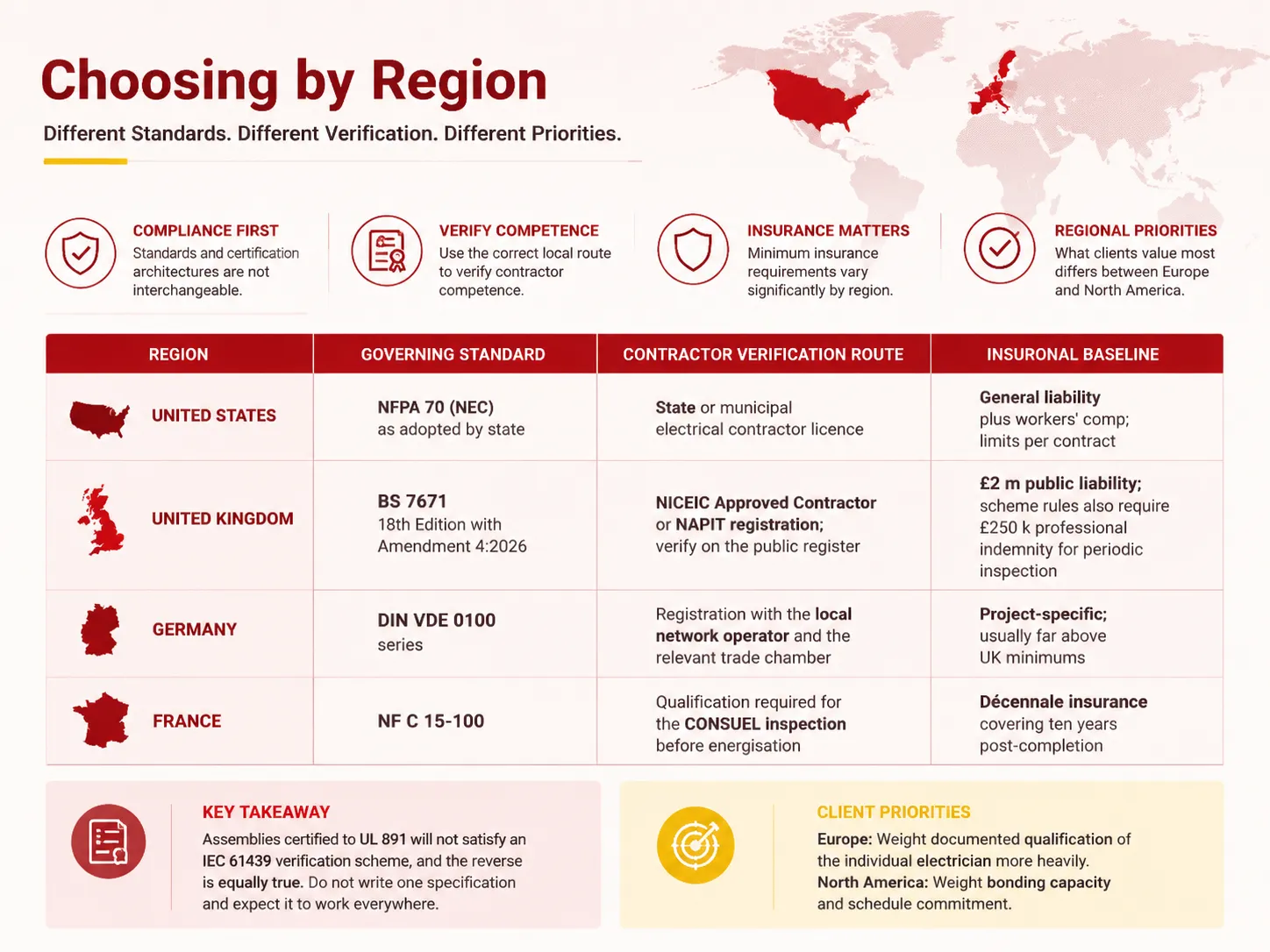
The differences in selection criteria are greater than most consumers believe since the compliance structure is not the same. North America follows the National Electrical Code (NFPA 70), which is adopted state by state with local amendments, and is certified to UL standards, while Europe follows IEC 60364 via its national wiring regulations and certifies equipment using IEC 61439 series which is different than UL 891 and UL 1558 in construction principles.
| Khu vực | Tiêu chuẩn quản lý | Contractor verification route | Insurance baseline |
|---|---|---|---|
| Hoa Kỳ | NFPA 70 (NEC) as adopted by state | State or municipal electrical contractor licence | General liability plus workers’ comp; limits per contract |
| Vương quốc Anh | BS 7671, 18th Edition with Amendment 4:2026 | NICEIC Approved Contractor or NAPIT registration; verify on the public register | £2 m public liability; scheme rules also require £250 k professional indemnity for periodic inspection |
| Đức | DIN VDE 0100 series | Registration with the local network operator and the relevant trade chamber | Project-specific; usually far above UK minimums |
| Pháp | NF C 15-100 | Qualification required for the CONSUEL inspection before energisation | Décennale insurance covering ten years post-completion |
Two important outcomes can be noted. Firstly, in the UK the most important filter that leads to registration is the registered competent-person scheme: the NICEIC registers and certifies nearly 33,000 businesses, conducts audits of some works by each company on an annual basis and obliges them to have the most recent version of the wiring regulations in possession. Consequently, public sector clients insist on the fact that only competent-person scheme registered firms can appear on tender lists. Secondly, in France it is impossible to energize any installation until it is inspected by CONSUEL, meaning that the contractor is certified by a third party before the client receives the service, which control does not exist in most regions of the USA.
When purchasing something that might be subjected to various national regulations, take care not to write one common specification. In the USA assemblies which were verified in accordance with UL 891 certification can be considered compliant with IEC 61439 regulations, and vice versa.
Red Flags and Contract Terms Worth Pushing Back On
Very low bids, those that appear more than 30% below the second lowest bid, are a clearly sign of a problem and invariably indicate one of four issues: use of unlicensed contractors, a lapse in the insurance certificate, the fact that permit fees were not included in the estimate, or avoidance of issues to come later due to incorrect substitution of materials after contract award. All four issues impact the owner eventually, with issues related to the latter usually occurring during failure investigation.
In addition to what has been mentioned above, we should also pay attention to contracting firms that would either not do the permitting under their name, answer scope questions without documents but verbally, or require a deposit of sums that are more than the cost of materials ordered. From a purely contractual standpoint, three items deserve scrutiny in the contract. The retainage clause states that part of the payment is held until the project is in compliance with the standards; the change-order clauses determine the payments in advance of the actual work; the completion and testing clause specifies the documents submitted by the contractor as proof of compliance so that the owner can get these documents in the end.
Câu hỏi thường gặp
How much does an electrician charge for commercial work?
In 2026, it is expected that commercial work in the U.S. cost around $100–$175 an hour for a licensed journeyman, while master electricians and industrial specialists charge $145–225 in areas with high costs. The majority of commercial contractors charge at a fixed rate which covers all the overhead and costs of insurance rather than simply billing for the person’s pay. Normally there will be a minimum charge of 2–4 hours for a service call and an application of 1.5–2.0 multiplier with a trip charge in case of after-hours call the client receives. Pricing for the projects is considered separately where the service of 200–400 A increases the expenses from $3,000 to $12,000, and for a tenant build-out the prices vary between $8,000 and $25,000 for 1,000 square feet.
Why is Romex not allowed in commercial buildings?
Though non-metallic sheathed cable is not completely forbidden, the list of permitted uses is limited. NEC Article 334 describes the requirements for the use of non-metallic sheathed cable. It is outlined in Section 334.10 that it may be used in one- and two-family dwellings, in addition to other types of buildings of Type III, IV and V constructions — that means wood-framed buildings and heavy-timber buildings, but must be used behind some fire-resistant barrier or inside the areas that are unlikely to be damaged. Section 334.12 bans the use of the cable in Type I and Type II construction due to the fact that this included buildings are made of steel and concrete and includes commercial buildings, such as theatres, motion picture studios, garages and battery rooms, including the places that are located above dropped ceilings in non-residential buildings. Additionally, there may not be the possibility to use the non-metallic cable in constructed concrete or in wet locations. The protection is referred to as justification — a non-metallic coat neither provides mechanical protections nor has any fire protection features in comparison to MC cable or conduit. In most cases, when making the buildings of commercial purposes, this cable is neglected due to the type of construction of it.
Is there a difference between commercial and residential electricians?
Certainly, it is structural in nature rather than cosmetic. The work of the residential electricians is nearly all within the basic single-phase 120/240 V systems with the usage of sheath cables and the dimensions of circuits calculated from the standard dwelling load calculation. On the other hand, the commercial electricians operate with the three-phase systems such as 208Y/120 V and 480Y/277 V systems using conduit and individual conductors and determining their services based on the commercial demand. They should also have experience with motor operations, electric generators, transformer systems, etc. The industrial electricians represent the last specialization that is aimed at machines and conversion of electric energy into another type of work. Many middle-sized companies have all three kinds of work but it is worth being sure of the crew you get because the company might have license but the crew on the site might not have any necessary skills.
What are the three types of electrical installation?
These installations are divided into residential, commercial and industrial categories, and they vary in terms of voltage category, type of wiring and type of potential risks. Residential installations include homes and other dwellings such as homes using low-voltage single-phase AC systems with voltages of 120 or 240-volt, armoured cables, distribution boards and systems to charge electric cars. Commercial installations cover operating buildings from offices to hotels, hospitals and schools with three-phase voltage range from 208 volts to 480 volts, trunks for wiring and systems supplying electric energy for CCTV, ventilation and air conditioning. Industrial installations include plants and other heavy industry sites where large amount electrical power used for running heavy machinery results in losses in a case of a power outage.
Tài liệu tham khảo
- NFPA — NFPA 70 National Electrical Code
- NFPA — 70E Standard for Electrical Safety in the Workplace
- UL Solutions — Product safety standards and listings
- Hiệp hội Nhà thầu Điện Quốc gia (NECA)
- EC&M Magazine — Top 50 Electrical Contractors ranking
- ENR — Top 600 Specialty Contractors
- Cục Thống kê Lao động Hoa Kỳ — Triển vọng Nghề nghiệp Thợ điện
- NICEIC — Approved Contractor scheme requirements
- IET — BS 7671 Requirements for Electrical Installations
- UK Health and Safety Executive — Electrical safety guidance
Kết luận
The ideal commercial electrical installation contractor is one with the proper license for the task, equipped with a competent team trained in the technology used in the facility, and ready to provide the documents necessary to confirm their credentials on the register, not just in a brochure. Size makes a poor indicator of suitability; the top revenue companies are engaged in building transmission lines and data centers, not performing your service upgrade.
Three things must be followed in any project. First, check credentials with the proper authorities before making the first payment rather than after. Second, demand that you receive all “as built” documentation, designs of the panels, and testing results before transferring last payment rather than as an afterthought. Finally, make sure three bidders provide you with the detailed scope of work since differences between the bids reveal the risk associated with a project better than any single price does. If you follow all the above, electrical work will become no more than what it is supposed to be in a project.