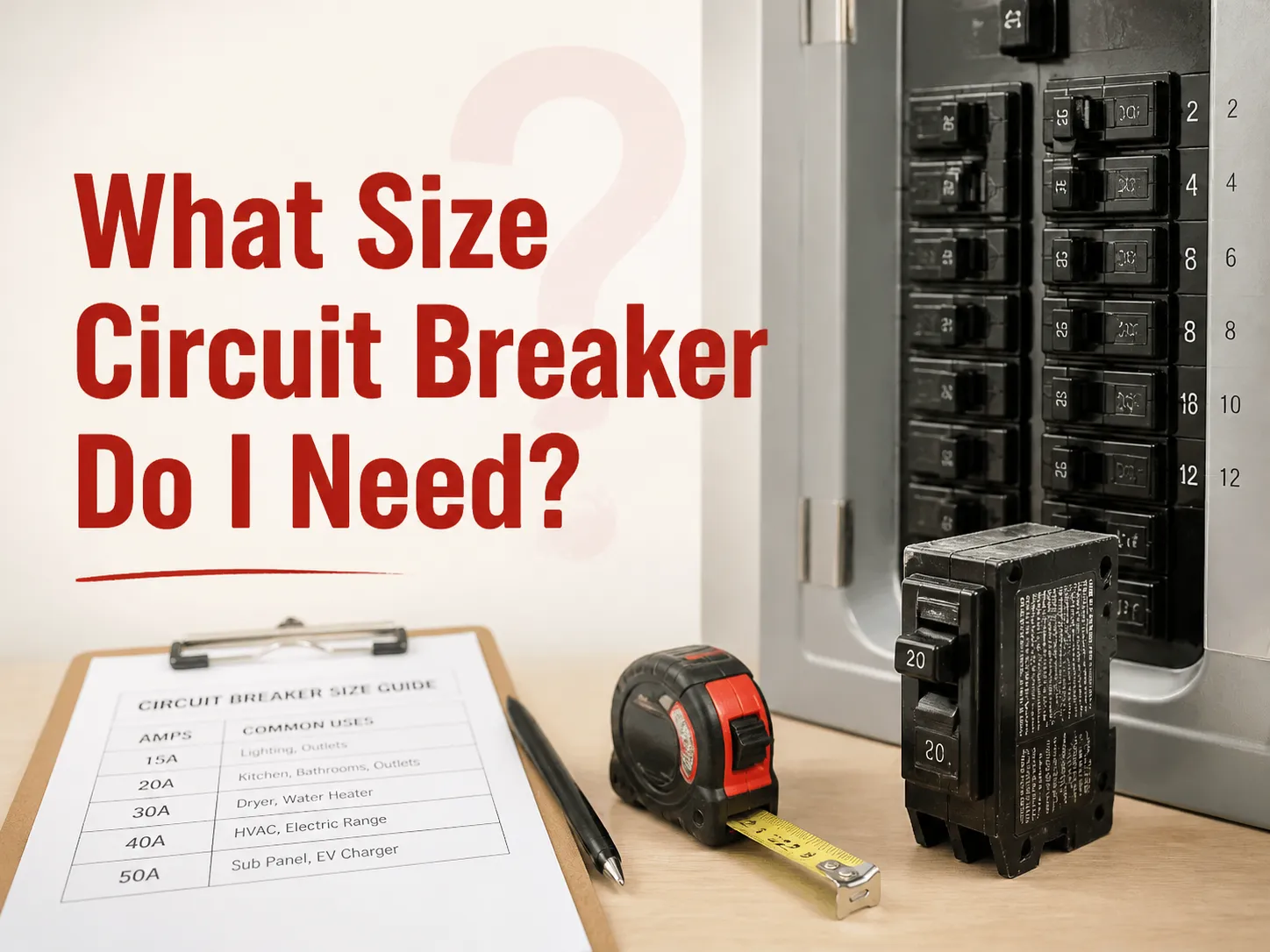

When you search for electrical services in the USA, you will find a range of listings, including that of a Fortune 500 infrastructure conglomerate and a small, two-truck operation that deals mostly in installing ceiling fans. While both may be in the same industry, they don’t compete for the same jobs, and there will not be a similarity between their quotes. The electrical services industry in the USA can best be understood by recognizing that it is made up of four different segments stacked one on top of the other, and the best way to lose a month is to send a quote for a 400 kW standby generator installation to the wrong segment.
What follows in the text is a practical guide to these segments of the market: a list of ten US companies in the electrical services industry, their niche area of expertise, their headquarters, duration of their projects, and the costs incurred for different jobs. It also discusses one important segment most customers do not pay attention to – the right type of provider best suited for handling their project.
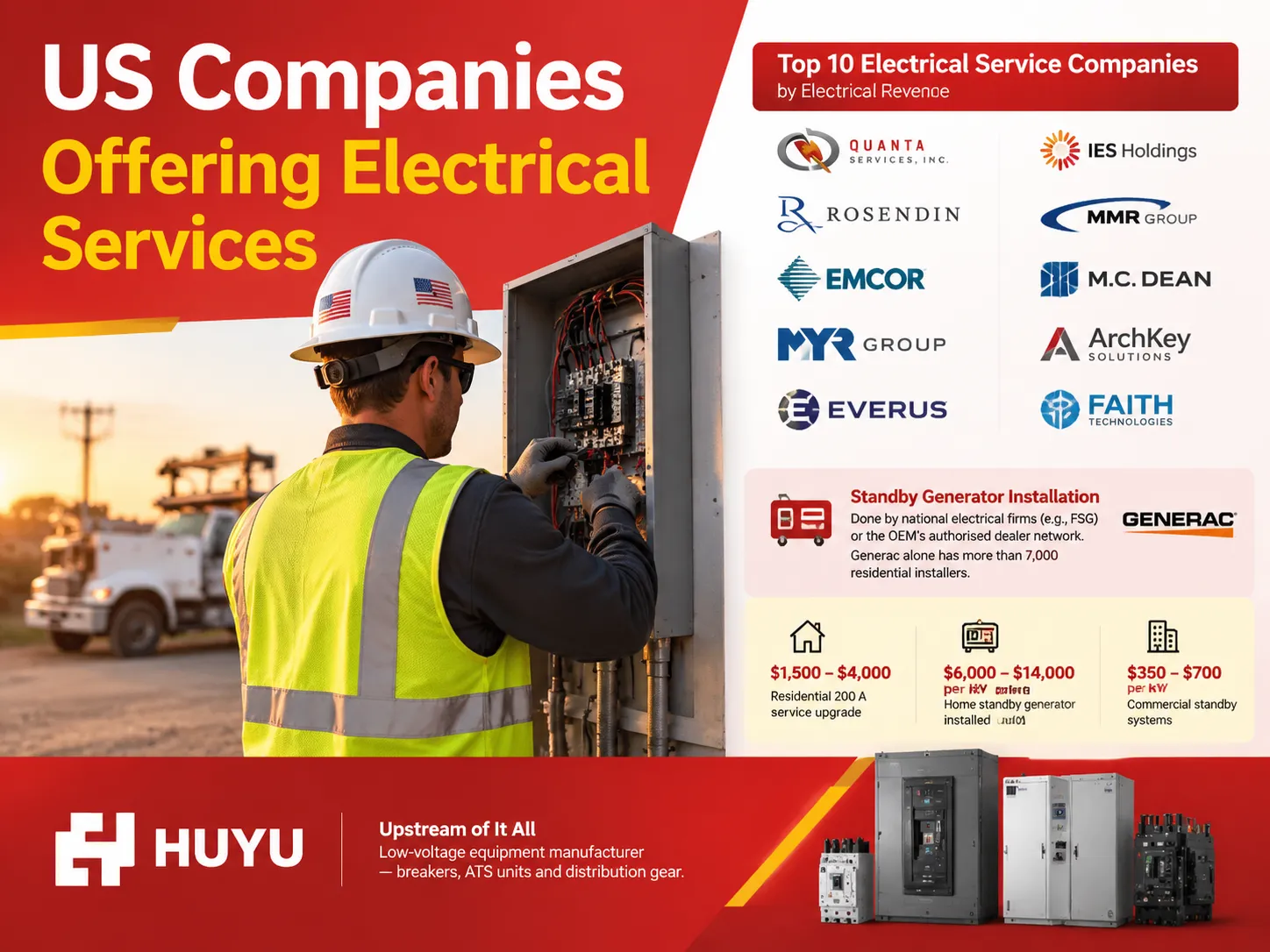
Here is the list of the ten foremost electrical service providers in the United States by revenue — Quanta Services (Houston, ~ US$ 13.5 billion), Rosendin (San Jose, ~ US$ 3.7 billion), the electrical branch of EMCOR (Norwalk, Connecticut; ~ US$ 3.6 billion), MYR Group (Thornton, Colorado; ~ US$ 3.4 billion), Everus (Bismarck, North Dakota; ~ US$ 2.8 billion), IES Holdings (Houston, ~ US$ 2. 5 billion), MMR Group (Baton Rouge, ~ US$ 2. 3 billion), M.C. Dean (Tysons, Virginia; ~ US$ 1.9 billion), ArchKey Solutions (St. Louis, ~ US$ 1.7 billion), and Faith Technologies (Menasha, WI, ~ US$ 1.4 billion). They are key players when it comes to functional service of utility, industrial and mission-critical enterprises. If we focus on standby generator installation, the works are performed either by the nationwide electrical service company such as FSG or through OEM’s franchising network as Generac having over 7,000 suppliers working at the residential segment alone.
The Four Layers of the US Electrical Services Market
The structure comes before the names. A majority of electrical contractors in the US can be classified under one of the four layers distinguished from each other by the specifics related to licensing, crew composition, and commercial contracts.
- Layer 1 – utility providing T&D services. These crews are responsible for installing substations, working on 69-765 kV transmission lines, and maintaining distribution circuitry. Work is awarded through utility master service agreements. Examples of such companies are Quanta and MYR Group. They definitely won’t be useful for restaurants.
- Layer 2 – industrial and mission-critical companies. Petchem plants, semiconductor manufacturing facilities, data centers, and hospitals can be taken as examples. There are high voltages at site, engineered drawings, arc flash studies, and commissioning documents. Companies involved – MMR, M.C. Dean, and Faith Technologies.
- Layer 3 – commercial construction and service sector. Office upgrades, retail, multifamily, and educational institutions can be placed in this layer. Voltages involved 120/208V, 277/480V, self-performed conduit wiring and service calls. Companies operating in this sector – Rosendin, EMCOR, ArchKey and thousands of regional players.
- Layer 4 – residential construction and light commercial services. Concerning such services, panel swaps, EV chargers, and generators can be considered. The operators working in these companies are Master electricians who run the business from their vans.
Bad procurement decisions are usually made when organizations are hiring Layer 1 companies for Layer 4 services and vice versa. A utility contractor will never send a vehicle for a tripping AFCI breaker, whereas a Layer 4 company cannot deliver a 15 kV switchgear package.
Ten US Companies Offering Electrical Services, Side by Side
The roster below is ranked by electrical contracting revenue, using the ENR and Modern Distribution Management rankings that the industry itself treats as the reference. The full roster of electrical contractors operating across the United States runs far beyond ten once you count the strong regional players — Miller Electric, Guarantee Electrical, Cupertino Electric, Helix Electric and others all carry serious volume in their home markets.
| บริษัท | สำนักงานใหญ่ | Electrical revenue | Built for |
|---|---|---|---|
| Quanta Services | ฮูสตัน, เท็กซัส | ~$13.5 bn | Utility T&D, substations, renewables |
| Rosendin | ซานโฮเซ, แคลิฟอร์เนีย | ~$3.7 bn | Data centres, semiconductor, tech campuses |
| EMCOR (electrical segment) | นอร์วอล์ค, คอนเนตทิคัต | ~$3.6 bn | Commercial, healthcare, mechanical + electrical bundles |
| MYR Group | ธอร์นตัน, โคโลราโด | ~$3.4 bn | T&D line and substation, C&I construction |
| Everus Construction Group | บิสมาร์ค, นอร์ทดาโคตา | ~$2.8 bn | Utility, transmission, industrial |
| IES Holdings | ฮูสตัน, เท็กซัส | ~$2.5 bn | Industrial, data centres, residential new build |
| MMR Group | บาตันรูช, หลุยเซียนา | ~$2.3 bn | Refineries, instrumentation, industrial turnaround |
| M.C. Dean | ไทสันส์, เวอร์จิเนีย | ~$1.9 bn | Mission-critical, secure government, cyber-physical |
| ArchKey Solutions | เซนต์หลุยส์, มิสซูรี | ~$1.7 bn | Commercial, healthcare, education |
| Faith Technologies | เมนาเช, วิสคอนซิน | ~$1.4 bn | Manufacturing, data centres, prefabrication |
What Each of the Ten Is Actually Good At
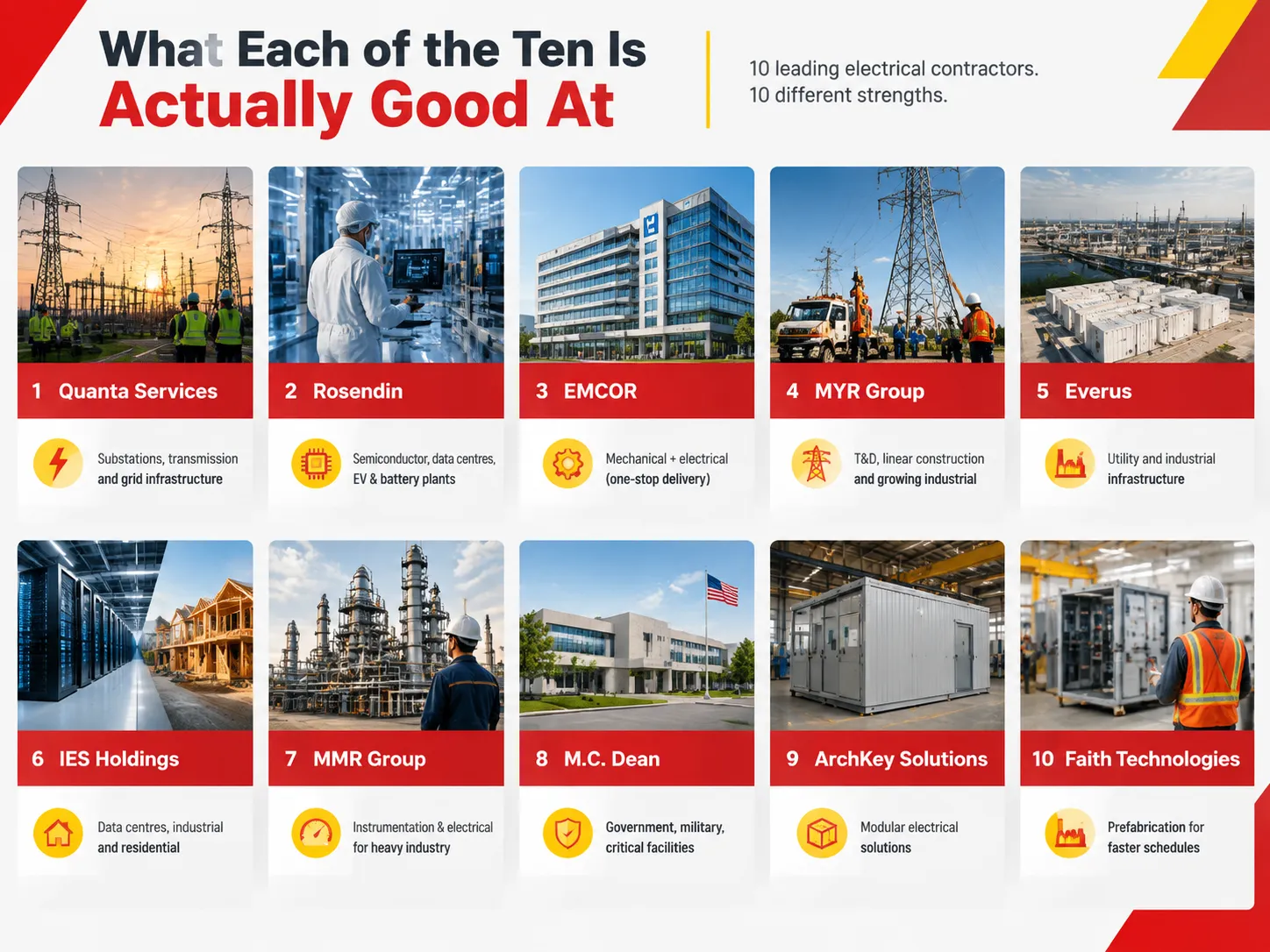
Quanta Services is a massive electrical contractor in the US. Most of the company’s projects are related to electric power infrastructure such as substations and transmission line rebuilds. It makes perfect sense to have Quanta on the list of contractors since the company can mobilize its 40,000 employees and fleet anywhere. There is, however, a downside to using this contractor in building operations; the customer is probably not big enough for Quanta to find the order attractive.
Rosendin is an employee-owned company, which makes the crew work on large projects with high retention rates. Rosendin’s core competence includes engineering work in the area of technology of the Western Coast, such as semiconductor fabrication plants, massive data centres, or battery plants. Being employee-owned means very slow decision-making at top management level.
EMCOR offers mechanical and electrical services during a single contract. There is a reason why customers want to go for this technical cooperation; it significantly simplifies the process of building because mechanical and electrical processes are well-coordinated without spending extra time.
MYR Group is a group of companies that supplies electrical services under its subsidiaries, which have been in the top-5 contractors in the USA for almost thirty years now. The company’s main specialization is T&D operations, such as building high-voltage transmission lines and substations connecting electric energy from its generator to consumers. The commercial and industrial segments of the market are less developed, though. The company excels at linear construction projects and would hardly be able to fit any bulky construction operations in the company’s structure.
Everus emerges from MDU Resources and focuses on both utilities and industrial infrastructures. More diversified than anticipated, IES Holdings operates in the industrial and datacentre sector and has a significant residential construction sector in the United States that gives them a unique insight into cycles in the housing markets.
MMR Group specializes in the electrical and instrumentation fields for heavy industry. If your plant runs turnaround times measured in shifts rather than weeks, then you are speaking their language. Budgets are also shaped by how a contractor is staffed: a commercial electrical installation company that self-performs its conduit and wire crews will hold a schedule better than one that brokers labour, and on a refinery shutdown the difference is measured in days of lost production.
M.C. Dean is the company that works in the settings where failure is impossible- data centers owned by the government, military bases, and intelligence centers. It began functioning in 1949, and is located in Tysons, Virginia, employing around 9,000 employees, out of them 1,000 have security clearance. It has purchased the majority of the shares of Bells Power Group, an established company in the UK that assists with designing, installing, and maintaining electricity supply systems since 1898, showing the market direction.
ArchKey Solutions and Faith Technologies occupy the last places in the top ten companies. Faith Technologies stands out due to its method of prefabrication; they manufacture electrical holes in a factory.
Standby Generator Installation: The Layer Most Buyers Get Wrong
The point at which standby generator installation diverges from the actual reality is in clarifying who wants to install a generator. Firms like M.C. Dean, MYR and Faith Technologies are all in the generator installation business. However, they’re likely to refuse any residential contracts using a 22 kW generator.
Indeed, the reality of the standby generator installation market breaks down into three distinct areas:
| Channel | Typical size | Installed cost | Who does it |
|---|---|---|---|
| Residential dealer network | 7–26 kW | $6,000–$14,000 | Generac (7,000+ installers), Kohler, Briggs & Stratton certified dealers |
| National commercial electrical firm | 500 kW–4 MW+ | $350–$700 per kW | FSG, Power Plus, GenServe, regional integrators |
| Mission-critical / OEM direct | 2–50 MW | Project-bid | Cummins, Caterpillar, Kohler, M.C. Dean |
Two statistics lend credence to the cost of the outages. EPRI and Primen estimate the average cost of a one-hour outage for industrial and digital economy businesses to be in the neighborhood of $7,800 per hour, while the EIA data indicates that the average major outage will take about nine hours in 2024—more than double the average in the previous decade. A cold storage facility of 300,000 sq ft loses all its product by the end of the eighth hour.
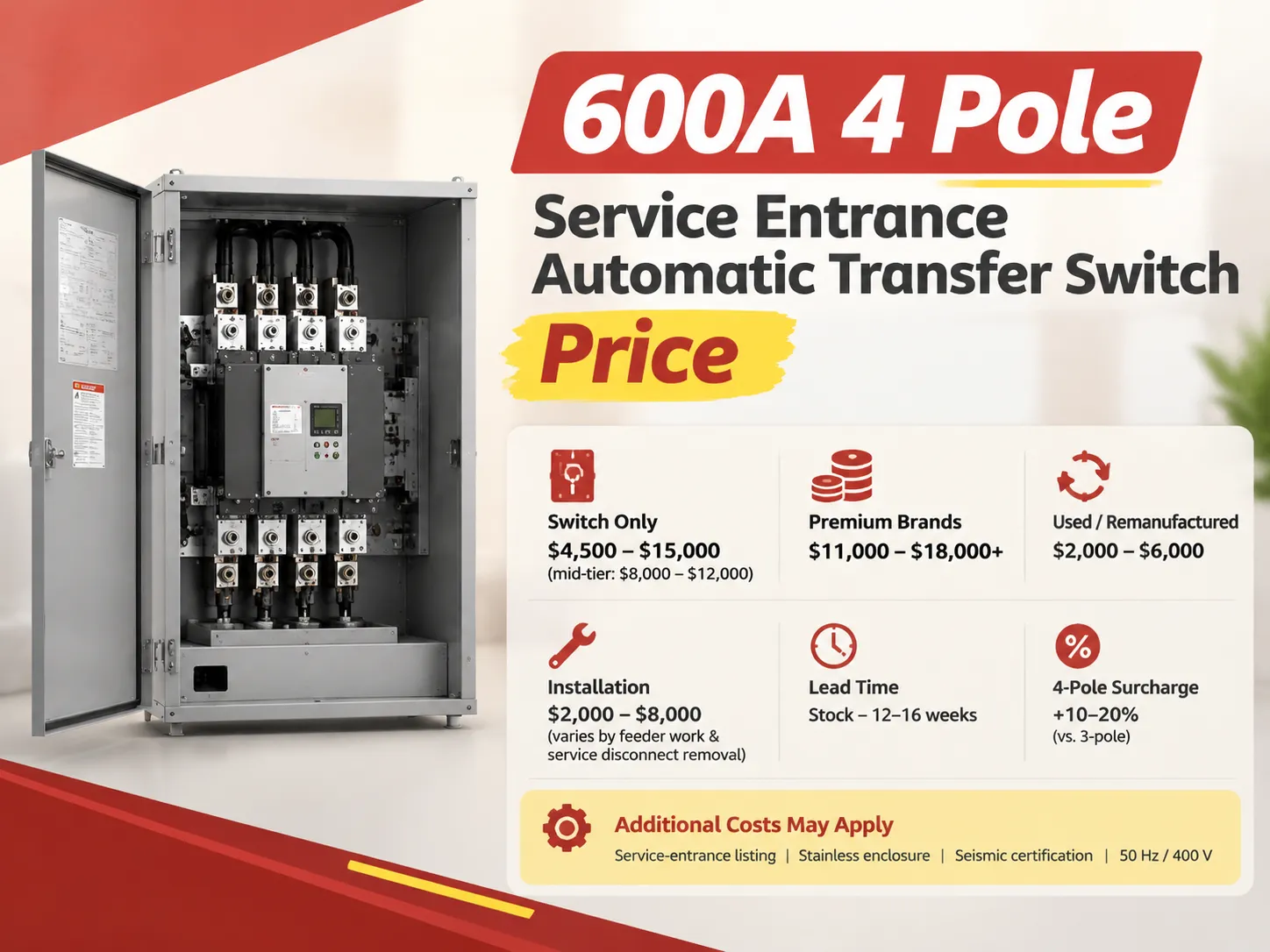
What counts in this context is not the generator but the transfer of power. The load of the data center needs transferring in less than 10 seconds to remain within UPS operating time. Hospitals are held to this same standard under NFPA 99, which also has NFPA 110 Level 1 testing criteria. Commercial and industrial stand-by systems under NEC Article 701 and 702 are allowed as much as 60 seconds.A three-phase automatic transfer switch sized to the full service — not to the emergency load — is what determines whether you land inside that window or outside it, and it is the single most common item buyers under-spec.
The other thing to consider is fuel capacity. The NFPA 110 requires Level 1 life safety systems to have minimum fuel supplies of 24 hours and Level 2 systems, 8 hours. You can also expect trouble if no one has tested the generator on load at least once per month. According to data, idle-only generators fail on demand in 15 to 20 percent of cases, compared to less than 3 percent of failure in the same situation for generators that have been tested for 30 minutes every month.
Delivery Timelines: What “Lead Time” Really Means for Each Layer
In the context of this industry, lead time signifies three different things, and contractors will choose whichever version makes them look most favorable. It is recommended to ask contractors to provide information on all three types of lead time: equipment lead time (i.e. the time from the factory to the site), permit lead time (i.e. the time from application through approval to energisation), and construction duration (i.e. the time from mobilisation to substantial completion).
| Project type | อุปกรณ์ | Permit / utility | Build |
|---|---|---|---|
| Residential 200 A service upgrade | 1–2 weeks | 2–6 weeks | 1–3 days |
| Home standby generator (22 kW) | 3–10 weeks | 2–8 weeks | 1–3 days |
| Commercial tenant fit-out | 2–8 weeks | 4–12 weeks | 6–20 weeks |
| Commercial generator, 500 kW–2 MW | 20–52 weeks | 8–24 weeks | 2–8 weeks |
| Medium-voltage switchgear package | 20–40 weeks | 8–20 weeks | 8–20 weeks |
| Utility substation | 30–60 weeks | 12–36 months | 12–24 months |
During the supply crunch of 2022-2023, the lead time for medium-voltage switchgear increased to more than 60 weeks, and while it has improved since, the standard now is still in the range of 20-40 weeks. If your construction schedule is tight, you may not want to waste your time going back and forth with the contractor; instead, order the gear ahead of time or design around readily available equipment.
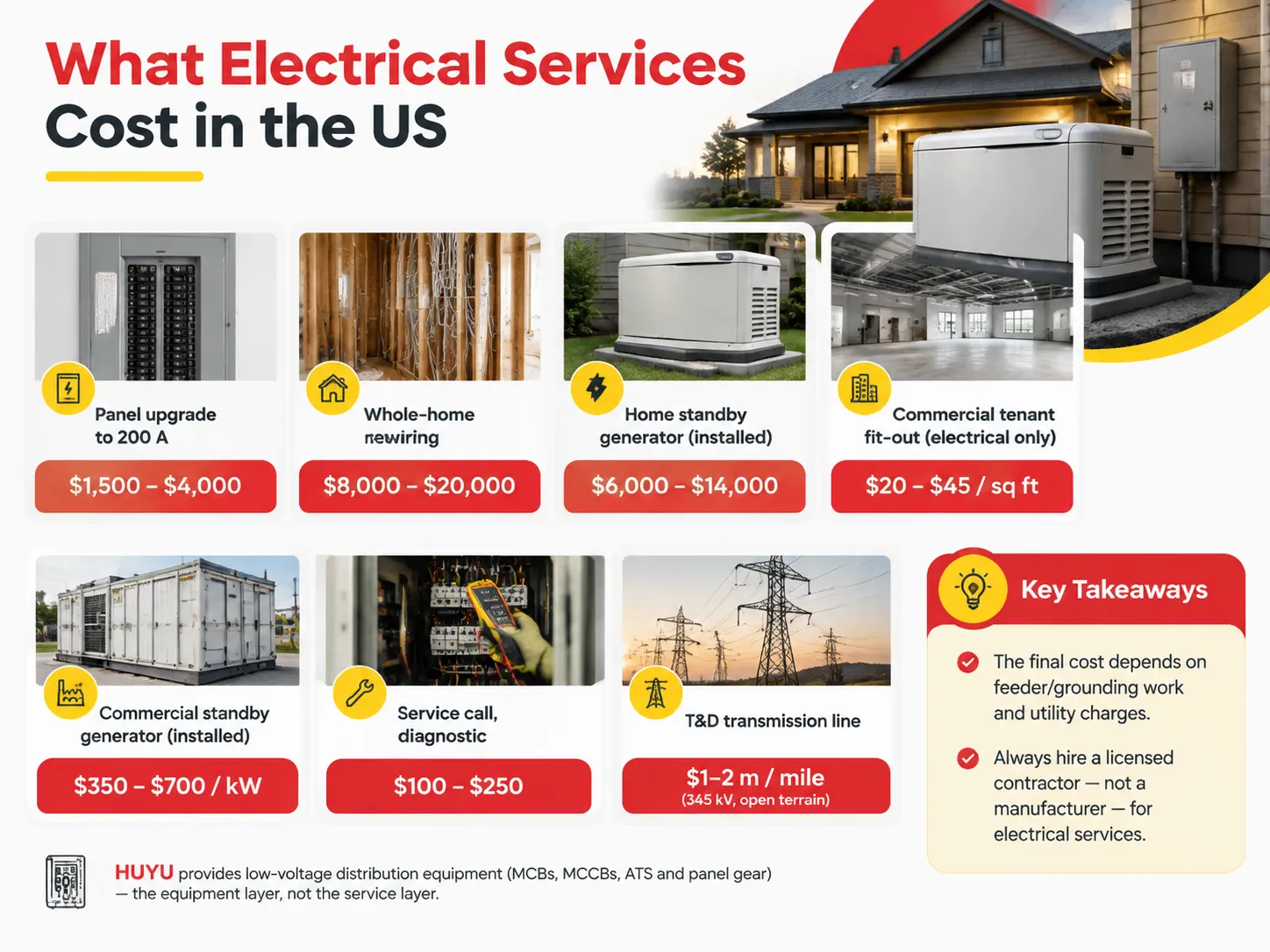
What Electrical Services Cost in the US
The following figures represent the actual levels of cost confronted by American buyers. These figures assume the presence of licensed contractors, the obtaining of permits and the having of standard access.
| บริการ | ค่าใช้จ่ายทั่วไป | หมายเหตุ |
|---|---|---|
| Residential panel upgrade to 200 A | $1,500–$4,000 | Add $500–$2,000 if the utility must replace the service drop |
| Whole-home rewiring | $8,000–$20,000 | Driven by wall access; finished walls cost the most |
| Home standby generator, installed | $6,000–$14,000 | 22 kW class, including transfer switch and pad |
| Commercial tenant fit-out, electrical only | $20–$45 per sq ft | Data-heavy or lab space runs well above this |
| Commercial standby generator, installed | $350–$700 per kW | 100 kW to 2 MW; paralleling gear adds cost fast |
| Service call, diagnostic | $100–$250 | Typically waived if you approve the repair |
| T&D transmission line | $1–2 m per mile (345 kV, open terrain) | Urban routing and river crossings multiply this |
For a residential service, replacing a 200 A electrical panel usually lands between $1,500 and $4,000, and the spread comes almost entirely from two things: how much of the existing feeder and grounding electrode conductor has to be redone, and whether the utility charges to disconnect and reconnect. Get those two answered in writing before you sign anything.
One important thing that explains a lot about pricing in the USA is the fact that many pieces of equipment behind the wall are imported. HUYU produces low-voltage equipment, including MCBs, MCCBs, automatic transfer switches and switchboards. HUYU only plays the role of equipment supplier but does not provide any services.
How to Choose a Provider for Your Scenario
Identify the layer corresponding to the task, and after that, find out the things that go wrong in that layer.
- The first filter that identifies which class of license is required is a voltage one. The line between high voltage and low voltage in the NEC sits at 600 V nominal, and crossing it changes who can legally perform the work, what drawings are required, and how much the insurance costs. A contractor who is excellent at 480 V building work may hold no qualification at 13.8 kV.
- When it comes to homeowners and the installation of standby generators, it’s crucial to ensure that you go through a factory-authorized dealer. That way, your warranty won’t be voided and you can be sure that the dealer will take care of the load calculation and sizing. Also, ensure that the dealer provides the transfer switch model in the quote.
- If you are dealing with a commercial contractor about a fit-out or service, make inquiries about the superintendent, including how many projects they are currently juggling. This knowledge gives you the ability to know whether the contractor is likely to be attentive to your project or if their attention might be diverted.
- It is important to ascertain whether industrial contractors offer arc-flash study capability, coordination study deliverables, and have a commissioning plan in writing.
- When you deal with mission-critical contractors, you should ask them about their experience with NFPA 110 and NFPA 99 standards. You can also obtain a load-bank report from another job that is similar to your own. It’s important that you don’t deal with hospitals that refuse to provide you with commissioning contracts.
- When it comes to utility or generation interconnections, find out if the contractor has an existing agreement with the utility and whether they self-generate or subcontract the work. Subcontracting usually means that the contractor has scheduling problems.
Regardless of your choice of contractor, you need to ask them three critical questions that will determine whether they can satisfactorily do the job. You need to ask them who their superintendent is and how many projects they are working on currently. This gives you a sense of how much attention they can devote to your project.
คำถามที่พบบ่อย
Who is the biggest electrical contractor in the USA?
Quanta Services is located in Houston, Texas, and its electric power segment has given it a revenue of about $13.5 billion each year. This means that Quanta makes more than thrice the revenue earned by the next biggest electric contractor, Rosendin, which earns close to $3.7 billion in revenues. Quanta mainly focuses on utility transmission and distribution, substations, and renewable interconnections as compared to commercial buildings. While measuring total electrical revenue, including service work, the next companies waiting in the line behind Quanta Services are EMCOR’s electrical segment and MYR Group.
Who is the largest electrical supplier in the US?
Whether the question is about the distribution of electrical equipment or its manufacturing defines the answer completely. WESCO International is the largest distributor of electrical supplies with an annual revenue of around $23.5 billion, followed by Sonepar North America (~$19.0 bn), Grainger (~$17.9 bn), Graybar (~$12.9 bn) and Rexel North America (~$10.1 bn). These distributors are used by contractors to purchase breakers and switchgear supplies. With regard to manufacturing, countries and manufacturers within the industry are divided according to their product specialties, for example, Schneider Electric, Eaton, ABB and Siemens are considered leaders in medium voltage distribution and switchgear production, while HUYU’s products comprise low-voltage breakers, ATS units and distribution boxes.
Who are the major electrical contractors in the US?
The leading companies in terms of revenue in electrical contracts are Quanta Services, Rosendin, EMCOR, MYR Group, Everus Construction Group, IES Holdings, MMR Group, M.C. Dean, ArchKey Solutions and Faith Technologies. Right under them is the exceptionally strong second tier of regional players with substantial market strength. The second tier is made up of local players such as Cupertino Electric and Helix Electric from the West Coast, Miller Electric from the southeast region and Guarantee Electrical from the Middle West region. For most building owners, the second tier becomes more relevant than the first ten as these companies are the ones which actually bid for medium-sized projects.
Is there a shortage of electricians in the USA?
Indeed, this is a more permanent situation rather than a temporary one . As per Bureau of Labor Statistics, the employment opportunities for electricians are going to grow rapidly in the next ten years. This might mean approximately 81000 job openings each year! Out of this, 20000 will be created due to retirements alone. The earnings of the electricians have also been growing which was $63190 median earnings in May. The highest paid top 10% of the employees earn at least $108510, showing the ongoing wage growth occurring along with shortage situation. According to the estimates of Associated Builders and Contractors, construction industry will need to find about 349000 workers by 2026. Most of the workers in the construction industry (around 20%) are already over 55 years.
อ้างอิง
- U.S. Bureau of Labor Statistics — Occupational Outlook Handbook: Electricians
- U.S. Bureau of Labor Statistics — OES Wage Data for Electricians
- M.C. Dean — Corporate Site and Capability Statement
- MYR Group — Investor Materials and Segment Reporting
- Quanta Services — Investor Relations and Annual Report
- NFPA 110 — Standard for Emergency and Standby Power Systems
- NFPA 99 — Health Care Facilities Code
- NFPA 70 — National Electrical Code (Articles 700, 701, 702)
- U.S. Energy Information Administration — Electric Power Monthly and Reliability Data
- Global Market Insights — U.S. Stationary Generators Market
สรุป
The electrical services sector in the United States has distinct levels of buyer knowledge. At the substation or interconnection level, consumers should focus on the service agreements and switchgear required by Quanta, MYR and Everus. At the data center or hospital level, buyers consider the commissioning documents offered by Rosendin, M.C. Dean and Faith Technologies. When it comes to home panels or stand-by generators, consumers should find a licensed electrician or an authorized dealer, who can conduct load calculation and transfer switch sizing.
There are three main takeaways here. First, separate equipment lead time, permit lead time and build duration into your schedule because the number that will halt the project will rarely be the one that the contractor tells you. Second, make sure to spec the transfer switch for complete service, not just for the emergency load. That’s where the failure of standby generator installation gets uncovered by the authorities, and therefore, this is where the 10-second rule is won or lost. Third, ensure the licenses and permits are in order because every year millions of American homeowners pay for the panel upgrades that the utility never authorized, since nobody bothered to pull the necessary permits first.