
Lorsque vous recherchez des services électriques aux États-Unis, vous trouverez une gamme d'annonces, y compris celle d'un conglomérat d'infrastructures Fortune 500 et une petite entreprise à deux camions qui s'occupe principalement de l'installation de ventilateurs de plafond. Bien que les deux puissent appartenir à la même industrie, ils ne concourent pas pour les mêmes travaux, et il n'y aura pas de similitude entre leurs devis. L'industrie des services électriques aux États-Unis peut être mieux comprise en reconnaissant qu'elle est composée de quatre segments différents empilés les uns sur les autres, et la meilleure façon de perdre un mois est d'envoyer un devis pour l'installation d'un générateur de secours de 400 kW au mauvais segment.
Ce qui suit dans le texte est un guide pratique de ces segments du marché : une liste de dix entreprises américaines dans l'industrie des services électriques, leur domaine de spécialisation, leur siège social, la durée de leurs projets, et les coûts engagés pour différents travaux. Il aborde également un segment important auquel la plupart des clients ne prêtent pas attention – le type de fournisseur le mieux adapté pour gérer leur projet.
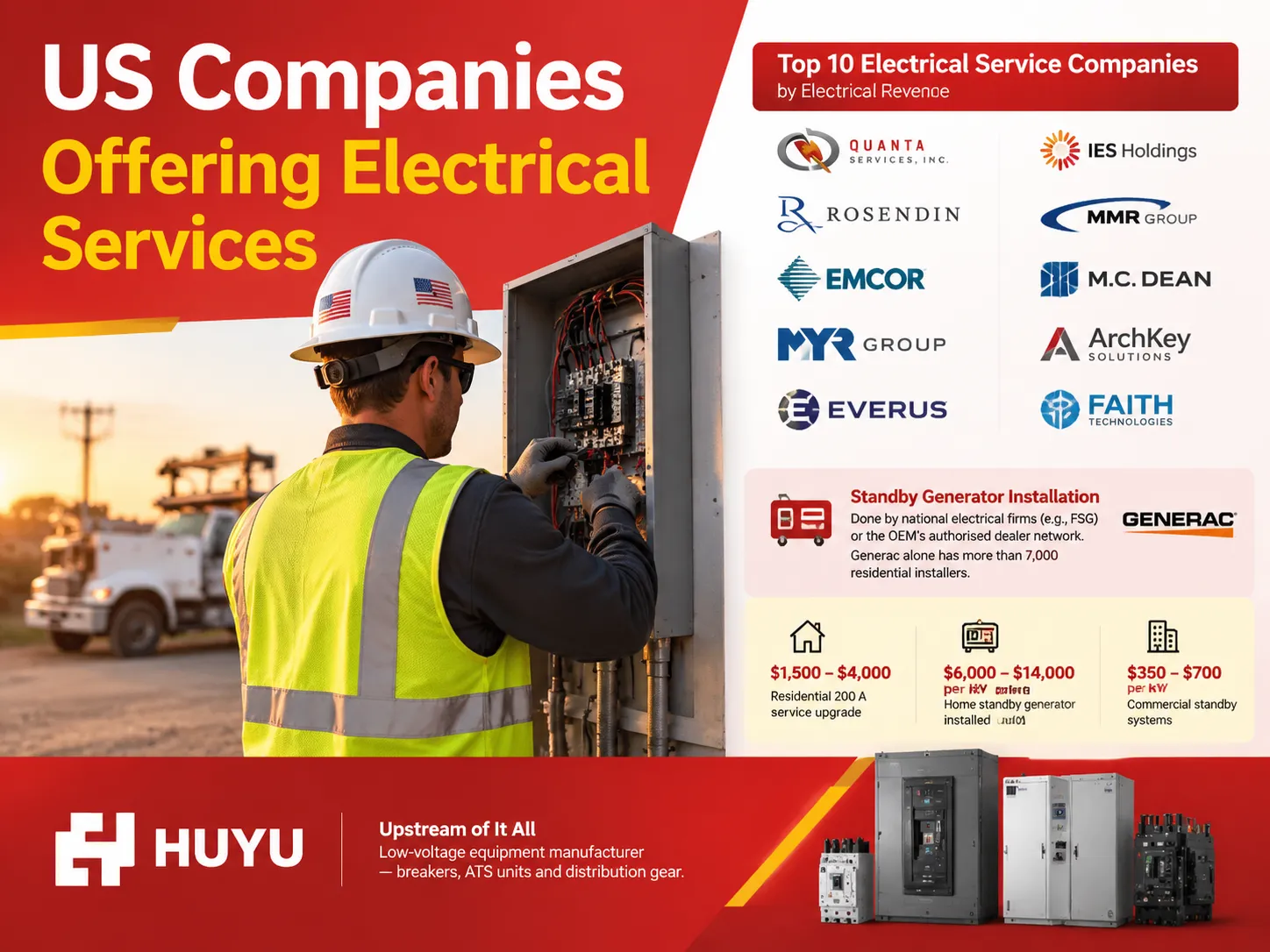
Voici la liste des dix principaux fournisseurs de services électriques aux États-Unis par chiffre d'affaires — Quanta Services (Houston, ~ US$ 13,5 milliards), Rosendin (San Jose, ~ US$ 3,7 milliards), la branche électrique d'EMCOR (Norwalk, Connecticut ; ~ US$ 3,6 milliards), MYR Group (Thornton, Colorado ; ~ US$ 3,4 milliards), Everus (Bismarck, Dakota du Nord ; ~ US$ 2,8 milliards), IES Holdings (Houston, ~ US$ 2,5 milliards), MMR Group (Baton Rouge, ~ US$ 2,3 milliards), M.C. Dean (Tysons, Virginie ; ~ US$ 1,9 milliard), ArchKey Solutions (St. Louis, ~ US$ 1,7 milliard), et Faith Technologies (Menasha, WI, ~ US$ 1,4 milliard). Ils sont des acteurs clés en ce qui concerne le service fonctionnel des entreprises de services publics, industrielles et critiques. Si l'on se concentre sur l'installation de générateurs de secours, les travaux sont réalisés soit par une entreprise nationale de services électriques telle que FSG, soit par le réseau de franchises des OEM comme Generac, qui compte plus de 7 000 fournisseurs travaillant uniquement dans le segment résidentiel.
Les quatre couches du marché des services électriques aux États-Unis
La structure précède les noms. La majorité des entrepreneurs électriciens aux États-Unis peuvent être classés dans l'une des quatre couches distinguées les unes des autres par des spécificités liées aux licences, à la composition des équipes et aux contrats commerciaux.
- Couche 1 – services T&D fournis par les services publics. Ces équipes sont responsables de l'installation de postes de transformation, du travail sur des lignes de transmission de 69 à 765 kV, et de la maintenance des circuits de distribution. Les travaux sont attribués via des accords-cadres de services publics. Des exemples de ces entreprises sont Quanta et MYR Group. Elles ne seront certainement pas utiles pour les restaurants.
- Couche 2 – entreprises industrielles et critiques pour la mission. Les usines pétrochimiques, les installations de fabrication de semi-conducteurs, les centres de données et les hôpitaux peuvent être pris comme exemples. Il y a des hautes tensions sur site, des plans d'ingénierie, des études d'arc flash et des documents de mise en service. Entreprises impliquées – MMR, M.C. Dean, et Faith Technologies.
- Couche 3 – construction commerciale et secteur des services. Les rénovations de bureaux, le commerce de détail, le multifamilial et les institutions éducatives peuvent être placés dans cette couche. Tensions impliquées 120/208V, 277/480V, câblage en conduit auto-exécuté et interventions de service. Entreprises opérant dans ce secteur – Rosendin, EMCOR, ArchKey et des milliers d'acteurs régionaux.
- Couche 4 – construction résidentielle et services commerciaux légers. Concernant ces services, les échanges de panneaux, les chargeurs VE et les générateurs peuvent être considérés. Les opérateurs travaillant dans ces entreprises sont des électriciens maîtres qui gèrent l’activité depuis leurs fourgons.
De mauvaises décisions d'approvisionnement sont généralement prises lorsque les organisations engagent des entreprises de la Couche 1 pour des services de la Couche 4 et vice versa. Un entrepreneur de services publics n'enverra jamais un véhicule pour un disjoncteur AFCI déclenchant, tandis qu'une entreprise de la Couche 4 ne peut pas fournir un ensemble de cellules haute tension 15 kV.
Dix entreprises américaines offrant des services électriques, côte à côte
La liste ci-dessous est classée par chiffre d'affaires en électricité, en utilisant les classements ENR et Modern Distribution Management que l'industrie elle-même considère comme référence. La liste complète des entrepreneurs électriciens opérant à travers les États-Unis dépasse largement dix lorsque l'on compte les acteurs régionaux forts — Miller Electric, Guarantee Electrical, Cupertino Electric, Helix Electric et d'autres réalisent tous un volume important sur leurs marchés locaux.
| Entreprise | Siège | Chiffre d'affaires électrique | Conçu pour |
|---|---|---|---|
| Quanta Services | Houston, TX | ~$13,5 milliards | Services publics T&D, postes, énergies renouvelables |
| Rosendin | San Jose, CA | ~$3,7 milliards | Centres de données, semi-conducteurs, campus technologiques |
| EMCOR (segment électrique) | Norwalk, CT | ~$3,6 milliards | Commercial, santé, lots mécaniques + électriques |
| Groupe MYR | Thornton, CO | ~$3,4 milliards | Ligne T&D et poste, construction C&I |
| Everus Construction Group | Bismarck, ND | ~$2,8 milliards | Services publics, transmission, industriel |
| IES Holdings | Houston, TX | ~$2,5 milliards | Industriel, centres de données, construction résidentielle neuve |
| Groupe MMR | Baton Rouge, LA | ~$2,3 milliards | Raffineries, instrumentation, arrêt industriel |
| M.C. Dean | Tysons, VA | ~$1,9 milliard | Critique pour la mission, gouvernement sécurisé, cyber-physique |
| ArchKey Solutions | St. Louis, MO | ~$1,7 milliard | Commercial, santé, éducation |
| Faith Technologies | Menasha, WI | ~$1,4 milliard | Fabrication, centres de données, préfabrication |
Ce en quoi chacun des dix excelle réellement
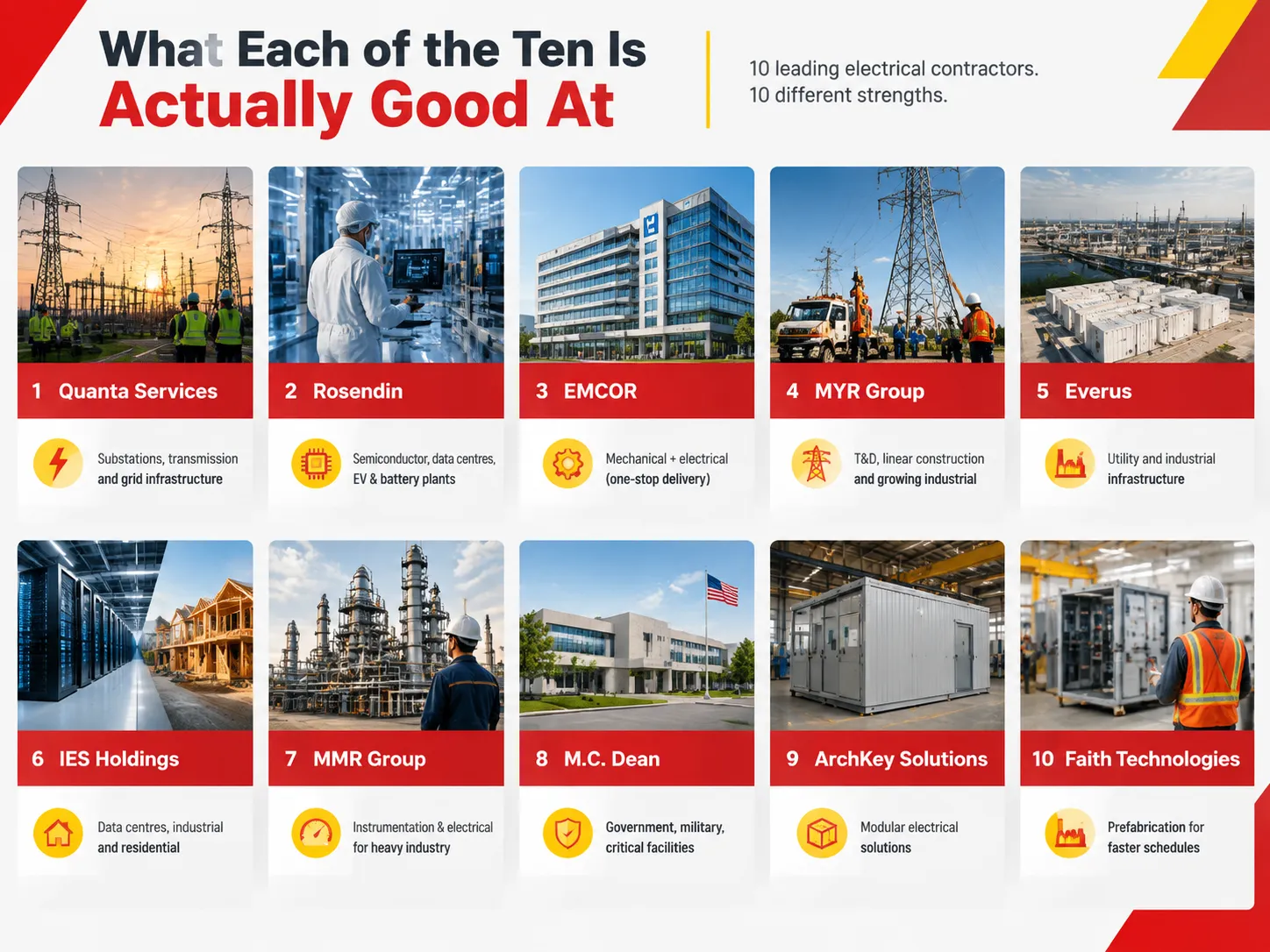
Quanta Services est un entrepreneur électrique massif aux États-Unis. La plupart des projets de l'entreprise sont liés à l'infrastructure électrique telle que les postes et la reconstruction de lignes de transmission. Il est tout à fait logique d'avoir Quanta sur la liste des entrepreneurs puisque l'entreprise peut mobiliser ses 40 000 employés et sa flotte partout. Cependant, il y a un inconvénient à utiliser cet entrepreneur dans les opérations de bâtiment ; le client n'est probablement pas assez important pour que Quanta trouve la commande attractive.
Rosendin est une entreprise détenue par ses employés, ce qui fait que l’équipe travaille sur de grands projets avec des taux de rétention élevés. La compétence principale de Rosendin inclut les travaux d’ingénierie dans la région technologique de la Côte Ouest, tels que les usines de fabrication de semi-conducteurs, les centres de données massifs ou les usines de batteries. Être détenu par les employés signifie une prise de décision très lente au niveau de la haute direction.
EMCOR offre des services mécaniques et électriques dans le cadre d’un seul contrat. Il y a une raison pour laquelle les clients choisissent cette coopération technique ; cela simplifie considérablement le processus de construction car les processus mécaniques et électriques sont bien coordonnés sans perdre de temps supplémentaire.
MYR Group est un groupe d’entreprises qui fournit des services électriques par l’intermédiaire de ses filiales, qui figurent parmi les cinq premiers entrepreneurs aux États-Unis depuis près de trente ans. La spécialisation principale de l’entreprise est les opérations T&D, telles que la construction de lignes de transmission haute tension et de postes de transformation reliant l’énergie électrique de son générateur aux consommateurs. Les segments commerciaux et industriels du marché sont cependant moins développés. L’entreprise excelle dans les projets de construction linéaire et aurait du mal à intégrer des opérations de construction volumineuses dans sa structure.
Everus provient de MDU Resources et se concentre à la fois sur les services publics et les infrastructures industrielles. Plus diversifié que prévu, IES Holdings opère dans le secteur industriel et des centres de données et possède un secteur important de construction résidentielle aux États-Unis, ce qui leur donne une perspective unique sur les cycles des marchés du logement.
MMR Group est spécialisé dans les domaines électrique et instrumentation pour l’industrie lourde. Si votre usine fonctionne avec des temps d’arrêt mesurés en équipes plutôt qu’en semaines, alors vous parlez leur langage. Les budgets sont également influencés par la manière dont un entrepreneur est doté en personnel : entreprise d’installation électrique commerciale qui réalise elle-même ses équipes de conduits et de câblage respectera mieux un calendrier qu’une entreprise qui sous-traite la main-d’œuvre, et lors d’un arrêt de raffinerie, la différence se mesure en jours de production perdue.
M.C. Dean est l’entreprise qui travaille dans des environnements où la défaillance est impossible – centres de données appartenant au gouvernement, bases militaires et centres de renseignement. Elle a commencé ses activités en 1949, est située à Tysons, en Virginie, et emploie environ 9 000 employés, dont 1 000 disposent d’une habilitation de sécurité. Elle a acquis la majorité des actions de Bells Power Group, une entreprise établie au Royaume-Uni qui aide à concevoir, installer et maintenir des systèmes d’alimentation électrique depuis 1898, montrant ainsi l’orientation du marché.
ArchKey Solutions and Faith Technologies occupy the last places in the top ten companies. Faith Technologies stands out due to its method of prefabrication; they manufacture electrical holes in a factory.
Standby Generator Installation: The Layer Most Buyers Get Wrong
The point at which standby generator installation diverges from the actual reality is in clarifying who wants to install a generator. Firms like M.C. Dean, MYR and Faith Technologies are all in the generator installation business. However, they’re likely to refuse any residential contracts using a 22 kW generator.
Indeed, the reality of the standby generator installation market breaks down into three distinct areas:
| Channel | Typical size | Installed cost | Who does it |
|---|---|---|---|
| Residential dealer network | 7–26 kW | $6,000–$14,000 | Generac (7,000+ installers), Kohler, Briggs & Stratton certified dealers |
| National commercial electrical firm | 500 kW–4 MW+ | $350–$700 per kW | FSG, Power Plus, GenServe, regional integrators |
| Mission-critical / OEM direct | 2–50 MW | Project-bid | Cummins, Caterpillar, Kohler, M.C. Dean |
Two statistics lend credence to the cost of the outages. EPRI and Primen estimate the average cost of a one-hour outage for industrial and digital economy businesses to be in the neighborhood of $7,800 per hour, while the EIA data indicates that the average major outage will take about nine hours in 2024—more than double the average in the previous decade. A cold storage facility of 300,000 sq ft loses all its product by the end of the eighth hour.
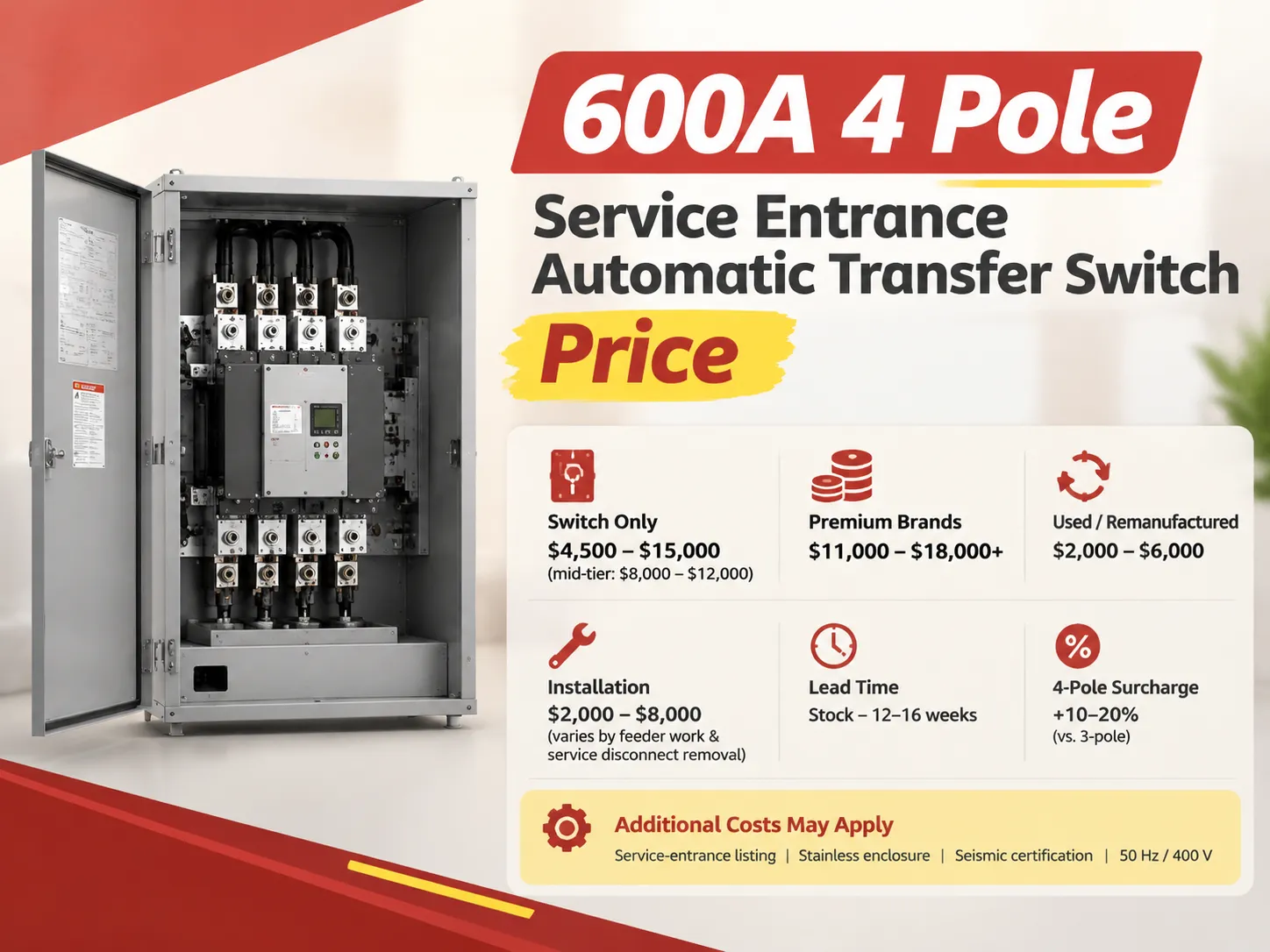
What counts in this context is not the generator but the transfer of power. The load of the data center needs transferring in less than 10 seconds to remain within UPS operating time. Hospitals are held to this same standard under NFPA 99, which also has NFPA 110 Level 1 testing criteria. Commercial and industrial stand-by systems under NEC Article 701 and 702 are allowed as much as 60 seconds.A three-phase automatic transfer switch sized to the full service — not to the emergency load — is what determines whether you land inside that window or outside it, and it is the single most common item buyers under-spec.
The other thing to consider is fuel capacity. The NFPA 110 requires Level 1 life safety systems to have minimum fuel supplies of 24 hours and Level 2 systems, 8 hours. You can also expect trouble if no one has tested the generator on load at least once per month. According to data, idle-only generators fail on demand in 15 to 20 percent of cases, compared to less than 3 percent of failure in the same situation for generators that have been tested for 30 minutes every month.
Delivery Timelines: What “Lead Time” Really Means for Each Layer
In the context of this industry, lead time signifies three different things, and contractors will choose whichever version makes them look most favorable. It is recommended to ask contractors to provide information on all three types of lead time: equipment lead time (i.e. the time from the factory to the site), permit lead time (i.e. the time from application through approval to energisation), and construction duration (i.e. the time from mobilisation to substantial completion).
| Project type | Équipement | Permit / utility | Build |
|---|---|---|---|
| Residential 200 A service upgrade | 1–2 weeks | 2–6 weeks | 1–3 days |
| Home standby generator (22 kW) | 3–10 weeks | 2–8 weeks | 1–3 days |
| Commercial tenant fit-out | 2–8 weeks | 4–12 weeks | 6–20 weeks |
| Commercial generator, 500 kW–2 MW | 20–52 weeks | 8–24 weeks | 2–8 weeks |
| Medium-voltage switchgear package | 20–40 weeks | 8–20 weeks | 8–20 weeks |
| Utility substation | 30–60 weeks | 12–36 months | 12–24 months |
During the supply crunch of 2022-2023, the lead time for medium-voltage switchgear increased to more than 60 weeks, and while it has improved since, the standard now is still in the range of 20-40 weeks. If your construction schedule is tight, you may not want to waste your time going back and forth with the contractor; instead, order the gear ahead of time or design around readily available equipment.
What Electrical Services Cost in the US
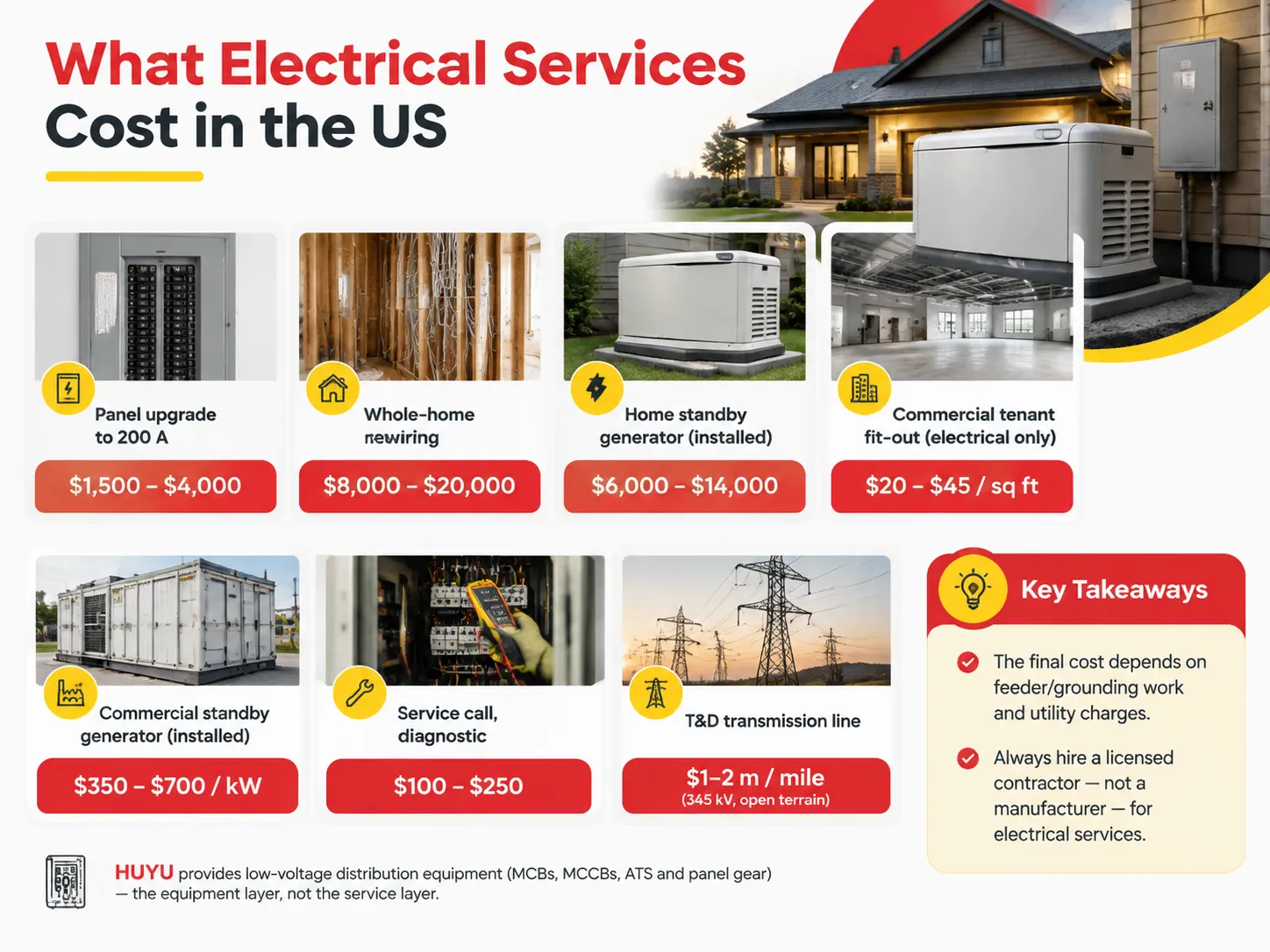
The following figures represent the actual levels of cost confronted by American buyers. These figures assume the presence of licensed contractors, the obtaining of permits and the having of standard access.
| Service | Coût typique | Remarques |
|---|---|---|
| Residential panel upgrade to 200 A | 1 500 $–4 000 $ | Add $500–$2,000 if the utility must replace the service drop |
| Whole-home rewiring | $8,000–$20,000 | Driven by wall access; finished walls cost the most |
| Home standby generator, installed | $6,000–$14,000 | 22 kW class, including transfer switch and pad |
| Commercial tenant fit-out, electrical only | $20–$45 per sq ft | Data-heavy or lab space runs well above this |
| Commercial standby generator, installed | $350–$700 per kW | 100 kW to 2 MW; paralleling gear adds cost fast |
| Service call, diagnostic | $100–$250 | Typically waived if you approve the repair |
| T&D transmission line | $1–2 m per mile (345 kV, open terrain) | Urban routing and river crossings multiply this |
For a residential service, replacing a 200 A electrical panel usually lands between $1,500 and $4,000, and the spread comes almost entirely from two things: how much of the existing feeder and grounding electrode conductor has to be redone, and whether the utility charges to disconnect and reconnect. Get those two answered in writing before you sign anything.
One important thing that explains a lot about pricing in the USA is the fact that many pieces of equipment behind the wall are imported. HUYU produces low-voltage equipment, including MCBs, MCCBs, automatic transfer switches and switchboards. HUYU only plays the role of equipment supplier but does not provide any services.
How to Choose a Provider for Your Scenario
Identify the layer corresponding to the task, and after that, find out the things that go wrong in that layer.
- The first filter that identifies which class of license is required is a voltage one. The line between high voltage and low voltage in the NEC sits at 600 V nominal, and crossing it changes who can legally perform the work, what drawings are required, and how much the insurance costs. A contractor who is excellent at 480 V building work may hold no qualification at 13.8 kV.
- When it comes to homeowners and the installation of standby generators, it’s crucial to ensure that you go through a factory-authorized dealer. That way, your warranty won’t be voided and you can be sure that the dealer will take care of the load calculation and sizing. Also, ensure that the dealer provides the transfer switch model in the quote.
- If you are dealing with a commercial contractor about a fit-out or service, make inquiries about the superintendent, including how many projects they are currently juggling. This knowledge gives you the ability to know whether the contractor is likely to be attentive to your project or if their attention might be diverted.
- It is important to ascertain whether industrial contractors offer arc-flash study capability, coordination study deliverables, and have a commissioning plan in writing.
- When you deal with mission-critical contractors, you should ask them about their experience with NFPA 110 and NFPA 99 standards. You can also obtain a load-bank report from another job that is similar to your own. It’s important that you don’t deal with hospitals that refuse to provide you with commissioning contracts.
- When it comes to utility or generation interconnections, find out if the contractor has an existing agreement with the utility and whether they self-generate or subcontract the work. Subcontracting usually means that the contractor has scheduling problems.
Regardless of your choice of contractor, you need to ask them three critical questions that will determine whether they can satisfactorily do the job. You need to ask them who their superintendent is and how many projects they are working on currently. This gives you a sense of how much attention they can devote to your project.
FAQ
Who is the biggest electrical contractor in the USA?
Quanta Services is located in Houston, Texas, and its electric power segment has given it a revenue of about $13.5 billion each year. This means that Quanta makes more than thrice the revenue earned by the next biggest electric contractor, Rosendin, which earns close to $3.7 billion in revenues. Quanta mainly focuses on utility transmission and distribution, substations, and renewable interconnections as compared to commercial buildings. While measuring total electrical revenue, including service work, the next companies waiting in the line behind Quanta Services are EMCOR’s electrical segment and MYR Group.
Who is the largest electrical supplier in the US?
Whether the question is about the distribution of electrical equipment or its manufacturing defines the answer completely. WESCO International is the largest distributor of electrical supplies with an annual revenue of around $23.5 billion, followed by Sonepar North America (~$19.0 bn), Grainger (~$17.9 bn), Graybar (~$12.9 bn) and Rexel North America (~$10.1 bn). These distributors are used by contractors to purchase breakers and switchgear supplies. With regard to manufacturing, countries and manufacturers within the industry are divided according to their product specialties, for example, Schneider Electric, Eaton, ABB and Siemens are considered leaders in medium voltage distribution and switchgear production, while HUYU’s products comprise low-voltage breakers, ATS units and distribution boxes.
Who are the major electrical contractors in the US?
The leading companies in terms of revenue in electrical contracts are Quanta Services, Rosendin, EMCOR, MYR Group, Everus Construction Group, IES Holdings, MMR Group, M.C. Dean, ArchKey Solutions and Faith Technologies. Right under them is the exceptionally strong second tier of regional players with substantial market strength. The second tier is made up of local players such as Cupertino Electric and Helix Electric from the West Coast, Miller Electric from the southeast region and Guarantee Electrical from the Middle West region. For most building owners, the second tier becomes more relevant than the first ten as these companies are the ones which actually bid for medium-sized projects.
Is there a shortage of electricians in the USA?
Indeed, this is a more permanent situation rather than a temporary one . As per Bureau of Labor Statistics, the employment opportunities for electricians are going to grow rapidly in the next ten years. This might mean approximately 81000 job openings each year! Out of this, 20000 will be created due to retirements alone. The earnings of the electricians have also been growing which was $63190 median earnings in May. The highest paid top 10% of the employees earn at least $108510, showing the ongoing wage growth occurring along with shortage situation. According to the estimates of Associated Builders and Contractors, construction industry will need to find about 349000 workers by 2026. Most of the workers in the construction industry (around 20%) are already over 55 years.
Références
- U.S. Bureau of Labor Statistics — Occupational Outlook Handbook: Electricians
- U.S. Bureau of Labor Statistics — OES Wage Data for Electricians
- M.C. Dean — Corporate Site and Capability Statement
- MYR Group — Investor Materials and Segment Reporting
- Quanta Services — Investor Relations and Annual Report
- NFPA 110 — Standard for Emergency and Standby Power Systems
- NFPA 99 — Health Care Facilities Code
- NFPA 70 — National Electrical Code (Articles 700, 701, 702)
- U.S. Energy Information Administration — Electric Power Monthly and Reliability Data
- Global Market Insights — U.S. Stationary Generators Market
Conclusion
The electrical services sector in the United States has distinct levels of buyer knowledge. At the substation or interconnection level, consumers should focus on the service agreements and switchgear required by Quanta, MYR and Everus. At the data center or hospital level, buyers consider the commissioning documents offered by Rosendin, M.C. Dean and Faith Technologies. When it comes to home panels or stand-by generators, consumers should find a licensed electrician or an authorized dealer, who can conduct load calculation and transfer switch sizing.
There are three main takeaways here. First, separate equipment lead time, permit lead time and build duration into your schedule because the number that will halt the project will rarely be the one that the contractor tells you. Second, make sure to spec the transfer switch for complete service, not just for the emergency load. That’s where the failure of standby generator installation gets uncovered by the authorities, and therefore, this is where the 10-second rule is won or lost. Third, ensure the licenses and permits are in order because every year millions of American homeowners pay for the panel upgrades that the utility never authorized, since nobody bothered to pull the necessary permits first.