
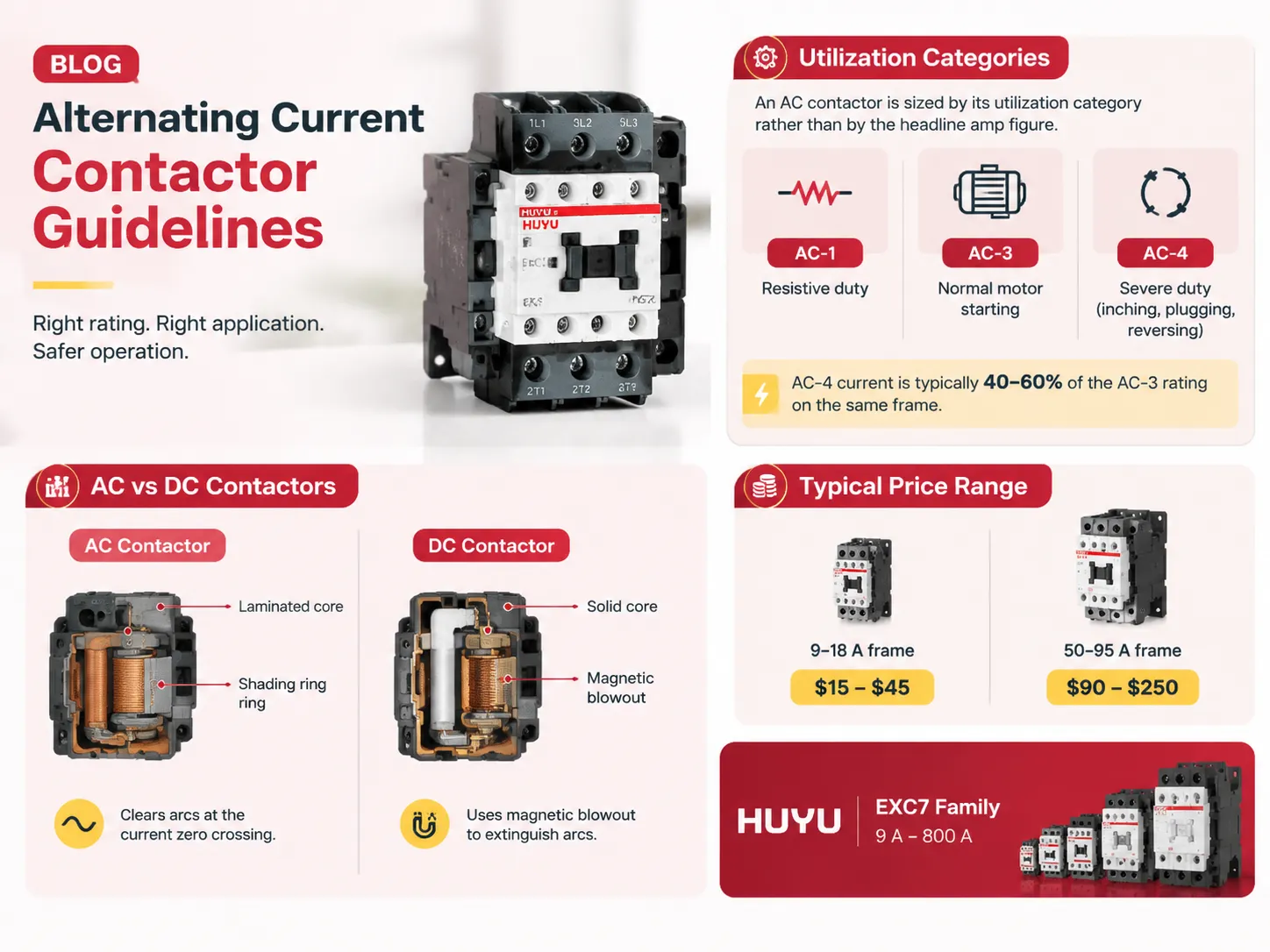
หนึ่งในส่วนหลักของการควบคุมมอเตอร์สามารถเรียกได้ง่ายๆ ว่า AC contactor แต่ควรสังเกตว่าการตั้งค่าที่ไม่ถูกต้องของ contactor ก็อาจเป็นหนึ่งในปัญหาได้ ตัวอย่างเช่น แอมป์ที่เห็นด้านข้างของ contactor ให้ข้อมูลเกี่ยวกับลักษณะประเภทความต้านทาน อย่างไรก็ตาม หากแปลงค่าตัวเลขนั้นเพื่อเริ่มต้นมอเตอร์ อาจทำให้เกิดจุดร้อนในแผงวงจร ดังนั้นบทความนี้จึงอธิบายว่า AC contactor คืออะไร ขดลวดที่ AC contactor มีคืออะไร และสิ่งที่ทำให้แตกต่างจาก DC contactor คืออะไร หมวดหมู่ที่ใช้กำหนดโหลดและวิธีการเดินสายไฟ การบำรุงรักษาที่จำเป็น และราคาของมันจะเป็นอย่างไร.
สรุปได้ว่า AC contactor ทำหน้าที่เป็นสวิตช์สำหรับควบคุมโหลดกระแสสลับจากระยะไกล ลักษณะสำคัญขึ้นอยู่กับวิธีการทำงานของ contactor ไม่ใช่กระแสไฟฟ้าที่เป็นเพียงหนึ่งในข้อกำหนด ตัวอย่างเช่น AC1 หมายถึงการใช้งานในวงจรความต้านทาน AC3 หมายถึงการใช้งานสำหรับการสตาร์ทมอเตอร์ และ AC4 หมายถึงการใช้งานในงานที่รุนแรงมาก (เช่น การย้อนกลับ การเสียบปลั๊ก การเคลื่อนที่ทีละนิด) ซึ่งกระแสจะอยู่ประมาณ 40-60% น้อยกว่า AC3 AC และ DC contactor เป็นสวิตช์ประเภทต่างกัน: AC contactor มีแกนลามิเนต เทคโนโลยี shaded pole ช่วยให้ AC contactor ตัดกระแสที่จุดตัดศูนย์ ในขณะที่ DC contactor ไม่มีแกนลามิเนตและใช้ magnetic blowout ราคาของ AC contactor มีตั้งแต่ 15 ถึง 45 สำหรับรุ่น 9-18 A และตั้งแต่ 90 ถึง 250 สำหรับ contactor ที่มีเรตติ้ง 50-95 A บริษัท HUYU ผลิต contactor รุ่น EXC7 ที่มีกระแสตั้งแต่ 9 A ถึง 800 A.
คอนแทคเตอร์ AC ทำงานอย่างไรจริงๆ
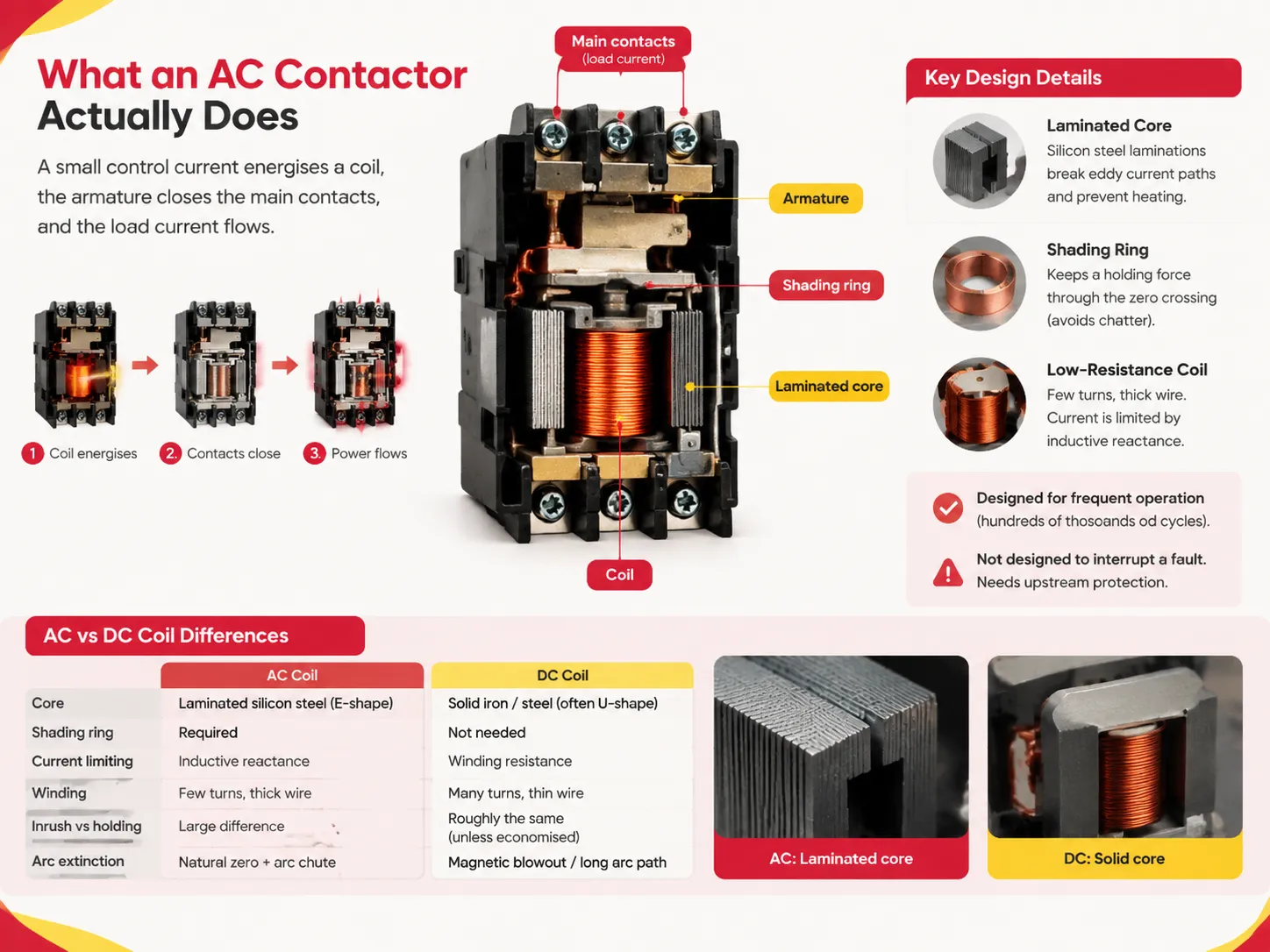
คอนแทคเตอร์โดยพื้นฐานคือสวิตช์ที่ทำงานด้วยแม่เหล็กไฟฟ้า เมื่อเปิดการควบคุม กระแสควบคุมเล็กน้อยจะทำให้ขดลวดแม่เหล็กไฟฟ้าทำงาน ซึ่งจะดึงแผ่นเหล็กเคลื่อนที่เข้ามา ปิดหน้าสัมผัสหลักและทำให้กระแสไหลได้ สัญญาณควบคุมถูกตัดและสปริงจะดันให้หน้าสัมผัสเปิดอีกครั้ง.
ความเรียบง่ายคือจุดสำคัญ มันถูกออกแบบมาเพื่อการทำงานที่ความถี่สูงมาก ๆ คือสามารถเปิด/ปิดได้หลายแสนครั้งตลอดอายุการใช้งาน จึงถูกใช้อย่างแพร่หลายในสตาร์ทเตอร์แบบปุ่มกด, ระบบปรับอากาศ, ปั๊ม และแผงไฟทั่วไป มันไม่ได้ถูกออกแบบมาให้ตัดวงจรเมื่อมีกระแสลัดวงจร แต่จะพึ่งพารีเลย์ด้านบนสำหรับฟังก์ชันนั้น.
วิธีการทำงานของขดลวดและแกน
การทำงานของคอนแทคเตอร์ AC สามารถอธิบายได้ด้วยสามลักษณะการออกแบบ.
แกนลามิเนต สนามแม่เหล็สสลับใด ๆ ที่ผ่านตัวนำแข็งจะทำให้เกิดกระแสไหลวน หากแกนทำจากเหล็กแข็ง มันจะร้อนขึ้น ดังนั้นการออกแบบคอนแทคเตอร์ AC จึงอนุญาตให้ซ้อนแผ่นฉนวนบาง ๆ ของเหล็กซิลิคอนรูปตัว E เพื่อขัดขวางเส้นทางของกระแสไหลวน นี่คือคำตอบสำหรับคำถามเกี่ยวกับแกนที่ใช้ในรีเลย์และคอนแทคเตอร์ AC: ใช้เหล็กซิลิคอนลามิเนต ไม่ใช่เหล็กแข็ง.
แหวนชดเชยป้องกันการสั่นสะเทือน ในความถี่ 50Hz กระแสจะผ่านศูนย์ 100 ครั้งต่อวินาที ดังนั้นในทุกครั้งที่ผ่านศูนย์ แรงดึงแม่เหล็กจะหายไป หากไม่มีการแก้ไข แขนแม่เหล็กจะเกิดเสียงดังและสั่นสะเทือนจนทำให้สูญเสียการสัมผัส วิธีแก้ไขคือแหวนชดเชยทองแดงที่ติดตั้งบนหน้าขั้ว แหวนชดเชยสร้างความล่าช้าในเวลาตามแรงแม่เหล็กในส่วนที่กำหนดเพื่อรักษาแรงยึดตลอดช่วงผ่านศูนย์ ดังนั้นเมื่อคอนแทคเตอร์เริ่มส่งเสียงดัง หมายความว่าแหวนชดเชยอาจแตกหรือหายไปด้วยเหตุผลอื่น.
ขดลวดมีความต้านทานต่ำและจำนวนรอบต่ำ ขดลวด AC จำกัดกระแสโดยใช้ปฏิกิริยาเหนี่ยวนำแทนความต้านทาน จึงสามารถใช้ตัวนำที่หนาและจำนวนรอบที่ค่อนข้างต่ำได้ ซึ่งมีความสำคัญอย่างยิ่งเมื่อพยายามใช้งานกับ DC นอกจากนี้ กระแสเริ่มต้นของขดลวดสูงกว่ากระแสยึดมาก หน่วย EXC7 มีการใช้พลังงาน 60-200 VA ขึ้นอยู่กับขนาดเฟรมในช่วงดึงเข้า และ 9-25 VA ในช่วงยึด.
| คุณสมบัติ | ขดลวด AC | ขดลวด DC |
|---|---|---|
| แกนแม่เหล็ก | เหล็กซิลิคอนแบบชั้นบาง (รูปตัว E) | เหล็กแข็ง / เหล็กกล้า (มักเป็นรูปตัว U) |
| แหวนชดเชย | จำเป็น | ไม่จำเป็น |
| การจำกัดกระแส | ปฏิกิริยาเหนี่ยวนำ | ความต้านทานของขดลวด |
| ขดลวด | จำนวนรอบน้อย สายไฟหนา | จำนวนรอบมาก สายไฟบาง |
| กระแสเริ่มต้นเทียบกับกระแสยึด | ความแตกต่างมาก | ประมาณเท่ากัน (เว้นแต่จะประหยัดพลังงาน) |
| การดับอาร์ค | ศูนย์กระแสธรรมชาติ + ตัวดับประกายไฟ | การระบายแม่เหล็ก / เส้นทางประกายไฟยาว |
จำนวนขั้ว กระแส และขนาดเฟรม
คอนแทคเตอร์ถูกกำหนดโดยสามมิติพร้อมกัน: จำนวนขั้ว กระแสที่กำหนด และขนาดเฟรม การเข้าใจช่วงจริงช่วยให้ตรรกะการกำหนดขนาดชัดเจน.
ครอบครัว EXC7 มีตั้งแต่เฟรมมาตรฐานที่กำหนดกระแส 9 A ถึง 110 A และเฟรมกระแสสูงที่กำหนดระหว่าง 120 A ถึง 800 A ทั้งหมดในรูปแบบสามขั้ว (3P) แรงดันฉนวนที่กำหนดคือ 690 V สำหรับเฟรมมาตรฐานและ 1000 V สำหรับเฟรมกระแสสูง โดยมีแรงดันใช้งาน 380/400 V หรือ 660/690 V กำลังไฟครอบคลุมตั้งแต่ 4 kW ที่ปลายขนาดเล็กถึง 450 kW บนเฟรม 800 A ภายใต้ภาระงาน AC-4 ที่ 690 V.
สังเกตความแตกต่างของค่าทั้งสองคอลัมน์ในตารางด้านล่าง ค่า AC-1 คือกระแสความร้อนที่ขั้วสามารถรับได้ ในขณะที่ค่า AC-3 คือค่าที่อุปกรณ์สามารถสวิตช์ได้จริงเมื่อมีมอเตอร์เข้ามาเกี่ยวข้อง สำหรับเฟรมขนาดเล็กที่สุดคือ 20 A ในขณะที่สำหรับขนาดใหญ่คือ 9 A การกำหนดขนาดโดยใช้ตัวเลขแรกและนำไปใช้กับมอเตอร์เป็นข้อผิดพลาดที่พบบ่อยที่สุดในการสร้างแผงควบคุม.
| ขนาดเฟรม | AC-1 (Ith) | AC-3 ที่ 380/400 V | AC-4 ที่ 380/400 V | กำลังไฟ AC-3 |
|---|---|---|---|---|
| JR28-25 | 20 แอมป์ | 9 A | 5 A | 4 กิโลวัตต์ |
| EXC7-18 | 32 A | 18 A | 7 A | 5 kW |
| EXC7-32 | 50 แอมป์ | 32 A | 12 A | 15 กิโลวัตต์ |
| EXC7-50 | 80 แอมป์ | 50 แอมป์ | 24 A | 22 กิโลวัตต์ |
| EXC7-95 | 125 แอมป์ | 95 แอมป์ | 44 แอมแปร์ | 45 กิโลวัตต์ |
| EXC7-225 (โครงสร้างกระแสสูง) | 275 แอมแปร์ | 225 แอมแปร์ | — | 110 กิโลวัตต์ (AC-4) |
| EXC7-800 (โครงสร้างกระแสสูง) | 900 แอมแปร์ | 800 แอมแปร์ | — | 450 กิโลวัตต์ (AC-4) |
โครงสร้างกระแสสูงไม่เทียบเท่ากันเนื่องจากผู้ผลิตจะให้เรตติ้งกระแส AC-3 พร้อมกับเรตติ้งกำลังไฟ AC-4 ในหน่วย kW ซึ่งผู้ใช้ต้องคำนวณปัจจัยลดกำลังจากตารางการเลือกโครงสร้างที่เกี่ยวข้องแทนที่จะมีการอ้างอิงข้ามที่ชัดเจน.
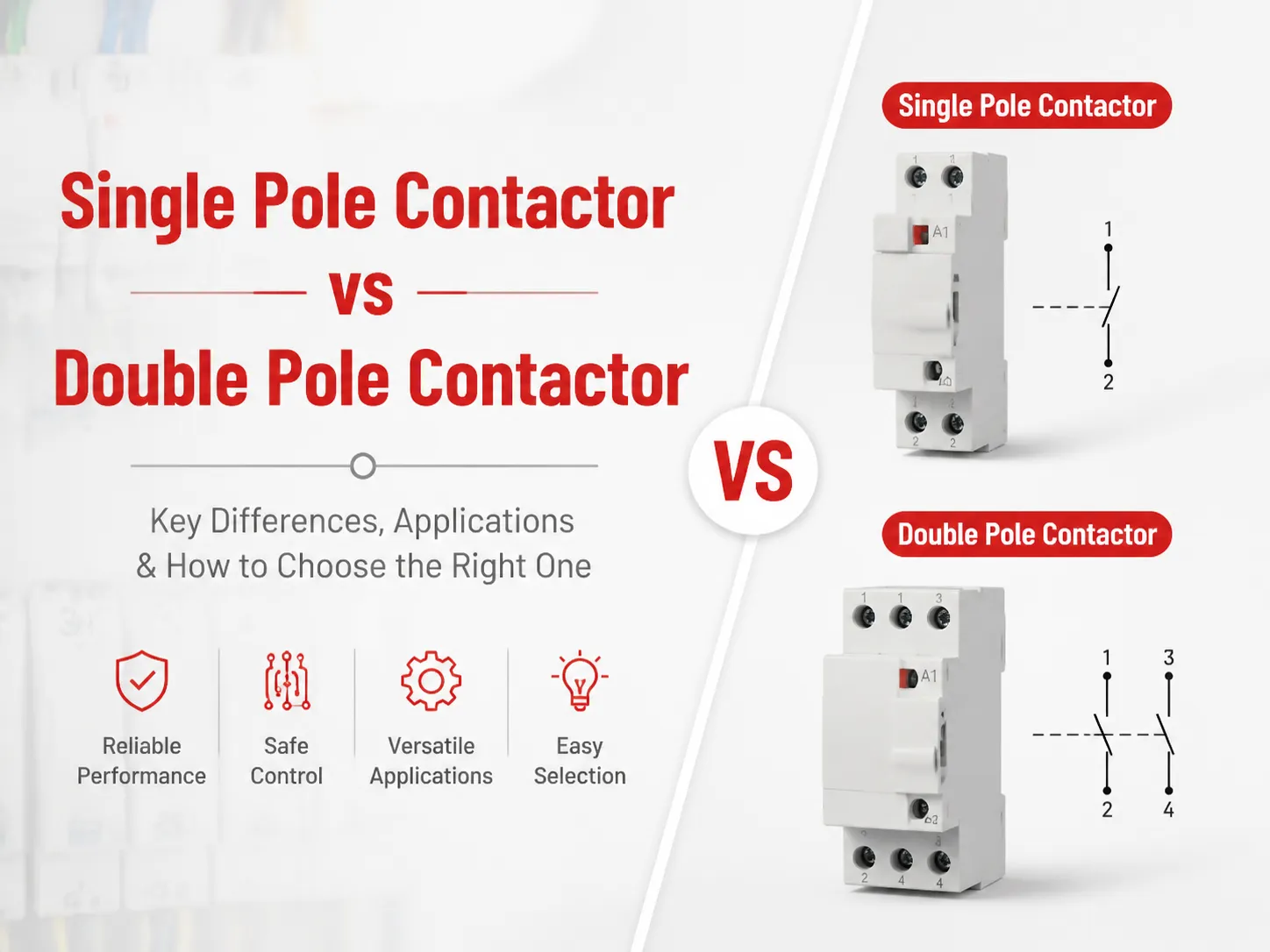
ปัจจัยอีกอย่างที่ต้องพิจารณาคือจำนวนขั้ว สำหรับมอเตอร์สามเฟส หน่วยสามขั้วเป็นมาตรฐาน ตัวเลือกขั้วเดียวและสองขั้วมีอยู่สำหรับการตัดกลาง โหลดเฟสเดียว หรือวงจรสองวงแยก และเป็นสิ่งสำคัญที่ต้องเข้าใจว่าอุปกรณ์สองขั้วต้องเชื่อมต่อแตกต่างจากอุปกรณ์ขั้วเดียว แม้ว่าทั้งสองจะมีจำนวนขั้วเท่ากัน.
นอกจากนี้ ครอบครัวของโครงสร้างต้องถูกพิจารณาเมื่อมองหาอุปกรณ์เสริม บล็อกสัมผัสเสริมสามารถติดตั้งด้านบนหรือด้านข้าง มาพร้อมกับการผสมผสานของสัมผัสปกติเปิดหรือปกติปิด มีหัวหน่วงเวลาลม มีฝาครอบกันฝุ่น โมดูลป้องกันแรงดันกระชาก และกลไกล็อกเชิงกลสำหรับคู่ย้อนกลับ.
หมวดหมู่การใช้งาน: ที่ซึ่งการกำหนดขนาดมอเตอร์เกิดขึ้นจริง
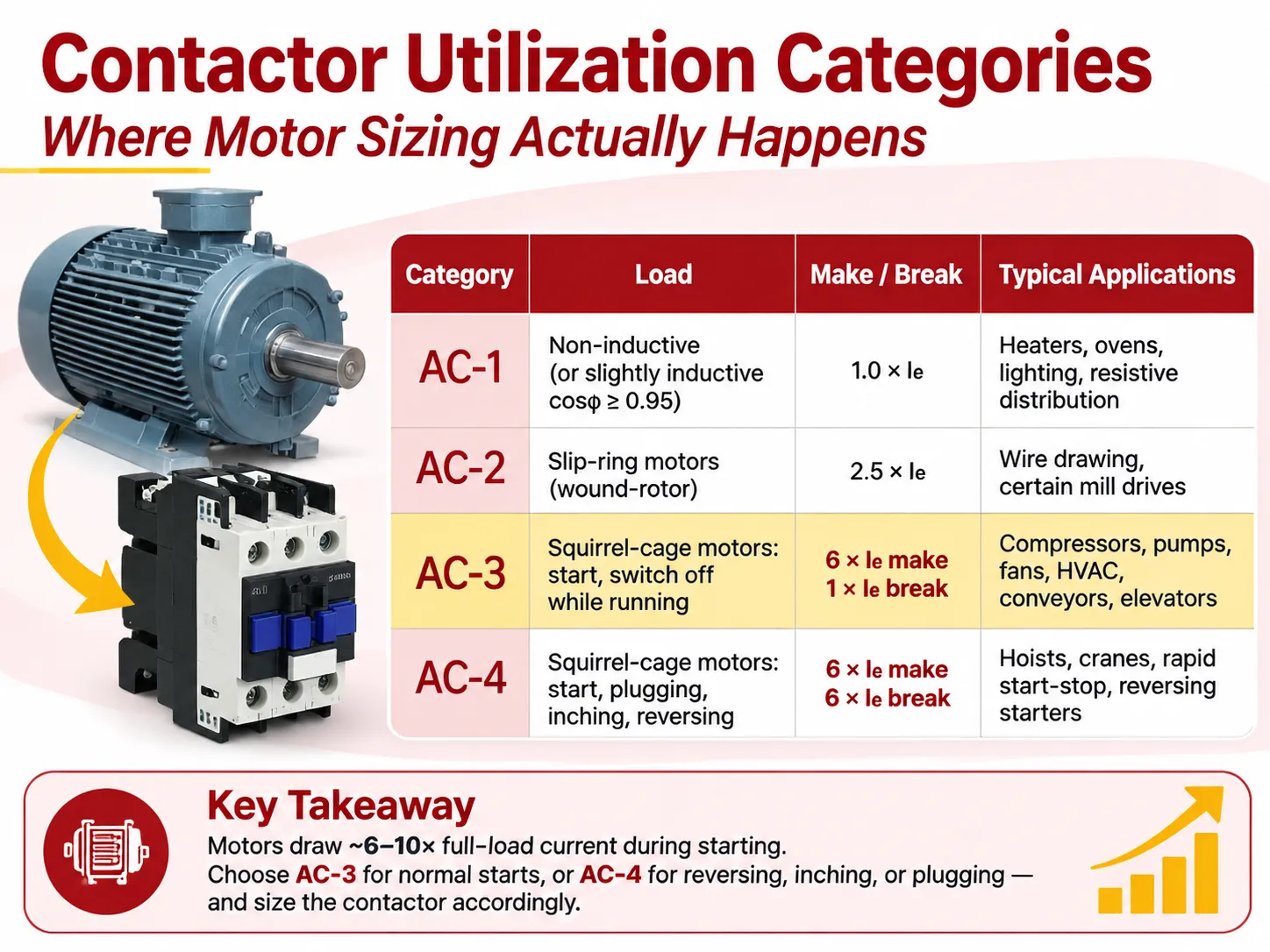
การจำแนกการใช้งานคอนแทคเตอร์ถูกกำหนดไว้ใน IEC 60947-4-1 โดยการรวมเงื่อนไขการทำงานที่ต้องผ่านการทดสอบการอนุมัติประเภท จากทางเลือกต่าง ๆ สี่ประเภทถูกใช้บ่อยที่สุดในทางปฏิบัติ และความแตกต่างเหล่านี้ไม่ใช่เพียงแค่ทางการเท่านั้น.
| หมวดหมู่ | โหลด | การทำงาน / การตัด | การใช้งานทั่วไป |
|---|---|---|---|
| AC-1 | ไม่เหนี่ยวนำหรือเหนี่ยวนำเล็กน้อย (cosφ ≥ 0.95) | 0 × Ie | ฮีตเตอร์, เตาอบ, ไฟส่องสว่างแบบไส้หลอด, การกระจายแบบต้านทาน |
| AC-2 | มอเตอร์สลิปริง (โรเตอร์พัน) | 5 × Ie | การดึงลวด, ไดรฟ์โรงงานเก่าบางประเภท |
| AC-3 | มอเตอร์กรงกระรอก: สตาร์ท, ปิดขณะทำงาน | 6 × Ie ทำงาน, 1 × Ie ตัด | คอมเพรสเซอร์, ปั๊ม, พัดลม, HVAC, สายพานลำเลียง, ลิฟต์, เครื่องผสม |
| AC-4 | มอเตอร์กรงกระรอก: สตาร์ท, การเสียบปลั๊ก, การเคลื่อนที่ทีละน้อย, การย้อนกลับ | 6 × Ie ทำงาน, 6 × Ie ตัด | เครน, รอก, การสตาร์ท-หยุดอย่างรวดเร็ว, สตาร์ทเตอร์ย้อนกลับ |
ผลกระทบในชีวิตจริง มอเตอร์จะดึงกระแสประมาณหกถึงสิบเท่าของค่ากระแสสูงสุดขณะสตาร์ท และคอนแทคเตอร์จะต้องทนต่อสภาวะนี้ ในกรณีการขับเคลื่อนมอเตอร์แบบง่ายที่เพียงแค่สวิตช์เปิด-ปิดขณะทำงาน จะเป็น AC-3 ดังนั้นต้องใช้คอลัมน์ AC-3 ในกรณีการใช้งานพิเศษอื่น ๆ ที่มอเตอร์ย้อนกลับทิศทางหลายครั้งหรือเคลื่อนที่ทีละน้อย จะใช้ AC-4 และจริง ๆ แล้วต้องเพิ่มขนาดอุปกรณ์เพราะขณะ AC-4 ตัด กระแสจะสูงกว่าปกติหกเท่า ดังนั้นอุปกรณ์มักจะต้องเพิ่มขนาดหนึ่งหรือสองเฟรม และบางครั้งต้องมีอุปกรณ์ป้องกันที่ใหญ่ขึ้นด้วย.
ตาราง EXC7 แสดงทั้งสองคอลัมน์ ทำให้สามารถกำหนดขนาดอุปกรณ์ได้อย่างถูกต้อง ตัวอย่างเช่น ในกรณีเฟรม 32 A AC-3 ที่ 400 V กระแสคือ 32 A แต่สำหรับ AC-4 จะเป็นเพียง 12 A การเคลื่อนที่ทีละน้อย 12 A บนคอนแทคเตอร์ 32 A ได้รับอนุญาต แต่การเคลื่อนที่ทีละน้อย 25 A ไม่ได้รับอนุญาต.
คอนแทคเตอร์ AC และ DC ไม่สามารถใช้แทนกันได้
นี่คือคำถามที่ถูกถามบ่อยที่สุด และมีสามเหตุผลทางกลไกที่อธิบายคำตอบนี้.
อาร์ค กระแสสลับจะถึงศูนย์สองครั้งในแต่ละรอบ ซึ่งหลังจากนั้นอาร์คจะสูญเสียพลังงาน หากช่องว่างระหว่างจุดสัมผัสและช่องอาร์คมีความต้านทานไฟฟ้า อาร์คจะไม่เกิดขึ้นอีก ดังนั้นหม้อแปลงมาตรฐานจึงใช้ช่องว่างเล็กและช่องอาร์คแบบตะแกรง กระแสตรงไม่ถึงศูนย์ ดังนั้นอาร์คจะดำเนินต่อไปจนกว่าจะถูกตัด คอนแทคเตอร์ DC จึงติดตั้งขดลวดแม่เหล็กสำหรับดับอาร์ค, ตัวนำอาร์ค, ช่องว่างที่ใหญ่กว่า และบางครั้งเป็นแบบปิดสนิทหรือสุญญากาศ หากอาร์ค DC ถูกใช้กับคอนแทคเตอร์ AC จะทำให้อุปกรณ์เสียหายอย่างรุนแรงจนเกิดการกัดกร่อนหรือการเชื่อมติดของจุดสัมผัส.
ขดลวด นี่คือประเภทความเสียหายที่พบบ่อยที่สุด อิมพีแดนซ์ของขดลวด AC ส่วนใหญ่ประกอบด้วยรีแอกแตนซ์เหนี่ยวนำ ซึ่งเป็นฟังก์ชันของความถี่ หากขดลวดเชื่อมต่อกับ DC ความถี่จะกลายเป็นศูนย์ รีแอกแตนซ์จะกลายเป็นศูนย์ และขดลวดจะทำหน้าที่เป็นตัวต้านทานที่มีความต้านทานต่ำมาก ดังนั้น กระแสจะเพิ่มขึ้นเป็น 5-10 เท่าของค่าที่กำหนด และขดลวดจะไหม้ในเวลาไม่กี่วินาที กระบวนการตรงกันข้ามไม่โดดเด่นเท่าไร แต่ก็ถือเป็นความเสียหายเช่นกัน: ขดลวด DC บน AC ไม่สามารถทำงานได้อย่างถูกต้อง เนื่องจากมีความต้านทานสูงกว่า.
แกนกลาง แกนกลางแข็งที่ทำงานภายใต้ DC คงที่จะไหม้ภายใต้ AC นอกจากนี้ แกนกลาง AC ยังทำให้วัสดุสำหรับ DC สูญเปล่า นี่คือคำตอบที่วิศวกรมักเข้าใจผิด: คอนแทคเตอร์ AC ใช้แกนกลางแบบแผ่นซ้อน ในขณะที่คอนแทคเตอร์ DC ใช้แกนกลางแบบแข็ง.
แม้ว่าจะมีขดลวด AC/DC แบบสากลที่ทำด้วยไดโอดเรียงกระแสและตัวควบคุมแรงดันไฟฟ้า แต่ก็ยังมีราคาสูงกว่าและทำงานได้เฉพาะในช่วงแรงดันไฟฟ้าที่กำหนดเท่านั้น หากป้ายระบุระบุเพียงแรงดันไฟฟ้าและประเภทเดียว ให้ถือว่าสิ่งนั้นเป็นจริง การจ่ายขดลวดผิดประเภทเป็นวิธีที่เร็วที่สุดวิธีหนึ่งในการทำลายคอนแทคเตอร์.
เมื่อคุณต้องการคอนแทคเตอร์ DC สำหรับการสวิตช์ DAV จริง เช่น แบตเตอรี่ สาย DC โซลาร์เซลล์ สถานีชาร์จ EV หรือไดรฟ์ DC ภูมิทัศน์การผลิตสำหรับกลุ่มผลิตภัณฑ์นั้นเป็นห่วงโซ่อุปทานที่แตกต่างกัน และภาพรวมนี้ของ โรงงานคอนแทคเตอร์ DC ชั้นนำ เป็นจุดเริ่มต้นที่มีประโยชน์สำหรับการจัดหาคอนแทคเตอร์.
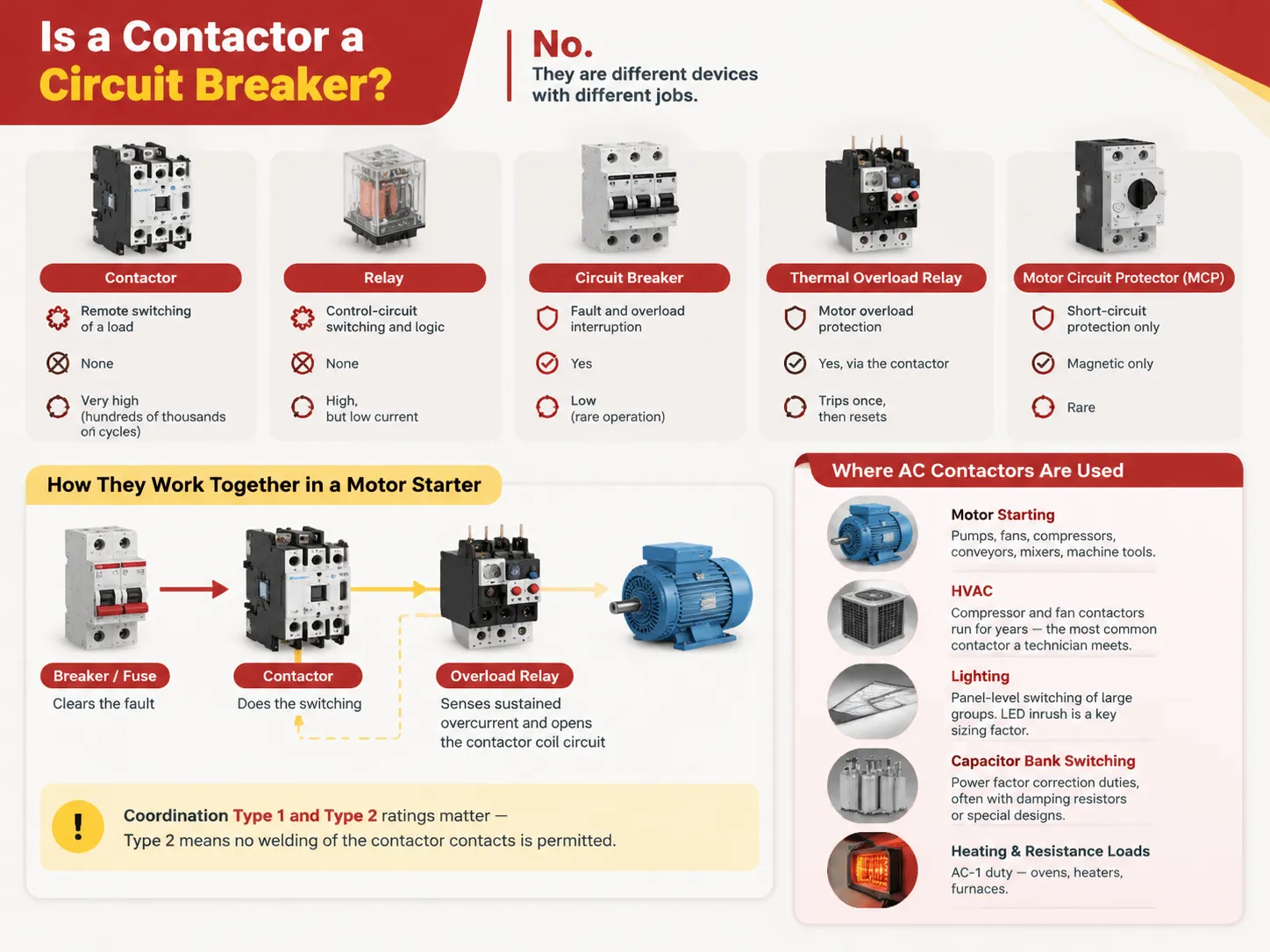
คอนแทคเตอร์คือเบรกเกอร์วงจรหรือไม่?
ไม่ใช่ และความสับสนนี้ทำให้เกิดข้อผิดพลาดในการออกแบบจริง อุปกรณ์สามประเภททำงานสามอย่างที่แตกต่างกัน.
| อุปกรณ์ | งาน | การตัดวงจรกระแสเกิน | ความถี่ในการทำงาน |
|---|---|---|---|
| คอนแทคเตอร์ | การสวิตช์โหลดระยะไกล | ไม่มี | สูงมาก (หลายแสนรอบ) |
| รีเลย์ | Control-circuit switching and logic | ไม่มี | High, but low current |
| เบรกเกอร์วงจร | Fault and overload interruption | ใช่ | Low (rare operation) |
| Thermal overload relay | Motor overload protection | Yes, via the contactor | Trips once, then resets |
| Motor circuit protector (MCP) | Short-circuit protection only | Magnetic only | Rare |
A contactor isn’t built to handle any short-circuit event, and its contacts will be damaged if it tries. A motor starter has all of the three devices working in synchronization: the contactor does the switching, the overload relay makes sure that there has been sustained overcurrent and opens the circuit of the contactor coil, the disruption of the current in the circuit happens upstream by the breaker or the fuse. That is why we need to know about the coordination Type 1 and Type 2 ratings since they tell us what will happen to the contactor when there is a short circuit with the Type 2 rating meaning that contact welding is not permitted.
Where AC Contactors Are Used
Five categories of applications account for the majority of the industry.
- Starting of motors. This includes pumps, fans, compressors, conveyor belts, mixers, and machinery where a small motor is either operated directly or in a star-delta combination or via a soft start for larger motors as well.
- HVAC. The contactors employed in compressors and fans operate for many years and are the type of contactor most frequently seen by a technician. How this task affects the contactor after multiple starts and what failures the contactor experiences and which are caused by the refrigeration circuit must be treated separately, and the processes will be discussed in the current clarification of the operation of the contactor for HVAC equipment.
- Lighting. This is related to the control of lighting at the switchboard level where the total inrush is a proper design component due to the new LED lamp drivers.
- Switching capacitor banks. This is a function of power factor correction which involves large inrushes and utilizes damping resistors or special design contactors.
- Heating and resistive loads. This is an AC-1 function which ensures a long service life of the contactor: furnaces, heaters, stoves.
Contactors, Starters and Motor Circuits
The contactor in association with a thermal overload relay functions just like an electromagnetic starter. This combination is what is used in many three-phase motor installations.
- Direct-on-line (DOL). Only a single contactor. It has full voltage during starting. This method is simple and cheap but has its limits beyond which the electrical supply company does not approve the starting current.
- Reversing. It uses two contactors that have physical and electrical interlocks so that both can never be on at the same time. The interlock device is necessary because a control problem can cause both contactors to be closed together.
- Star-delta. This system uses three contactors and also utilizes the timer for reducing starting current while introducing some complications in the station.
- Soft Starter/VFD. This system is used at places where starting current or torque control is important, and in this case, the contactor acts as a bypass or isolation device rather being the main switching element in the circuit.
How to Wire an AC Contactor
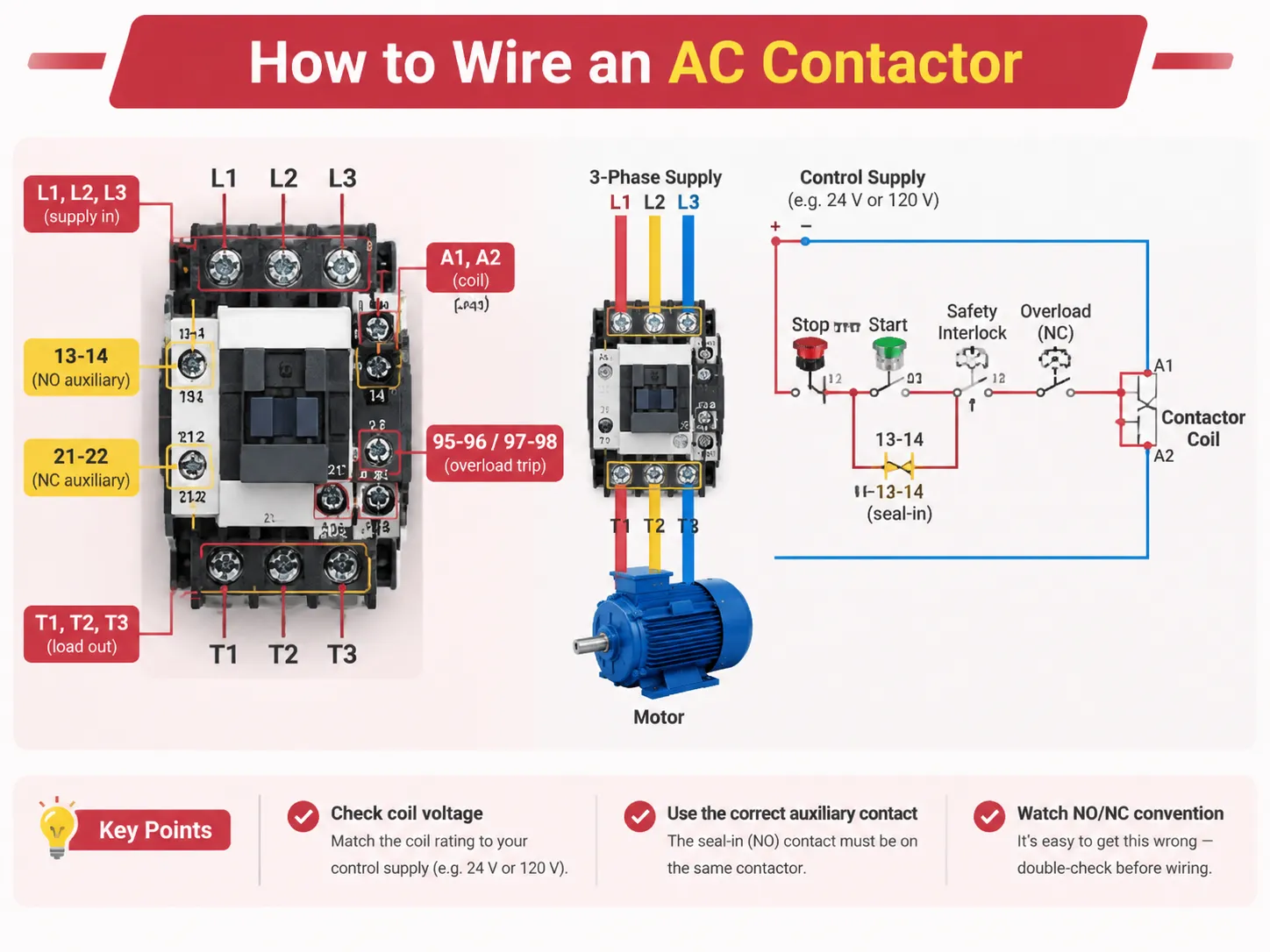
The standard identification of each terminal should be memorised. If there is a mistake in the identification of any terminal, the contactor may falsely seem to operate but control something else.
| เทอร์มินัล | ความหมาย |
|---|---|
| L1, L2, L3 | Line side of the main poles (supply in) |
| T1, T2, T3 | Load side of the main poles (motor out) |
| A1, A2 | Coil terminals |
| 13-14 | Normally open auxiliary contact |
| 21-22 | Normally closed auxiliary contact |
| 95-96 / 97-98 | Overload relay trip contact (NC / NO) |
The wiring corresponds to its purpose. L1 to L3 correspond to power supply wires, while T1 to T3 correspond to the motor wires. The control circuit is supplied through A1 and A2 of the start button, stop button, relevant safety interlocks and normally closed contact of overload relay.
A few practical notes. First of all, test the voltage before wiring up the coil as a coil rated for 120 V will not work when connected to 24 V supply. Secondly, make sure that the AUX contact used for seal-in is actually present on the contactor on which it is sealing rather than being part of a separate relay located in the vicinity. Getting the NO/NC convention wrong is common enough to be worth a deliberate check, and the distinction is explained clearly in this comparison of normally open versus normally closed contactor wiring.
Installing and Maintaining an AC Contactor
There are two main factors that influence installation: torque and environment. In the EXC7 family of products, terminals have capacities that vary from 1 to 4 mm² in the smallest frames to 50 to 240 mm² in the largest. The fastening torque ranges from 1.2 N·m to 14 N·m. Most of the field failures of contactors are due to terminals not receiving proper torque—they end up being loose, causing heating, which leads to the failure of the terminal block.
The presence of dust covers is well justified in factories, woodworking shops, or agricultural plants since abrasive or conductive dust would wear the contacts mechanically and electrically much faster than the accessory itself would cost. Surge suppression modules also help out; when you switch a coil, the inductive effect might end up damaging the output of a PLC if not properly suppressed. AC coils often use RC snubbers or varistors while DC coils use the flyback diode or transient voltage suppressor (TVS) though the latter has a downside: simple diodes slow release timing, making them less suitable for circuits where such timing checks are required for safety.
Maintenance is not a complex process: just isolate the circuit and perform the following operations. You need to check the state of wear of contacts and pitting; see if the screws in the terminal are tight; and check the mechanical functioning of the armature and the arc chutes. Then take the readings of the coil. The coil resistance between A1 and A2 should be about tens of ohms if the coil is healthy. If the contactor does not show any odd readings, there will be a low resistance in case of a short. The voltage drop across a closed pole while the load is switched on will be in millivolts but a reading of one volt or higher indicates that the contactor is in danger of overheating.
The most helpful thing a maintenance program can do is to monitor symptoms. Будучиaanut what type of fault occurs when a contactor starts to buzz, trip overload more frequently, or hold the circuit. Collecting those early signals and acting on them is the whole basis of condition-based maintenance, and the pattern of warning signs is set out in this overview of อาการล้มเหลวของคอนแทคเตอร์ AC.
Ultimately, it is important to express life in quantifiable terms. Electrical life is stated in terms of operational cycles and depends on duty: the same frame that supports about a hundred thousand AC-3 operations may only be capable of a fifth under AC-4. In general, mechanical life is greater than electrical life by a factor of ten. If a contactor is replaced more often than indicated by the duty cycle, then the mistake lies in sizing and not with the equipment.
What They Cost and How to Choose a Brand
Here are the prices from US and international distributors in 2026. The gap between a famous brand and a low-cost brand is real. It is visible in the kind of contact materials used to make them, not the plastic.
| รายการ | Typical price | หมายเหตุ |
|---|---|---|
| General-purpose relay, 10 A | $8–$15 | Control circuits only |
| Contactor, 9–18 A AC-3 | $15–$45 | Premium brands at the top of the band |
| Contactor, 25–40 A AC-3 | $40–$95 | Most common motor sizes |
| Contactor, 50–95 A AC-3 | $90–$250 | Frames get heavier; accessories extra |
| Contactor, 120–800 A | $250–$1,500+ | Frame size dominates the price |
| Thermal overload relay | $25–$120 | Matched to the contactor frame |
| Auxiliary contact block | $8–$25 | Per block |
| Surge suppression module | $10–$30 | RC or varistor for AC coils |
When it comes to choosing the right brand, it is no secret that major players such as Schneider, ABB, Siemens, Eaton, WEG and LS perform best when it comes to the type test results and the amount of documentation available to customers. They, however, require you to pay for it. Even though cheaper replicas of such products do exist, they are generally meant for heavier use; however, corners are being cut in the contact part, resulting in short life cycles of the devices themselves.
HUYU is in the second category, having an undeniable advantage of offering an extensive product line instead of a few types of equipment, which puts them at the bottom of the competition. The EXC7 AC contactor range covers 9 A to 800 A in one platform with the same accessory system — auxiliary blocks, delay heads, dust covers, suppressors and interlocks — and the high-current frames use a dual-coil control circuit that cuts holding power by more than 40%, which matters on a panel that runs continuously. What HUYU lacks is the decades of established customers and the native distributor network that a European brand can provide, and for a job in which the name of the brand is specified by some local utility or equipment manufacturer, this discrepancy is decisive.
คำถามที่พบบ่อย
What is an AC contactor used for?
The remote and continual ability to manipulate an alternating current load. This technology is mainly used for motor control, i.e., for starting or stopping three-phase motors of pumps, compressors, fans, conveyors, mixers, machine tools, and HVAC equipment. The remaining four applications include panel lighting switching, capacitor bank switching for power factor correction, resistance heating applications like ovens and furnaces, as well as general remote circuit switching when the operator has to control the load without having the manual switch that carries the full load.
AC จะทำงานได้หรือไม่โดยไม่มี contactor?
Definitely. A contactor is one of many ways of switching an AC load, while smaller loads are usually switched through a manual switch, relay, solid-state relay, or some drive output. If using a contactor it means one is able to switch large currents with a small control signal and at a high rate, and also take care of arc management. If the load is small, seldom switched, or managed already by current controller, the contactor might be useless or limited to isolation functions only.
ความแตกต่างระหว่างคอนแทคเตอร์ AC และ DC คืออะไร?
The three differences are: the core – an AC contactor has a laminated silicon steel core with a shading ring whereas a DC contactor has a solid core, since the magnetic flux doesn’t change; the coil – AC coils are characterized by a low-resistance coil of only a few turns and limited by inductive reactance, while DC coils have many turns and their high resistance eliminates the effect of reactance; the function of arc control mechanism – AC uses naturally occurring zeroes of DC has to involve magnetic blowout coils, since the arc does not get extinguished by itself.
What is AC1 and AC3 contactor?
The terms are the usage categories as described in IEC 60947-4-1. AC-1 is used for either non-inductive or slightly inductive loads such as heaters and resistance loads. For AC-1 class, the only requirement for the contactor is to carry and switch the current equal to its rating. AC-3 applies to induction motors, where six times the current rating is required at the start of the motor and at switch-off operation the contactor has the same rating.When selecting the appropriate column for your application, this is one case where a 32 A rating makes sense, where AC-1 gives a rating of 50A while AC-3 gives a rating of only 32A. Thus we should be using a 32 A rated motor, not the higher number indicated on the label.
Can AC contactor be used for DC?
The normal coil does not work perfectly on the first contact or reliably on of the electrics section. An AC coil operated by DC will lose the inductive resistance, as the current will become five to ten times higher than the rated current in a second. If an AC coil is substituted with a DC coil the main contacts still will fail, as the arc chamber is designed for the arc that crosses zero in each cycle, whereas the DC arc will not break up inside the chamber.
How do I know which frame size to buy?
Consult the AC-3 column for the full-load current of this motor at its working voltage and add some margin if inching or reversing is involved; in this case, check the AC-4 column instead. Check that the appropriate accessories exist for that frame. Do not size based on the AC-1 figure or the kW figure alone, since the kW figure is declared at different voltages, hence one frame size would carry more power at 400 V and less power at 690 V.
อ้างอิง
- UL Standards & Engagement — UL 508, Industrial Control Equipment
- NFPA — NFPA 70, National Electrical Code (motor circuits, Article 430)
- NFPA — NFPA 70E, Standard for Electrical Safety in the Workplace
- International Electrotechnical Commission — IEC 60947-4-1, contactors and motor-starters
- WEG — IEC contactor sizing, utilization categories and coordination types
สรุป
Laminated core fitted with the shading coil that also works at low resistance using inductive reactance and arc chute working on zero-cross current basis. The understanding of these principles is essential; everything else is then easy.
The following points must be considered. First, the size should be chosen according to the application type and not based on the ampere rating so that in simple applications AC-3 is sufficient, whereas in some applications such as inverting AC-4 should be used, as this means achieving only half of the load required for the former; second, make sure that an AC coil is not being switched on from a DC supply, otherwise the coil would be burnt in a few seconds; and third, we need to understand that both terminal torque and arc chute and surge protection must be considered as maintenance items, not installation items.