
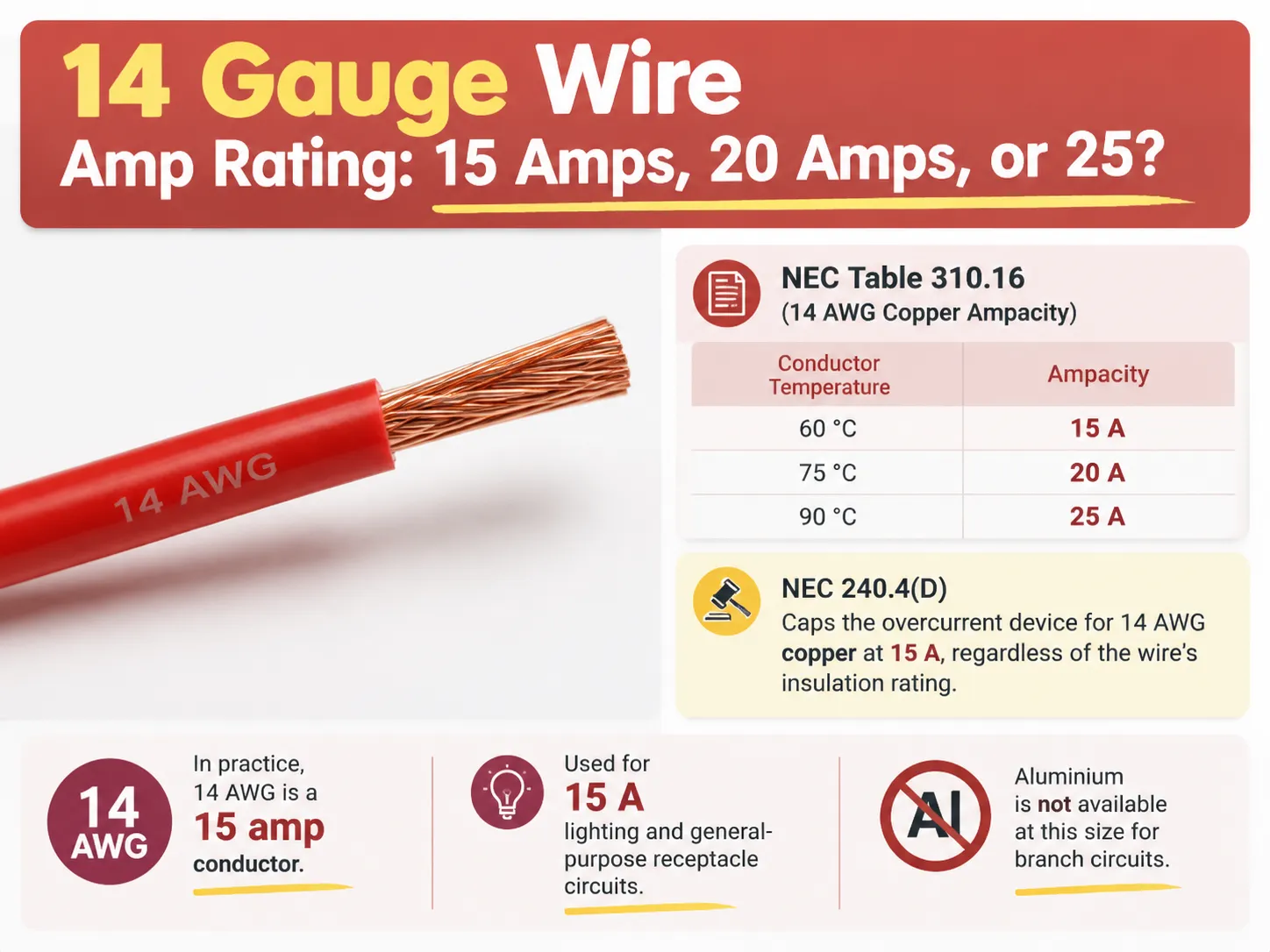
When you ask any three electricians about the ampacity of 14 gauge wire, you will hear three technically valid answers: 15, 20 or 25 amps. As far as the code table is concerned, both groups rely on the same set of data. The landmark difference is which regulation is applicable to the circuit you’re dealing with. In the case of 14 AWG wire, this makes it possibly the most important wire size of all, since there is one particular section of the code that overrides ampacity tables totally.
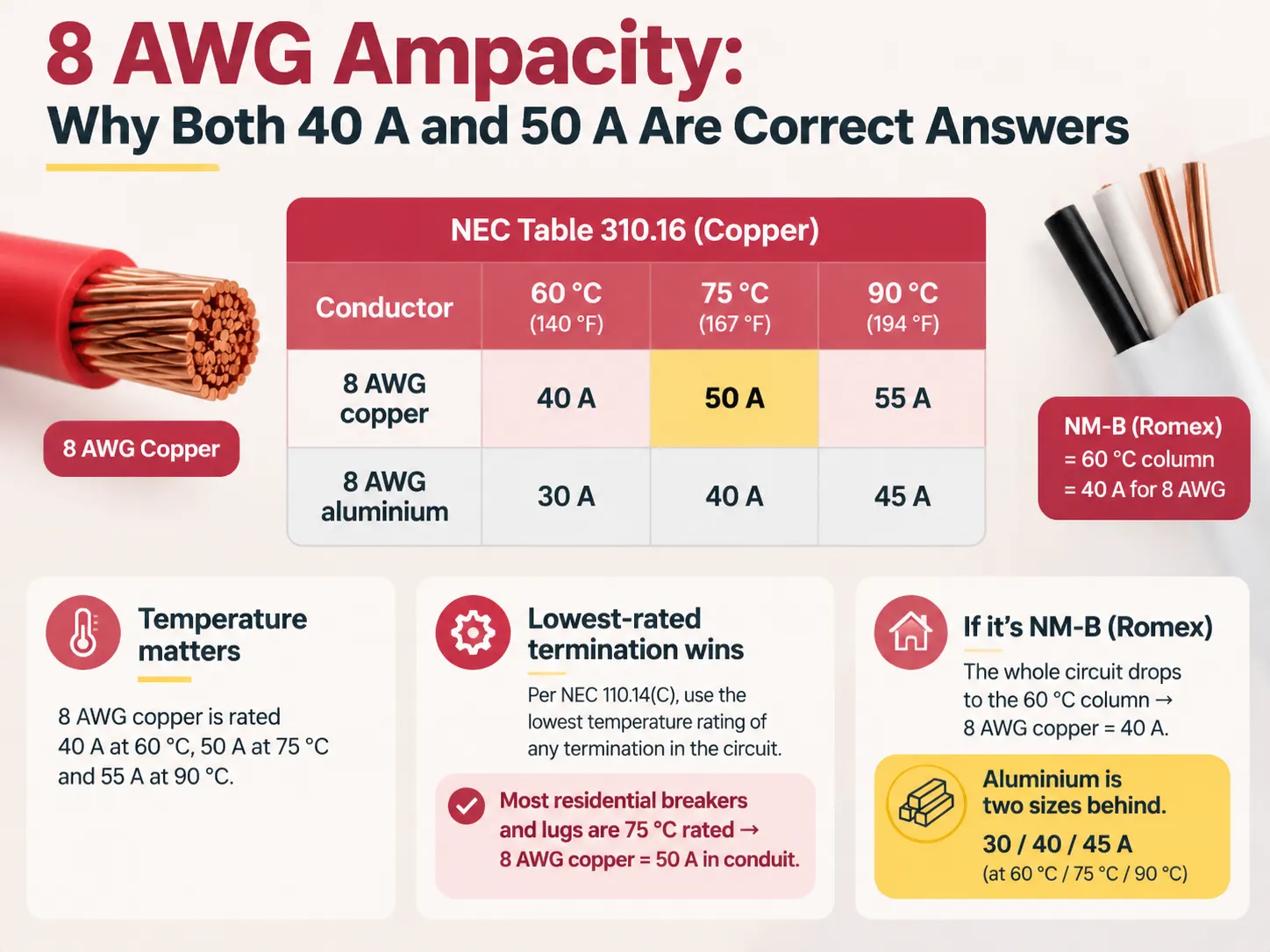
In summary, according to NEC Table 310.16, 14 AWG copper wire rated at 60 degrees Celsius has an ampacity of 15A and at 75 degrees Celsius its ampacity increases to 20A and at 90 degrees Celsius it increases to a maximum of 25A. However, using NEC 240.4D, it can be seen that 14 AWG copper wire has its amperage capped to 15 regardless of insulation ratings. Because of this limitation, 14 AWG copper wire can be used only for lighting and receptacle circuits. Additionally, it must be mentioned that there are no aluminum wires available at this gauge for branch wiring.
What 14 AWG Actually Is
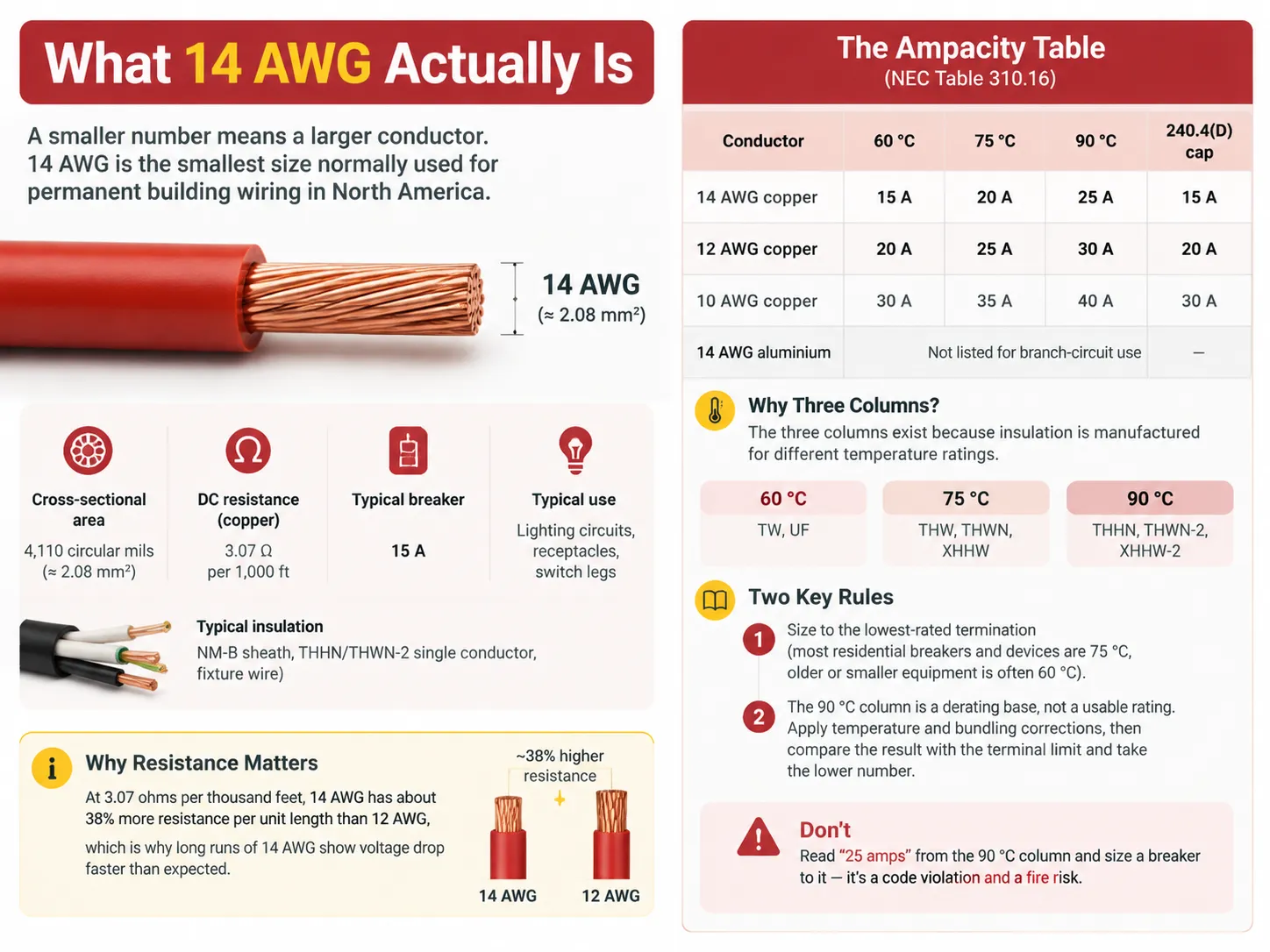
The American Wire Gauge is reversed — in this system, a smaller number indicates a larger wire. The smallest size typically used for permanent wiring in North America is 14 AWG, which is one size less than 12 AWG and two sizes less than 10 AWG.
| คุณสมบัติ | ค่า |
|---|---|
| พื้นที่หน้าตัด | 4,110 circular mils (about 2.08 mm²) |
| DC resistance, copper | 3.07 Ω per 1,000 ft |
| DC resistance, aluminium | 5.06 Ω per 1,000 ft (where available) |
| Typical insulation | NM-B sheath, THHN/THWN-2 single conductor, fixture wire |
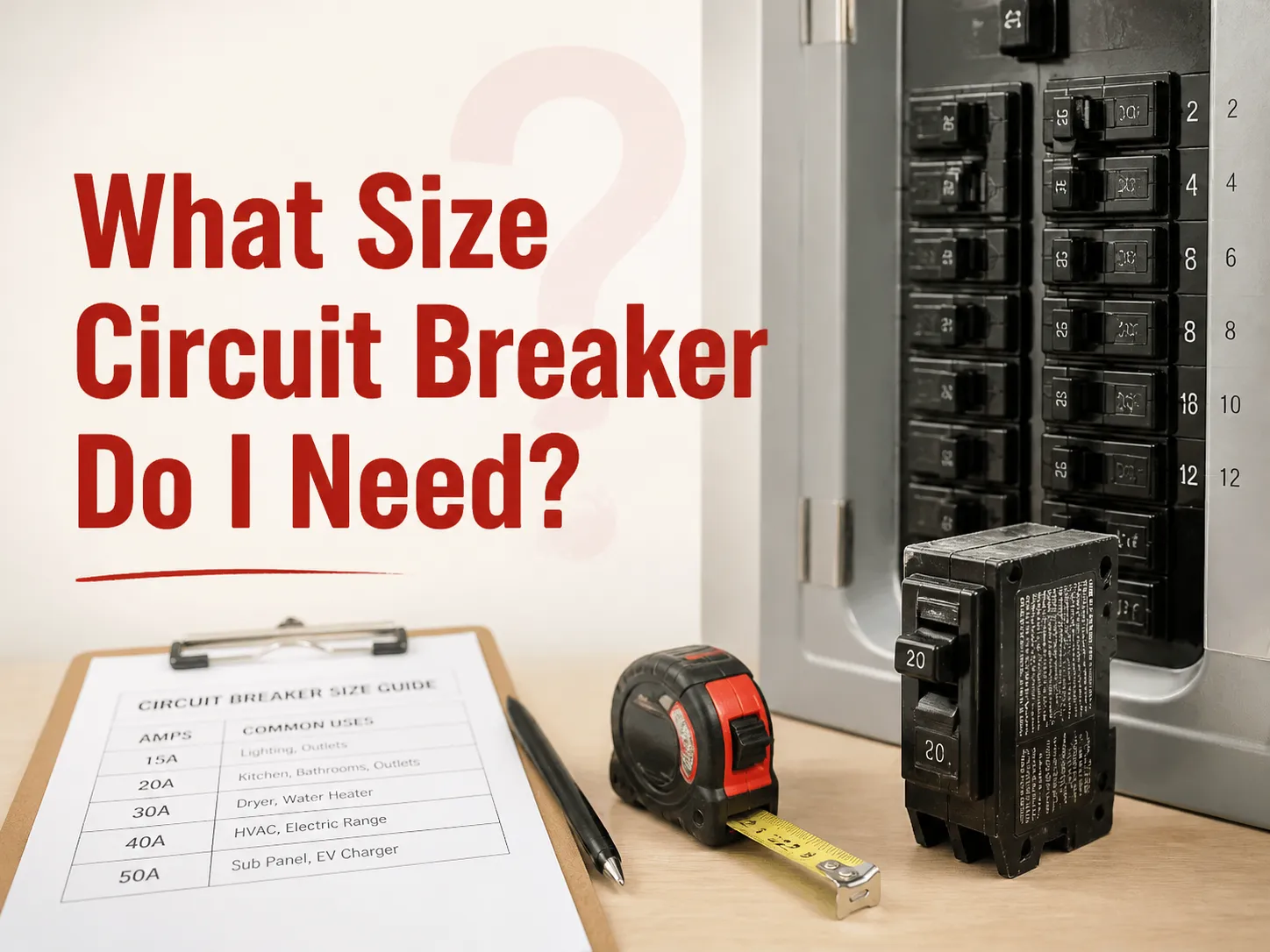
| Typical breaker | 15 A |
| การใช้งานทั่วไป | Lighting circuits, general-purpose receptacles, switch legs |
The resistance wire is the one that performs the actual task in due course. 14 AWG has a resistance of 3.07 ohms/thousand feet, which is almost 38% higher than that of 12 AWG. So long runs of 14 AWG show a voltage drop more quickly than anticipated – even when the current is easily within the ampacity.
ตารางแอมแปร์ และเหตุผลที่มีสามคอลัมน์
The data is derived from NEC Table 310.16, presenting allowable ampacity values with an environment temperature of 30 °C and utilizing up to three current-carrying conductors in one conduit or cable.
| ตัวนำ | 60 °C | 75 °C | 90 °C | 240.4(D) cap |
|---|---|---|---|---|
| 14 AWG copper | 15 แอมป์ | 20 แอมป์ | 25 แอมป์ | 15 แอมป์ |
| 12 AWG copper | 20 แอมป์ | 25 แอมป์ | 30 แอมป์ | 20 แอมป์ |
| 10 AWG ทองแดง | 30 แอมป์ | 35 แอมป์ | 40 แอมป์ | 30 แอมป์ |
| 14 AWG aluminium | Not listed for branch-circuit use | — | ||
Three columns have been created due to the fact that different temperature rating insulation is available. For instance, TW and UF types are rated 60 °C; varieties THW, THWN, and XHHW are rated 75 °C; and THHN, THWN-2, and XHHW-2 types are rated 90 °C.
Two regulations decide when to use a column. The first, NEC 110.14(C), requires that termination sizing of a circuit is based on the lowest temperature rating used in the circuit. Most residential circuit breakers and device terminals are rated 75 °C and older/ smaller devices are mostly rated 60 °C. The second regulation dictates that 90 °C is used purely for derating purposes rather than actual rating, that is, it is to be used for temperature and bundling calculations and only thereafter compared with terminal rating. Thus if 25 amps is obtained from 90 °C column and a circuit breaker is sized accordingly it violations both codes and fire safety requirements, respectively.
240.4(D): Why 14 AWG Is Always 15 Amps
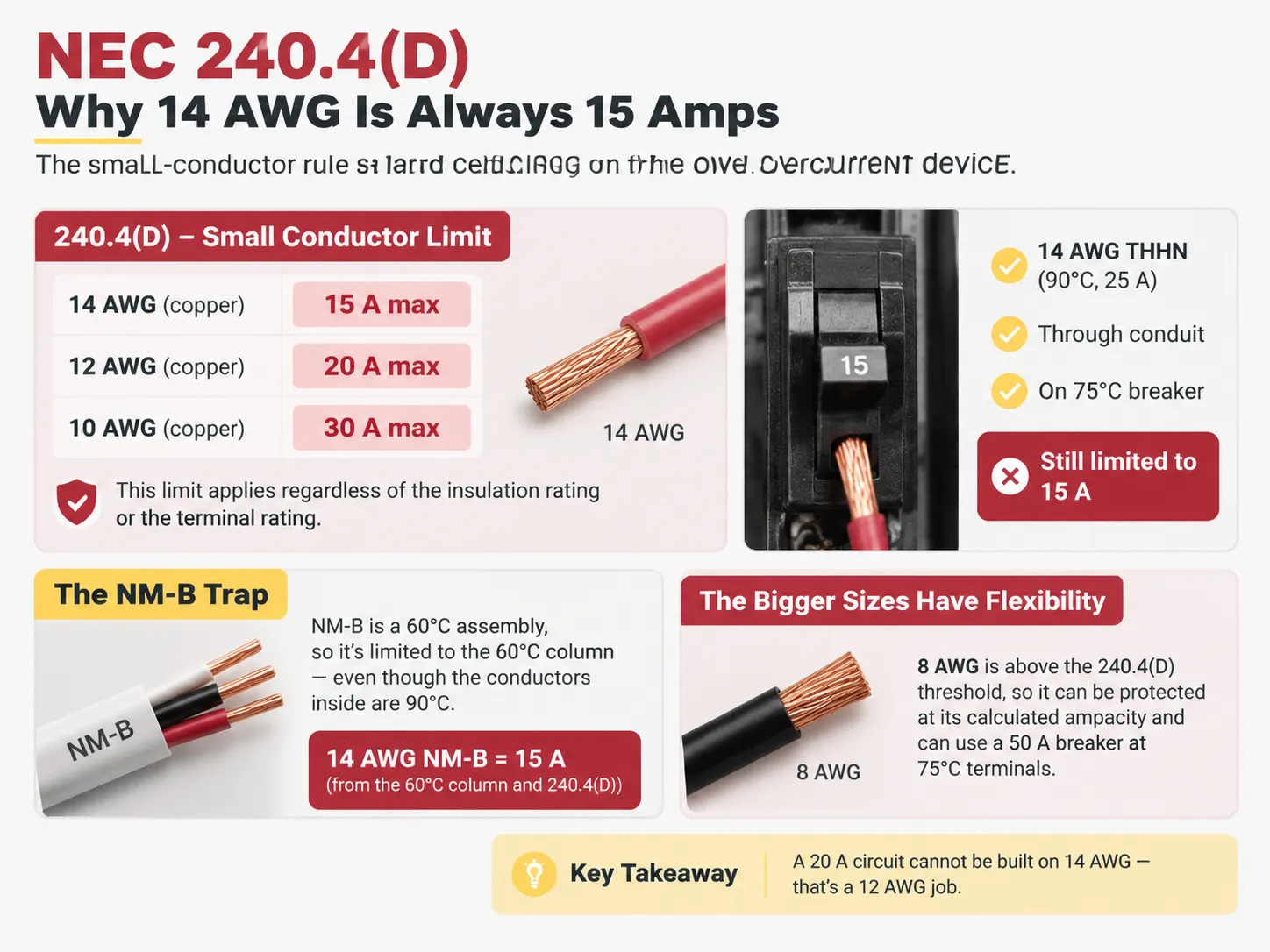
NEC 240.4(D) clarifies the issue at hand. The small-conductor standard is a limitation that places a limit on current-limiting devices for the smallest wire sizes:
- 14 AWG copper → 15 A maximum
- 12 AWG copper → 20 A maximum
- 10 AWG copper → 30 A maximum
This limitation applies regardless of the type of insulation used, or if terminal connections are rated above the maximum amps for smaller conductors. For example, you could use 14 AWG THHN wire with a rating of 25 A and connect it to a 75°C circuit breaker, but the breaker would still be limited to 15 A. The principle behind the rule is that small wire sizes usually terminate at circuit breaker terminals without sufficient thermal capacity.
This point marks the major difference between the two types of conductors here – 14 AWG does not have the same level of flexibility as larger wire sizes do in terms of ampacity and use of circuit breakers.
Hence, 14 AWG cannot be used in a 20 A circuit even if the wire run is short and the terminals are good. It is in fact 12 AWG that can be used.If you are working through the sizing logic for the first time, the underlying method — load calculation, then conductor, then protection — is set out in this explanation of how minimum circuit ampacity is determined.
The NM-B Trap
In a home electrical installation, most of the 14 AWG wires come from NM-B cable, which is also known as Romex. The NM-B wire has a rating of 60 °C, and because of that, according to NEC 334.80, the ampacity can only be measured in the 60 °C column even although THHN wire itself can run at 90 °C.
This means that there are two oppositional limitations in place. In the 60 °C row, the ampacity is rated at 15 amps, and according to 240.4(D), it is 15 amps too. Therefore, when using 14 AWG wires with a 15 amp circuit breaker, familiarizing yourself with such a pairing will not cause you any troubles as it comes to home wiring. Moreover, in case you find the same wires (14 AWG THHN) in another kind of installation project (such as that of a conduit system), the ampacity will still remain at the level of 15 amps, as the same regulation 240.4(D) will apply.
Most electrical installations fail when it comes to derating rules. Since NM-B wire cannot be placed in a higher temperature column, it makes almost impossible to take into account the effects of ambient temperature correction and bundling adjustment. Once NM-B wire is placed in a hot attic, its ampacity drops, and the circuit breaker cannot compensate for this loss of ampacity.How ambient temperature and conductor counts interact with the base table is covered in this look at NEC requirements for wire types and the voltage they carry.
Copper Versus Aluminium at This Size
The absence of any viable 14 AWG aluminium market is a known fact. In fact, in the design of branch-circuit and feeder conductors, aluminium does not make it to the short list of small wire gauges. The reason for this is that aluminium has a big problem with connections that appeared late in the 1960s and 1970s precisely as a result of connection issues with the small gauge wires.
Aluminium becomes feasible starting from the 8 AWG size when the savings in weight and material justifies the introduction of larger wire. Note that aluminium wires carry up to 20% less current than coppers ones due to higher resistance, which is about 65% bigger than copper’s.
Thus, copper wires definitely remain the only option for the 14 AWG segment. The broader comparison between the two materials, including where each is genuinely the better choice, is set out in this explanation of why both copper and aluminium are used for power conductors.
Derating: When 14 AWG Stops Being Enough
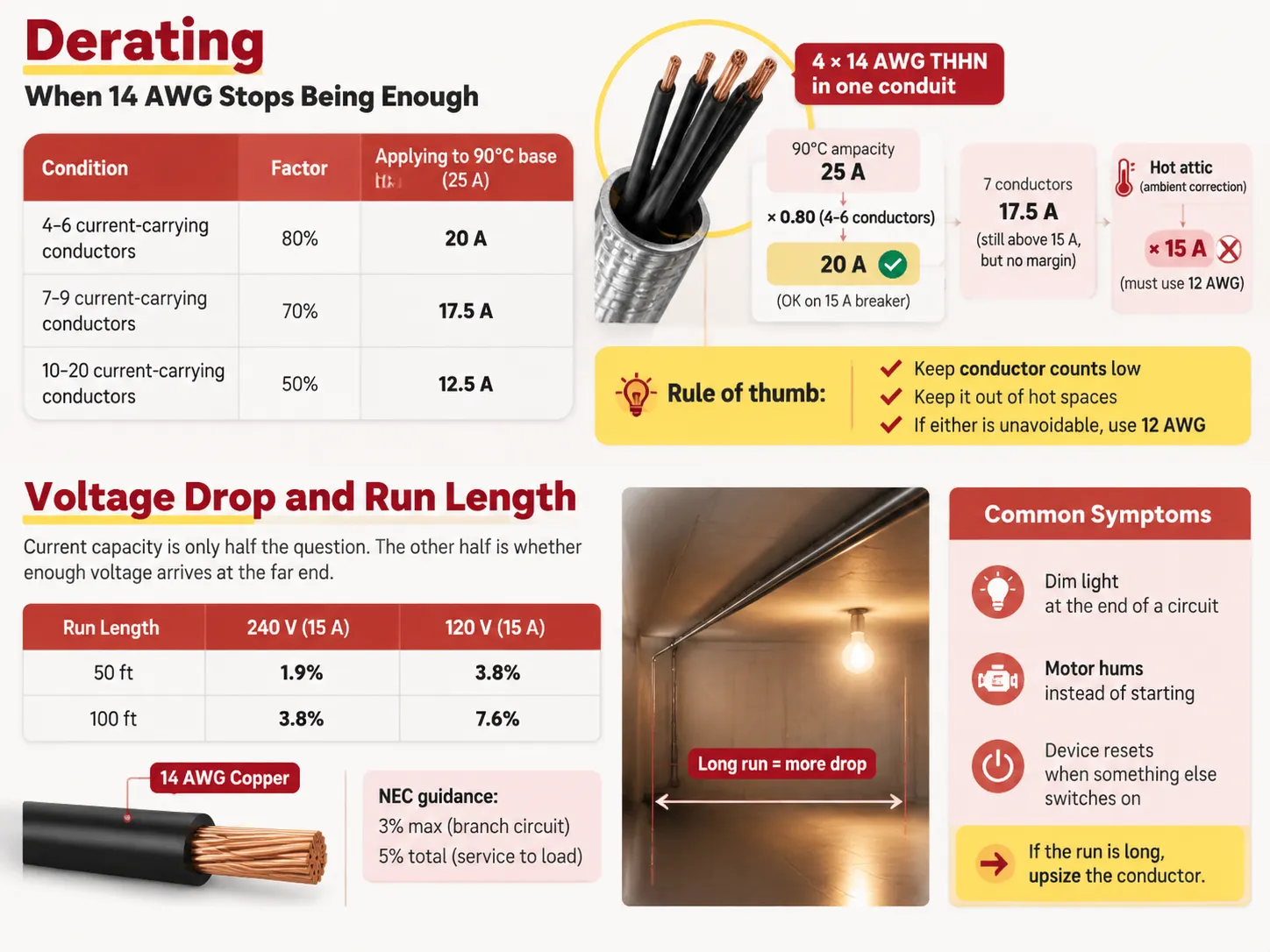
The table presumes the presence of no more than three wires transmitting electrical current at ambient temperature of 30 °C. These assumptions usually do not hold true, and even with 14 AWG wires, there is soon a marked derating of the conductor below the 15 A threshold, which results in it becoming non-compliant instead of just borderline compliant.
| สภาพ | ปัจจัย | Applying to the 90 °C base (25 A) |
|---|---|---|
| 4–6 current-carrying conductors | 80% | 20 แอมป์ |
| 7–9 current-carrying conductors | 70% | 5 A |
| 10–20 current-carrying conductors | 50% | 12.5 A |
Let’s examine a clear-cut example: four wires consisting of 14 AWG in the shared environment of one conduit. The amp rating of 25A multiplied with 0.80 gives 20A. That is still more than enough since the minimum needed is 15A which should be enough for a 15A breaker.When the number of wires forms up to seven, the amp rating drops down to 17.5A which is still more than 15A but the tolerance level is out of reach. If the space is too hot, which means more ampacity drops below the minimum required. In such a case, one has to switch to the thicker wire such as 12 AWG.
The simplicity of the case of 14 AWG wire is that, as soon as one exceeds wires count or temperature, it is better to switch to the better grade wire of 12 AWG.
แรงดันตกและความยาวสาย
The current capacity forms only one side of the question; at the far end, one has to ask the other side-question: Do I have sufficient voltage?
In the case of a 15-A 240-V circuit, copper-sized 14 AWG shows a drop of about 1.9% up to 50 feet and 3.8% over 100 feet. Using a 120-V circuit means that the same drop would proportionally raise percentages by twofold.
Hence, 14 AWG is anyfavor large-maybe too large-for any wiring on long runs. Following the NEC’s guidance, a 3% drop on the branch circuit and a 5% drop from service to load are allowable. At 50 feet long, you hit 3% drop on branch circuits with 14 AWG wired for a 120V, which isn’t too shabby until you’re measuring cable length rather than the direct distance.
Long runs also account for a lot of mysterious defeat symptoms-the light dims at the end of the circuit, the motor hums instead of trying to start up, a device resets itself when something else clicks on. All three are voltage drop symptoms in borrowed clothes. If the run is long, use a larger conductor instead of tolerating the drop.
What 14 AWG Is Used For, and What It Is Not
| Suitable | Not suitable |
|---|---|
| 15 A lighting circuits | 20 A receptacle circuits (needs 12 AWG) |
| General-purpose receptacle circuits on a 15 A breaker | Kitchen small-appliance circuits, which must be 20 A |
| Switch legs and traveler wiring | Bathroom receptacle circuits, which must be 20 A |
| Smoke and CO alarm circuits | Laundry receptacle circuits |
| Short runs to fixed lighting | Water heaters, dryers, ranges, EV chargers, air conditioners |
| Low-draw device circuits | Any circuit where 240.4(D) would be exceeded |
In this way, it is the case that while 14 AWG is allocated to general lighting and general receptacles, any application that requires a fairly high fixed load is supported by its own circuit that is larger than that. Indeed, this allocation is intentional, for circuits that have general purposes cannot really be predicted so they remain small and numerous.
The formula for calculating load in a 15 A circuit is worth knowing by heart. 15 A units at 120 V equal 1800 W; since almost all interpretations of code limit continuous loads at 80%, 12 A or 1440 W of useful and continuous capacity is possible. That being said, 1500 W space heater is right at the edge and cannot allow anything else to be connected.The wattage side of the calculation is worked through in this guide to how many watts a 15 amp circuit can supply.
14 Versus 12: How to Choose
This is because the two sizes are so similar in terms of both their prices and performance that the choice is usually influenced by the “type of circuit,” rather than “doing the math.”
- Use the 14AWG wire size in wiring your 15 A lighting circuits and general-purpose receptacle circuits, as both the code and ampacity correspond, but the runs are medium.
- Use 12 AWG when wiring any of the 20 A type circuits: kitchens, bathrooms, laundry rooms, garages, outdoor receptacles, or when there are long runs and voltage drop is an important factor.
- Use 12 AWG whenever the installation situation requires the derating of the wire: hot attics, a lot of wires inside conduits, or cables bundled together.
- Use 12 AWG if there is a slight chance of needing a 20 A circuit in the future, as the price difference is very small, while the cost of retrofitting it later will be significant.
Final note about handling: The 12 AWG wire is stiffer and harder to place in a box, and therefore the number of what can be placed in the box is higher in its case. If you increase the size, check the volume of the box and breaker as well. The direct comparison of the two sizes, including where 12 AWG becomes mandatory, is set out in this guide to 12 gauge wire and what it is rated for.
คำถามที่พบบ่อย
Can I put 20 amps on 14 gauge wire?
According to NEC 240.4(D), even if the columns show 20 A and 25 A for 14 AWG copper at 75°C and 90°C respectively, it does not mean that 14 AWG copper can carry more than 15 A. This limitation applies without regard to the thermal rating or terminal rating. To be able to utilize the 20 A circuit, one must use 12 AWG copper, which is also restricted to 20 A in accordance with the NEC limitations.
Can 14 gauge wire handle 1500 watts?
At 120 volts, 1500 watts uses 12.5 amps – under the 15-amp rating and over the 80% continuous load rule of about 12 amps. Therefore, although it will run under these circumstances, it runs the whole circuit at 1500 watts continuously and will run warm as the conductor runs without any margin. On the other hand, at 240 volts, this same load draws only 6.25 amps comfortably within limits.
Can a 14 gauge handle 30 amps?
Not at all. The maximum rating of 14 AWG copper in Table 310.16 is 25 A at an ambient temperature of 90 °C, so it cannot be used as a termination. Regarding the limitation imposed by 240.4(D), the maximum rating is 15 A. A 30 A circuit must use 10 AWG copper, which is limited to 30 A under the same regulation.
Should you run 12 or 14 gauge to 20 amp breakers in residential code?
Use 12 AWG. A 20A breaker on 14 AWG violates 240.4(D) and would leave the wire unprotected at its own limit. However, in reality, most residential 20A circuits — kitchen small-appliance, bathroom, laundry — are required to be 20A anyway. Thus, 12 AWG is standard for these rooms irrespective of breaker selection. 14 AWG should only be used for 15A circuits.
อ้างอิง
- NFPA — NFPA 70 National Electrical Code, Table 310.16, Sections 240.4(D), 110.14(C) and 334.80
- Southwire — conductor resistance, ampacity and NM-B cable construction data
- NEMA — building wire standards and insulation temperature class definitions
- Grainger — current pricing and specification data for 14 AWG and 12 AWG building wire
- International Association of Electrical Inspectors — small-conductor overcurrent protection interpretation
- EC&M Magazine — ampacity adjustment factors and terminal temperature guidance
- Eaton — circuit breaker terminal ratings and residential load centre specifications
- US Department of Energy — residential wiring and electrical load guidance
สรุป
14 AWG copper is rated 15 A at 60 °C; 20 A at 75 °C; and 25 A at 90 °C. However, under the code, you can use exactly one of those ratings for overcurrent protection: 15 A. That is how section 240.4(D) works, which is what makes this wire gauge the most predictable and least flexible when implementing wiring in residential buildings. You should use it for 15 A circuits in lighting and general-purpose receptacles, limit the number of conductors and ambient temperatures, be mindful of run lengths, and switch to 12 AWG the moment you need to implement a circuit rated for 20 A or if your run is long.