
หากคุณเพิ่งซื้อเครื่องปรับอากาศใหม่ เครื่องชาร์จรถยนต์ไฟฟ้า หรือเตาอบเชิงพาณิชย์ ช่างเทคนิคของคุณอาจขอค่า minimum circuit ampacity ที่ระบุบนแผ่นชื่อ ในขณะนั้น คุณอาจพบว่าตัวเองกำลังมองตัวเลขที่ดูเหมือนไม่มีความหมาย หากคุณทำผิดพลาด คุณอาจใช้สายไฟที่มีขนาดเล็กเกินไป (ซึ่งอาจทำให้สายไฟร้อนเกินไป เกิดการตัดวงจรโดยไม่ตั้งใจ และอาจเกิดไฟไหม้) หรือคุณอาจใช้เงินมากเกินไปกับการเดินสายไฟที่มีขนาดใหญ่เกินความจำเป็น.
ในคู่มือนี้ คุณจะได้เรียนรู้ว่า minimum circuit ampacity หมายถึงอะไร วิธีการคำนวณ ความแตกต่างระหว่าง minimum circuit ampacity กับการกำหนดขนาดเบรกเกอร์ และวิธีการแปลงค่า minimum circuit ampacity นี้ให้เป็นขนาดสายไฟที่เหมาะสม โดยปฏิบัติตามข้อกำหนดของ NEC.
อย่างง่าย MCA หรือ Minimum Circuit Ampacity คือความจุขั้นต่ำของสายไฟที่จำเป็นสำหรับการใช้งานอุปกรณ์อย่างถูกต้อง ในการคำนวณ ให้ใช้กฎ 125% ของ NEC ซึ่งหมายถึงการคูณโหลดต่อเนื่องที่ใหญ่ที่สุด คือกระแสไฟฟ้าของมอเตอร์ที่ทำงานเต็มโหลดที่ใหญ่ที่สุด ด้วย 1.25 พร้อมกับโหลดอื่น ๆ ทั้งหมด หลังจากนั้นให้เลือกสายไฟที่มีขนาดเล็กที่สุดที่ตรงตามหรือเกินกว่าความต้องการนี้ตามตาราง NEC 310.16.
Minimum Circuit Ampacity คืออะไร?
Minimum Circuit Ampacity คือค่าที่คำนวณได้ต่ำสุดที่แสดงเป็นแอมแปร์ ซึ่งแสดงถึงความจุขั้นต่ำของตัวนำวงจรที่จำเป็นในการจ่ายโหลดโดยไม่ให้เกิดความร้อนเกิน MCA ไม่ได้แสดงถึงปริมาณกระแสไฟฟ้าที่อุปกรณ์จะใช้จริงในสภาวะการใช้งานปกติ แต่เป็นข้อกำหนดขั้นต่ำที่ได้มาจากรหัสเพื่อให้แน่ใจว่ามีความปลอดภัยสำหรับการทำงานต่อเนื่องของวงจรและสำหรับกระแสไฟฟ้าชั่วขณะตอนเริ่มต้น.
ในทางปฏิบัติ คุณจะพบค่า MCA บนแผ่นชื่อของระบบ HVAC, ปั๊มความร้อน, เครื่องทำความเย็นเชิงพาณิชย์, เครื่องทำน้ำร้อน, เครื่องชาร์จรถยนต์ไฟฟ้า และอุปกรณ์ส่วนใหญ่ที่มีมอเตอร์และองค์ประกอบความร้อน ผู้ผลิตต้องระบุค่า MCA เพื่อให้เป็นไปตามรหัสที่กำหนดว่าต้องคำนึงถึงขนาดสายไฟที่เหมาะสมพร้อมกับความปลอดภัยที่เพียงพอ นอกจากนี้ มีเพียงผู้ผลิตเท่านั้นที่ทราบถึงการรวมกันของโหลดในกรณีที่เลวร้ายที่สุด.
ประเด็นสำคัญที่สุดคือคุณต้องปฏิบัติตามค่า MCA ที่กำหนดสำหรับตัวนำไฟฟ้า ตัวอย่างเช่น หากแผ่นชื่อระบุค่า MCA เป็น 26.4 A สายไฟต้องมีการจัดอันดับไม่ต่ำกว่าค่านี้ (คือ ต้องปฏิบัติตามค่านี้หลังจากปรับตามปัจจัยการลดค่ากระแส).
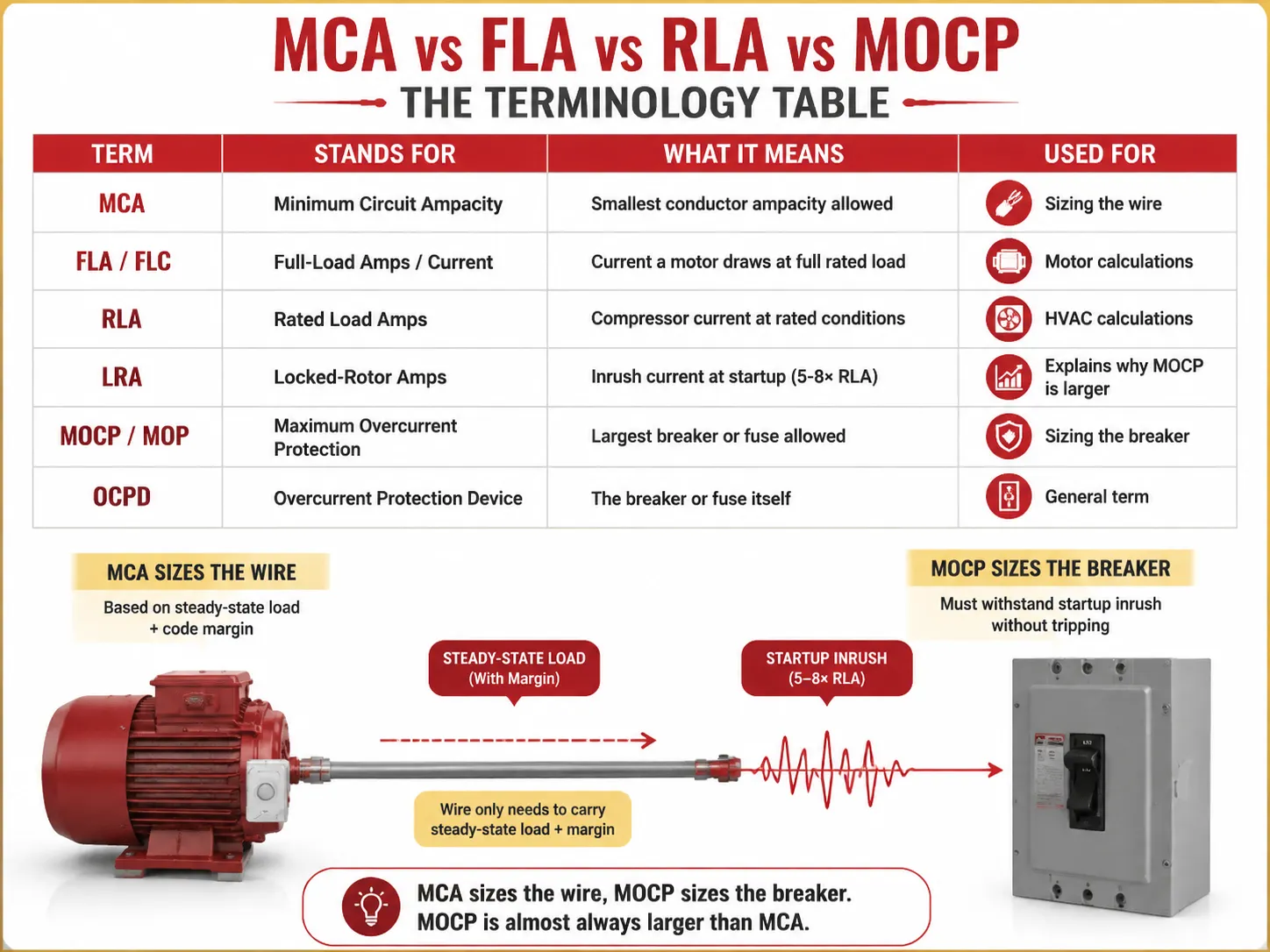
MCA กับ FLA กับ RLA กับ MOCP: ตารางคำศัพท์
ความสับสนรอบ MCA ส่วนใหญ่เกิดจากตัวอักษรย่อที่อยู่ข้าง ๆ บนแผ่นชื่อ นี่คือความหมายของแต่ละคำศัพท์:
| คำศัพท์ | ย่อมาจาก | ความหมาย | ใช้สำหรับ |
|---|---|---|---|
| MCA | กระแสไฟฟ้าขั้นต่ำของวงจร | ความจุของตัวนำไฟฟ้าที่เล็กที่สุดที่อนุญาต | การกำหนดขนาดสายไฟ |
| FLA / FLC | กระแสไฟฟ้าเต็มโหลด / กระแสไฟฟ้า | กระแสไฟฟ้าที่มอเตอร์ดึงเมื่อทำงานเต็มโหลด | การคำนวณมอเตอร์ |
| RLA | กระแสไฟฟ้าภาระงานที่กำหนด | กระแสของคอมเพรสเซอร์ในสภาวะที่กำหนด | การคำนวณ HVAC |
| LRA | กระแสไฟฟ้าขณะโรเตอร์ล็อก | กระแสไฟฟ้าเริ่มต้นที่สตาร์ท (5-8× RLA) | อธิบายว่าทำไม MOCP ถึงมีขนาดใหญ่กว่า |
| MOCP / MOP | การป้องกันกระแสเกินสูงสุด | เบรกเกอร์หรือฟิวส์ที่ใหญ่ที่สุดที่อนุญาต | การกำหนดขนาดเบรกเกอร์ |
| OCPD | อุปกรณ์ป้องกันกระแสเกิน | เบรกเกอร์หรือฟิวส์เอง | คำทั่วไป |
องค์ประกอบหลักของการสร้างแบบจำลองทางจิตคือการพิจารณาพารามิเตอร์สองตัวที่เกี่ยวข้องในการคำนวณนี้ — MCA และ MOCP ซึ่งไม่ใช่ตัวเลขเดียวกัน — โดยทั่วไป MCA จะน้อยกว่า MOCP เพราะเบรกเกอร์ต้องทนต่อกระแสไฟฟ้ากระชากเมื่ออุปกรณ์เริ่มทำงาน ในขณะที่สายไฟดูแลกระแสไฟฟ้าที่ไหลอย่างต่อเนื่องพร้อมกับปัจจัยที่กำหนดโดยรหัส.
อธิบายกฎ 125%
กฎ 125% เป็นพื้นฐานของการคำนวณ MCA ทุกครั้ง สามารถพบได้ในหลายส่วนของ NEC และในแต่ละส่วนมีเป้าหมายเพื่อให้มีความปลอดภัยที่กำหนดไว้ในกรณีของโหลดที่ทำงานอย่างต่อเนื่องหรือโหลดที่เปิดใช้งานพร้อมกระแสไฟฟ้ากระชาก.
- NEC 210.19(A)(1) — วงจรสาขา: สายไฟต้องมีความสามารถในการรับกระแสไม่น้อยกว่า 125% ของโหลดต่อเนื่อง และ 100% ของโหลดที่ไม่ต่อเนื่อง โหลดจะถูกเรียกว่า “โหลดต่อเนื่อง” หากโหลดนั้นทำงานเต็มกำลังเป็นเวลา 3 ชั่วโมงขึ้นไป (ตามคำจำกัดความของ NEC 100).
- NEC 215.2 — สายจ่ายไฟ: ข้อกำหนด 125% เดียวกันนี้ใช้กับสายจ่ายไฟด้วย.
- NEC 430.22 — มอเตอร์หนึ่งตัว: สายไฟต้องคำนวณตาม 125% ของ FLA ของมอเตอร์.
- NEC 440.22 / แนวปฏิบัติของผู้ผลิต — HVAC: MCA = 125% ของ RLA สำหรับมอเตอร์ที่ใหญ่ที่สุด.
ทำไมต้อง 125%? มีสองเหตุผล ประการแรก ไม่มีความร้อนต่อเนื่อง: เมื่อสายไฟรับกระแสไฟฟ้าตามกำหนดเป็นเวลานานจะร้อนถึงอุณหภูมิสูงสุดที่กำหนด 25% ที่เพิ่มขึ้นหมายความว่าฉนวนยังคงเย็น ประการที่สอง เมื่อเริ่มต้นมอเตอร์ใด ๆ ที่ทำงานในโหมดปกติจะดึงกระแสไฟฟ้ามากกว่าขณะทำงานจริงหลายเท่า.
วิธีคำนวณ MCA (พร้อมตัวอย่างที่ทำงานแล้ว)
สำหรับมอเตอร์แต่ละตัว (ตามรหัส NEC 430.22),
MCA = FLA ของมอเตอร์ × 1.25
ตัวอย่างเช่น หากมีมอเตอร์ 3 HP, 230V เฟสเดียว ที่มี FLA 17 A แล้ว,
MCA = 17 × 1.25 = 21.25 A. ตอนนี้ ตามตาราง NEC 310.16 (คอลัมน์ 75 °C) สามารถสรุปได้ว่าสายไฟขนาดเล็กที่สามารถรองรับค่าของ 21.25 A นี้ได้คือ 12 AWG ซึ่งมีเรตติ้งความสามารถในการนำกระแสไฟฟ้า 25 A.
สำหรับระบบโหลดหลายตัว (NEC 430.24),
MCA = (FLA มอเตอร์ที่สูงที่สุด × 1.25) + SLA ของมอเตอร์อื่นทั้งหมด
| โหลด | FLA (แอมป์) | ตัวคูณ | การมีส่วนร่วม |
|---|---|---|---|
| มอเตอร์ที่ใหญ่ที่สุด (10 HP, 460V) | 14.0 | ×1.25 | 5 A |
| มอเตอร์ที่สอง (5 HP) | 7.6 | ×1.00 | 6 A |
| มอเตอร์ที่สาม (2 HP) | 3.4 | ×1.00 | 4 A |
| MCA รวม | 5 A | ||
สำหรับ 28.5A, NEC 310.16 (75°C) ระบุว่าสายทองแดงขนาด 10 AWG (35A) เป็นขนาดเล็กสุดที่เหมาะสม — 12 AWG (25A) จะเล็กเกินไป.
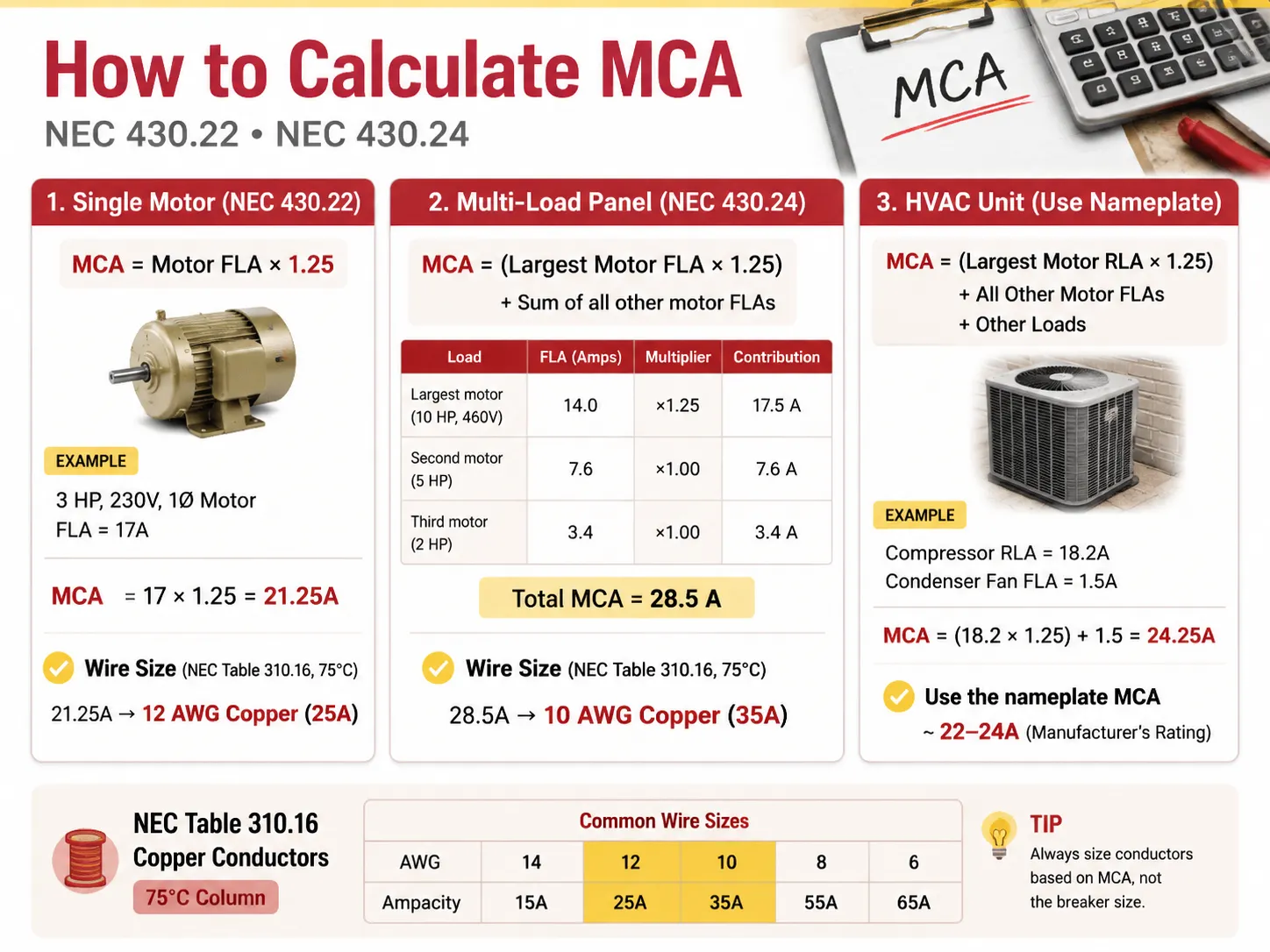
ในกรณีของยูนิต HVAC ที่มีคอมเพรสเซอร์และมอเตอร์พัดลม ค่า RLA ที่เหมาะสมจะเป็นดังนี้: MCA = (RLA มอเตอร์ที่ใหญ่ที่สุด × 1.25) + FLA ของมอเตอร์อื่น + โหลดอื่น ๆ.
ตัวอย่างเช่น หากคอมเพรสเซอร์มี RLA 18.2 แอมป์ และพัดลมคอนเดนเซอร์มี FLA 1.5 แอมป์ จะได้ดังนี้: MCA = (18.2 × 1.25) + 1.5 = 24.25 แอมป์.
โปรดทราบว่าค่านี้ถูกปัดโดยผู้ผลิตให้เป็นค่ามาตรฐานมากขึ้นที่ 22-24 แอมป์ บนแผ่นชื่อของยูนิต HVAC.
MCA กับ การป้องกันกระแสเกินสูงสุด (MOCP)
นี่คือจุดที่ผู้ทำเองมักเข้าใจผิด: พวกเขาคิดว่าตัวเบรกเกอร์ต้องตรงกับ MCA ซึ่งไม่ใช่ ตัวเบรกเกอร์จะถูกจัดเรตตาม MOCP ซึ่งแตกต่างจากตัวเลขบนแผ่นชื่อ.
| ปัจจัย | MCA (สายไฟ) | MOCP (เบรกเกอร์) |
|---|---|---|
| สิ่งที่กำหนดขนาด | ตัวนำ (สายไฟ) | อุปกรณ์ป้องกันกระแสเกิน (เบรกเกอร์/ฟิวส์) |
| ความสัมพันธ์ทั่วไป | ตัวเลขที่เล็กกว่า | ตัวเลขที่ใหญ่กว่า (ต้องอนุญาตให้กระแสเริ่มต้นไหล) |
| ป้องกัน | การร้อนเกินของฉนวน | วงจรลัดวงจรและกราวด์ฟอลต์ |
| กฎ | ความสามารถในการนำกระแสของสายไฟ ≥ MCA | ขนาดเบรกเกอร์ ≤ MOCP (ตามขนาดมาตรฐาน NEC 240.6) |
| ตัวอย่างยูนิต | MCA 26.4A | MOCP 45A |
ในกรณีนี้ ใช้สายทองแดงขนาด 10 AWG (ความสามารถในการนำกระแส 30-35A) เพื่อจ่ายไฟให้กับยูนิต และได้รับการป้องกันจากกระแสเกินโดยเบรกเกอร์ 45A ซึ่งอนุญาตได้ภายใต้ NEC 440.22(a) เนื่องจากคอมเพรสเซอร์มีระบบป้องกันของตัวเอง ดังนั้นในกรณีนี้ เบรกเกอร์จะต้องป้องกันเฉพาะกระแสเกินเท่านั้น ซึ่งใช้ได้ทั้งระบบมอเตอร์และ HVAC ยกเว้นระบบเดินสายไฟปกติที่เบรกเกอร์ต้องมีเรตติ้งต่ำกว่าสายไฟ.
วิธีเลือกขนาดสาย AWG ที่เหมาะสม
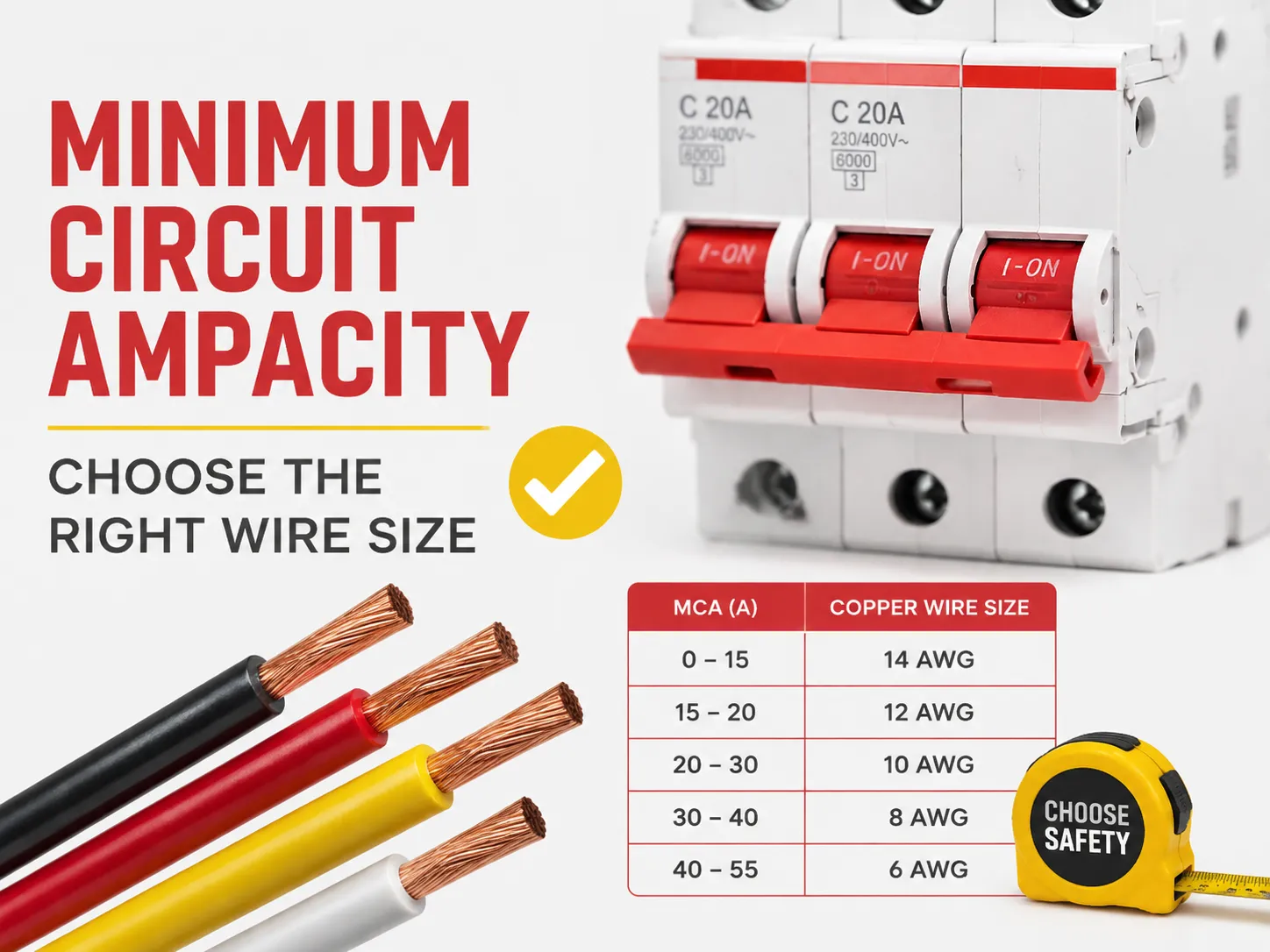
เมื่อคุณมีค่า MCA การเลือกสายไฟก็เพียงแค่ดูตาราง NEC 310.16 อ้างอิงคอลัมน์ 75°C เมื่อใช้สายทองแดง THHN/THWN-2 (ซึ่งเป็นสายมาตรฐานสำหรับท่อร้อยสาย) หรือถ้าใช้ NM-B (Romex) หรือเดินสายไฟเก่า ให้ดูที่คอลัมน์ 60°C.
| ขนาดสายทองแดง (AWG) | ความสามารถในการนำกระแส @ 60°C | ความจุแอมป์ @ 75°C | ครอบคลุม MCA สูงสุดถึง | เบรกเกอร์ทั่วไป |
|---|---|---|---|---|
| 14 AWG | 15 แอมป์ | 20 แอมป์ | 15-20 แอมป์ | 15 แอมป์ |
| 12 AWG | 20 แอมป์ | 25 แอมป์ | 20-25 แอมป์ | 20 แอมป์ |
| 10 AWG | 30 แอมป์ | 35 แอมป์ | 30-35 แอมป์ | 30 แอมป์ |
| 8 AWG | 40 แอมป์ | 50 แอมป์ | 40-50 แอมป์ | 40 แอมป์ |
| 6 AWG | 55 แอมป์ | 65 แอมป์ | 55-65 แอมป์ | 60 แอมป์ |
| 4 AWG | 70 แอมป์ | 85 แอมป์ | 70-85 แอมป์ | 80 แอมป์ |
| 2 AWG | 95 แอมป์ | 115 แอมป์ | 95-115 แอมป์ | 100 แอมป์ |
| 1/0 AWG | 125 แอมป์ | 150 แอมป์ | 125-150 แอมป์ | 150 แอมป์ |
| 2/0 AWG | 145 แอมป์ | 175 แอมป์ | 145-175 แอมป์ | 175 แอมป์ |
| 3/0 AWG | 165 แอมป์ | 200 แอมป์ | 165-200 แอมป์ | 200 แอมป์ |
เลือกสายไฟที่มีขนาดเล็กที่สุดซึ่งมีความสามารถในการรับกระแสไฟฟ้าอย่างน้อยเท่ากับค่าความสามารถในการรับกระแสไฟฟ้าที่กำหนด (หลังจากการลดค่าซึ่งอธิบายไว้ด้านล่าง) สำหรับค่าความสามารถในการรับกระแสไฟฟ้าที่กำหนดที่ 24.25A สายไฟที่เล็กที่สุดที่สามารถใช้ได้คือ 12 AWG (25A) อย่างไรก็ตาม ผู้ติดตั้งหลายรายมักเลือกใช้สายไฟขนาดใหญ่กว่า เช่น 10 AWG เพื่อรองรับการเดินสายไฟระยะยาวและ/หรือความต้องการในอนาคต.
บริการ 200 แอมป์: สามารถใช้สายไฟ 1/0 ได้หรือไม่?
คำถามนี้มักถูกถามเกี่ยวกับการอัปเกรดบริการที่อยู่อาศัย และคำตอบคือ สำหรับบริการเต็มรูปแบบ 200A นั้น เป็นคำตอบที่ดูเก่าแต่ไม่ถูกต้อง โดยคำนึงถึงอุณหภูมิ 75°C สายทองแดง 1/0 จะมีค่าความสามารถสูงสุดที่ 150A และไม่สามารถรองรับโหลดบริการ 200A ตามกฎหมายได้ หากต้องการบริการที่อยู่อาศัย 200A จำเป็นต้องใช้สายทองแดงหรืออลูมิเนียมประเภทใดประเภทหนึ่งดังต่อไปนี้:
- สายทองแดง 2/0 ซึ่งสามารถรองรับ 175A ที่อุณหภูมิ 75°C สายนี้ได้รับอนุญาตให้ใช้สำหรับ 200A ในบางพื้นที่ (ตามรหัสพาณิชย์พิเศษ A).
- สายทองแดง 3/0 ซึ่งสามารถรองรับโหลด 200A ที่ 75°C ได้อย่างสำเร็จ.
- สายอลูมิเนียม 4/0 ที่สามารถจ่ายไฟ 180A ที่ 75°C มักใช้ในสายทางเข้าบริการที่ต้องการเดินสายไฟ 200A.
อีกทางเลือกหนึ่งคือการใช้สายทองแดง 1/0 ซึ่งเหมาะสำหรับใช้ในสายบริการ 150A เท่านั้น และใช้กับแผงย่อย 150A เท่านั้น หลีกเลี่ยงการใช้สาย 1/0 กับสายบริการ 200A อย่างเด็ดขาดเนื่องจากจะร้อนเกินไปเมื่อใช้งานเป็นเวลานาน นอกจากนี้ ควรตรวจสอบกับรหัสการเดินสายไฟท้องถิ่นและเจ้าหน้าที่ตรวจสอบเนื่องจากมีความคลุมเครือหลายประการใน NEC 310.12 Service Entrance.
กฎ 80% สำหรับเบรกเกอร์วงจร
กฎ NEC 210.20(A) และ 215.3 ระบุว่าเบรกเกอร์วงจรไม่ควรรับโหลดเกิน 80% ของค่าที่กำหนด ตัวอย่างเช่น:
- เบรกเกอร์ 15A ควรรับโหลดต่อเนื่องได้เพียง 12A เท่านั้น.
- เบรกเกอร์ 20A ควรรับโหลดต่อเนื่องได้เพียง 16A เท่านั้น.
- เบรกเกอร์ 30A ควรรับโหลดต่อเนื่องได้เพียง 24A เท่านั้น.
- เบรกเกอร์ 100A ควรรับโหลดเต็มได้เพียง 80A เท่านั้น.
เปรียบเทียบตัวอย่างทั้งหมดข้างต้น หลักการเบื้องหลังข้อบังคับนี้เหมือนกันในทั้งสองกรณี: ปัจจัย 80% และ 125% มีความเหมือนกันในสาระสำคัญโดยระบุว่าโหลดสูงสุดไม่ควรเกินความสามารถที่กำหนดของอุปกรณ์และสามารถแสดงในรูปแบบเฉพาะ (1/1.25=0.8) ตัวอย่างเช่น หากอุปกรณ์ถูกใช้กับโหลดต่อเนื่อง 16A ตัวนำควรทนได้ 16*1.25=20A ดังนั้นเบรกเกอร์ที่เหมาะสมควรมีค่ากำหนดสำหรับโหลด 20A และในความเป็นจริงก็มีค่ากำหนดที่ 20A เท่านั้น เมื่อคุณต้องจับคู่กับอุปกรณ์ป้องกันสำหรับวงจรใหม่ ชุดเบรกเกอร์วงจรขนาดเล็กที่ได้รับการรับรองสำหรับงานนั้น เช่น ชุด HUYU HUM18 MCB ครอบคลุม 1P ถึง 4P และเส้นโค้ง B/C/D — ทำให้การจับคู่สายไฟกับเบรกเกอร์เป็นเรื่องง่ายสำหรับผู้สร้างแผงและผู้รับเหมา.
การลดค่าความสามารถตามอุณหภูมิและการเติมท่อสายไฟ
ตารางแอมแปร์ซิตี้ตั้งสมมติฐานที่อุณหภูมิแวดล้อม 30 องศาเซลเซียส (86 องศาฟาเรนไฮต์) โดยไม่มีการนำกระแสผ่านสายไฟมากกว่า 3 เส้นในท่อร้อยสาย เมื่ออุณหภูมิเพี้ยนไป ต้องลดแอมแปร์ซิตี้ของสายไฟก่อนเปรียบเทียบกับ MCA.
- อุณหภูมิแวดล้อมสูง: ตามตาราง 310.15(B)(1) ของ NEC สามารถใช้ปัจจัยแก้ไขได้ เช่น ความสามารถในการนำกระแสของตัวนำที่ระบุไว้ที่ 75°C จะกลายเป็น 22A เนื่องจากที่อุณหภูมิแวดล้อม 40°C คูณด้วย 0.88.
- การบรรจุท่อร้อยสาย: ในกรณีส่วนใหญ่ ตาราง 310.15(C)(1) ของ NEC ระบุปัจจัยแก้ไขต่าง ๆ ตามจำนวนสายไฟในท่อร้อยสาย ดังนั้น สำหรับตัวนำ 4-6 เส้น ปัจจัยแก้ไขคือ 0.80; สำหรับ 7-9 เส้น คือ 0.70; และสำหรับ 10-20 เส้น เท่ากับ 0.50 ดังนั้น จำนวนสายไฟที่มากขึ้นจะทำให้ความร้อนสะสมในท่อร้อยสายมากขึ้น.
- มาตรฐาน: หลังจากเงื่อนไขการลดแอมแปร์ซิตี้แล้ว แอมแปร์ซิตี้ใหม่ต้องไม่น้อยกว่า MCA.
การลดแรงดันไฟฟ้าบนสายไฟยาว
ในสถานที่ส่วนใหญ่ในสหรัฐอเมริกา การลดแรงดันไฟฟ้าไม่ใช่ข้อกำหนดของรหัส (ยกเว้นบางแอปพลิเคชัน) แต่ยังคงมีประโยชน์และชาญฉลาด: การลดแรงดันไฟฟ้าของวงจรสาขาต้องไม่เกิน 3% และการลดแรงดันไฟฟ้าของวงจรฟีด + สาขาต้องไม่เกิน 5% แนวทางที่ดีคือเมื่อระยะทางเกิน 50 ถึง 100 ฟุต ต้องใช้ขนาดสายไฟที่ใหญ่ขึ้น ดังนั้นสำหรับวงจร 120 โวลต์ที่วิ่งเกิน 150 ฟุต ต้องใช้สายไฟขนาดใหญ่ขึ้นแม้ว่าตาราง MCA จะระบุว่าสามารถใช้ 12 AWG ได้ (10 AWG จะทำงานได้ดีกว่า) การใช้สายไฟขนาดผิดพลาดในระยะทางไกลจะทำให้ไฟสลัว มอเตอร์ช้า และเกิดความร้อนสูงเกินไป.
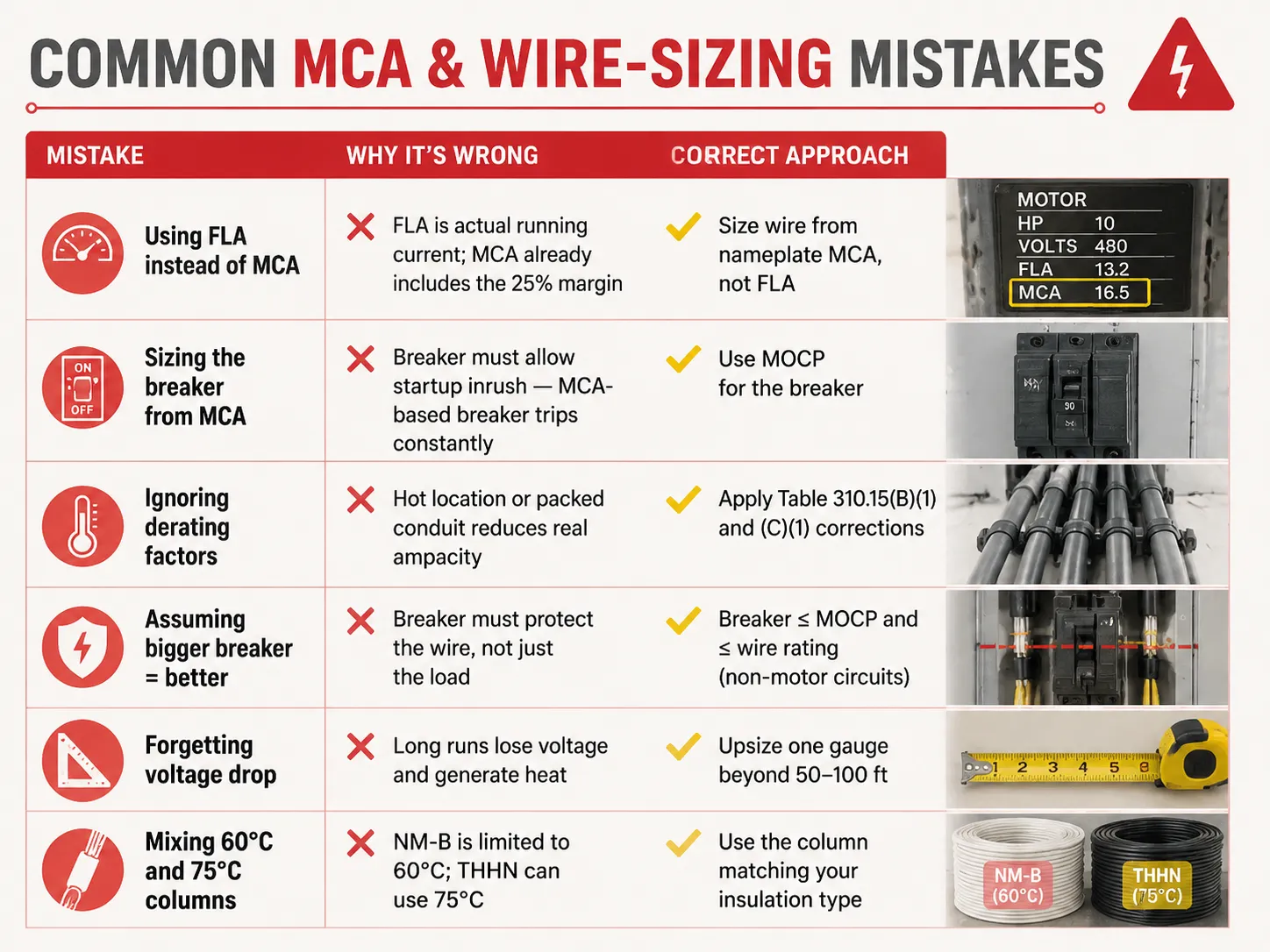
ความผิดพลาดทั่วไปในการกำหนด MCA และขนาดสายไฟ
| ความผิดพลาด | เหตุผลที่ผิด | วิธีแก้ไขที่ถูกต้อง |
|---|---|---|
| ใช้ FLA แทน MCA | FLA คือกระแสไฟฟ้าที่ใช้งานจริง; MCA รวมเผื่อ 25% แล้ว | กำหนดขนาดสายไฟจาก MCA บนแผ่นชื่อ ไม่ใช่ FLA |
| กำหนดขนาดเบรกเกอร์จาก MCA | เบรกเกอร์ต้องอนุญาตให้กระแสเริ่มต้นผ่าน — เบรกเกอร์ที่กำหนดจาก MCA จะตัดบ่อย | ใช้ MOCP สำหรับเบรกเกอร์ |
| ไม่สนใจปัจจัยการลดแอมแปร์ซิตี้ | สถานที่ร้อนหรือท่อร้อยสายแน่นลดแอมแปร์ซิตี้จริง | ใช้การแก้ไขตามตาราง 310.15(B)(1) และ (C)(1) |
| Assuming bigger breaker = better | Breaker must protect the wire, not just the load | Breaker ≤ MOCP and ≤ wire rating (non-motor circuits) |
| Forgetting voltage drop | Long runs lose voltage and generate heat | Upsize one gauge beyond 50-100 ft |
| Mixing 60°C and 75°C columns | NM-B is limited to 60°C; THHN can use 75°C | Use the column matching your insulation type |
Typical MCA Values for Common Equipment
| Equipment | Typical MCA | Wire Size (75°C copper) | MOCP / Breaker |
|---|---|---|---|
| 3 HP 230V motor | ~21.3 A | 12 AWG | 30 แอมป์ |
| 5 HP 230V motor | ~26.3 A | 10 AWG | 40 แอมป์ |
| 10 HP 460V motor | ~17.5 A | 12 AWG | 25-30 A |
| 3.5-ton heat pump | ~22-26 A | 10 AWG | 30-45 A |
| 5-ton AC unit | ~30-35 A | 8 AWG | 45-60 A |
| Level 2 EV charger (48A) | ~60 A | 6 AWG | 60 แอมป์ |
| Electric water heater (4500W/240V) | ~23.4 A | 10 AWG | 30 แอมป์ |
| 200A residential service | ไม่มีข้อมูล | 2/0-3/0 copper or 4/0 aluminum | 200 A main |
These are general figures — you should regularly refer to the nameplate of your unit. Also, when you are designing or enlarging your distribution installation, ensuring that the protection devices suit the cables is the kind of issue which certified equipment produced by a manufacturer ensuring the whole range addresses: understanding what a 15-amp circuit can actually carry is a good starting point, and for replacement decisions our guide on วิธีบอกว่าเบรกเกอร์เสีย covers the inspection side of the story.
คำถามที่พบบ่อย
What is the 125 rule for breakers?
According to the 125% rule (NEC 210.19, 215.2, 430.22), conductors must be sized at 125% of the continuous load, or 125% of the motor’s full-load amps. In the case of the breaker, it can be seen that the same philosophy is entailed in the 80% rule, meaning that the breaker can only sustain 80% of its rating over time. Both are used to prevent overheating of the insulation. One example would be the case when the continuous load of 20A requires conductors of 25A rating (12 AWG) and a breaker rated 25A or 30A, while only 20A is used continuously in the circuit.
Can I use 1/0 wire for 200 amp service?
1/0 copper can carry 150A current at 75° C. Thus, 1/0 copper is not an appropriate option for 200A power. The right options include either 2/0 copper, good for 175A, or 3/0 copper of 200A. 4/0 aluminum can also be considered as it is good for 180A. In the case of a power of less than 150A, 1/0 copper can be successfully used. Consult a local inspector as NEC 310.12 states that service entrance has its own exceptions.
Will a 100 amp breaker accept 1/0 wire?
In most cases, if the terminal of the breaker is okay for it, then yes—most of the terminals for 100A breakers can take a wire sized up to 2/0 copper or 4/0 aluminum. However, a 100A breaker does not need a wire gauge of 1/0; the only determining thing is the load as it is what tells us what wire size to use in this instance; as an example, when the load is only 70A, then 4 AWG (85A) is the right size. It is important to read the information given on the terminals of the breaker because it is what offers all the necessary information.
What is the 80% rule for circuit breakers?
The 80% rule (NEC 210.20(A), 215.3) indicates that a breaker is limited to carrying 80% of its rating for continuous loads. For example, a 15A breaker has a continuous current maximum of 12A, whereas a 20A breaker can carry 16A and a 100A breaker can carry 80A. There is a balance in the safety margin because it mirrors the 125% rule of current rating in conductors. The full breaker rating can be used for non-continuous loads since they do not follow this rule.
อ้างอิง
- NFPA 70 — National Electrical Code (NEC), Articles 210, 215, 240, 310, 430, 440
- OSHA 1910.303 — Electrical Systems: General Requirements
- Mike Holt — NEC Code Change Explanations (125% / 80% rules)
- EC&M Magazine — Conductor Sizing and MCA/MOCP Applications
- ENERGY STAR — HVAC Installation and Circuit Sizing Guidance
- NEMA — Motor and Electrical Product Standards
สรุป
Minimum circuit ampacity provides the lowest size of wire that can be used for different types of equipment. The number is calculated based on the 125% rule by taking the largest current load or motor load multiplied by 1.25 and adding other loads to get the calculation. The wire size is determined by the MCA but the size of the breaker is determined by a separate number called MOCP. Be aware of applicable features such as the 80% rule for continuous loads, derating for heat as well as conduit fill, and voltage drop on long runs to avoid the problems of underused wires as well as wasted copper. And when a replacement breaker or panel upgrade is part of the job, understanding breaker replacement costs and the differences between protection devices like MCBs and MCCBs helps you plan the whole circuit — not just the wire.