
Nếu bạn vừa mua một thiết bị điều hòa không khí mới, bộ sạc xe điện hoặc lò nướng thương mại, kỹ thuật viên của bạn có thể yêu cầu thông số dòng điện tối thiểu của mạch (minimum circuit ampacity) được ghi trên bảng tên. Lúc đó, bạn có thể sẽ nhìn thấy một con số dường như không có ý nghĩa đối với bạn. Nếu bạn mắc sai lầm, bạn có thể sử dụng dây dẫn có kích thước nhỏ hơn yêu cầu (và do đó – có thể quá nhiệt, gây ngắt mạch không mong muốn và có thể gây cháy), hoặc bạn có thể chi quá nhiều tiền cho việc đi dây bằng dây dẫn quá lớn.
Trong hướng dẫn này, bạn sẽ tìm hiểu ý nghĩa của minimum circuit ampacity, cách tính toán nó, sự khác biệt giữa minimum circuit ampacity và kích thước bộ ngắt mạch, cũng như cách chuyển đổi minimum circuit ampacity thành kích thước dây dẫn phù hợp — tuân thủ các quy định của NEC trong quá trình này.
Nói một cách đơn giản, MCA hay Minimum Circuit Ampacity là công suất tối thiểu của dây dẫn cần thiết để vận hành thiết bị một cách chính xác. Để tính toán, sử dụng quy tắc 125% của NEC, theo đó nhân dòng tải liên tục lớn nhất, tức là dòng điện định mức đầy tải lớn nhất của động cơ, với 1.25, cùng với tất cả các tải khác. Sau đó, chọn dây dẫn nhỏ nhất đáp ứng hoặc vượt yêu cầu này theo Bảng 310.16 của NEC.
Minimum Circuit Ampacity là gì?
Minimum Circuit Ampacity là giá trị nhỏ nhất được tính toán và biểu thị bằng ampe, cho thấy dòng điện tối thiểu của dây dẫn mạch cần thiết để cung cấp tải mà không bị quá nhiệt. MCA không biểu thị lượng dòng điện mà thiết bị thực sự tiêu thụ trong quá trình sử dụng bình thường. Thay vào đó, nó là yêu cầu tối thiểu được rút ra từ quy chuẩn nhằm đảm bảo có một biên an toàn cho hoạt động liên tục của mạch và dòng khởi động tăng đột biến.
Trong thực tế, bạn sẽ tìm thấy MCA trên bảng tên của các hệ thống HVAC, bơm nhiệt, thiết bị làm lạnh thương mại, bình nước nóng, bộ sạc xe điện và phần lớn các thiết bị có động cơ và phần tử gia nhiệt. Nhà sản xuất phải ghi nó để tuân thủ quy chuẩn yêu cầu phải tính toán kích thước dây dẫn phù hợp với biên an toàn đầy đủ. Hơn nữa, chỉ nhà sản xuất mới biết được các tổ hợp trường hợp xấu nhất về cách các tải hoạt động.
Điểm quan trọng nhất là bạn phải tuân thủ MCA yêu cầu của dây dẫn. Ví dụ, nếu bảng tên ghi giá trị MCA là 26.4 A, thì dây dẫn phải được định mức không thấp hơn mức này (tức là tuân thủ mức này sau khi điều chỉnh theo các hệ số giảm định mức).
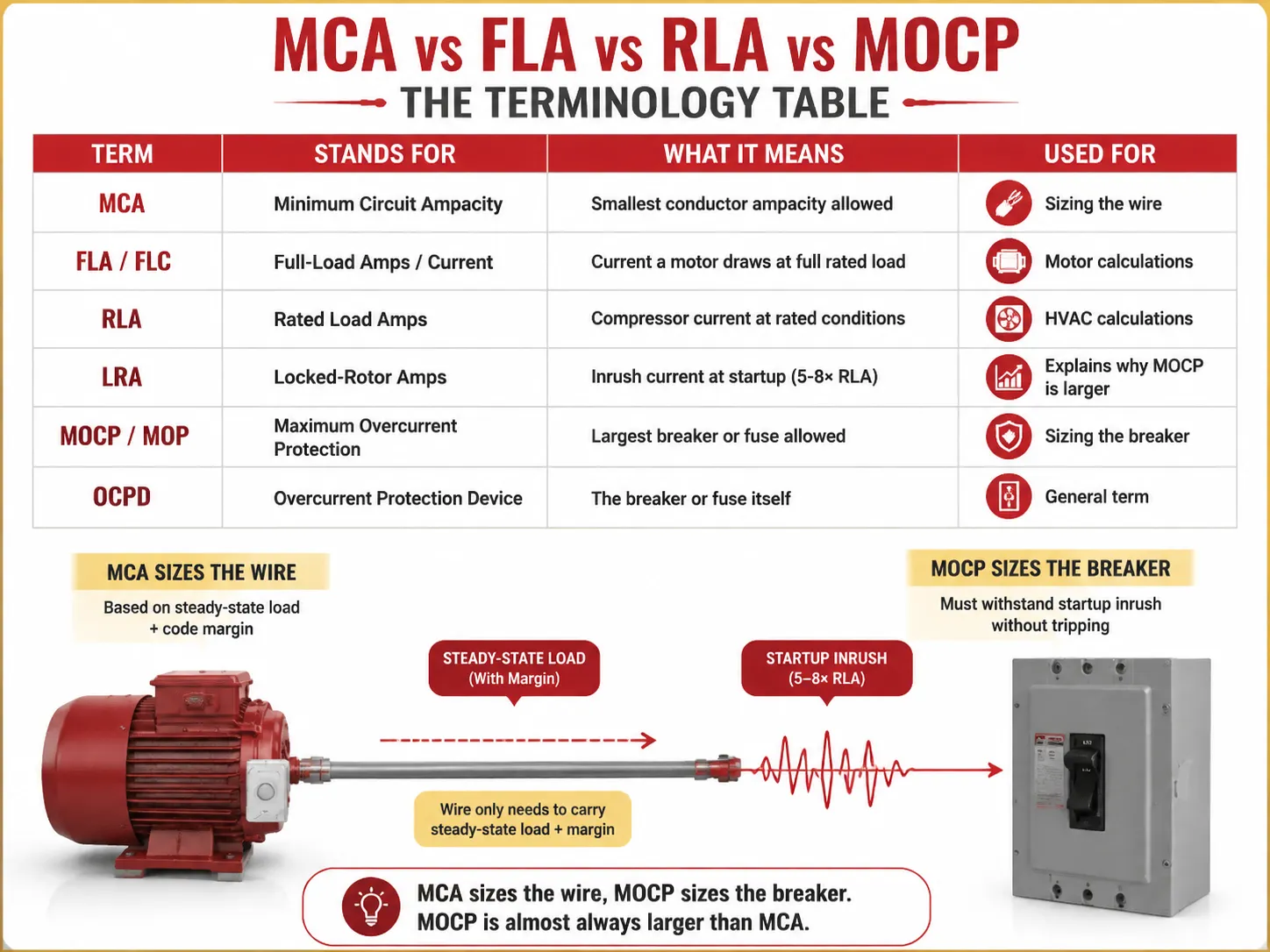
MCA vs FLA vs RLA vs MOCP: Bảng Thuật Ngữ
Một nửa sự nhầm lẫn về MCA đến từ các chữ cái viết tắt bên cạnh nó trên bảng tên. Dưới đây là ý nghĩa thực sự của từng thuật ngữ:
| Thuật ngữ | Viết tắt cho | Ý nghĩa | Sử dụng cho |
|---|---|---|---|
| MCA | Dòng điện định mức tối thiểu của mạch | Dòng điện tối thiểu của dây dẫn được phép | Kích thước dây dẫn |
| FLA / FLC | Dòng điện tải đầy đủ / Dòng điện | Dòng điện động cơ khi tải đầy đủ định mức | Tính toán động cơ |
| RLA | Dòng điện tải định mức | Dòng điện máy nén ở điều kiện định mức | Tính toán HVAC |
| LRA | Dòng điện rôto khóa | Dòng khởi động (5-8× RLA) | Giải thích tại sao MOCP lớn hơn |
| MOCP / MOP | Bảo vệ quá dòng tối đa | Bộ ngắt mạch hoặc cầu chì lớn nhất được phép | Kích thước bộ ngắt mạch |
| OCPD | Thiết bị bảo vệ quá dòng | Bộ ngắt mạch hoặc cầu chì chính nó | Thuật ngữ chung |
Thành phần chính của mô hình tư duy là xem xét hai tham số khác nhau liên quan đến phép tính này — MCA và MOCP, vốn không phải là các con số giống nhau — cái trước thường nhỏ hơn cái sau vì bộ ngắt mạch phải chịu được dòng điện tăng đột biến khi thiết bị khởi động trong khi dây dẫn đảm nhận dòng điện liên tục cùng các yếu tố được quy định bởi các mã.
Giải thích Quy tắc 125%
Quy tắc 125% là nền tảng của mọi phép tính cho MCA. Nó có thể được tìm thấy trong nhiều phần của NEC và trong mỗi phần, mục tiêu là cung cấp một biên an toàn nhất định trong trường hợp tải hoạt động liên tục hoặc tải được bật với dòng khởi động.
- NEC 210.19(A)(1) — mạch nhánh: dây dẫn phải có ampacity tối thiểu 125% của tải liên tục, và 100% của tải không liên tục. Một tải được gọi là “tải liên tục” nếu tải đó hoạt động ở giá trị đầy đủ trong 3 giờ trở lên (định nghĩa NEC 100).
- NEC 215.2 — nguồn cấp: yêu cầu 125% tương tự cũng áp dụng cho nguồn cấp.
- NEC 430.22 — một động cơ: dây dẫn phải được tính toán dựa trên 125% của FLA động cơ.
- NEC 440.22 / thực hành nhà sản xuất — HVAC: MCA = 125% của RLA cho động cơ lớn nhất.
Tại sao là 125%? Có hai lý do cho điều này. Thứ nhất, không có nhiệt liên tục: khi dây dẫn mang dòng định mức trong thời gian dài, nó sẽ nóng lên đến nhiệt độ đỉnh. 25% thêm vào có nghĩa là lớp cách điện vẫn giữ mát. Thứ hai, khi khởi động, bất kỳ động cơ nào hoạt động ở chế độ bình thường cũng kéo dòng điện nhiều lần hơn so với khi vận hành thực tế.
Cách tính MCA (Có ví dụ minh họa)
Đối với động cơ riêng lẻ (theo mã NEC 430.22),
MCA = FLA động cơ × 1.25
Ví dụ, nếu có một động cơ 3 HP, 230V một pha với FLA là 17 A thì,
MCA = 17 × 1.25 = 21.25 A. Bây giờ, theo bảng NEC 310.16 (cột 75 °C), có thể suy ra rằng dây nhỏ nhất có thể chịu được giá trị 21.25 A này là 12 AWG, được định mức cho khả năng mang dòng 25 A.
Đối với hệ thống tải đa năng (NEC 430.24),
MCA = (FLA động cơ cao nhất × 1.25) + tất cả các SLA động cơ khác
| Tải | FLA (Ampe) | Hệ số nhân | Đóng góp |
|---|---|---|---|
| Động cơ lớn nhất (10 HP, 460V) | 14.0 | ×1.25 | 5 A |
| Động cơ thứ hai (5 HP) | 7.6 | ×1.00 | 6 A |
| Động cơ thứ ba (2 HP) | 3.4 | ×1.00 | 4 A |
| Tổng MCA | 5 A | ||
Đối với 28.5A, NEC 310.16 (75°C) quy định dây đồng 10 AWG (35A) là kích thước nhỏ nhất phù hợp — 12 AWG (25A) sẽ quá nhỏ.
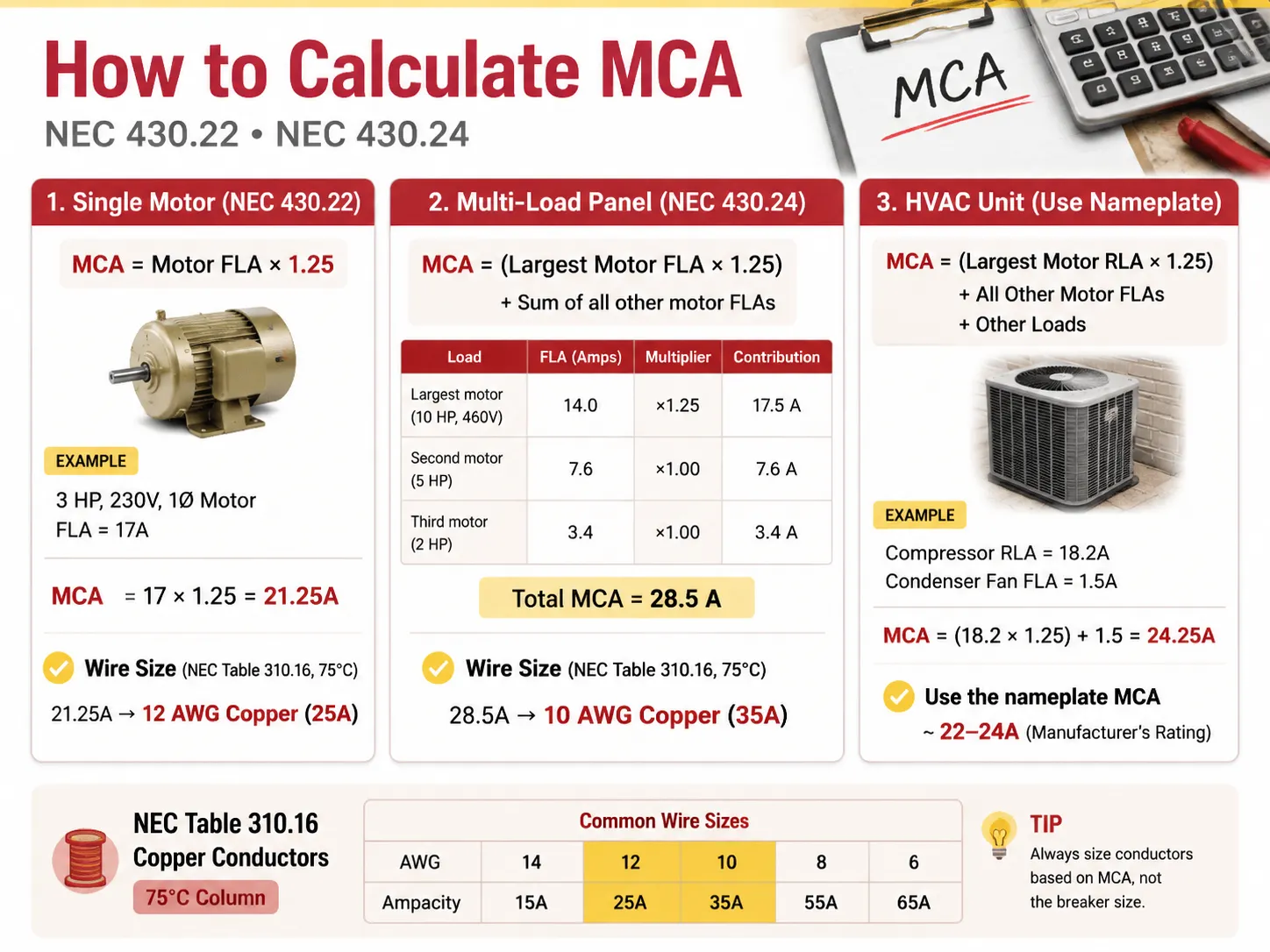
Trong trường hợp một thiết bị HVAC với máy nén và động cơ quạt, giá trị RLA lý tưởng sẽ là:MCA = (RLA động cơ lớn nhất × 1.25) + FLA các động cơ khác + các tải khác.
Ví dụ, nếu máy nén có RLA là 18.2 Ampe và quạt dàn ngưng có FLA là 1.5 Ampe, thì ta có:MCA = (18.2 × 1.25) + 1.5 = 24.25 Ampe.
Xin lưu ý rằng giá trị này được nhà sản xuất làm tròn thành mức tiêu chuẩn hơn là 22-24 Ampe, trên bảng tên của thiết bị HVAC.
MCA so với Bảo vệ quá dòng tối đa (MOCP)
Đây là điểm mà người tự làm thường sai lầm: họ nghĩ rằng cầu dao phải phù hợp với MCA. Không phải vậy. Cầu dao được định mức theo MOCP, khác với con số trên bảng tên.
| Yếu tố | MCA (Dây dẫn) | MOCP (Cầu dao) |
|---|---|---|
| Kích thước của | Dây dẫn (dây) | Thiết bị bảo vệ quá dòng (cầu dao/cầu chì) |
| Mối quan hệ điển hình | Số nhỏ hơn | Số lớn hơn (phải cho phép dòng khởi động) |
| Bảo vệ chống lại | Quá nhiệt cách điện | Ngắn mạch và lỗi đất |
| Quy tắc | Dòng chịu tải dây ≥ MCA | Kích thước cầu dao ≤ MOCP (theo kích thước tiêu chuẩn NEC 240.6) |
| Ví dụ thiết bị | MCA 26.4A | MOCP 45A |
Trong trường hợp này, dây đồng AWG 10 (dòng chịu tải 30-35A) được sử dụng để cấp điện cho thiết bị và được bảo vệ chống quá tải bởi cầu dao 45A. Điều này có được phép không — có cầu dao định mức cao hơn dây dẫn? Điều này được phép theo NEC 440.22(a) vì máy nén có cơ chế bảo vệ riêng. Do đó, trong trường hợp này, chỉ cần bảo vệ chống quá tải từ cầu dao. Điều này áp dụng cho cả hệ thống động cơ và HVAC, ngoại trừ hệ thống dây dẫn thông thường, nơi cầu dao phải có định mức thấp hơn dây dẫn.
Cách chọn kích thước dây AWG phù hợp
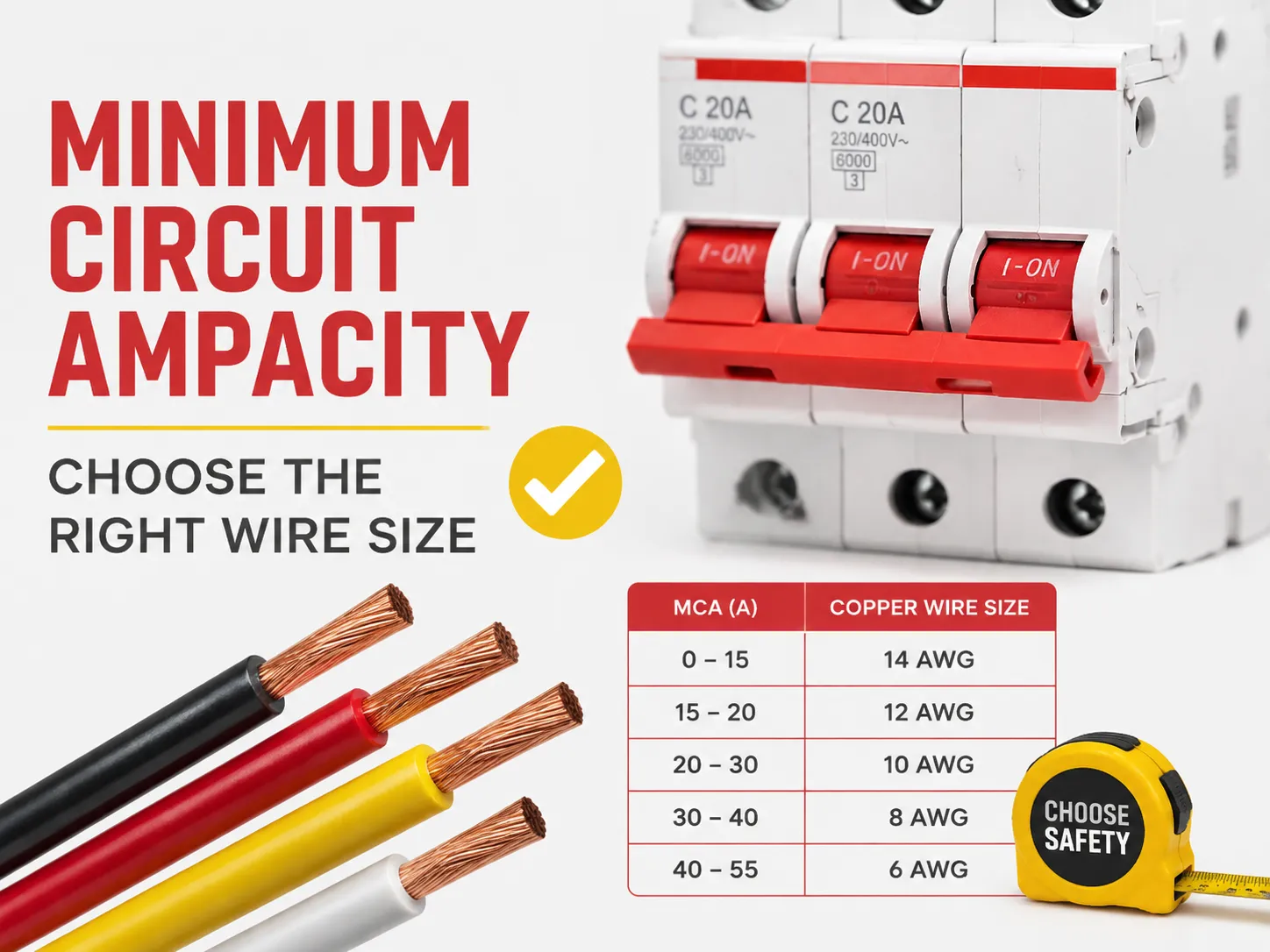
Khi bạn có MCA, việc chọn dây chỉ đơn giản là tham khảo Bảng NEC 310.16. Tham khảo cột 75°C khi sử dụng dây đồng THHN/THWN-2 (dây tiêu chuẩn cho ống dẫn), hoặc nếu sử dụng NM-B (Romex) hoặc dây cho các lắp đặt cũ hơn, tham khảo cột 60°C.
| Kích thước dây đồng (AWG) | Dòng chịu tải @ 60°C | Dòng điện định mức @ 75°C | Phù hợp với MCA lên đến | Cầu dao điển hình |
|---|---|---|---|---|
| 14 AWG | 15 A | 20 A | 15-20 A | 15 A |
| 12 AWG | 20 A | 25 A | 20-25 A | 20 A |
| 10 AWG | 30 A | 35 A | 30-35 A | 30 A |
| 8 AWG | 40 A | 50 A | 40-50 A | 40 A |
| 6 AWG | 55 A | 65 A | 55-65 A | 60 A |
| 4 AWG | 70 A | 85 A | 70-85 A | 80 A |
| 2 AWG | 95 A | 115 A | 95-115 A | 100 A |
| 1/0 AWG | 125 A | 150 A | 125-150 A | 150 A |
| 2/0 AWG | 145 A | 175 A | 145-175 A | 175 A |
| 3/0 AWG | 165 A | 200 A | 165-200 A | 200 A |
Chọn dây nhỏ nhất có ampacity ít nhất bằng ampacity định mức (sau khi giảm hệ số, được giải thích bên dưới). Với ampacity định mức 24,25A, dây nhỏ nhất có thể sử dụng là 12 AWG (25A). Tuy nhiên, nhiều nhà lắp đặt chọn dây lớn hơn, như 10 AWG, để phù hợp với các đoạn dây dài và/hoặc nhu cầu trong tương lai.
Dịch vụ 200 Amp: Có thể sử dụng dây 1/0 không?
Câu hỏi này thường được đặt ra liên quan đến nâng cấp dịch vụ dân dụng, và câu trả lời là, đối với dịch vụ đầy đủ 200A, đó là một câu trả lời cũ kỹ nhưng sai. Lưu ý nhiệt độ 75°C, dây đồng 1/0 có định mức tối đa là 150A, và không thể chịu tải dịch vụ 200A theo quy định pháp luật. Nếu cần đạt dịch vụ dân dụng 200A, cần sử dụng một trong các loại dây đồng hoặc nhôm sau:
- Dây đồng 2/0 có thể chịu tải 175A ở nhiệt độ 75°C. Dây này được phép dùng cho 200A ở một số khu vực (theo Mã Thương Mại Đặc Biệt A).
- Dây đồng 3/0 có thể chịu tải 200A ở 75°C.
- Dây nhôm 4/0 có khả năng cấp tải 180A ở 75°C, thường dùng trong các đường dây vào dịch vụ yêu cầu dây 200A.
Một biến thể khác là sử dụng dây đồng 1/0, chỉ phù hợp cho đường dây dịch vụ 150A và cấp tải cho tủ phụ 150A. Tránh sử dụng dây 1/0 cho đường dây dịch vụ 200A vì nó sẽ quá nóng khi sử dụng lâu dài. Ngoài ra, cần kiểm tra với quy định dây điện địa phương và thanh tra vì có nhiều điểm mơ hồ trong NEC 310.12 Service Entrance.
Quy tắc 80% cho cầu dao tự động
Các quy định NEC 210.20(A) và 215.3 nói rằng cầu dao tự động không nên chịu tải vượt quá 80% định mức của nó. Ví dụ:
- Cầu dao 15A chỉ nên chịu tải liên tục 12A.
- Cầu dao 20A chỉ nên chịu tải liên tục 16A.
- Cầu dao 30A chỉ nên chịu tải liên tục 24A.
- Cầu dao 100A chỉ nên chịu tải tối đa 80A.
So sánh giữa các ví dụ trên. Nguyên tắc đằng sau quy định là giống nhau trong cả hai trường hợp: hệ số 80% và 125% đều thể hiện rằng tải tối đa không được vượt quá công suất định mức của thiết bị và có thể biểu diễn theo tỉ lệ (1/1,25=0,8). Ví dụ, nếu thiết bị dùng tải liên tục 16A, dây dẫn phải chịu được 16*1,25=20A; do đó, cầu dao cần được định mức cho tải 20A, và thực tế được định mức 20A. Khi cần chọn thiết bị bảo vệ phù hợp cho mạch mới, dải cầu dao tự động nhỏ gọn được chứng nhận cho công việc — như dòng HUYU HUM18 MCB bao gồm từ 1P đến 4P và các đường cong B/C/D — giúp việc kết nối dây với cầu dao trở nên đơn giản cho nhà sản xuất tủ và nhà thầu.
Giảm hệ số do nhiệt độ & độ đầy ống dẫn dây
Bảng ampacity dựa trên giả định nhiệt độ môi trường 30 độ C (86 độ F), không có sự dẫn truyền của hơn 3 dây qua ống dẫn. Khi nhiệt độ thay đổi, bạn phải giảm (hạ) ampacity của dây trước khi so sánh với MCA.
- Nhiệt độ môi trường cao: Theo Bảng 310.15(B)(1) của NEC, các hệ số hiệu chỉnh có thể được sử dụng. Ví dụ, khả năng mang dòng của dây dẫn định mức 75°C trở thành 22A vì ở nhiệt độ môi trường 40°C nó được nhân với 0,88.
- Độ đầy ống dẫn: Trong hầu hết các trường hợp, Bảng 310.15(C)(1) của NEC chỉ ra các hệ số hiệu chỉnh khác nhau tùy theo số lượng dây qua ống dẫn. Do đó, với 4-6 dây dẫn, hệ số hiệu chỉnh là 0,80; với 7-9 dây dẫn, là 0,70; và với 10-20 dây dẫn, bằng 0,50. Vì vậy, số lượng dây lớn hơn dẫn đến lượng nhiệt bị giữ lại trong ống dẫn nhiều hơn.
- Tiêu chuẩn: sau điều kiện giảm ampacity, ampacity mới không được nhỏ hơn MCA.
Sụt áp trên các đoạn dây dài
Ở hầu hết các địa điểm tại Hoa Kỳ, sụt áp không phải là yêu cầu mã (ngoại trừ một vài ứng dụng) nhưng vẫn hữu ích và thông minh: sụt áp mạch nhánh phải là 3% và sụt áp cho toàn bộ feeder + nhánh phải bằng 5%. Một hướng dẫn tốt là khi khoảng cách vượt quá 50 đến 100 feet, bạn phải sử dụng dây kích thước lớn hơn một cỡ. Vì vậy, với mạch 120 volt chạy hơn 150 feet, bạn cần dùng dây kích thước lớn hơn ngay cả khi bảng MCA cho phép dùng 12 AWG (10 AWG sẽ hoạt động tốt hơn). Sử dụng dây kích thước sai trên khoảng cách dài dẫn đến đèn mờ, động cơ chạy chậm và quá nhiệt.
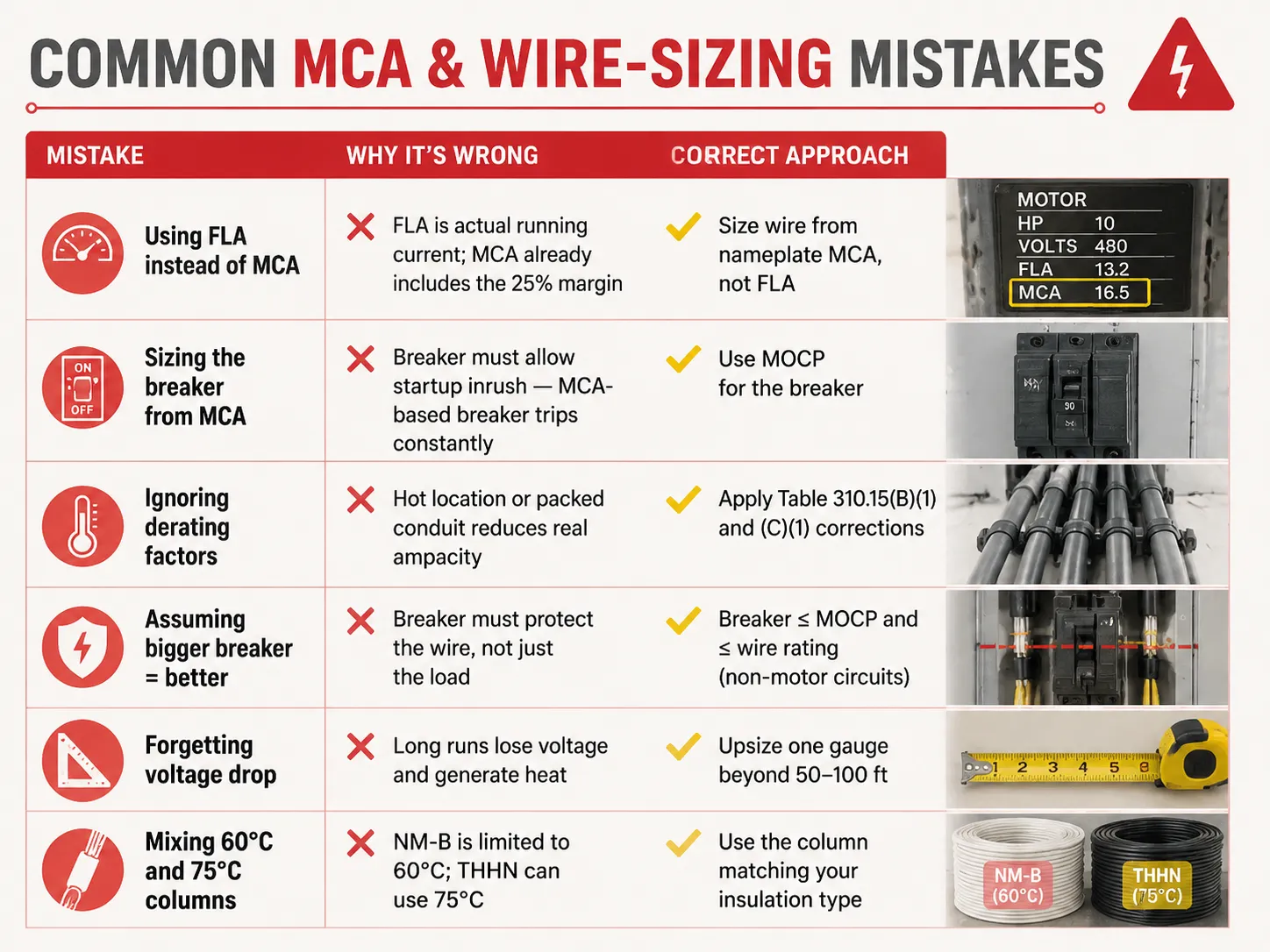
Các lỗi phổ biến về MCA & kích thước dây
| Sai lầm | Tại sao sai | Cách tiếp cận đúng |
|---|---|---|
| Sử dụng FLA thay vì MCA | FLA là dòng chạy thực tế; MCA đã bao gồm biên độ 25% | Chọn kích thước dây dựa trên MCA trên bảng tên, không phải FLA |
| Chọn kích thước bộ ngắt dựa trên MCA | Bộ ngắt phải cho phép dòng khởi động — bộ ngắt dựa trên MCA sẽ nhảy liên tục | Sử dụng MOCP cho bộ ngắt |
| Bỏ qua các hệ số giảm ampacity | Vị trí nóng hoặc ống dẫn chật làm giảm ampacity thực tế | Áp dụng các hiệu chỉnh theo Bảng 310.15(B)(1) và (C)(1) |
| Giả định bộ ngắt lớn hơn = tốt hơn | Breaker must protect the wire, not just the load | Breaker ≤ MOCP and ≤ wire rating (non-motor circuits) |
| Forgetting voltage drop | Long runs lose voltage and generate heat | Upsize one gauge beyond 50-100 ft |
| Mixing 60°C and 75°C columns | NM-B is limited to 60°C; THHN can use 75°C | Use the column matching your insulation type |
Typical MCA Values for Common Equipment
| Equipment | Typical MCA | Wire Size (75°C copper) | MOCP / Breaker |
|---|---|---|---|
| 3 HP 230V motor | ~21.3 A | 12 AWG | 30 A |
| 5 HP 230V motor | ~26.3 A | 10 AWG | 40 A |
| 10 HP 460V motor | ~17.5 A | 12 AWG | 25-30 A |
| 3.5-ton heat pump | ~22-26 A | 10 AWG | 30-45 A |
| 5-ton AC unit | ~30-35 A | 8 AWG | 45-60 A |
| Level 2 EV charger (48A) | ~60 A | 6 AWG | 60 A |
| Electric water heater (4500W/240V) | ~23.4 A | 10 AWG | 30 A |
| 200A residential service | Không áp dụng | 2/0-3/0 copper or 4/0 aluminum | 200 A main |
These are general figures — you should regularly refer to the nameplate of your unit. Also, when you are designing or enlarging your distribution installation, ensuring that the protection devices suit the cables is the kind of issue which certified equipment produced by a manufacturer ensuring the whole range addresses: understanding what a 15-amp circuit can actually carry is a good starting point, and for replacement decisions our guide on cách nhận biết một cầu dao bị hỏng covers the inspection side of the story.
Câu hỏi thường gặp
What is the 125 rule for breakers?
According to the 125% rule (NEC 210.19, 215.2, 430.22), conductors must be sized at 125% of the continuous load, or 125% of the motor’s full-load amps. In the case of the breaker, it can be seen that the same philosophy is entailed in the 80% rule, meaning that the breaker can only sustain 80% of its rating over time. Both are used to prevent overheating of the insulation. One example would be the case when the continuous load of 20A requires conductors of 25A rating (12 AWG) and a breaker rated 25A or 30A, while only 20A is used continuously in the circuit.
Can I use 1/0 wire for 200 amp service?
1/0 copper can carry 150A current at 75° C. Thus, 1/0 copper is not an appropriate option for 200A power. The right options include either 2/0 copper, good for 175A, or 3/0 copper of 200A. 4/0 aluminum can also be considered as it is good for 180A. In the case of a power of less than 150A, 1/0 copper can be successfully used. Consult a local inspector as NEC 310.12 states that service entrance has its own exceptions.
Will a 100 amp breaker accept 1/0 wire?
In most cases, if the terminal of the breaker is okay for it, then yes—most of the terminals for 100A breakers can take a wire sized up to 2/0 copper or 4/0 aluminum. However, a 100A breaker does not need a wire gauge of 1/0; the only determining thing is the load as it is what tells us what wire size to use in this instance; as an example, when the load is only 70A, then 4 AWG (85A) is the right size. It is important to read the information given on the terminals of the breaker because it is what offers all the necessary information.
What is the 80% rule for circuit breakers?
The 80% rule (NEC 210.20(A), 215.3) indicates that a breaker is limited to carrying 80% of its rating for continuous loads. For example, a 15A breaker has a continuous current maximum of 12A, whereas a 20A breaker can carry 16A and a 100A breaker can carry 80A. There is a balance in the safety margin because it mirrors the 125% rule of current rating in conductors. The full breaker rating can be used for non-continuous loads since they do not follow this rule.
Tài liệu tham khảo
- NFPA 70 — National Electrical Code (NEC), Articles 210, 215, 240, 310, 430, 440
- OSHA 1910.303 — Electrical Systems: General Requirements
- Mike Holt — NEC Code Change Explanations (125% / 80% rules)
- EC&M Magazine — Conductor Sizing and MCA/MOCP Applications
- ENERGY STAR — HVAC Installation and Circuit Sizing Guidance
- NEMA — Motor and Electrical Product Standards
Kết luận
Minimum circuit ampacity provides the lowest size of wire that can be used for different types of equipment. The number is calculated based on the 125% rule by taking the largest current load or motor load multiplied by 1.25 and adding other loads to get the calculation. The wire size is determined by the MCA but the size of the breaker is determined by a separate number called MOCP. Be aware of applicable features such as the 80% rule for continuous loads, derating for heat as well as conduit fill, and voltage drop on long runs to avoid the problems of underused wires as well as wasted copper. And when a replacement breaker or panel upgrade is part of the job, understanding breaker replacement costs and the differences between protection devices like MCBs and MCCBs helps you plan the whole circuit — not just the wire.