
A couple of months ago, we received an acute phone call from a facility manager in a controlled panic mode. A phase loss had taken down one of the compressor racks at a cold storage site in Atlanta, and the night shift was involved in an expedited scramble to return to work. After performing a walk-through of the electrical room and checking all the branch panels, the VFD cabinets and the fire alarm control panel but unable to locate any source for safely shutting down power to the compressor rack to troubleshoot the problem, the facility manager found the main breaker for the compressor rack location outside in a NEMA 3R enclosure on the opposite side of the loading dock behind a stack of empty pallets; the label on the disconnect had faded. After the facility manager had waited approximately 15 minutes while the technician searched for a switch/human error, it became clear that the location of the main breaker for this compressor rack had essentially been hidden in plain sight. Similar situations (searching for the main breaker for a site) occur every day either during residential service calls, commercial build-outs or industrial sites and would not be publicly admitted by most electrician(s). Verification of the location of main breaker for a facility should never be considered to be a trivia question but should be treated as an urgent and time-sensitive issue.
The Main Breaker: Why Its Position Matters
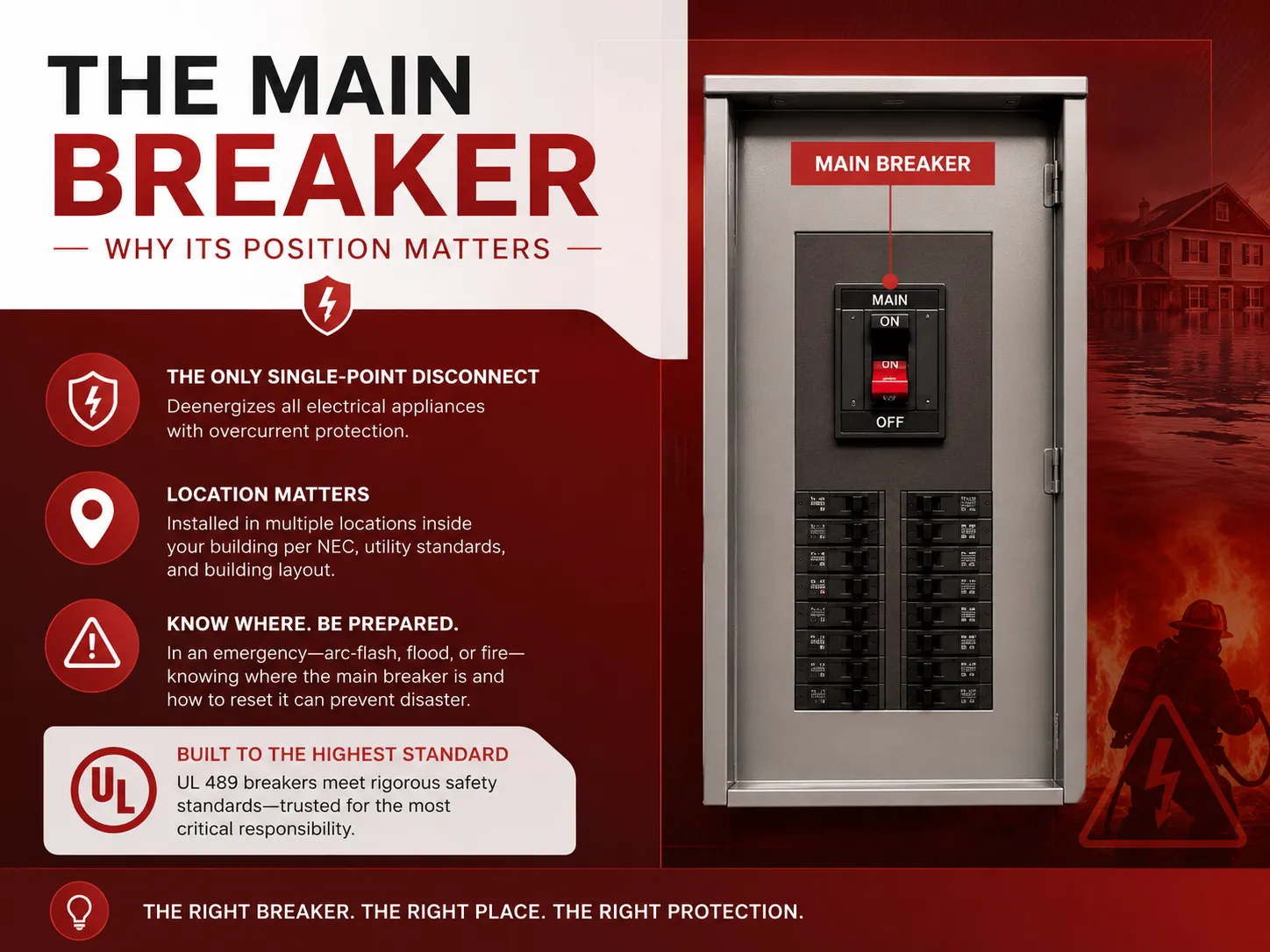
The main breaker is the only single-point disconnect for deenergizing all electrical appliances, with overcurrent protection, downstream from the utility meter. The first point in which power enters your building is through the main breaker, and it can be located in multiple places inside as dictated by the National Electrical Code (NEC), local utility standards, and the physical layout of your service entrance. In the event of an arc-flash, flooded basement or fire, knowing exactly where to find the main breaker and how to reset it could save you from experiencing a controlled shutdown, or a catastrophic output beyond your response capability. For a deeper understanding of why this device carries so much responsibility, our explanation of what UL 489 breakers are describes the rigorous standard that any main breaker — whether in a residential load center or a commercial switchboard — must meet to be trusted with that role.
Residential Locations: Indoors, Outdoors, and the Hidden Spots
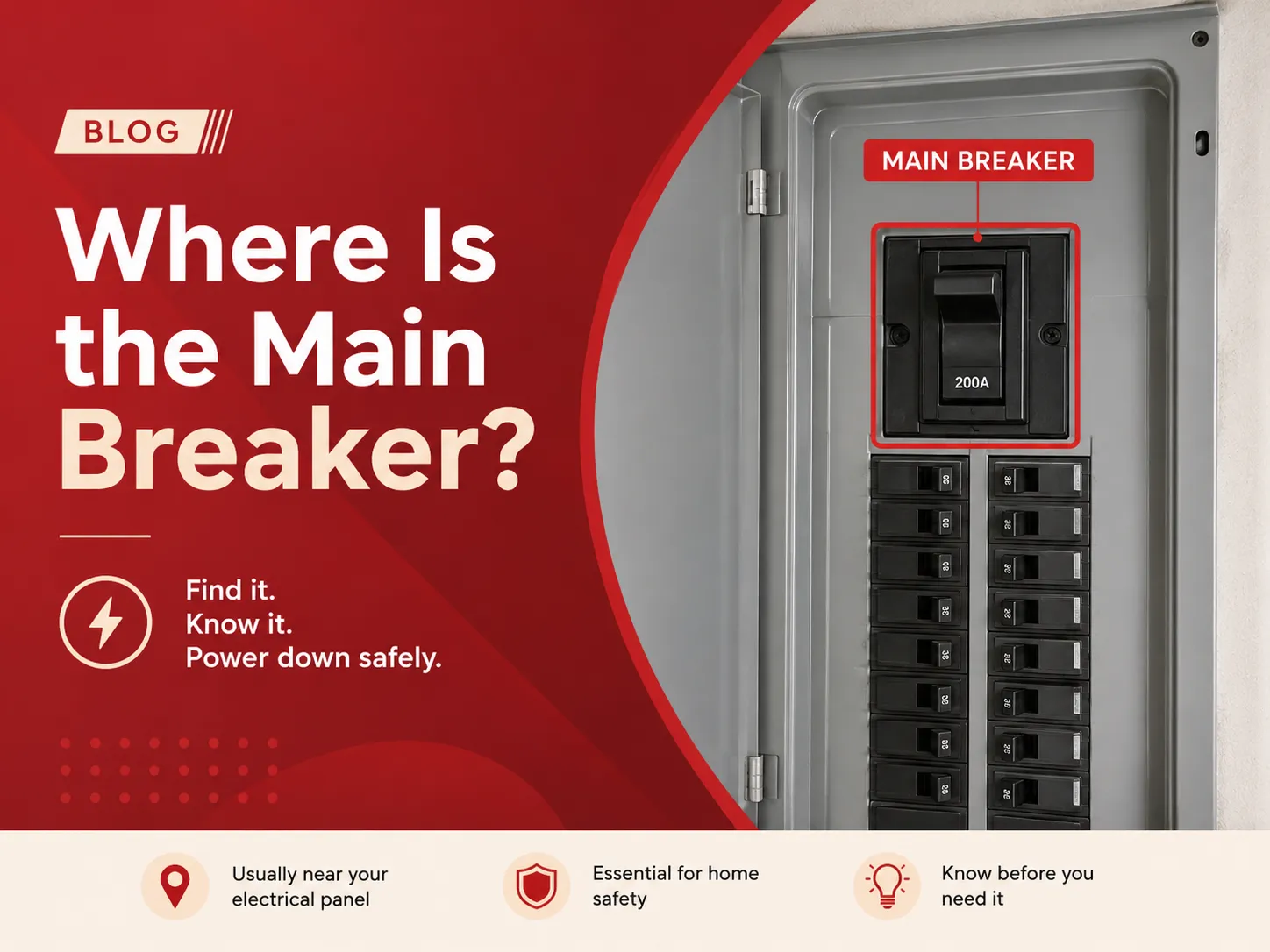
The four most common locations for a main circuit breaker in a single-family home are as follows: Here’s how to find it in just a few minutes:
- The main electrical panel inside the house. This is the gray metallic enclosure where you would find the connection to the utility wires; this is typically located within a utility room, in your basement or garage, and sometimes in a hallway or similar location. At the top of this panel is a main circuit breaker which is completely separate from the branch circuit breakers that are located in this enclosure. This large circuit breaker could be and is typically a two-pole configuration and have a rating of either 100A, 150A, or 200A. This circuit breaker will either have its own cover or have a screw that goes into the top of the circuit breaker to secure it to the metal enclosure. If your home was built after the enforcement of the NEC’s exterior disconnect rule was generally adopted, your interior panel may not be equipped with a main circuit breaker; if this is the case, your panel will not be a main lug only (MLO) panel, but will have a feed from an exterior disconnect.
- An exterior service disconnect near the meter. New one-family & 2-family dwellings must have an external Emergency Disconnector starting in 2020 NEC, which will usually be a gray box mounted on the exterior next to or beneath the Utility Meter Socket. The labels (“Service Disconnect”, “Main”, “Emergency Disconnect”) may vary. If your home contains this type of configuration, your interior Panel will not have a Main Circuit Breaker. The Outside Emergency Disconnector acts as your Main Circuit Breaker.
- A meter‑main combo. An external box which combines the main breaker with a Meter socket is present as part of an external Service Unit containing all branch circuits and may be installed in locations where basements usually do not exist due to warmer climates.
- An older split‑bus panel (pre‑1970s). A split-bus panel is one that does not provide a single ‘main’ switch for the flow of electricity into the home and therefore has two separate buses with the upper half of the bus containing six double-pole breakers (hence the name “six-throw rule”). If you want to shut off power to your entire house using a split-bus panel, you will need to turn off all six breakers. Split-bus panels are subject to being overloaded and should be considered for replacement. Our guide on upgrade circuit breaker proposals explains what a modern panel replacement involves.
Commercial and Light Industrial: Following the Feeder Path
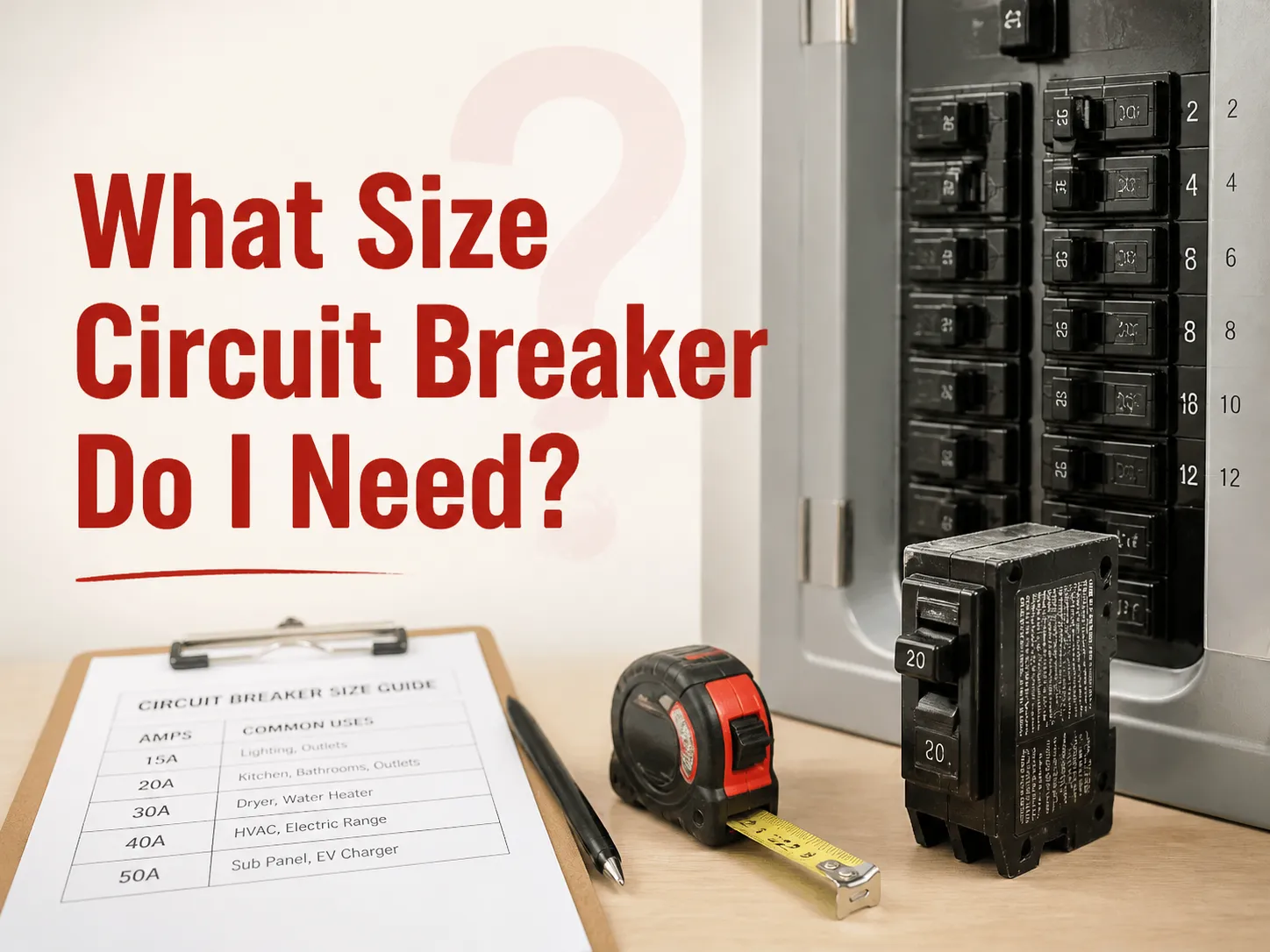
The main breaker in commercial buildings is rarely contained within one obvious panel; rather, it can be located in a fused disconnect switch, a switchboard or an MDP (main distribution panel). To determine the location of the breaker, trace the conduit from the utility’s transformer or from the service lateral into the building. The first over-current device encountered in the wiring is the main breaker. This breaker could exist in dedicated electrical rooms, in vaults contained in basements or outside of the transformer and/or service lateral. Some buildings have their main disconnect located on an exterior wall with the main distribution panel located inside. For very large buildings, there are sometimes multiple disconnects located together, with up six disconnects grouped together being code compliant. If you are specifying breakers for a new distribution system or replacing an aging main, our article on what size circuit breaker you need walks through the full‑load calculation that determines the correct main breaker rating.
How to Reset a Main Breaker Safely
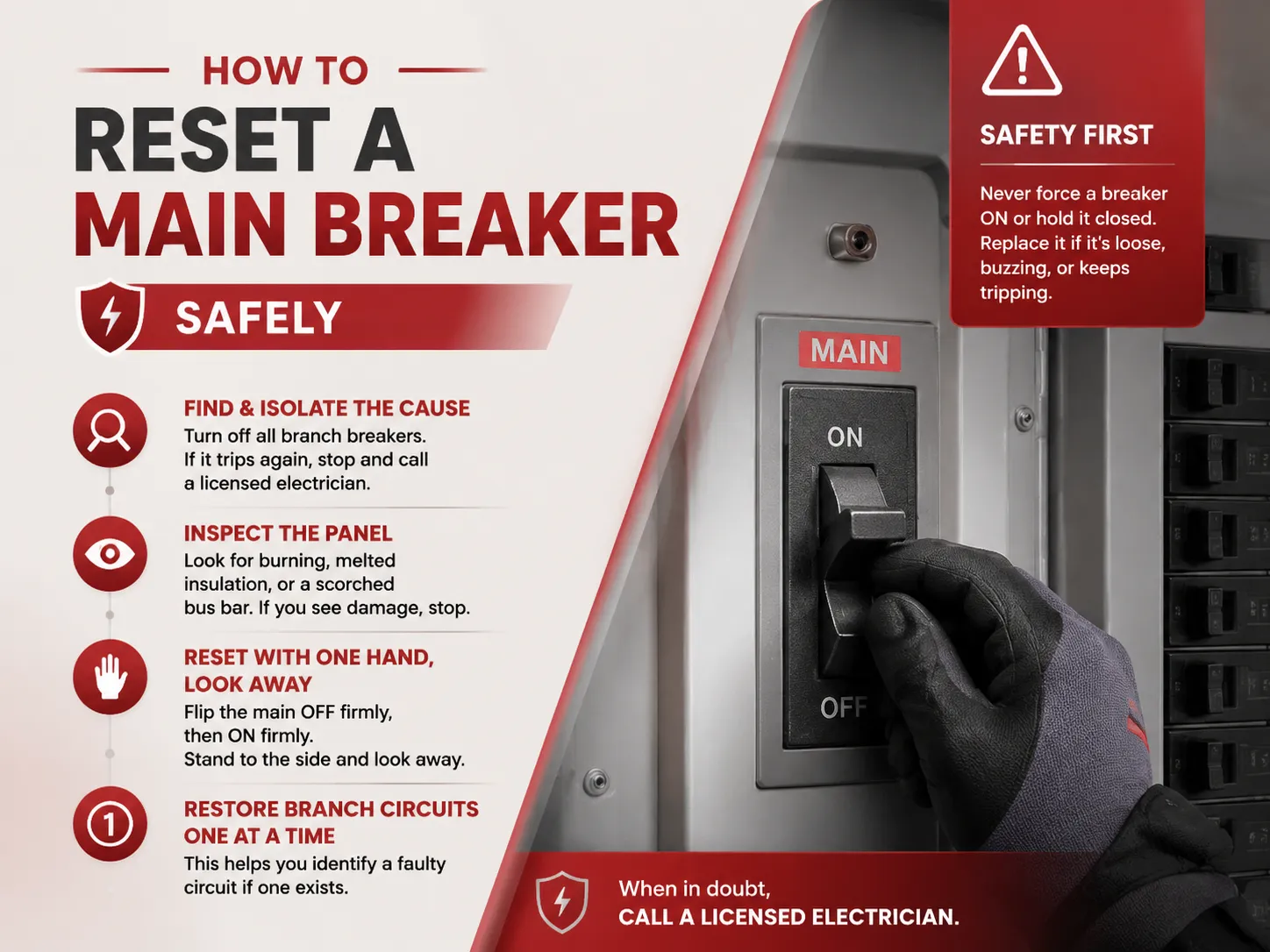
Flipping a branch breaker’s switch back on and resetting a mains breaker aren’t the same. A main breaker carries the whole load in a building, plus it’s been exposed to the same overcurrent/short-circuit that caused it to trip. Consider these things before resetting:
- Identify and isolate the cause of the trip. First, turn off all branch circuit breakers to remove load from the main breaker. If the main breaker tries again with the branch circuit breakers off, then either there is a fault between the main and the panel bus or the main has failed. Do not try again; call for a licensed electrical contractor.
- Inspect the panel. Look for signs of burning, melted insulation, or a scorched bus bar. If you see damage, stop.
- Reset the main with one hand and look away. To minimize exposure from an arc blast, stand beside the panel, look away, and only use one hand while operating the switch. To operate the main switch, you should first flip it firmly into the OFF position, then flip it firmly into the ON position.
- Restore branch circuits one at a time. This helps you find a faulty branch circuit if one exists.
You should only replace your main breaker if it is loose, makes a buzzing sound, or continues to trip repeatedly. You should not attempt to keep the main breaker in the ‘ON’ position or hold it closed.
Replacement Costs and When to Call an Electrician
For most homeowners, replacing a main circuit breaker is not a do-it-yourself (DIY) project. The main circuit breaker carries unfused electricity from the utility transformer to the electrical panel; if you make a mistake while installing your new main circuit breaker, the result could be electrocution and/or fire, and you may not be covered by your homeowner’s insurance. An average licensed electrician will charge about $150 – $600 to replace your main breaker, based on the size of the amperage, number of breakers on the electrical panel, and whether or not the breaker is readily available from distributors. If the main breaker is part of a large distribution switchboard or the load bus bars have melted or are otherwise damaged, the expense of replacing the entire electrical panel or switchboard can be $2,000 – $6,000 or more. The hourly labor rate for an experienced commercial or industrial electrician is typically $100 – $200 per hour. If you are replacing your main circuit breaker on a “live” load (not disconnected), there is an even higher risk of injury and more complicated procedures; thus, the cost will increase significantly. When it comes to replacing your main breaker, a licensed handyman is not the best option to save money.
How HUYU Supports Safe Main Breaker Replacement
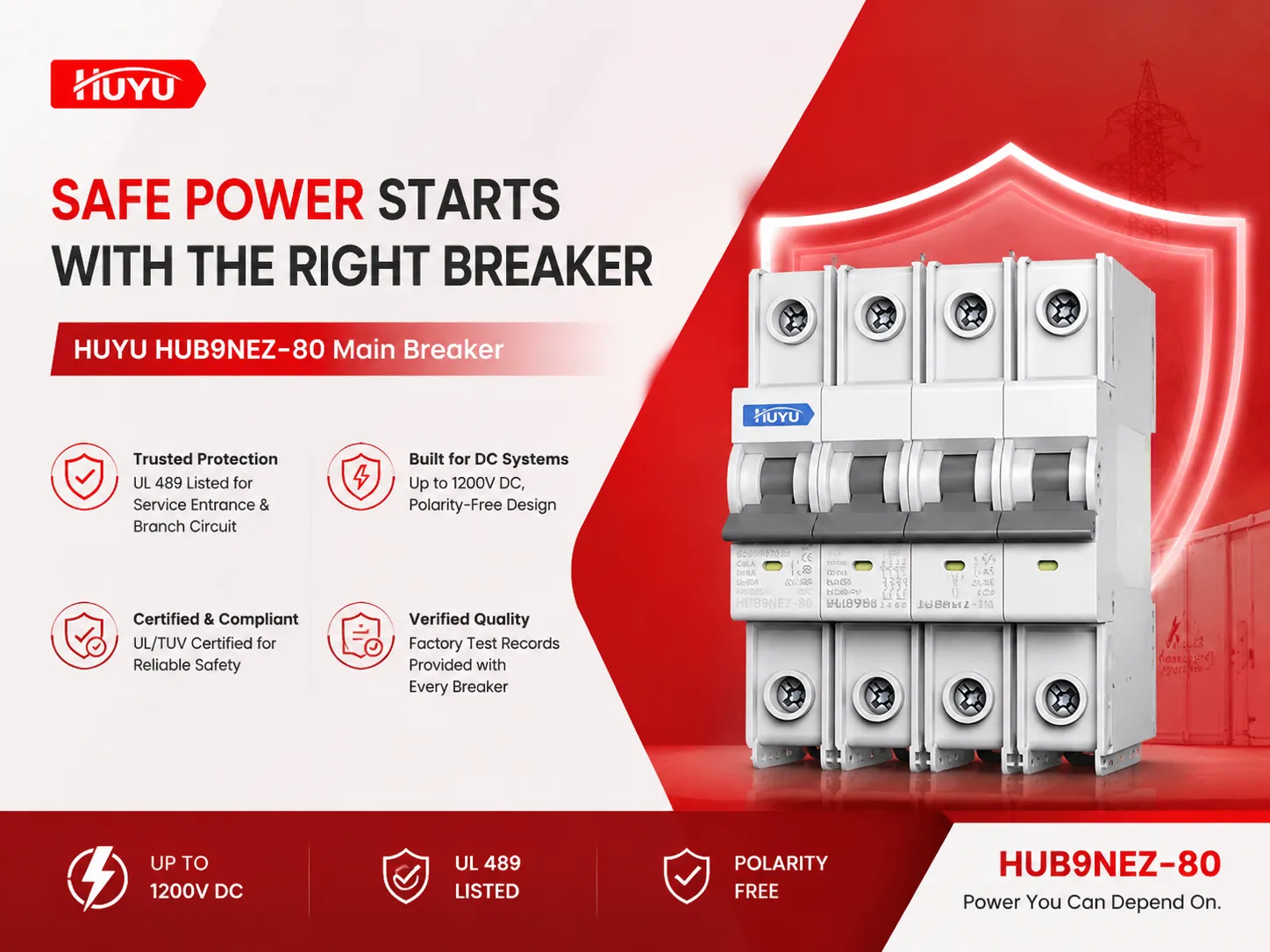
When it comes to the protection electrical circuits, we believe that the most important part of an electrical system is the main breaker. If the main breaker fails, then the whole electrical system has failed. Our main breakers and our molded case circuit breakers are UL 489 listed products; and are produced under the same standards required by code authorities and insurance companies for service entrance and branch circuit protection. For DC applications, including battery energy storage systems that are more frequently being utilized as a backup power supplies for important systems and loads, we offer products such as the HUB9NEZ-80 DC circuit breaker, which has the ability to operate at voltages up to 1200V DC, has a design that does not require polarity, and which has the comprehensive UL/TUV certifications. When you need to purchase a new main breaker, you can be assured that the new breaker you purchase has the same pedigree as the previous one; and our team will provide you with a complete set of the factory test records to verify this information.
Frequently Asked Questions
How do I find my main breaker?
Inside the garage, basement or utility room, locate the electrical panel and the main breaker, which is commonly located at the top of the panel (large two-pole). If there is not one located there check outside of your house near the utility meter either a “Service Disconnect” or a “Main” enclosure. If you have a meter-main combination the main breaker will reside in that outdoor enclosure. If your house has a split-bus panel, the six upper double-pole breakers will function as the main disconnect together.
How do I reset my main breaker?
The first step is to turn off all of the breakers in the panel. After this has been accomplished, check the panel for burnt components, as well as physical damage. After inspecting the panel, you should stand to the side and flip the Main breaker OFF, then ON. If the breaker immediately trips after flipping the lever while all other breakers in the panel are OFF, do not reset and call a qualified licensed electrician. The Main breaker could have failed completely, or there is a significant fault between the Main breaker and the bus bar.
How much does an electrician charge to replace a main breaker?
The cost associated with replacing a residential main breaker generally varies from $150-$600 for both labor and the breaker. If the bus is damaged or if the main breaker is located on a larger switchboard, the price will rise. A typical full panel replacement will cost between $2000-$6000. Replacing an industrial main breaker ballistic on a live bus will result in higher labor costs due to safety concerns.
Is there a main breaker outside the house?
Correct – homes built after 2020 must have an outdoor emergency disconnect – which is the same thing as a main breaker. In older homes which are located in warmer areas, the meter-main combo (which includes the main breaker), will be outside the house. If your inside panel lacks a main breaker, see if there’s an outside enclosure located directly above or below your utility meter.
Finding the main breaker should take seconds, not minutes. In an emergency, those seconds matter. Walk your facility or your home today, before you need it, and physically locate the main disconnect. Make sure it is clearly labeled, unobstructed, and that everyone who might need to operate it knows exactly where it is. When the main eventually reaches the end of its service life — as all electromechanical devices do — choose a replacement that carries the same UL 489 certification and interrupting rating as the original. At HUYU, we supply main breakers and distribution equipment that meet that standard, with the test reports to prove it, because the one breaker that must never fail is the one that protects everything else.