
In the summer of last year, there was a flickering of lights in the home of a family from Lake Forest, CA while their air conditioning unit was running due to an issue with their electrical panel, which was original to the house since its construction in the early 1980’s. Their electrical service was 100 amps and their breakers were old and stiff with some buzzing. When using the microwave and the toaster at the same time, the circuit breaker for that circuit would trip. An electrician evaluated the panel and discovered corrosion on the bus bars, several breakers that did not trip under test and the total connected load was overshooting the panel rating (maximum capacity). The recommendation was an upgrade of the circuit breaker to a modern designed 200-amp circuit breaker (panel) with new breakers and surge protection.
In Lake Forest, where construction took place over multiple decades, there are a lot of homes (built in the 1970s or earlier) that are carrying the additional electrical load from today’s lifestyle. This additional demand is due in part to new office equipment, EV charging stations, smart appliances, and air conditioning systems that run longer and harder than in generations past. Upgrading to larger circuit breakers will not only improve the performance of your home’s electrical system — it is also the best way to bring the electrical infrastructure in your older home up to the safety standards and power requirements present today.
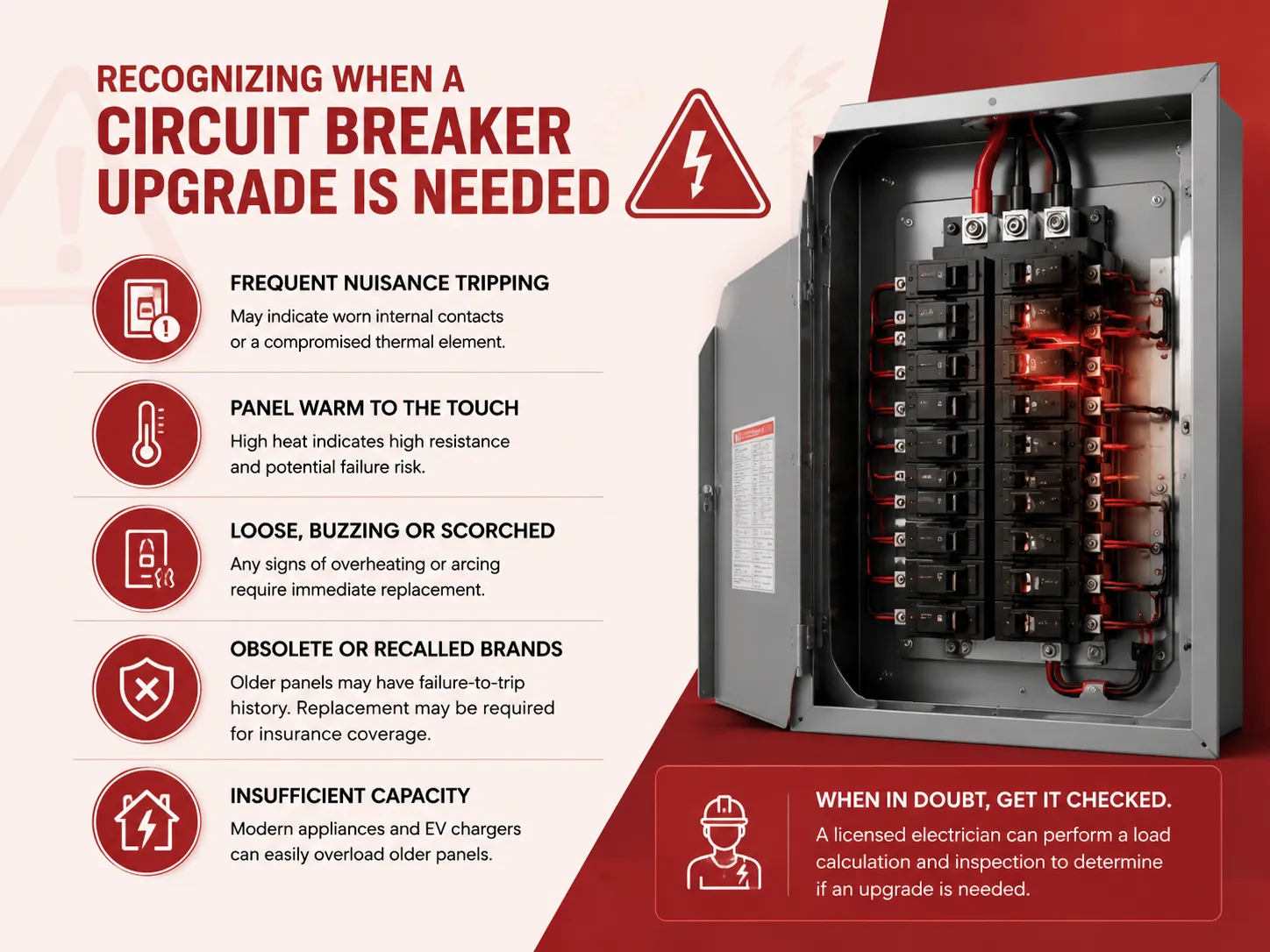
Recognizing When a Circuit Breaker Upgrade Is Needed
Circuit breakers will eventually fail. A high-quality circuit breaker can last a very long time, sometimes several decades. However, circuit breakers that are old, exposed to moisture and corrosion, and that have been tripped repeatedly all lead to deterioration of the internal mechanism. Some failures will be apparent just by visual inspection. Some problems can only be detected by an electrician using a thermal scanning device or performing a trip test. The most common signs that you may want to consider upgrading your circuit breakers are:
- Frequent nuisance tripping. Recurring tripping of a breaker while under its ordinary operating conditions, may indicate either worn internal contacts or a compromised thermal element. Simply restoring power to it without conducting an investigation might lead to wiring overheating.
- A panel that is warm to the touch. A breaker or busbar that is generating a lot of heat (usually measurable by an infrared thermometer) indicates there is high resistance and there may be a problem with it or that it may fail.
- Breakers that feel loose, buzz, or show visible scorching. Any physical sign of overheating or arcing is a mandatory replacement signal.
- Obsolete or recalled breaker brands. Some older type of electrical panels (Federal Pacific Electric [FPE] Stab-Lok panels, Zinsco panels and a few early model Challenger panels) have been documented to have failure to trip history. In California today, most insurance companies require that these types of panels be replaced in order to continue coverage.
- Insufficient capacity. A 100-amp panel that was sufficient in 1980 could now be dangerously overloaded if the home has an electric vehicle (EV) charging station (50 amps), a heat pump (30 to 50 amps), and a modern kitchen (multiple 20 amp circuits).
If you observe any of these symptoms, a licensed electrical contractor will need to conduct a load calculation as well as an inspection of the panel or breaker. If you’re intending to upgrade your panel, you’re required to obtain a permit from Lake Forest’s Building Division, and the work completed will be subject to the requirements of the California Electrical Code, which was adopted from the National Electrical Code but has state-specific modifications.
Which Circuit Breakers Typically Need Upgrading?
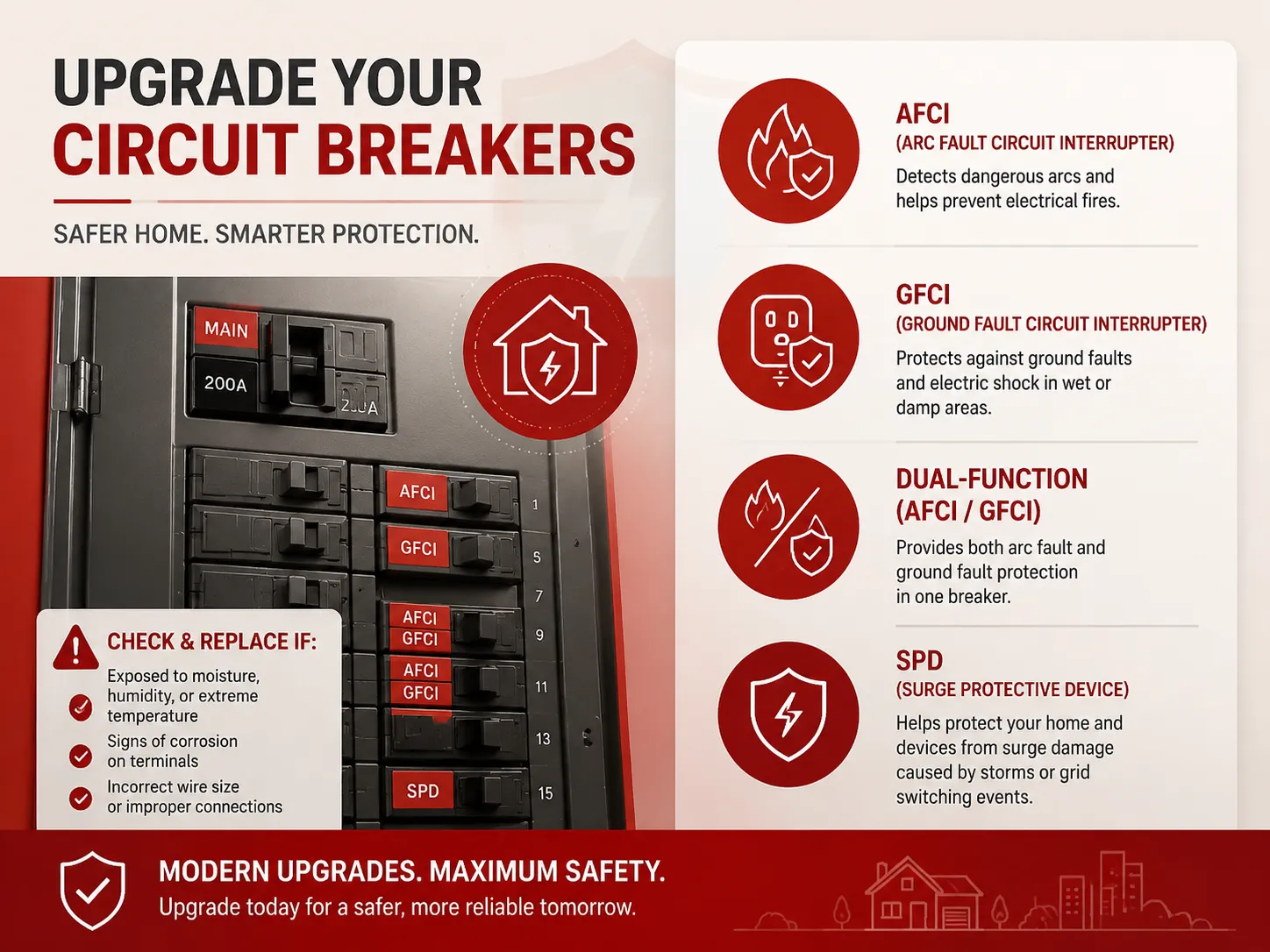
Sometimes it is necessary to replace individual breakers in a panel, but there are several breakers that should be considered for replacement during a panel upgrade. For example, older thermal-magnetic circuit breakers that have been tripped many times may not retain their calibration. In addition, circuit breakers located outside or in the garage that have been exposed to moisture/humidity and/or fluctuating temperatures might have had their terminals corrode. Finally, all circuit breakers that supply a newly added large electrical demand load/such as a hot tub, an electric vehicle charging station, or a home entertainment center (the “new loads”) will need to have the correct wire gauge size and continuous loads according to NEC 210.19.
Upgrades to existing installations commonly involve modernising your electrical panel with new specialty circuit breakers that include additional safety features not found in older style panels.
- Arc Fault Circuit Interrupters (AFCI). AFCI breakers, as mandated by the NEC for many residential circuits, will trip before arcing has created a fire. They also represent a large improvement over traditional breakers for circuits found in bedrooms, rooms, and hallways.
- Ground Fault Circuit Interrupters (GFCI). GFCI breakers are installed in the bathrooms, kitchens, garages, and outside and provide complete circuit ground-fault protection at the panel, which protects the wiring and all connected devices.
- Dual‑Function (AFCI/GFCI) Breakers. With an increasing number of new buildings being constructed, the combination of two types of protection into one device is becoming more common.
- Surge Protective Devices (SPD). Although it doesn’t function as a circuit breaker, a Type 2 SPD mounted in the service panel will provide protection from voltage surges for all circuits connected downstream. This is critical in the event of a thunderstorm or grid switch in Southern California.
HUYU supplies a comprehensive range of replacement and upgrade breakers to support these modernizations. For residential panels, the HUM18‑63 10kA miniature circuit breaker provides reliable overload and short‑circuit protection in standard single‑pole and multi‑pole configurations. For circuits requiring earth leakage protection, the HUM18LE‑63 RCBO combines overcurrent and residual current protection in a compact DIN‑rail format. And for installations requiring the highest level of DC arc management — such as a home battery storage system or a solar PV combiner — the HUB9NEZ‑80 DC circuit breaker is a non‑polarity design rated up to 1200V DC, fully certified to UL and TUV standards. Each of these devices carries the testing documentation that a California building inspector will want to see.
The Cost of a Circuit Breaker Upgrade in Lake Forest
The cost of a circuit breaker upgrade depends on the scope: a simple breaker swap is inexpensive; a full panel replacement is a major project. The table below provides a general range for common upgrade scenarios in Southern California, including Lake Forest.
| Upgrade Scope | Typical Cost Range (USD) | What’s Included |
|---|---|---|
| Replace a few standard breakers | $50–$200 per breaker installed | Breaker cost ($10–$50), labor, and testing |
| Replace obsolete panel (e.g., Zinsco) with new 200A panel | $2,500–$5,500 | Panel, new main breaker, new branch breakers, permits, inspection |
| Full 200A service upgrade (new meter, mast, panel) | $4,000–$8,000+ | Utility coordination, new service entrance cable, grounding, permits |
| Add SPD, AFCI/GFCI breakers to existing panel | $500–$1,500 | Breakers, surge protector, labor |
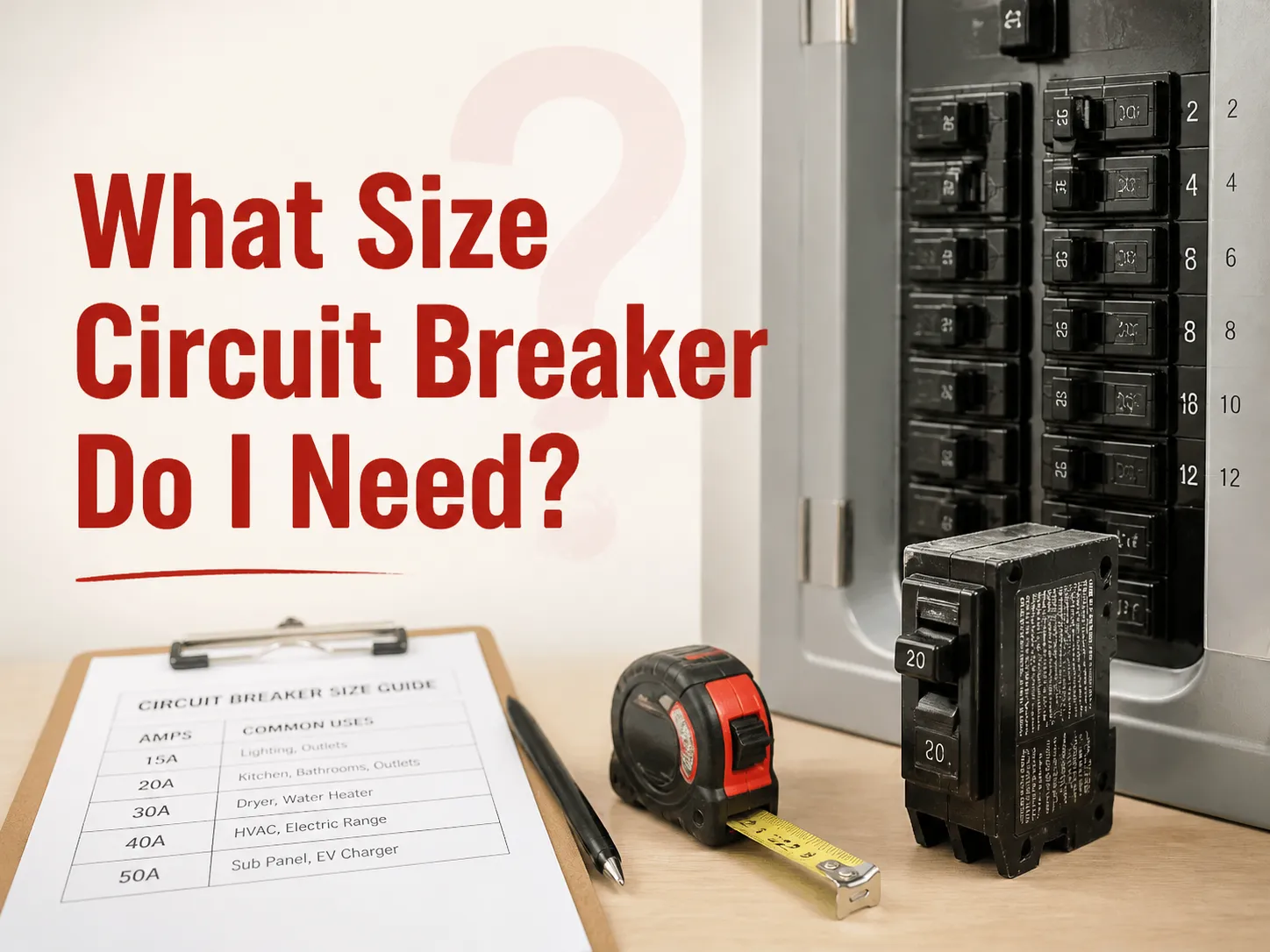
These are estimates based on 2025 pricing. The actual cost depends on the condition of the existing service entrance cable, the accessibility of the panel location, and the electrician’s hourly rate in the Lake Forest area. Always obtain at least three written quotes, each specifying the breakers to be installed, the manufacturer, and the amperage and interrupting capacity. For guidance on matching breaker ratings to your specific load, our article on what size circuit breaker you need walks through the NEC calculation process.
Can You Upgrade a Breaker Panel Yourself?
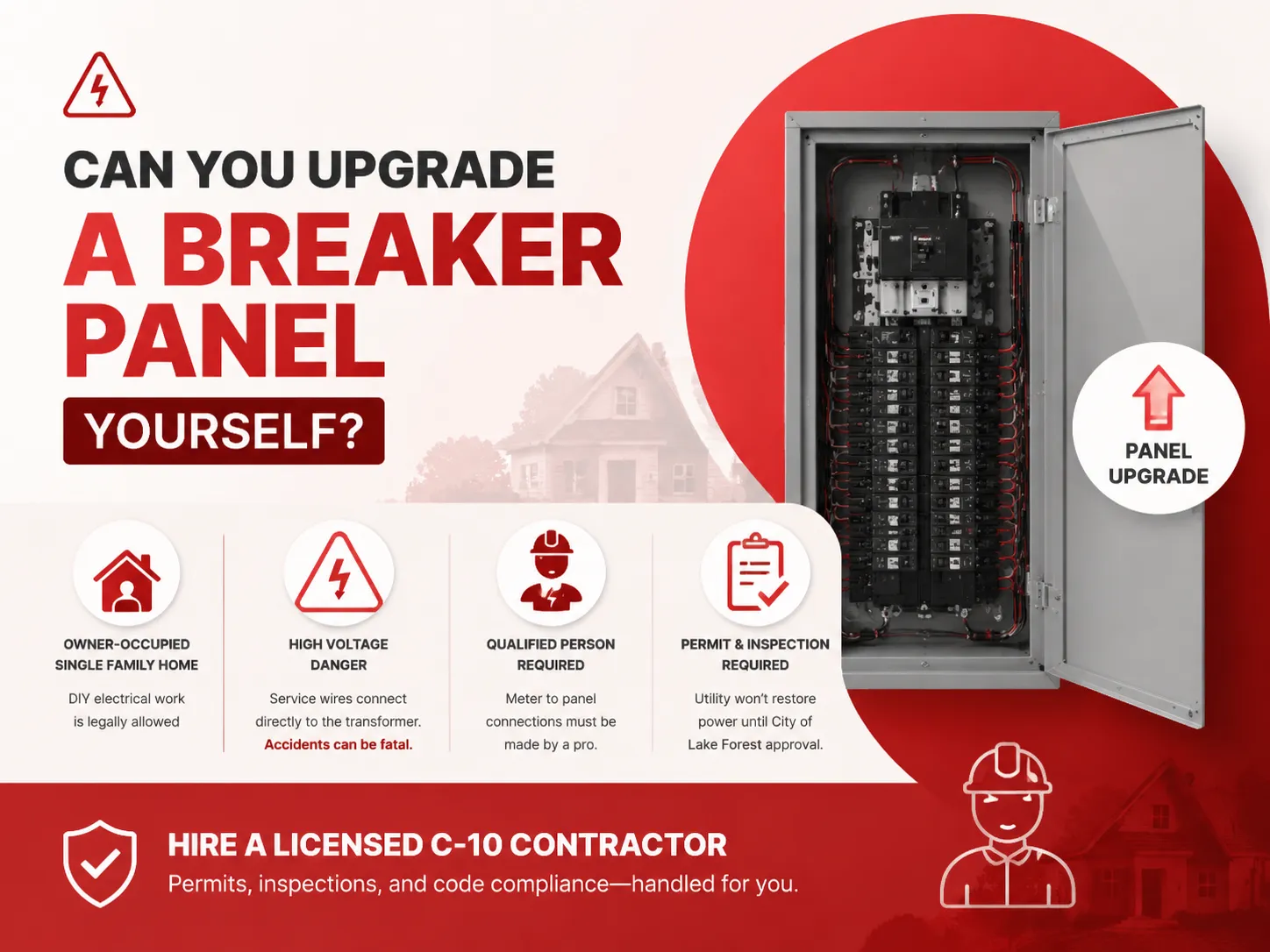
Under California state law, it is permissible for the owner of a single family home who occupies the residence to perform electrical work upon their own property. However, a panel upgrade, especially one that entails changing the service, is not a project most owners will want to attempt on their own. A service upgrade will cause the disconnection of the service entrance conductors (these connect directly to the transformer and carry current directly to the meter without any fuses). Accidentally cutting these wires can be fatal. The connection from the meter to the panel must be made by a qualified person, and the utility will not turn the power on until the construction is inspected and approved by the City of Lake Forest Building Department. In practical terms, most people will have this work done through a licensed C-10 contractor. The contractor will generally assist with the costs of the permits and inspection, as well as provide you with guarantee of compliance to all code requirements.
The Permit Process and Code Requirements in Lake Forest
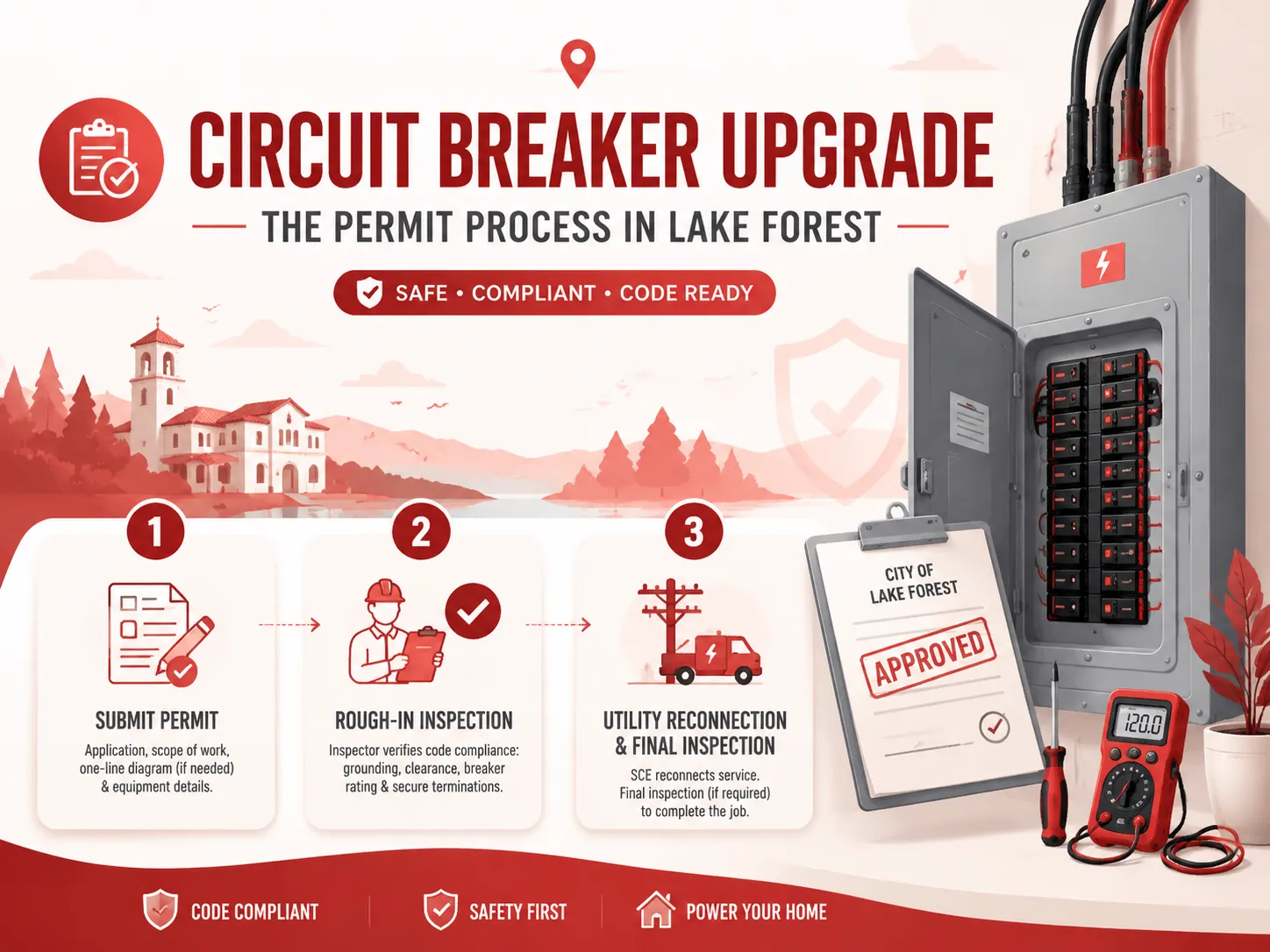
The City of Lake Forest requires you to obtain a permit for any Circuit Breaker upgrade that involves replacing the panel, changing the service amperage, or adding new circuits. A simple-to-follow process exists to support electric upgrades in the City of Lake Forest, including three main parts to be implemented in order:
- Submit an electrical permit application. The contractor/homeowner’s responsibility to deliver written documents for the project includes providing an explanation of the work to be done, submitting a copy of an electrical one-line diagram if needed, and providing detailed equipment specifications.
- Schedule a rough‑in inspection. The inspector checks for conformity with the California Electrical Code for grounding, clearance for working area, breaker rating and secured terminations to ensure the job is completed and ready to operate after the new breaker panel is installed.
- Utility reconnection and final inspection. Once the rough-in has been passed, Southern California Edison will receive a notification to reconnect the service and, in some cases, a final inspection may need to occur before the re-connection and/or finalizing the job.
The California Electrical Code adopts the NEC with amendments, and Lake Forest enforces the state code. The relevant article for panel installations is NEC 408, which covers panelboards, and Article 250 for grounding and bonding. The work must comply with the manufacturer’s instructions for the panel and breakers used. Using listed, tested breakers — such as HUYU’s EXB3‑125 MCB or HYM1 MCCB — ensures the inspector can verify the UL or equivalent listing.
Installation and Maintenance Tips for an Upgraded Panel
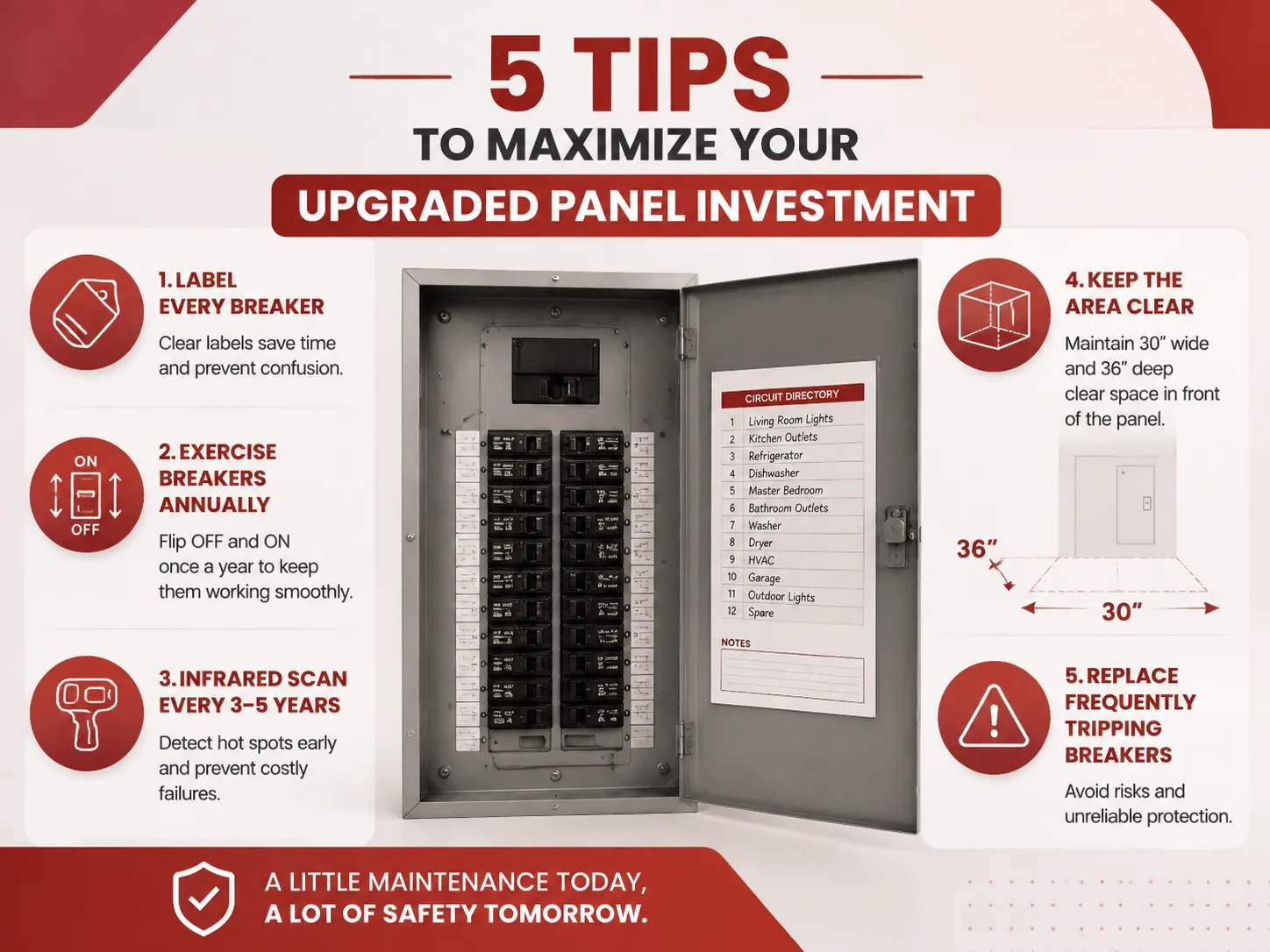
When a circuit breaker upgrade has been finished, some measures can prolong or maximize the value of that investment while maintaining safety within the system.
- Label every breaker clearly. Labels made from durable materials or printed directories can be located inside the cover of the panel door. Using “Master Bedroom” is much more helpful than just saying “Lights.”
- Exercise breakers annually. Rotate breaker switches to OFF and ON at least once every year. This will help protect the breaker from freezing up and help to redistribute the internal lubricant.
- Perform an infrared scan every 3–5 years. An infrared camera can see hot spots on breaker terminals/busbar connections well before they’re a failure. Many electrical contractors from Lake Forest provide this as a stand-alone service.
- Keep the panel area clear. NEC 110.26 specifies that there must be a clear working space in front of the electric panel with at least 30 inches wide and 36 inches deep for safety reasons, as opposed to using it as a storage space.
- Replace any breaker that trips frequently. Internal damage can occur after a breaker interrupts a major fault and replacing it is significantly less expensive than diagnosing an intermittent trip.
For systems that include both AC and DC circuits — a growing reality as home battery storage and solar become common in Lake Forest — it is essential to use breakers rated for the specific current type. Our article on DC MCB AC circuit compatibility explains why a DC‑rated breaker must never be used on an AC circuit, and vice versa. HUYU’s DC breaker range, including the HUM18PV‑63 DC MCB and the HUM9NEZ DC MCCB, is purpose‑built for the DC side of hybrid systems, ensuring that the arc‑extinguishing mechanism correctly handles the steady‑state DC arc.
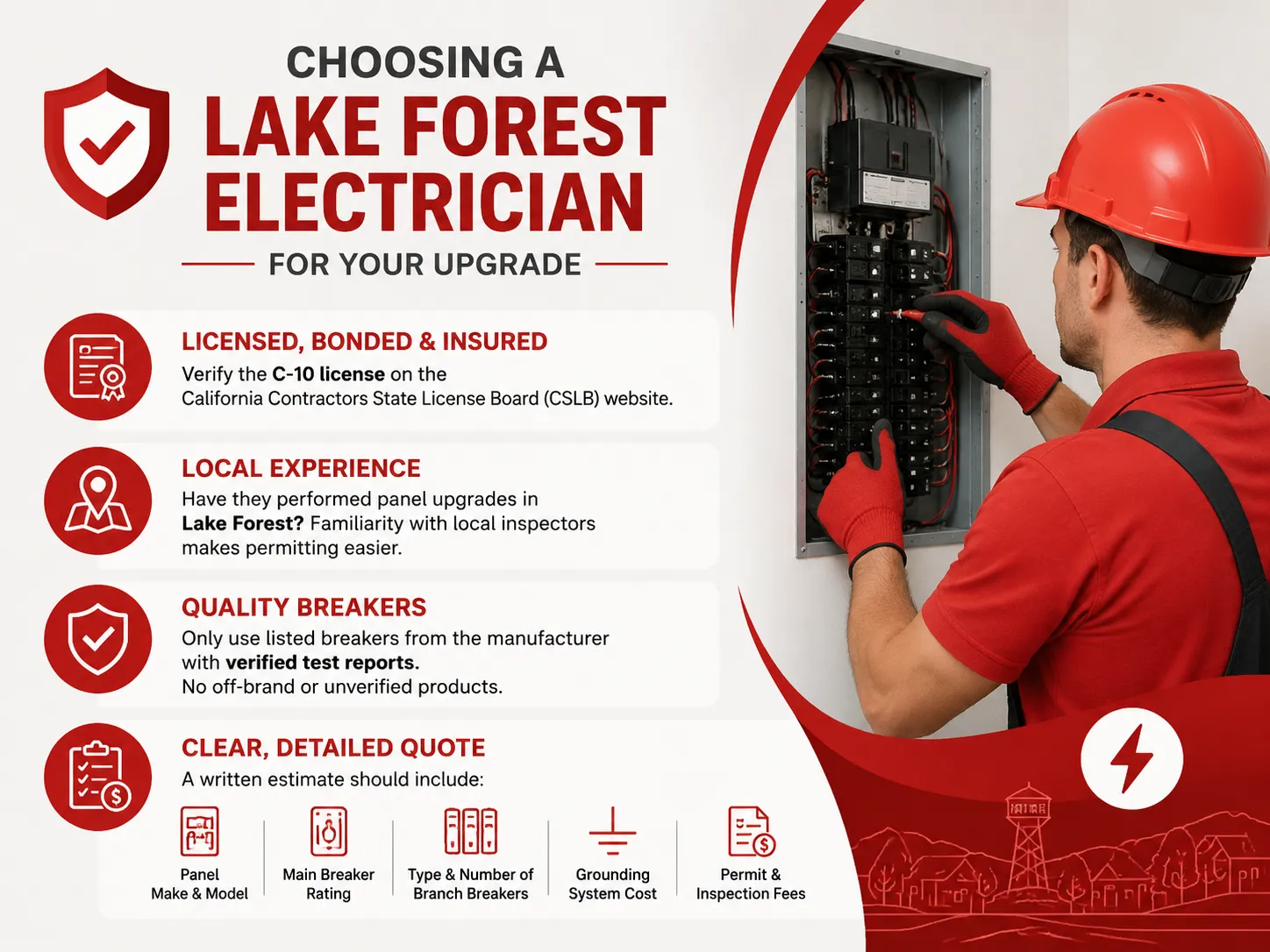
Choosing a Lake Forest Electrician for Your Upgrade
Selecting a licensed electrical contractor is critical as their expertise will affect how well your installation meets your city’s electrical building codes. Here are some additional questions to consider when comparing electricians in Lake Forest:
- Are you licensed, bonded, and insured in California? Verify the C‑10 license on the California Contractors State License Board (CSLB) website.
- Have you performed panel upgrades in Lake Forest specifically? Getting to know the inspectors from the city’s building division and what they require will help make the permitting process easier.
- What breakers do you specify? If a contractor tries to cut their costs by utilizing off-brand or unverified products, they are not helping you at all. Require them to only use listed breakers from the manufacturer, which have proper test reports that have been verified.
- What is included in the quote? The written estimate must include the following information: (1) make and model of the panel; (2) rating of the main breaker; (3) type and number of all branch breakers; (4) cost associated with completing the grounding system as per your area; (5) cost associated with obtaining a permit (if applicable) and inspection fee.
References
- NFPA 70 (National Electrical Code) — Current edition adopted by California with amendments. Articles 210, 250, 408, and 690 apply to panel upgrades.
- California Building Standards Commission — 2022 California Electrical Code (Title 24, Part 3).
- City of Lake Forest Building Division — Permit requirements, fee schedules, and inspection procedures for electrical work.
- California Contractors State License Board (CSLB) — License verification for C‑10 electrical contractors.
Frequently Asked Questions
How much does it cost to get a circuit breaker upgraded?
Costs for upgrading a circuit breaker can run the gamut from less than $200, if you are only replacing one breaker versus a total upgrade to a service/panel costing more than $8,000. Replacement of a typical 200amp panel in Lake Forest would cost between $2,500 – $5,500, which includes the cost of obtaining permits and having an inspector inspect your installation.
Can I upgrade my electrical panel without rewiring my house?
Although an update to the electrical panel provides a new cabinet for mounting the new electrical panel and installing new main/branch circuit breakers, the existing in-wall wiring (conductors) will normally remain untouched by the update. The electrician will re-attach existing wires/circuits to newly installed breakers. If any damaged or under-sized wiring is present, then replacement of these cables will be included as part of the project scope.
Can I upgrade my breaker panel myself?
In California, homeowners can legally work on their own homes, however, the panel upgrade is considered one of the highest risk projects involving live service conductors. Most people hire a licensed electrical contractor in accordance with C-10 for their panel upgrades and the electric utility company will not re-establish power services to the homeowner until the work has been inspected and approved. It is difficult for the homeowner to have their project approved as an inspection without professional experience for the person who installed the system.
Do I need a permit to upgrade my electrical panel in California?
You must have electrical permits from your local municipality if you are replacing panels, performing service upgrades, or adding new circuits in Lake Forest, California. All work done will be inspected by an electrician to make sure it is in compliance with the California Electrical Code. If you do not obtain a permit you could face fines, an unsafe installation, or difficulty selling the home for an extended period of time.
A circuit breaker upgrade in Lake Forest is an investment in safety, reliability, and the capacity to power modern life. An older panel with degraded breakers is a latent fire risk. A modern panel, properly sized, with arc‑fault and ground‑fault protection, with a surge protective device, and with clearly labeled circuits, is a system that will serve the home for decades. Whether the project is a targeted replacement of a few breakers or a full service upgrade to 200 amps, the same principles apply: use listed, certified breakers, hire a qualified contractor, pull the required permit, and document the work. HUYU supplies the circuit protection devices that make these upgrades possible — from miniature breakers to molded‑case breakers to DC and RCBO solutions — with the test data and certifications that both code officials and homeowners rightfully demand.