
In case your facility uses outdated switchgears, you may wonder whether you can refurbish your circuit breakers or should obtain brand new gadgets. The answer is not that simple, as it depends on a type of circuit breaker in your facility. As stated by the National Electrical Code (NEC) of 2020, low-voltage power circuit breakers, medium-voltage circuit breakers, and high-voltage circuit breakers are allowed to be restored while molded case circuit breakers (MCCBs), GFCI circuit breakers, and AFCI breakers should not be renewed according to NEC Article 210.15 and Section 240.88. Consequently, this distinction is very important for managers of plants, electrical contractors, and maintenance engineers in need of balancing the expenses with safety and compliance with the code.
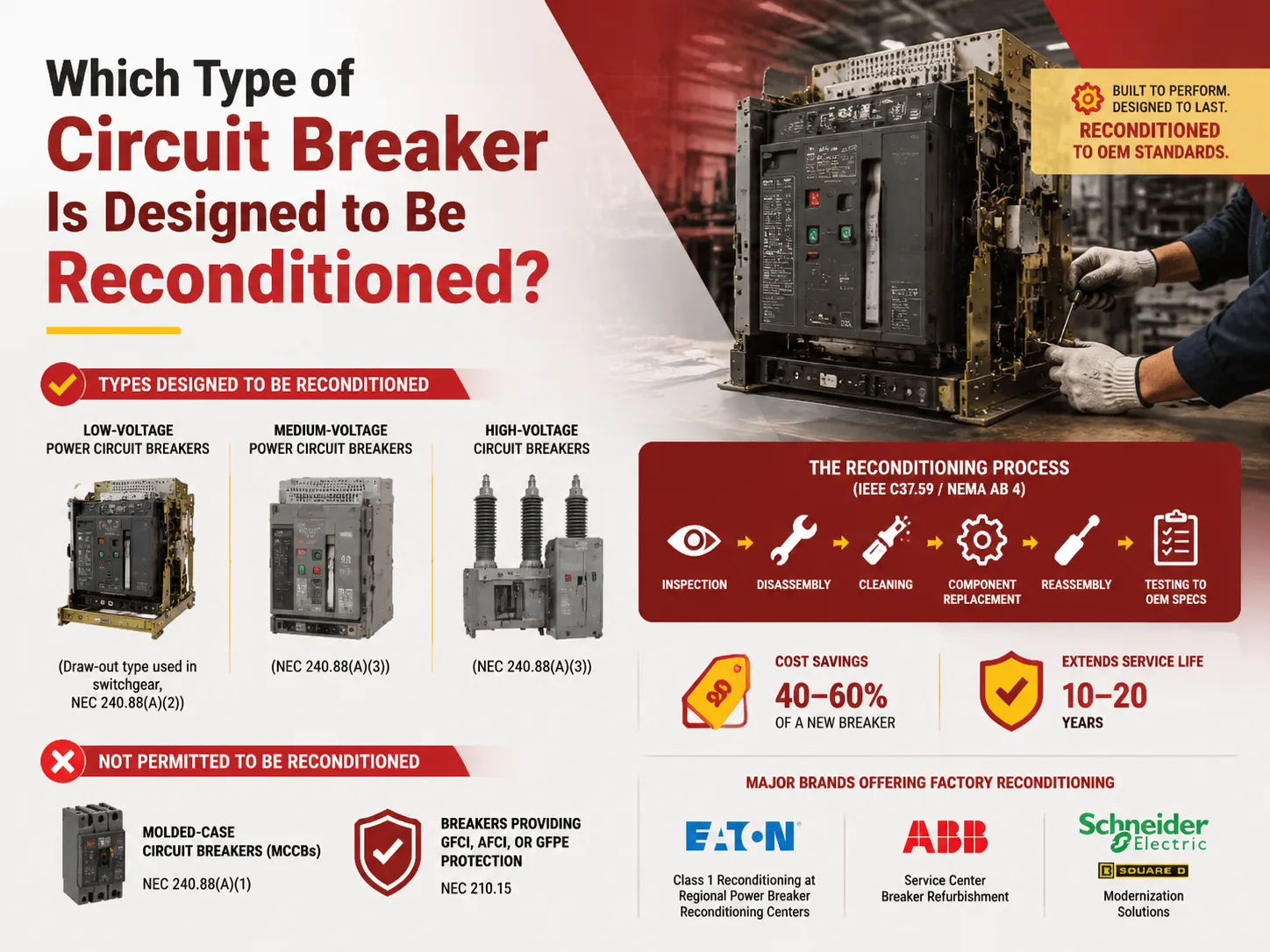
Quick answer: The circuit breakers that can be refurbished include low voltage power circuit breakers, medium voltage power circuit breakers, and high voltage circuit breakers. Molded case circuit breakers cannot be refurbished as stated by NEC 240.88(A)(1), and also any circuit breaker that provides GFCI protection, AFCI protection, or GFPE is prohibited by NEC 210.15. Noteworthy manufacturers offering factory refurbishment include the following: Eaton, ABB, and Schneider Electric / Square D. The refurbishment process complies with IEEE C37.59 and NEMA AB 4 rules and regulations. Generally, the refurbishment costs 40-60% of a new circuit breaker and adds 10-20 years of service life.
Circuit Breaker Types Permitted for Reconditioning
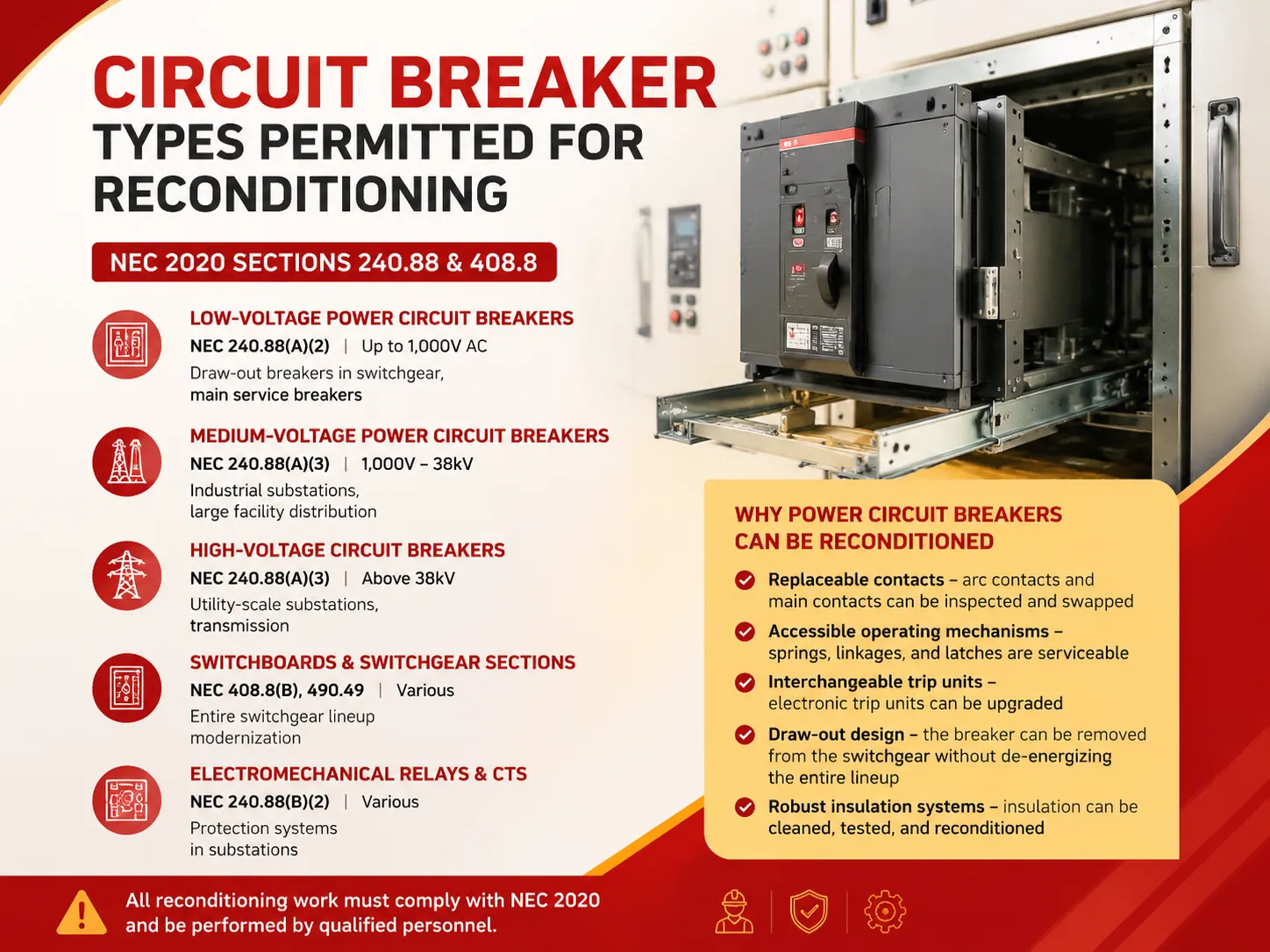
Per NEC 2020 Section 240.88(A), the following circuit breaker types are explicitly permitted to be reconditioned:
| Breaker Type | NEC Reference | Typical Application | Voltage Range |
|---|---|---|---|
| Low-voltage power circuit breakers | 240.88(A)(2) | Draw-out breakers in switchgear, main service breakers | Up to 1,000V AC |
| Medium-voltage power circuit breakers | 240.88(A)(3) | Industrial substations, large facility distribution | 1,000V – 38kV |
| High-voltage circuit breakers | 240.88(A)(3) | Utility-scale substations, transmission | Above 38kV |
| Switchboards and switchgear sections | 408.8(B), 490.49 | Entire switchgear lineup modernization | Various |
| Electromechanical protective relays & CTs | 240.88(B)(2) | Protection systems in substations | Various |
The key characteristic shared by all reconditionable circuit breakers is that they are draw-out or removable types designed for maintenance — not sealed units. Low-voltage power circuit breakers, such as those used in air circuit breakers rated up to 6300A, are specifically engineered with field-serviceable mechanisms, replaceable contacts, and accessible trip units. This is fundamentally different from molded-case breakers, which are factory-sealed.
Why Power Circuit Breakers Can Be Reconditioned
Circuit breakers are designed to enable maintenance. Their attributes include:
- Replaceable Contacts – inspection and replacement of arc and main contacts can take place
- Accessible Operating Mechanisms – service can be performed on the springs, linkages, and latches of the switch
- Interchangeable Trip Units – upgrading the electronic trip units of the circuit breakers is possible
- Draw-out Design – the breaker can be removed from the panel without turning off the power
- Extensive Insulation Systems – the existing insulation can be cleaned, tested, and rehabilitated
For more on the difference between breaker categories, our guide on what MCCB and MCB are covers the structural differences that determine serviceability.
Circuit Breaker Types Prohibited from Reconditioning
According to NEC 2020, there are items that are prohibited from being refurbished. These prohibitions stem from the fact that the safety-critical nature of this equipment makes it imperative that any changes made inside would affect its safety features.
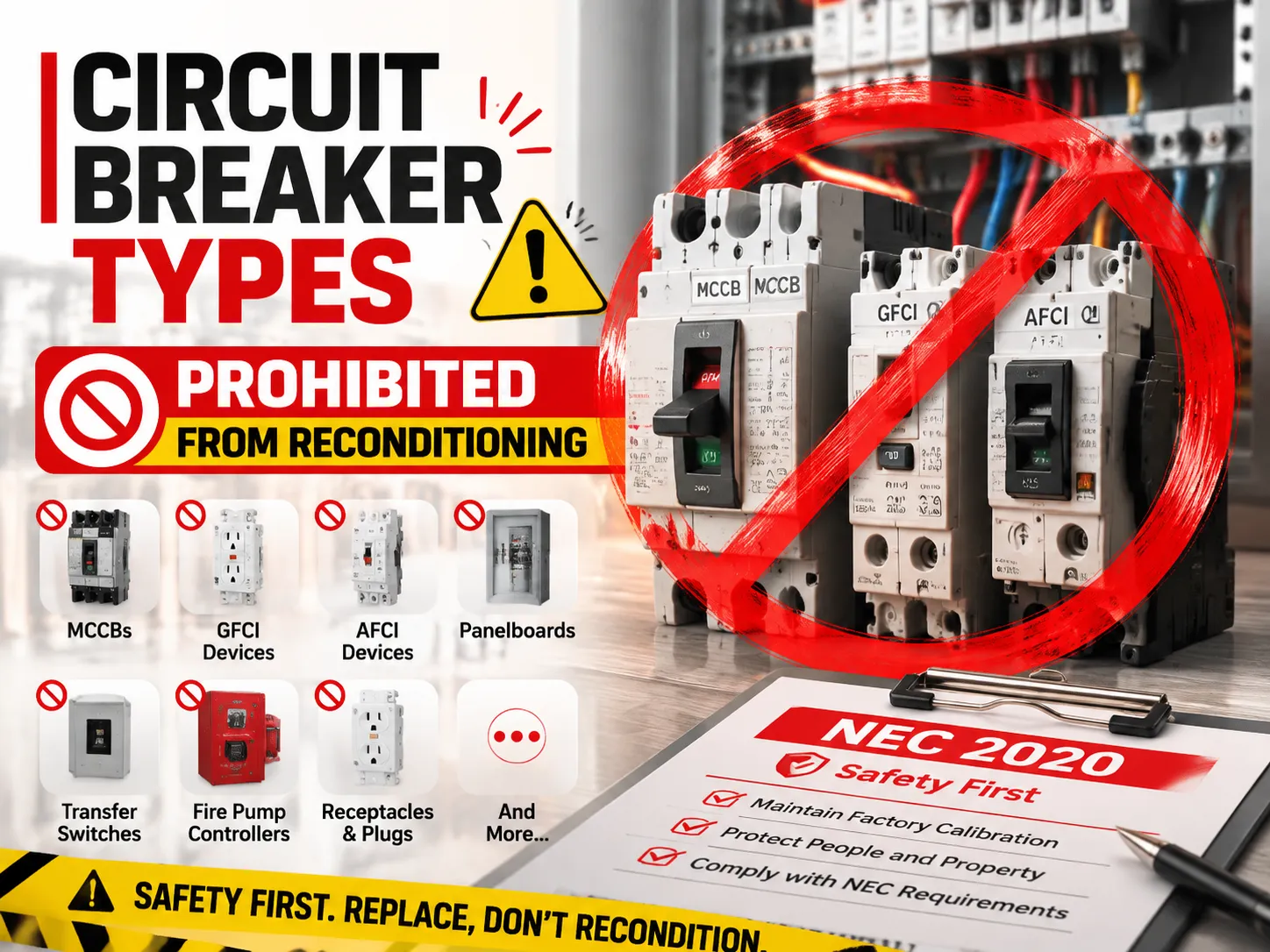
| Prohibited Equipment | NEC Reference | Reason |
|---|---|---|
| Molded-case circuit breakers (MCCBs) | 240.88(A)(1) | Factory-sealed; breaking the seal voids UL listing and calibration |
| GFCI protection devices | 210.15(1) | Safety-critical personnel protection; calibration cannot be verified after reconditioning |
| AFCI protection devices | 210.15(2) | Complex electronics detect arc signatures; reconditioning could miss subtle degradation |
| Ground-fault protection of equipment (GFPE) | 210.15(3) | Equipment protection function must remain factory-calibrated |
| Electronic trip units for LV power breakers | 240.88(B) | Electronics cannot be reliably reconditioned; must be replaced with new |
| Panelboards | 408.8(A) | Structural integrity and bus connections cannot be verified post-reconditioning |
| Transfer switches (emergency systems) | 700.5(C), 701.5(C), 702.5(A) | Life-safety applications require new equipment |
| Fire pump controllers | 695.10 | Critical life-safety equipment |
| Receptacles and attachment plugs | 406.3(A), 406.7 | Wear and contact degradation not reliably detectable |
Stressing the point about MCCBs: Even if previously some inspections and preventative maintenance practices were permitted according to NEMA AB 4 standards, it should be noted that re-conditioning of molded case circuit breakers has been prohibited in the latest 2020 edition of NEC. Maintenance (cleaning, exercising, torque checking) is still valid but any disassembly of internal structure and reconstruction of molded case circuit breakers is not allowed.
Brands That Support Circuit Breaker Reconditioning
Different well-known manufacturers manage the reconditioning programs authorized by their factories. They do not use refurbishers working on behalf of other companies.
| Brand | Program Name | Coverage | Warranty |
|---|---|---|---|
| Eaton | Class 1 Reconditioning (Power Breaker Reconditioning Centers) | Eaton and non-Eaton LV/MV power breakers; Magnum DS remanufacturing; VCP-W FAME upgrades | 3-year (1-year for motor starter applications) |
| ABB | Service Center Breaker Refurbishment | ABB and non-ABB breakers; nuclear and non-nuclear; LV and MV | 1-year parts and labor |
| Schneider Electric / Square D | Modernization Solutions / Circuit Breaker Reconditioning | Square D and most major OEM brands; LV and MV breakers; switchgear modernization | Varies by scope |
| Siemens | Service & Reconditioning Programs | Siemens and legacy brands (ITE, Gould); LV and MV power breakers | Varies by program |
| GE / Vertiv | Reconditioning Services | GE breakers and legacy brands; MV and HV breakers | Varies by program |
What Each Brand Offers
In the region of North America, Eaton has founded five Power Breaker Reconditioning Centers. Their class 1 protocols include the complete disassembly of parts, cleaning in compliance with component standards, resurfacing, and eventually, the final performance testing. They have also developed the FAME upgrade concept for some specific mid-volt breakers as well as retrofitting of circuit breakers with the Digitrip RMS trip unit and Arcflash Reduction Maintenance System. Each reconditioned breaker is added to the central Pow-R-DB database.
In their service centers, ABB offers reresting services for both their own circuit breaker models and for those of other manufacturers. Their services include receiving the equipment, inspecting and testing it, and disassembling it. As well as cleaning all parts, ABB will also check for cracking, be sure to replace already damaged parts, apply lubrication of all moving points, then reassemble it.
In its Modernization Solutions program, Schneider Electric invited the service of reconfiguring low- and medium-voltage power circuit breakers. The reconditioning is performed by using the following steps: through all stages, including partial replacement of components, washing and painting of details, and lubrication.
Key Standards: NEC, NEMA AB 4, IEEE C37.59 & UL 489
Multiple standards govern circuit breaker reconditioning. Understanding which applies to your situation is essential for code compliance:
| Standard | Publisher | Scope |
|---|---|---|
| NEC Article 210.15 & 240.88 | NFPA | Defines what can and cannot be reconditioned; requires listing as “reconditioned” |
| NEMA AB 4 | NEMA | Guidelines for inspection and preventive maintenance of molded-case breakers (not reconditioning) |
| IEEE C37.59 | IEEE | Standard for reconditioning power switchgear equipment; defines the reconditioning process |
| UL 489 | UL | Standard for molded-case circuit breakers; relevant as a testing benchmark |
| NEMA Policy on Reconditioned Equipment | NEMA | Industry positions on suitability and safety of reconditioned equipment |
| PEARL Standards | PEARL | ANSI-accredited standards for inspecting, testing, and reconditioning electrical apparatus |
The essential factor: the initial marking must be taken away and the equipment must be identified as reconditioned when it is refurbished. UL provides a certification procedure for reconstructed equipment. The devices renovated in compliance with the procedure are marked with the UL Mark containing the word “Rebuilt,” “Remanufactured,” “Rebuilt,” or “Reconditioned.” For more on breaker standards, see our article on UL 489 breaker requirements.
The Reconditioning Process Step by Step
According to Eaton Class 1 and IEEE C37.59, this is the process undertaken when the circuit breaker needs reconditioning:
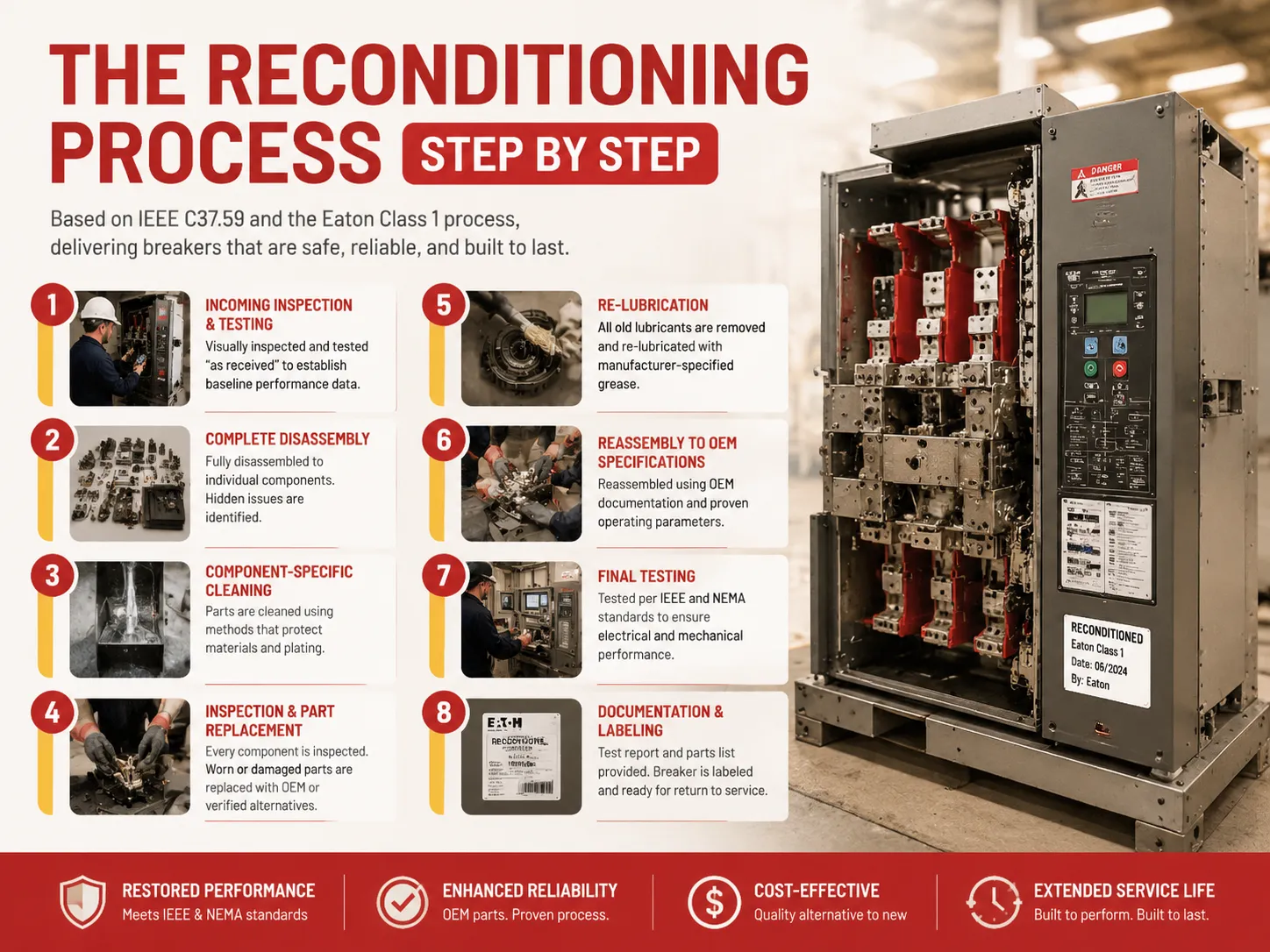
Step 1: Incoming Inspection & Testing
The breaker is received, visually inspected, and tested in the “as received” condition to document baseline performance. The important measurements taken include contact resistance (in millivolts) insulation resistance, mechanical operating effort and dimensions. The information obtained is documented.
Step 2: Complete Disassembly
The disassembly of the breaker is complete and the breaker has been taken apart into its components including: the operating system, the arc chute, the insulation barrier, frame and other systems. This is the stage where one identifies flaws such as, the faulty drive link, or misaligned contacts, damaged insulation that makes the whole device liable to failure when the fault is detected.
Step 3: Component-Specific Cleaning
Various types of materials need various types of cleaning processes. The non-current components are cleaned thoroughly in such a way that no foreign material is left while dielectric and structural characteristics are preserved. The current components are cleaned without damaging the original plating. Contact surfaces are regenerated so that metallurgy and contact pressure play their role properly.
Step 4: Inspection & Part Replacement
All parts should be checked for cracks, deterioration, rust, and size accuracy. Parts that have worn out are replaced by new OEM parts, while parts that are not in production anymore will need to be replaced with reverse-engineered components which must comply with standards stated in IEEE C37.59. Such components may require verification in strict laboratory conditions such as examples of high-power testing. The typical substitutes for the worn parts may be springs, contacts, shunts, and bushing.
Step 5: Re-Lubrication
All outdated lubricants have been eliminated, and the machine and connection points are relubricated using grease specified by the manufacturer. One of the key reasons that circuit breakers fail is due to inappropriate lubrication — stiff mechanisms slow down the process of trouble clearing, which results in much higher arc flash incident energy.
Step 6: Reassembly to OEM Specifications
In the process of reassembling the breaker, the OEM documentation is utilized. However, if OEM information is not available, for instance if the original manufacturer is defunct, Eaton will instead use the centralized Pow-R-DB database of records from similar breakers that are proven to give desired outcomes.
Step 7: Final Testing
The rebuilt circuit breaker will go through conclusive testing as per IEEE and NEMA guidelines including:
- Insulation resistance assessment
- Contact resistance test (millivolt drop)
- Mechanical operation assessment (open-close timing)
- Overcurrent trip test (long-time, short-time, instantaneous trip)
- Dielectric withstand assessment
Step 8: Documentation & Labeling
The production of the test report occurs to establish a contrast between “as received” and “final” test findings, supported by information mentioning all the fixed components. The circuit breaker is provided with a traceability label signifying it as reconditioned, which indicates the name as well as the date of the reconditioning firm. The circuit breaker is operational again.
When to Choose Reconditioning vs. Replacement
The decision to recondition or replace depends on breaker type, age, criticality, and cost. Here’s a practical decision matrix:
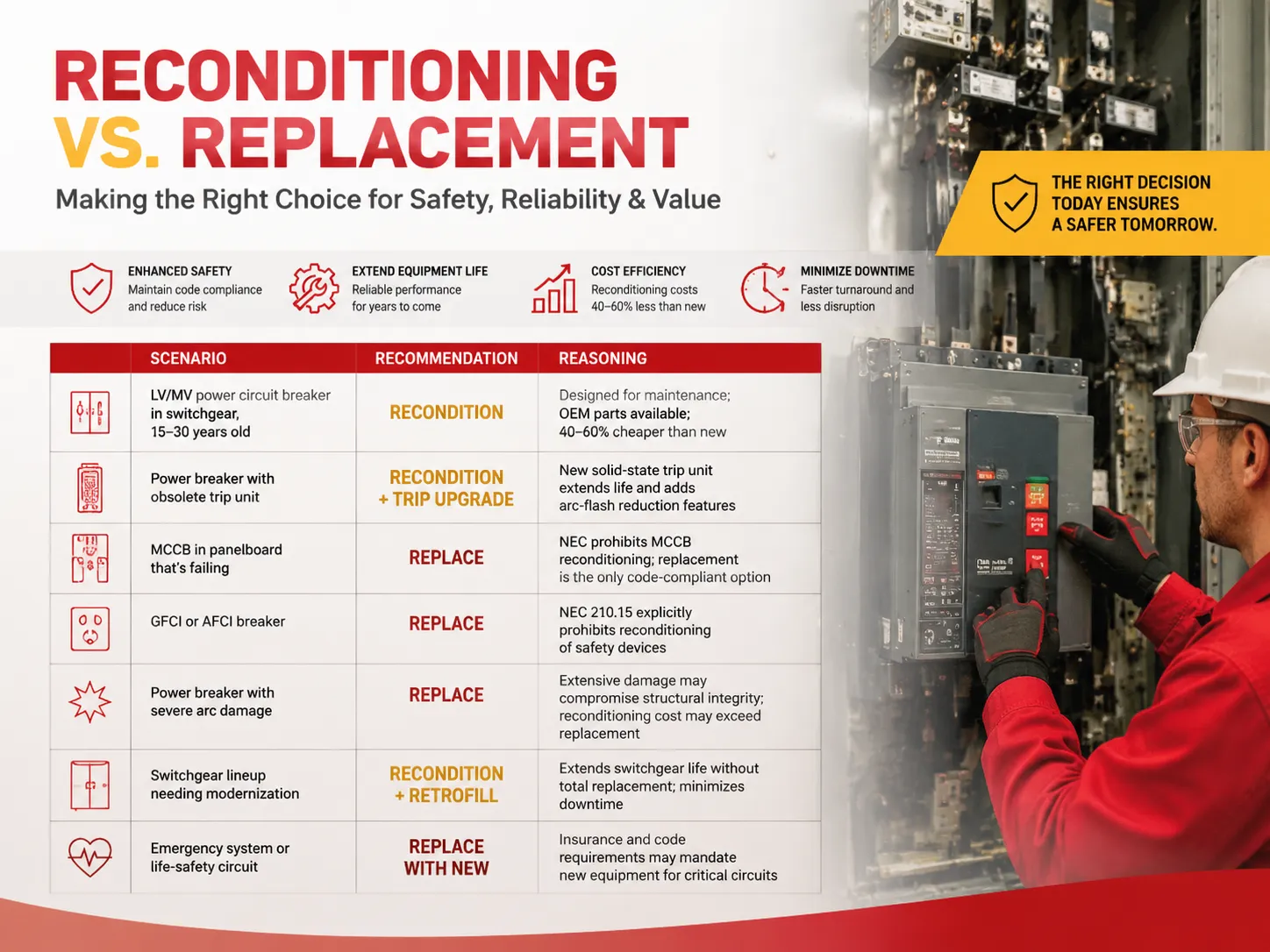
| Scenario | Recommendation | Reasoning |
|---|---|---|
| LV/MV power circuit breaker in switchgear, 15–30 years old | Recondition | Designed for maintenance; OEM parts available; 40–60% cheaper than new |
| Power breaker with obsolete trip unit | Recondition + trip upgrade | New solid-state trip unit extends life and adds arc-flash reduction features |
| MCCB in panelboard that’s failing | Replace | NEC prohibits MCCB reconditioning; replacement is the only code-compliant option |
| GFCI or AFCI breaker | Replace | NEC 210.15 explicitly prohibits reconditioning of safety devices |
| Power breaker with severe arc damage | Replace | Extensive damage may compromise structural integrity; reconditioning cost may exceed replacement |
| Switchgear lineup needing modernization | Recondition breakers + retrofill | Extends switchgear life without total replacement; minimizes downtime |
| Emergency system or life-safety circuit | Replace with new | Insurance and code requirements may mandate new equipment for critical circuits |
For help diagnosing whether your breaker actually needs attention, see our guide on how to tell if a breaker is bad. And if replacement is the right call, our article on how much it costs to replace a circuit breaker covers pricing across breaker types and amperage ratings.
Cost Comparison: Reconditioned vs. New
When it comes to the reconditioning of circuit breakers, the expenses usually range between 40 and 60% of the total cost of acquiring new equipment. This is especially true for larger models that can help save lots of money:
| Breaker Type | New Cost (Approx.) | Reconditioned Cost (Approx.) | Savings |
|---|---|---|---|
| LV power breaker, 800A frame | $8,000–$15,000 | $3,200–$9,000 | 40–60% |
| LV power breaker, 3200A frame | $20,000–$40,000 | $8,000–$24,000 | 40–60% |
| MV vacuum breaker, 5kV | $15,000–$30,000 | $6,000–$18,000 | 40–60% |
| MV vacuum breaker, 15kV | $25,000–$50,000 | $10,000–$30,000 | 40–60% |
| Trip unit upgrade (Digitrip/AC-PRO) | $3,000–$8,000 | Included in reconditioning | Bundle savings |
Additional expenses: The reconditioning process saves costs associated with switchgear modification that would be needed in case of changes in size of a new breaker, minimizes lead time since reconditioned breakers arrive in 2-4 weeks in contrast to the new ones that will be delivered in 12-20 weeks, and reduces the downtime due to the fact that the reconditioned breaker can be immediately implemented in the current cubicle.
Safety Considerations & Documentation Requirements
Reconditioning can be performed only by certified personnel in line with accepted standards. Here are the requirements that need to be checked before installation of a reconditioned circuit breaker:
- Labeling: The reconditioned circuit breaker is marked “Reconditioned” with the name of the reconditioning company and date.
- Test: Get a complete report evidencing “as received” and “final” test results along with a list of parts replaced.
- Certification: In case UL certification is required, verify that the circuit breaker is marked with UL Mark with “Rebuilt” or “Reconditioned.”
- Approval by AHJ: The Authority Having Jurisdiction (electrical inspector) may need proof of reconditioning by a certified company – stay prepared.
- Warranty: Verify the warranty conditions and length (Eaton: 3-year; ABB: 1-year; others vary).
- Traceability: The reconditioning company should do recordkeeping linked to the circuit breaker serial number for future reference.
- Do not install the reconditioned circuit breaker in the life-safety circuit unless the AHJ and your insurance agent approved the installation.
Also, OSHA 29 CFR 1910.334(b)(2) states that once the circuit is de-energized with the protective device it is not allowed to re-energize it manually until it is determined that the equipment and circuit can be safely energized.
Frequently Asked Questions
What is a reconditioned circuit breaker?
A reconditioned power circuit breaker refers to a power circuit breaker which has undergone a restoration process at a factory-authorized facility. According to the requirements set forth by IEEE C37.59, the entire activity involves an incoming inspection, complete disassembly, cleaning of components, replacement of parts, reapplication of lubricants, reassembly of components according to OEM specifications, and final testing. In addition, the circuit breaker must be labeled as being reconditioned with the name and date of the reconditioning firm, and the original listing had to be taken off due to the NEC requirements.
What are type B, type C, and type D circuit breakers?
Types B, C, and D are classifications of MCBs regarding tripping characteristics and not types of circuit breakers classified according to NEC 240.88. Type B circuit breakers trip at three to five times the rated current; these are used in residential applications for circuits with purely resistive loads. After that, we have Type C circuit breakers, which trip at five to ten times the rated current and are used in commercial and industrial electrical systems, as well as circuits with inductive loads, such as fluorescent lights and small motors. The third type is Type D MCBs, which trip at ten to twenty times the rated current and deal with inrush current in transformers, large motors, or welding machines. All the above types of breakers are miniature circuit breakers, molded-cased, and cannot be reconditioned in accordance with NEC 240.88(A)(1).
Are molded case circuit breakers permitted to be reconditioned?
Based on the NEC Section 240.88(A)(1) in the year 2020, it is not allowed to refurbish molded- case circuit breakers. MCCBs come as sealed units hence breaking the seals means losing the UL listing and warranty of the manufacturer. Though there is guidance for inspection and preventive maintenance of MCCBs in the NEMA AB 4 guidelines, it is not equal to reconditioning. Routine maintenance is fine but disassembly or modification of the internal structure of the MCCB is not accepted.
Which type of equipment is not allowed to be reconditioned according to article 210?
The NEC states under Article 210.15 that there are three kinds of equipment that are not permitted to be reconditioned. These include (1) equipment that supplies personnel with ground-fault circuit interrupting (GFCI) protection, (2) equipment that supplies arc-fault circuit interrupting (AFCI) protection, and (3) equipment that provides ground-fault protection for equipment (GFPE). The reason for these prohibitions is that the devices that are required to be reconditioned are also safety critical devices that possess calibration and sensitivity requirements that cannot be assured even after they are reconditioned. Thus, if any of the reconditioned devices (GFCI, AFCI, or GFPE) fails to trip at the required threshold, then a life hazard will be created. Also, the NEC states that molded circuit breakers cannot be reconditioned by Section 240.88(A)(1) nor can the electronic trip units of low-voltage power circuit breakers be reconditioned according to Section 240.88(B).
References
- NFPA 70 — National Electrical Code (NEC) 2020, Articles 210.15 and 240.88
- ANSI/NEMA AB 4-2023 — Guidelines for Inspection and Preventive Maintenance of Molded Case Circuit Breakers
- IEEE C37.59-2018 — Standard for Reconditioning Power Switchgear Equipment
- UL 489 — Standard for Molded-Case Circuit Breakers, Molded-Case Switches and Circuit Breaker Enclosures
- UL — Reconditioned Electrical Equipment: A 2020 NEC Guide
- Eaton — Class 1 Circuit Breaker Reconditioning for Low- and Medium-Voltage Power Circuit Breakers
- ABB — Service Center Breaker Refurbishment Services
- Schneider Electric — Electrical Distribution Modernization and Upgrade Solutions
- PEARL — Professional Electrical Apparatus Reconditioning League
Reconditionable circuit breakers include low-voltage, medium-voltage, and high-voltage circuit breakers of the draw-out, field-serviceable type that are commonly used in substations and switchgear. The design of the circuit breaker makes use of replaceable contacts, easily accessible mechanism, and interchangeable trip units allowing practical reconditioning in compliance with NEC 240.88. Major manufacturers such as Eaton, ABB, and Schneider Electric offer the reconditioning service according to IEEE C37.59 standards guaranteeing warranties comparable to what new equipment receives.
On the other hand, molded-case circuit breakers, GFCI devices, AFCI devices, and GFPE equipment are unconditionally prohibited from being reconditioned as per NEC 210.15 and 240.88 and must be replaced if broken. The 2020 NEC has made it clear that circuit breakers designed to be maintained may be maintained while sealed safety-critical breakers may not. When opting for reconditioning or replacement, identify the type of circuit breakers first and compare the cost of failure, so you are able to understand what is worth doing more — reconditioning or replacing the circuit breaker.