
Caso sua instalação utilize equipamentos de manobra obsoletos, você pode se perguntar se é possível reformar seus disjuntores ou se deve adquirir dispositivos novos. A resposta não é tão simples, pois depende do tipo de disjuntor presente em sua instalação. Conforme estabelecido pelo National Electrical Code (NEC) de 2020, disjuntores de baixa tensão, disjuntores de média tensão e disjuntores de alta tensão podem ser restaurados, enquanto disjuntores em caixa moldada (MCCBs), disjuntores GFCI e disjuntores AFCI não devem ser renovados segundo o Artigo 210.15 e a Seção 240.88 do NEC. Consequentemente, essa distinção é muito importante para gerentes de plantas, empreiteiros elétricos e engenheiros de manutenção que precisam equilibrar custos com segurança e conformidade com o código.
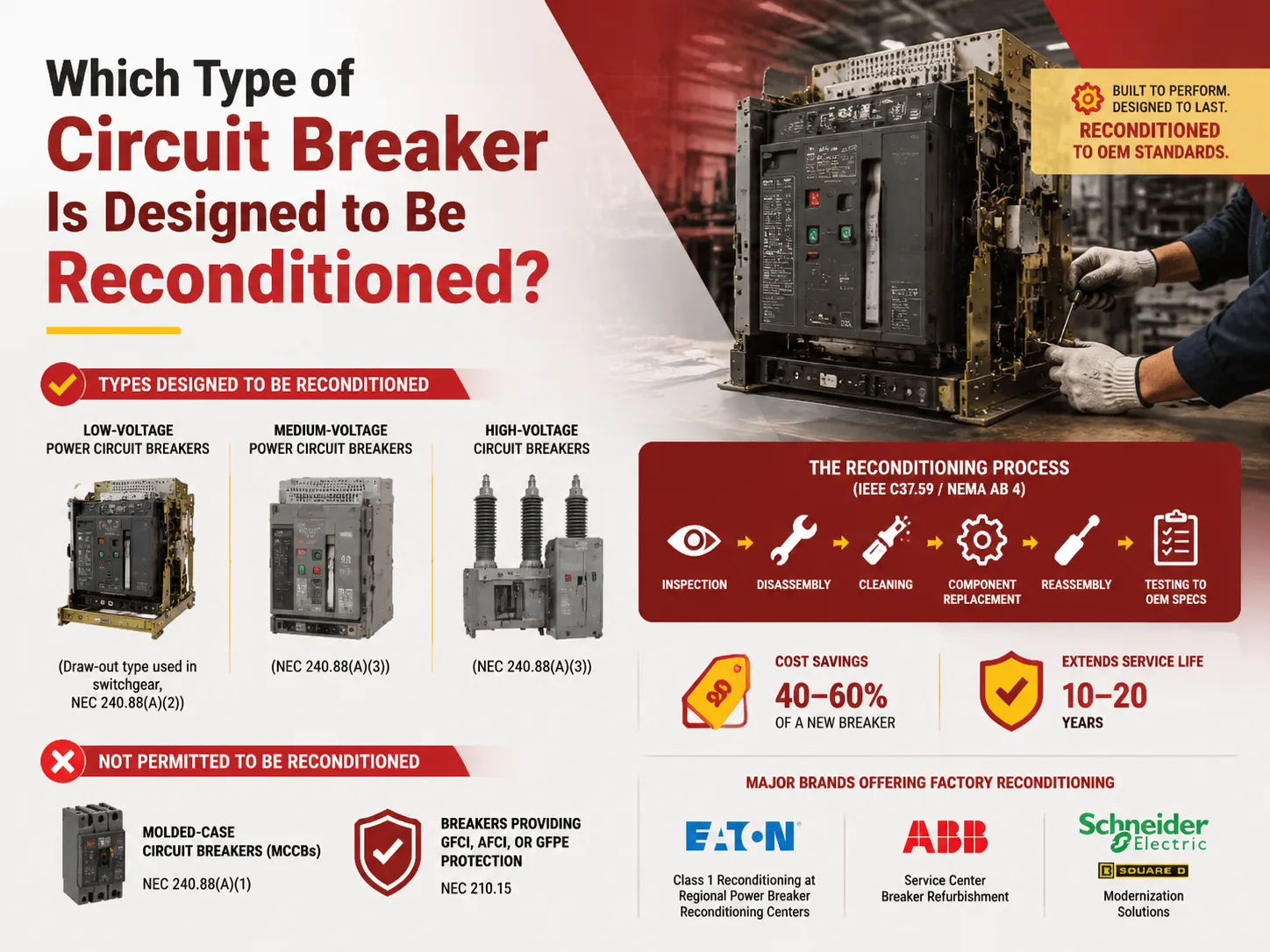
Resposta rápida: Os disjuntores que podem ser reformados incluem disjuntores de baixa tensão, disjuntores de média tensão e disjuntores de alta tensão. Disjuntores em caixa moldada não podem ser reformados conforme o NEC 240.88(A)(1), e qualquer disjuntor que forneça proteção GFCI, proteção AFCI ou GFPE é proibido pelo NEC 210.15. Fabricantes notáveis que oferecem reforma em fábrica incluem: Eaton, ABB e Schneider Electric / Square D. O processo de reforma está em conformidade com as normas IEEE C37.59 e NEMA AB 4. Geralmente, o custo da reforma corresponde a 40-60% do custo de um disjuntor novo e adiciona 10-20 anos de vida útil.
Tipos de Disjuntores Permitidos para Recondicionamento
Conforme a Seção 240.88(A) do NEC 2020, os seguintes tipos de disjuntores são explicitamente permitidos para recondicionamento:
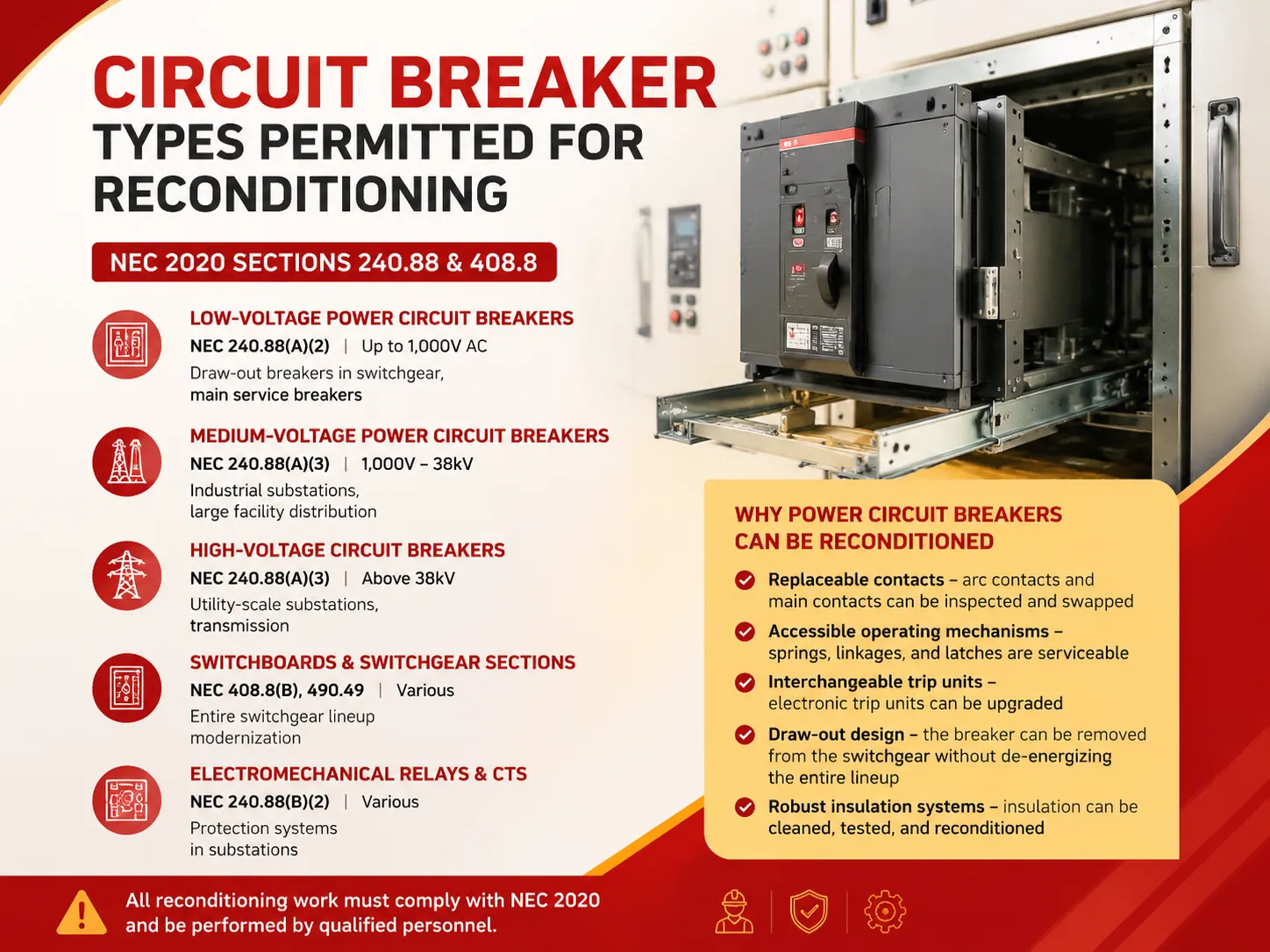
| Tipo de Disjuntor | Referência NEC | Aplicação Típica | Faixa de Tensão |
|---|---|---|---|
| Disjuntores de baixa tensão | 88(A)(2) | Disjuntores extraíveis em equipamentos de manobra, disjuntores principais de serviço | Até 1.000V CA |
| Disjuntores de média tensão | 88(A)(3) | Subestações industriais, distribuição em grandes instalações | 000V – 38kV |
| Disjuntores de alta tensão | 88(A)(3) | Subestações em escala de utilidade, transmissão | Acima de 38kV |
| Painéis de distribuição e seções de equipamentos de manobra | 8(B), 490.49 | Modernização completa da linha de equipamentos de manobra | Diversos |
| Relés eletromecânicos de proteção e TC | 88(B)(2) | Sistemas de proteção em subestações | Diversos |
A característica principal compartilhada por todos os disjuntores recondicionáveis é que eles são do tipo extraível ou removível projetados para manutenção — não unidades seladas. Disjuntores de baixa tensão, como aqueles usados em disjuntores a ar com corrente nominal de até 6300A, são especificamente projetados com mecanismos que permitem manutenção em campo, contatos substituíveis e unidades de disparo acessíveis. Isso é fundamentalmente diferente dos disjuntores em caixa moldada, que são selados de fábrica.
Por que Disjuntores de Potência Podem Ser Recondicionados
Disjuntores são projetados para permitir manutenção. Suas características incluem:
- Contatos Substituíveis – inspeção e substituição dos contatos de arco e principais podem ser realizadas
- Mecanismos Operacionais Acessíveis – manutenção pode ser realizada nas molas, articulações e travas do disjuntor
- Unidades de disparo intercambiáveis – é possível atualizar as unidades eletrônicas de disparo dos disjuntores
- Design extraível – o disjuntor pode ser removido do painel sem desligar a energia
- Sistemas extensivos de isolamento – o isolamento existente pode ser limpo, testado e reabilitado
Para mais informações sobre a diferença entre categorias de disjuntores, nosso guia sobre o que são MCCB e MCB aborda as diferenças estruturais que determinam a possibilidade de manutenção.
Tipos de Disjuntores Proibidos para Recondicionamento
De acordo com a NEC 2020, existem itens que são proibidos de serem recondicionados. Essas proibições decorrem do fato de que a natureza crítica para a segurança deste equipamento torna imperativo que quaisquer alterações internas afetem suas características de segurança.
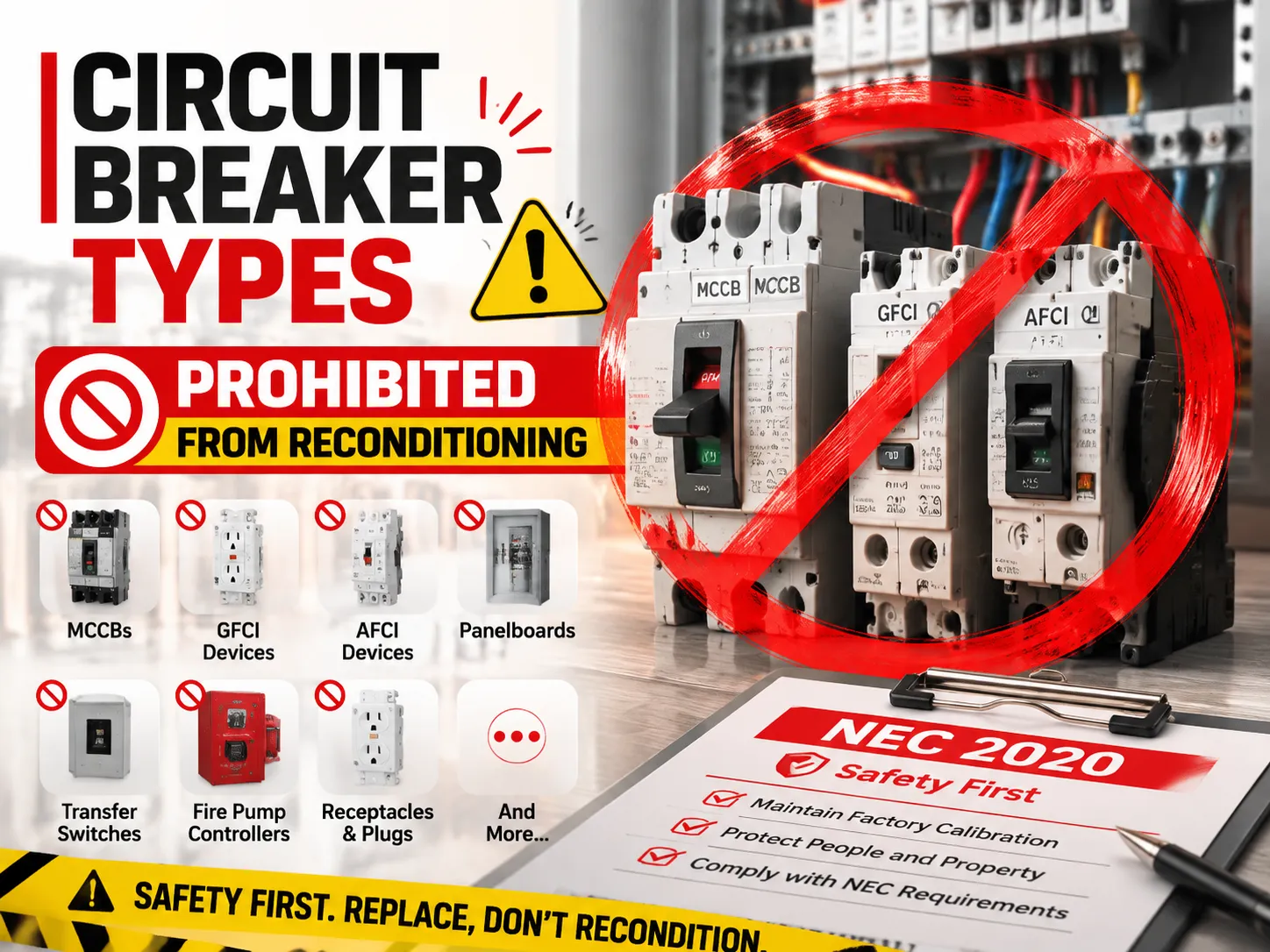
| Equipamento Proibido | Referência NEC | Motivo |
|---|---|---|
| Disjuntores em caixa moldada (MCCBs) | 88(A)(1) | Selados de fábrica; romper o selo invalida a certificação UL e a calibração |
| Dispositivos de proteção GFCI | 210.15(1) | Proteção de pessoal crítica para segurança; calibração não pode ser verificada após recondicionamento |
| Dispositivos de proteção AFCI | 210.15(2) | Eletrônica complexa detecta assinaturas de arco; recondicionamento pode não detectar degradação sutil |
| Proteção contra falha à terra de equipamentos (GFPE) | 210.15(3) | Função de proteção do equipamento deve permanecer calibrada de fábrica |
| Unidades eletrônicas de disparo para disjuntores de baixa tensão | 88(B) | Eletrônica não pode ser recondicionada de forma confiável; deve ser substituída por nova |
| Painéis de distribuição | 8(A) | Integridade estrutural e conexões de barramento não podem ser verificadas após recondicionamento |
| Chaves de transferência (sistemas de emergência) | 5(C), 701.5(C), 702.5(A) | Aplicações de segurança de vida requerem equipamento novo |
| Controladores de bombas de incêndio | 695.10 | Equipamento crítico para segurança de vida |
| Tomadas e plugues de conexão | 3(A), 406.7 | Desgaste e degradação de contato não detectáveis de forma confiável |
Enfatizando o ponto sobre MCCBs: Mesmo que anteriormente algumas inspeções e práticas de manutenção preventiva fossem permitidas conforme os padrões NEMA AB 4, deve-se notar que o recondicionamento de disjuntores moldados foi proibido na última edição de 2020 do NEC. A manutenção (limpeza, operação, verificação de torque) ainda é válida, mas qualquer desmontagem da estrutura interna e reconstrução dos disjuntores moldados não é permitida.
Marcas que suportam recondicionamento de disjuntores
Diferentes fabricantes renomados gerenciam os programas de recondicionamento autorizados por suas fábricas. Eles não utilizam recondicionadores que atuam em nome de outras empresas.
| Marca | Nome do Programa | Cobertura | Garantia |
|---|---|---|---|
| Eaton | Recondicionamento Classe 1 (Centros de Recondicionamento de Disjuntores de Potência) | Disjuntores Eaton e não-Eaton de baixa/média tensão; remanufatura Magnum DS; atualizações VCP-W FAME | 3 anos (1 ano para aplicações em motor starter) |
| ABB | Recondicionamento de Disjuntores em Centro de Serviço | Disjuntores ABB e não-ABB; nucleares e não nucleares; baixa e média tensão | 1 ano para peças e mão de obra |
| Schneider Electric / Square D | Soluções de Modernização / Recondicionamento de Disjuntores | Square D e a maioria das principais marcas OEM; disjuntores de baixa e média tensão; modernização de painéis | Varia conforme o escopo |
| Siemens | Programas de Serviço e Recondicionamento | Siemens e marcas legadas (ITE, Gould); disjuntores de baixa e média tensão | Varia conforme o programa |
| GE / Vertiv | Serviços de Recondicionamento | Disjuntores GE e marcas legadas; disjuntores de média e alta tensão | Varia conforme o programa |
O que Cada Marca Oferece
Na região da América do Norte, a Eaton fundou cinco Centros de Recondicionamento de Disjuntores de Potência. Seus protocolos classe 1 incluem desmontagem completa das peças, limpeza conforme padrões de componentes, recondicionamento de superfícies e, finalmente, testes finais de desempenho. Também desenvolveram o conceito de atualização FAME para alguns disjuntores de média tensão específicos, bem como retrofit de disjuntores com a unidade de disparo Digitrip RMS e o Sistema de Manutenção para Redução de Arco Elétrico (Arcflash Reduction Maintenance System). Cada disjuntor recondicionado é adicionado ao banco de dados central Pow-R-DB.
Em seus centros de serviço, a ABB oferece serviços de reteste tanto para seus próprios modelos de disjuntores quanto para os de outros fabricantes. Seus serviços incluem o recebimento do equipamento, inspeção e teste, e desmontagem. Além de limpar todas as peças, a ABB também verificará a existência de trincas, garantirá a substituição de peças já danificadas, aplicará lubrificação em todos os pontos móveis e, em seguida, remontará o equipamento.
Em seu programa de Soluções de Modernização, a Schneider Electric oferece o serviço de reconfiguração de disjuntores de baixa e média tensão. O recondicionamento é realizado utilizando as seguintes etapas: por todas as fases, incluindo substituição parcial de componentes, lavagem e pintura de detalhes, e lubrificação.
Normas principais: NEC, NEMA AB 4, IEEE C37.59 & UL 489
Múltiplas normas regem o recondicionamento de disjuntores. Entender qual se aplica à sua situação é essencial para a conformidade com o código:
| Norma | Editor | Escopo |
|---|---|---|
| Artigo NEC 210.15 & 240.88 | NFPA | Define o que pode e o que não pode ser recondicionado; requer listagem como “recondicionado” |
| NEMA AB 4 | NEMA | Diretrizes para inspeção e manutenção preventiva de disjuntores moldados (não recondicionamento) |
| IEEE C37.59 | IEEE | Norma para recondicionamento de equipamentos de chaveamento de energia; define o processo de recondicionamento |
| UL 489 | UL | Norma para disjuntores moldados; relevante como referência para testes |
| Política NEMA sobre Equipamentos Recondicionados | NEMA | Posições da indústria sobre adequação e segurança de equipamentos recondicionados |
| Normas PEARL | PEARL | Normas acreditadas pela ANSI para inspeção, teste e recondicionamento de aparelhos elétricos |
O fator essencial: a marcação inicial deve ser removida e o equipamento deve ser identificado como recondicionado quando for reformado. A UL fornece um procedimento de certificação para equipamentos reconstruídos. Os dispositivos renovados em conformidade com o procedimento são marcados com a Marca UL contendo as palavras “Rebuilt,” “Remanufactured,” “Rebuilt,” ou “Reconditioned.” Para mais informações sobre normas de disjuntores, veja nosso artigo sobre Requisitos do disjuntor UL 489.
O Processo de Recondicionamento Passo a Passo
De acordo com Eaton Classe 1 e IEEE C37.59, este é o processo realizado quando o disjuntor necessita de recondicionamento:
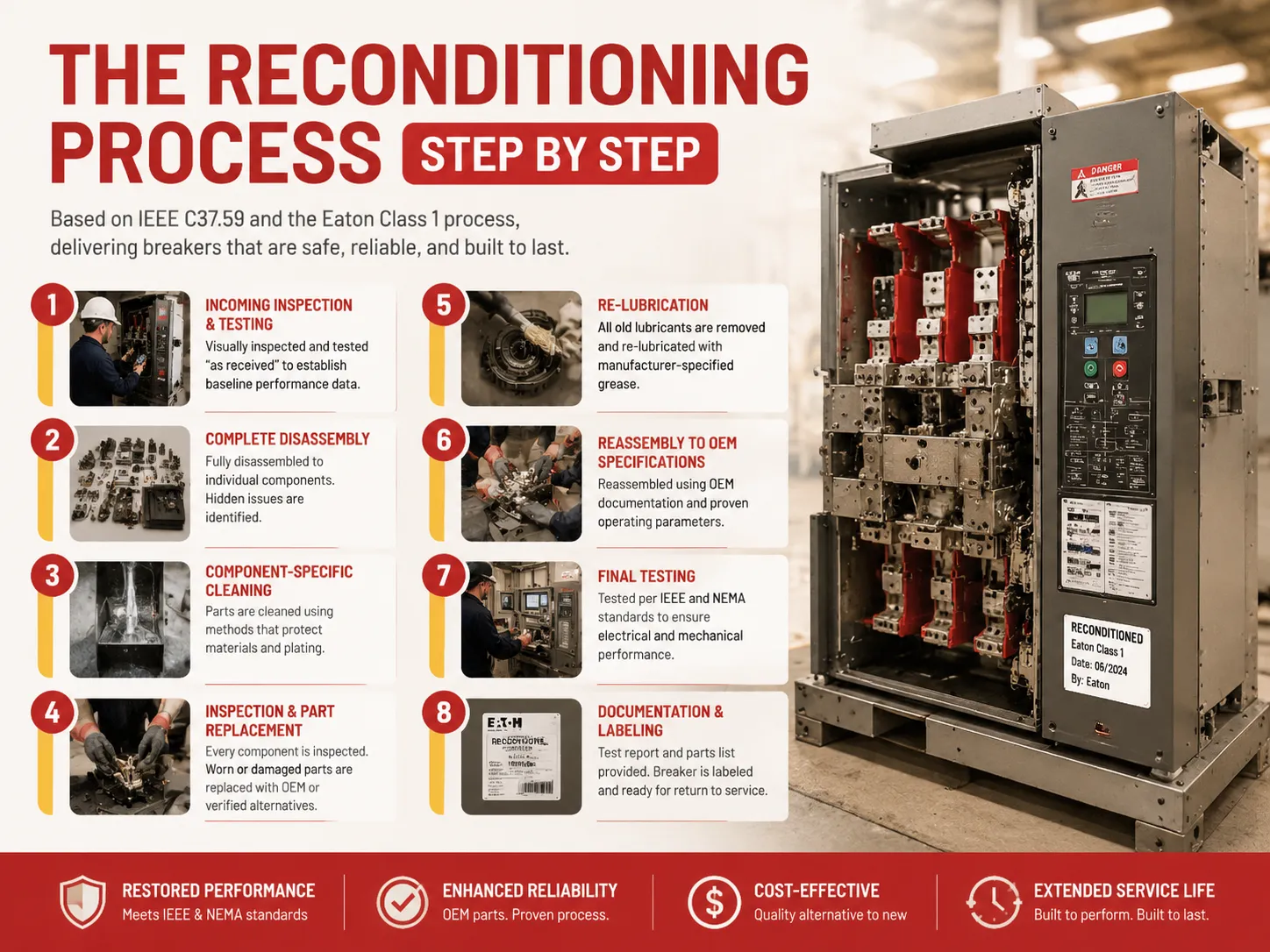
Passo 1: Inspeção e Teste de Recebimento
O disjuntor é recebido, inspecionado visualmente e testado na condição “como recebido” para documentar o desempenho inicial. As medições importantes incluem resistência de contato (em milivolts), resistência de isolamento, esforço mecânico de operação e dimensões. As informações obtidas são documentadas.
Passo 2: Desmontagem Completa
A desmontagem do disjuntor é completa e o disjuntor foi separado em seus componentes, incluindo: o sistema de operação, o canal de arco, a barreira de isolamento, a estrutura e outros sistemas. Esta é a etapa onde se identificam falhas como, por exemplo, o elo de acionamento defeituoso, contatos desalinhados, isolamento danificado que torna o dispositivo suscetível a falhas quando a falta é detectada.
Passo 3: Limpeza Específica dos Componentes
Vários tipos de materiais requerem diferentes processos de limpeza. Os componentes não condutores são limpos minuciosamente de modo que nenhum material estranho permaneça, enquanto as características dielétricas e estruturais são preservadas. Os componentes condutores são limpos sem danificar o revestimento original. As superfícies de contato são regeneradas para que a metalurgia e a pressão de contato desempenhem seu papel adequadamente.
Passo 4: Inspeção e Substituição de Peças
Todas as peças devem ser verificadas quanto a trincas, deterioração, ferrugem e precisão dimensional. Peças desgastadas são substituídas por peças OEM novas, enquanto peças que não estão mais em produção precisam ser substituídas por componentes desenvolvidos por engenharia reversa que devem cumprir as normas estabelecidas na IEEE C37.59. Esses componentes podem requerer verificação em condições laboratoriais rigorosas, como testes de alta potência. Os substitutos típicos para peças desgastadas podem ser molas, contatos, shunts e buchas.
Passo 5: Relubrificação
Todos os lubrificantes desatualizados foram eliminados, e a máquina e os pontos de conexão são relubrificados usando graxa especificada pelo fabricante. Uma das principais razões pelas quais os disjuntores falham é devido à lubrificação inadequada — mecanismos rígidos retardam o processo de eliminação de falhas, o que resulta em uma energia de incidente de arco elétrico muito maior.
Passo 6: Montagem conforme especificações OEM
No processo de remontagem do disjuntor, a documentação OEM é utilizada. No entanto, se as informações OEM não estiverem disponíveis, por exemplo, se o fabricante original estiver extinto, a Eaton utilizará o banco de dados centralizado Pow-R-DB com registros de disjuntores similares que comprovadamente fornecem os resultados desejados.
Passo 7: Teste final
O disjuntor reconstruído passará por testes conclusivos conforme as diretrizes IEEE e NEMA, incluindo:
- Avaliação da resistência de isolamento
- Teste de resistência de contato (queda de milivolts)
- Avaliação da operação mecânica (tempo de abertura-fechamento)
- Teste de disparo por sobrecorrente (disparo de longa duração, curta duração, instantâneo)
- Avaliação da resistência dielétrica
Passo 8: Documentação e rotulagem
A produção do relatório de teste ocorre para estabelecer um contraste entre os resultados dos testes “como recebido” e “final”, apoiado por informações mencionando todos os componentes reparados. O disjuntor recebe uma etiqueta de rastreabilidade que o identifica como recondicionado, indicando o nome e a data da empresa responsável pelo recondicionamento. O disjuntor está operacional novamente.
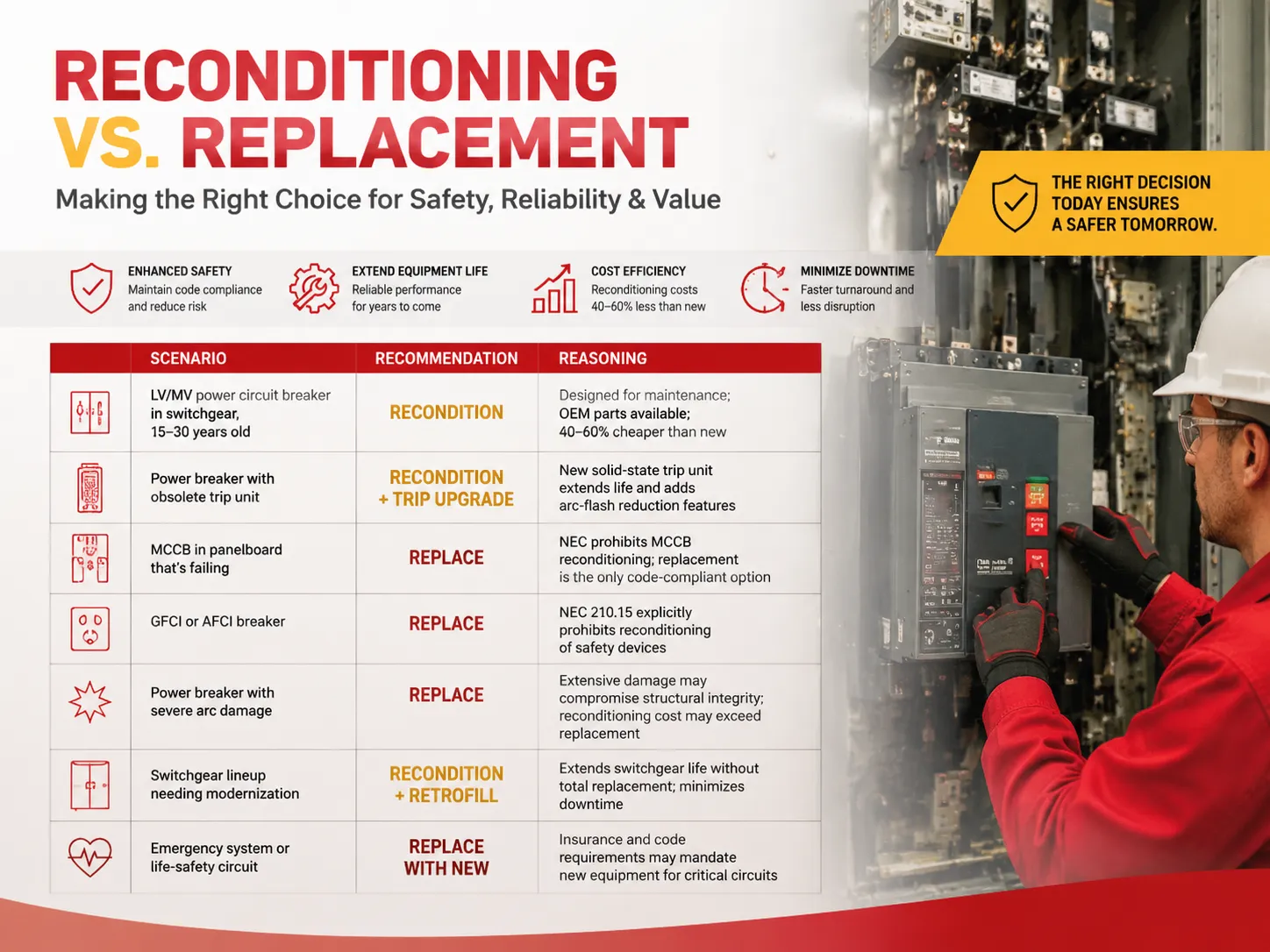
Quando escolher recondicionamento versus substituição
A decisão de recondicionar ou substituir depende do tipo de disjuntor, idade, criticidade e custo. Aqui está uma matriz de decisão prática:
| Cenário | Recomendação | Justificativa |
|---|---|---|
| Disjuntor de potência LV/MV em painel de distribuição, 15–30 anos | Recondicionar | Projetado para manutenção; peças OEM disponíveis; 40–60% mais barato que novo |
| Disjuntor de potência com unidade de disparo obsoleta | Recondicionar + atualização da unidade de disparo | Nova unidade de disparo estado sólido prolonga a vida útil e adiciona recursos de redução de arco elétrico |
| MCCB em painel que está falhando | Substituir | NEC proíbe a recondicionamento de MCCB; a substituição é a única opção conforme o código |
| Disjuntor GFCI ou AFCI | Substituir | NEC 210.15 proíbe explicitamente a recondicionamento de dispositivos de segurança |
| Disjuntor de potência com dano severo de arco | Substituir | Danos extensos podem comprometer a integridade estrutural; o custo da recondicionamento pode exceder o da substituição |
| Linha de switchgear que necessita modernização | Recondicionar disjuntores + retrofill | Estende a vida útil do switchgear sem substituição total; minimiza o tempo de inatividade |
| Sistema de emergência ou circuito de segurança de vida | Substituir por novo | Requisitos de seguro e código podem exigir equipamento novo para circuitos críticos |
Para ajuda no diagnóstico se seu disjuntor realmente precisa de atenção, veja nosso guia em como saber se um disjuntor está ruim. E se a substituição for a decisão correta, nosso artigo sobre quanto custa substituir um disjuntor cobre preços para tipos de disjuntores e classificações de amperagem.
Comparação de Custos: Recondicionado vs. Novo
Quando se trata da recondicionamento de disjuntores, as despesas geralmente variam entre 40 e 60% do custo total de aquisição de equipamento novo. Isso é especialmente verdadeiro para modelos maiores que podem ajudar a economizar muito dinheiro:
| Tipo de Disjuntor | Custo Novo (Aproximado) | Custo Recondicionado (Aproximado) | Economia |
|---|---|---|---|
| Disjuntor de baixa tensão, quadro 800A | R$8.000–R$15.000 | R$3.200–R$9.000 | 40–60% |
| Disjuntor de baixa tensão, quadro 3200A | R$20.000–R$40.000 | R$8.000–R$24.000 | 40–60% |
| Disjuntor a vácuo média tensão, 5kV | R$15.000–R$30.000 | R$6.000–R$18.000 | 40–60% |
| Disjuntor a vácuo média tensão, 15kV | R$25.000–R$50.000 | R$10.000–R$30.000 | 40–60% |
| Atualização da unidade de disparo (Digitrip/AC-PRO) | R$3.000–R$8.000 | Incluído na recondicionamento | Economia em pacote |
Despesas adicionais: O processo de recondicionamento economiza custos associados à modificação do switchgear que seriam necessários em caso de mudanças no tamanho de um disjuntor novo, minimiza o tempo de entrega já que disjuntores recondicionados chegam em 2-4 semanas em contraste com os novos que serão entregues em 12-20 semanas, e reduz o tempo de inatividade devido ao fato de que o disjuntor recondicionado pode ser imediatamente implementado no cubículo atual.
Considerações de Segurança e Requisitos de Documentação
A recondicionamento só pode ser realizada por pessoal certificado em conformidade com normas aceitas. Aqui estão os requisitos que precisam ser verificados antes da instalação de um disjuntor recondicionado:
- Rotulagem: O disjuntor recondicionado é marcado como “Recondicionado” com o nome da empresa de recondicionamento e data.
- Teste: Obtenha um relatório completo evidenciando os resultados dos testes “como recebido” e “final” junto com uma lista de peças substituídas.
- Certificação: Caso seja necessária certificação UL, verifique se o disjuntor está marcado com o Selo UL com “Rebuilt” ou “Reconditioned.”
- Aprovação pela AHJ: A Autoridade Competente (inspetor elétrico) pode exigir prova da recondicionamento por uma empresa certificada – esteja preparado.
- Garantia: Verifique as condições e duração da garantia (Eaton: 3 anos; ABB: 1 ano; outros variam).
- Rastreabilidade: A empresa de recondicionamento deve manter registros vinculados ao número de série do disjuntor para referência futura.
- Não instale o disjuntor recondicionado no circuito de segurança de vida, a menos que o AHJ e seu agente de seguros tenham aprovado a instalação.
Além disso, a OSHA 29 CFR 1910.334(b)(2) estabelece que, uma vez que o circuito esteja desenergizado com o dispositivo de proteção, não é permitido reenergizá-lo manualmente até que seja determinado que o equipamento e o circuito podem ser energizados com segurança.
Perguntas Frequentes
O que é um disjuntor recondicionado?
A reconditioned power circuit breaker refers to a power circuit breaker which has undergone a restoration process at a factory-authorized facility. According to the requirements set forth by IEEE C37.59, the entire activity involves an incoming inspection, complete disassembly, cleaning of components, replacement of parts, reapplication of lubricants, reassembly of components according to OEM specifications, and final testing. In addition, the circuit breaker must be labeled as being reconditioned with the name and date of the reconditioning firm, and the original listing had to be taken off due to the NEC requirements.
What are type B, type C, and type D circuit breakers?
Types B, C, and D are classifications of MCBs regarding tripping characteristics and not types of circuit breakers classified according to NEC 240.88. Type B circuit breakers trip at three to five times the rated current; these are used in residential applications for circuits with purely resistive loads. After that, we have Type C circuit breakers, which trip at five to ten times the rated current and are used in commercial and industrial electrical systems, as well as circuits with inductive loads, such as fluorescent lights and small motors. The third type is Type D MCBs, which trip at ten to twenty times the rated current and deal with inrush current in transformers, large motors, or welding machines. All the above types of breakers are miniature circuit breakers, molded-cased, and cannot be reconditioned in accordance with NEC 240.88(A)(1).
Are molded case circuit breakers permitted to be reconditioned?
Based on the NEC Section 240.88(A)(1) in the year 2020, it is not allowed to refurbish molded- case circuit breakers. MCCBs come as sealed units hence breaking the seals means losing the UL listing and warranty of the manufacturer. Though there is guidance for inspection and preventive maintenance of MCCBs in the NEMA AB 4 guidelines, it is not equal to reconditioning. Routine maintenance is fine but disassembly or modification of the internal structure of the MCCB is not accepted.
Which type of equipment is not allowed to be reconditioned according to article 210?
The NEC states under Article 210.15 that there are three kinds of equipment that are not permitted to be reconditioned. These include (1) equipment that supplies personnel with ground-fault circuit interrupting (GFCI) protection, (2) equipment that supplies arc-fault circuit interrupting (AFCI) protection, and (3) equipment that provides ground-fault protection for equipment (GFPE). The reason for these prohibitions is that the devices that are required to be reconditioned are also safety critical devices that possess calibration and sensitivity requirements that cannot be assured even after they are reconditioned. Thus, if any of the reconditioned devices (GFCI, AFCI, or GFPE) fails to trip at the required threshold, then a life hazard will be created. Also, the NEC states that molded circuit breakers cannot be reconditioned by Section 240.88(A)(1) nor can the electronic trip units of low-voltage power circuit breakers be reconditioned according to Section 240.88(B).
Referências
- NFPA 70 — National Electrical Code (NEC) 2020, Articles 210.15 and 240.88
- ANSI/NEMA AB 4-2023 — Guidelines for Inspection and Preventive Maintenance of Molded Case Circuit Breakers
- IEEE C37.59-2018 — Standard for Reconditioning Power Switchgear Equipment
- UL 489 — Standard for Molded-Case Circuit Breakers, Molded-Case Switches and Circuit Breaker Enclosures
- UL — Reconditioned Electrical Equipment: A 2020 NEC Guide
- Eaton — Class 1 Circuit Breaker Reconditioning for Low- and Medium-Voltage Power Circuit Breakers
- ABB — Service Center Breaker Refurbishment Services
- Schneider Electric — Electrical Distribution Modernization and Upgrade Solutions
- PEARL — Professional Electrical Apparatus Reconditioning League
Reconditionable circuit breakers include low-voltage, medium-voltage, and high-voltage circuit breakers of the draw-out, field-serviceable type that are commonly used in substations and switchgear. The design of the circuit breaker makes use of replaceable contacts, easily accessible mechanism, and interchangeable trip units allowing practical reconditioning in compliance with NEC 240.88. Major manufacturers such as Eaton, ABB, and Schneider Electric offer the reconditioning service according to IEEE C37.59 standards guaranteeing warranties comparable to what new equipment receives.
On the other hand, molded-case circuit breakers, GFCI devices, AFCI devices, and GFPE equipment are unconditionally prohibited from being reconditioned as per NEC 210.15 and 240.88 and must be replaced if broken. The 2020 NEC has made it clear that circuit breakers designed to be maintained may be maintained while sealed safety-critical breakers may not. When opting for reconditioning or replacement, identify the type of circuit breakers first and compare the cost of failure, so you are able to understand what is worth doing more — reconditioning or replacing the circuit breaker.