
Trong trường hợp cơ sở của bạn sử dụng các thiết bị đóng cắt lỗi thời, bạn có thể thắc mắc liệu có thể tân trang lại các bộ ngắt mạch hay nên mua thiết bị mới hoàn toàn. Câu trả lời không đơn giản, vì nó phụ thuộc vào loại bộ ngắt mạch trong cơ sở của bạn. Theo Quy chuẩn Điện Quốc gia (NEC) năm 2020, các bộ ngắt mạch điện áp thấp, bộ ngắt mạch điện áp trung bình và bộ ngắt mạch điện áp cao được phép phục hồi trong khi các bộ ngắt mạch vỏ đúc (MCCB), bộ ngắt mạch GFCI và bộ ngắt mạch AFCI không nên được làm mới theo Điều 210.15 và Mục 240.88 của NEC. Do đó, sự phân biệt này rất quan trọng đối với các quản lý nhà máy, nhà thầu điện và kỹ sư bảo trì cần cân bằng chi phí với an toàn và tuân thủ quy chuẩn.
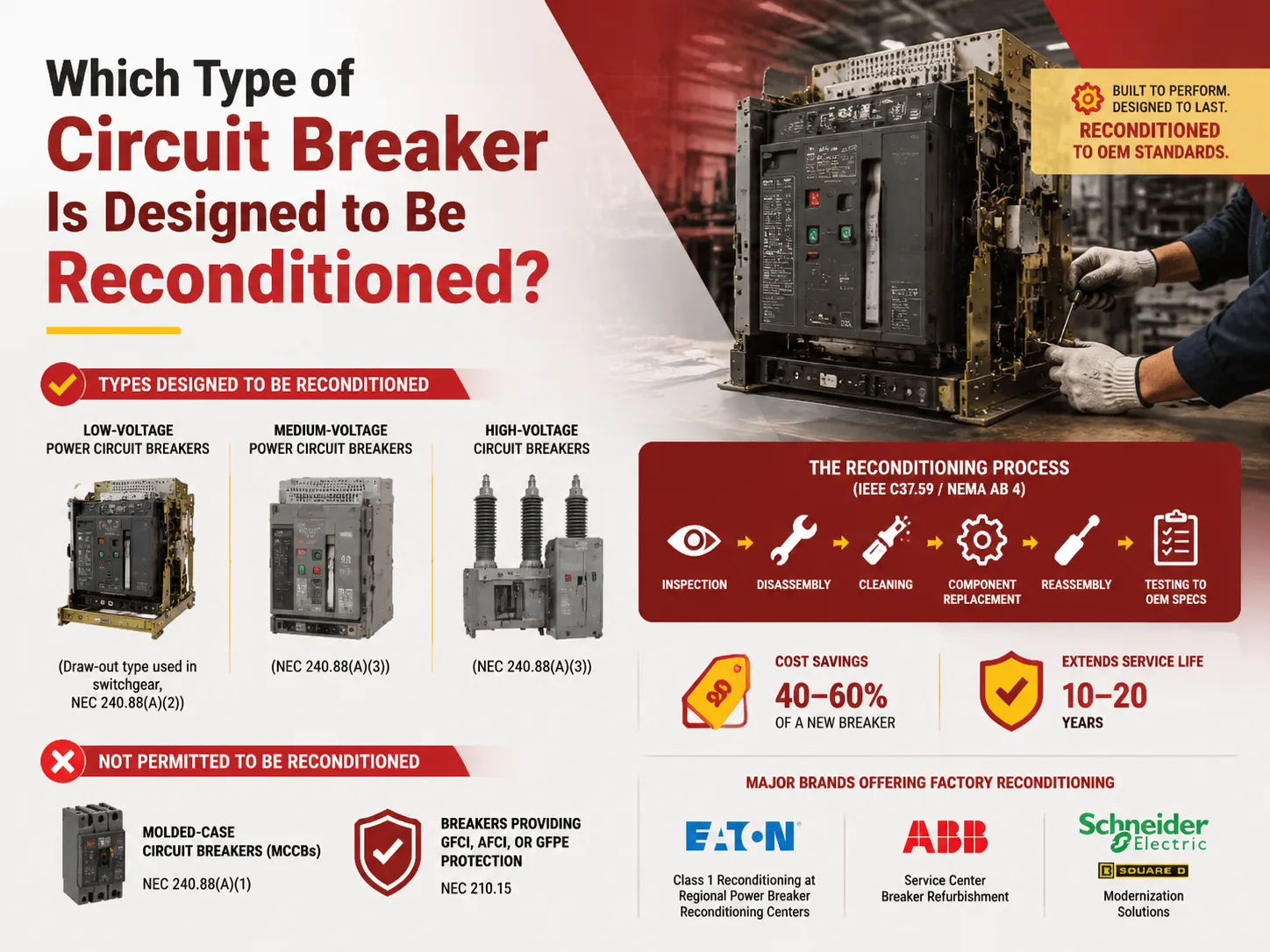
Trả lời nhanh: Các bộ ngắt mạch có thể được tân trang bao gồm bộ ngắt mạch điện áp thấp, bộ ngắt mạch điện áp trung bình và bộ ngắt mạch điện áp cao. Bộ ngắt mạch vỏ đúc không thể được tân trang như quy định tại NEC 240.88(A)(1), và bất kỳ bộ ngắt mạch nào cung cấp bảo vệ GFCI, bảo vệ AFCI hoặc GFPE đều bị cấm theo NEC 210.15. Các nhà sản xuất đáng chú ý cung cấp dịch vụ tân trang tại nhà máy bao gồm: Eaton, ABB và Schneider Electric / Square D. Quá trình tân trang tuân thủ các quy định của IEEE C37.59 và NEMA AB 4. Thông thường, chi phí tân trang bằng 40-60% chi phí của bộ ngắt mạch mới và kéo dài thêm 10-20 năm tuổi thọ sử dụng.
Các loại bộ ngắt mạch được phép tái chế
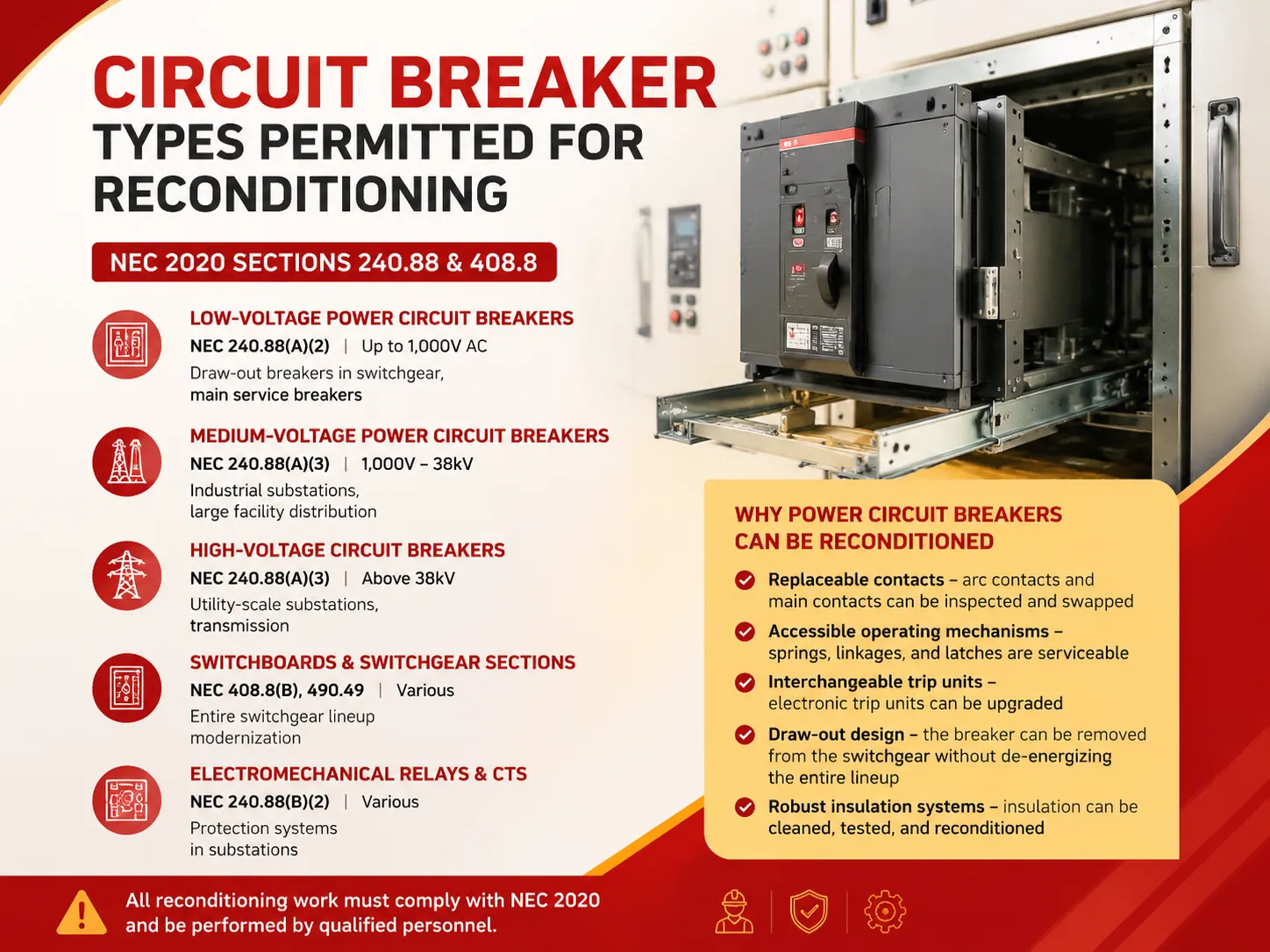
Theo Mục 240.88(A) của NEC 2020, các loại bộ ngắt mạch sau đây được phép tái chế rõ ràng:
| Loại Cầu Dao | Tham chiếu NEC | Ứng dụng điển hình | Dải Điện Áp |
|---|---|---|---|
| Bộ ngắt mạch điện áp thấp | 88(A)(2) | Bộ ngắt mạch rút ra trong thiết bị đóng cắt, bộ ngắt mạch dịch vụ chính | Lên đến 1.000V AC |
| Bộ ngắt mạch điện áp trung bình | 88(A)(3) | Trạm biến áp công nghiệp, phân phối cơ sở lớn | 000V – 38kV |
| Bộ ngắt mạch điện áp cao | 88(A)(3) | Trạm biến áp quy mô tiện ích, truyền tải | Trên 38kV |
| Bảng điều khiển và các phần thiết bị đóng cắt | 8(B), 490.49 | Hiện đại hóa toàn bộ dòng thiết bị đóng cắt | Nhiều loại |
| Rơ le bảo vệ điện cơ & CT | 88(B)(2) | Hệ thống bảo vệ trong trạm biến áp | Nhiều loại |
Đặc điểm chính chung của tất cả các bộ ngắt mạch có thể tái chế là chúng thuộc loại rút ra hoặc có thể tháo rời được thiết kế cho việc bảo trì — không phải là các đơn vị kín. Bộ ngắt mạch điện áp thấp, như những bộ được sử dụng trong bộ ngắt mạch không khí có định mức lên đến 6300A, được thiết kế đặc biệt với cơ chế có thể bảo trì tại hiện trường, tiếp điểm có thể thay thế và bộ phận trip dễ tiếp cận. Điều này hoàn toàn khác với bộ ngắt mạch vỏ đúc, vốn được niêm phong tại nhà máy.
Tại sao bộ ngắt mạch điện áp có thể được tái chế
Bộ ngắt mạch được thiết kế để cho phép bảo trì. Các đặc tính của chúng bao gồm:
- Tiếp điểm có thể thay thế – có thể kiểm tra và thay thế tiếp điểm hồ quang và tiếp điểm chính
- Cơ chế vận hành dễ tiếp cận – có thể bảo trì lò xo, liên kết và chốt của công tắc
- Đơn vị ngắt mạch có thể thay thế – có thể nâng cấp các đơn vị ngắt mạch điện tử của các bộ ngắt mạch
- Thiết kế rút ra – bộ ngắt có thể được tháo ra khỏi bảng điều khiển mà không cần tắt nguồn điện
- Hệ thống cách điện rộng rãi – lớp cách điện hiện có có thể được làm sạch, kiểm tra và phục hồi
Để biết thêm về sự khác biệt giữa các loại bộ ngắt, hướng dẫn của chúng tôi về MCCB và MCB là gì bao gồm các khác biệt về cấu trúc quyết định khả năng bảo trì.
Các loại bộ ngắt mạch bị cấm tái chế
Theo NEC 2020, có những thiết bị bị cấm tái chế. Các lệnh cấm này xuất phát từ thực tế rằng tính chất an toàn quan trọng của thiết bị này khiến bất kỳ thay đổi nào bên trong đều ảnh hưởng đến các tính năng an toàn của nó.
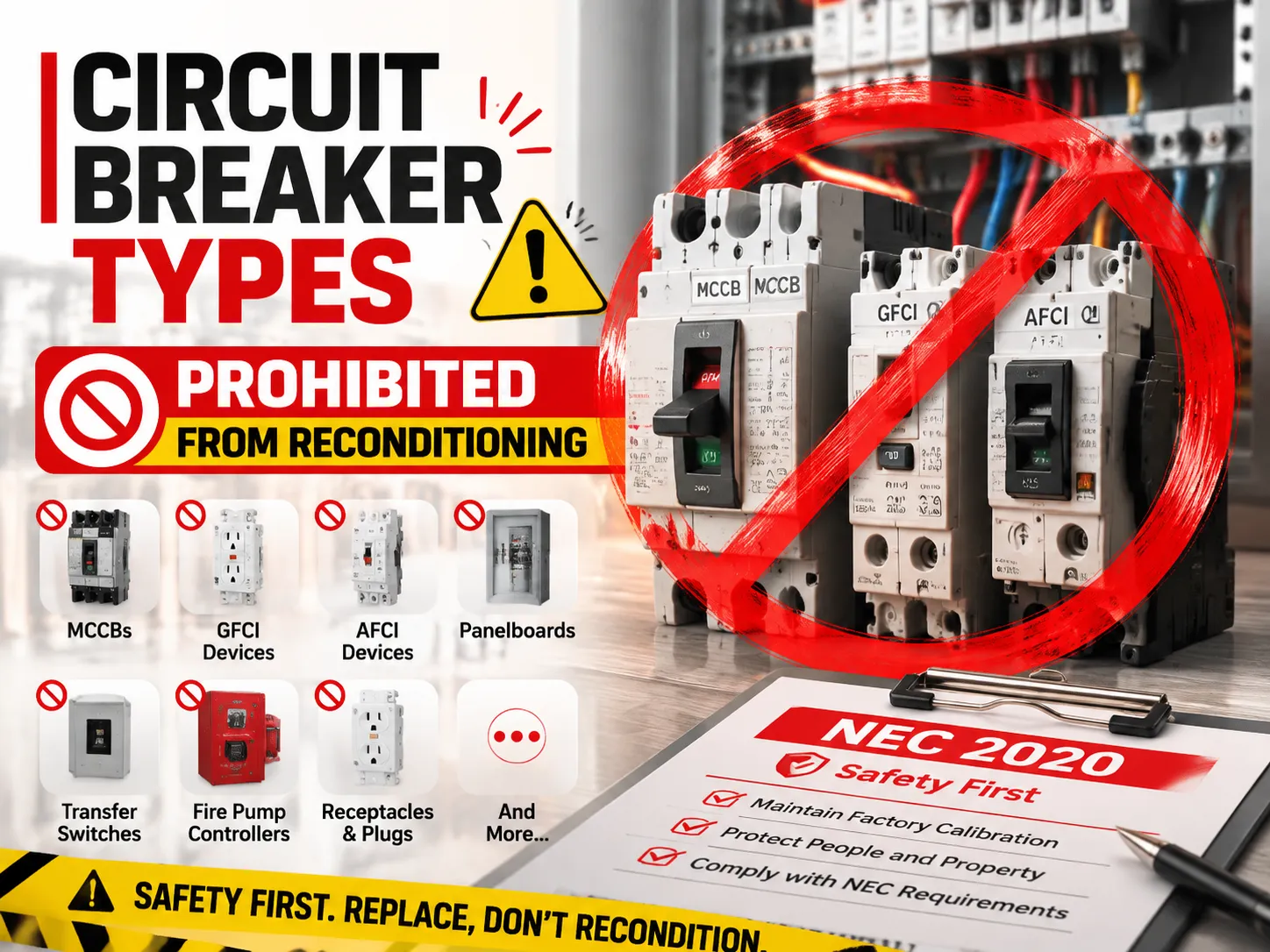
| Thiết bị bị cấm | Tham chiếu NEC | Lý do |
|---|---|---|
| Bộ ngắt mạch vỏ đúc (MCCBs) | 88(A)(1) | Niêm phong tại nhà máy; phá vỡ niêm phong sẽ làm mất hiệu lực danh sách UL và hiệu chuẩn |
| Thiết bị bảo vệ GFCI | 210.15(1) | Bảo vệ nhân sự quan trọng về an toàn; hiệu chuẩn không thể xác minh sau khi tái chế |
| Thiết bị bảo vệ AFCI | 210.15(2) | Điện tử phức tạp phát hiện dấu hiệu hồ quang; tái chế có thể bỏ sót sự suy giảm tinh vi |
| Bảo vệ thiết bị chống sự cố nối đất (GFPE) | 210.15(3) | Chức năng bảo vệ thiết bị phải giữ nguyên hiệu chuẩn từ nhà máy |
| Đơn vị ngắt điện tử cho bộ ngắt điện áp thấp | 88(B) | Điện tử không thể tái chế đáng tin cậy; phải thay thế bằng thiết bị mới |
| Bảng điều khiển | 8(A) | Tính toàn vẹn cấu trúc và kết nối bus không thể xác minh sau khi tái chế |
| Công tắc chuyển mạch (hệ thống khẩn cấp) | 5(C), 701.5(C), 702.5(A) | Ứng dụng an toàn tính mạng yêu cầu thiết bị mới |
| Bộ điều khiển bơm chữa cháy | 695.10 | Thiết bị an toàn tính mạng quan trọng |
| Ổ cắm và phích cắm gắn kèm | 3(A), 406.7 | Mòn và suy giảm tiếp xúc không thể phát hiện đáng tin cậy |
Nhấn mạnh về MCCB: Mặc dù trước đây một số kiểm tra và thực hành bảo trì phòng ngừa được phép theo tiêu chuẩn NEMA AB 4, cần lưu ý rằng việc tái chế bộ ngắt mạch vỏ đúc đã bị cấm trong phiên bản NEC mới nhất năm 2020. Bảo trì (vệ sinh, vận hành thử, kiểm tra lực siết) vẫn hợp lệ nhưng không được phép tháo rời cấu trúc bên trong và tái cấu trúc bộ ngắt mạch vỏ đúc.
Các thương hiệu hỗ trợ tái chế bộ ngắt mạch
Các nhà sản xuất nổi tiếng khác nhau quản lý các chương trình tái chế được ủy quyền bởi nhà máy của họ. Họ không sử dụng các đơn vị tân trang làm việc thay mặt cho các công ty khác.
| Thương Hiệu | Tên chương trình | Phạm vi | Bảo Hành |
|---|---|---|---|
| Eaton | Tái chế loại 1 (Trung tâm tái chế bộ ngắt điện) | Bộ ngắt điện LV/MV của Eaton và không phải Eaton; tái sản xuất Magnum DS; nâng cấp VCP-W FAME | 3 năm (1 năm cho ứng dụng khởi động động cơ) |
| ABB | Tân trang bộ ngắt tại trung tâm dịch vụ | Bộ ngắt ABB và không phải ABB; hạt nhân và phi hạt nhân; LV và MV | 1 năm phụ tùng và lao động |
| Schneider Electric / Square D | Giải pháp hiện đại hóa / Tái chế bộ ngắt mạch | Square D và hầu hết các thương hiệu OEM lớn; bộ ngắt LV và MV; hiện đại hóa thiết bị đóng cắt | Thay đổi theo phạm vi |
| Siemens | Chương trình dịch vụ & tái chế | Siemens và các thương hiệu cũ (ITE, Gould); bộ ngắt điện LV và MV | Thay đổi theo chương trình |
| GE / Vertiv | Dịch vụ tái chế | Bộ ngắt GE và các thương hiệu cũ; bộ ngắt MV và HV | Thay đổi theo chương trình |
Mỗi thương hiệu cung cấp gì
Tại khu vực Bắc Mỹ, Eaton đã thành lập năm Trung tâm tái chế bộ ngắt điện. Giao thức loại 1 của họ bao gồm tháo rời hoàn toàn các bộ phận, vệ sinh theo tiêu chuẩn linh kiện, làm mới bề mặt, và cuối cùng là kiểm tra hiệu suất cuối cùng. Họ cũng phát triển khái niệm nâng cấp FAME cho một số bộ ngắt điện áp trung bình cụ thể cũng như cải tiến bộ ngắt mạch với đơn vị ngắt Digitrip RMS và Hệ thống Bảo trì Giảm Hồ quang. Mỗi bộ ngắt được tái chế đều được thêm vào cơ sở dữ liệu trung tâm Pow-R-DB.
Tại các trung tâm dịch vụ của họ, ABB cung cấp dịch vụ kiểm tra lại cho cả các mẫu cầu dao của chính họ và của các nhà sản xuất khác. Dịch vụ của họ bao gồm tiếp nhận thiết bị, kiểm tra và thử nghiệm, cũng như tháo rời thiết bị. Ngoài việc làm sạch tất cả các bộ phận, ABB cũng sẽ kiểm tra các vết nứt, đảm bảo thay thế các bộ phận đã bị hư hỏng, bôi trơn tất cả các điểm chuyển động, sau đó lắp ráp lại.
Trong chương trình Giải pháp Hiện đại hóa của mình, Schneider Electric đã mời dịch vụ tái cấu hình các cầu dao điện áp thấp và trung bình. Việc tái điều chỉnh được thực hiện qua các bước sau: qua tất cả các giai đoạn, bao gồm thay thế một phần các thành phần, rửa và sơn các chi tiết, và bôi trơn.
Tiêu chuẩn chính: NEC, NEMA AB 4, IEEE C37.59 & UL 489
Nhiều tiêu chuẩn điều chỉnh việc tái điều chỉnh cầu dao. Hiểu rõ tiêu chuẩn nào áp dụng cho tình huống của bạn là điều cần thiết để tuân thủ mã quy định:
| Tiêu chuẩn | Nhà xuất bản | Phạm vi |
|---|---|---|
| Điều 210.15 & 240.88 của NEC | NFPA | Định nghĩa những gì có thể và không thể được tái điều kiện; yêu cầu liệt kê là “tái điều kiện” |
| NEMA AB 4 | NEMA | Hướng dẫn kiểm tra và bảo trì phòng ngừa cho bộ ngắt mạch vỏ đúc (không phải tái điều kiện) |
| IEEE C37.59 | IEEE | Tiêu chuẩn cho việc tái điều kiện thiết bị chuyển mạch điện; định nghĩa quy trình tái điều kiện |
| UL 489 | UL | Tiêu chuẩn cho bộ ngắt mạch vỏ đúc; liên quan như một chuẩn kiểm tra |
| Chính sách NEMA về Thiết bị Tái điều kiện | NEMA | Quan điểm ngành về tính phù hợp và an toàn của thiết bị tái điều kiện |
| Tiêu chuẩn PEARL | PEARL | Tiêu chuẩn được ANSI công nhận cho việc kiểm tra, thử nghiệm và tái điều kiện thiết bị điện |
Yếu tố thiết yếu: dấu hiệu ban đầu phải được loại bỏ và thiết bị phải được xác định là tái điều kiện khi được tân trang. UL cung cấp quy trình chứng nhận cho thiết bị tái cấu trúc. Các thiết bị được cải tạo theo quy trình này được đánh dấu bằng Dấu UL chứa từ “Rebuilt,” “Remanufactured,” “Rebuilt,” hoặc “Reconditioned.” Để biết thêm về tiêu chuẩn bộ ngắt mạch, xem bài viết của chúng tôi về Yêu cầu bộ ngắt UL 489.
Quy trình Tái điều kiện Từng bước
Theo Eaton Class 1 và IEEE C37.59, đây là quy trình thực hiện khi bộ ngắt mạch cần tái điều kiện:
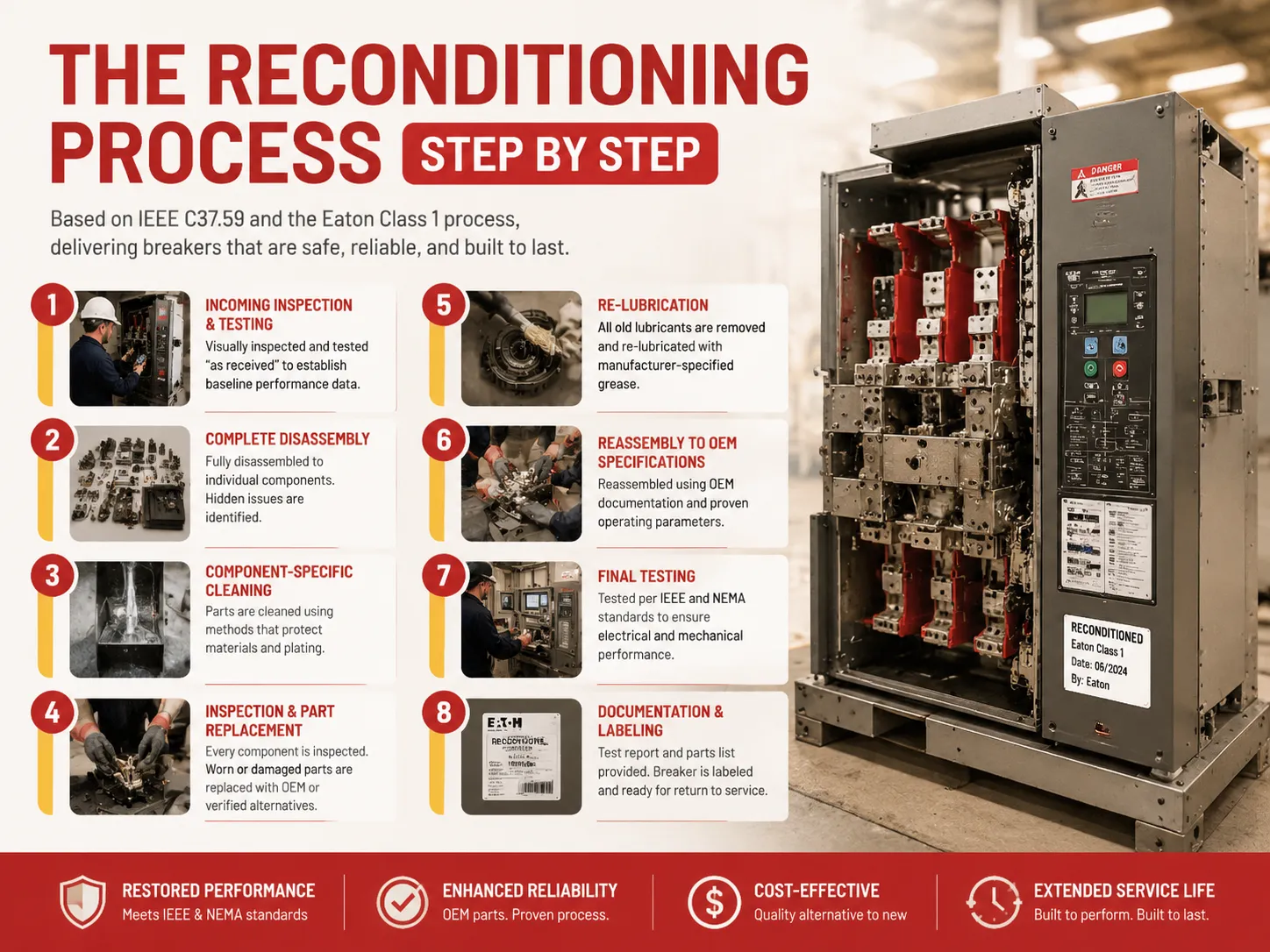
Bước 1: Kiểm tra & Thử nghiệm khi nhận hàng
Bộ ngắt được nhận, kiểm tra bằng mắt và thử nghiệm trong điều kiện “nhận hàng” để ghi lại hiệu suất cơ bản. Các phép đo quan trọng bao gồm điện trở tiếp xúc (tính bằng millivolt), điện trở cách điện, lực vận hành cơ học và kích thước. Thông tin thu được được ghi lại.
Bước 2: Tháo rời hoàn toàn
Việc tháo rời bộ ngắt hoàn tất và bộ ngắt đã được tách thành các thành phần bao gồm: hệ thống vận hành, ống hồ quang, rào cách điện, khung và các hệ thống khác. Đây là giai đoạn xác định các lỗi như liên kết truyền động bị lỗi, tiếp điểm lệch, cách điện hư hỏng làm cho toàn bộ thiết bị dễ bị hỏng khi phát hiện sự cố.
Bước 3: Vệ sinh theo từng bộ phận
Các loại vật liệu khác nhau cần các quy trình vệ sinh khác nhau. Các bộ phận không dẫn điện được làm sạch kỹ lưỡng sao cho không còn vật liệu lạ trong khi vẫn giữ được đặc tính điện môi và cấu trúc. Các bộ phận dẫn điện được làm sạch mà không làm hỏng lớp mạ ban đầu. Bề mặt tiếp xúc được tái tạo để đảm bảo tính chất luyện kim và áp lực tiếp xúc hoạt động đúng.
Bước 4: Kiểm tra & Thay thế bộ phận
Tất cả các bộ phận phải được kiểm tra vết nứt, suy giảm, rỉ sét và độ chính xác kích thước. Các bộ phận đã mòn được thay thế bằng bộ phận OEM mới, trong khi các bộ phận không còn sản xuất sẽ cần được thay thế bằng các bộ phận kỹ thuật ngược phải tuân thủ tiêu chuẩn trong IEEE C37.59. Các bộ phận này có thể cần được kiểm tra trong điều kiện phòng thí nghiệm nghiêm ngặt như thử nghiệm công suất cao. Các bộ phận thay thế điển hình cho các bộ phận mòn có thể là lò xo, tiếp điểm, shunt và bushing.
Bước 5: Bôi trơn lại
Tất cả các chất bôi trơn cũ đã được loại bỏ, và máy móc cùng các điểm kết nối được bôi trơn lại bằng mỡ được nhà sản xuất chỉ định. Một trong những nguyên nhân chính khiến cầu dao ngắt mạch bị hỏng là do bôi trơn không phù hợp — cơ chế cứng làm chậm quá trình xử lý sự cố, dẫn đến năng lượng sự cố hồ quang cao hơn nhiều.
Bước 6: Lắp ráp lại theo thông số kỹ thuật của OEM
Trong quá trình lắp ráp lại cầu dao, tài liệu của OEM được sử dụng. Tuy nhiên, nếu thông tin OEM không có sẵn, ví dụ như nhà sản xuất gốc đã ngừng hoạt động, Eaton sẽ sử dụng cơ sở dữ liệu tập trung Pow-R-DB chứa hồ sơ từ các cầu dao tương tự đã được chứng minh mang lại kết quả mong muốn.
Bước 7: Kiểm tra cuối cùng
Cầu dao ngắt mạch đã được xây dựng lại sẽ trải qua kiểm tra kết luận theo hướng dẫn của IEEE và NEMA bao gồm:
- Đánh giá điện trở cách điện
- Kiểm tra điện trở tiếp điểm (sụt áp millivolt)
- Đánh giá hoạt động cơ học (thời gian mở-đóng)
- Kiểm tra ngắt quá dòng (ngắt lâu, ngắt ngắn, ngắt tức thời)
- Đánh giá khả năng chịu điện môi
Bước 8: Tài liệu & Gắn nhãn
Báo cáo kiểm tra được lập để thiết lập sự khác biệt giữa kết quả kiểm tra “nhận được” và “cuối cùng”, được hỗ trợ bởi thông tin đề cập đến tất cả các bộ phận đã được sửa chữa. Cầu dao được cung cấp nhãn truy xuất nguồn gốc xác nhận là đã được tái điều chỉnh, ghi rõ tên cũng như ngày của công ty tái điều chỉnh. Cầu dao hoạt động trở lại.
Khi nào nên chọn tái điều chỉnh so với thay thế
Quyết định tái điều chỉnh hay thay thế phụ thuộc vào loại cầu dao, tuổi, mức độ quan trọng và chi phí. Dưới đây là ma trận quyết định thực tế:
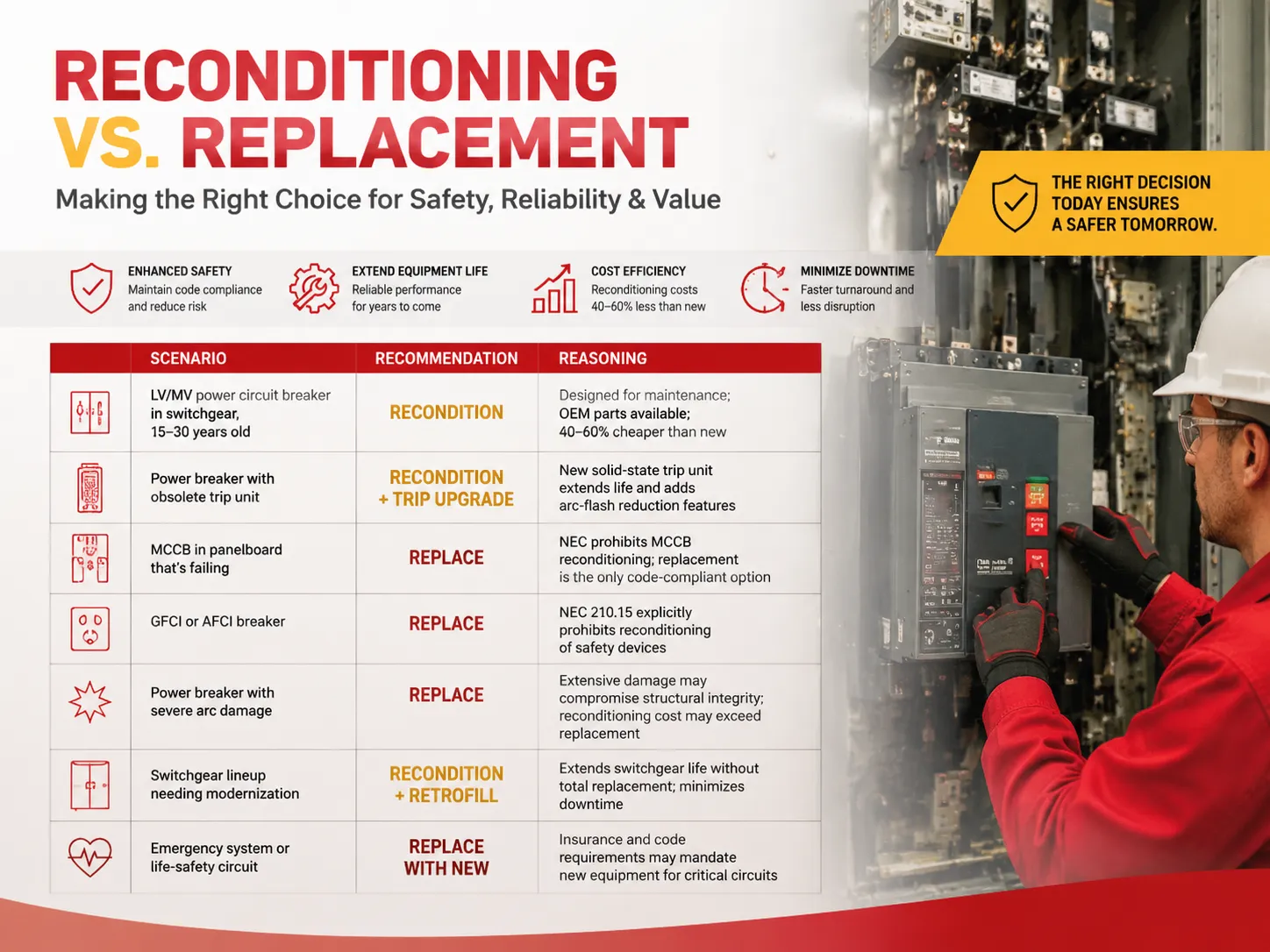
| Kịch bản | Khuyến nghị | Lý do |
|---|---|---|
| Cầu dao điện áp thấp/trung bình trong tủ điện, 15–30 năm tuổi | Tái điều chỉnh | Thiết kế cho bảo trì; có sẵn phụ tùng OEM; 40–60% rẻ hơn hàng mới |
| Cầu dao điện có bộ ngắt lỗi lỗi thời | Tái điều chỉnh + nâng cấp bộ ngắt | Bộ ngắt trạng thái rắn mới kéo dài tuổi thọ và thêm tính năng giảm hồ quang |
| MCCB trong bảng điều khiển đang bị hỏng | Thay thế | NEC cấm tái chế MCCB; thay thế là lựa chọn duy nhất tuân thủ mã |
| Bộ ngắt GFCI hoặc AFCI | Thay thế | NEC 210.15 cấm rõ ràng việc tái chế các thiết bị an toàn |
| Bộ ngắt nguồn bị hư hỏng nặng do hồ quang | Thay thế | Hư hỏng nghiêm trọng có thể làm suy yếu tính toàn vẹn cấu trúc; chi phí tái chế có thể vượt quá chi phí thay thế |
| Dòng thiết bị chuyển mạch cần hiện đại hóa | Tái chế bộ ngắt + lắp đặt lại | Kéo dài tuổi thọ thiết bị chuyển mạch mà không cần thay thế toàn bộ; giảm thiểu thời gian ngừng hoạt động |
| Hệ thống khẩn cấp hoặc mạch an toàn sinh mạng | Thay thế bằng thiết bị mới | Yêu cầu bảo hiểm và mã có thể bắt buộc thiết bị mới cho các mạch quan trọng |
Để được hỗ trợ chẩn đoán xem bộ ngắt của bạn có thực sự cần chú ý hay không, xem hướng dẫn của chúng tôi tại cách nhận biết một cầu dao bị hỏng. Và nếu thay thế là lựa chọn đúng, bài viết của chúng tôi về chi phí thay thế bộ ngắt mạch bao gồm giá cả theo loại bộ ngắt và định mức ampe.
So sánh chi phí: Tái chế so với Mới
Khi nói đến việc tái chế bộ ngắt mạch, chi phí thường dao động từ 40 đến 60% tổng chi phí mua thiết bị mới. Điều này đặc biệt đúng với các mẫu lớn hơn có thể giúp tiết kiệm nhiều tiền:
| Loại Cầu Dao | Chi phí mới (Ước tính) | Chi phí tái chế (Ước tính) | Tiết kiệm |
|---|---|---|---|
| Bộ ngắt nguồn LV, khung 800A | 8,000–15,000 | 3,200–9,000 | 40–60% |
| Bộ ngắt nguồn LV, khung 3200A | 20,000–40,000 | 8,000–24,000 | 40–60% |
| Bộ ngắt chân không MV, 5kV | 15,000–30,000 | 6,000–18,000 | 40–60% |
| Bộ ngắt chân không MV, 15kV | 25,000–50,000 | 10,000–30,000 | 40–60% |
| Nâng cấp bộ phận trip (Digitrip/AC-PRO) | 3,000–8,000 | Bao gồm trong tái chế | Tiết kiệm gói |
Chi phí bổ sung: Quá trình tái chế tiết kiệm chi phí liên quan đến việc sửa đổi thiết bị chuyển mạch cần thiết khi thay đổi kích thước bộ ngắt mới, giảm thời gian chờ vì bộ ngắt tái chế có thể đến trong 2-4 tuần so với bộ ngắt mới sẽ được giao trong 12-20 tuần, và giảm thời gian ngừng hoạt động do bộ ngắt tái chế có thể được lắp đặt ngay lập tức trong tủ hiện tại.
Các cân nhắc về an toàn & yêu cầu tài liệu
Việc tái chế chỉ được thực hiện bởi nhân viên được chứng nhận theo các tiêu chuẩn được chấp nhận. Dưới đây là các yêu cầu cần kiểm tra trước khi lắp đặt bộ ngắt mạch tái chế:
- Dán nhãn: Bộ ngắt mạch tái chế được đánh dấu “Reconditioned” kèm tên công ty tái chế và ngày tháng.
- Kiểm tra: Nhận báo cáo đầy đủ chứng minh kết quả kiểm tra “nhận được” và “cuối cùng” cùng danh sách các bộ phận đã thay thế.
- Chứng nhận: Trong trường hợp yêu cầu chứng nhận UL, xác minh bộ ngắt mạch được đánh dấu UL Mark với “Rebuilt” hoặc “Reconditioned.”
- Phê duyệt bởi AHJ: Cơ quan có thẩm quyền (kiểm tra điện) có thể cần bằng chứng về việc tái chế bởi công ty được chứng nhận – hãy chuẩn bị sẵn sàng.
- Bảo hành: Xác minh điều kiện và thời hạn bảo hành (Eaton: 3 năm; ABB: 1 năm; các hãng khác khác nhau).
- Truy xuất nguồn gốc: Công ty tái chế nên lưu giữ hồ sơ liên quan đến số sê-ri bộ ngắt mạch để tham khảo trong tương lai.
- Không được lắp đặt bộ ngắt mạch đã được tái chế trong mạch an toàn tính mạng trừ khi AHJ và đại lý bảo hiểm của bạn đã phê duyệt việc lắp đặt.
Ngoài ra, OSHA 29 CFR 1910.334(b)(2) quy định rằng khi mạch đã được ngắt điện bằng thiết bị bảo vệ thì không được phép cấp điện lại bằng tay cho đến khi xác định rằng thiết bị và mạch có thể được cấp điện an toàn.
Câu hỏi thường gặp
Bộ ngắt mạch tái chế là gì?
Bộ ngắt mạch điện tái chế đề cập đến bộ ngắt mạch điện đã trải qua quá trình phục hồi tại một cơ sở được ủy quyền bởi nhà máy. Theo các yêu cầu được đặt ra bởi IEEE C37.59, toàn bộ hoạt động bao gồm kiểm tra đầu vào, tháo rời hoàn toàn, làm sạch các thành phần, thay thế các bộ phận, bôi lại chất bôi trơn, lắp ráp lại các thành phần theo thông số kỹ thuật của OEM, và kiểm tra cuối cùng. Ngoài ra, bộ ngắt mạch phải được dán nhãn là đã được tái chế với tên và ngày của công ty tái chế, và danh sách gốc phải được gỡ bỏ do yêu cầu của NEC.
Bộ ngắt mạch loại B, loại C, và loại D là gì?
Loại B, C, và D là các phân loại của MCB liên quan đến đặc tính ngắt mạch và không phải là các loại bộ ngắt mạch được phân loại theo NEC 240.88. Bộ ngắt mạch loại B ngắt ở mức ba đến năm lần dòng điện định mức; loại này được sử dụng trong các ứng dụng dân dụng cho các mạch có tải thuần trở. Tiếp theo, chúng ta có bộ ngắt mạch loại C, ngắt ở mức năm đến mười lần dòng điện định mức và được sử dụng trong các hệ thống điện thương mại và công nghiệp, cũng như các mạch có tải cảm kháng, như đèn huỳnh quang và động cơ nhỏ. Loại thứ ba là MCB loại D, ngắt ở mức mười đến hai mươi lần dòng điện định mức và xử lý dòng khởi động trong máy biến áp, động cơ lớn hoặc máy hàn. Tất cả các loại bộ ngắt trên đều là bộ ngắt mạch nhỏ gọn, vỏ đúc, và không thể tái chế theo NEC 240.88(A)(1).
Bộ ngắt mạch vỏ đúc có được phép tái chế không?
Dựa trên NEC Mục 240.88(A)(1) năm 2020, không được phép tái chế bộ ngắt mạch vỏ đúc. MCCB được thiết kế như các đơn vị kín nên việc phá vỡ niêm phong đồng nghĩa với việc mất danh sách UL và bảo hành của nhà sản xuất. Mặc dù có hướng dẫn kiểm tra và bảo trì phòng ngừa MCCB trong tiêu chuẩn NEMA AB 4, nhưng điều này không tương đương với việc tái chế. Bảo trì định kỳ là hợp lý nhưng việc tháo rời hoặc sửa đổi cấu trúc bên trong của MCCB không được chấp nhận.
Loại thiết bị nào không được phép tái chế theo điều khoản 210?
NEC quy định tại Điều 210.15 rằng có ba loại thiết bị không được phép tái chế. Bao gồm (1) thiết bị cung cấp bảo vệ ngắt mạch sự cố nối đất (GFCI) cho nhân viên, (2) thiết bị cung cấp bảo vệ ngắt mạch sự cố hồ quang (AFCI), và (3) thiết bị cung cấp bảo vệ sự cố nối đất cho thiết bị (GFPE). Lý do của các lệnh cấm này là các thiết bị cần được tái chế cũng là các thiết bị an toàn quan trọng có yêu cầu hiệu chuẩn và độ nhạy không thể đảm bảo ngay cả sau khi được tái chế. Do đó, nếu bất kỳ thiết bị tái chế nào (GFCI, AFCI hoặc GFPE) không ngắt mạch tại ngưỡng yêu cầu, thì sẽ tạo ra nguy hiểm đến tính mạng. Ngoài ra, NEC quy định rằng cầu dao khuôn không được tái chế theo Mục 240.88(A)(1) cũng như các bộ phận ngắt điện tử của cầu dao điện áp thấp không được tái chế theo Mục 240.88(B).
Tài liệu tham khảo
- NFPA 70 — Bộ Quy chuẩn Điện Quốc gia (NEC) 2020, Điều 210.15 và 240.88
- ANSI/NEMA AB 4-2023 — Hướng dẫn Kiểm tra và Bảo trì Phòng ngừa Cầu dao Khuôn
- IEEE C37.59-2018 — Tiêu chuẩn Tái chế Thiết bị Công tắc Điện
- UL 489 — Tiêu chuẩn cho Cầu dao Khuôn, Công tắc Khuôn và Vỏ Cầu dao
- UL — Thiết bị Điện Tái chế: Hướng dẫn NEC 2020
- Eaton — Tái chế Cầu dao Lớp 1 cho Cầu dao Điện áp Thấp và Trung bình
- ABB — Dịch vụ Tân trang Trung tâm Cầu dao
- Schneider Electric — Giải pháp Hiện đại hóa và Nâng cấp Phân phối Điện
- PEARL — Liên đoàn Tái chế Thiết bị Điện chuyên nghiệp
Cầu dao có thể tái chế bao gồm cầu dao điện áp thấp, trung bình và cao loại rút ra, có thể bảo trì tại hiện trường, thường được sử dụng trong trạm biến áp và thiết bị chuyển mạch. Thiết kế của cầu dao sử dụng tiếp điểm có thể thay thế, cơ chế dễ tiếp cận và bộ phận ngắt có thể hoán đổi cho nhau cho phép tái chế thực tế phù hợp với NEC 240.88. Các nhà sản xuất lớn như Eaton, ABB và Schneider Electric cung cấp dịch vụ tái chế theo tiêu chuẩn IEEE C37.59 đảm bảo bảo hành tương đương với thiết bị mới.
Mặt khác, cầu dao khuôn, thiết bị GFCI, thiết bị AFCI và thiết bị GFPE bị cấm tuyệt đối không được tái chế theo NEC 210.15 và 240.88 và phải được thay thế nếu hỏng. NEC 2020 đã làm rõ rằng cầu dao được thiết kế để bảo trì có thể được bảo trì trong khi cầu dao an toàn được niêm phong thì không thể. Khi lựa chọn tái chế hoặc thay thế, trước tiên hãy xác định loại cầu dao và so sánh chi phí thất bại để bạn có thể hiểu được việc nào đáng làm hơn — tái chế hay thay thế cầu dao.