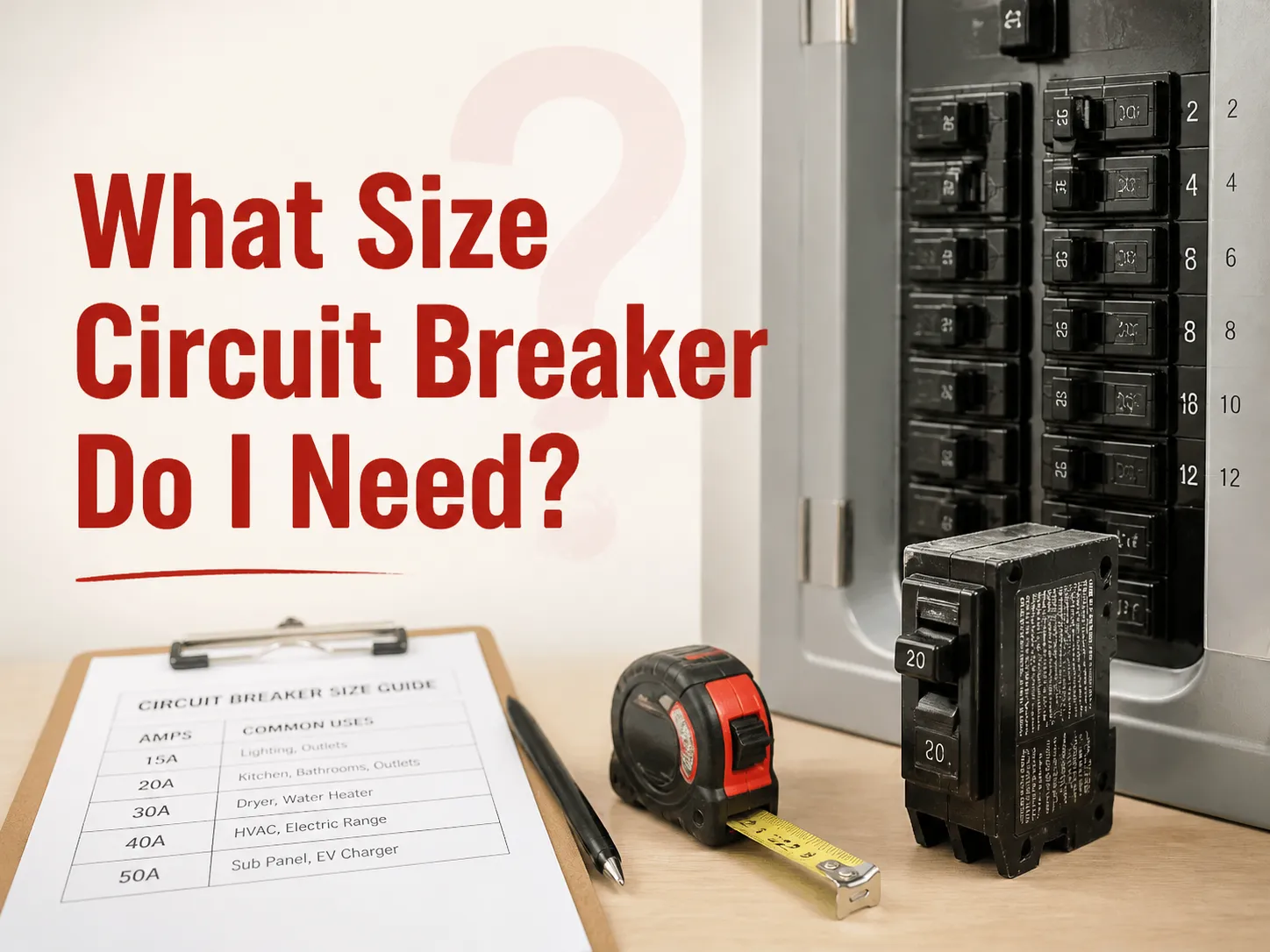

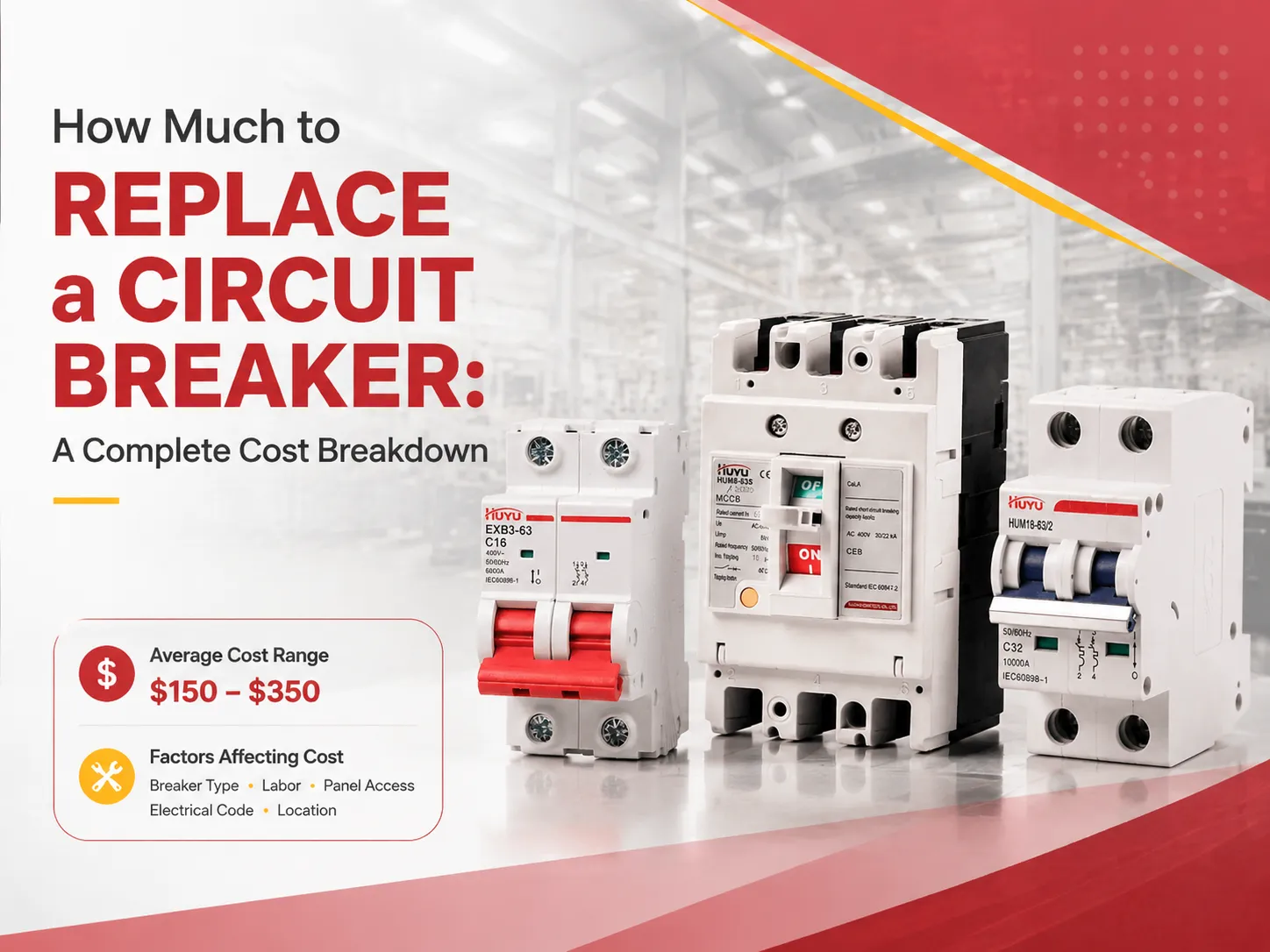
An Atlanta homeowner noticed during the third time she had to reset her kitchen circuit breaker that it was warm to the touch and smelled of burnt plastic. She immediately called an electrician who replaced her defective 20-amp circuit breaker in under thirty minutes for a total of $185 — a mere $15 for replacement hardware and $170 for the service call and labor. The question of how much a circuit breaker replacement costs usually has a simple answer, but the answer requires much more than just a reference number range of $150-$400 for a typical single-pole replacement job done by a licensed electrician. The actual cost strongly depends on a number of factors like the kind of the circuit breaker itself, accessibility of the electrical panel, safety of the main switch turn-off, and possible damages the old breaker could have caused to the bus bar behind the panel. By doing this, a homeowner will be more prepared for the repair expenses and will be able to distinguish a fair price from an inflated estimate.
The Total Cost at a Glance: Parts, Labour, and the Service Call
The below table illustrates a realistic breakdown of the costs associated with replacing a typical circuit breaker in a home. The pricing reflects mid‐2025 rates for most regions in both the United States and the United Kingdom. The pricing of the labor may vary from region to region. A city will charge much higher than a rural area but the prices for the components themselves are fairly similar.
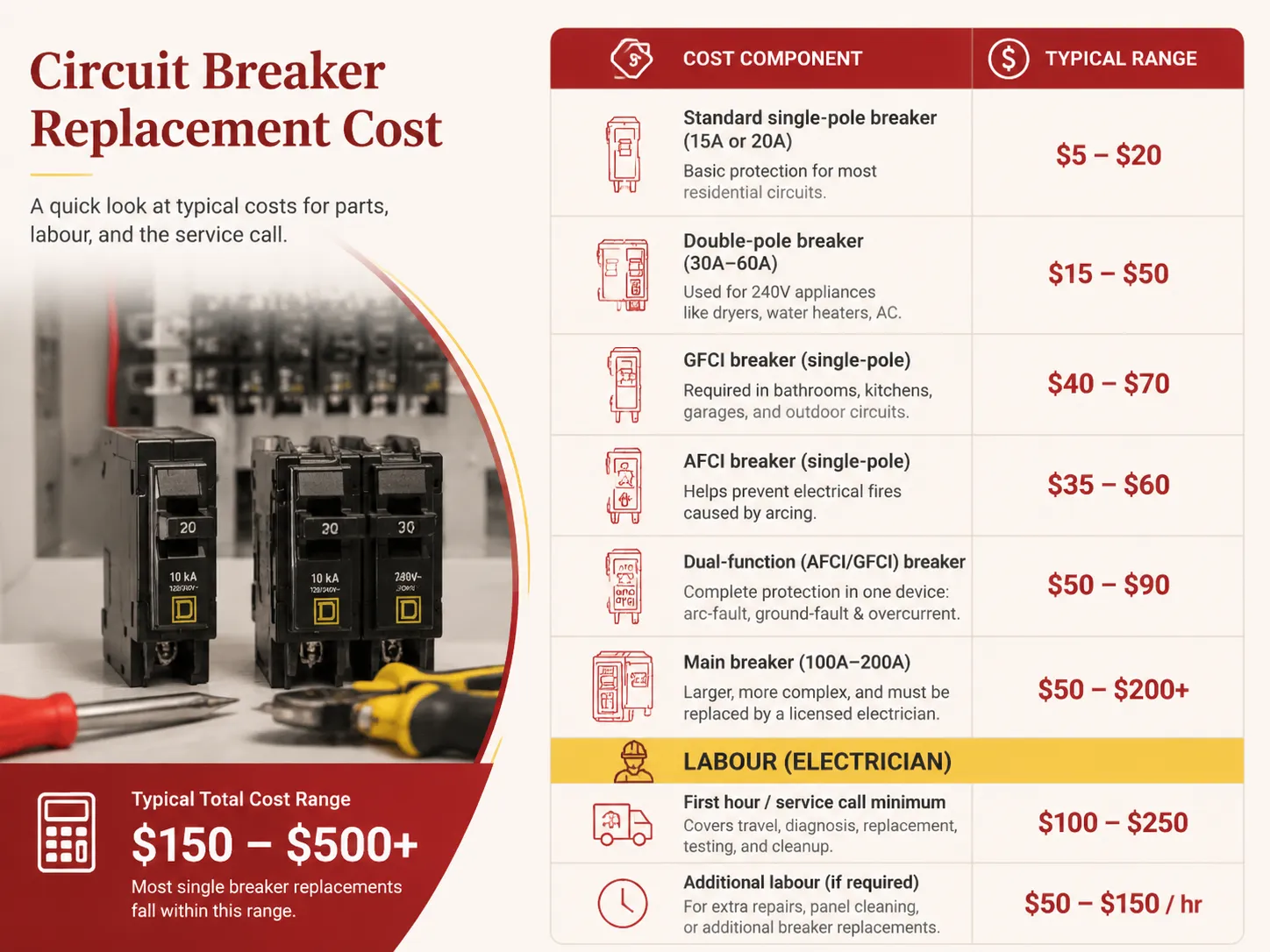
| Cost Component | Typical Range | Notes |
|---|---|---|
| Standard single‑pole breaker (15A or 20A) | $5–$20 | A basic thermal‑magnetic MCB for residential panels. The cost depends on the brand and the panel type — a Square D QO breaker costs more than a generic equivalent, but using the correct listed breaker is non‑negotiable. |
| Double‑pole breaker (30A–60A) | $15–$50 | Used for 240‑volt appliances — dryers, water heaters, air conditioners, EV chargers. Larger amperages and higher interrupting ratings increase the price. |
| GFCI breaker (single‑pole) | $40–$70 | Combines overcurrent and ground‑fault protection in one device. Required in bathrooms, kitchens, garages, and outdoor circuits. The internal electronics add cost. |
| AFCI breaker (single‑pole) | $35–$60 | Provides arc‑fault protection. Required in most living areas of new homes. Contains a microprocessor that analyses the current waveform for arc signatures. |
| Dual‑function (AFCI/GFCI) breaker | $50–$90 | Combines arc‑fault, ground‑fault, and overcurrent protection in a single device. The most complete protection for a single circuit. |
| Main breaker (100A–200A) | $50–$200+ | The main breaker is larger, more expensive, and must be replaced by a licensed electrician. The incoming lugs remain live even when the main is off, and replacing a main breaker often requires pulling the meter or coordinating with the utility. |
| Labour (electrician, first hour / service call minimum) | $100–$250 | This is the largest portion of the total cost for a single breaker replacement. The electrician’s time covers travel, diagnosis, isolation, replacement, testing, and cleanup. Many electricians charge a minimum service call fee that includes the first hour of labour. |
| Additional labour (if required) | $50–$150 per additional hour | If the bus bar is damaged, if the panel requires cleaning or repair, or if additional breakers need to be replaced, the labour time increases. |
For a straightforward circuit breaker replacement — a standard single‑pole 20‑amp breaker, replaced by a licensed electrician in a modern, accessible panel — the total cost is typically $150 to $250. For a specialty breaker — a GFCI, an AFCI, or a dual‑function unit — the total rises to $200 to $400. For a main breaker replacement, the cost can reach $500 to $800 or more, depending on the complexity of the service disconnect and the utility coordination required. Home improvement resources such as Family Handyman and HomeAdvisor publish aggregated pricing data that supports these ranges.
The Hidden Costs: When a Simple Breaker Swap Becomes a Larger Project
Not all breaker changes involve merely taking old ones out and putting new ones in. There are numerous aspects that could make a $200 service transformation into an expensive servicing. The most common “hidden cost” is a burned bus bar. The bus bar is a conductor which is made of metal and which is located inside the panel and serves to transmit electricity to breakers. The thing is that when a breaker has been arcing for an extended period of time (which usually happens if the breaker is loose on the bar or if it is not suitable for this type of panel), the heat can burn the bus bar on the connection. Therefore, if a bus bar is burned, it must be replaced, meaning that the panel must also be replaced. Replacing a panel is quite expensive – from $1500 to $3000 if done only.
Additional conditions that contribute to replacing costs are reported brands of panel – Federal Pacific Electric Stab‑Lok, Zinsco, or other early Challenger brands. Electricians generally do not replace one breaker in these panels since they considered it as a fire hazard and will consider a full panel replacement as a solution instead. The homes using aluminium wiring usually need certain technologies in order to replace the breaker properly which means more expenses in this case. Moreover, if the panel is placed in hard-to-reach places like a small crawl space or a rusty outdoor enclosure, this fact will also increase labor costs for service. For help identifying the correct replacement breaker for a specific panel and circuit, our guide on what size circuit breaker you need covers the ampacity and trip‑curve selection process.
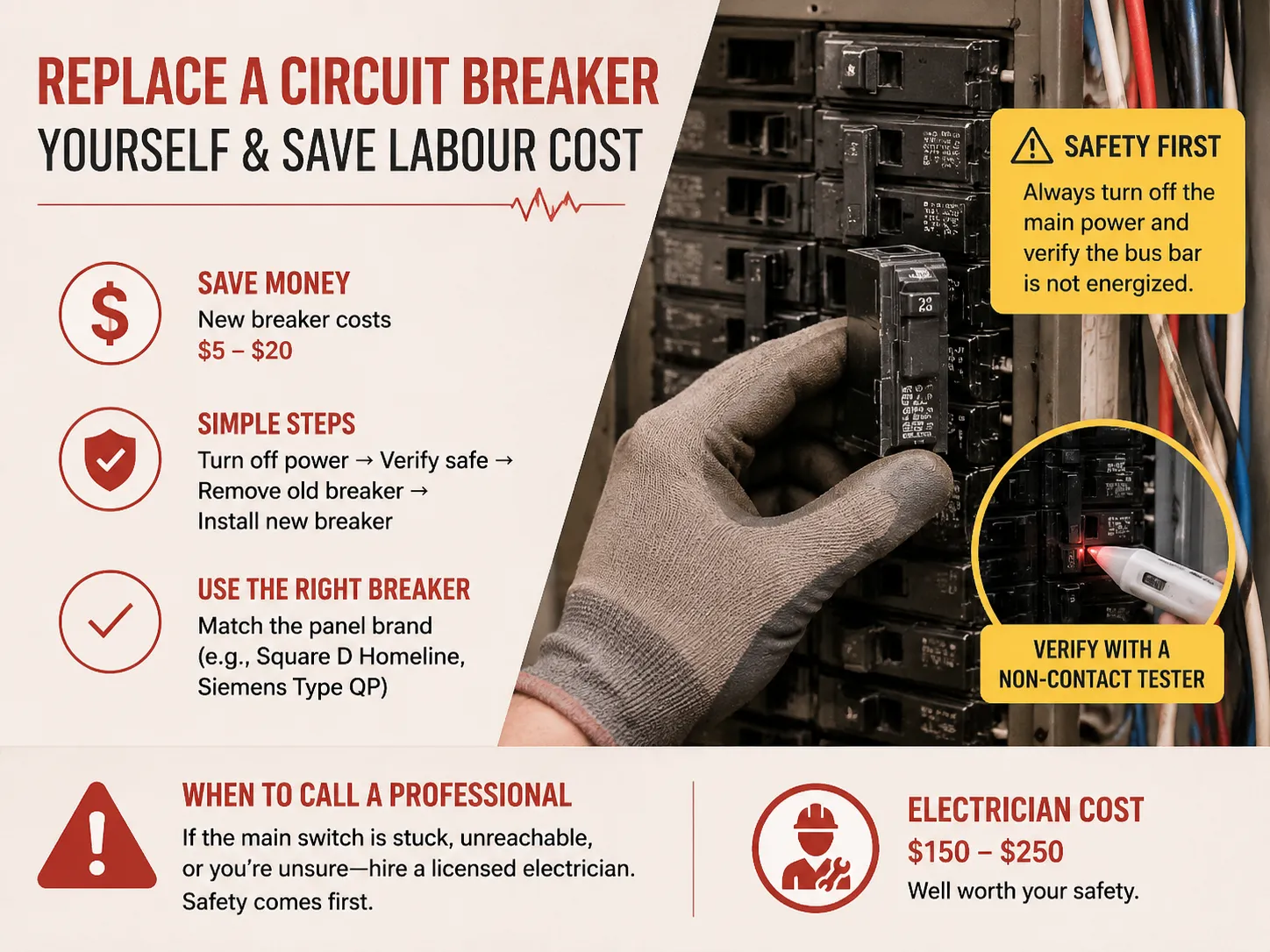
Can You Replace a Circuit Breaker Yourself and Save the Labour Cost?
Replacing a typical circuit breaker, such as a normal single-pole device of 15 or 20 amps, in a modern panel is possible for someone skilled enough. The cost of a new circuit breaker tends to range from $5 to $20, depending on the type of breaker. The replacement is pretty simple, as it only requires switching off the primary breaker to cut off electricity from the bus bar, verifying that the bus bar is not energized with the help of a non-contact tester. Taking off the broken circuit breaker, disconnecting the load wire, attaching the new circuit breaker, and making sure it is secure on the bus bar are required.
However, if the main safety switch cannot be turned off because it is stuck, hard to reach (like in an electrical room locked in an apartment building), or if it is itself being replaced, hire a professional electrician to do the job for you. Working with a live busbar without arc-flash PPE or insulated equipment can be extremely unsafe. The Electrical Safety Foundation International (ESFI) provides helpful information about safety in residential electrical work and states that before any work such as troubleshooting a circuit breaker can be done, the panel should be de-energized. If you feel uncomfortable or doubtful about something, the costs you’ll incur by hiring an electrician ($150-250 for a work) are much lower than the costs of an electric shock or a fire.
For the homeowner who opts to change a breaker on his/her own, it is important to use the appropriate replacement breaker. The breaker type should be as indicated in the panel label – for example, a panel from Square D requires the use of Homeline breakers, while a Siemens panel calls for the use of Siemens Type QP breakers. Using a breaker type that is not titled for the panel even if it fits perfectly is illegal and could result in fires. HUYU manufactures a variety of replacement circuit breaker types for different AC and DC applications such as MCBs, RCBOs, and specialized breakers. For a deeper understanding of the certification that every breaker in a panel must carry, our article on what UL 489 breakers are explains the testing and listing requirements.
Frequently Asked Questions
How much should an electrician charge to replace a breaker?
Replacing a standard single-pole circuit breaker generally costs from $150 to $400. This cost includes the service call, labor, and circuit breaker costs. Replacing a GFCI or AFCI breaker will cost between $200 to $400. The price varies according to the region, accessibility of the panel, and whether the job is done as part of regular business hours, or is instead an emergency call-out.
Do I need an electrician to replace a circuit breaker?
Changing a typical circuit breaker is feasible with the main switch turned off and the bus bar checked to be dead. If you can’t turn off the main switch, the panel is an old system or a recalled brand, there is damage in the bus bar, or you feel unsure about working inside an electric panel, you need a licensed electrician.
How long does it take an electrician to replace a breaker?
An uncomplicated breaker change consumes an electrician anywhere from 15 to 30 minutes, not counting travel times. The process includes turning off the circuit, getting rid of the old breaker, putting in the new one, and putting it to the test. If a main breaker has to be replaced or changes are needed in a hard-to-reach panel, the operation will take one hour or longer.
Is it cheaper to repair or replace a breaker?
Circuit breakers are not repairable If a breaker is failing (being warm, buzzing, tripping repeatedly, or showing visible signs of damage) the breaker must be replaced. The price of a replacement breaker is between $5 -$90 while the cost of the damages on account of a malfunctioning breaker is far more expensive.
References
- Electrical Safety Foundation International (ESFI) — Home Electrical Safety. Consumer guidance on safe practices for residential electrical work, including circuit breaker replacement.
- Family Handyman — How to Replace a Circuit Breaker. Step‑by‑step guidance for safe DIY breaker replacement, including the tools and the safety checks required.
- HomeAdvisor — Cost to Replace a Circuit Breaker. Aggregated pricing data from electrical contractors across the United States for breaker replacement.
- Eaton — Residential Circuit Breaker Replacement Guide. Manufacturer guidance on identifying the correct replacement breaker for different panel types and brands.
The cost to replace a circuit breaker is modest in most cases — $150 to $250 for a standard breaker, $200 to $400 for a specialty unit — and the job is usually completed in under an hour. The cost of circuit breaker installations comes mostly from the electrician’s labour and service charges, while the cost of the actual breaker is relatively low. However, the total cost of ignoring an old and failing circuit breaker can be thousands of times higher if a bus bar malfunctions or a fire occurs. During its service, the breaker should display no signs of wearing out, which include heat being emitted, a buzzing noise, problems with the breaker tripping correctly, etc. HUYU manufactures electric circuit breakers that comply with all required standards and regulations.