
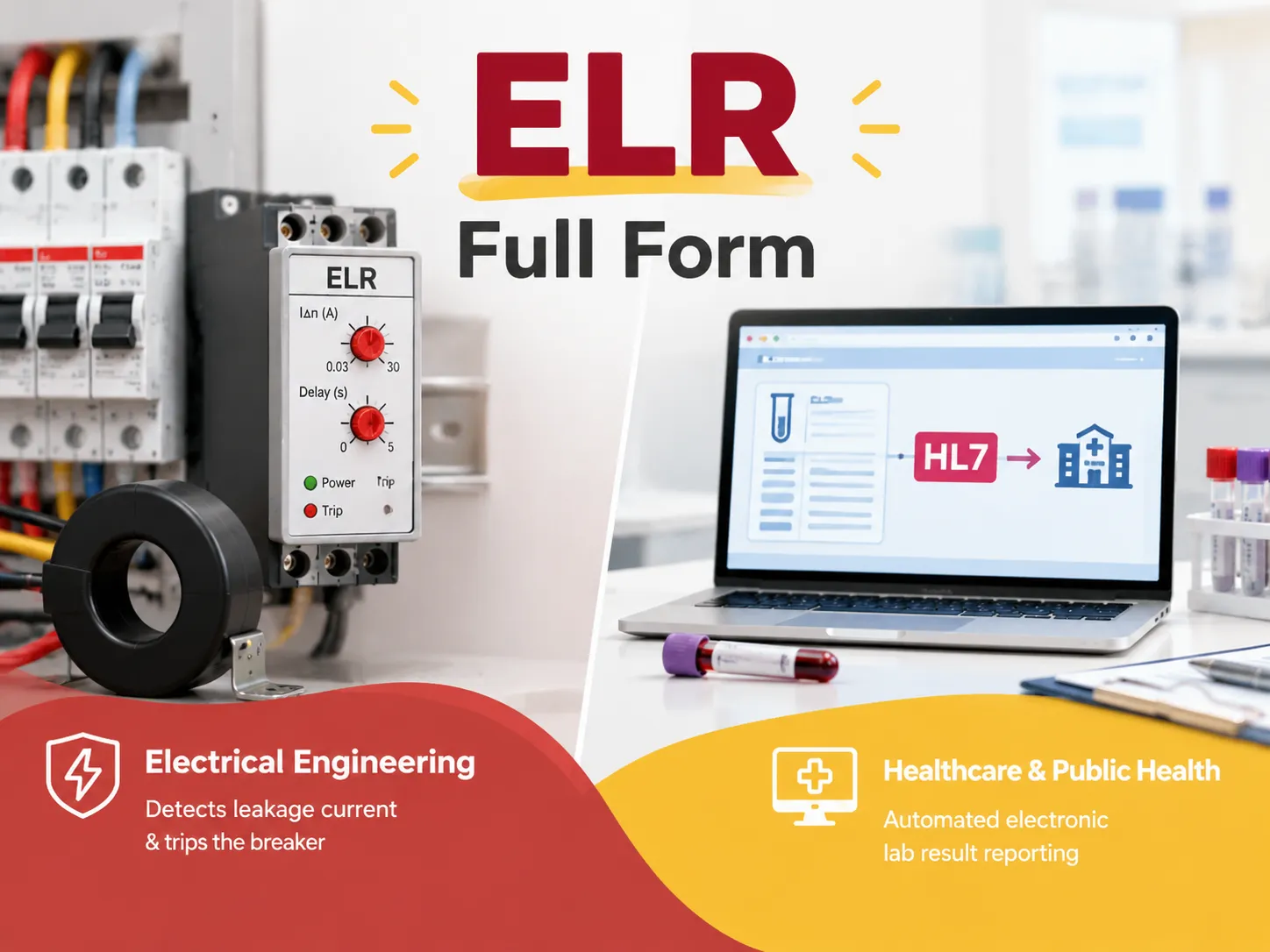
Searching the “full form of ELR” will return results from a number of industries which could potentially be correct but may not be the answer that you are after. This is due to the nature of three letters being used again and again, making the use of context the only differentiating element among them. The ELR refers to the Earth Leakage Relay in electrical engineering, which is the topic of this article. However, if you came here after attending an IT meeting at a hospital or a public health project, we will help you find out what you should be looking for.
The abbreviation ELR stands for earth leakage relay in the field of electrical engineering. An earth leakage relay, which is sometimes known as a residual current relay or an earth fault relay, is a device connected to a panel and uses an external toroidal current transformer to monitor the leakage current to the earth in order for the upstream breaker to be cut off. This device has a sensitivity that can be adjusted between 0.03 A and 30 A with a delay of 0 to 5 seconds. In the health sector, ELR refers to electronic laboratory reporting. ELR is the process of sending lab results electronically to the health agencies.
The short answer: ELR means different things in different rooms
A common annoyance in technical writing is the existence of acronyms. Acronyms such as GFCI, RCD, ELR, and RCM are repetitive as they refer to different things entirely like a safety measure, or a set of standards.We ran into the same issue with what GFCI stands for, where the common confusion isn’t a different industry but a different word in the same phrase.
The distinction is simple: when it talks about panels, feeders, grounding, or switches, you know that ELR stands for Earth Leakage Relay. However, if it mentions test results, HL7, labs, or disease monitoring, ELR stands for Electronic Laboratory Reporting. You must rely on the contextual clues to figure out which ELR is in use.
ELR in electrical work: Earth Leakage Relay
An earth leakage relay serves as a protector and monitor for low-voltage distribution systems. Unlike circuit breakers, which are located in the actual circuit, the relay is located in the panel and provides measurement and control signals to other devices. This makes one of the main differences between the ELR and the circuit breakers: the first one detects the leak while the second does the switching.
The earth leakage relay is made of a toroidal current transformer, also known as a core balance current transformer, which makes it possible to pass all the current carrying wires (phase and neutral), and, thus, measures the amount of leakage. The relay is usually made in the form of a panel instrument that has some sort of controls, such as a dial or keypad for the purposes of setting time delay and sensitivity levels, and few output contacts. Some models might show the actual amount of current in milliamps.
Although they are generally referred to as ELRs, the devices can have different names depending on the manufacturer. For instance, ABB’s version is referred to as a residual current relay. Other companies also use such terms as “earth fault relay” or “residual current monitor”.They describe the same function, and they belong to the same broad family of protective devices as the miniature and moulded case devices covered in MCB and MCCB — with one important difference, which is that the ELR is the member of that family designed to be adjustable rather than fixed.
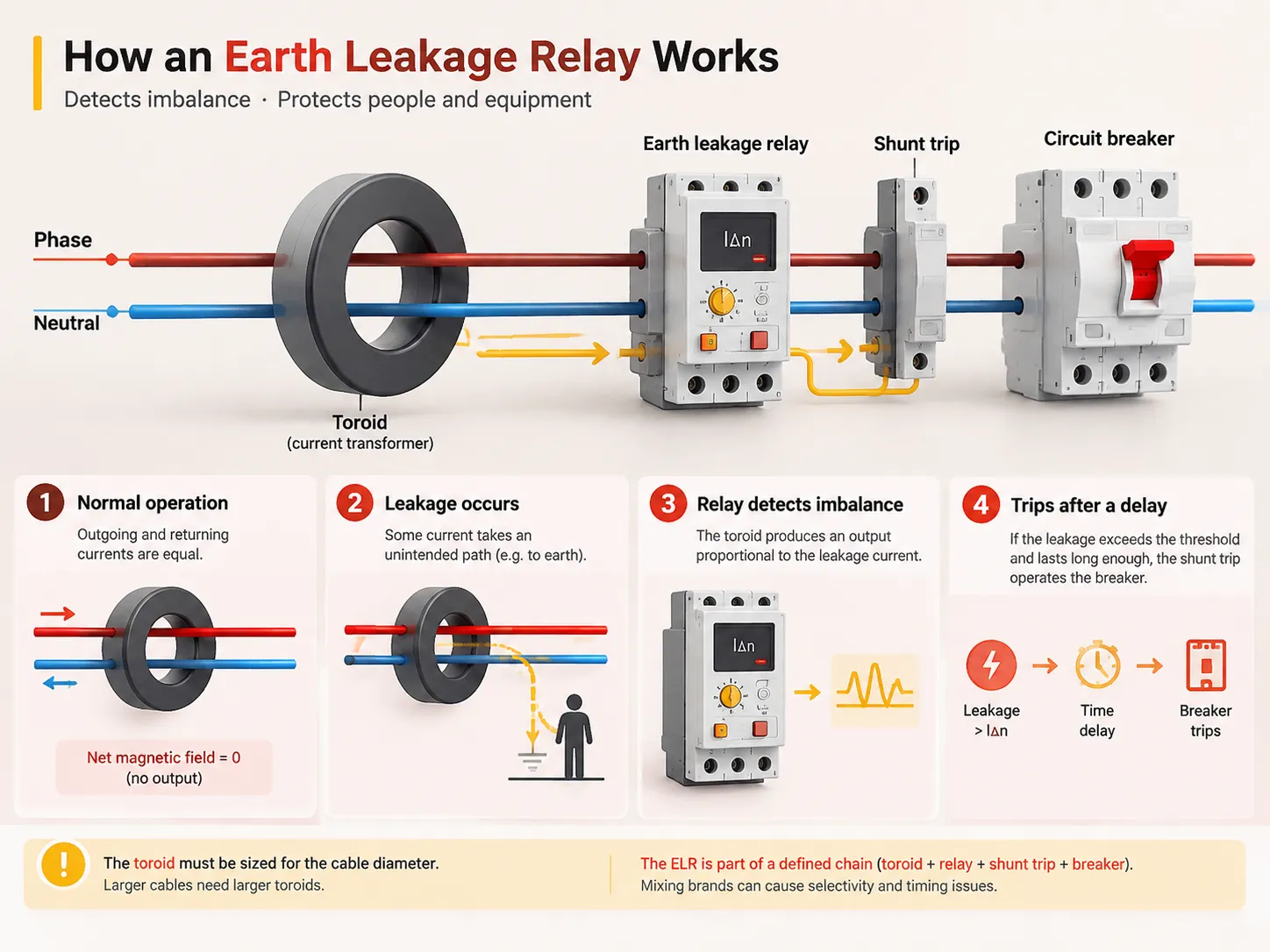
How an earth leakage relay works
The science of physics is critical to understand, as it will lead to the comprehension of the device’s functioning.
The first step is to compare the current flowing in the phase conductor and the current flowing in the neutral. In the toroid, the currents from both conductors cancel out each other producing zero vector sum. Consequently, there’s no signal at the CT. In case of any uncontrolled current (through degraded insulation, hydrated state, damage, or passing through a person) the returning current will differ from the outgoing one. Therefore, there will be a non-zero vector sum which gives rise to the signal indicating leakage current.
The relay receives the signal and compares it to the preset value which is measured in amperes (labelled IΔn). The relay will start functioning only if two conditions are met: the leakage current exceeds the preset value and lasts longer than the preset time delay. Both conditions must be true at the same time in order for the relay contact to change state and thus create the effect of the shunt trip in the upstream breaker.
In practice, two design peculiarities have to be mentioned. Since the measurement is taking place in the toroid rather than in the relay, the toroid must match the diameter of the cable passing through. This means that larger cables require larger toroids. The other thing worth mentioning is that since the ELR is a separate device from the breaker, the manufacturer’s approval does not cover the relay alone but rather the whole chain these devices form. If you chain devices of different brands and expect them to perform as independently as stated in the manuals, then this means that there might be some selectivity issues.
The settings you’ll see on the front panel
| Setting | Typical range | What it’s for |
|---|---|---|
| Sensitivity (IΔn) | 0.03 A to 30 A | How much leakage trips the device — low for personnel protection, high for equipment monitoring |
| Time delay | 0 to 5 seconds (some to 10 s) | Avoids nuisance tripping and lets downstream devices trip first |
| Pre-alarm | Usually 60% of IΔn | Warns before the device trips, so a slow insulation fault can be found during planned work |
| Fail-safe selector | On / off | Determines whether loss of auxiliary supply or a broken CT connection also trips the breaker |
| Reset mode | Manual, remote, auto | Whether someone has to attend the panel, or the circuit restores itself once the fault clears |
| Frequency filter | On selected models | Discriminates between real leakage and harmonic currents from variable speed drives |
| Fault memory | On selected models | Retains the trip indication after an auto-reset, so the cause is still visible later |
The fail-safe options is the one that causes confusion. When fail-safe is activated, the relay will automatically trip the circuit breaker when it either loses its auxiliary power supply or when the connection with the toroid is lost. It may seem beneficial on the surface, but when performing a job where unnecessary shutdowns can lead to up to ten thousand dollars of loss per hour, the situation evolves into a question of engineering rather than merely choosing the one that seems like the best one.
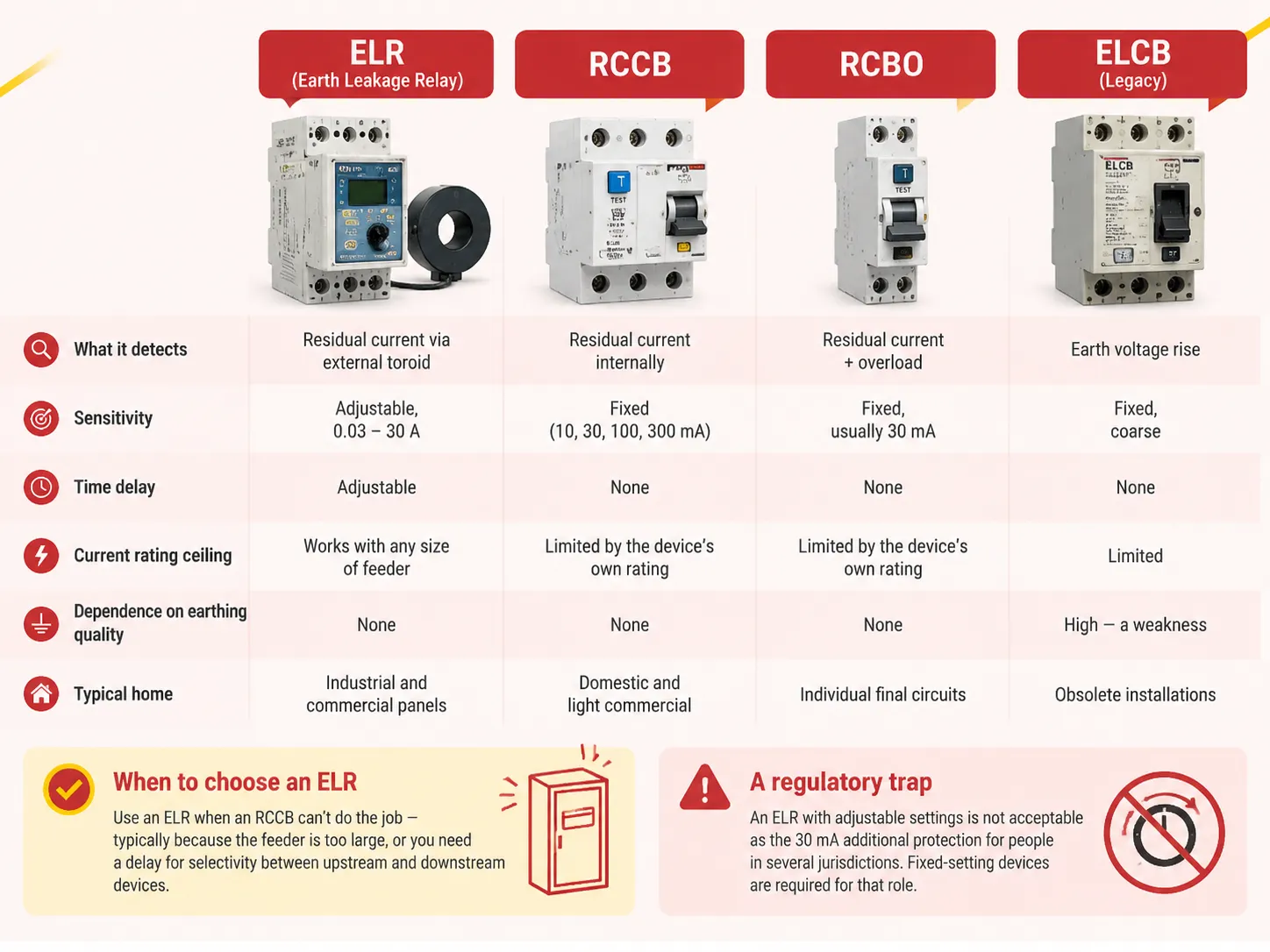
ELR vs RCCB vs ELCB vs RCBO
These four get mixed up constantly, and the differences are real rather than pedantic.
| ELR (earth leakage relay) | RCCB | RCBO | ELCB (legacy) | |
|---|---|---|---|---|
| What it detects | Residual current via external toroid | Residual current internally | Residual current plus overload | Earth voltage rise |
| Sensitivity | Adjustable, 0.03-30 A | Fixed (10, 30, 100, 300 mA) | Fixed, usually 30 mA | Fixed, coarse |
| Time delay | Adjustable | None | None | None |
| Current rating ceiling | Works with any size of feeder | Limited by the device’s own rating | Limited by the device’s rating | Limited |
| Dependence on earthing quality | None | None | None | High — a weakness |
| Typical home | Industrial and commercial panels | Domestic and light commercial | Individual final circuits | Obsolete installations |
Two points are clear from the table. Firstly, it is clear that where the RCCB fails to act, the ELR is used, typically because the feeder is too large or where selectivity is required by having a delay. Secondly, and this is the crucial trap due to the fact that its adjustable form is not accepted as the 30 mA people protection in various jurisdictions because the setting can be changed because in this case only fixed-setting ones are appropriate.The narrower comparison between fixed-setting device families is covered in RCCB versus RCBO.
Types and where they’re used
ELRs can be found in a few sizes and shapes as they exist in physical forms. Traditional sizes of panel-mount units include front-of-door types in sizes 48×48, 72×72 and 96×96 mm. There are alternatives like DIN-sized versions for smaller usages that have come up recently. Other than this, the use of digital versions is also found for measuring, logging and communication purposes. Functionally speaking, ELRs can be categorized into the same type, although they are available in different feature combinations.The application of ELR is quite essential:
- Industrial distribution boards and engine control centers in situations of this nature where preventing the effect of leaks cannot be done by fitting an RCCB.
- Powerful feeders – anything exceeding the limited current of RCCB.
- Long cables and outdoor installations – in case of cumulative leaks caused by cable capacitance reaching a level at which the permanent device works.
- Marine, offshore, or temporary outdoor installations – in conditions of insulation deterioration with the gradual principle of the alarm, forced to trip at a certain moment.
- Protection against fires at the installations with power levels determined by insulation faults.
In all of those the design logic is similar: detect residual current, allow a graded response, and coordinate with the devices around it so the right breaker opens. Where the ELR sits alongside what is often called an earth leakage circuit breaker or ground fault interrupter in the same panel, the coordination rather than the device becomes the engineering problem — the general anatomy of that is covered in how circuit breakers and ground fault interrupters work together.
ELR in healthcare: Electronic Laboratory Reporting
If you have come here from a hospital, lab, or public health initiative, then you have landed in the right place. In that world, ELR stands for Electronic Laboratory Reporting, and it refers to the process of automatically transferring laboratory reports electronically from diagnostic laboratories to various public health organizations.
The operation is quite simple and effective. Once a laboratory produces a reportable finding, it is put in the Laboratory Information Management System (LIMS). This system could be either manually or automatically used as a medium to provide the necessary information. The LIMS creates a message of standard format (HL7 version 2.5.1 is used in public health in the U.S.) containing information about test results coded by vocabularies like LOINC. After that, the message is sent to the health department.
Why is it important? It eliminates the need for manual data entering and prevents possible types of errors, as well as reduces the time between getting a positive test result and the public health response. According to the Centers for Disease Control and Prevention, over 90% of laboratory results delivered to public health authorities are provided via ELR and not in the paper format. The fact that the infrastructure used since 2005 has made it possible to deal with the COVID-19 issue in such a short time.
One thing that should be noted if you plan to implement it is that ELR refers to the process of delivering results to public health departments, while the similar process ETOR (electronic test orders and results) is intended for sending the order from physicians and getting the results from labs.
Other ELR meanings you might be looking for
We aren’t saying this list is comprehensive, because the rate at which three-letter initials can gain meaning is extremely fast. But there are two more that are fairly known and worth discussing: in the context of labour relations and employment law, ELR is found as part of the names of the laws and legal tribunals related to this area; and in the UK’s heritage and transportation, ELR can stand for the preserved railway located in north-west England.
A good habit is to get used to looking at two words associated with any ELR abbreviation. For example: “Toroid”, “IΔn”, “shunt trip”, “breaker” – electrical; “HL7”, “LIMS”, “notifiable”, “surveillance” – medical; “tribunal”, “statute”, “claimant” – legal; “locomotive”, “station”, “heritage” – transport. Two words will usually be enough.
So which ELR did you mean?
When it comes to specifying or maintaining electrical distribution equipment, ELR refers to an earth leakage relay. It is a type of panel device featuring an external toroidal loop and adjusted sensitivity and delay in accordance with IEC/EN 60947-2 Annex M. If what you’re actually dealing with on site is a breaker that keeps tripping and you’re not sure whether the leakage protection is the cause or a symptom, the diagnostic side is usually more productive than the naming side — and the common causes are covered in what causes a circuit breaker to trip.
When it comes to the healthcare system, electronic laboratory reporting (ELR) can easily be confused with other processes; therefore, remember that your expected answers can be provided by your LIMS vendor as well as by your public health authority’s onboarding group (not your electrical supplier). This should be stated openly, as this is how you can get to the needed discussion in a faster way.
FAQ
What does ELR stand for?
The meaning is determined by the issue. In the electrical engineering sector, ELR is short for Earth Leakage Relay – which is also referred to as residual current relay or earth fault relay. In the public health and healthcare sectors, ELR is understood as Electronic Laboratory Reporting, meaning sending laboratory results automatically to health authorities. Other meanings appear in transport and employment law which indicates that checking context around each acronym is very important.
What is ELR in electricity?
Earth leakage relay — a device mounted within a panel for measuring residual current. The earth leakage relay will switch off the circuit breaker upstream once the earth leakage exceeds its predefined threshold. The unique features of this device are adjustable sensitivity — in the range of approximately 30mA to 30A — and adjustable time delay of about 5 seconds, which allows synchronizing to the protection system down this device. The device is manufactured and tested as per IEC/EN 60947-2 Annex M that defines the full system with the toroid, relay, shunt trip and breaker.
What is ELR in medical and healthcare contexts?
Electronic Laboratory Reporting. Laboratories send electronic reports of the tests that can be reported to the health department or public health agencies on the state or national level. In most cases, this is done via HL7 messages sent from the Laboratory Information Management System with results being mapped to the standard vocabularies. This method offers a number of advantages like getting rid of manual reporting, eliminating possible transcription errors, and decreasing time for outbreak detection. It is important to mention that it is not a device related to clinical medicine or another medical term, because it refers to public health processes and does not have the same significance in practice as the other terms stated above.
Is an earth leakage relay the same as an RCCB?
Although both devices protect against the same hazards, there are significant differences between an RCCB and an Earth Leakage Relay. An RCCB is a complete stand-alone unit that is directly fixed in circuit. In comparison, an Earth leakage relay is a kind of sensing and signaling instrument with adjustable operating parameters, which is designed to work with an external toroid and to trip an additional circuit. From practice, it means that an Earth leakage relay can protect circuits much larger than any rated RCCB; also, the device can have certain time delay in operation in order to provide for selectivity which RCCB or RCBO cannot provide because the latter have fixed characteristics.
Why would I use an ELR instead of an RCBO?
Primarily, it is scale and coordination. The composite device of the residual current circuit breaker is a combination of residual current and overcurrent protection so it may work perfectly in individual final circuits but its current rating is limited. When it comes to the large feeder, motor group or bus section, the current is far beyond what an RCBO can carry and the fault levels exceed its ability for interruption. In this case, the protection comes to the circuit breaker sized for the task with an ELR system and toroid monitoring the residual current and shunt trip executing the command.
References
- International Electrotechnical Commission — IEC 60947-2 Annex M: Residual Current Relays and their Combination with Circuit Breakers
- International Electrotechnical Commission — IEC 62020: Electrical Accessories — Residual Current Monitors for Household and Similar Uses
- ABB — ELR Series Residual Current Relays (Technical Documentation)
- US Centers for Disease Control and Prevention — Electronic Laboratory Reporting (ELR)
- Health Level Seven International — HL7 Version 2.5.1 Implementation Guide: Electronic Laboratory Reporting to Public Health
- LOINC — Logical Observation Identifiers Names and Codes
Conclusion
The ELR abbreviation is one of those that can lead one to a grave misunderstanding. In electrical engineering it means Earth Leakage Relay, which comprises a toroidal transformation, the relay itself having a variable setting, and a trip on the circuit-breaker with the current parameters according toy IEC 60947-2 Annex M. Moreover, it has to be employed in cases when fixed stealing devices cannot be used. What is more, ELR is used when talking about health informatics, where ELR means Electronic Laboratory Reporting. It means sending messages in HL7 format that contain laboratory results to public health authorities. Therefore, both definitions can be considered correct. An important point is that it is only through the understanding of the meaning of the words surrounding the abbreviation that one can differentiate between the two definitions. If you have come here for the electrical definition, remember that ELR is a monitoring rather than a protective device.