
In Chicago, when a homeowner turned on her heater one chilly January morning, she thought the heat would be there for some time. However, just after fifteen minutes, the entire room went dark due to the tripping of the circuit breaker. The lady then walked to the circuit panel, adjusted it, and returned to enjoying her coffee. After twenty minutes or so, the circuit breaker tripped again. Twice in a row now, after doing her laundry. After some time, she felt the breaker to notice it was warm.
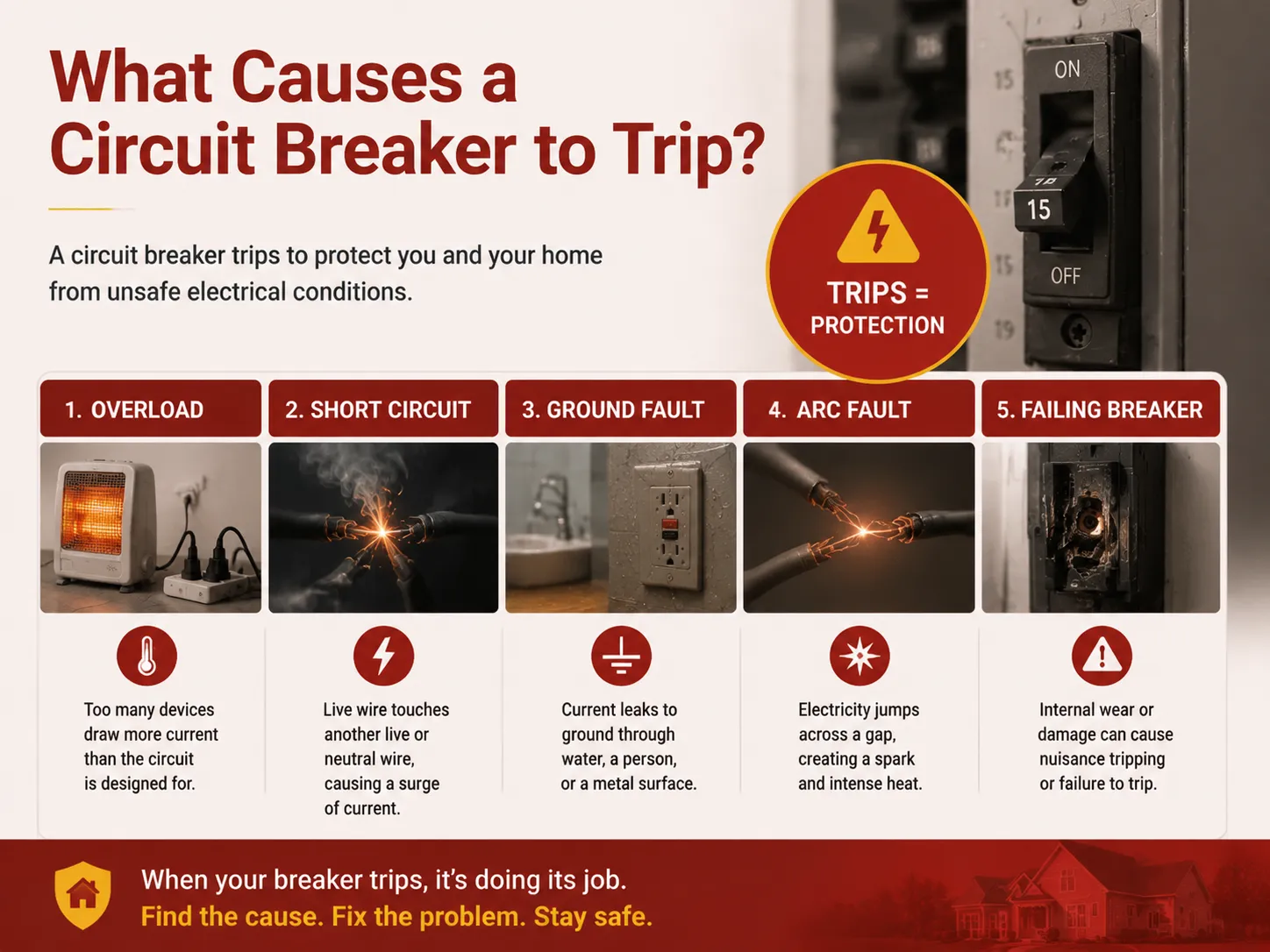
She had been treating the breaker as if it was a nuisance. In fact, the circuit breaker was doing precisely what it was supposed to do: preventing her wires from overheating and causing a fire in the wall. The reasons behind circuit breaker trips may include overload, short circuit, ground fault, arc fault, and faulty breaker. Each reasoning is backed by entirely different approach making it absolutely vital to be able to understand the difference and deal with all cases.
Summary: When a circuit breaker trips, it happens for one of five main reasons: overload (too many electrical devices connected to a circuit — typically known as the biggest cause of tripping as the circuit breaker will trip after a certain delay time, usually because of the presence of an appliance that draws large amount of current); short circuit (when a live wire comes into contact with either neutral or another live wire — the trip happens at once, often accompanied by a loud popping noise, a flash, or smell of burning); ground fault (when a live wire touches a ground surface, or the current finds a path to ground through a person or water — an instant trip that happens only under certain circumstances, like when a device is turned on or in the wet environment); arc fault (when a wire connection is loose or damaged so that an arc is generated but the AFCI breaker trips based on the presence of that arc — this situation may seem chaotic, but the arc will be linked to a damaged wire, a loose connection or a backstabbed outlet); failing breaker (when the breaker itself is worn out, pitted or has thermal drifts — trips that happen without a known reason, or when the breaker is buzzing, warm, or cannot be reset).
Overload: The Most Common Cause of a Tripping Breaker
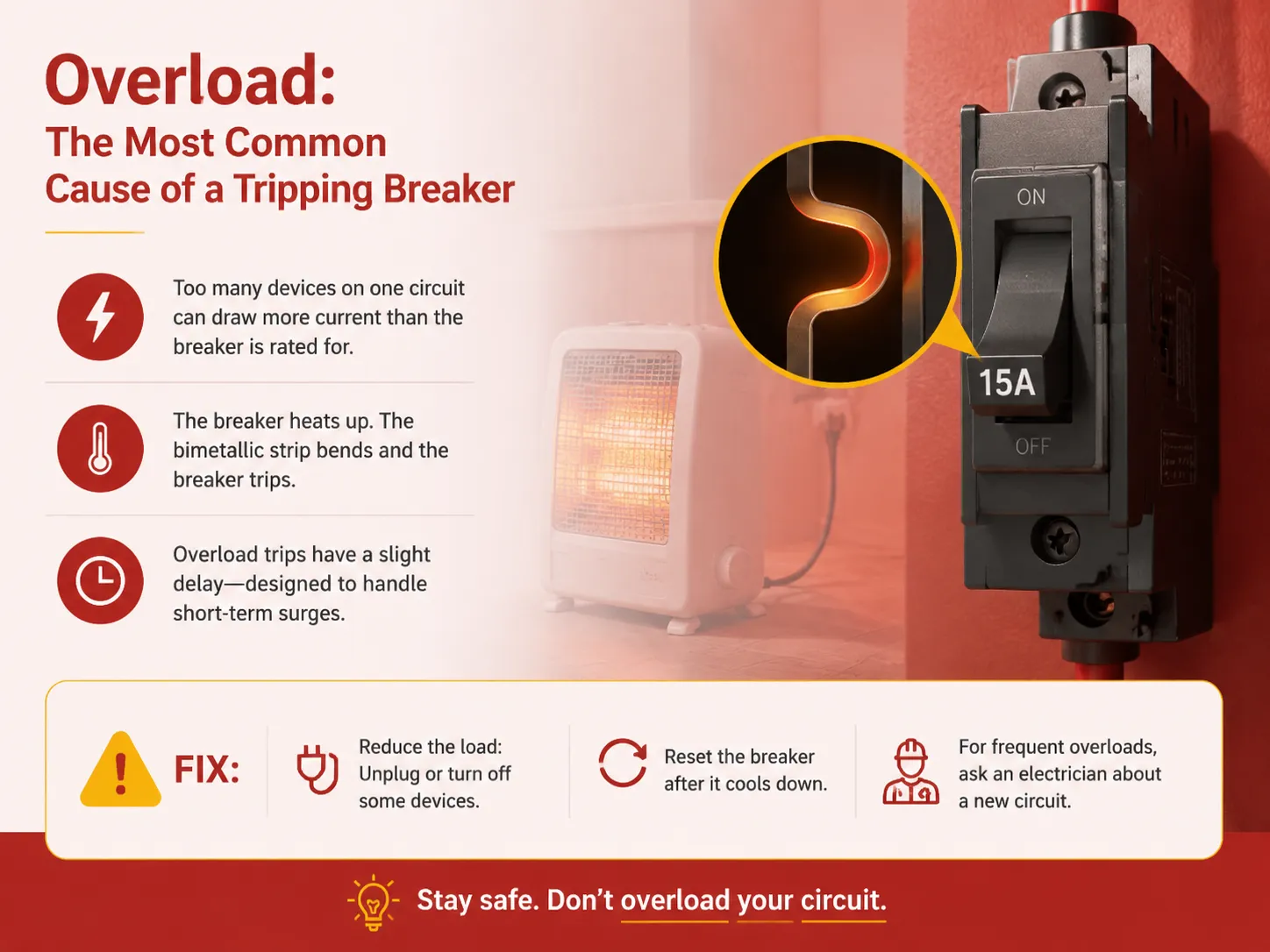
An overload occurs when all devices in a circuit draws a current that exceeds the rated current of the circuit breaker for a period above its rating. A circuit breaker rated for 15A can carry a current of 15A for a short period of time as well as 12A according to the National Electric Code (NEC) but only if used on a circuit rated 120V. When the circuit heats up above its rated current, the bimetallic strip inside the circuit breaker (overload trip) bends due to heat and disengages the trip latch. As mentioned before, the thermal element of the breaker operates according to the time–current curve which allows for momentary overloads without activating the trip of the circuit breaker. The symptom of an overload trip is a slight delay in its operation. When a person turns on an electrical heater, he/she might experience some interruption in power supply due to overload. The space heater draws 1500 watts of power, which is equivalent to 12.5 A in 120 V circuit. If any device is using electricity in the same circuit, the current will exceed the current rating of the breaker and the trip will be activated.
An overload may be fixed easily, though one may need to change his/her behaviour or replace the wiring. Initially, the response to the overload will be to disconnect or turn on several loads from the circuit, reset the breaker, and stop using any high-wattage device at the same time as any other devices. In the case of any chronic overload, like an office at home that constantly consumes more voltage than allowed by a single 15-amp circuit, it would be recommended to call on an electrician to create a new circuit just for the high-wattage appliance. Having a new circuit costs much less than dealing with overload with the circuit. For help calculating the load on any given circuit, our guide on what size circuit breaker you need explains the NEC‑based sizing process for both general and motor loads.
Short Circuit: The Instantaneous, Dangerous Trip
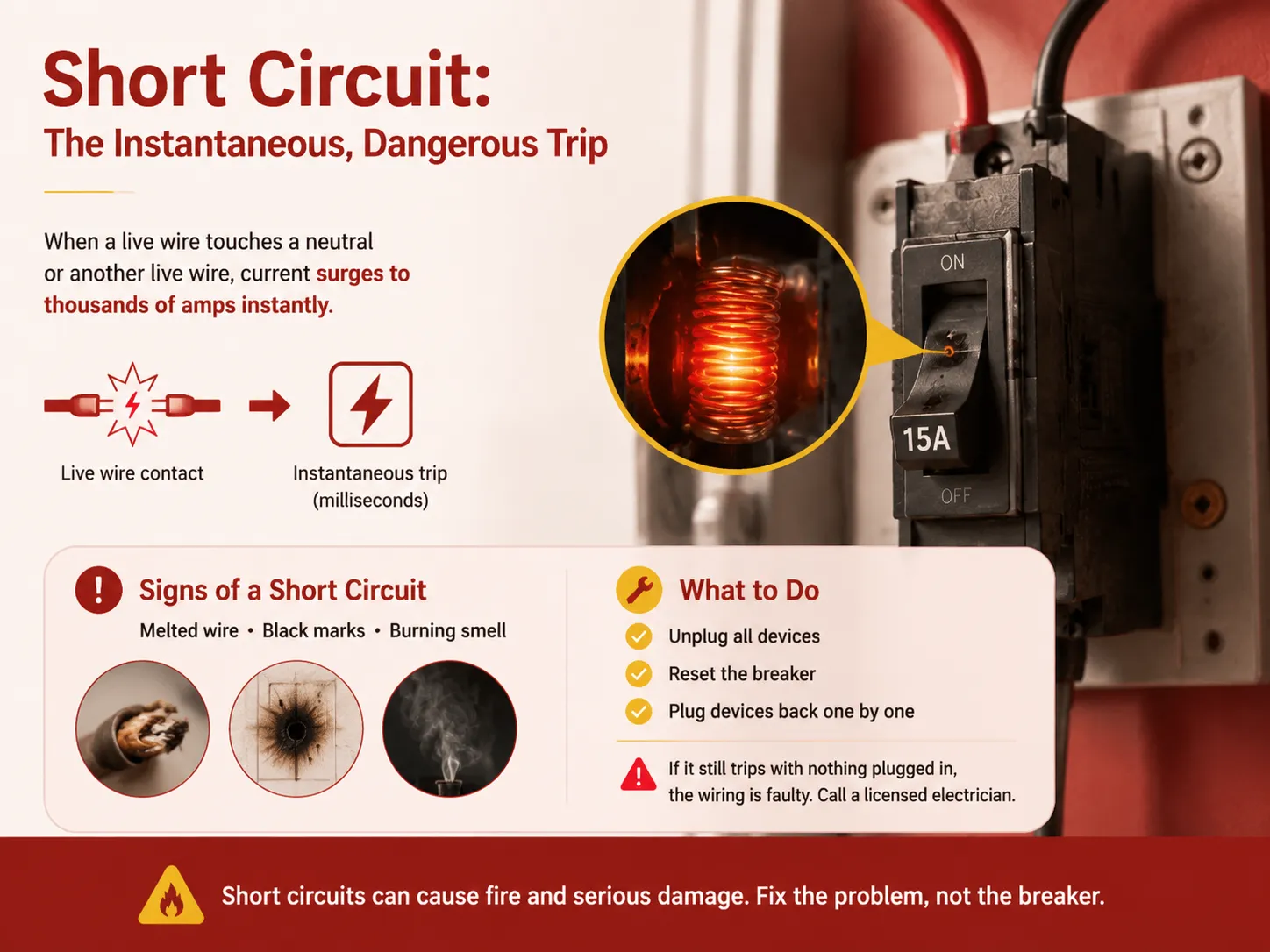
A short circuit happens when a live wire comes into contact with a neutral wire, or if two live wires in a different phase come into contact. The resistance of the fault that the electricity takes causes the current to increase almost instantly to thousands of amps. To react to this shocking and overwhelming increase in current, the breaker uses its magnetic component, called the magnetic coil. The tripping of the breaker from fault takes place almost immediately (within milliseconds) the instant the fault occurs, often making a sound while doing so. In addition to being dramatic, a short circuit can leave some signs of its occurrence which include the melted part of a wire, black marks on an outlet, or a burning smell around the switch or junction box.
A short circuit is a major fault that should be recognized and fixed before the breaker is reset. The common causes of short circuit are damaged cord of appliance in case the wire comes into contact with the cord and if the wire within the outlet box is damaged. It could also happen due to a screw or nail driven through a wire, killing the component within the appliance or lighting fixture. The process of diagnosing begins with removing all devices from the circuit, resetting the breaker, and plugging devices back one by one. The first appliance that causes the breaker to trip is identified as responsible for the short circuit. If no appliance is plugged into the circuit and the breaker trips, the problem is in the fixed wiring, which has to be fixed by licensed electrician. Continuing resetting the breaker with a short circuit fault could lead to melting of the contacts, destroying of the bus bar and starting of fire. The Electricity Safety Foundation International considered short circuits as one of the most common causes of fire electrical accidents.
Ground Fault: When Current Leaks to Earth
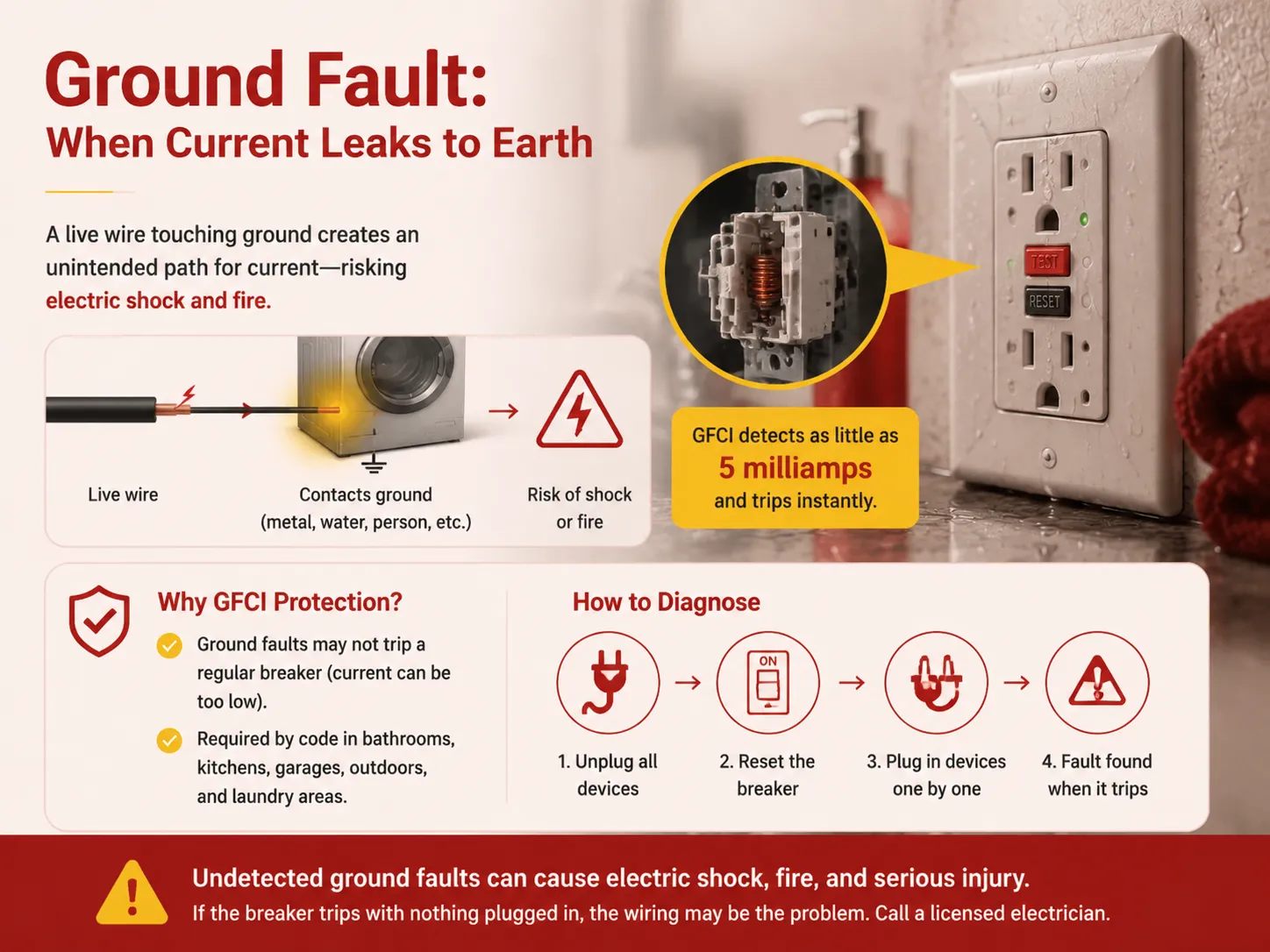
A ground fault is the result of a live conductor coming into contact with the ground — this ground could either be a metal housing of an appliance, a junction box, water pipes, a person on a wet surface, etc. Current moves from the wire to the ground via unintended route therefore creating a risk of electric shock and fire. A ground fault might or might not lead to tripping of a circuit breaker depending on the amount of fault current. In cases when ground path has high resistance — for example, when it travels through rusted pipe or dry concrete — electric shock might be very high, but current might be too low for a typical circuit breaker to trip. Therefore, the National Electrical Code requires that GFCI protection be installed in bathrooms, kitchens, garages, outside users’ homes, and laundry rooms. GFCI receptors and breakers detect undercurrent at a level of 5 milliamps and trip almost instantaneously. The characteristic sign of a ground fault on GFCI protected circuit is an immediate trip with regards to a specific device, wet condition, or time of the day.
The method for diagnosing a ground fault is identical to that for diagnosing a short circuit: unplug all of the devices, reset the circuit breaker, and plug in the devices one by one until the fault is located. The faulting device is the one that caused the tripping of the circuit breaker — it could be one of the cords, the heating elements, or the motors that have a problem with insulation that would necessitate repair or replacement. However, if a circuit breaker trips without any devices being plugged into it, then the problem would be in the wiring, which could easily be moisture in the junction box, nails piercing any of the wires, or failure of the breaker itself. In such instances, the ground fault can be determined by an electrician with the help of a megger. In the case of circuits that do not have ground fault protection, the high level of ground fault current would cause tripping of any circuit breaker. HUYU manufactures GFCI breakers and RCBOs (Residual Current Breakers with Overcurrent), such as the HUM18LE‑63 RCBO, that combine ground‑fault, overload, and short‑circuit protection in a single device, providing comprehensive protection for every final circuit.
Arc Fault: The Hidden Fire Starter
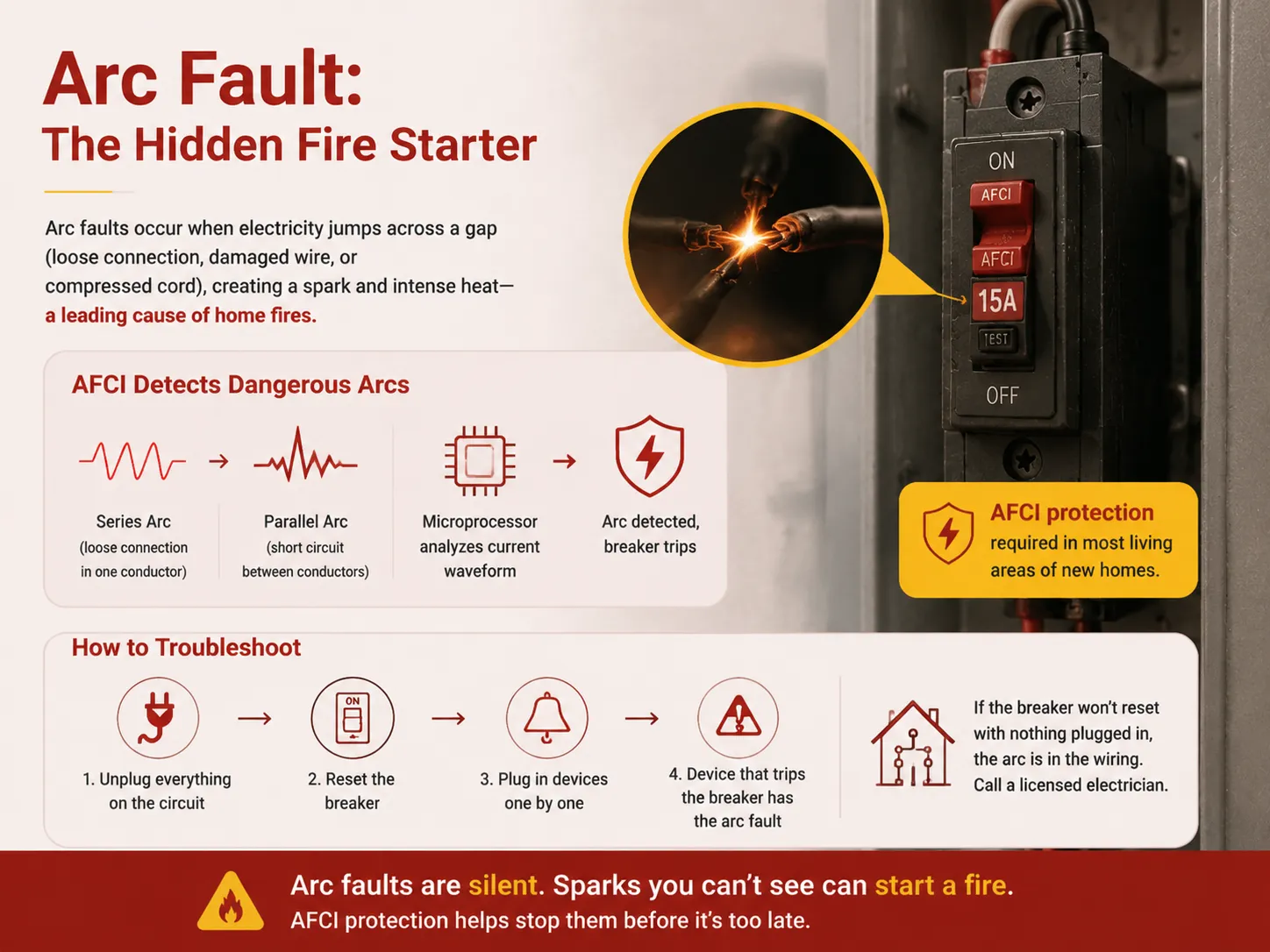
An arc fault constitutes a hazardous condition whereby electricity traverses the gap — a loose connection, damaged wire, or a compressed cord — which produces a spark leading to intense heat without necessarily drawing current sufficient to activate conventional circuit breake. The arcing phenomenon ranks among the primary reasons behind fires in residential buildings, which is why NEC stipulates the need for the AFCI (Arc Fault Circuit Interrupter) in almost all living sections of newly built houses. The AFCI circuitry is fitted with a microprocessor responsible for analyzing the waveform of the current in order to identify the existing patterns of both series arcs (loose connection in one conductor) and parallel arcs (a short circuit between conductors). After detecting the arc, the breaker will interrupt the circuit. A distinguishing feature of the arc fault circuit interruption is that it can seem to be random – it may trigger the breaker after switching on a certain lamp, using a vacuum cleaner, or even in the absence of any noticeable change. An arc may have occurred either somewhere within a wall or at a loose terminal of the outlet or in the cord of an electrical appliance.
The process for trying to determine why an AFCI has tripped starts the same way as for any tripped circuit: unplug everything on the line and see if the breaker resets. If it does, plug in things one by one. The device that trips the breaker is responsible for the arc – faulty cords, a malfunctioning switch, or loose parts. If the breaker does not reset when devices are plugged in, there is an arc issue with the electrical installation, and there will be a need for an electrician to check the wiring junctions including boxes, outlets, and switches. For a detailed explanation of how AFCIs work and how they differ from standard breakers, our article on how to tell if a breaker is bad covers the symptoms of a failing AFCI and the diagnostic steps to confirm it.
A Failing Breaker: When the Protector Becomes the Problem
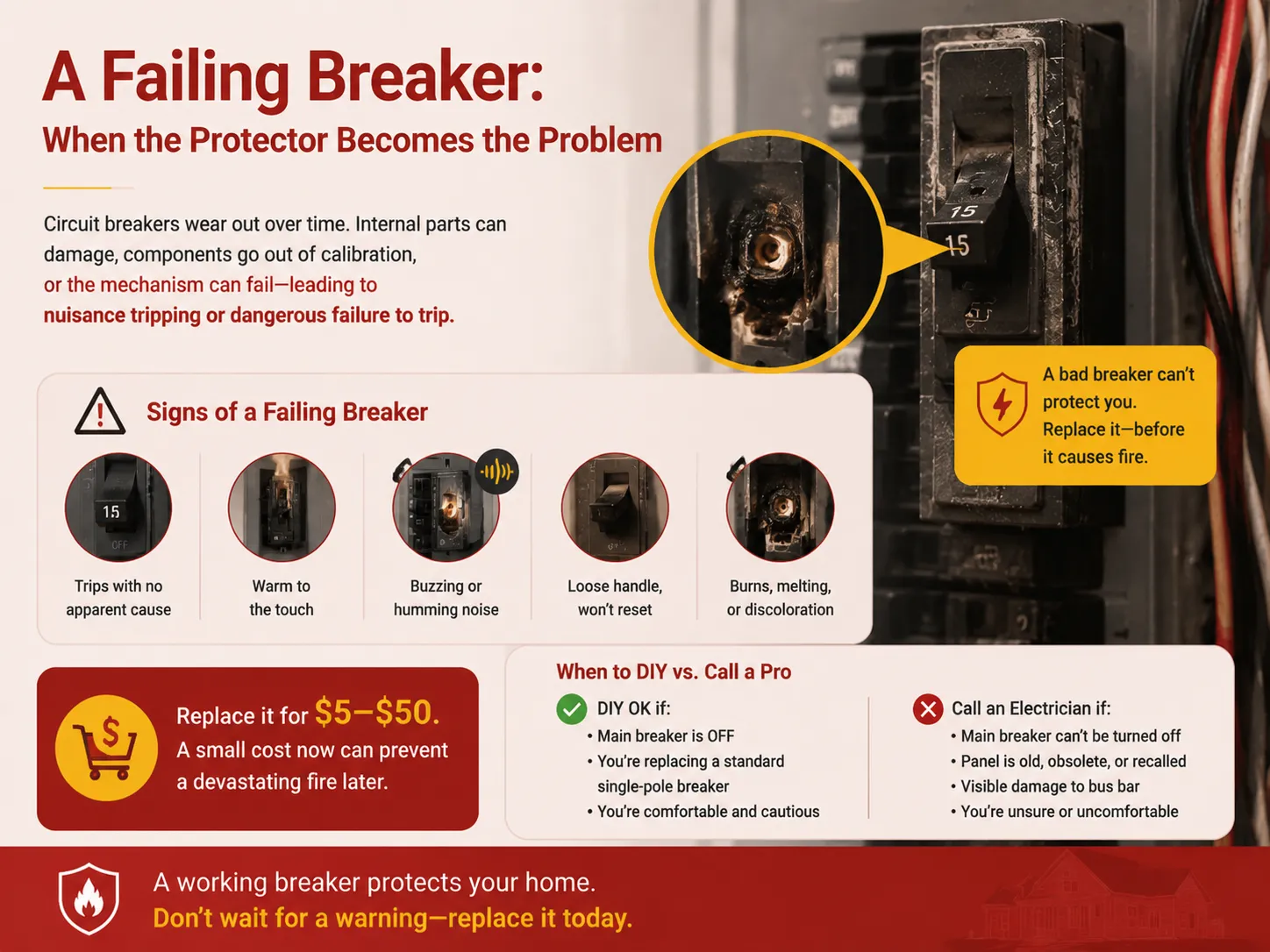
A circuit breaker is a built component with defined life which means that it will inevitably suffer wear; it is subjected to the internal contacts being damaged and obliterated because of repeated interruptions caused by short circuits. The bimetallic strip may become out of calibration due to many years of work under load close to the nominal value. The mechanism may become jammed or slack. If the circuit breaker is malfunctioning, it may not trip at the current which is below the rated value, resulting in nuisance tripping or, even worse, the opposite situation when the circuit breaker does not trip and allows dangerous conditions. The common signs of malfunctioning circuit breaker include tripping without any visible overload or defect in the circuit, breaking body being warm when touched, buzzing or humming noise from the circuit, a loose handle which cannot be set to the rest state, and overheating, burns, or even melting seen on the breaker. Each sign means that the circuit breaker should be replaced without delay. The price of circuit breaker replacement varies anywhere from $5 to $50 — that is way cheaper than the cost of the fire caused by a non-working circuit.
Changing out a conventional single-pole circuit breaker can be a simple endeavor for the cautious homeowner as long as the main breaker and voltage have already been proven to be off. If it is not possible to turn the main breaker off, if the breaker box is of an obsolete or recalled brand, if there is any visible damage to the bus bar, or if one does not feel at ease working in an electrical panel, then it is advisable to consult a professional electrician regarding the situation. For a detailed step‑by‑step guide through the safe replacement procedure, our article on how much to replace a circuit breaker covers the costs, the procedure, and the circumstances that require a professional.
The Diagnostic Sequence: What to Do When a Breaker Trips
When a circuit breaker trips, the approach must be rational rather than routine. Using the following steps will determine the cause in most instances and indicate whether the solution involves unplugging something or calling an electrician.
- Identify what was running when the breaker tripped. The suspect in the event of a circuit trip is the appliance that was switched on at the time of the trip. In this case, unplugging the appliance and resetting the breaker would be the next step to take. If the breaker does not trip, the next part of the troubleshooting process is to plug the appliance into a different circuit to find out if the appliance is still tripping the circuit breaker.
- If no single appliance was the obvious cause, unplug everything on the circuit. Shut down all switches in the electrical circuit. reset the breaker switch. If the breaker holds, the problem lies with one of the appliances. Reconnect the electrical appliances one at a time, pausing for a few minutes in between each one. The appliance that causes the circuit breaker to trip can be identified.
- If the breaker trips with nothing plugged in and all switches off, visually inspect every accessible outlet, switch, and junction box on the circuit. First and foremost, disconnect the main circuit breaker. After that, see whether there are signs of burning, such as traces of burning, melted plastic, burning odour, or loose wires.
- If the visual inspection reveals nothing, the fault is likely in the fixed wiring or in the breaker itself. At this stage, it is best to contact a licensed electrician. The electrician will measure the insulation resistance of the circuit, visit all junction boxes, and find out if the reason for the trip is in the breaker, the wiring, or a hidden defect.
Prevention: How to Avoid the Next Trip
The ideal circuit breaker trip is no trip at all. The following methods reduce the chances of any form of trip and contribute to the longevity of all circuit breakers in a panel:
- Respect the 80% rule for continuous loads. A circuit breaker must not be loaded beyond 80% of its rated current for three hours or more. For a 15-amp circuit, this means that the continuous load must remain under 12 amps.
- Avoid back‑stab connections on outlets and switches. A screw terminal makes a more robust and lower-resistance connection. Whereas back-stabbed wires become loose over time, causing an arc that will trip an AFCI breaker or potentially set fire to the wiring connection.
- Inspect appliance cords regularly. A frayed, pinched, or cracked cord could potentially become either a short circuit or a ground fault in the near future. Be sure to replace a damaged cord rather than tape it.
- Test GFCIs and AFCIs monthly. Click the TEST button, If the device does not trip, it has malfunctioned and needs to be replaced. A GFCI or AFCI that fails to trip on demand is offering no protection.
- Replace breakers that have cleared a major fault. The breaker that remains functional after the interruption of a dead short circuit or lightning strike has still undergone contact erosion. It is worth replacing.
Frequently Asked Questions
How do you fix a breaker that keeps tripping?
To resolve the problem, determine what caused it: either an overloaded circuit or an appliance or wiring fault, or if there is a failing breaker. You need to unplug every connected device, reset the breaker, and plug each device back into the circuit one by one, until you identify the device that trips the breaker; this device needs to be either repaired or replaced. If resetting the breaker does not solve your problem, or if the breaker feels warm or makes buzzing noises, you may need to contact a licensed electrician.
What device is most likely to trip a circuit breaker?
High‑wattage heating appliances Space heaters, hair dryers, toasters, and electric kettles cause the most frequent overload trips since these items almost reach the circuit’s maximum capacity on their own. For example, a 15 amp circuit may have a maximum capacity of 12.5 amps in a space heater.
How do I find out what is tripping my circuit breaker?
Disconnect all gadgets from the circuit and switch off all the switches. Reset the circuit breaker. If the circuit breaker stays that way, plug in the devices one at a time while waiting several minutes in between each connection. The device that causes the circuit breaker to trip is responsible. If the circuit breaker trips even though nothing is connected, visually inspect every amenable outlet and switch for signs of burning, loose wires, or presence of water. In case nothing is revealed, call a qualified electrician to check the insulation resistance and find the problem.
How many times can a breaker trip before it needs to be replaced?
The number of operations is not fixed. Circuit breakers may withstand a limited number of full-rated short-circuit interrupts – usually 2 or 3 times. After this, the contacts will be so worn out that they can no longer carry load. A breaker that has been overloaded too many times may have a thermal element that is out of order. Any breaker that runs hot, buzzes or has visible damages should be replaced, regardless of how many times it tripped.
References
- Electrical Safety Foundation International (ESFI) — Home Electrical Safety and Circuit Breaker Tripping. Consumer and professional guidance on the causes of breaker trips, including overload, short circuit, ground fault, and arc fault, and the recommended responses.
- National Fire Protection Association (NFPA) — NEC Articles 210, 230, and 240. The foundational requirements for overcurrent protection, GFCI and AFCI protection, and circuit breaker sizing and coordination in residential and commercial installations.
- Eaton — Circuit Breaker Diagnostic Guide. Manufacturer guidance on identifying the cause of a tripped breaker, testing a breaker’s functionality, and determining when a breaker must be replaced.
- Fluke — Electrical Troubleshooting and Insulation Resistance Testing. Manufacturer of test and measurement equipment, with application guidance on using multimeters and insulation resistance testers to diagnose circuit faults.
A circuit breaker that trips is not an inconvenience to be ignored or a handle to be reset repeatedly. It is a voice — the voice of a thermal element saying “too much current,” the voice of a magnetic coil saying “dead short,” the voice of a GFCI saying “current is leaking to ground,” the voice of an AFCI saying “something is arcing and could start a fire,” or the voice of the breaker itself saying “I am worn out and I need to be replaced.” Listening to that voice, identifying the cause, and responding correctly is the difference between a safe electrical system and a fire waiting to happen. HUYU manufactures the circuit breakers, GFCIs, RCBOs, and AFCIs that provide those voices — clear, reliable, and tested to the standards that protect the people and the buildings they serve.