
You might be reading a specification sheet, preparing for a test in electricity, or simply trying to figure out how your kitchen outlets work when you stumble on the statement that “GFCI means ground fault circuit interference.” It may sound right, but it is wrong. What GFCI actually means is ground fault circuit interrupter. You may think that the difference between the words “interrupter” and “interference” is just in terms of spelling, but it is not only about the spelling; it is the difference in meaning. In this article you will find explanations of what is GFCI, why ground fault circuit interference is wrong and how GFCI works, what can cause the device to trip and what you should not plug into GFCI.
Quick answer: The proper term GFCI, which stands for Ground Fault Circuit Interrupter, is often misunderstood as other names such as ground fault circuit interference and grand fuse circuitry in electrical terminology. This term refers to the apparatus that breaks electrical circuit when it senses a ground fault. According to the National Electrical Code and UL codes, the meaning of GFCI can be properly understood it in this way.
What GFCI Actually Stands For
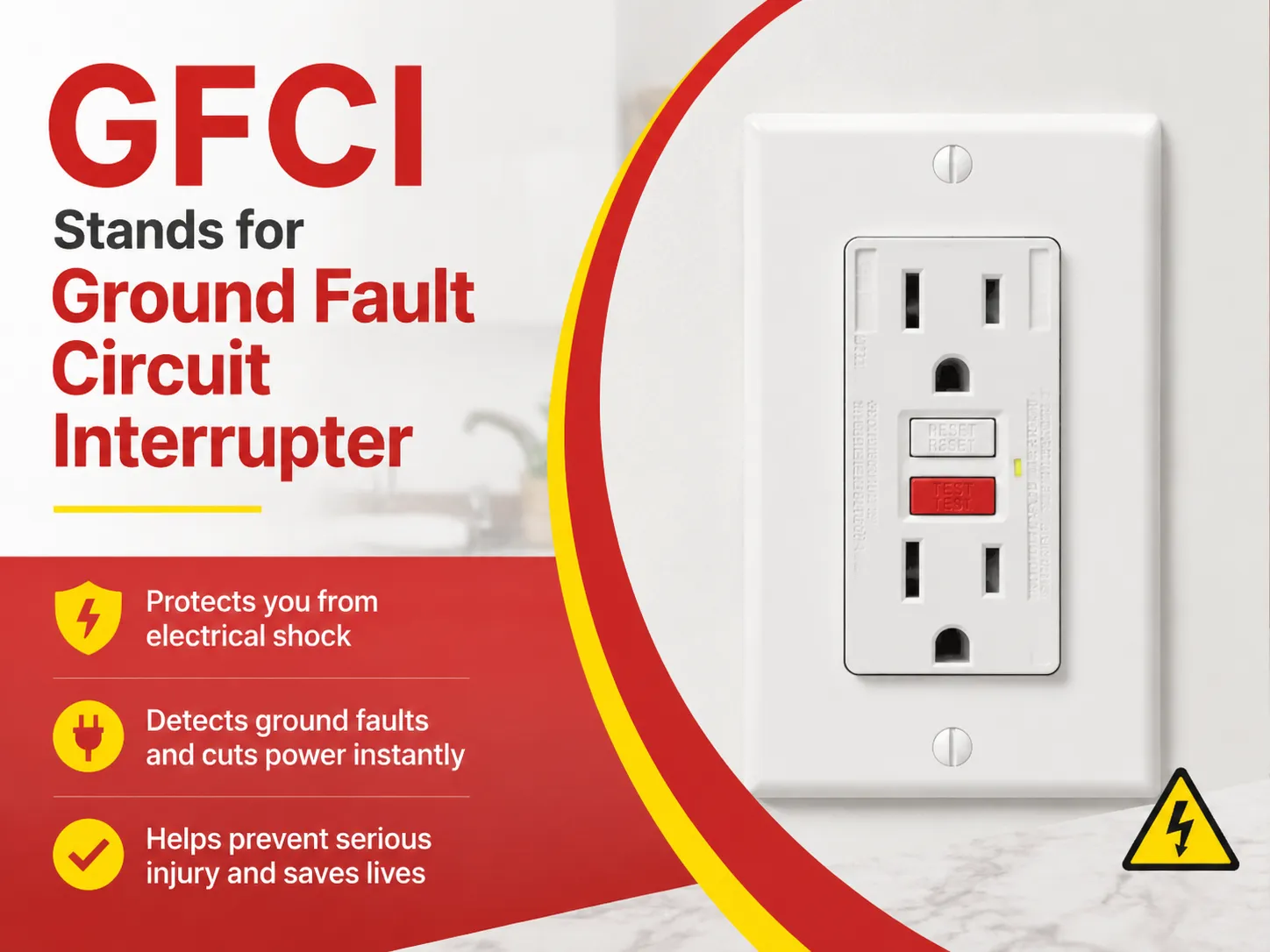
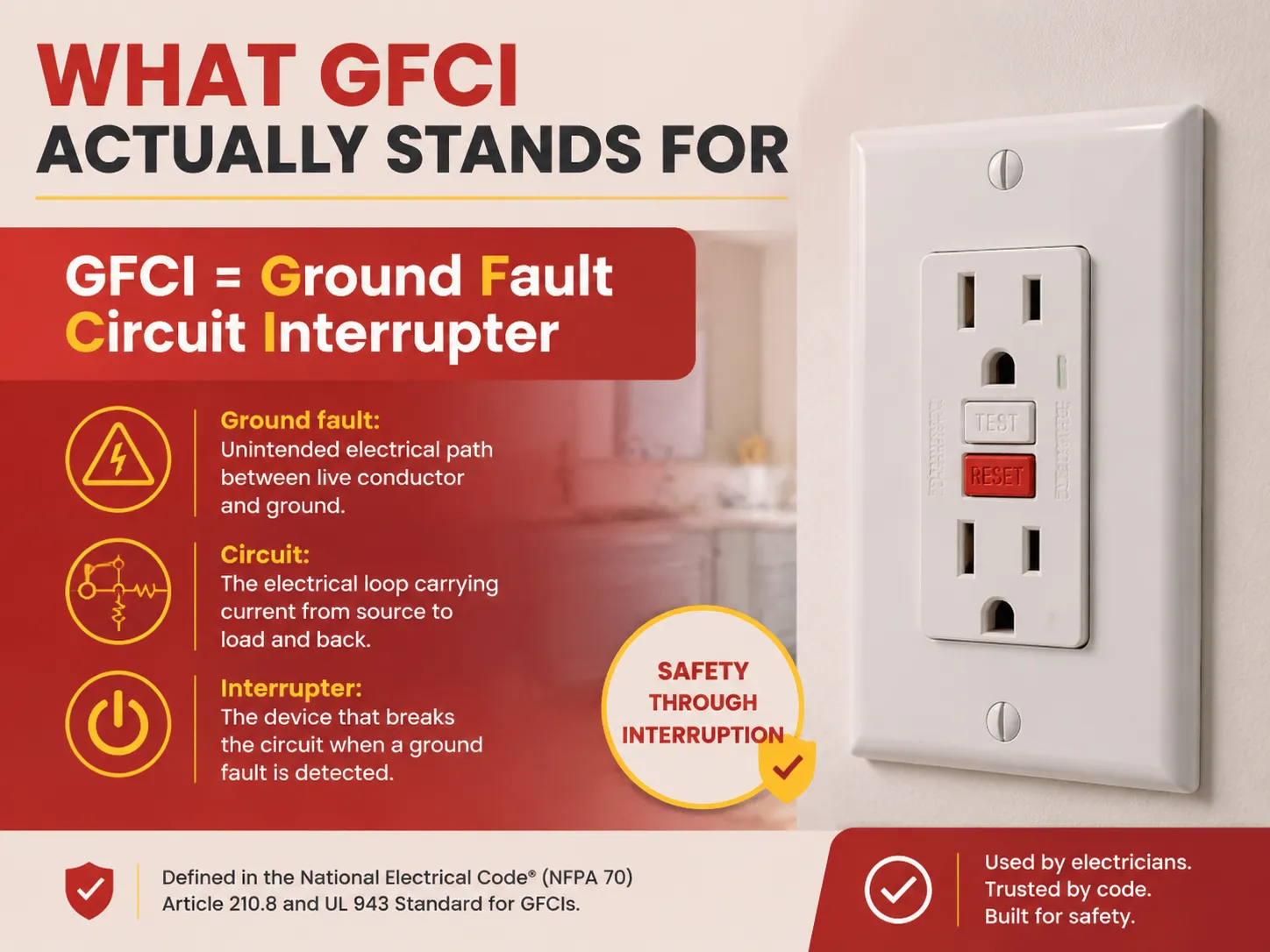
The acronym GFCI stands for: Ground Fault Circuit Interrupter.
Let us look at the definitions of each of the words:
- Ground fault: an unintentional course of electricity between a live wire and ground (i.e., through a person, through water, through the broken wire or through an appliance casing).
- Circuit: the electrical pathway that makes the current flow from N to L in a loop.
- Interrupter: a unit that makes a break in a circuit if any ground fault occurs.
This is not just an opinion. It is laid down in the National Electrical Code (NFPA 70), where the term “ground-fault circuit-interrupter” is used in Article 210.8 and other related articles. It is also used in UL 943, which is the safety standard for GFCIs. Moreover, all electrical training programs, manufacturers’ documentation (e.g., Leviton, Eaton, Legrand), and inspection reports use the term “interrupter.”
Why “Ground Fault Circuit Interference” Is Wrong
The term “interference” implies the interruption, obstruction, or interference of a circuit by the device, like electromagnetic interference (EMI). This is not what the GFCI does. The GFCI does not interfere with normal circuit functioning since it sits quietly and proves to be invisible in the circuit while letting the current flow through as it should. The only function it has is to stop the flow of the current as soon as it detects a ground fault. Thus, it is anything but interference.
But where does the confusion come from? Here are some explanations:
- Sound: the words “interrupter” and “interference” start from the same letters and sound somewhat similar, which leads to the confusion.
- Autocomplete: spell-checks and AI occasionally replace “interference” with that word because it is a more widely used one.
- Confusion with EMI: people tend to confuse “interference” with “electromagnetic interference” (EMI).
The exact word, verified according to NEC and UL, is interrupter, and GFCIs cannot mean “ground fault circuit interference.” An example of that mistake would be GFCI being written as meaning “ground fault circuit interference”.
What Is a GFCI and What Does It Do?
An electrical fault circuit interruption device is a rapid acting precautionary device used to protect individuals from electric shock hazards. The device compares the current in the source which is flowing in the hot line wire with the current in the neutral wire. Normally, these currents are equal. However, when some current flow is lost through the ground such as when a wet hand touches an appliance, dropping a hair dryer into water, or having damaged wire. The GFCI senses the imbalance of current and stops the flow of electricity in a maximum of 1/40 of a second.
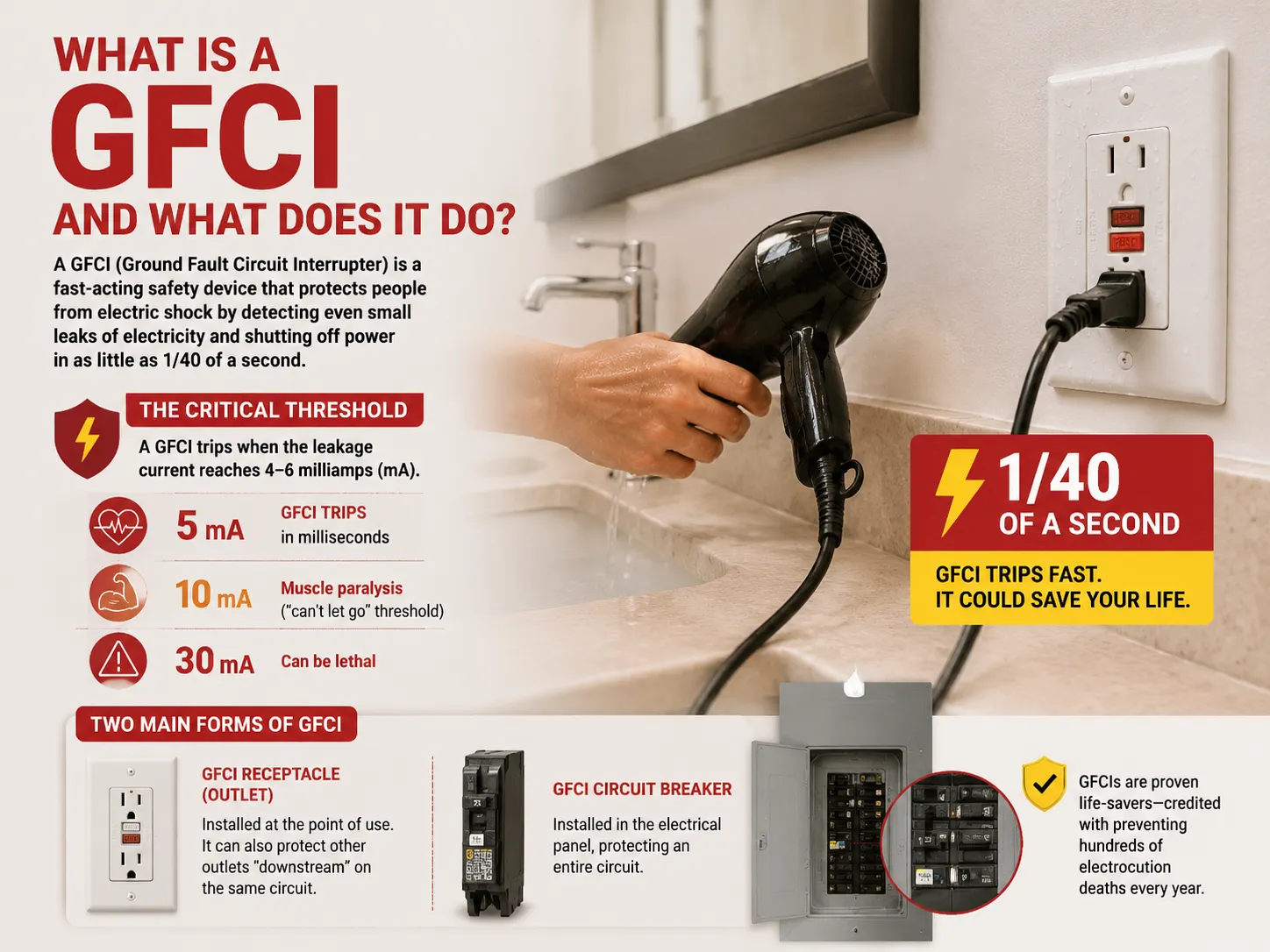
The critical level: the GFCI gets triggered at the 4-to-6 mA mark. To compare, 10 mA may cause muscle paralysis (the “can’t let go” threshold), while the lethal level is about 30 mA. In milliseconds, GFCIs activate at 5 mA and stop the shock before it is too late. That’s why the Consumer Product Safety Commission mostly gives GFCIs credit for saving hundreds from electrocution.GFCIs have two major types:
- GFCI outlet: the outlet with the TEST and RESET buttons that we know can be found at locations of their usage. It can also serve to protect other outlets on its circuit.
- GFCI circuit breaker: located at the electrical panel, saving the whole circuit from dangers.
Our article on circuit breakers and ground fault circuit interrupters explains how the two work together.
How a GFCI Detects a Ground Fault
The GFCI contains a little transformer known as a current transformer (CT) that encircles both hot and neutral wires. Here’s how it works:
- Normal operation: Current flows through the hot wire and returns through the neutral wire as equal amounts of current. The magnetic fields cancel each other, and therefore the transformer does not detect any current.
- Ground fault: Current gets diverted through a person, water, or break to the ground instead of following its usual course. Thus, the hot wire gets more current than the neutral wire.
- Imbalance: Transformer detects the difference from 4–6 milliamperes.
- Signal: Current transformer triggers a solenoid that mechanically opens the contacts and disconnects the power from the outlet.
- Reset: User needs to push the reset button to enable the power again because GFCI retains the information about the fault.
GFCI is a completely different type of protection from the circuit breaker because it detects ground leakage and not overloads.
The Facts and Evidence: Standards & Codes
Here’s the documentary evidence that settles the question once and for all:
| Source | What It Says |
|---|---|
| NFPA 70 (National Electrical Code) | Defines and requires “ground-fault circuit-interrupters” in Article 210.8 (dwelling units), Article 210.12 (arc-fault), and Article 680 (pools). The official term is “interrupter.” |
| UL 943 | The safety standard is titled “Standard for Safety for Ground-Fault Circuit-Interrupters.” UL listed GFCIs are tested to trip at 4–6 mA within 25 ms. |
| NEC 210.8 | Requires GFCI protection for bathroom receptacles, kitchen countertops, garages, outdoors, basements, crawl spaces, laundry areas, and wet bars. |
| Manufacturer literature | Leviton, Eaton, Legrand, Hubbell — every major manufacturer’s product pages and installation manuals use “ground fault circuit interrupter.” |
| Dictionary/industry usage | Electrical industry glossaries (IEEE, ESFI, OSHA) all define GFCI as “ground fault circuit interrupter.” |
All genuine authorities on electricity avoid the term “interference.” If you are given a quiz or license examination based on the acronym, the answer that you must choose is always the word “interrupter.”
Where GFCIs Are Required
In accordance with NEC 210.8, the following areas in residential settings are mandated to be fitted with Ground Fault Circuit Interrupter (GFCI) protection:
- The bathrooms should have GFCI protection for all outlets.
- For kitchen countertops, all outlets within 6 feet of the sink should be protected with GFCI.
- GFCI protection should be provided in all garages or unfinished basements.
- All outdoor receptacles, including those used in the crawl spaces and unfinished buildings must have GFCI fitted.
- The laundry rooms must comply with the GFCI requirements.
- Wet bars must be provided with GFCI protection.
- GFCI protection is also required for the boat houses, swimming pools, and spas.
However, expansive GFCI requirements are applicable in commercial and industrial settings as well. Current codes have become stricter (2020 and 2023) in regard to appliance that previously did not require functioning GFCI.
What Causes a GFCI to Trip?
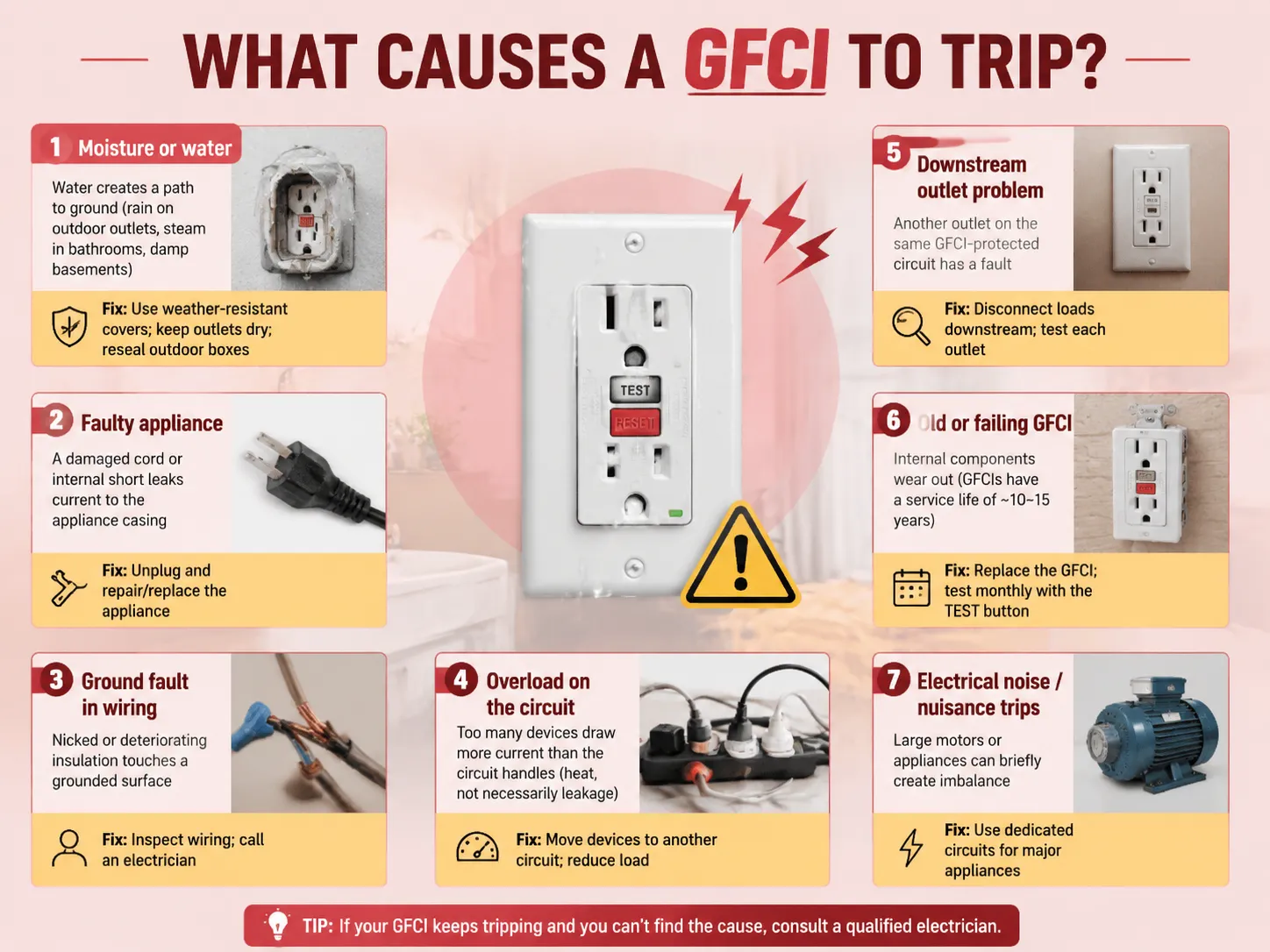
A GFCI trips whenever it senses current leaking to ground. The most common causes:
| Cause | What’s Happening | Fix |
|---|---|---|
| Moisture or water | Water creates a path to ground (rain on outdoor outlets, steam in bathrooms, damp basements) | Use weather-resistant covers; keep outlets dry; reseal outdoor boxes |
| Faulty appliance | A damaged cord or internal short leaks current to the appliance casing | Unplug and repair/replace the appliance |
| Ground fault in wiring | Nicked or deteriorating insulation touches a grounded surface | Inspect wiring; call an electrician |
| Overload on the circuit | Too many devices draw more current than the circuit handles (heat, not necessarily leakage) | Move devices to another circuit; reduce load |
| Downstream outlet problem | Another outlet on the same GFCI-protected circuit has a fault | Disconnect loads downstream; test each outlet |
| Old or failing GFCI | Internal components wear out (GFCIs have a service life of ~10–15 years) | Replace the GFCI; test monthly with the TEST button |
| Electrical noise / nuisance trips | Large motors or appliances can briefly create imbalance | Use dedicated circuits for major appliances |
For more on diagnosing repeated trips at the breaker level, see our articles on what causes a circuit breaker to trip and whether a repeatedly tripping breaker is dangerous.
What Should Not Be Plugged into a GFCI
This is an important detail worth paying attention to. The building codes state the necessity of GFCI safety in some cases, but there are several devices which should not run on circuits equipped with GFCI safety since their unexpected shut off may lead to destruction.
- Refrigerators and freezers: if a GFCI trips unexpectedly, the refrigerator is turned off without you being aware of it and this situation leads to spoiling food. In numerous cases, electricians usually place refrigerators on dedicated circuits and ensure GFCI protection exists only where required by code, for instance, in case of being situated less than 6 feet from a sink.
- Sump pumps: in case GFCI has tripped the pump gets turned off and the basement floods. The current code states that sump pump circuits must possess GFCI protection hence it is advisable to apply either alarm-sensing GFCI breakers or battery powered sump pumps.
- Life-support and medical machines: these must remain operational and they require guaranteed energy supply.
- Freezers and garage freezers: the same issue as for refrigerators.
- Computers/servers (in some cases): unwanted tripping of circuits can result in the loss of important information hence uninterruptible circuits must be installed.
The main thing here is that following the NEC guidelines is a must if GFCI protection is stated for your case as some appliances have dedicated circuits separately from others and equipped with GFCI breakers with alarms to notify you about tripping situation. In case you are not sure what the active requirements are, it is always better to contact a licensed electrician.
GFCI vs. Circuit Breaker: Same Thing?
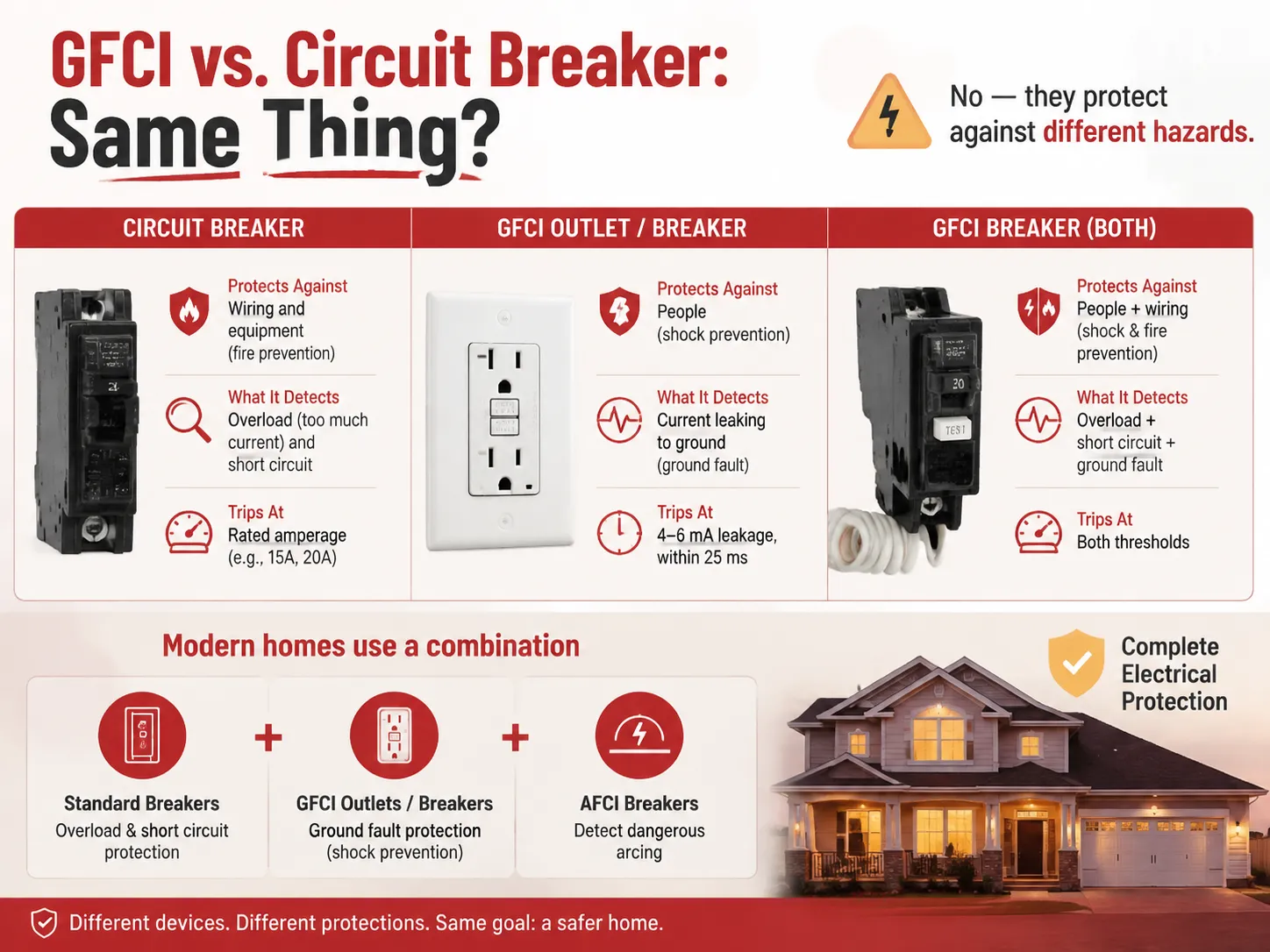
No — they protect against different hazards:
| Device | Protects Against | What It Detects | Trips At |
|---|---|---|---|
| Circuit breaker | Wiring and equipment (fire prevention) | Overload (too much current) and short circuit | Rated amperage (e.g., 15A, 20A) |
| GFCI | People (shock prevention) | Current leaking to ground (ground fault) | 4–6 mA leakage, within 25 ms |
| GFCI breaker (both) | People + wiring | Overload + short circuit + ground fault | Both thresholds |
Today’s housing incorporates standard circuit breakers for circuit overload protection, GFCI (Ground Fault Circuit Interrupter) outlets or GFCI breakers for current shock protection, and altar-circuit breaker for detecting unsafe levels of arcing current.If you want to understand related residual-current devices used in other parts of the world, our comparison of RCCB vs RCBO covers the international versions of the same concept.
Frequently Asked Questions
Does GFCI stand for ground fault circuit interrupter?
Indeed — GFCI signifies ground fault circuit interrupter. This is the correct version given by the National Electrical Code (NFPA 70), UL 943 and all leading manufacturers. GFCI keeps an eye on current travelling out through hot wire against the return on the neutral wire with regard to which GFCI disconnects the circuit almost during a span of 1/40 of a second if the difference comes to about 4-6 milliamps (ground fault). All other states of the expansion like ground fault circuit interference are wrong.
What should not be plugged into a GFCI?
Appliances that can be dangerous if there is a loss of power are refrigerators (food spoilage), sump pumps (flooding), medical and life-support equipment (risk to life), and important computers/servers (risk of data loss). However, the code still requires GFCI to be present in many of these places. In most instances, this can be achieved via the use of a dedicated circuit, GFCI breaker with alarm, or a battery backup; protection should not be disregarded. Consult an expert for your situation and check the local codes.
What does GFCI stand for good for circuit installations grand fuse circuitry impulse ground fault circuit interrupter ground fault circuitry installation?
The right answer is the ground fault circuit interrupter. All the other alternatives are incorrect; “grand fuse circuitry” mistakes GFCI for fuses; “impulse” has nothing to do with the functioning of GFCI; and “ground fault circuitry installation” describes a generic installation not the device. The term that corresponds to the definition given in the NEC and UL is only ground fault circuit interrupter — the device that interrupts a circuit as soon as it detects ground fault.
What can cause a ground fault circuit interrupter (GFCI) to trip?
When a GFCI recognizes an electric current leakage to the ground (4–6 mA), it trips. The following are the usual reasons leading to this: the presence of moisture or water in the area of the outlets (like rain, steam, damp basements); faulty appliances that have damaged wires or shorts within them; ground fault in the wiring (nicked insulation); circuit overloads caused by connecting too many devices; malfunctions on the downstream outlets that fall under the same GFCI protection; faulty old or worn-out GFCIs (lifespan about 10-15 years); and noise produced by big motors. If the GFCI trips too often, it would be necessary to unplug all equipment on the circuit. It has to be reset and plugged back in one by one in order to identify the source of failure, or the help of a professional electrician has to be requested.
References
- NFPA 70 (National Electrical Code) — The authoritative code defining “ground-fault circuit-interrupter” and specifying where GFCI protection is required (Article 210.8, Article 680).
- UL 943 — Standard for Safety for Ground-Fault Circuit-Interrupters — The UL safety standard that certifies GFCIs, specifying the 4–6 mA trip threshold and 25 ms trip time.
- OSHA Electrical Safety — U.S. workplace safety guidance on GFCI use in construction and general industry, reinforcing the correct terminology and required applications.
- Electrical Safety Foundation International (ESFI) — Nonprofit organization providing consumer education on GFCI testing, installation, and the life-saving role of ground fault protection.
- CPSC Electrical Safety — U.S. Consumer Product Safety Commission data on electrocutions prevented by GFCIs and home electrical safety guidance.
- U.S. Department of Energy — Operating GFCI Outlets — Practical guidance on how GFCI outlets work, how to test them monthly, and what trips them.
Conclusion
It is evident that GFCI means Ground Fault Circuit Interrupter and NOT “ground fault circuit interference.” The word “interrupter” is used as it defines the job of this particular device — to temporarily cut off the circuit after detecting a ground fault. The word “interference,” however, defines something that causes the disruption of normal functioning, which is absolutely the opposite of what GFCIs do.
Here’s what to keep in mind:
- The term is interrupted, which has been officially affirmed by NEC, UL 943, OSHA, and all producers.
- GFCI compares outgoing and incoming currents; it trips at 4-6 mA within milliseconds.
- It protects a person but not wires because while circuit protection prevents overloading, GFCIs work to prevent shocks.
- Make sure GFCIs are tested monthly with TEST buttons, and are replaced every 10-15 years.
- Avoid connecting life-supporting and food-storing equipment to GFCI circuits where tripping might be harmful — instead, choose circuits with no GFCIs or ones that have alarm signals where allowed by code.
Next time you see “GFCI stands for ground fault circuit interference” on the web, you will know for sure that this is wrong and why.