

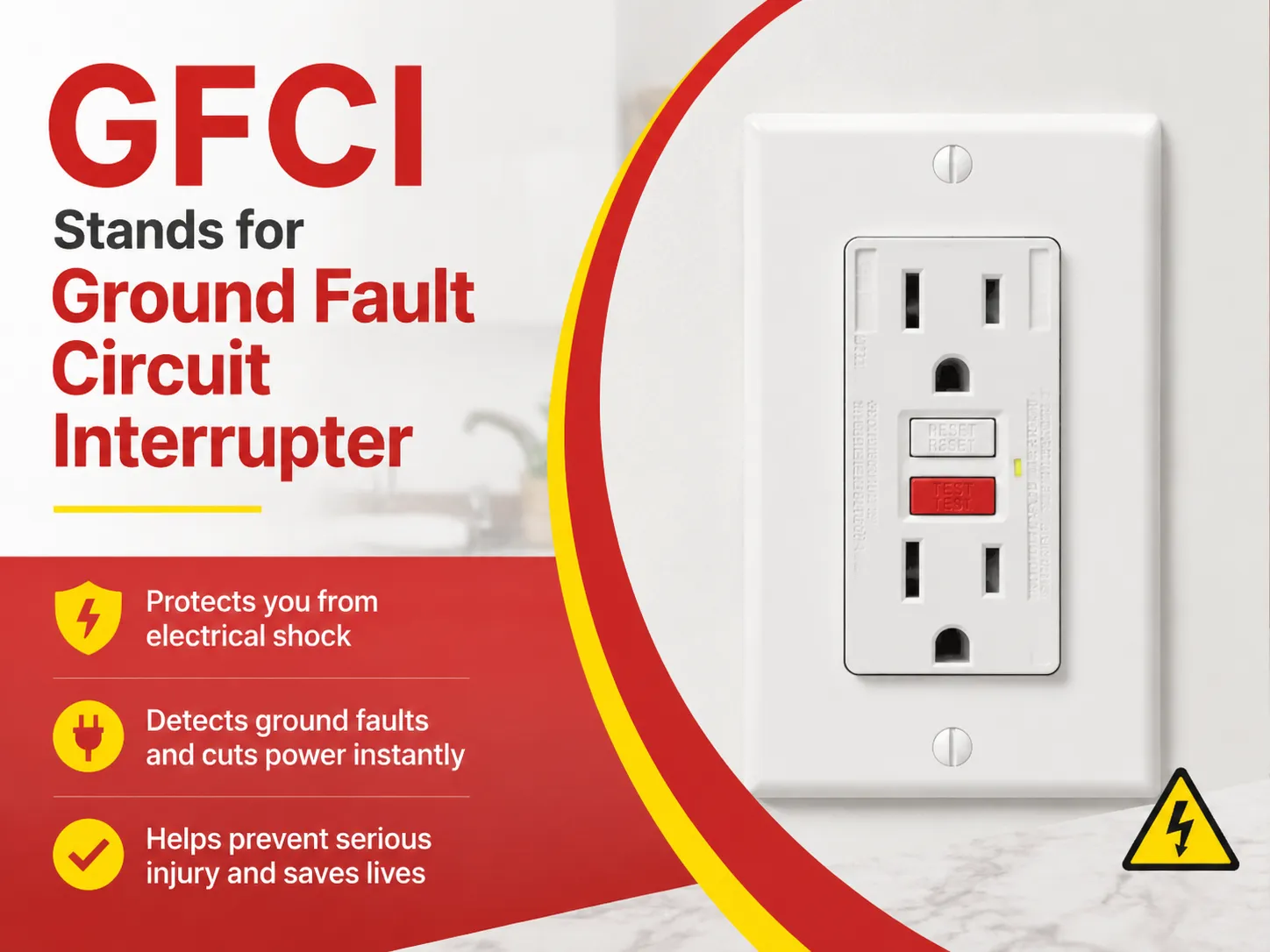
Você pode estar lendo uma ficha técnica, se preparando para um teste em eletricidade ou simplesmente tentando entender como funcionam as tomadas da sua cozinha quando se depara com a afirmação de que “GFCI significa interferência de circuito de falha à terra.” Pode parecer correto, mas está errado. O que GFCI realmente significa é interruptor de circuito de falha à terra. Você pode pensar que a diferença entre as palavras “interruptor” e “interferência” está apenas na grafia, mas não se trata apenas da grafia; é a diferença no significado. Neste artigo, você encontrará explicações sobre o que é GFCI, por que interferência de circuito de falha à terra está errado, como o GFCI funciona, o que pode causar o disparo do dispositivo e o que você não deve conectar em um GFCI.
Resposta rápida: O termo correto GFCI, que significa Ground Fault Circuit Interrupter, é frequentemente mal interpretado como outros nomes, como interferência de circuito de falha à terra e circuito de fusível principal na terminologia elétrica. Este termo refere-se ao aparelho que interrompe o circuito elétrico quando detecta uma falha à terra. De acordo com o Código Elétrico Nacional e os códigos UL, o significado de GFCI pode ser corretamente entendido dessa forma.
O que GFCI Realmente Significa
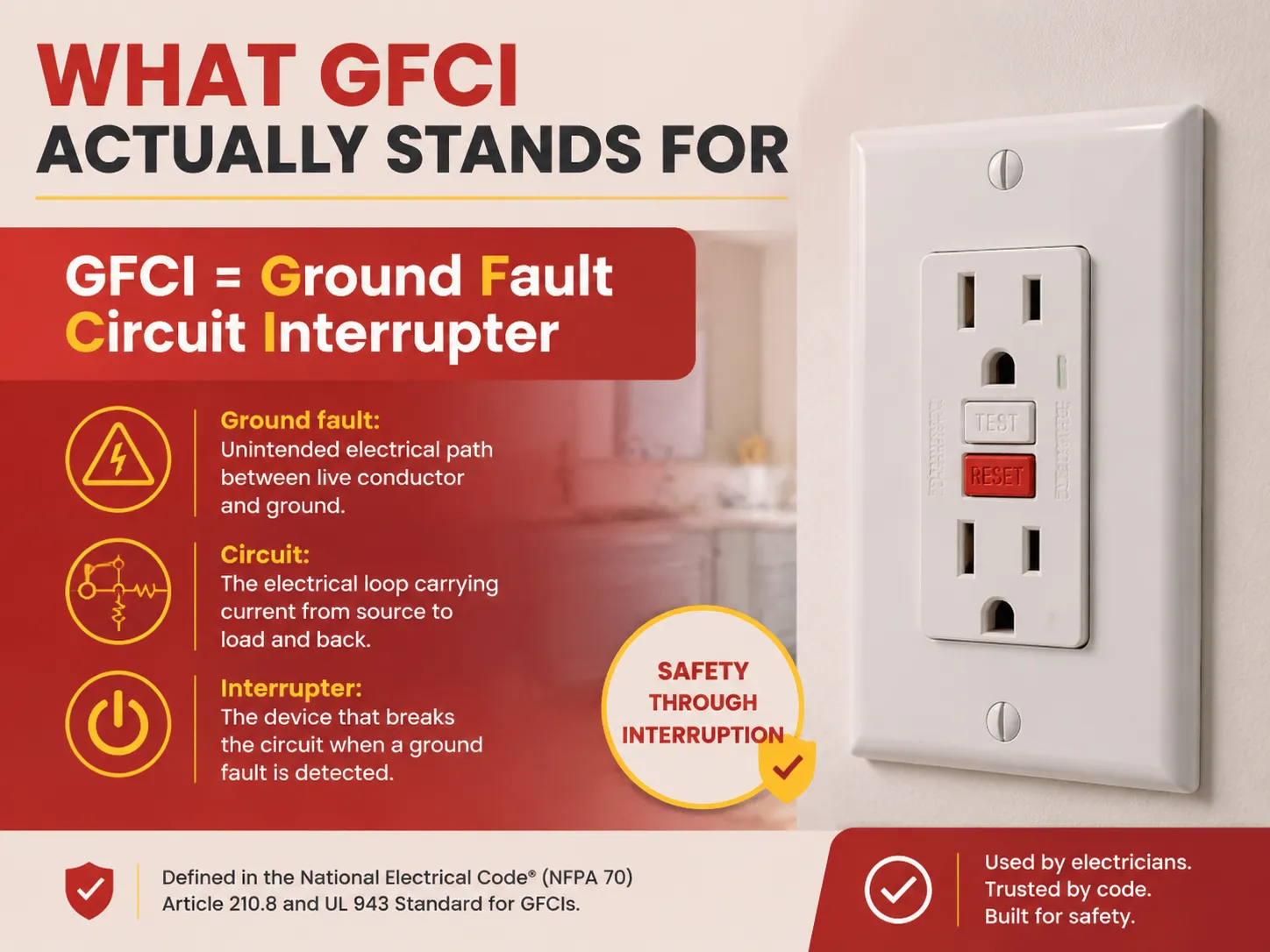
A sigla GFCI significa: Ground Fault Circuit Interrupter.
Vamos analisar as definições de cada uma das palavras:
- Falha à terra: um caminho não intencional de eletricidade entre um fio ativo e a terra (ou seja, através de uma pessoa, através da água, através de um fio rompido ou através da carcaça de um aparelho).
- Circuito: o caminho elétrico que faz a corrente fluir de N para L em um loop.
- Interruptor: uma unidade que faz uma interrupção no circuito se ocorrer qualquer falha à terra.
Isso não é apenas uma opinião. Está estabelecido no Código Elétrico Nacional (NFPA 70), onde o termo “ground-fault circuit-interrupter” é usado no Artigo 210.8 e em outros artigos relacionados. Também é usado na UL 943, que é o padrão de segurança para GFCIs. Além disso, todos os programas de treinamento elétrico, documentação dos fabricantes (por exemplo, Leviton, Eaton, Legrand) e relatórios de inspeção usam o termo ’interruptor.“
Por Que “Interferência de Circuito de Falha à Terra” Está Errado
O termo “interferência” implica a interrupção, obstrução ou interferência de um circuito pelo dispositivo, como interferência eletromagnética (EMI). Isso não é o que o GFCI faz. O GFCI não interfere no funcionamento normal do circuito, pois permanece silencioso e invisível no circuito enquanto permite que a corrente flua como deveria. A única função que ele tem é interromper o fluxo da corrente assim que detecta uma falha à terra. Portanto, está longe de ser interferência.
Mas de onde vem a confusão? Aqui estão algumas explicações:
- Som: as palavras “interruptor” e “interferência” começam com as mesmas letras e soam de forma semelhante, o que leva à confusão.
- Autocompletar: verificadores ortográficos e IA ocasionalmente substituem “interferência” por essa palavra porque é mais amplamente usada.
- Confusão com EMI: as pessoas tendem a confundir “interferência” com “interferência eletromagnética” (EMI).
A palavra exata, verificada de acordo com a NEC e UL, é interrupter, e GFCIs não podem significar “ground fault circuit interference.” Um exemplo desse erro seria GFCI sendo escrito como significando “ground fault circuit interference”.
O que é um GFCI e o que ele faz?
Um dispositivo de interrupção de circuito por falha elétrica é um dispositivo de precaução de ação rápida usado para proteger indivíduos contra riscos de choque elétrico. O dispositivo compara a corrente na fonte que está fluindo no fio da linha quente com a corrente no fio neutro. Normalmente, essas correntes são iguais. No entanto, quando algum fluxo de corrente é perdido através do aterramento, como quando uma mão molhada toca um aparelho, deixa um secador de cabelo cair na água ou há um fio danificado. O GFCI detecta o desequilíbrio de corrente e interrompe o fluxo de eletricidade em no máximo 1/40 de segundo.
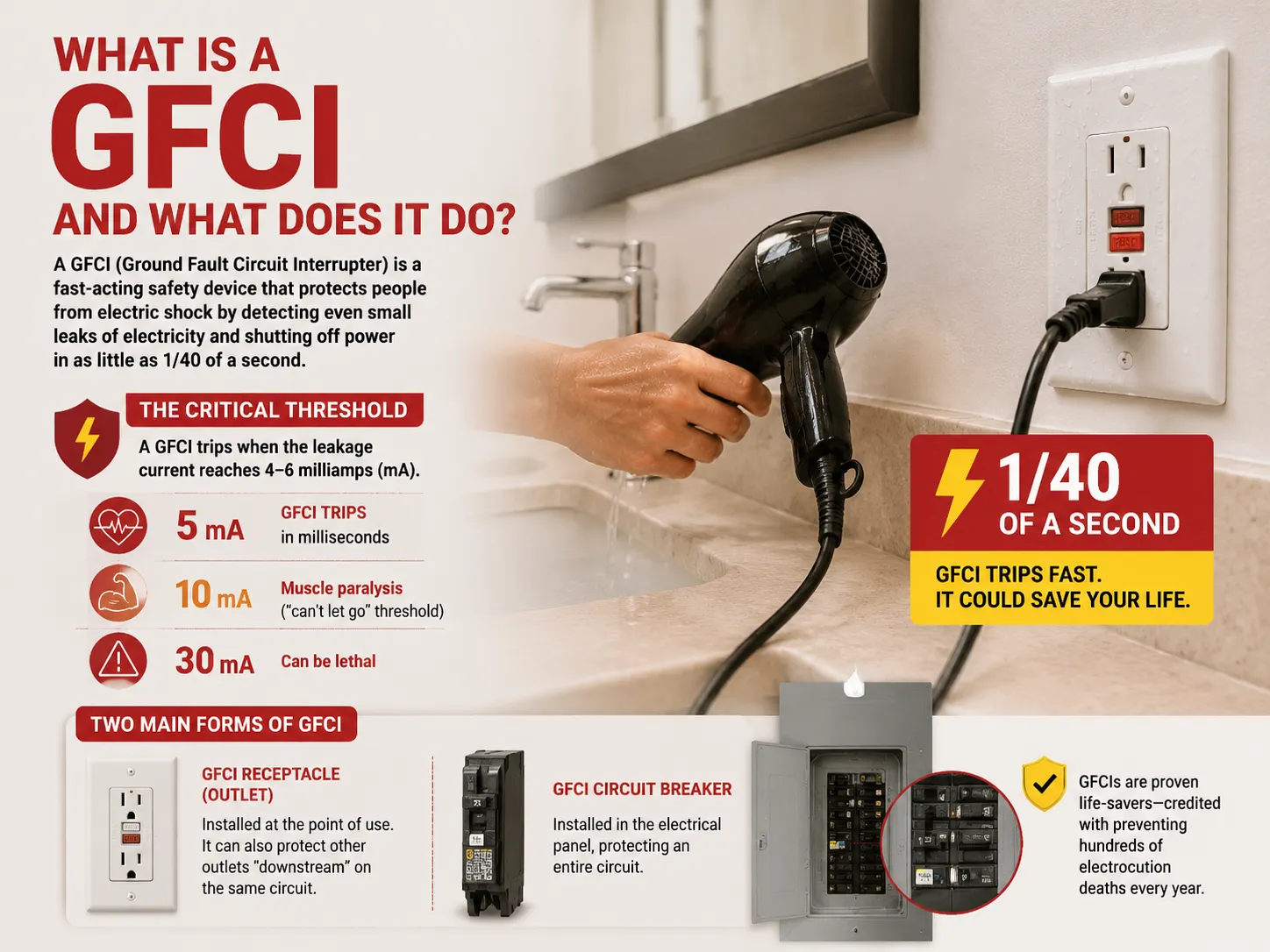
O nível crítico: o GFCI é acionado na marca de 4 a 6 mA. Para comparar, 10 mA podem causar paralisia muscular (o limiar do “não conseguir soltar”), enquanto o nível letal é cerca de 30 mA. Em milissegundos, os GFCIs ativam em 5 mA e interrompem o choque antes que seja tarde demais. É por isso que a Consumer Product Safety Commission geralmente credita os GFCIs por salvar centenas de pessoas de eletrocussão. Os GFCIs têm dois tipos principais:
- Tomada GFCI: a tomada com os botões TEST e RESET que conhecemos e que pode ser encontrada nos locais de uso. Também pode proteger outras tomadas em seu circuito.
- Disjuntor GFCI: localizado no painel elétrico, protegendo todo o circuito contra perigos.
Nosso artigo sobre disjuntores e interruptores de circuito por falha elétrica explica como os dois funcionam juntos.
Como um GFCI detecta uma falha de aterramento
O GFCI contém um pequeno transformador conhecido como transformador de corrente (CT) que envolve os fios quente e neutro. Veja como funciona:
- Operação normal: A corrente flui pelo fio quente e retorna pelo fio neutro em quantidades iguais de corrente. Os campos magnéticos se cancelam, e portanto o transformador não detecta nenhuma corrente.
- Falha à terra: A corrente é desviada através de uma pessoa, água ou ruptura para o aterramento em vez de seguir seu curso habitual. Assim, o fio quente recebe mais corrente do que o fio neutro.
- Desequilíbrio: O transformador detecta a diferença de 4 a 6 miliamperes.
- Sinal: O transformador de corrente aciona um solenóide que abre mecanicamente os contatos e desconecta a energia da tomada.
- Redefinir: O usuário precisa pressionar o botão de reset para habilitar a energia novamente porque o GFCI mantém a informação sobre a falha.
O GFCI é um tipo completamente diferente de proteção do disjuntor porque detecta fuga para o aterramento e não sobrecargas.
Os fatos e evidências: normas e códigos
Aqui está a evidência documental que resolve a questão de uma vez por todas:
| Fonte | O que diz |
|---|---|
| NFPA 70 (Código Elétrico Nacional) | Define e exige “ground-fault circuit-interrupters” no Artigo 210.8 (unidades residenciais), Artigo 210.12 (falha de arco) e Artigo 680 (piscinas). O termo oficial é “interrupter.” |
| UL 943 | A norma de segurança é intitulada “Standard for Safety for Ground-Fault Circuit-Interrupters.” GFCIs listados pela UL são testados para disparar entre 4–6 mA dentro de 25 ms. |
| NEC 210.8 | Exige proteção GFCI para tomadas de banheiro, bancadas de cozinha, garagens, áreas externas, porões, espaços rastejantes, áreas de lavanderia e bares molhados. |
| Literatura do fabricante | Leviton, Eaton, Legrand, Hubbell — as páginas de produtos e manuais de instalação de todos os principais fabricantes usam “ground fault circuit interrupter.” |
| Uso em dicionários/indústria | Glossários da indústria elétrica (IEEE, ESFI, OSHA) definem GFCI como “ground fault circuit interrupter.” |
Todas as autoridades genuínas em eletricidade evitam o termo “interference.” Se você fizer um teste ou exame de licença baseado no acrônimo, a resposta que deve escolher é sempre a palavra “interrupter.”
Onde os GFCIs são exigidos
De acordo com o NEC 210.8, as seguintes áreas em ambientes residenciais devem ser equipadas com proteção Ground Fault Circuit Interrupter (GFCI):
- Os banheiros devem ter proteção GFCI para todas as tomadas.
- Para bancadas de cozinha, todas as tomadas dentro de 6 pés da pia devem ser protegidas com GFCI.
- A proteção GFCI deve ser fornecida em todas as garagens ou porões inacabados.
- Todas as tomadas externas, incluindo aquelas usadas em espaços rastejantes e edifícios inacabados, devem ter GFCI instalado.
- As lavanderias devem cumprir os requisitos de GFCI.
- Bares molhados devem ser providos com proteção GFCI.
- A proteção GFCI também é exigida para casas de barcos, piscinas e spas.
No entanto, requisitos expansivos de GFCI também são aplicáveis em ambientes comerciais e industriais. Os códigos atuais tornaram-se mais rigorosos (2020 e 2023) em relação a aparelhos que anteriormente não exigiam funcionamento de GFCI.
O que causa o disparo de um GFCI?
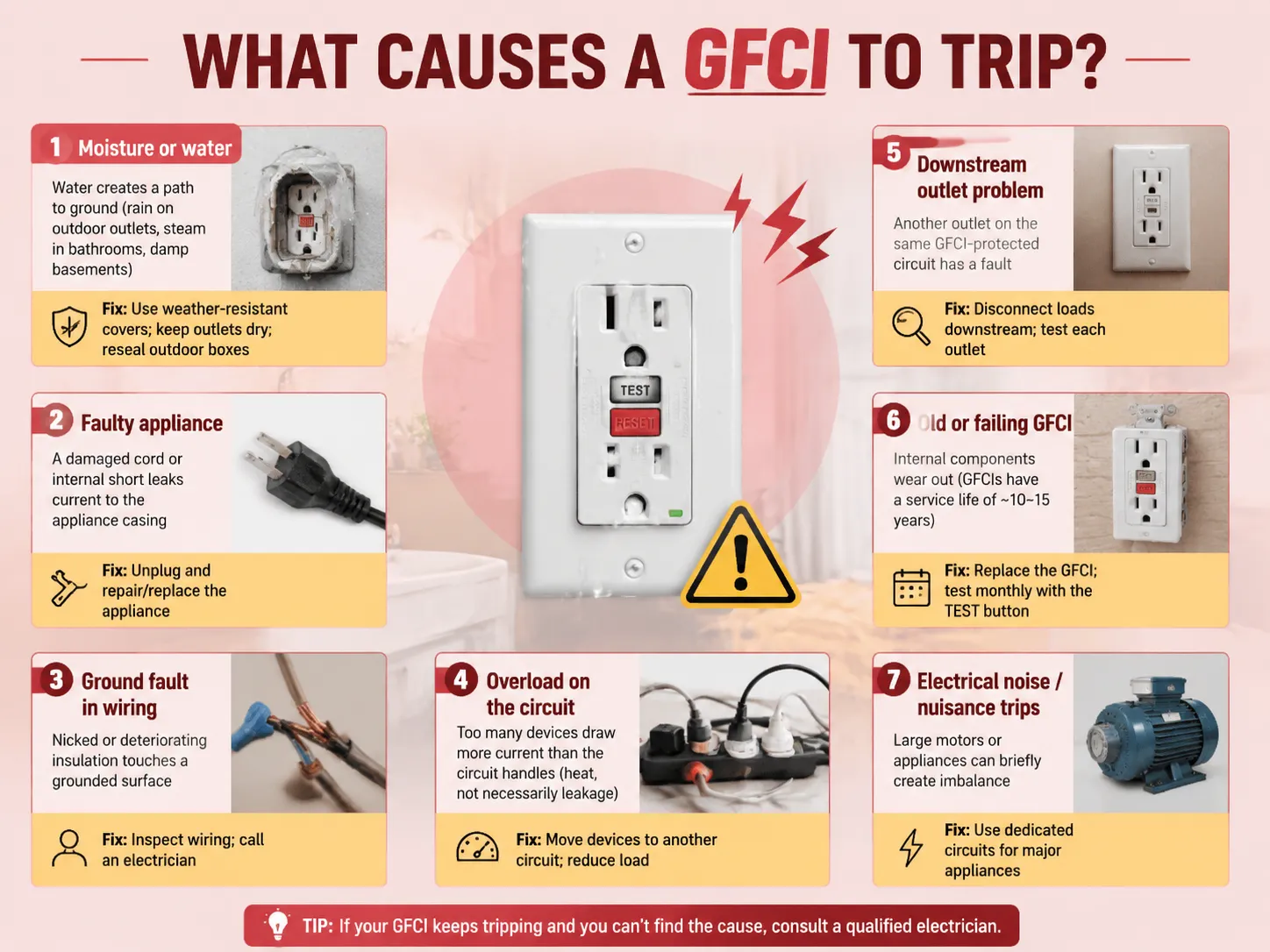
Um GFCI dispara sempre que detecta corrente vazando para o terra. As causas mais comuns:
| Causa | O que está acontecendo | Solução |
|---|---|---|
| Umidade ou água | A água cria um caminho para o terra (chuva em tomadas externas, vapor em banheiros, porões úmidos) | Use coberturas resistentes ao tempo; mantenha as tomadas secas; resele caixas externas |
| Aparelho defeituoso | Um cabo danificado ou curto interno vaza corrente para a carcaça do aparelho | Desconecte e repare/substitua o aparelho |
| Falha de aterramento na fiação | Isolamento cortado ou deteriorado toca uma superfície aterrada | Inspecione a fiação; chame um eletricista |
| Sobrecarga no circuito | Muitos dispositivos consomem mais corrente do que o circuito suporta (calor, não necessariamente vazamento) | Mova dispositivos para outro circuito; reduza a carga |
| Problema na tomada a jusante | Outra tomada no mesmo circuito protegido por GFCI apresenta falha | Desconecte cargas a jusante; teste cada tomada |
| GFCI antigo ou com defeito | Componentes internos desgastam-se (GFCIs têm vida útil de ~10–15 anos) | Substitua o GFCI; teste mensalmente com o botão TEST |
| Ruído elétrico / disparos indesejados | Grandes motores ou aparelhos podem criar desequilíbrio temporário | Use circuitos dedicados para aparelhos principais |
Para mais informações sobre diagnóstico de disparos repetidos no nível do disjuntor, veja nossos artigos sobre o que causa o disparo de um disjuntor e se um disjuntor que dispara repetidamente é perigoso.
O que Não Deve Ser Conectado a um GFCI
Este é um detalhe importante que merece atenção. Os códigos de construção estabelecem a necessidade de segurança GFCI em alguns casos, mas existem vários dispositivos que não devem funcionar em circuitos equipados com segurança GFCI, pois seu desligamento inesperado pode levar à destruição.
- Refrigeradores e freezers: se um GFCI desarmar inesperadamente, o refrigerador será desligado sem que você perceba, e essa situação leva ao estrago dos alimentos. Em inúmeros casos, eletricistas geralmente colocam refrigeradores em circuitos dedicados e garantem que a proteção GFCI exista apenas onde exigido pelo código, por exemplo, quando estiverem situados a menos de 6 pés de uma pia.
- Bombas de sumidouro: caso o GFCI tenha desarmado, a bomba é desligada e o porão alaga. O código atual estabelece que os circuitos das bombas de sumidouro devem possuir proteção GFCI, portanto, é recomendável aplicar disjuntores GFCI com alarme ou bombas de sumidouro alimentadas por bateria.
- Máquinas de suporte à vida e médicas: estas devem permanecer operacionais e requerem fornecimento de energia garantido.
- Freezers e freezers de garagem: o mesmo problema dos refrigeradores.
- Computadores/servidores (em alguns casos): desligamentos indesejados dos circuitos podem resultar na perda de informações importantes, portanto circuitos ininterruptos devem ser instalados.
O principal aqui é que seguir as diretrizes do NEC é obrigatório se a proteção GFCI for indicada para o seu caso, pois alguns aparelhos possuem circuitos dedicados separados dos outros e equipados com disjuntores GFCI com alarmes para notificá-lo sobre a situação de desligamento. Caso não tenha certeza dos requisitos ativos, é sempre melhor contatar um eletricista licenciado.
GFCI vs. Disjuntor: a mesma coisa?
Não — eles protegem contra riscos diferentes:
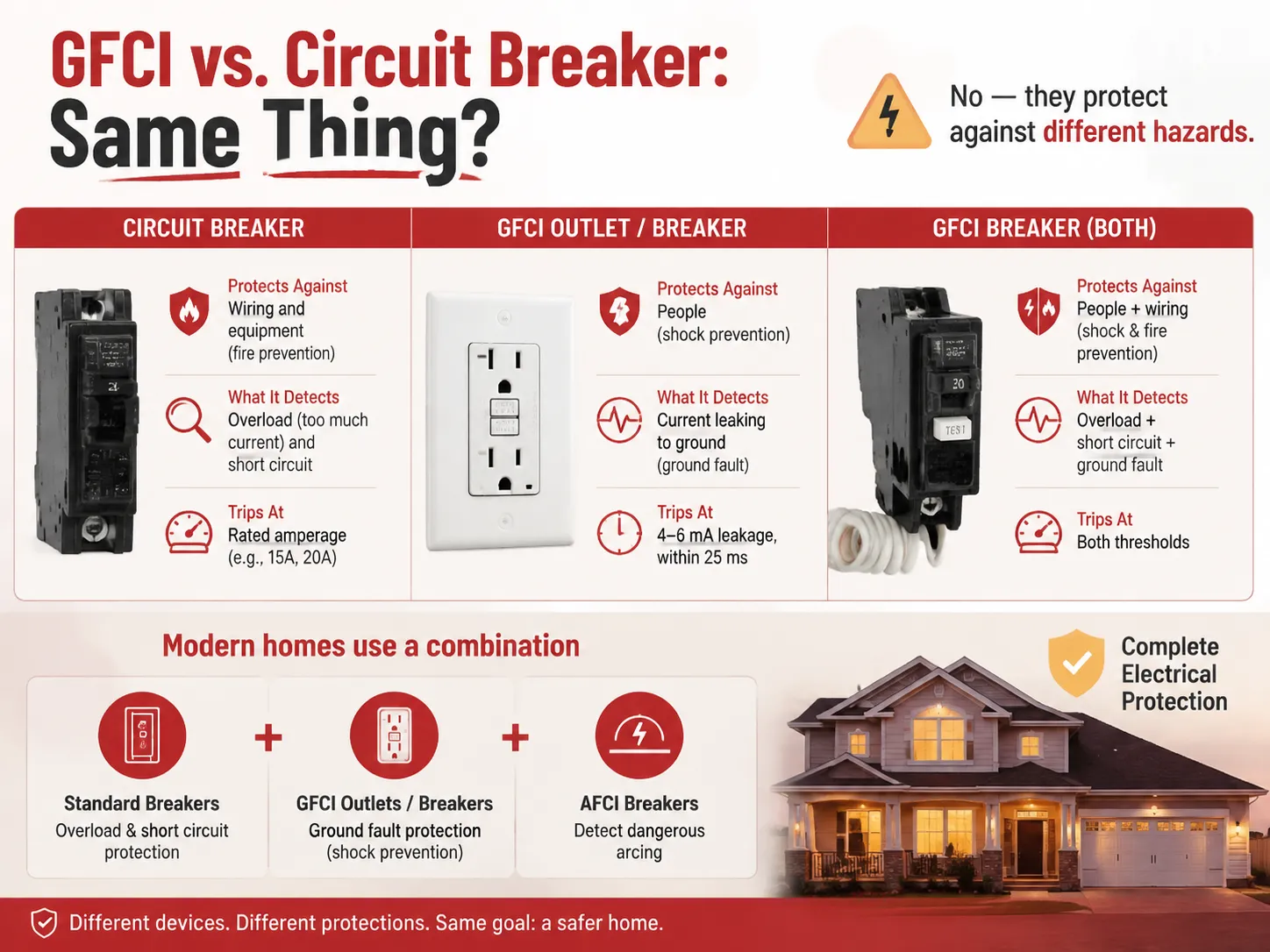
| Dispositivo | Protege Contra | O Que Detecta | Desarma em |
|---|---|---|---|
| Disjuntor | Fiação e equipamentos (prevenção de incêndio) | Sobrecarga (corrente excessiva) e curto-circuito | Corrente nominal (ex.: 15A, 20A) |
| proteção para banheiros, cozinhas, garagens, tomadas externas, | Pessoas (prevenção de choque) | Corrente vazando para o terra (falha à terra) | Vazamento de 4–6 mA, em até 25 ms |
| Disjuntor GFCI (ambos) | Pessoas + fiação | Sobrecarga + curto-circuito + falha à terra | Ambos os limiares |
As residências atuais incorporam disjuntores padrão para proteção contra sobrecarga de circuito, tomadas GFCI (Ground Fault Circuit Interrupter) ou disjuntores GFCI para proteção contra choque elétrico, e disjuntor de arco para detectar níveis inseguros de corrente de arco. Se desejar entender dispositivos diferenciais residuais relacionados usados em outras partes do mundo, nossa comparação de RCCB vs RCBO cobre as versões internacionais do mesmo conceito.
Perguntas Frequentes
GFCI significa ground fault circuit interrupter?
De fato — GFCI significa ground fault circuit interrupter. Esta é a versão correta dada pelo National Electrical Code (NFPA 70), UL 943 e todos os principais fabricantes. O GFCI monitora a corrente que sai pelo fio quente em relação ao retorno pelo fio neutro, e desconecta o circuito quase em um intervalo de 1/40 de segundo se a diferença atingir cerca de 4-6 miliamperes (falha à terra). Todas as outras variações como ground fault circuit interference estão incorretas.
O que não deve ser conectado a um GFCI?
Aparelhos que podem ser perigosos em caso de perda de energia são refrigeradores (estrago de alimentos), bombas de poço (inundações), equipamentos médicos e de suporte à vida (risco à vida) e computadores/servidores importantes (risco de perda de dados). No entanto, o código ainda exige a presença de GFCI em muitos desses locais. Na maioria dos casos, isso pode ser alcançado por meio do uso de circuito dedicado, disjuntor GFCI com alarme ou bateria de backup; a proteção não deve ser negligenciada. Consulte um especialista para sua situação e verifique os códigos locais.
Para que serve o GFCI em instalações de circuito, fusíveis principais, circuito de impulso, interruptor de falha à terra, instalação de circuito de falha à terra?
A resposta correta é o interruptor de circuito por falha à terra. Todas as outras alternativas estão incorretas; “grand fuse circuitry” confunde GFCI com fusíveis; “impulse” não tem relação com o funcionamento do GFCI; e “ground fault circuitry installation” descreve uma instalação genérica, não o dispositivo. O termo que corresponde à definição dada no NEC e UL é apenas ground fault circuit interrupter — o dispositivo que interrompe um circuito assim que detecta uma falha à terra.
O que pode causar o disparo de um interruptor de circuito por falha à terra (GFCI)?
Quando um GFCI reconhece um vazamento de corrente elétrica para a terra (4–6 mA), ele dispara. As seguintes são as razões habituais que levam a isso: a presença de umidade ou água na área das tomadas (como chuva, vapor, porões úmidos); aparelhos defeituosos que possuem fios danificados ou curtos internos; falha à terra na fiação (isolamento cortado); sobrecarga do circuito causada pela conexão de muitos dispositivos; mau funcionamento nas tomadas a jusante que estão sob a mesma proteção GFCI; GFCIs antigos ou desgastados (vida útil de cerca de 10-15 anos); e ruído produzido por motores grandes. Se o GFCI disparar com muita frequência, será necessário desconectar todos os equipamentos do circuito. Ele deve ser resetado e os equipamentos reconectados um a um para identificar a fonte da falha, ou deve-se solicitar a ajuda de um eletricista profissional.
Referências
- NFPA 70 (Código Elétrico Nacional) — O código autoritário que define “ground-fault circuit-interrupter” e especifica onde a proteção GFCI é exigida (Artigo 210.8, Artigo 680).
- UL 943 — Norma de Segurança para Interruptores de Circuito por Falha à Terra — A norma de segurança UL que certifica os GFCIs, especificando o limiar de disparo de 4–6 mA e o tempo de disparo de 25 ms.
- Segurança Elétrica OSHA — Orientação de segurança no trabalho dos EUA sobre o uso de GFCI na construção e indústria geral, reforçando a terminologia correta e as aplicações exigidas.
- Fundação Internacional de Segurança Elétrica (ESFI) — Organização sem fins lucrativos que fornece educação ao consumidor sobre teste, instalação e o papel vital da proteção contra falha à terra.
- Segurança Elétrica CPSC — Dados da Comissão de Segurança de Produtos de Consumo dos EUA sobre eletrocussões evitadas por GFCIs e orientações de segurança elétrica residencial.
- Departamento de Energia dos EUA — Operação de Tomadas GFCI — Orientação prática sobre como as tomadas GFCI funcionam, como testá-las mensalmente e o que as faz disparar.
Conclusão
É evidente que GFCI significa Ground Fault Circuit Interrupter e NÃO “ground fault circuit interference.” A palavra “interrupter” é usada pois define a função deste dispositivo específico — cortar temporariamente o circuito após detectar uma falha à terra. A palavra “interference,” entretanto, define algo que causa a interrupção do funcionamento normal, o que é absolutamente o oposto do que os GFCIs fazem.
Aqui está o que deve ser lembrado:
- O termo correto é interrupter, que foi oficialmente afirmado pelo NEC, UL 943, OSHA e todos os fabricantes.
- O GFCI compara correntes de saída e entrada; ele dispara em 4-6 mA dentro de milissegundos.
- Ele protege uma pessoa, mas não os fios, porque enquanto a proteção do circuito previne sobrecarga, os GFCIs funcionam para evitar choques.
- Certifique-se de que os GFCIs sejam testados mensalmente com os botões TEST e substituídos a cada 10-15 anos.
- Evite conectar equipamentos de suporte à vida e armazenamento de alimentos em circuitos com GFCI onde o desligamento possa ser prejudicial — em vez disso, escolha circuitos sem GFCIs ou com sinais de alarme onde permitido pelo código.
Da próxima vez que você vir “GFCI significa interferência de circuito de falha à terra” na web, você saberá com certeza que isso está errado e por quê.